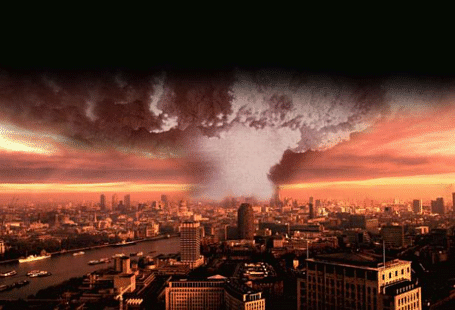
In July 16, 1945, at around 5:30 in the morning, 11-year-old Henry Herrera was outside his home in Tularosa, New Mexico, helping his father work on the radiator of their truck, when he saw a blinding flash of light. He thought he was witnessing the end of the world. In fact, he was witnessing the first ever use of a nuclear weapon — the Trinity nuclear test.
As we approached the 75th anniversary of the fateful bombings of Japan, we decided we needed to do more.
To begin, we reached out to our partners in Japan, and learned an important lesson. The survivors of the bombings, known as hibakusha, generally focus on messages of hope and resiliency, in pursuit of opportunities to build a peaceful world. They share their haunting memories of the bombings, but then they look forward and demand progress.
We also looked to the survivors of nuclear weapons activities here at home. Estimates range from tens of thousands to hundreds of thousands of people in the United States and in the Marshall Islands that have been sickened and killed due to nuclear weapons testing, uranium mining and nuclear-weapons production.
Despite the distances between them — in time, place and culture — the stories of many of these survivors are the same. A flash of blinding light, the feeling the world was ending. Falling dust and powder — like snow — that sickened people and would lead, eventually, to cancers. Secrecy and neglect shrouded their experiences for decades.
United by these tragedies, now most impacted communities have the same ultimate goals: ensuring these weapons are never used again, and that they are one day eliminated.
With these goals in mind, our national coalition is gathering virtually on Aug. 6 and 9, the anniversaries of the bombings in Hiroshima and Nagasaki. The event will feature presentations from many of the 150 groups that have joined the effort so far. We hope readers will join us to learn more and hear from the people who have been impacted and are fighting for change.
Seventy-five years after these bombings, nuclear weapons are still here, continuing to threaten every person on earth. But the survivors are still here, too. And in a time of separation and mourning, this is a chance to stand in solidarity with communities around the world that are calling for peace.
But don’t be mistaken: This facility wouldn’t be an alternative to the disastrous Yucca Mountain nuclear waste repository. In fact, its existence depends on Yucca Mountain becoming an operating repository. That’s unacceptable, because the Nevada facility poses far too many risks for our state.
The license application for the New Mexico facility calls for it to operate over 40 years, after which the waste stored in it would go to Yucca Mountain.
Twelve years ago, the Department of Energy submitted an application for a construction authorization and license to make Yucca Mountain the nation’s high-level nuclear waste repository. Two years later, in 2010, the department attempted to withdraw the application. It had determined that the plan was “unworkable” due to the opposition and unending resistance of the people of Nevada, but the court decided that the licensing process should proceed. It did, until funding ran out, and today those deliberations are on an indefinite hold.
Now comes the New Mexico license application to the Nuclear Regulatory Commission, which in the opinion of the Nevada Nuclear Waste Task Force the commission should not have accepted with the assumption that Yucca Mountain would be an operating repository. We have submitted comments to that effect to the commission.
During all of the time that Nevada has been fighting the Yucca Mountain proposal, we were repeatedly assured that we could place our trust in the commission because before any license was granted for construction or operation, a thorough and unbiased process would fully play out. We were told there was no reason for questioning the fairness of the commission’s licensing process.
Nevadans have been accused of having a NIMBY (not in my backyard) attitude about nuclear waste — that we would be pleased if some other place were forced to host a repository instead of us. That is not true. We know that Yucca Mountain is unsuitable and should have been disqualified, and we have respected the democratic right of others to oppose dangers or threats where they live.
Any siting of a facility that creates risk for the community should require informed consent, and the people of New Mexico do not consent.
What we see happening with this so-called interim site is that it does not solve the nuclear waste problem. In fact it increases the risks by putting the waste on the roads and rails, and requiring it to be loaded and unloaded multiple times and transported more than once. Additionally, the only way a site can be considered “interim” is to know that the waste will leave, and the assumption here is that it will leave New Mexico and come to Nevada.
The incentive for the company proposing to build the facility is purely financial — specifically, it’s to gain access to the $42 billion in the federal nuclear waste fund. An interim site does not increase or improve public safety, but rather does just the opposite. It creates one more nuclear waste site and provides more room at reactor sites for more waste. And it moves the waste closer to Nevada.
A national high-level nuclear waste repository at Yucca Mountain is an overwhelmingly unsafe idea. Nevada residents, elected officials and people across the country living near transport routes know it. For 20 years, the Department of Energy studied the site and discovered — or were forced to admit — that there were conditions present that, according to their own guidelines, disqualified the site.
If the licensing process ever restarts, how could we trust the Nuclear Regulatory Commission to fairly judge the science when it has previously assumed a licensed and operating repository at Yucca Mountain? Congress needs to reverse the action it took naming Yucca Mountain as the only site to be considered for a national repository, and take a fresh and fair look at nuclear waste disposal.
Initiatives like the interim storage site in New Mexico are simply misguided and misleading diversions.
Judy Treichel is executive director of the Nevada Nuclear Waste Task Force.
Democrats split on Trump plan to use development funds for nuclear projects, The Hill, BY REBECCA BEITSCH – 07/13/20 Democratic lawmakers are split over a Trump administration proposal that would allow international development funds to be used for overseas nuclear projects.
The U.S. International Development Finance Corp. (DFC), a fledgling government fund with an aim to alleviate poverty, has proposed lifting the longtime ban it inherited from its predecessor that bars funding for any nuclear projects.
Proponents say nixing the ban, originally conceived to limit the risks of nuclear proliferation, will allow the U.S. to help provide nuclear power to countries that will need more energy to grow their economies.
But opponents of removing the prohibition see a number of issues arising if the ban is lifted, including how to handle spent nuclear fuel, the potential for money to be funneled away from poorer nations and the challenge of dealing with risky and expensive projects.
“International nuclear power projects described by DFC are not a cost-competitive form of zero-carbon energy, remain unproven, will divert funds from higher-priority low-income countries, and are not supported by other development banks,” Sens. Ed Markey (D-Mass.) and Bernie Sanders (I-Vt.) wrote in a letter to the DFC on Friday.
“DFC financing of overseas nuclear reactors may offshore the physical risks associated [with] nuclear power, but they would keep U.S. taxpayers on the hook for the steep financial ones,” the senators added. ………
Sen. Sheldon Whitehouse (D-R.I.) and Rep. Conor Lamb (D-Pa.) along with seven other Democratic lawmakers, called the ban “outdated because of advances in nuclear technology.”…….
Lifting the DFC’s prohibition against financing nuclear power would likely direct more funding toward wealthier countries, instead of to the countries that the DFC was created to help,” Markey and Sanders wrote in their letter, pointing to Eastern Europe and the Middle East……… The DFC should not be dedicating its limited financing to unproven technologies that present both safety and security risks. Pushing experimental research and development is not part of the DFC’s mandate.”…… https://thehill.com/policy/energy-environment/507052-democrats-split-on-trump-plan-to-use-development-funds-for-nuclear
It’s been more than 41 years, but Stephen Mohr still remembers how he knew something went wrong at the nuclear power plant on Three Mile Island.
“I knew something happened because I went out to get the newspaper and I could smell it,” said Mohr, a lifelong resident of Conoy Township — only yards south of the Dauphin County island.
“The smell was a combination of rotting eggs, diesel fuel and a smoldering fire pit,” he said.
The plant’s Unit 2 reactor had partially melted down about 4 a.m. March 28, 1979, and as Mohr remembers it, locals panicked, fearing for their safety. Some fled, others hid inside.
“I can remember this like it was yesterday,” said Mohr, who has been a longtime township supervisor. “There was definitely an air of uncertainty. People were confused.”
Four decades later, confusion and concern have returned near the now-inactive power plant as officials at Utah-based EnergySolutions plan to dismantle the historic reactor.
It’s a plan that has state environmental officials and local nuclear watchdogs ringing proverbial alarm bells, pointing to concerns that money set aside for the decommissioning could run out before the work is finished.
That’s in addition to fears about the potential for indefinite radioactive contamination on the island, which sits just upstream from Lancaster County on the Susquehanna River.
Old concerns resurface
To Arthur Morris, Lancaster city’s mayor from 1980 to 1990, some of those worries are familiar. They existed in the years after the 1979 accident, when Morris sat on a state advisory board that focused on radioactive decontamination of Unit 2.
Back then — and now — the Susquehanna River served as the primary source for several downstream Lancaster County drinking water systems, including in Lancaster city.
As mayor, Morris said one of his priorities on the panel was to make sure radiation wasn’t carried downstream and piped through Lancaster residents’ faucets — a priority that led to regular testing near the plant that persists today.
Last week, Morris said he isn’t surprised that some of those old concerns have resurfaced with Unit 2 coming back under scrutiny.
“Those things don’t go away until the island is cleaned up,” Morris said.
‘Worst-case scenario’
However, it’s a cleanup plan that has nuclear watchdog Eric Epstein speaking out on signs of pending danger.
“It’s the worst-case scenario,” said Epstein, a leader of the Harrisburg-based group Three Mile Island Alert.
Last fall, Unit 2’s owners at Ohio-based FirstEnergy Corp. announced that they planned to transfer all related licenses and assets to TMI-2 Solutions LLC, an EnergySolutions subsidiary.
The transfer would mean that EnergySolutions also would take over the responsibility of eventually dismantling the Unit 2 reactor.
And that eventuality had already been planned for by the time the proposed transfer was announced in October. Then, EnergySolutions revealed plans to contract decommissioning work out to New Jersey-based construction company Jingoli, which has had past success with nuclear projects in the United States and Canada.
Despite a track record, state Department of Environmental Protection officials warned that planning for and beginning decommissioning work too early could put the island and surrounding areas at risk.
After all, DEP Secretary Patrick McDonnell noted, Unit 2 is the site of the worst commercial nuclear accident in United States history — an accident that released radioactive gases and grossly contaminated the reactor and its surrounding buildings.
“Because of this, we understand there are very high radiation areas within TMI Unit 2 that present a grave risk to personnel that enter,” a letter signed by McDonnell reads.
That high radiation has prevented all but minor exploration of the Unit 2 area, meaning the radiological conditions inside large portions of the plant remain a mystery, according to the letter.
“I firmly believe TMI Unit 2 is the most radiologically contaminated facility in our nation outside of the Department of Energy’s weapons complex,” it reads.
Postponing the cleanup for “several decades” could allow for a decrease in radioactive potency, possibly lessening the chance of further environmental contamination, McDonnell wrote.
All of that is in addition to raising questions about how radioactive waste will be disposed, transported and stored. That includes concerns about whether any of that waste will be stored on the island — a site that Epstein believes could remain indefinitely radioactive.
Both McDonnell’s writings and Epstein’s concerns were submitted this spring to officials at the U.S. Nuclear Regulatory Commission, which must approve the FirstEnergy-to-EnergySolutions transfer request.
Commission officials have been reviewing the request since November, and similar reviews have been completed in a year or less, according to spokeswoman Diane Screnci.
Financial concerns
But it’s not only environmental issues that will be weighed as part of that review, with Epstein and state officials also raising serious financial concerns.
Specifically, they’ve drawn attention to a largely ratepayer-funded $901 million trust set aside to cover the cost of decommissioning, which has been estimated at upward of $1.2 billion.
Further complicating the issue, according to McDonnell’s letter, is the fact that trust fund dollars are tied to the stock market, which has seen large fluctuations due to the ongoing COVID-19 pandemic.
“Given the obvious uncertainties and complexities associated with cleaning up the remains … the demonstration of adequate funding to complete the decommissioning of TMI-2 and restoration of the site, is a significant concern of the department and the citizens of Pennsylvania,” McDonnell wrote.
Beyond sharing McDonnell’s letters, DEP officials said they could not further discuss the proposed decommissioning, citing litigation. Nondisclosure agreements stipulated by EnergySolutions also prevent DEP and Epstein from sharing some details.
EnergySolutions spokespeople did not respond to multiple requests for comment, though they indicated they are aware of concerns about their work.
Jennifer Young, a FirstEnergy spokeswoman, said company officials have faith the job will be completed on budget despite the existing disparity between the trust fund and estimated cost.
Cost estimates show there are sufficient funds given the project schedule for decommissioning,” she said. “Keep in mind that those funds will continue to accumulate value throughout the decommissioning process, which takes place over many years. Not all the money will be required or spent at one time.”
Epstein said it’s important to point out that the Unit 2 trust is full of ratepayer money, which will be under the full control of EnergySolutions’s TMI-2 Solutions LLC, a private company, with little public scrutiny.
Right company for the job
Despite those concerns, Young said FirstEnergy officials believe EnergySolutions is the right company to dismantle Unit 2. In fact, EnergySolutions decommissioning proposal was selected over offers from two other companies, she said. The unsolicited EnergySolutions proposal was made in 2018, Young said.
By Nuclear Regulatory Commission decree, the plant must be decommissioned within 60 years of halting operation, and Three Mile Island’s functioning Unit 1 was taken offline by its owner, Exelon, in 2019.
“We were faced with a decision to decommission the unit now or wait to start in the 2030s,” Young said.
“Waiting would not guarantee there would be companies available to start the dismantlement in time to comply with the 60-year requirement due to the large number of nuclear plant licenses that will expire in the 2030s,” he said.
Still, Epstein said he’d like a Nuclear Regulatory Commission decision on the transfer to remain delayed until his and DEP’s concerns can be worked through.
Like a big gravestone
Back in Conoy Township, Mohr said his full faith is in the commission to make the right decision — an opinion steeped in the immediate aftermath of the 1979 partial meltdown.
It was a commission official, Harold Denton, who shared the first details with locals, offering assurances that everything would be alright, he said.
“When he was done speaking, it was like the world calmed down,” Mohr said of the commission official. “He put it into a perspective that even we understood.”
For decades since, the plant has meant local jobs and local money, but since the 2019 shutdown, much of that has fallen by the wayside, he said. And it’s mostly for that reason that Mohr said he’s indifferent to the island’s fate.
“It’s almost to the point now that it was never there. If we drive north, we see it,” he said. “It reminds me of the biggest gravestone that I ever saw.”
July 16 of this year marks the 75th anniversary of the first nuclear bomb detonation. I don’t foresee any dancing in the street to mark the occasion. In fact, I imagine your nightly newscast will ignore it entirely. Oh, we’ll probably hear something about Hiroshima three weeks later. That first use of the weapon in malice has more historic significance. The two bombs dropped on Japan resulted in 214,000 deaths by the end of 1945.
Frankly, I’m mystified that we hear so little about the threat of nuclear war today considering how consequential such an event would be. It’s a danger far more clear and present than an errant asteroid, or an eruption of the Yellowstone Caldera. Currently, we’re all agog about the novel coronavirus. We’ve lived with a nuclear Sword of Damocles hanging over our collective head for 75 years now, and we tend to think we experienced real danger of thermonuclear war for a period of only 13 days back in 1962. We survived that physically unscathed; that’s probably it for one lifetime, right?
The post-World War II arms race has seen 2,056 nuclear test detonations by at least eight nations; more than half of that total (1,030) were American. The United States has not conducted a nuclear test since 1992, when a bipartisan congressional majority mandated a nine-month testing moratorium. In 1996, the United States was the first to sign the Comprehensive Test Ban Treaty, which verifiably prohibits all nuclear test explosions of any yield. Today, the CTBT has 184 signatories and almost universal support. But it hasn’t formally entered into force due to the failure of the United States, China, Egypt, Iran and Israel to ratify the agreement; and by India, Pakistan and North Korea, which have neither signed nor ratified the measure.
This leaves the door to renewed testing open. According to a May 22 article in The Washington Post, senior national security officials discussed the option of a demonstration of nuclear air detonation at a May 15 interagency meeting. A senior official told the Post that a “rapid test” by the United States could prove useful from a negotiating standpoint as the Trump administration tries to pressure Russia and China to engage in talks on a new arms-control agreement.
Making matters worse, in a party-line vote last month, the Senate Armed Services Committee approved an amendment by Sen. Tom Cotton (R-Ark.) to authorize $10 million specifically for a nuclear test if so ordered by President Trump. Such a test could be conducted underground in just a few months at the former Nevada Test Site outside Las Vegas. This pro-testing contingent of senators is informally known as the Dr. Strangelove Caucus.
The push to restart nuclear weapons testing is happening at a time when tensions between the United States and Russia have stepped up provocative moves in airborne “show of force” demonstrations that can turn hazardous when combat aircraft come nail-bitingly close to each other. The danger expands exponentially when the aircraft involved are nuclear-capable, and when the operations are staged in militarily sensitive areas, such as a first-time U.S. B-1B bomber flight May 21 over the Sea of Okhotsk; or a May 29 flight by two B-1B bombers across Ukrainian-controlled airspace for the first time, coming close to Russian-controlled airspace over Crimea.
Not wanting to be left out of the merriment, Russia conducted a March 12 flight of two nuclear-capable Tu-160 “Blackjack” bombers over Atlantic waters near Scotland, Ireland and France from its base on the Kola Peninsula in Russia’s far north, prompting France and the United Kingdom to scramble interceptor aircraft. In conducting these operations, U.S. and Russian military leaders appear to be delivering two messages to their counterparts. First, despite any perceived reductions in military readiness caused by the coronavirus pandemic, they are fully prepared to conduct all-out combat operations against the other. Second, any such engagements could include a nuclear component at an early stage of the fighting.
Although receiving precious little media attention in the U.S. and international press, these maneuvers represent a dangerous escalation of U.S.-Russian military interactions and could set the stage for a dangerous incident involving armed combat between aircraft of the opposing sides. This by itself could precipitate a major crisis and possible escalation. Just as worrisome are the strategic implications of these operations, suggesting a commitment to the early use of nuclear weapons in future major-power engagements.
The U.S. Air Force Global Strike Command has long since supplanted the Strategic Air Command in its function as our nuclear war delivery system. Its commander, Gen. Timothy Ray, has said, “We have the capability and capacity to provide long-range fires anywhere, anytime, and can bring overwhelming firepower, even during the pandemic.” It really doesn’t matter whether those words reassure or horrify you; the eventual outcome of merely holding weapons of nearly limitless lethality is written in stone.
Sources: Arms Control Association Newsletter, July/August 2020; The Washington Post, May 22, 2020; and JanesDefenseWeekly.com, July 5, 2020.
Gerry Dionne is a writer, musician and coffee-table philosopher who moved to our area when he was 18. He’s in his 70s now, so y’all give him a break.
Long-Planned and Bigger Than Thought: Strike on Iran’s Nuclear Program
Some officials say that a joint American-Israeli strategy is evolving — some might argue regressing — to a series of short-of-war clandestine strikes. NYT, By David E. Sanger, Eric Schmitt and Ronen Bergman, 12 July 20
As Iran’s center for advanced nuclear centrifuges lies in charred ruins after an explosion, apparently engineered by Israel, the long-simmering conflict between the United States and Tehran appears to be escalating into a potentially dangerous phase likely to play out during the American presidential election campaign.
New satellite photographs over the stricken facility at Natanz show far more extensive damage than was clear last week. Two intelligence officials, updated with the damage assessment for the Natanz site recently compiled by the United States and Israel, said it could take the Iranians up to two years to return their nuclear program to the place it was just before the explosion. An authoritative public study estimates it will be a year or more until Iran’s centrifuge production capacity recovers.
Another major explosion hit the country early Friday morning, lighting up the sky in a wealthy area of Tehran. It was still unexplained — but appeared to come from the direction of a missile base. If it proves to have been another attack, it will further shake the Iranians by demonstrating, yet again, that even their best-guarded nuclear and missile facilities have been infiltrated.
Although Iran has said little of substance about the explosions, Western officials anticipate some type of retaliation, perhaps against American or allied forces in Iraq, perhaps a renewal of cyberattacks. In the past, those have been directed against American financial institutions, a major Las Vegas casino and a dam in the New York suburbs or, more recently, the water supply system in Israel, which its government considers “critical infrastructure.”
Officials familiar with the explosion at Natanz compared its complexity to the sophisticated Stuxnet cyberattack on Iranian nuclear facilities a decade ago, which had been planned for more than a year. In the case of last week’s episode, the primary theory is that an explosive device was planted in the heavily-guarded facility, perhaps near a gas line. But some experts have also floated the possibility that a cyberattack was used to trigger the gas supply.
Some officials said that a joint American-Israeli strategy was evolving — some might argue regressing — to a series of short-of-war clandestine strikes, aimed at taking out the most prominent generals of the Islamic Revolutionary Guards Corps and setting back Iran’s nuclear facilities…….. https://www.nytimes.com/2020/07/10/world/middleeast/iran-nuclear-trump.html
US senators urge agency not to allow funding of ‘risky’ nuclear projects, S and P Global Platts, Author Joniel Cha , Editor Keiron Greenhalgh 12 July 20
HIGHLIGHTS
DFC proposes to reverse prior policy
Lawmakers say nuclear not cost competitive
Washington — Senators Edward Markey, Democrat-Massachusetts, and Bernie Sanders, Independent-Vermont, in a July 10 letter jointly urged US Development Finance Corp., not to “waste American tax dollars on risky international nuclear projects.”
DFC proposed June 10 to revise its policy so that the federal agency could provide financing for nuclear power projects, beginning a 30-day public comment period ending July 10.
The agency was created in 2019 through the consolidation of Overseas Private Investment Corp. and the US Agency for International Development’s Development Credit Authority.
OPIC and USAID both had bans in place prohibiting them from supporting nuclear reactor projects.
The senators said international nuclear power projects “are not a cost-competitive form of zero-carbon energy, remain unproven, will divert funds from higher-priority low-income countries, and are not supported by other development banks.” ……..
The senators said: “DFC should not be dedicating its limited financing to unproven technologies that present both safety and security risks. Pushing experimental research and development is not part of the DFC’s mandate.”
DFC has a total investment limit of $60 billion……..
The senators requested a response from DFC by July 31.
The American Nuclear Society and advocacy group Clear Path, along with 40 other organizations and individuals, submitted comment letters to DFC July 2 and 9, respectively, supporting the removal of the ban.
At thirty-five, I was diagnosed with Hodgkin’s lymphoma. One year before my diagnosis, my mother died from complications after heart surgery. At the time of her death, my mother had cancer — lymphoma. Five years prior to Mom’s death, my father passed away from a brain tumor, a metastasis from the cancer melanoma.
Two years after I had completed my chemotherapy treatment for cancer, I gave birth to Olivia. My miracle baby.
At first, I was ecstatic about the pregnancy. I had always wanted children, and with my cancer, I feared this would never happen. My doctors said I was lucky to give birth to a biological child after chemotherapy (my treatment left me with a 50 percent chance of remaining fertile afterward). But now, a mother-to-be, I was also afraid. How could I protect my child from our family cancer blight?
My desire to protect my daughter from a future cancer diagnosis drove me into a rabbit hole of reading and learning about the reasons for my family’s affliction. I began with Rachel Carson’s Silent Spring and moved forward to more recent literature by Sandra Steingraber, Theo Colburn, and numerous others, including the President’s Cancer Panel Report. I learned that the cancer rates today are off the charts: one in two men and one in three women will get cancer in their lifetimes. Carson predicted this plague in 1963. She warned us of humankind’s “hubris” in carelessly polluting our earth with toxic chemicals and ionizing radiation. The epidemiologist Alice Stewart’s study on the grave danger of X-rays on babies in the womb in the 1950s, sounded the alarm about ionizing radiation as well. Today, our world swirls with pollutants — these carcinogens penetrate mothers’ wombs and breasts. Mother’s milk is a toxic cocktail. Newborns today are born with hundreds of synthetic chemicals in their umbilical cord blood. Synthetic chemicals and ionizing radiation change our makeup, harm our genes, and cause mutagenetic damage. More than 80,000 unregulated pollutants fill our environment.
We are guinea pigs.
Fast forward about eleven years: one summer day, in 2009, on the Upper West Side of Manhattan, at lunch with a close friend (and cousin) of my deceased mother, Phyllis Resnick, I stumbled upon a story about my mom that I had never heard before. The tale Phyllis told would radically change my life. My then-preteen daughter, Olivia, was by my side. She listened rapt with me as we learned of our maternal nuclear legacy.
Phyllis described how in the early 1960s, my mother and she, along with their good friend Thalia Stern Broudy, had been a members of Women Strike for Peace (WSP), an antinuclear group led by Dagmar Wilson and the future congresswoman, Bella Abzug. During the Cold War 1950s and early 60s, the U.S. had detonated one hundred above-ground nuclear test bombs in the Nevada desert and one hundred and six atmospheric test bombs in the South Pacific. The government claimed these test bombs posed no harm and the fallout had not spread, but scientists and medical professionals were concerned. A team of experts in St. Louis, MO, directed by Dr. Louise Reiss, initiated a survey to determine the extent of the impact of the bomb testing. With a chemical makeup similar to calcium, strontium-90, a radioisotope found in fallout, is easily absorbed in teeth and bones. Thousands of baby teeth from across the U.S. were collected between 1958 and 1971 for the St. Louis Baby Tooth Survey. In 1961, preliminary results showed high levels of strontium-90 in baby teeth of children born after 1945 and these levels increased over the time period, as the test-bombing continued. When the mothers of Women Strike for Peace learned the results of the survey, they banded together to stop atmospheric bomb testing. 50,000 WSP members from across the U.S. wrote letters, gathered petitions, lobbied congressional representatives, initiated lawsuits, and protested through marches and street demonstrations. My mother and her cohort of 15,000 WSP members traveled to D.C. to protest, lobby, and meet with their legislators November, 1961. In 1963, the United States, the U.K., and the Soviet Union signed the Partial Nuclear Test Ban Treaty, an agreement to halt atmospheric, under water, and outer space bomb testing. The signing of this treaty has been attributed to the efforts of WSP.
The government claimed these test bombs posed no harm and the fallout had not spread, but scientists and medical professionals were concerned.
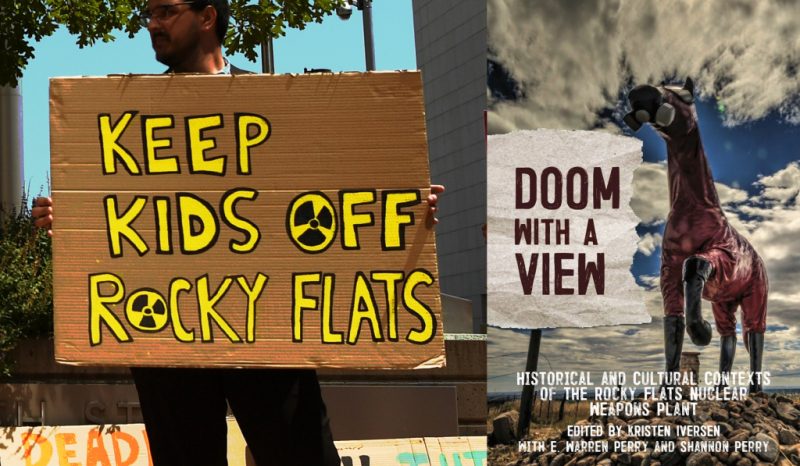
Operating from 1952 to 1992, the Rocky Flats nuclear weapons facility was located approximately 15 miles northwest of Denver, a city built by an influx of miners during the gold rush in the nineteenth century. During the years of its operation, the plant constructed more than 70,000 triggers for nuclear bombs. Rocky Flats would be the site of two major secret plutonium fires, blowing radioactive poison into sections of Arvada and Denver in 1957 and 1969. Hundreds of smaller fires also took place, as well as regular leaks, spills, and atmospheric plutonium releases. Plutonium clouds blew over houses, swimming pools, schools, churches, farms, fields, and streams. Rocky Flats is known for powerful Chinook winds — winds that would blow plutonium dust into local neighborhoods. Locals did not know that Rocky Flats was a weapons factory for most of its years of operation. Workers employed there were forbidden to speak of their work and often didn’t comprehend the full extent of the factory’s activities.
By 1989, The FBI and EPA suspected criminal negligence at Rocky Flats, which led to a raid, led by FBI agent Jon Lipsky.
A federal grand jury began an investigation, a settlement was negotiated, the court documents were sealed, and the plant closed. The story of this federal grand jury is fraught and complex, and cover-ups are suspected in the sealing of the documents and lack of full prosecution. The Rocky Flats cleanup was officially completed in 2004; however, numerous scientists, nuclear experts, local citizens, and antinuclear activists argue the cleanup is far from finished. Unknown but large amounts of plutonium and other contaminants remain on the land in what has been turned into a Superfund site, a designation made under the Comprehensive Environmental Response, Compensation, and Liability Act of 1980. The primary industrial site (the Superfund area — 485 acres) was never completely remediated. There is a buffer zone, also heavily contaminated, although the EPA claims this area is fully remediated. The surrounding area, now called a National Wildlife Refuge, was not remediated. Significant contamination has been detected there in the soil and groundwater. Many other toxic and radioactive contaminants have also been found at Rocky Flats in addition to plutonium: americium, uranium, cadmium, PCBs, beryllium, and more. A 2019 study found plutonium “hot particles” in the soil frighteningly close to the homes abutting the Flats………
Rocky Flats is “a national sacrifice zone,” says Robert Alvarez, associate fellow at the Institute for Policy Studies and former senior policy advisor to the secretary at the US Department of Energy. “That’s what it is, although no one will say so officially. How much remains buried there? A tremendous amount — plutonium doesn’t go away. No one has done this yet — it’s costly and complex — but someone needs to go into those houses nearby in Arvada and take samples. We don’t know how much plutonium is in them.”…….. https://longreads.com/2020/06/30/the-grieving-landscape/amp/
Spent Nuclear Reactor Passes On Its Way To Disposal, JULY 8, 2020 BY VROBISONBy CHARLENE PAUL, The Progress
A huge convoy carrying a low-level nuclear reactor is making its way through Nevada. Last week it passed through the Coyote Springs Valley via U.S. Highway 93. PHOTO BY CHARLENE PAUL/The Progress.
A nuclear reactor vessel from southern California’s decommissioned San Onofre Nuclear Generating Station slowly made it’s way through the Coyote Springs Valley on Monday, June 29………
The vessel’s trip to Utah began on May 24, 2020, when the 770-ton low-level reactor vessel left southern California on the world’s largest rail car, a 40-year-old, 36-axle Schnabel car weighing 2.2 million pounds. (It is believed that this was the rail car’s last load.)
Once the load arrived at Apex, it took a couple of weeks for cranes to lift the reactor from the train car and put it on a 45-axle, 180-tire trailer for the trip to northern Utah.
Experts with the Nevada Department of Transportation (NDOT) worked long and hard to ensure that the state’s roads wouldn’t be damaged as the load passes through.
Two railway tunnels east of Caliente along with rock outcroppings that are too tight to allow the reactor to be shipped by rail to Salt Lake City and then on to Clive, made travel on the highway a necessity.
“It would be, by far, the biggest object ever moved on a road in [Nevada],” said NDOT spokesman Tony Illia. “Our people have been scratching their heads for months to figure out a route that could work. It won’t move until the transportation department issues a permit 24 hours before hitting the highway.”
“The record-sized move over state highways marks the culmination of over a year of planning and coordination across three states,” Illia said. “At 2.4 million total pounds, it’s the heaviest load to ever cross Nevada roadways.”
Making such a massive shipment in summer months is a much bigger issue than it would be in colder months. Asphalt or other road surfaces could easily buckle under the over 1.5-million-pound reactor plus a shipping skid that adds seven tons to the total weight. For the load to be transported safely, drainage structures along the way needed to be reinforced.
“The structures would get crushed like a soda can because the load is so heavy,” said Illia. “Heavy equipment operators with Emmert International [among the world’s biggest movers of heavy equipment] plan to use heavy-duty hydraulic jacks to support culverts when the vehicle hauling the reactor passes over.”
To keep the load off Interstate 15 and Interstate 80, the travel route will follow U.S. Highway 93 and State Route 318 before crossing into Utah.
Interestingly, the route passes by the Yucca Mountain Nuclear Waste Repository. The mountain was to be the nation’s nuclear waste repository, but the plan was terminated in 2008 amid a political battle over its safety. When the San Onofre plant is completely dismantled, all of its low-level waste will be buried in Utah.
The extreme weight of the super-load is dispersed across 460 total tires to prevent damage to state roads and bridges. Pilot cars and Nevada Highway Patrol (NHP) vehicles are escorting the rig. The full convoy is almost two miles long, including extra trucks, mechanics, and project managers. Because of the weight, travel averages four to six miles per hour, and the 400-mile trip is estimated to take eight days.
On the first day of the trip, the convoy stopped at the Coyote Springs turn-off on Highway 93. On July 1, the convoy stopped just south of Alamo, Nevada, and did not travel from July 2 through July 5 to minimize impacts on travel over the Fourth of July holiday weekend.
Nuclear worker with COVID-19 dies, SC plant officials say, The State, BY NOAH FEIT, JULY 07, 2020 An employee at a nuclear plant in South Carolina has died after testing positive for the coronavirus, according to Savannah River Nuclear Solutions.
The employee, who was not publicly identified, got sick last week and died soon after, SRNS President and CEO Stuart MacVean said in a news release.
“I regret to inform you that we have lost a member of the SRNS team to a COVID-related death,” ” MacVean said in the statement. “Our hearts and prayers go out to the individual’s family and friends during this time.”
Grief counseling is being provided to employees in the wake of their colleague’s death at the Savannah River Site atomic weapons and nuclear waste complex near Aiken……..
Through Monday, Savannah River Site officials confirmed 70 staff members tested positive for COVID-19. Of those, 45 have recovered from the virus and been cleared to return to work, it said in the release.
On Tuesday, Savannah River Site announced plans to safely resume operations that were reduced as part of the federal government’s response to the coronavirus pandemic…….
As of Tuesday, there are 47,214 confirmed cases of COVID-19 in South Carolina, and 838 coronavirus-related deaths, according to the Department of Health and Environmental Control. https://www.thestate.com/news/local/article244058147.html
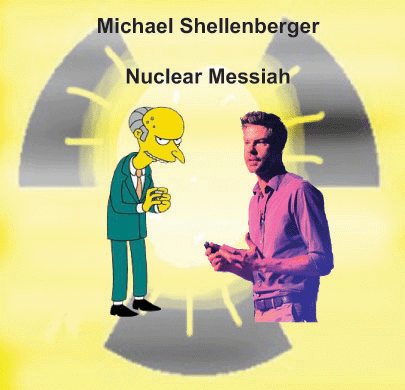
The end of ecomodernism , John Quiggin, 9 July 20,“….. The most important group of nuclear power advocates who have consistently promoted concerns about climate change as the main reason for their advocacy have been the self-described ‘eco-modernists’. The main organizational focus of ecomodernism is the Breakthrough Institute, established by Michael Shellenberger and Ted Nordhaus in 2003.
Recently, Shellenberger has issued what he describes as ‘an apology on behalf of environmentalists everywhere’ in which he repudiates previous concerns about catastrophic climate change and indicates that he never sincerely shared these concerns. Other ecomodernists have demurred at some of his claims, but have not indicated fundamental disagreement. The result is that, as a movement combining a pro-nuclear position with a commitment to a serious response to climate change, ecomodernism has ceased to exist…..https://johnquiggin.com/2020/07/09/the-end-of-ecomodernism/
The tragic thing about “Ecomodernism” is that it sucked in a whole heap of very well -intentioned people. It’s prime focus was to promote the nuclear industry – “new’ nuclear in particular. (Fossil fuel promotion has become a secondary aim). But, if you read the 7 page Ecomodernist Manifesto, http://www.ecomodernism.org/manifesto-english , nuclear power gets only ONE short paragraph, low down on page 4. It is all touchy-feeling lovely, seemingly pro environment stuff. It gently and subtly rubbishes any concept of energy conservation, and of renewable energy.
This is the genius of the nuclear propagandists. Like Dr Joseph Goebbels, they know how to pitch their sales talk to which audience. They’ll come up with important sounding technical and economic jargon, to put it over politicians and other “important people. I do think that Australia’s Ben Heard deserves an acknowledgement for his sales pitching skills. He wouldn’t muck up his message, as Shellenberger has recently done, in revealing climate denialism
U.S. Rep. Ben McAdams, D-Utah, announced Monday that he would be sponsoring an extension of the Radiation Exposure Control Act as well as opposing the possibility of more explosive nuclear weapons testing in the United States. McAdams said that next year’s House spending bill covering the Energy Department’s National Nuclear Security Administration would prohibit the use of money to prepare or conduct any nuclear testing.
The RECA act was originally passed in 1990 and compensated people who are known as “downwinders,” those who worked on the sites of the nuclear testing and the Uranium Miners, Millers and Ore Transporters. The act covered nine counties in Utah as well as areas of Arizona and Nevada, where the nuclear testing took place.
In a Facebook live video with Mary Dickson, former KUED on-air host and downwinder, McAdams said that there were over 1,000 nuclear tests, with the last one being conducted in 1992. He added that the fallout of the nuclear testing not only impacted Southern Utah, but all of Utah, Wyoming, Montana, the Dakotas and elsewhere in the United States.
The act is set to expire in 2022, but McAdams is sponsoring an extension that would go through 2045 as well as broaden the areas included in the act.
“In Utah, we’ve seen increases in certain types of cancers — myeloma, thyroid cancer, breast cancer — much of that is due to some of this nuclear weapons testing that happened in Nevada,” McAdams said in a Facebook live video. “RECA, the compensation act, is set to expire in 2022. The impacts are still here, so this would extend it through 2045, so those people who are impacted can receive compensation. Nothing is going to replace the loss of life or a cancer diagnosis, but at the very least, for the harm caused by our government, they should receive some compensation to help pay their medical bills, lost of income and other things.”
A press release from McAdams mentioned the Trump Administration’s recent announcement of plans to resume nuclear testing.
“Any plan to resume nuclear weapons tests would again put us ‘downwind’ of deadly radioactive fallout, even as the government has still not atoned for the devastating consequences from earlier nuclear weapons tests,” McAdams said in the press release. “I thank Chairwoman Kaptur for this important step, and I will continue to fight until this prohibition is signed into law.”
Dickson also spoke out about the issue with the congressman at Monday’s press conference.
“People are still getting sick, their cancers are coming back,” Dickson said. “We are living with health consequences that haven’t gone away. The way I view it is we were all deemed expendable. They killed their own in the name of national security, and it’s so important for us to tell our stories and have these opportunities, or they die with us.”
Inside the luxury nuclear bunker protecting the mega-rich from the apocalypse
A volcanic-ash scrubber, a decontamination room, a waterslide — when it comes to surviving a nuclear apocalypse, the Survival Condo has everything you could need, at a price. CNet.com, Claire Reilly, July 6, 2020 ……. after visiting my first real nuclear bunker, my apocalypse plan has been upgraded. Now my list of needs includes “underground swimming pool” and “postapocalyptic rock-climbing wall.” I’ve become fussy about how I’ll spend time during the planet’s dying breaths. My bug-out bag has gotten bougie. I’ve seen the world’s most high-tech bunker, and I want in.
Welcome to the Survival Condo. This former Atlas Missile silo turned luxury condominium complex offers the world’s rich and powerful a chance to buy into the ultimate life insurance: an apocalypse bunker that promises the perfect combination of shelter and style.
……. The starting cost for a unit in this complex is $1 million, plus an extra $2,500 per month in dues to cover your living expenses: electricity, water, internet, all the tinned eggs you could dream of.
For the ultra-rich and paranoid, though, you can’t put a price on safety…
The end of the world as we know it
Nuclear winter isn’t like spending Christmas upstate. It’s a global nightmare realm, where Ice Age-like temperatures last for years, populations perish and life as we know it becomes the stuff of sci-fi nightmares.
At least that’s according to Brian Toon, professor of atmospheric and oceanic sciences at the University of Colorado and world-renowned expert on the global effects of nuclear war. ……
Toon says a nuclear explosion is like “bringing a piece of the sun down to the Earth,” and the aftermath of that kind of explosion causes huge fires — think citywide infernos. Those fires push huge amounts of smoke up into the stratosphere. And because it never rains in the stratosphere, sunlight can’t reach Earth. Welcome to nuclear winter.
“The temperatures become colder than the last Ice Age,” says Toon. “So we have sub-Ice Age temperatures over the whole planet for about 10 years.”
That’s exactly why the Survival Condo exists — to protect the mega-rich from the devastation of global nuclear war, and to make sure the world’s most powerful people can survive in comfort, rather than shivering in the wasteland, waiting to have their billionaire brains eaten by hungry hordes. ……..
I’m at the very top of a bunker that descends 15 floors and 200 feet underground. On this upper level, a wide dome set into the hill houses the main entry and communal recreation facilities. That’s where you’ll find the pet park, climbing wall and swimming pool (complete with a water slide).
Beneath the dome, the cylindrical silo houses a further 14 floors — the top three floors are where you’ll find the mechanical rooms, medical facilities and a food store (complete with a full hydroponics and aquaculture setup), followed beneath by seven levels of residential condos. At the bottom, the final four floors house the classroom and library, a cinema and bar, and a workout room (with a sauna). ……..
what if there’s radiation because of a dirty bomb? You would have to go in this room, which is a decontamination scrub room. The chemicals in here can take care of everything. We have iodine pills to treat you for radiation, we have Geiger counters that detect radiation, and we have special chemicals to scrub both biological and radioactive contaminants from you. But you would lose your clothes. You’d be naked and afraid.”
As we wind our way through the Survival Condo, it’s like I’m in an episode of Cribz, set in a dark, alternate reality. This is where we keep the camo gear! This is the gun range! Here’s how we scrub the volcanic ash out of the air in the event of a supervolcano! …….
As a bonus, if the world is really ending, these windows display a real-time view of the carnage outside, thanks to the Survival Condo’s external surveillance cameras. Everyone come to the kitchen! The surface-dwellers are hunting in packs now!….
I guess there’s a grim irony in the idea that even when the nukes drop and the very fabric of society has disintegrated beyond recognition, the rich and powerful will still have it better off than the rest of us.
Swarm of insects cause nuclear reactor to lose power in Michigan, Fox 23, July 2, 2020 NEWPORT, Mich. — The Enrico Fermi 2 Nuclear Power Plant in Newport lost offsite power Wednesday in what has been described as a “mayfly accumulation.”
In a report released by the Nuclear Regulatory Commission that the outage was “caused by mayfly accumulation” around the facility’s switchyard. Diesel generators started automatically as a backup power supply.
The Pentagon’s budget is not large enough to buy new nuclear weapons and conventional forces simultaneously, the U.S. Air Force’s top general said Wednesday.
Chief of Staff Gen. Dave Goldfein gave a blunt assessment of the Pentagon’s growing list of bills amid a growing US deficit, on Wednesday, suggesting nuclear expenses have grown so great they may require a separate account of their own.
I think a debate is that this will be the first time that the nation has tried to simultaneously modernize the nuclear enterprise while it’s trying to modernize an aging conventional enterprise,” Goldfein said during a Brookings Institution appearance. “The current budget does not allow you to do both.”
The Trump administration’s $705 billion fiscal 2021 budget request for the Pentagon — which Congress is reviewing — calls for nearly $29 billion in nuclear weapons spending. The money would go toward new stealth bombers, intercontinental ballistic missiles, ballistic missile submarines, a new nuclear cruise missile and upgrades to the global nuclear command, control and communications network. The stealth bomber is the only weapon that could be used for nuclear or conventional strikes. The Energy Department, which oversees nuclear warheads, has requested $15.6 billion in fiscal 2021.
In January 2019, the Congressional Budget Office estimated that the Pentagon’s nuclear weapons spending plan would cost $494 billion between 2019 and 2028, an average of about $50 billion per year.
“There are either going to be some significant trades made or we’re going to have to find a fund for strategic nuclear deterrence, that we can use to modernize,” Goldfein said.
In recent years, Pentagon officials, including former Defense Secretary Ash Carter, and lawmakers have considered creating a nuclear weapons fund separate from the military services budgets. Todd Harrison, director of defense budget analysis and the Aerospace Security Project at the Center for Strategic and International Studies, questioned the rationale for moving those funds.
“It doesn’t make new money appear,” he said.
During the Obama administration, the Pentagon began the decades-long process of updating its nuclear arsenal with new ICBMs, bombers, submarines and missiles. Some independent estimates say the price tag could reach nearly $1.7 trillion over the next 30 years. How to pay for it is still debated in the Defense Department, but the need for nuclear weapons is not.
“I would just offer that in my mind, I could never advise anybody to unilaterally disarm or give up second strike capability,” Goldfein said. “I do believe we have to have a debate about the way we’re going to fund this essential part of our military going forward.”