Reflecting on Cape Cod’s Cold War nuclear history
Sadly, this lack of nuclear knowledge is not solely a Cape Cod problem. Nationwide, nuclear education is lacking. Most people do not know the United States government conducted 1,032 nuclear tests that sickened and killed thousands of people around the world. It is not general knowledge that the United States and Russia still possess more than 90% of the world’s remaining nuclear weapons — about 6,000 each.
So, as you eat ice cream, photograph cotton candy sunsets, and talk about how different the world is because of the pandemic, it’s worth brushing up on your nuclear history and learning how nuclear weapons continue to affect our daily lives. Thankfully, when it comes to reducing nuclear threats, Massachusetts legislators have led the way for decades. Today, our delegation continues to champion policies that protect their constituents — and the world — from nuclear catastrophe.
Kentucky man indicted after illegally dumping nuclear waste at landfill.
Associated Press 19 Jul 29, LEXINGTON, Ky. (AP) — A federal grand jury has indicted a Kentucky man with illegally dumping low-level nuclear waste at an Estill County landfill.The Lexington Herald-Leader reports that Cory David Hoskins was indicted Thursday on multiple charges earlier this week, including violating safety regulations and mail fraud due to checks as part of the alleged crimes.
In 2016, Hoskins and his company TENORM were each fined $2.65 million by the Kentucky Cabinet for Health and Family Services after officials said Advanced TENORM was responsible for dumping of out-of-state radioactive waste in landfills in Estill and Greenup counties.
Officials say the waste was a byproduct of fracking and had been transported from Ohio, West Virginia and Pennsylvania in 2015…….. https://www.courier-journal.com/story/news/crime/2020/07/18/kentucky-man-indicted-illegally-dumping-nuclear-waste-landfill/5465037002/
America’s nuclear attack on itself ? The fallout from nuclear testing
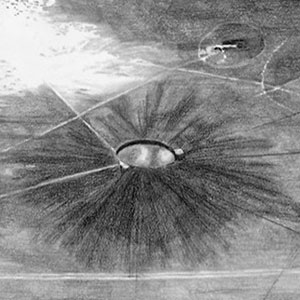
Above – Trinity nuclear test site crater 1945
It’s Been 75 Years, and America Still Won’t Admit a Nuclear Disaster. Remember when we blew radioactive ash over New Mexico? Now the Trump administration is talking about testing bombs again. https://www.nytimes.com/2020/07/15/opinion/75-anniversary-trinity-nuclear-testing.html, By Joshua Wheeler, Mr. Wheeler is the author of “Acid West.” July 15, 2020 When America detonated the world’s first atomic bomb at 0529 hours on July 16, 1945, it was an attack on American soil.
The blast melted the sand of southern New Mexico and infused it with the bomb’s plutonium core — 80 percent of which failed to fission — scattering radioactive material across the desert. The first atomic bomb was both a feat of engineering and, by today’s standards, a crude dirty bomb.
An Army doctor later wrote about Trinity: “A few people were probably overexposed, but they couldn’t prove it and we couldn’t prove it. So we just assumed we got away with it.”
Aboveground nuclear testing was halted in 1963. Underground testing, which is comparably safer but still terrifying, was stopped in 1992. But today the Trump administration is floating the idea of resuming such testing — despite the fact that America is, after more than 1,000 tests, already the most nuclear-bombed country in the world.
Any explosive nuclear test is an escalation toward global annihilation.
But the decision to resume explosive nuclear tests should never be made at all. We can and do perform successful tests in virtual-reality chambers using advanced supercomputers. Explosives tests of any kind carry magnitudes more risk, and the consequence of that risk has historically fallen on the most vulnerable Americans.
It should come as no surprise that the downwinders of Trinity were largely impoverished agricultural families, mostly Hispanic and Native. New Mexico, one of the poorest states in the nation, is the only one with a cradle-to-grave nuclear industry, where weapons are designed, uranium mined, and waste stored. After a recent study from the Nuclear Regulatory Commission raised no concerns, the federal government looks poised to finalize Holtec International’s bid to store nuclear waste between the New Mexico towns of Hobbs and Carlsbad, despite vehement objections from the governor and many residents of the area. And any resumed nuclear testing would add more radioactive waste to the controversial storage site already in existence near Carlsbad.
This is further evidence of what’s been called radioactive colonialism, where minority and impoverished communities are forced to suffer the costs of the nuclear industry.
Henry Herrera, whose family’s drying linens were stained by the fallout on that July morning in 1945, told me: “We were lab rats. That ought to make us hero patriots or something. Which we are. But nobody gives a damn.” Mr. Herrera, his brother and his two sisters all had cancer.
If Congress truly wants to awaken Americans to the dangers of nuclear testing, it should start by finally telling the truth about the disaster at Trinity. Bills to acknowledge and compensate Mr. Herrera and other Trinity downwinders have lingered in legislative purgatory for over a decade. Passing them would help establish what should be obvious: The shameful legacy of nuclear weapons testing is something we should never attempt to revive.
Joshua Wheeler is the author of the essay collection “Acid West.” He teaches in the creative writing program at Louisiana State University.
The Times is committed to publishing a diversity of letters to the editor. We’d like to hear what you think about this or any of our articles. Here are some tips. And here’s our email: letters@nytimes.com.
Follow The New York Times Opinion section on Facebook, Twitter (@NYTopinion) and Instagram.
Global heating is turning cities into death traps
|
Cities Are Becoming Climate Death Traps https://newrepublic.com/article/158537/cities-becoming-climate-death-traps 17 July 20 A new era of heat waves is here. We aren’t ready. As the coronavirus pandemic continues throughout the United States, another deadly pandemic comes out to strike in the summer: extreme heat. Year after year, more people are dying because it’s simply too hot. As of right now, both this country and others lack even an accurate way of counting those deaths—let alone a comprehensive plan to reduce them. Thanks to climate change, it’s about to get much worse.
For the past week, the American South and Southwest have been experiencing record-breaking temperatures. The National Oceanic and Atmospheric Administration has predicted above-average heat for nearly the entire U.S. this summer. Unprecedented, early-summer heat waves roasted the Middle East in May and Siberia in June, setting the latter on fire. Arizona had its earliest-ever hundred-degree heat wave in April—and another 110 degree heat wave in May. Spain endured 105 degree heat this month. When the heat index, a “feels-like” combination of temperature and humidity, reaches 104 degrees Fahrenheit indoors or out, human body temperature risks rising above the typical roughly 99 degrees Fahrenheit. When body temperature rises above 104 degrees, the consequences can be fatal within 30 to 60 minutes. “Heat-related deaths are notoriously difficult to track because the role of heat isn’t always obvious. One 2017 study found that extreme heat can kill people in 27 different ways,” Juanita Constible, senior advocate, climate and health at the National Resources Defense Council, told me. “If someone dies of a heart attack during a heat wave, there’s a good chance that’s how their death will be recorded by officials, even if high temperatures were the trigger.” Many scientists argue that official heat-death counts underestimate substantially. According to the World Health Organization, 166,000 people died due to heat waves between 1998 and 2017, but the true figure may be far higher. In the U.S., the Centers for Disease Control and Prevention only count deaths where heat illness is explicitly noted, so the official CDC count of heat-triggered deaths sits at just around 600 per year. Epidemiologists estimate that the real figure may be closer to 12,000—20 times higher than the official count. Climate change is making heat waves longer, hotter, and more deadly. Scientists estimate that 80 percent of record-breaking heat waves would not have occurred without human-caused warming due to greenhouse gas emissions. And urban areas, in particular, face special risk of heat deaths because of the heat island effect, in which dark pavement, roofs, and concrete absorb additional heat, making temperatures much hotter than the reported weather in any given city. In the U.S., heat deaths have more than doubled in Arizona in the last 10 years. Last year, a dangerous heat wave hit while storms left residents in the D.C. and New York City metro areas without power. Power outages can be deadly in a heat wave because without air conditioning, many people can’t cool off. In two heat deaths in a 2018 Arizona heat wave, the deceased were found indoors with a broken air conditioning unit that they couldn’t afford to fix. “Some people won’t use their air conditioning because they’re afraid of the bills,” Patricia Solís, executive director of the Knowledge Exchange for Resilience at Arizona State University, told National Geographic. “They think they’re OK without it, but that’s how people die.” “There are huge policy gaps in the U.S. with respect to extreme heat protections,” Rachel Licker, a senior climate scientist at the Union of Concerned Scientists, told me. “We found that without real action on climate change, by midcentury more than 250 cities across the U.S. are projected to experience 30 or more days with a heat index above 100 degrees Fahrenheit. This includes many cities that historically haven’t experienced this level of extreme heat.” |
|
Massive wildfire in rural central California

 Massive wildfire in rural central California, https://www.sbs.com.au/news/massive-wildfire-in-rural-central-california 17 Jul 20 More than 900 firefighters aided by helicopters and air tankers battled a wildfire in a rural area of central California.
Peace cranes flyimg in Vermont , in support of U.N. Treaty on the Prohibition of Nuclear Weapons
 Peace cranes on Church Street aim to abolish nukes, https://www.wcax.com/2020/07/17/peace-cranes-hanging-on-church-street-to-abolish-nuclear-weapons/ WCAX News Team Jul. 17, 2020 BURLINGTON, Vt. (WCAX) – Cranes are a symbol of peace in many cultures, and 1,000 origami peace cranes from Japan are now displayed in front of Burlington City Hall in observance of next month’s 75th anniversary of the atomic bombings of Hiroshima and Nagasaki in World War II.The story behind the peace cranes is of a little girl, Sadako Sasaki, who developed cancer from atomic radiation because of the Hiroshima bombing. Sasaki started getting sick around age 11.
Robin Lloyd, an activist for abolishing nuclear weapons, believes Sasaki’s story will not only reach the hearts of Vermonters but also teaches an important lesson.
“The cranes date from a little girl who got leukemia from the Hiroshima bombing,” Lloyd said. “Then her health started to fail and her friends said, ‘If you can fold 1,000 cranes, then your wish will come true.‘”
Sasaki died before she reached 1,000 cranes, but her story lives on. Organizers at Thursday’s event in Burlington say they want to use the peace cranes to gain support for the abolition of nuclear weapons.
Joseph Gainza, a longtime Vermont peace activist, says that Vermont has supported nuclear weapons abolition in the past.
”The House of Representatives overwhelmingly — and the Vermont Senate unanimously — voted on a resolution calling on the United States to enter into the nuclear weapons abolition treaty,” Gainza said.
Today, the Treaty on the Prohibition of Nuclear Weapons continues to gain support, according to Maho Takahashi, an activist in Burlington. ”With that treaty, once 50 countries ratify it, it will enter into force,” Gainza said.
The peace cranes will be flying for the next week. Each crane has a lesson that visitors are encouraged to take and learn from.
California Coastal Commission unanimously approves storage plan at San Onofre Nuclear Generating Station
California Coastal Commission unanimously approves storage plan at San Onofre Nuclear Generating Station CBS8, 17 Jul 20, The Commission voted 10-0 to approve the program to allow storage of spent nuclear fuel on-site. SAN DIEGO COUNTY, Calif. — The California Coastal Commission voted 10-0 in a special meeting today to approve an inspection and maintenance program allowing Southern California Edison to store spent nuclear fuel in a storage site at the San Onofre Nuclear Generating Station.
The program outlines actions SCE will take to inspect the canisters that contain spent nuclear fuel, as well as how potential issues with the canisters will be remedied.
Robotic devices will be used to inspect the canisters and site conditions will be simulated on a test canister, which will be observed for potential degradation. Two spent fuel storage canisters will be inspected every five years starting in 2024, and the test canister will be inspected every two to three years.
Canister flaws will be repaired by the application of a nickel-based metallic spray, and the presence of flaws may result in increased canister inspection frequency and an increase in the number of canisters inspected.
The inspection and maintenance program was also reviewed by the engineering consulting firm LPI, which provided recommendations that included the increase in canister inspections should flaws arise.
Nearly 3.6 million pounds of spent nuclear fuel are stored at the plant, which stopped producing electricity in 2012.
Concerns remain over the plant’s proximity to the ocean and the potential for the site to be affected by rising sea levels, tsunami inundation, seismic hazards.
By 2035, the commission may look to relocate the canisters to another site, although no such location is available, according to a commission report. ……. https://www.cbs8.com/article/news/local/san-onfre-nuclear-power-plant-storage-approval/509-b0c102a6-86b7-45c3-a5d7-b5013cfc19c4
Nuclear waste is piling up in California: leadership is needed
Gov. Gavin Newsom and leaders from the Legislature must demand action on nuclear waste and fill gaps in oversight. By Bart Ziegler, CalMatters, 17 Jul 20,
Bart Ziegler is president of the Samuel Lawrence Foundation, a nonprofit based in Del Mar, bart@samuellawrencefoundation.org.
From San Onofre to Humboldt Bay, nuclear waste is piling up in California.
This most-toxic waste – tons and tons of it – is deadly for 200,000 years. Stranded next to a rising ocean at aging and decommissioned plants, the waste has no permanent home.
California is overdue in showing leadership.
Just as California has broken ranks with the federal government on regulating greenhouse gas emissions, Gov. Gavin Newsom and leaders from the Legislature must demand action on nuclear waste and fill gaps in oversight.
With federal regulators all but cornering nuclear policy, the industry all too often is left to regulate itself. Meanwhile, private contractors slop at ratepayer-funded decommissioning troughs while running loose with safety.
Enough is enough, California!
In north San Diego County, conditions at the shuttered San Onofre Nuclear Generating Station scream for state intervention, as Rep. Mike Levin, a Democrat from San Juan Capistrano, concluded in a task force report issued recently.
First, some background.
Decommissioning started this year at the San Onofre plant, which quit making electricity in 2012. The plant’s majority owner, Southern California Edison, has opened its $4 billion decommissioning purse to Holtec International as lead contractor in charge of transferring 3.6 million pounds of spent nuclear fuel from cooling pools to a storage system of Holtec’s design.
That’s where things get dicey.
Edison’s contractors are cramming the spent fuel assemblies into thin-walled, steel canisters. Workers hoist the canisters from wet storage with a behemoth, track-driven gantry crane and crawl them to a concrete, dry-storage vault. That’s where the 73 canisters will stay. Indefinitely.
Public hand-wringing intensified after a near-accident in 2018 involving a fully-loaded canister and the release of reports showing the canisters are prone to gouging during transfer. That can lead to corrosion and failure, especially in a marine environment. To make matters worse, the canisters cannot be repaired, monitored, inspected or transported once entombed in the vault.
What can California do? For starters, leaders can immediately improve oversight of nuclear waste storage.
Nuclear plant owners admit to not having developed procedures to replace fully-loaded canisters. That’s why, as part of decommissioning California’s coastal nuclear plants at San Onofre, Diablo Canyon and Humboldt Bay, the state Coastal Commission must demand the construction of handling facilities – known as “hot cells” – where canisters can be repaired or replaced.
State lawmakers should order construction of a hot cell at the decommissioned Rancho Seco Nuclear Generating Station, just 40 miles south of their offices in Sacramento.
In San Diego County, near the border with Orange County, 8.2 million people live within 50 miles of the old San Onofre plant. On July 16, the California Coastal Commission is set to act on a staff recommendation to approve Edison’s application to dismantle the plant’s cooling pools. That approval would be disastrous. For now at least, the spent fuel cooling pools provide our last option for dealing with a damaged canister.
Coastal Commissioners are appointed by the same Legislature that should prepare for a crisis instead of responding to one. You don’t wait for a fire to create a fire department. Preparation is cheaper and faster than responding to a crisis. Tragically, the COVID-19 pandemic has shown that preparation is not always our strongest suit.
As recommended in the Report of the San Onofre Nuclear Generating Station Task Force, a state model would improve agency coordination on waste storage permit applications and increase engagement with federal agencies to advance solutions for containing and handling deadly nuclear waste. The solutions should be tied to strict, economic enforcement.
Coastal commissioners, lawmakers, regulators and anyone else with a stake in California – that’s nearly 40 million of us – should read the report and demand action on nuclear waste.
Slow progress of Michigan bill opposing high-level nuclear waste dump
Michigan bill opposing high-level nuclear waste dump languishes in Senate committee Iosco County News Herald, By Jim Bloch For MediaNews Group,Jul 16, 2020
-
- The Michigan House of Representative passed a concurrent resolution on Feb. 5 opposing the proposed high-level nuclear waste dump near the shores of Lake Huron in the municipality of South Bruce, Ontario, Canada.
The resolution was sponsored by Gary Howell, the republican representative of the 82nd District, which comprises Lapeer County.
It urges “the United States Congress to take every legal action possible to prevent the construction of any underground high-level nuclear waste repository in the Great Lakes basin,” and urges “the Canadian government to prohibit a high-level nuclear waste repository anywhere in the Great Lakes basin.”
One of the cosponsors of the resolution was Gary Eisen, the St. Clair Township Republican who represents the 81st District, which swoops around the southern half of St. Clair County and includes Marysville, St. Clair, Marine City and Algonac, as well as surrounding townships.
“It’s sitting in the Senate now in Dan Lauwers’s committee,” Eisen said in June, noting that the onset of the COVID-19 pandemic put the brakes on a lot of the legislature’s work. “Everything’s ten times harder now.”
The resolution is in the Committee on Energy and Technology, which Lauwers chairs. His 25th Senate District includes St. Clair County………..
“Placing a deep geological repository near the Great Lakes is a high-risk venture with the potential of causing irreparable harm to millions of lives,” said the resolution. “Underground waste repositories have leaked in the past, costing billions of dollars to repair. Germany, for instance, is spending billions of dollars to dig up low- and intermediate-level radioactive waste that was stored in a salt mine due to leakage and other environmental concerns. In 2014, chemical reactions in a steel barrel full of radioactive waste caused an explosion and fire at a low- and intermediate-level underground waste site in Carlsbad, New Mexico causing a cloud of radioactivity to be released at the surface. Not only did this put the health and safety of the public at risk, it cost taxpayers $2 billion to clean up and repair. As demonstrated, low- and intermediate-level facilities have failed, and this high-level nuclear proposal provides no guarantee, whatsoever, to keep radioactive waste from our environment.”
If the Michigan Senate approves the resolution, it will be sent to Prime Minister of Canada, the Minister of Environment and Climate Change, the Minister of Foreign Affairs, the Premier of Ontario, the Canadian Nuclear Safety Commission, the Canadian Environmental Assessment Agency, the Speaker of the U.S. House, the President of the U.S. Senate, the members of the Michigan congressional delegation, and the U.S. Nuclear Regulatory Commission.
On Jan. 17, Michigan’s U.S. Sens. Debbie Stabenow and Gary Peters, along with Congressman Dan Kildee and Congressman John Moolenaar, introduced a bipartisan resolution opposing Canada’s placement of a permanent nuclear waste storage in South Bruce.
If the Michigan Senate approves the resolution, it will be sent to Prime Minister of Canada, the Minister of Environment and Climate Change, the Minister of Foreign Affairs, the Premier of Ontario, the Canadian Nuclear Safety Commission, the Canadian Environmental Assessment Agency, the Speaker of the U.S. House, the President of the U.S. Senate, the members of the Michigan congressional delegation, and the U.S. Nuclear Regulatory Commission.
On Jan. 17, Michigan’s U.S. Sens. Debbie Stabenow and Gary Peters, along with Congressman Dan Kildee and Congressman John Moolenaar, introduced a bipartisan resolution opposing Canada’s placement of a permanent nuclear waste storage in South Bruce. http://www.iosconews.com/news/state/article_c5a6ae58-996b-5665-b599-cfa8fde7c6ae.html
State of Texas allows reduction in price of importing nuclear waste
State allows reduction in price of importing nuclear waste to Texas https://news4sanantonio.com/news/trouble-shooters/state-allows-drastic-reduction-in-price-of-importing-nuclear-waste-to-texas by APRIL MOLINA, Friday, July 17th 2020 SAN ANTONIO — The state has agreed to allow a private company in West Texas to drop the price charged for incoming nuclear waste.
Waste Control Services (WCS) has been disposing of the nation’s low level nuclear waste in Andrews County at a cost of $100 dollars per cubic foot for Class A waste and $1000 dollars per cubic foot for Class B and C waste.
There is an additional surcharge of 40 cents per unit of radioactivity, but The Texas Commission on Environmental Quality recently approved the request by WCS to drop the price to 5 cents per unit.
A spokesman for WCS explained the market is dynamic so when the price drops, they need to be able to continue to compete.
Public Citizen Texas Office Director, Adrian Shelley worries that by allowing WCS to import nuclear waste at a fraction of the cost, it could result in massive liability for the state.
“If WCS collects less money to import waste in Texas, then there will be less money available should an accident occur and ultimately we’re concerned Texas taxpayers will be on the hook should an accident occur,” Shelley said.
The company doesn’t expect less revenue, rather they anticipate more income as a result of the price drop.
WCS reports Andrews County gets 5% of their revenue and the state gets 25%.
WCS has also been working to get approval for years to temporarily store the nation’s high level nuclear waste that would include spent nuclear fuel rods.
The effects of radiation on the “downwinders” – guinea pigs for nuclear bomb research

Now I Am Become Death’: The Legacy of the First Nuclear Bomb Test, NYT, By Maria Cramer July 15, 2020
“………The effects of radiation were not well understood by most scientists on the project at the time, according to historians, and the preparations that were made to keep civilians safe reflected that ignorance.
They placed crude monitors around the small towns within 40 miles of the testing site. A scientist who was seven months pregnant and her husband, who was also a scientist, were sent to a motel in one of the towns with a Geiger counter, a device used to detect radioactive emissions, to measure the radiation. If the needle hit a certain mark, she was instructed to alert officials so that they could evacuate the town, Professor Wellerstein said.
Officials did not warn any of the residents — many of them ranchers, Navajos, Mexican settlers and their descendants who raised cattle and drank water from cisterns — about the test. Should anyone ask about the blast, officials had proposed several cover stories, including telling the public that a remote ammunitions depot had exploded, Professor Wellerstein said.
“It produced more light and heat than the sun,” said Tina Cordova, a founder of the Tularosa Basin Downwinders Consortium, which has urged the government to conduct more research about the aftermath of the blast and to compensate the affected communities.
Ash fell for days afterward in the landscape and in every direction and in amazing quantities,” she said.
Warnings went unseen and ignored.
“Thus a nation which sets the precedent of using these newly liberated forces of nature for purposes of destruction may have to bear the responsibility of opening the door to an era of devastation on an unimaginable scale,” the petition cautioned.
The bombs in Nagasaki and Hiroshima are believed to have killed up to about 200,000 people, with many of those victims succumbing to radiation poisoning in the weeks that followed.
The government never conducted a full investigation into the effects of the radiation, even after the communities downwind of the blast saw an unusual spike in infant deaths in the months after the explosion, said Joseph J. Shonka, a scientist and one of the authors of a 2010 study about the effects of nuclear testing for the Centers for Disease Control and Prevention.
“The Trinity downwinders have not been treated in either a fair or a just manner,” he said.
Ms. Cordova, who grew up in Tularosa, N.M., said cancer had been pervasive in the towns near the Trinity test site, where everyone can name someone who died of the disease.
“We know that the government basically walked away and has taken no responsibility for the suffering and the dying,” said Ms. Cordova, who has survived thyroid cancer and has several relatives who died of various forms of cancer.
Members of Congress from New Mexico have introduced legislation that would expand the Radiation Exposure Compensation Act, which compensates uranium miners and people who lived downwind from nuclear testing sites, to include the residents who lived around Trinity.
In 2014, the National Cancer Institute began interviewing people who lived in the towns near the testing site to try and document the effects of the blast. The institute said it anticipated publishing the results “within the next few months.” https://www.nytimes.com/2020/07/15/us/trinity-test-anniversary.html
Nuclear bomb testing – a form of racism and colonialism
Danielle Endres: Nuclear testing as a form of colonization, https://www.sltrib.com/opinion/commentary/2020/07/15/danielle-endres-nuclear/ By Danielle Endres ·16 July 20
At 5:29 a.m. on July 16, 1945, scientists in the Manhattan Project detonated the world’s first nuclear weapon in the desert homelands of the Mescalero Apache, a place now known as Alamogordo, New Mexico. As the detonation cloud mushroomed into the sky, the Trinity test ushered in a new era, the atomic age.
July 16 1945 – the first nuclear bomb test – the start of many more
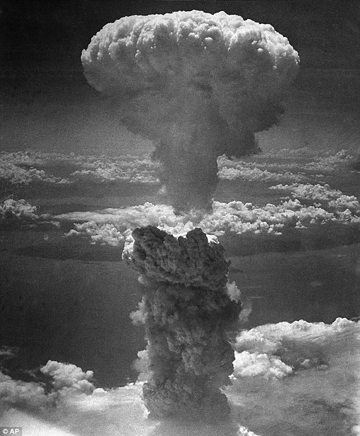 Now I Am Become Death’: The Legacy of the First Nuclear Bomb Test
The 75th anniversary of what’s known as the Trinity explosion, the world’s first nuclear weapon test, comes as tensions over nuclear devices intensify. NYT, By Maria Cramer July 15, 2020 It was 1 a.m. on July 16, 1945, when J. Robert Oppenheimer met with an Army lieutenant general, Leslie Groves, in the parched landscape of Jornada del Muerto — Dead Man’s Journey — a remote desert in New Mexico.
A group of engineers and physicists was about to detonate an atomic device packed with 13 pounds of plutonium, a nuclear weapon that the government hoped would bring an end to World War II……..At 5:29 a.m. local time, the device exploded with a power equivalent to 21,000 tons of TNT and set off a flash of light that would have been visible from Mars, researchers said.
It was the first nuclear test in history.
Less than a month later, the United States would drop a nearly identical weapon on the city of Nagasaki in Japan. The bomb, named Fat Man, fell three days after Americans dropped a uranium bomb, called Little Boy, on Hiroshima. Both weapons immediately killed tens of thousands of Japanese people and forced Japan’s surrender on Aug. 14, bringing an abrupt end to the war.
Mr. Oppenheimer said a Hindu scripture ran through his mind at the sight of the explosion: “Now I am become Death, the destroyer of worlds.”
The top secret test was heard and seen for miles.
The goal of the test was to see if the military could harness plutonium into a weapon that would destroy whole cities, said Alex Wellerstein, a science historian at the Stevens Institute of Technology in Hoboken, N.J., who studies the history of nuclear weapons…… https://www.nytimes.com/2020/07/15/us/trinity-test-anniversary.html
SCANA’s ex-top executive to plead guilty in a $9 billion nuclear fraud.

EXECUTIVE TO PLEAD GUILTY TO $9 BILLION NUCLEAR FRAUD, https://www.lexingtonchronicle.com/news/executive-plead-guilty-9-billion-nuclear-fraud Possible 5 years in prison and $1 million in fines, By Jerry Bellune, JerryBellune@yahoo.com, 13 July 20,
An ex-SCANA executive is to plead guilty tomorrow in a $9 billion nuclear fraud.
SCANA’s top nuclear executive, Steve Byrne, is accused of conspiracy in a failed nuclear project which cost investors – including his own employees – millions in stock losses.
The joint SCANA-Santee Cooper project:
1. Saddled more than 725,000 SC Electric & Gas ratepayers with $2 billion in costs.
2. Led to a near bankruptcy of Lexington County-based SCE&G and its sale to Dominion Energy.
3. Damaged the future of nuclear power in SC.
Byrne’s guilty plea will be entered Tuesday, July 14, at the federal courthouse in Columbia.
As Chief Operating Officer of SCANA, the owners of SCE&G, Byrne has admitted to knowingly engaging with others in fraud during construction of 2 Westinghouse AP100 reactors.
Byrne may face 5 years in prison and fines of not more than $1 million although the court could fine him more.
Federal officials are believed to have offered him a deal to testify against fellow executives and their lawyers who may have participated in the conspiracy.
To assure that Byrne, a former Irmo resident, follows the terms, sentencing will occur later.
Byrne has signed a plea agreement with federal agents which stipulate what he must do.
According to court postings, a bond hearing will immediately follow before Magistrate Judge Shiva V. Hodges
The failed nuclear project and a state law that allowed SCE&G to bilk rqtepayers of $2 billion was formally opposed before the Public Service Commission by Friends of the Earth, the Sierra Club, the SC Small Business Chamber and the Coalition to Stop the Blank Check.
Byrne agreed to be “fully truthful” about “criminal activities about which he has knowledge” and to provide documentation and testify at the trial of others.
Court documents reveal that the federal attorney believes other executives and lawyers:
1. Were involved in the conspiracy to cover-up problems at the failing nuclear project.
2. Made “false and misleading statements” about it to the PSC.
3. Took advantage of the Base Load Review Act in which SC lawmakers allowed SCE&G to pass all costs and risks to ratepayers.
State regulators inadequately reviewed the fraud due to a bias for SCE&G and against ratepayers, said Tom Clements, director Savannah River Site Watch.
“Byrne’s plea for his role in the reactor construction boondoggle will be historic as officials responsible for such failed projects rarely get caught and never confess to their crimes,” he said.
Clements was a main intervenor at the start and finish of the project.
“Byrne, who should serve prison time, must fully reveal the criminal role of others in the conspiracy that has been so disastrous for ratepayers, Clements said.
These include former CEO Kevin Marsh and former CFO Jimmy Addison,” he said.
Court documents imply that other individuals are being investigated,.
That means they and “lawyers who advised them” may face criminal charges, Clements said.
Blistering debate over San Onofre’s “nuclear waste dump by the sea,”
 Plan to inspect San Onofre’s aging nuclear waste expected to spark debate at Coastal Commission meeting Plan to inspect San Onofre’s aging nuclear waste expected to spark debate at Coastal Commission meeting
Although the analysis suggests doomsday scenarios may be more fantastical than factual, an engineering firm did suggest several improvements By TERI SFORZA | tsforza@scng.com | Orange County Register July 13, 2020 As debate continues to blister over San Onofre’s “nuclear waste dump by the sea,” an independent analysis concludes that the giant canisters housing that waste — and the program Southern California Edison has created to monitor and potentially repair them — will keep everything safe at least through 2035.Edison’s inspection and maintenance plan for its Holtec dry storage system — the “concrete monolith” now holding 69 of the 73 radioactive waste canisters it will hold by summer’s end, when all radioactive waste is finally removed from its spent fuel pools — is unveiled years earlier than the California Coastal Commission originally envisioned. It will be the subject of fiery debate at the Coastal Commission’s online meeting beginning 9 a.m. Thursday, July 16. Commission staff recommends approval of Edison’s plan, but critics are expected to vigorously oppose it………. How will it work?There are several layers to the inspection and maintenance program. Edison will keep tabs on the “concrete bunker” itself. Every day, workers will monitor temperatures and inspect air passageways and vent screens to make sure they remain free of blockage. Every month, air vent screens will be inspected for damage. Every year, there will be visual inspections of external surfaces for degradation. And every five years, there will be inspections of the structure for concrete settlement. How will it work?There are several layers to the inspection and maintenance program. Edison will keep tabs on the “concrete bunker” itself. Every day, workers will monitor temperatures and inspect air passageways and vent screens to make sure they remain free of blockage. Every month, air vent screens will be inspected for damage. Every year, there will be visual inspections of external surfaces for degradation. And every five years, there will be inspections of the structure for concrete settlement………. Bigger problemThe national paralysis over long-term storage of spent nuclear fuel is the elephant in the room. The federal government agreed to start collecting commercial nuclear waste for permanent disposal more than 20 years ago — but it hasn’t collected an ounce. That’s why it’s stuck at San Onofre, and dozens of commercial nuclear plants nationwide. There are hopes that temporary storage facilities in Texas and New Mexico might be licensed by the NRC while the federal government tries to find a permanent solution, but waste is likely to remain at San Onofre for many years. That’s why a maintenance and inspection program is required. While the Coastal Commission approved two dry storage systems at San Onofre Nuclear Generating Station, “it also has expressed concern regarding storing spent nuclear fuel at SONGS because of the facility’s location adjacent to the Pacific Ocean and Interstate-5, proximity to major population centers, and site topography and potential effects from coastal hazards,” the staff report says. “Because of the lack of a long-term repository for spent nuclear fuel, SONGS — like other nuclear power plants in the United States — has had to resort to interim storage of spent nuclear fuel on site.” Officials urge those who want spent fuel moved from San Onofre to focus on prodding the federal government toward a solution. Edison also is working on a strategic plan to explore the possibility of moving the waste off the bluff over the Pacific, and expects to finish by the end of the year. https://www.ocregister.com/2020/07/13/plan-to-inspect-san-onofres-aging-nuclear-waste-expected-to-spark-debate-at-coastal-commission-meeting/ |
|
-
Archives
- October 2026 (129)
- September 2026 (339)
- August 2026 (330)
- July 2026 (355)
- June 2026 (287)
- May 2026 (306)
- April 2026 (356)
- March 2026 (251)
- February 2026 (267)
- January 2026 (308)
- December 2025 (358)
- November 2025 (359)
-
Categories
- 1
- 1 NUCLEAR ISSUES
- business and costs
- climate change
- culture and arts
- ENERGY
- environment
- health
- history
- indigenous issues
- Legal
- marketing of nuclear
- media
- opposition to nuclear
- PERSONAL STORIES
- politics
- politics international
- Religion and ethics
- safety
- secrets,lies and civil liberties
- spinbuster
- technology
- Uranium
- wastes
- weapons and war
- Women
- 2 WORLD
- ACTION
- AFRICA
- Atrocities
- AUSTRALIA
- Christina's notes
- Christina's themes
- culture and arts
- Events
- Fuk 2022
- Fuk 2023
- Fukushima 2017
- Fukushima 2018
- fukushima 2019
- Fukushima 2020
- Fukushima 2021
- general
- global warming
- Humour (God we need it)
- Nuclear
- RARE EARTHS
- Reference
- resources – print
- Resources -audiovicual
- Weekly Newsletter
- World
- World Nuclear
- YouTube
-
RSS
Entries RSS
Comments RSS

