The military-industrial-media complex renders the American populus ill-informed in matters regarding war .

[and – it’s the same i Australia C.M.]
“How real is all this influence? Does the military-industrial-media complex (MIMC) actually affect the information we receive and our perception of war?”
The military-industrial-media complex renders the American populus ill-informed in matters regarding war — Rise Up Times
“The media has been a major player in ‘hyping up’ the sense of danger and need for military action in many situations.” https://wordpress.com/read/feeds/34005311/posts/3390423975
By HELEN JOHNSON The Miscellany News, Vassar College May 20, 2021
This is the fifth article in a five-part series about the military-industrial-media complex. The fourth article,“The (im)proper meshing of the corporate media and the military-industrial complex,” can be found here.
I have now examined the military-industrial complex (MIC) and the corporate media each individually; explained how the MIC has expanded to include not only the arms makers, Congress and the military, but also oil companies, service and equipment providers, surveillance and technology companies and think tanks; examined how the consolidation of corporate power within the media industry has resulted in a handful of companies controlling 90 percent of our media, and how these huge corporations hold incredible political power, not just to influence politicians and legislation directly, but to subtly shape entire ideologies. In this installment, I illustrated how the corporate media is linked in many ways to the MIC, including through outright ownership, interlocking directorates, revolving doors and overreliance on the government and the military for information and access to the battlefield during war.
But how real is all this influence? Does the military-industrial-media complex (MIMC) actually affect the information we receive and our perception of war? In this article I’ll explain that yes, because of its enormous reach, the extreme consolidation of its power and its entanglement with the gigantic machine that is the MIC, the media today has failed to properly inform the American citizenry on matters concerning war. The MIMC manufactures pro-military opinion among the public; suppresses information relevant to military activities; provides a sanitized coverage of war; fails to investigate, criticize, or thoroughly debate issues of military involvement; too easily bends to pressure from government and military officials and sometimes even spreads outright lies and false information.
This has resulted in an American populus that, in general terms, is ill-informed, uneducated and misled in matters regarding military involvement, as well as overly militaristic and pro-war. Americans are thus unable to hold their government accountable for unnecessary or inappropriate use of military force, and are complicit in the perpetuation of American imperialism, colossal defense budgets that strip the country of severely lacking social programs and never-ending wars that kill and destroy while a handful of corporations reap immense profits.
The media has been a major player in ‘hyping up’ the sense of danger and need for military action in many situations. Douglas Kellner—American academic and sociologist—explains in his book, Media Spectacle and the Crisis of Democracy: Terrorism, War and Election Battles, how Sept. 11 was a prime example of the media spreading hysteria and fear among an already panicked and traumatized nation. He notes how the media obsessively focused on terrorism, possible threats and retaliation in the weeks and months after Sept. 11. It also handed a megaphone to extremism and did little to weed out the potentially dangerous or incorrect information being spread on its platforms.
Spreading hysteria and panic throughout the population had two effects: First, it made Americans feel heavily reliant on the government for protection and, according to Kellner, made any disagreement with or questioning of the Bush administration seem “unpatriotic and even treasonous.” Second, it was extremely profitable for the media companies themselves; with millions of eyes glued to TVs, newspapers and other media platforms, media consumption spiked and profits went up. Thus, the corporate media and the military-industrial complex both benefited from this collaboration……………
An important note here is that this type of behavior is by no means limited to right-wing or conservative news outlets. In its analysis, FAIR cited The New York Times, The Hill, the Associated Press, and The Washington Post—in addition to Fox News—as all contributing to this culture of hysteria. A separate FAIR article’s headline directs a pointed accusation at CNN: “CNN’s Iran Fearmongering Would Make More Sense Coming Directly From Pentagon.” No mainstream media outlet is innocent of pro-war fear mongering.
The media has also suppressed or downplayed information relevant to military activity on multiple occasions. For example, although the media did everything in their power to vilify Iraq and Saddam Hussein in the lead-up to and during the Iraq war, they completely ignored how the United States backed Hussein in the past. The United States played an integral role in Hussein’s rise to power and actively supported Iraq during the Iran-Iraq War—including going along with Hussein’s use of chemical weapons. However, this seemed to be irrelevant once Bush Jr. had made up his mind to invade Iraq.
Another instance of the U.S. media suppressing or failing to report information came during the middle of the Iraq War in 2004. On Jun. 28, 2004, the United States transferred sovereignty of Iraq in a secret ceremony, immediately after which Paul Bremer—who had been seen by Iraqis as a dictator—left the country. Bremer had heavily controlled Iraqi politics and privatized a huge portion of the economy, including handing out contracts to American firms like Halliburton. However, Bremer’s replacement wasn’t much better. The U.S. chose Ayad Allawi, who had ties to the CIA, to serve as interim prime minister until elections could be held, and the U.S. handpicked the rest of the Iraqi council as well. The two months following the transfer of power saw escalated violence and a continuation of the chaos that had been produced by Bremer.
But watching the news in the United States, you would think “we had turned a corner,” as President Bush repeated over and over again. If the media had thoroughly reported on the situation in Iraq, it could have led to a nationwide understanding that the war was doing more harm than good and serving the interests of huge corporations at the expense of American and Iraqi lives. A truly informed citizenry could have put public pressure on the Bush administration to end the war, or an electorate dissatisfied with the situation could have voted him out of office. Instead, it would be seven more years before the withdrawal of American troops from Iraq.
Suppressing or downplaying information isn’t the only way the mainstream media—in complicity with the MIC—has warped our understanding of war. The media also produces an extremely sanitized coverage of war: it avoids printing and broadcasting images of death and destruction; sidesteps discussions of American casualties and almost entirely refuses to mention casualties on the other side (which are usually much higher); and uses euphemisms like “collateral damage” and “air campaign” that hold very different connotations from what these phrases actually mean—i.e., innocent civilian death and continuous bombing.
Kellner notes that during the Iraq war, “Entire networks like Fox and the NBC cable networks provided little but propaganda and jingoism, as did for the most part CNN. All of the cable networks, as well as the big three U.S. broadcasting networks, tended to provide highly sanitized views of the war, rarely showing Iraqi casualties, thus producing a view of the war significantly different than that shown in other parts of the world.”……………….
Not only do reporters and news anchors oftentimes receive direct instructions from higher-ups on what to and what not to say, but there is also careful screening of experts and guests brought onto the TV networks during wartime. And, as noted in my previous article, many of these “experts” are former generals and Pentagon officials, whose talking points have been carefully scripted and who have been trained on how to speak about matters of war in order to paint the U.S. military and government in the best possible light.
The U.S. corporate media has also chronically failed to properly investigate, criticize and debate issues of war and military involvement. It tends to take the current administration’s account of the situation as fact, and during times of war or military tension, it is branded unpatriotic to criticize the government. Although there are many examples of the media’s failure to investigate and report the truth when it comes to war, the most egregious case was in the lead-up to the invasion of Iraq.
George W. Bush and Dick Cheney had planned from day one of their administration to invade Iraq. As explained in this article, Bush and Cheney—as well as Paul Wolfowitz, Donald Rumsfeld and others in and around the Bush administration—were either directly a part of or tangentially related to the neoconservative think tank PNAC, which was advocating for a regime change in Iraq as early as 1998. The fact that Bush planned to invade Iraq from the get-go has been confirmed by multiple officials close to the administration.
From the immediate aftermath of Sept. 11 up until the 2003 invasion of Iraq, the Bush administration waged a propaganda war to convince the nation that Saddam Hussein was linked to Al Qaeda and that he possessed weapons of mass destruction (WMD). These claims turned out to be false. Not only did Saddam Hussein have nothing to do with the Sept. 11 attacks, but Iraq was not in possession of WMD nor were they in the process of making any.
Even so, these allegations were widely circulated in the mainstream media. The nonpartisan Center for Public Integrity documented a total of 935 false statements made by top administration officials regarding the threat from Iraq before the war, and the majority of these assertions “were broadcast widely by U.S. media with little or no investigation of their credibility, and few rebuttals from war skeptics or dissenters.”
Not only did the media outlets completely fail to properly investigate these claims before broadcasting them to the nation—even The Washington Post and The New York Times admitted that they had uncritically published information fed to them by the Bush administration—but they continued to circulate the misinformation long after it had been disproven. Even after ABC, NBC and The Washington Post reported that the claims were false, Fox Television and other U.S. cable networks continued to play the stories about Iraq’s alleged connection with Al Qaeda and supposedly threatening weapons program.
The Bush administration had accomplished its goal: to convince enough of the American population, still reeling and traumatized from Sept. 11, that Saddam Hussein was dangerous—so that they could have their war. The failure on the part of the corporate media to investigate and criticize the Bush administration’s claims, and the continued circulation of these claims even after they were proven false, would lead to a disastrous eight-year long conflict resulting in hundreds of thousands of deaths.
There are many, many more instances of skewed reporting when it comes to war and military involvement. Not all of these instances involve outright lying to the American public or regurgitating government pro-war propaganda; many of the ways in which the corporate media influences our perception of war are small and relatively unnoticeable……….. more https://riseuptimes.org/2021/06/12/the-military-industrial-media-complex-renders-the-american-populus-ill-informed-in-matters-regarding-war/
A nuclear plant in a volcano zone? What could possibly go wrong, Mr Gates?

A nuclear power plant, built in partnership with two of the world’s most notorious egoists with funding from questionable sources, using technology developed in tandem with the Chinese, and sited on one of the most active seismic systems on the planet. What could possibly go wrong?
A nuclear plant in a volcano zone? What could possibly go wrong, Mr Gates? ht tps://www.conservativewoman.co.uk/a-nuclear-plant-in-a-volcano-zone-what-could-possibly-go-wrong-mr-gates/ By Kate Dunlop June 11, 2021 NOT content with being the biggest private landowner in the US, blotting out the sun and jabbing the world, Bill Gates is getting over his divorce by building a ‘next-generation’ nuclear power plant in Wyoming.
The Republican state’s governor Mark Gordon announced the deal between Gates’s TerraPower Company, PacifiCorp owned by Warren Buffett’s Berkshire Hathaway, and the US government on June 2.
He said the multi-billion-dollar project, called ‘Natrium’, is to be constructed on the site of a ‘soon-to-be-retired coal-fired plant over the next several years’. TerraPower President Chris Levesque said costs would be split evenly between government and the two billionaires.
No information has been published about the contractual elements of the deal or the likely rate of return to Messrs Gates and Buffett but this is a ‘commercial not a charitable’ effort.
According to the press release, the nuclear plant will feature a 345-megawatt sodium-cooled fast reactor with a molten salt-based energy storage system, which will produce enough power for 250,000 homes. New storage technology will be able to boost output to 500 megawatts of power for about five and a half hours, equivalent to the energy needed to power 400,000 homes.
Wyoming is both a leading coal mining and uranium mining state, and Governor Gordon promised that the development did not signal any lack of commitment to fossil fuels or to making the state ‘carbon negative’.
He said, ‘I am not going to abandon any of our fossil fuel industry – it is absolutely essential to our state and one of the things that we believe very strongly is our fastest and clearest course to being carbon negative. Nuclear power is clearly a part of my all-of-the-above strategy for energy.’
Last month Gates’s TerraPower signed a ‘memorandum of understanding’ with the China National Nuclear Corporation (CNNC) which they called ‘the next step towards developing a prototype’.
Wyoming is a glorious, sparsely populated state of 97,000 square miles and 580,000 people. It is also home to a ‘hyperactive volcanic region’, the 3,472-square-mile Yellowstone National Park.
At the park’s centre lies a bubbling caldera that is the scar of a supervolcano eruption 640,000 years ago. The Norris Geyser Basin to the northwest of the caldera has more than 500 hydrothermal features, with dynamic geysers and pools that often change from day to day, but a much larger transformation has been taking place as well. For more than two decades, an area larger than Chicago centred near the basin has been inflating and deflating by several inches in erratic bursts.
Daniel Dzurisin, a research geologist at the U.S. Geological Survey’s Cascades Volcano Observatory, and a co-author of new research published in the Journal of Geophysical Research: Solid Earth, explains why the land is so unstable.
To be clear, the research does not indicate that the supervolcano that created Yellowstone’s caldera is any more likely to erupt now. Instead, researchers speculate that the changes below Norris may mean an increased chance of hydrothermal explosions taking place throughout the basin.
In March 2014, a magnitude 4.9 earthquake rocked Norris Geyser Basin. The ground fluctuated between sinking and rising until early in 2019, when it began to subside. The basin today is five inches higher than it was in 2000.
Researchers suspect that magma-derived fluids are sitting just beneath the entire surface of the region. Hydrothermal craters caused by geologic pressure cookers of boiling water may violently explode on to the surface, an event that is all but impossible to forecast.
In the Northwest, on the borders of Yellowstone, the Teton Mountain Range rises along the Teton Fault Line which forms part of one of the most seismically active areas in the Intermountain US. The entire area is prone to storms and considerable earthquakes.
These facts will increase the many challenges of delivering a safe nuclear power plant, as well as protecting it from hackers, ‘green activists’, and domestic or foreign terrorists.
An example that Gates and Buffett could learn from happened in Japan on March 11, 2011, when an earthquake and tsunami caused a severe nuclear accident at the Fukushima Daiichi nuclear plant.
The risk of tsunami had been engineered into the plant design but underestimated the potential flood risk. Three of the six reactors sustained severe core damage and released hydrogen and radioactive materials. Explosion of the released hydrogen damaged the reactor buildings and impeded onsite emergency response efforts.
None of this data prevents the building of a nuclear power plant in Wyoming but it highlights the requirement for authentic public consultation, absolute transparency, and perhaps, humility in the face of nature – behaviours that have not hitherto been associated with the global activities of either Gates or Buffett.
A nuclear power plant, built in partnership with two of the world’s most notorious egoists with funding from questionable sources, using technology developed in tandem with the Chinese, and sited on one of the most active seismic systems on the planet. What could possibly go wrong?
Pro nuclear politicians angry at suggestion of canceling sea-launched cruise missile.
Lawmakers Fume Over Acting Navy Secretary’s Call to Cancel Nuclear Sea-Launched Cruise Missile, Military.com 11 Jun 2021Stars and Stripes | By Sarah Cammarata
I think we’re all shocked to have heard the news of the acting secretary of the Navy appearing to take action to zero out the sea-launched cruise missile. This is something that is incredibly important,” said Rep. Mike Turner of Ohio, the ranking Republican on the House Armed Services Committee subpanel on strategic forces.
WASHINGTON — House and Senate lawmakers voiced concern Thursday over the acting Navy secretary’s move to cancel the service’s nuclear sea-launched cruise missile in fiscal 2023 as top defense leaders said they had not been briefed on the decision.
“I think we’re all shocked to have heard the news of the acting secretary of the Navy appearing to take action to zero out the sea-launched cruise missile. This is something that is incredibly important,” said Rep. Mike Turner of Ohio, the ranking Republican on the House Armed Services Committee subpanel on strategic forces.
“We know that the Nuclear Posture Review isn’t underway, and yet we have the first steps toward actions that would be unilateral disarmament,” Turner said during the committee’s hearing to review the fiscal 2022 budget proposal for nuclear forces.
Multiple media outlets reported this week that acting Navy Secretary Thomas Harker directed the service in a June 4 memo to “defund [the] sea-launched cruise missile.”
The 2018 Nuclear Posture Review — an examination of U.S. nuclear policy that occurs when a new administration takes office — supported pursuing this type of missile. The strategy under former President Donald Trump’s administration called for expanding the role and capability of the U.S. nuclear arsenal.
The Defense Department’s Melissa Dalton testified Thursday that the review by President Joe Biden’s administration is “on the cusp” of commencing. Biden has said he wants to reduce reliance on nuclear weapons.
“The sole purpose of the U.S. nuclear arsenal should be deterring — and if necessary, retaliating against — a nuclear attack,” Biden’s campaign said in an online statement before the president’s election. …….. https://www.military.com/daily-news/2021/06/11/lawmakers-fume-over-acting-navy-secretarys-call-cancel-nuclear-sea-launched-cruise-missile.html
Another corrupt executive pleads guilty in South Carolina’s nuclear scandal
‘Key Westinghouse witness’ in SC nuclear scandal told lies to help SCANA fool public, The News and Observer,
BY JOHN MONKJUNE 10, 2021 COLUMBIA, SC

A former Westinghouse executive who oversaw construction on SCANA’s doomed $10 billion nuclear project in Fairfield County admitted lying about the project in an effort to fool people into thinking the doomed project would be a success, a federal prosecutor said Thursday in federal court.
The former Westinghouse official, Carl Churchman, 70, was in court in Columbia before U.S. District Judge Mary Lewis to plead guilty to one count of lying to FBI agent Aaron Hawkins.
Churchman, who now lives in Utah, was the third person so far to plead guilty in an ongoing four-year FBI investigation of criminal acts connected to the 2017 failure of SCANA’s effort to build two nuclear plants at the V.C. Summer facility in Fairfield County, about 25 miles northwest of Columbia.
It was the biggest business failure in S.C. history and threw more than 4,000 people out of work. At first, the July 2017 failure of the nuclear project was attributed to cost overruns and mismanagement, but the FBI investigation established that top SCANA officials engaged in a criminal conspiracy to hide the looming business failure from the public, regulars and investors who owned SCANA stock.
“There is more to come (in the investigation), and Mr. Churchman is a key witness for us,” assistant U.S. Attorney Winston Holliday told Judge Lewis, indicating that more people would face criminal charges.
In 2020 and this year, two former top SCANA executives — Stephen Byrne and Kevin Marsh — pleaded guilty to criminal fraud charges related to their knowing about costly delays to the project, delays they unlawfully kept secret for years from regulators and shareholders. Sentences in those cases are pending.
“There is more to come (in the investigation), and Mr. Churchman is a key witness for us,” assistant U.S. Attorney Winston Holliday told Judge Lewis, indicating that more people would face criminal charges.
In 2020 and this year, two former top SCANA executives — Stephen Byrne and Kevin Marsh — pleaded guilty to criminal fraud charges related to their knowing about costly delays to the project, delays they unlawfully kept secret for years from regulators and shareholders. Sentences in those cases are pending.
In several court hearings, prosecutors have described the lies told by SCANA executives not as crimes of greed but crimes of hubris and an abuse of public trust — an inability to tell the truth and admit publicly that such a huge project that was supposed to showcase a major commitment to nuclear energy with Westinghouse nuclear reactors had turned into such an abject failure………… https://www.newsobserver.com/news/state/south-carolina/article252009438.html
Marginalized voices are ignored in favor of nuclear development
How Nuclear Waste Impacts Marginalized Communities, Geopolitics. By Ainsley Lawrence -June 11, 2021 ‘
(Amazingly, this excerpt comes from a quite enthusiastic pro nuclear article)
‘………………..Marginalized Voices are Ignored in Favor of Nuclear Development.
All over the world, nuclear power plants are planned and developed within communities that do not want them and question their safety. Yet, corporations press on with their plans. One prominent example occurred in the aftermath of the Fukushima nuclear disaster, in which an estimated 32 million people were affected.
Marginalized Voices are Ignored in Favor of Nuclear Development
All over the world, nuclear power plants are planned and developed within communities that do not want them and question their safety. Yet, corporations press on with their plans. One prominent example occurred in the aftermath of the Fukushima nuclear disaster, in which an estimated 32 million people were affected.
As a direct consequence of their being ignored, marginalized communities like those below the poverty level or with higher populations of minority groups tend to live closer to nuclear power plants. According to Stanford University research, a larger percentage of African Americans lived within 50 miles of nuclear power plants than their white peers.
Infamously, Chernobyl represents exactly what happens to marginalized communities when a nuclear disaster occurs. The city’s many subsistence farmers found themselves suddenly without the means to make a living when the disaster occurred. As a result, they were forced to rely on government subsistence to make ends meet, and many have either returned or stayed in the region where housing is cheaper.
Because the risks associated with nuclear power lower property values, lower-income families both already live in planned sites for nuclear development or come to live there after they’re built. This means when a disaster occurs, it is the poor who face more of the devastation.
Protections Aren’t for Everyone
The leaks at the Savannah River nuclear site in the American South showcased just how racially and financially disparate the effects tend to be when dealing with dangerous nuclear waste. From the evidence that emerged that black workers were frequently sent into high-radiation areas without the proper protection to the lack of job mobility experienced by the same, historically marginalized workers and the larger black community in Savannah River took a disproportionate amount of the fallout.
There were at least 30 cases of cancer and ailments associated with the Savannah River site in its earlier days, but the leaks of nuclear containments continue to give the community health concerns, especially when it comes to the availability of safe drinking water. Poor water quality can lead to illness and even death. When polluted with radiation, the effects of contaminated drinking water can be even worse.
But Stanford research shows that ionizing radiation standards are designed more to protect adult males. For nuclear facility workers, even these standards can be waived, allowing facility owners to expose workers to as much as 50 times more radiation than is allowed for the common citizen. Often, these workers don’t even receive hazard pay.
Minority and low-income communities are at higher risk of the radiation pumped via nuclear waste into their communities because of their proximity. At the same, these communities have statistically higher levels of women and children. These risk factors, much like the reasons nuclear power plants are built in these areas in the first place, perpetuate racist and classist outcomes………
Great powers’competition – the war industry’s best tactic

”……………..Pretexts keep the military budget elevated, sustain the war industry’s profits, and incite a violent foreign policy. Manufactured fear is essential. After pumping the “War on Terror” for trillions of dollars — and with veterans and the U.S. public growing skeptical of such interventions — the war industry has returned to targeting Russia and China through “great power competition.
A PEOPLE’S GUIDE TO THE WAR INDUSTRY -5: PORTFOLIO OF CONFLICTS, By Christian Sorensen by Rise Up Times · Great Power Competition , 9 June 21,
”……………..Pretexts keep the military budget elevated, sustain the war industry’s profits, and incite a violent foreign policy. Manufactured fear is essential. After pumping the “War on Terror” for trillions of dollars — and with veterans and the U.S. public growing skeptical of such interventions — the war industry has returned to targeting Russia and China through “great power competition.
Facing off against Russia and China is more comfortable territory for war corporations. In the calculus of corporate suites, the big-ticket items inherent to competition with another major industrial nation are where the real money can be made. A war on terror was lucrative for a decade or two, and it will continue, but it is not enough to justify excessive spending on cyber, submarines, satellites, hypersonic propulsion, anti-ballistic missiles, nuclear weaponry, artificial intelligence/machine learning, and aircraft carriers.
Competition against Moscow and Beijing also continues the militarization of U.S. society, channeling anger (which might otherwise manifest itself as class awareness and/or physical protest against Washington’s corruption) into outrage against a stereotypical enemy that resides overseas — just as the War on Terror did.
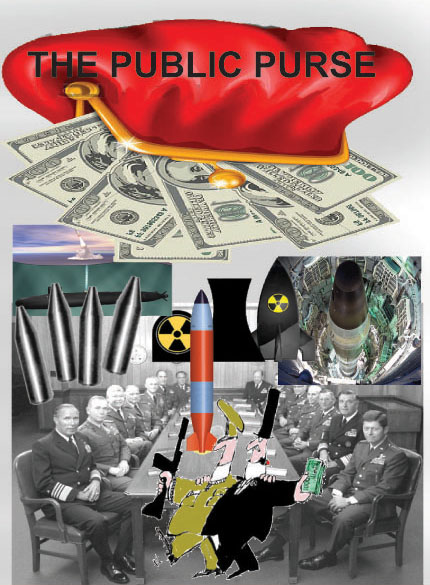
Great power competition is fully entrenched in the Pentagon, as made clear by the 2018 National Defense Strategy, developed in 2017 by military and corporate personnel. It emphasized, “inter-state strategic competition, not terrorism, is now the primary concern in U.S. national security.”
Etching the National Defense Strategy into stone, the then chairman of the Joint Chiefs of Staff, General Joseph Dunford declared in November 2018, that great power competition was here to stay, demanding a shift in Pentagon funding priorities and weapons development. Dunford was speaking at the Halifax International Security Forum, sponsored by corporations (e.g. Boeing, CAE, United Technologies) and NATO, among other powerful groups, including energy and IT firms.
Four months later, the war industry pressure group NDIA presented General Dunford with its most prestigious award. Dunford soon retired and joined the board of Lockheed Martin.
Great power competition has enabled a high volume of war industry goods and services and U.S. military personnel to deploy to Germany, the Czech Republic, Poland and eastern Europe, particularly in the Baltic States and Romania, as well as other clients surrounding China, particularly South Korea, Japan, Taiwan and Guam. Large engineering and project management firms build and sustain the associated infrastructure.
Meanwhile, Beijing’s construction is framed as a threat. “I mean, this is insane. Look at all that crazy construction,” remarked a U.S. naval officer observing Chinese military construction projects in the South China Sea. Though a useful bogeyman, Beijing’s construction in the South China Sea does not hold a candle to what Washington has built up overseas.
Great power competition fills peaceful voids. At the Sea Air Space Forum of 2019 (sponsored by CACI, Lockheed Martin, Northrop Grumman, and shipbuilder Huntington Ingalls), MIC officials cited the “threat” of great power competitors in order to justify expansion of U.S. military power into the Arctic.
They ignored the real threat: The U.S. Armed Forces’ rampant carbon-based military activity contributes to anthropogenic climate change, which melts Arctic ice, which opens up northern sea lanes, into which the Pentagon projects its polluting arsenal, which puts more carbon in the atmosphere.
Great power competition’s consequences are terrifying: increased militarization of an already militarized U.S. economy and public life; greater likelihood of wars big and small; more pollution (notably toxic particulates, carbon emissions, and radiological contamination) in an era of climate catastrophe and mass extinction; nuclear weapons on a hair trigger; narrowing of permissible speech and assembly; and relentless corporatization of the U.S. Armed Forces, the world’s mightiest organization.
The pretext known as great power competition is off to an impressive start, financially, bureaucratically, and industrially. It is incumbent upon the workers of the world to stop it. ”https://riseuptimes.org/2021/06/09/a-peoples-guide-to-the-war-industry-5-portfolio-of-conflicts/
U.S. Navy to cancel development of super expensive nuclear missile
Navy eyes canceling nuclear missile
By BRYAN BENDER , 06/09/2021 NIXING A NUKE? Politico, Acting Navy Secretary Thomas Harker has issued a memo directing the service to cancel development of a nuclear-armed cruise missile in fiscal 2023, a potential signal that the Biden administration could dial back some nuclear modernization programs, Aerospace Daily scooped on Tuesday.
The June 4 memo, also obtained by POLITICO, is part of preparations to craft a five-year spending plan. The memo declares that the Navy may have to choose either a new fighter jet, destroyer or submarine and delay two of them.
“The Navy cannot afford to simultaneously develop the next generation of air, surface, and subsurface platforms and must prioritize these programs balancing the cost of developing next-generation capabilities against maintaining current capabilities,” Harker wrote.
It “makes clear that budgets aren’t expected to increase enough in the coming years to undertake all of the modernization efforts envisioned by the Navy,” as our colleague Paul McLeary writes for Pros………. https://www.politico.com/newsletters/morning-defense/2021/06/09/navy-eyes-canceling-nuclear-missile-795839
“IT’S VERY PROFITABLE to prepare for omnicide,”
NOT EVEN COVID-19 COULD SLOW DOWN NUCLEAR SPENDING https://theintercept.com/2021/06/07/nuclear-weapons-spending-pandemic-ican/
A new report finds that nine countries collectively spent $72 billion in 2020 on nukes., Jon Schwarz,
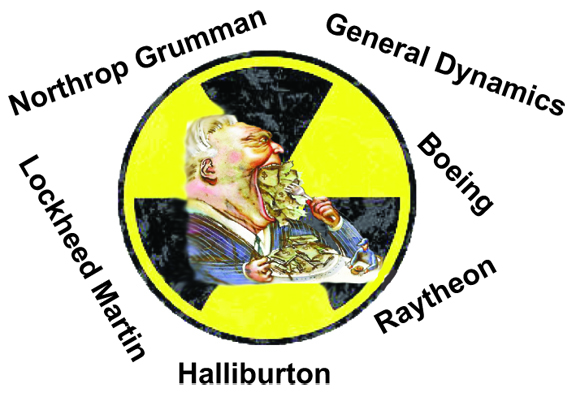
June 7 2021, “IT’S VERY PROFITABLE to prepare for omnicide,” Daniel Ellsberg, famed whistleblower and anti-nuclear weapons activist, said in a recent interview. “Northrop Grumman and Boeing and Lockheed and General Dynamics make a lot of money out of preparing for such a war. The congressmen get campaign contributions, they get votes in their district and almost every state for preparing for that.”
But don’t just take it from Ellsberg. At an investor conference in 2019, a managing director from the investment bank Cowen Inc. queried Raytheon’s CEO on this subject. “We’re about to exit the INF [Intermediate-Range Nuclear Forces Treaty] with Russia,” said the Cowen executive. Did this mean, he asked, whether “we will really get a defense budget that will really benefit Raytheon?” Raytheon’s CEO happily responded that he was “pretty optimistic” about where things were headed.
There are currently nine countries that possess nuclear weapons: the United States, China, Russia, the United Kingdom, France, India, Pakistan, Israel, and North Korea. ICAN calculated that they collectively spent $72.6 billion in 2020 on nukes. (picture below – a little out of date – 2019 )
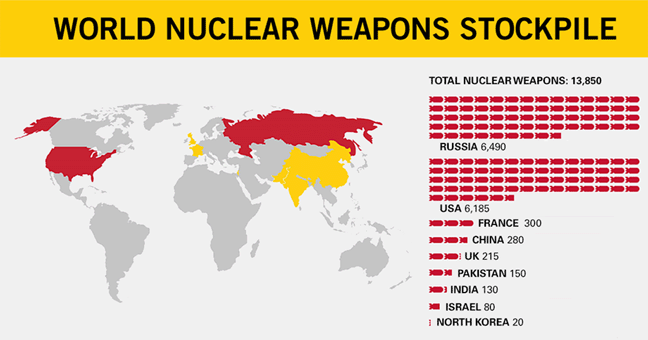
The U.S. was responsible for just over half of this doomsday payout, at $37.4 billion. According to the Congressional Budget Office, U.S. nuclear spending is anticipated to soon increase sharply due to plans for technological upgrades, rising to $41.2 billion next year and totaling $634 billion during the 10 years from 2021-2030.
China came in second in 2020 at an estimated $10.1 billion. Russia was third at $8 billion. Notably, in a year when the world economy was flattened by the coronavirus pandemic, nuclear spending continued on an upward trajectory without a hiccup.
Despite these hefty numbers, they’re probably an underestimate. “There’s always more [nuclear spending] out there … even more still lurking in the shadows,” said Susi Snyder, co-author of the report and managing director of the project Don’t Bank on the Bomb. Snyder points out that “governments, especially U.S., U.K., [and] France are always demanding ‘transparency’ … yet they do not hold themselves to the standards they demand of others.”
A great deal of U.S. nuclear spending consists of profitable contracts with private corporations.
The four companies Ellsberg said were raking in cash “preparing for war” indeed received the most money in 2020:
- Northrop Grumman — $13.7 billion
- General Dynamics — $10.8 billion
- Lockheed Martin — $2.1 billion
- Boeing — $105 million

These enormous contracts create obvious incentives for these companies to lobby for more government expenditures on Armageddon, and they assiduously do so. Indeed, lobbying unquestionably is the most profitable investment these companies make. According to ICAN’s report, for every $1 they spent on lobbying, they received $239 in nuclear weapon contracts.
The specifics are notable here. Northrop reported $13.3 million in lobbying expenses in 2020. Last year it was formally awarded the enormous initial contract to develop a new intercontinental ballistic missile system called the “Ground Based Strategic Deterrent.” It will inevitably receive the contract for the entire program, estimated to be worth $85 billion over its life. In discussion on the GBSD, the Air Force’s assistant secretary for acquisition stated that he didn’t see the pandemic affecting nuclear spending.

There is also much more to lobbying than that which goes by the name. In the 2006 documentary “Why We Fight,” journalist Gwynne Dyer explained that President Dwight Eisenhower considered the military-industrial complex actually to have three components: the military, defense corporations, and Congress. But now, Dyer said, there’s a fourth: think tanks, which generally push their funders’ policies under a thin veneer of scholarship.
According to the report, companies profiting from nuclear weapons contributed $5-10 million to think tanks in 2020. Northrop alone spent at least $2 million funding nine of them, including the Atlantic Council, the Brookings Institution, the Center for a New American Security, and the Center for Strategic and International Studies.
However, ICAN did not produce the report for passive consumption or as an inducement to despair. Instead, it is part of a sophisticated strategy to eventually make nuclear weapons as taboo worldwide as chemical and biological weapons are now.
ICAN was a key force behind the Treaty on the Prohibition of Nuclear Weapons, which was adopted in 2017 at the United Nations. It makes illegal any activities related to nuclear weapons and has been signed by 86 countries and ratified by 54. It entered into force this past January.
None of the nuclear powers are signatories. Yet they need not be for the treaty to create a noose around those countries and their companies that should tighten over time. For instance, Airbus produces missiles for France’s nuclear weapons arsenal. But it is headquartered in the Netherlands, so if that country ratified the TPNW, it could no longer do so.
This financial threat has now attracted the attention of the stockholders of these nuclear corporations. Snyder notes that a 2020 Northrop shareholders resolution stated that the company “has at least $68.3 billion in outstanding nuclear weapons contracts, which are now illegal under international law,” and it received 22 percent support. A similar Lockheed resolution got over 30 percent support. The KBC Group, the 15th-largest bank in Europe, has announced that it will not fund any nuclear weapon-related activity because of the TPNW.
Success here will obviously require a long-term campaign and increased activism across the world. But the trajectory is headed in the right direction. “The days of spending with impunity on WMD,” believes Snyder, “are numbered.”
Lawsuit aims to stop the dismantlement of San Onofre nuclear plant (closed in 2012)
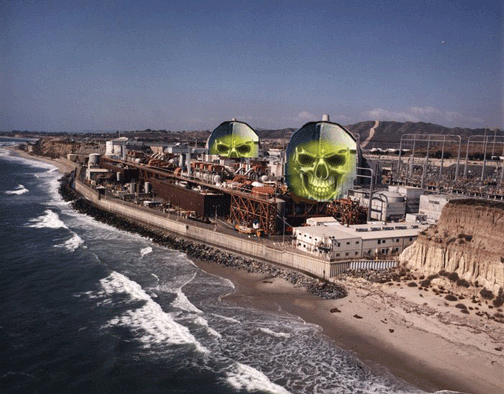
Hearing set for lawsuit aimed at stopping dismantlement of San Onofre nuclear plant, LA Times ROB NIKOLEWSKI SAN DIEGO UNION-TRIBUNE, JUNE 4, 2021 SAN DIEGO —
A June 16 court date has been set to hear a lawsuit filed by an advocacy group against the California Coastal Commission, seeking to stop dismantlement work at the San Onofre Nuclear Generating Station.
Los Angeles County Superior Court Judge Mitchell L. Beckloff will consider the petition by the Samuel Lawrence Foundation that argues the commission should not have granted a permit to Southern California Edison, the majority owner of the plant, to take down buildings and other infrastructure at the now-closed generating station, known as SONGS.
“The public interest is at risk, based on [the commission’s] decision,” said Chelsi Sparti, associate director of the Samuel Lawrence Foundation, based in Del Mar. “The waste is located right next to the ocean, [and] the economy, transportation, the environmental and natural resources that we have are at risk from the long-term storage of stranded radioactive waste.”…………
In October 2019, the commission on a 9-0 vote approved a permit for Edison to begin demolition work at the plant, which has not produced electricity since 2012. Dismantlement began in early 2020 and is expected to take about eight years to complete.
Before granting the permit, the commission required Edison to agree to a number of provisions, including establishing an enhanced inspection and maintenance program for the 123 stainless steel canisters filled with nuclear waste that sit in a pair of dry storage facilities at the north end of the plant.
The permit lasts 20 years and includes a condition that allows the commission by 2035 to revisit whether the dry storage site should be moved to another location in case of rising sea levels, earthquake risk, canister damage or other possible scenarios.
One of the major contentions in the lawsuit deals with what to do with a pair of wet storage pools at SONGS. Before going into canisters, the highly radioactive fuel rods were placed into pools 40 feet deep in order to cool………..
Some 3.55 million pounds of used-up nuclear fuel, or waste, remain at SONGS because the federal government has not opened a facility to deposit all the waste that has accumulated at commercial nuclear power plants across the country. About 80,000 metric tons has piled up at 121 sites in 35 states……………. https://www.latimes.com/california/story/2021-06-04/hearing-set-for-lawsuit-aimed-at-stopping-dismantlement-at-san-onofre-nuclear-plant
Illinois nuclear power stations’future hangs in the balance, awaiting decision on taxpayer subsidies.
Fate of Illinois nuclear plants in balance after PJM auction fail and stalled subsidy plan. Utility Dive June 7, 2021 By Scott Voorhis
Dive Brief:
- Exelon Corp. reports that three of its nuclear plants in Illinois failed to clear the PJM Interconnection’s capacity auction last week.
- Exelon, in a filing with the U.S. Securities and Exchange Commission, revealed that its Bryon, Dresden and Quad Cities nuclear plants in Illinois all failed to sell their power at the PJM auction, losing out to other power plants and energy resources. Bryon and Dresden are currently slated to be retired this fall, with Quad Cities remaining open thanks to previously awarded subsidies from the state of Illinois.
The fate of Illinois’ nuclear power sector, meanwhile, remains in the balance, as an impasse drags on in the state legislature over an energy bill that would provide hundreds of millions of dollars in subsidies to the sector………….. https://www.utilitydive.com/news/fate-of-illinois-nuclear-plants-in-balance-after-pjm-auction-fail-and-stall/601324/
Elevated cancer deaths in Monroe may be result of nuclear plant,
Report alleges elevated cancer deaths in Monroe may be result of nuclear plant,
Tyler EagleThe Monroe News, 12 March 2921 A new report has found that Monroe County’s cancer mortality rate is significantly higher than that of the national average.
And the scientist behind it contends the driving force behind that statistic is DTE Energy’s Fermi 2 Nuclear Power Plant in Newport.
A new report has found that Monroe County’s cancer mortality rate is significantly higher than that of the national average.
And the scientist behind it contends the driving force behind that statistic is DTE Energy’s Fermi 2 Nuclear Power Plant in Newport.
Epidemiologist and executive director of the Radiation and Health Project Joseph Mangano unveiled a report titled “Fermi 2 Nuclear Reactor and Rising Cancer Rates” Thursday afternoon during a virtual press conference.
Using mortality data collected by the Centers for Disease Control and Prevention, Mangano’s analysis found that cancer-related deaths in Monroe County were 14.3% higher than the national average.
“We have raised red flags — these are matters of concern,” Mangano said. “There are no other obvious reasons for such an unexpected change. …
You wouldn’t think Monroe County is a (center) for cancer. It’s a suburban county.”
More:DTE Energy decries advocacy group’s report
The national average for cancer-related deaths nationally was about 150 deaths per 100,000, according to Mangano’s report. Monroe County’s most recent metric — which is from 2019 — was 170 per 100,000.
Prior to Fermi 2’s activation in 1985, Monroe County’s cancer death rate was 3% less the national average, according to Mangano. He said the elevated trend has continued to increase in the last ten years, resulting in the most recent and highest metric.
Mangano said elevated risk and mortality of cancer was present in all population groups, including those classified by gender, race and age.
His report shows that in Monroe County, 10 of the 11 most common cancers in the U.S. occurred at a significantly higher rate, including leukemia, brain and central nervous system and bronchus and lung cancers.
The report also indicates that cancer-related mortality among younger populations is also much higher than the national average.
According to the report, cancer-related deaths among those ages 0-24 occurred 40.2% more than the national average.
Among those ages 25-49, the rate was 49.2% above the U.S. average.
Mangano is calling for more research into the matter, saying the federal and state government have not done enough to examine nuclear plants’ impact on those who live near such sites.
“You don’t have to wait for a meltdown for nuclear reactor to harm people,” Mangano said. “Every single day, reactors release a mix of 100 or more (harmful) chemicals into the environment. It gets into people’s bodies through the food chain.”
……….. Mangano also discussed a new initiative to collect donated baby teeth from Monroe County residents in an effort to investigate whether there are increased instances of in-body radioactive contamination.
Mangano said the Tooth Fairy Project will analyze collected specimens for Strontium-90, a harmful substance that is a byproduct of nuclear reaction.
The project will seek to collect 25-50 local specimens, he said. ………..
For more information, to read Mangano’s report in full or to find out how to participate in the Tooth Fairy Project, visit radiaiton.org. https://www.monroenews.com/story/news/2021/03/11/study-elevated-cancer-deaths-monroe-may-result-nuclear-plant/4649665001/
Exelon and NRG share prices fall as U.S. nuclear power firms to be hit by plunge in grid payments

Plunging Payouts on Top U.S. Power Grid Slam Coal, Nuclear, Bloomberg Green, By Will Wade and Mark Chediak3 June 2021,
- Power providers will get $50 a megawatt-day, down from $140
- ‘I can’t imagine how nuclear is going to be able to cover’
Coal plants, nuclear reactors and other generators will take a hit next year on the biggest U.S. power grid as payments designed to ensure the lights remain on from New Jersey to Illinois plunge 64%.
Suppliers to PJM Interconnection LLC’s grid, which serves more than 65 million people, will get $50 a megawatt-day to provide backup capacity for the year starting June 2022, according to the results of an auction released Wednesday. It’s the lowest price in 11 years.
The results are an especially harsh blow for coal plants and nuclear reactors already struggling to compete. The PJM auction is the single most important event for generators across the eastern U.S., including Calpine Corp., NRG Energy Inc. and Exelon Corp., because it dictates a big chunk of their future revenue.
It also plays a pivotal role in shaping the region’s electricity mix, determining how much the region is willing to stick with coal and natural gas plants or replace then with wind and solar.
“I can’t imagine how nuclear is going to be able to cover all their fixed costs with such a low price,” said Brianna Lazerwitz, an analyst for BloombergNEF.
Exelon shares fell as much as 2% before trading opened in New York Thursday. NRG fell 1.6%. And Vistra fell 2%.
“It’s a direct hit to the companies’ income statements,” Gayle Podurgiel, a power markets analyst at Moody’s, said in an interview. She predicted it would push more coal plants to close.
Analysts had expected the auction would hurt renewables and nuclear power, while potentially boosting coal. That’s because of new rules imposed by regulators under Former President Donald Trump were designed to blunt any advantage wind, solar and reactors gained from state subsidies.
But in the end, the rule wasn’t much of a factor, in part because the steep price decline mitigated some participants’ advantages. Plus, many bidders were granted exemptions. As a result, coal plants fared disastrously………..https://www.bloomberg.com/news/articles/2021-06-02/electricity-payouts-on-biggest-u-s-grid-fall-64-in-auction-kpfwja1a
The transition to clean energy is held back by subsidies to the nuclear industry
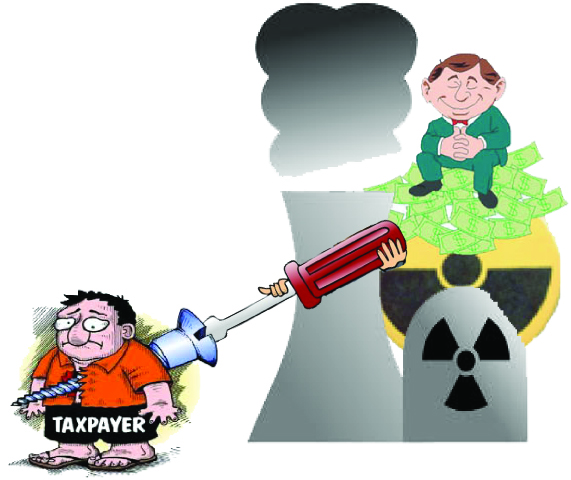
Nuclear Subsidies May Be Slowing Transition to Clean Energy, Advocates Say, BY Leanna FirstArai, Truthout, 6 June 21,
The fight to define what counts as clean energy has grown more contentious as the Biden administration’s infrastructure bill takes shape. Many activists, scientists and lawmakers agree that nuclear energy — which provides one fifth of power in the U.S — is by definition not “clean” or renewable, given that spent fuel remains radioactive and dangerous for thousands of years….. A group of staunch advocates say billions in state and federal subsidies that prop up the nuclear industry — payments that the Biden administration has signaled it may continue to support — may be slowing the transition to a truly clean energy economy…… Four days after Indian Point shuttered, on May 4, the Nuclear Regulatory Commission (NRC) approved a 20-year license renewal for two Dominion Energy reactors in Virginia, now slated to run until May 25, 2052. Half of the United States’ nuclear fleet of 93 remaining reactors will similarly be required to seek license extensions by 2040, or retire.
The Union of Concerned Scientists (UCS) supported the closure of Indian Point, Steve Clemmer, director of research and analysis for the organization’s climate and energy program, told Truthout, noting that other nuclear plants must be considered on a case-by-case basis. Based on data from a September 2019 presentation by a state task force, increases in energy efficiency and renewable generation spanning 2011-2021 were projected to not only replace but exceed Indian Point’s capacity. But Clemmer notes that according to data from the U.S. Energy Information Administration (EIA), output by the shuttered reactor has ultimately been replaced by three new natural gas plants built over the past three years.
Clemmer said California is similarly projected to burn more natural gas when its last nuclear plant closes mid-decade, which would cumulatively raise global warming and air pollution emissions over the next 10 years. But, Clemmer added, it doesn’t have to be that way. “With sufficient planning and strong policies, existing nuclear plants like Diablo Canyon can be replaced with renewables and energy efficiency without allowing natural gas generation and heat-trapping emissions to increase,” he said. In the case of California, a February 2021 UCS analysis called for more rigorous emissions standards, and accelerating wind build-outs while slightly slowing solar and battery storage build-outs.
Elizabeth Moran, environmental policy director for the New York Public Interest Research Group characterized New York’s failure to replace Indian Point’s energy output with clean energy as “a total lack of planning.” Moran is among a group of clean energy advocates who have deemed New York’s ongoing reliance on both nuclear energy and natural gas as unnecessarily postponing the work required to achieve what’s laid out in the state’s climate law, the Climate Leadership and Community Protection Act. “These are bridges to nowhere,” Moran said. “They delay investment in what we truly need to be putting money towards, which is safe, clean, green renewable energy like solar, wind and geothermal.”
With Indian Point now closed, New York has four remaining nuclear reactors at three power stations upstate, all on the southern shore of Lake Ontario. The plants — which are indirectly owned and operated by Exelon Corporation — receive millions in annual subsidy payments — a total of $7.6 billion to be paid from 2017 to 2029. That’s upwards of $1.6 million dollars per day, which Moran estimates shows up on ratepayers’ bills as about three dollars extra each payment period. New York residents pay among the highest rates for electricity in the U.S.
Under the subsidy system, which other states, including Maryland and Pennsylvania, have since considered and is currently under negotiation in Illinois, subsidies for “zero carbon” power, which the nuclear facilities qualify for, have far eclipsed financial support for wind and solar. According to the New York State Energy Research and Development Authority’s latest financial status report, the state’s nuclear facilities received over $500 million in 2020, where renewable energy facilities received only $5 million.
Clean energy advocates highlight that ratepayers’ dollars would stretch further if spent supporting the most affordable energy options. According to a 2020 analysis by the asset management firm Lazard, each megawatt hour of nuclear power generated without subsidy payments cost $129-$198 in comparison with the price of generating the same amount of energy via wind power, estimated at $26-$54, or community solar power, at $63-94. Amory Lovins, founder of energy think tank the Rocky Mountain Institute, explained in Forbes that curbing climate change requires saving the most carbon in the least amount of time, a calculus in which price plays a major role. “Costly options save less carbon per dollar than cheaper options. Slow options save less carbon per year than faster options. Thus, even a low- or no-carbon option that is too costly or too slow will reduce and retard achievable climate protection,” Lovins wrote.
Under the subsidy system, which other states, including Maryland and Pennsylvania, have since considered and is currently under negotiation in Illinois, subsidies for “zero carbon” power, which the nuclear facilities qualify for, have far eclipsed financial support for wind and solar. According to the New York State Energy Research and Development Authority’s latest financial status report, the state’s nuclear facilities received over $500 million in 2020, where renewable energy facilities received only $5 million.
Clean energy advocates highlight that ratepayers’ dollars would stretch further if spent supporting the most affordable energy options. According to a 2020 analysis by the asset management firm Lazard, each megawatt hour of nuclear power generated without subsidy payments cost $129-$198 in comparison with the price of generating the same amount of energy via wind power, estimated at $26-$54, or community solar power, at $63-94. Amory Lovins, founder of energy think tank the Rocky Mountain Institute, explained in Forbes that curbing climate change requires saving the most carbon in the least amount of time, a calculus in which price plays a major role. “Costly options save less carbon per dollar than cheaper options. Slow options save less carbon per year than faster options. Thus, even a low- or no-carbon option that is too costly or too slow will reduce and retard achievable climate protection,” Lovins wrote.
Energy policy analyst and activist Paul Gunter of Beyond Nuclear reinforced Lovins’s point. “Operating economically distressed and deteriorating nuclear power stations diverts critical resources and wastes what precious little time remains for deploying more carbon reduction quicker, more cost effectively,” he told Truthout. Gunter also suggested that replacing nuclear plants with efficiency upgrades to cut down on demand, and renewables, can be a one-to-three-year process. If the owners of the plants don’t give enough public notice about their closure, more natural gas may be burned, but that can be offset over the following years by other carbon-free substitutes, Gunter said.
Jessica Azulay is executive director of the nonprofit Alliance for a Green Economy. She told Truthout state regulators should find a way to end contracts with the nuclear plants earlier than planned, which would enable an accelerated phase-out and save consumers money. “We think that will be more advantageous than delaying the renewable energy transition until 2029 when the nuclear subsidies end.”
Energy policy analyst and activist Paul Gunter of Beyond Nuclear reinforced Lovins’s point. “Operating economically distressed and deteriorating nuclear power stations diverts critical resources and wastes what precious little time remains for deploying more carbon reduction quicker, more cost effectively,” he told Truthout. Gunter also suggested that replacing nuclear plants with efficiency upgrades to cut down on demand, and renewables, can be a one-to-three-year process. If the owners of the plants don’t give enough public notice about their closure, more natural gas may be burned, but that can be offset over the following years by other carbon-free substitutes, Gunter said.
Jessica Azulay is executive director of the nonprofit Alliance for a Green Economy. She told Truthout state regulators should find a way to end contracts with the nuclear plants earlier than planned, which would enable an accelerated phase-out and save consumers money. “We think that will be more advantageous than delaying the renewable energy transition until 2029 when the nuclear subsidies end.”
Activists who have dedicated decades to pushing for the closure of Indian Point, like Manna Jo Greene, environmental director of Hudson River Sloop Clearwater, have said they are not aware of or planning efforts to shut down the state’s remaining nuclear plants ahead of schedule. Rather, helping to ensure a safe decommissioning process at Indian Point is already an all-hands-on-deck effort. “There’s a direct danger to the workers as they’re cutting equipment apart — radioactive dust and isotopes — and that can cause worker and community exposure,” Greene said.
Greene noted that activists are also pushing Congress to closely oversee the NRC, which she described as having a history of granting waivers and exemptions and not following their own safety regulations during decommissioning.
said, there’s still a lot of radioactive material to figure out what to do with. “That is the legacy of 40 years of generating electricity using nuclear power. It’s a very toxic and dangerous legacy with a lot of unanswered questions,” she said. “If we didn’t have all these other solutions, some of this risk might be worth undertaking, but we’ve got plenty of opportunity for renewable energy with storage and efficiency and that’s where we should be investing.” https://truthout.org/articles/nuclear-subsidies-may-be-slowing-transition-to-clean-energy-advocates-say/?eType=EmailBlastContent&eId=9c5e3c09-f9ca-446a-b9ad-869dd4d7b4c7
Progressive Democrats slam Joe Biden’s about-face on nuclear weapons spending
Left slams Biden’s nuclear weapons budget Politico, By BRYAN BENDER 06/03/2021
ABOUT-FACE? Biden ran on a platform opposing new nuclear weapons, but his first defense budget goes all in on the Trump-era expansion, including maintaining plans for two new weapons. And leading Democrats and arms control groups are angry at what they see as a betrayal, Lara, Connor and your Morning D correspondent report for Pros.
A number of progressive Democrats, including those who have proposed legislation to curtail several nuclear projects, sounded emboldened. “We must instead spend money on threats that Americans are actually facing like pandemics and climate change, instead of on new destabilizing weapons when we can extend the lifespan of the ones we already have for much cheaper,” progressive Rep. Ro Khanna said in a statement.
Rep. John Garamendi, a senior member of the House Armed Services Committee, told POLITICO he also “strongly” believes “the United States needs to alter its modernization strategy from one that’s predicated on dominance to one that is based on deterrence.”
The strongest backlash came from disarmament advocates, who said they were expecting Biden to live up to his word. “President Biden ran on a campaign to reverse the budget and outrageous policies put forward by the Trump administration,” the Council for a Livable World said in a statement. “However, this budget expands nearly every nuclear program put forward by that administration. This is not acceptable.”
As “a long-time supporter of arms control and nuclear threat reduction,” the group said, Biden “can — and should — do better.”
Biden told the group during the campaign that “our current arsenal of weapons … is sufficient to meet our deterrence and alliance requirements.” The Democratic Party platform in 2020 also bluntly stated that “the Trump Administration’s proposal to build new nuclear weapons is unnecessary, wasteful, and indefensible.” https://www.politico.com/newsletters/morning-defense/2021/06/03/left-slams-bidens-nuclear-weapons-budget-795711
Bill Gates, Warren Buffett’s piddly little ”Natrium” nuclear reactor – greenwashing, while keeping fossil fuels going.

The key to understanding this story is found in Governor Gordon’s use of the words “all of the above.” That’s free market speak for “We’rehappy to have a piddly little 350 MW facility of over here, just so long as we can continue supporting coal- and gas-powered generating plants that churn out hundreds of gigawatts over there.”
In other words, it’s asmokescreen designed to allow fossil fuel interests to kick the can down the road a little further and add some greenwashing to their corporate portfolios at the same time. Being rich does not necessarily make a person all that smart. America needs more nuclear power like a fish needs a bicycle.
People in Wyoming may be fooled by this blather, but CleanTechnica readers aren’t taking the bait. Natrium was probably selected as the name of thus new nuclear technology because it sounds a little like “nature” or “natural.” That’s a great marketing ploy, but we’re not buying it. Frankly, the Bill and Warren show is more than a little disappointing.
Clean Technica 3rd June 2021
Bill Gates & Warren Buffett To Build A New Kind Of Nuclear Reactor — Is That Good News?
-
Archives
- October 2026 (112)
- September 2026 (339)
- August 2026 (330)
- July 2026 (355)
- June 2026 (287)
- May 2026 (306)
- April 2026 (356)
- March 2026 (251)
- February 2026 (267)
- January 2026 (308)
- December 2025 (358)
- November 2025 (359)
-
Categories
- 1
- 1 NUCLEAR ISSUES
- business and costs
- climate change
- culture and arts
- ENERGY
- environment
- health
- history
- indigenous issues
- Legal
- marketing of nuclear
- media
- opposition to nuclear
- PERSONAL STORIES
- politics
- politics international
- Religion and ethics
- safety
- secrets,lies and civil liberties
- spinbuster
- technology
- Uranium
- wastes
- weapons and war
- Women
- 2 WORLD
- ACTION
- AFRICA
- Atrocities
- AUSTRALIA
- Christina's notes
- Christina's themes
- culture and arts
- Events
- Fuk 2022
- Fuk 2023
- Fukushima 2017
- Fukushima 2018
- fukushima 2019
- Fukushima 2020
- Fukushima 2021
- general
- global warming
- Humour (God we need it)
- Nuclear
- RARE EARTHS
- Reference
- resources – print
- Resources -audiovicual
- Weekly Newsletter
- World
- World Nuclear
- YouTube
-
RSS
Entries RSS
Comments RSS

