Cuban missile crisis -a reminder that nuclear war could so easily still happen
Yes, nuclear war could still happen https://thehill.com/opinion/white-house/523951-yes-nuclear-war-could-still-happen, BY JOHN DALE GROVER, — 11/02/20 The recent anniversary of the Cuban Missile Crisis should be a reminder to American citizens and policymakers that nuclear war is not impossible. For 13 days from Oct. 16, 1962, to Oct. 28, 1962, America and the Soviet Union nearly killed each other in a nuclear war. Today, the passing of that anniversary should warn us that through a crisis that spirals out of control, sheer accident, or miscommunication, Washington could still find itself in a nuclear exchange with Moscow, Beijing, or Pyongyang.
Today, relations with China are strained and tensions with North Korea — though on an uneasy pause — will likely resume sooner rather than later. America’s relationship with Russia is also contentious and only one arms control treaty remains in place between Washington and Moscow. The 2011 New Strategic Arms Reduction Treaty (New START) is set to expire in February 2021, but last-minute negotiations are underway to extend that treaty for another year.
Kennedy considered many options, including bombing the missile sites or invading Cuba, but thankfully decided against military action. Instead, he ordered a “quarantine” of Cuba. While America enforced its de-facto blockade, negotiations commenced, and a secret agreement was made: Moscow would remove its nuclear missiles from Cuba if Washington removed its Jupiter missiles from Turkey. However, Washington kept its end of the deal quiet to make it look as if Moscow had backed down — a decision which has incorrectly given the impression to later generations of policymakers that hard power is all that matters when facing a crisis.
The Cuban Missile Crisis nearly spiraled into a nuclear war as accidents, errors, and miscommunication was commonplace. For example, the CIA incorrectly estimated that only around 12,000 Soviet troops were in Cuba. In reality, there were over 40,000 and if any of them had died, Moscow would surely have retaliated.
Kennedy considered many options, including bombing the missile sites or invading Cuba, but thankfully decided against military action. Instead, he ordered a “quarantine” of Cuba. While America enforced its de-facto blockade, negotiations commenced, and a secret agreement was made: Moscow would remove its nuclear missiles from Cuba if Washington removed its Jupiter missiles from Turkey. However, Washington kept its end of the deal quiet to make it look as if Moscow had backed down — a decision which has incorrectly given the impression to later generations of policymakers that hard power is all that matters when facing a crisis.
The list goes on. Shortly after being ordered to Defcon 2, General Thomas Powers, commander of America’s nuclear bombers and intercontinental ballistic missiles (ICBMs) dangerously broadcast some of his orders without code and out in the open. America also conducted a routine ICBM test even though such a move may have looked like an attack.
A guard at Duluth Air Base mistook a bear for a saboteur and pulled an alarm, which accidentally rang the nuclear attack warning at Volks Field in Wisconsin. The nuclear-armed fighter jets nearly took off but were halted by an officer who drove onto the runway with his lights flashing.
There were also not one — but two — simultaneous U-2 spy plane incidents. One American spy plane accidentally got lost over the Soviet Union for at least an hour and a half, while another U-2 over Cuba was actually shot down by Russian troops that acted unilaterally without authorization from Moscow.
A USA Senator reflects on the anniversary of the Cuban missile crisis
|
Sam Nunn on Cold War & nuclear weapons, Technique, Hope Williams on November 2, 2020 2020 marks the 75th anniversary of the end of World Word II and the start of the Cold War, a conflict that shaped former United States Senator Sam Nunn’s time while serving in Congress, as well as his work afterwards with the Nuclear Threat Initiative.On Oct. 14, Nunn discussed how nuclear weapons still pose a threat to the world today in a talk with the Georgia Historical Society.
Nunn, who was born in Macon, Georgia, attended Tech, Emory University and Emory Law School. He then served in the U.S. Coast Guard and Georgia House of Representatives before being elected in 1972 to the U.S. Senate. One of his earliest experiences with the intersection of foreign policy and nuclear war was the Cuban Missile Crisis in October 1962, during which he was attending a NATO Conference with the Armed Services Committee in Europe. “We were actually briefed by the Air Force with photographs and all the classified information, sort of every step of the way once the Cuban Missile Crisis broke out,” said Nunn. “… We were at Wiesbaden Air Force Base, which was sort of the head of the U.S. Air Force Europe, on the night where it really looked like we were going to war.” That night, Nunn sat next to the top Air Force General in Europe during dinner. “He had a whole big computer back [with] him with all sorts of communication equipment,” said Nunn. “During the course of the dinner, he told me that he had about 20 to 30 seconds, once he got the signal, to basically turn loose his aircraft to go after the Soviet Union, because we thought we were going to war.” This experience shaped his view of nuclear war. “That brought home a sense of reality to me about the dangers of nuclear war that had an effect on the rest of my life,” said Nunn. “… It brought home to me two things: how close we came to war and how much subjective judgment was involved in the [John F.] Kennedy decisions and the [Nikita] Khrushchev decisions to avoid war and second, how little warning time we had.” Nunn points out that during the 1960s, leaders had more decision time because planes flew much slower. “Having very little decision time in a moment of great crisis is extremely dangerous for the world and that’s, to me, one of the prime goals we should have today, which is to give both U.S. and Russian leaders more time so that we do not move into a nuclear war by blunder,” said Nunn. New technology adds additional danger. “When you introduce cyber and possible interference in command and control and warning systems, I still very much worry about compressed decision time,” said Nunn. “And if I had my way today, and I’ve told President Obama this, I’ve told President Trump this and I’ve told President Putin this, that if I had my way, the leaders would call in their military and say ‘Look, we have a mutual existential interest to give each other more warning time.’”………. Relating decisions about the usage of nuclear weapons to presidential politics, Nunn served under six presidents during his terms as a Senator: Presidents Richard Nixon, Gerald Ford, Jimmy Carter, Ronald Reagan, George H.W. Bush and Bill Clinton. As commander-in-chief, presidents have the sole authority to authorize the use of nuclear weapons. “It is a moral question, but every military commander is charged with the responsibility of carrying out orders from the commander-in-chief,” said Nunn. “But those orders have to be moral orders, and how do you determine that?”……. In conclusion, Nunn reiterates there is currently less of a chance of premeditated nuclear attacks than there was during the Cold War, but with a more compressed decision time for leaders, there is a higher risk of a mistake. “We’ve got a lot of work to do so that our children and grandchildren can live in a world that does not have the perils of nuclear, biological and climate change, all of those things hanging over us,” said Nunn. “So it’s very hard under these circumstances to get out to the voters, to get seen.”…….. In conclusion, Nunn reiterates there is currently less of a chance of premeditated nuclear attacks than there was during the Cold War, but with a more compressed decision time for leaders, there is a higher risk of a mistake. “We’ve got a lot of work to do so that our children and grandchildren can live in a world that does not have the perils of nuclear, biological and climate change, all of those things hanging over us,” said Nunn. “So it’s very hard under these circumstances to get out to the voters, to get seen.”…… https://nique.net/life/2020/11/02/sam-nunn-on-cold-war-nuclear-weapons/ |
|
Nukes in space

Coronavirus cases rise in grim march to America’s Election Day


Coronavirus cases rise in grim march to Election Day, SMH, By Doina Chiacu and Susan Cornwell
Nearly 87,000 cases were reported on Saturday, with 909 deaths and record hospitalisations for the sixth straight day in the Midwest, according to a Reuters tally. In October, 31 states set records for increases in new cases, 21 for hospitalised COVID-19 patients and 14 for record increases in deaths.
President Donald Trump, the Republican seeking re-election against Democratic challenger Joe Biden on Tuesday, downplays the virus and has accused Democrats of overblowing the pandemic that has killed more 230,000 Americans, more than any other country.
Biden and fellow Democrats have hammered Trump as a poor leader who failed to contain COVID-19 in the United States, which also leads the world in the daily average number of new cases.
Trump’s false accusation Friday that doctors were profiting from COVID-19 deaths drew harsh criticism from the governor of the election battleground state of Wisconsin.
“We have a president that believes that the doctors are at fault, they’re messing with the numbers and he believes that it’s over. It ain’t over,” Democratic Governor Tony Evers told CNN’s State of the Union on Sunday.
“We have hospitalisations going through the roof,” he said. “We absolutely need somebody that understands that this is an issue, it’s a thing. People are dying.”……..
Stanford University economists estimated that Trump’s campaign rallies have resulted in 30,000 additional confirmed cases of COVID-19, and likely led to more than 700 deaths overall, according to a paper posted this weekend.
Infectious disease experts have long suspected that the president’s rallies might be so-called superspreader events. But scientists have not been able to get a good read on their impact, in part because of a lack of robust contact tracing.
Trump has repeatedly disdained masks, even after outbreaks affected his own family and multiple White House staffers.
In contrast, Biden has stuck to federal health guidelines that discourage large, crowded gatherings during his campaign events. He has called Trump’s handling of the virus negligent and irresponsible.
Amid the acrimony, DeWine urged Americans to come together and fight what he called a war against a common enemy.
“This virus doesn’t care whether we vote for Joe Biden or whether we vote for Donald Trump. It’s coming after us.” https://www.smh.com.au/world/north-america/coronavirus-cases-rise-in-grim-march-to-election-day-20201102-p56ali.html
USA should accept Russia’s offer of a one-year extension of the Strategic Arms Reduction Treaty
 Russia and the U.S. Need a Timeout on Nuclear Weapons, With New START about to expire, the U.S. should accept Moscow’s offer of a one-year extension. Bloombeerg By James Stavridis, 31 October 2020, “…….. The stakes are vastly higher when it comes to negotiations involving the possible use of strategic nuclear weapons, such as those on intercontinental ballistic missiles, which have the potential to end civilization as we know it. In my final military job, as supreme allied commander at NATO, I argued contentiously with senior Russian officials that U.S. Aegis missile systems in Eastern Europe — which are intended primarily to avert an Iranian attack on the continent — could not threaten their strategic nuclear force. It was a debate that went around and around in circles.
The administration’s goals are overambitious for now — particularly given that Trump may not be in office in three months — so it would be smart to take up Russia’s offer.
U.S. Senate unanimously passes resolution supporting nuclear weapons workers made ill by radiation
 Senate Unanimously Passes Udall, Heinrich Resolution Honoring Nation’s Nuclear Weapons Workers, Declares National Day of Remembrance Daily Post by Carol A. Clark November 1, 2020, WASHINGTON D.C. – U.S. Senators Tom Udall (D-N.M.) and Martin Heinrich (D-N.M.) announced Thursday that the Senate unanimously passed a bipartisan resolution to designate Oct. 30, 2020, as National Day of Remembrance for workers who helped develop and support the nation’s nuclear weapons program…….. Senate Unanimously Passes Udall, Heinrich Resolution Honoring Nation’s Nuclear Weapons Workers, Declares National Day of Remembrance Daily Post by Carol A. Clark November 1, 2020, WASHINGTON D.C. – U.S. Senators Tom Udall (D-N.M.) and Martin Heinrich (D-N.M.) announced Thursday that the Senate unanimously passed a bipartisan resolution to designate Oct. 30, 2020, as National Day of Remembrance for workers who helped develop and support the nation’s nuclear weapons program……..“Today, we honor the thousands of miners, millers, maintenance workers, scientists, support staff, and families in New Mexico and across the country whose sacrifice has too often gone unrecognized,” Udall said. “During the Cold War, thousands of New Mexicans made tremendous sacrifices to build the country’s first nuclear weapons and mine the uranium to protect our national defense. Many of these brave Americans have been left out of programs Congress has designated to care for and compensate nuclear workers including the Radiation Exposure Compensation Act program and the Energy Employees Occupational Illness Compensation Program. While we can never take away the years of pain and suffering these families have endured as a result of their service, we can take action to make them whole. We will never stop fighting to expand these laws until those affected by this nation’s nuclear weapons activities are fairly compensated.”
……… I also recognize the many atomic workers who are coping with serious health problems due to their exposure to hazardous and radioactive material. I will never stop fighting for the justice and compensation that these atomic workers deserve for their service to our nation.”
Tens of thousands of Americans have worked in the nuclear weapons programs since World War II at the Department of Energy’s (DOE) Los Alamos and Sandia National Labs in New Mexico. Many of these workers became sick due to exposure from toxic or radioactive materials before proper workplace protections and scientific understanding were established. Congress has since enacted the Energy Employees Occupational Illness Compensation Program Act (EEOICPA) in October 2000. This resolution additionally provides compensation to those who were exposed in uranium mines and mills during the Cold War, some of whom are covered separately by the Radiation Exposure Compensation Act (RECA). Udall and Heinrich have long pushed to expand the RECA law to compensate not only the workers affected, but those suffering from the effects of radiation during the Cold War by these nuclear weapons facilities. https://ladailypost.com/senate-unanimously-passes-udall-heinrich-resolution-honoring-nations-nuclear-weapons-workers-declares-national-day-of-remembrance/
|
|
Expert guidance for the next President to head off a nuclear catastrophe
 5 Steps for the Next President to Head Off a Nuclear Catastrophe
To the horror of experts, 30 years after the Cold War, the global risk from nuclear weapons is actually getting worse. Here’s how a new administration can turn that around. Politico, By EDMUND G. BROWN JR. , REP. RO KHANNA and WILLIAM J. PERRY, 10/30/2020
Edmund G. Brown Jr. is the former governor of California and executive chair of the Bulletin of the Atomic Scientists.
Rep. Ro Khanna (D-Calif.) represents Silicon Valley in the House of Representatives.
William J. Perry was the 19th United States Secretary of Defense.
As fires rage across the West and the coronavirus continues its deadly march, President Donald Trump tweets and fulminates but refuses to take charge. He denies climate change; on the pandemic, he leaves to the states his clear responsibility to protect the people of America.
Tragically, his incompetence extends beyond Covid-19 and climate change to another existential danger, rarely debated in Washington or covered by the media: the chance of a nuclear blunder.
The Cold War may have ended in 1989, but the United States and Russia together still possess more than 12,000 nuclear weapons, 90 percent of the world’s arsenal, nearly 2,000 of which are programmed to launch in minutes at the command of either countries’ president. The risk of a real nuclear catastrophe is not a bugbear from a past decade. It is a current threat, and becoming more serious because of Trump’s policies—and because the public has largely stopped paying attention.
How can we change course? That starts with the election of a new president, one who will have the courage to restore nuclear sanity. This is precisely what President Ronald Reagan did when he joined Mikhail Gorbachev in 1985, declaring that “a nuclear war can never be won and must never be fought.”
Third, the next president should immediately extend the New START Treaty with Russia and begin follow-on negotiations to reduce deployed strategic nuclear forces by one-third, something Obama himself had planned to do.
The next president should reflect deeply on our existential predicament and chart a new and wiser path for America. https://www.politico.com/news/magazine/2020/10/30/5-steps-for-the-next-president-to-head-off-a-nuclear-catastrophe-433695
Financial red flags warn against Utah’s NuScale small nuclear reactor project

|
Is nuclear power Utah’s future? Red flags suggest holding off https://www-deseret-com.cdn.ampproject.org/c/s/www.deseret.com/platform/amp/opinion/2020/10/27/21535010/guest-opinion-nuclear-power-plant-idaho-utah-uamps-nuscale-red-flags?fbclid=IwAR13pzEW_7Bl0BQVlj8jN5UUIcoX9Mi_BZbgQq-22TBtjnJLSeSov8rZER, By M.V. Ramana, – on October 27, 2020 UAMPS has promised electricity at $55 per megawatt hour (MWh), down from the $65 it promised two years ago. One might imagine that the lower price is due to declining costs, but according to UAMPS, the project’s estimated costs have gone up, not down. In its 2018 Budget & Plan of Finance, UAMPS approved a construction cost of approximately $4.2 billion. This year, the UAMPS Amended Budget & Plan of Finance mentions a figure of approximately $6.1 billion. If the construction costs are going up, then why did the cost of electricity come down from $65/MWh to $55/MWh? The question arises because UAMPS and NuScale have not been transparent with the methodology used to develop figures like $55/MWh. The lack of transparency means the public does not know what assumptions are being made, let alone whether those assumptions are realistic. We do know that Pacificorp and Idaho Power have concluded that electricity from NuScale reactors would cost $94-$121/MWh. The UAMPS project also bears other red flags, and seems headed for failure. Less than 25% subscriptions. Based on public testimony, the UAMPS project has subscribers for less than 25% of the total power, leaving 75% of the output unclaimed. Communities continue to withdraw, citing the increasing costs, uncertain technology and the lack of subscribers. Several of the communities that withdrew were among the project’s largest subscribers. Project delays continue. NuScale initially claimed it could deliver the first working nuclear reactor in 2015. Now, the first UAMPS reactors aren’t scheduled to come online until 2029-2030, roughly 15 years later than originally expected — provided there are no further delays. NuScale’s experience is consistent with an independent study that showed that 175 of the 180 nuclear power projects examined took on average 64% longer than projected (and had final costs that exceeded the initial budget by an average of 117%). Unpredictable taxpayer subsidies. UAMPS and NuScale expect taxpayers to cover 25% of the project’s costs over the next nine years. Contrary to NuScale/UAMPS’ assurances about the recent U.S. Department of Energy $1.4 billion “funding vehicle,” there is no way to guarantee these funds. As the on-again, off-again Yucca Mountain project illustrates, federal funding for nuclear projects can be fickle and subject to withdrawal at any time. In the long history of failed U.S. nuclear projects, the public is almost never given an honest, transparent assessment of the likelihood of expensive overruns, lengthy scheduling delays and possible project collapse. The problems already apparent in the UAMPS project fit squarely into this history of failure. Some UAMPS members — Logan, Lehi, Kaysville and Murray, among them — seem to have realized that the risk of such failure is high enough and have pulled out of the project, cutting their losses. By the end of this week, roughly 30 Utah cities and towns will have a similar decision to make. They can either decide to continue the gamble and be tied to a contract that could leave them with millions of dollars of public debt. Or they could follow the lead of Logan, Lehi, Kaysville and Murray and vote to withdraw from this financially risky nuclear project. The sad irony is that even in the highly unlikely event of NuScale delivering on its promises, the $55/MWh figure is well above the current cost of procuring electricity for UAMPS itself, which has averaged around $29/MWh in the last two years. The $55/MWh would also far exceed the cost of renewables, which are continuing to decline in prices. Thus, a long term contract for $55/MWh is a recipe for excessive electricity costs for decades. I do think that UAMPS can achieve one of the stated goals of NuScale project promoters, namely invest in low-carbon sources of energy. But the way to do that is to pursue currently available solar, wind, energy storage (batteries) and energy efficiency. That is cheaper, safer, cleaner and more reliable than going deeper into the NuScale dead-end. Professor M.V. Ramana is the Simons Chair in Disarmament, Global and Human Security and Director of the Liu Institute for Global Issues at the School of Public Policy and Global Affairs at the University of British Columbia in Vancouver, Canada. Dr. Ramana is a member of the International Panel on Fissile Materials, the International Nuclear Risk Assessment Group and the team that produces the annual World Nuclear Industry Status Report. |
|
Another city bites the dust in regard to Utah’s NuScam small nuclear reactors plan

Seven Utah cities have now bailed out of an Idaho nuclear power project, Salt Lake Tribune, By Taylor Stevens-30 Oct 20,
Three more Utah cities voted this week not to move forward with a first-of-its kind nuclear power project that proponents have pitched as the future of clean energy but that opponents have lined up against over concerns about financial risk.
Beaver, Bountiful and Heber are the latest municipalities to exit the small modular nuclear reactor pursuit, following in the footsteps of Murray, Kaysville, Lehi and Logan, which also backed out in recent weeks. ………
The Heber Light and Power Board, which voted 5-1 to get out of the project, and the Bountiful City Council, which unanimously made the decision to back out, both did so this week largely over concerns about the subscription rate of the nuclear energy pursuit.
“There’s enough things wrong with this project that it made it really scary,” said Bart Miller, Heber Light and Power’s chief financial officer. “We’re just a bunch of little utilities in the state of Utah trying to do a $6 billion nuclear power plant.”………
Bountiful City Councilman Richard Higginson said the leaders there had similar concerns, and felt too many of the development and construction costs were falling to a small number of municipalities…….
Costs have been one of the main concerns for several of the cities that have backed out over the last few weeks, as the project’s projected price tag has ballooned significantly, from $4.5 billion a few years ago to around $6 billion now. Opponents have also raised concerns about time and cost overruns, safety considerations and an uncertain regulatory environment.
The Utah Taxpayers Association has been among the critics of the project, arguing that municipal power companies should not act as a “seed investor” for the new technology, a responsibility it’s argued should lie with the private sector.
Environmental groups, such as the Healthy Environment Alliance of Utah, have also raised concerns about the radioactive waste that would be generated by the project.
Cities participating in the Carbon Free Power Project through the Utah Associated Municipal Power Systems — a consortium of municipally owned power systems in Utah and several other Western states that has partnered with NuScale Power to study and create the nuclear technology — have until Saturday to decide whether to stay in the project or back out. https://www.sltrib.com/news/politics/2020/10/29/seven-utah-cities-have/
A Joe Biden administration would re-examine the U.S. nuclear strategy and arsenal.
 Biden White House Seen Revamping Strategy for Nuclear Weapons Biden White House Seen Revamping Strategy for Nuclear Weapons
Rep. Adam Smith (D-Wash.), who’s questioned and criticized the need to boost the nuclear arsenal, said Thursday he’s “quite confident,” a new administration would reassess plans. Boosting and overhauling nuclear weapons has been an issue that has split—sometimes acrimoniously—Democrats and Republicans on the Armed Services panel. Current plans call for modernizing the capacity to deliver nuclear weapons via land-based missile systems, nuclear submarines, and strategic bombers—the “nuclear triad.” The Congressional Budget Office estimates such an effort could cost as much as $1.2 trillion through 2046 for development, purchasing and long-term support. If a triad is necessary for that deterrence, I can see that argument; I am skeptical about it,” Smith said at an event hosted by the Center for a New American Security. The intercontinental ballistic missile (ICBM) fleet “right now, is driven as much about politics as it is by policy and necessity,” Smith added. Few DetailsWhile not offering details, Democratic presidential nominee Biden has indicated that he would place smaller emphasis on the role that nuclear weapons would play in a defense strategy. Biden’s campaign website says he believes the “sole purpose” of the U.S. nuclear arsenal is for deterrence or, if necessary, for retaliation against an atomic attack…….. https://about.bgov.com/news/biden-white-house-seen-revamping-strategy-for-nuclear-weapons/ |
|
A Joe Biden victory could push Scott Morrison – and the world – on climate change
 A Joe Biden victory could push Scott Morrison – and the world – on climate change, Guardian Katharine Murphy 30 Oct 20, International action on emissions reduction will get a huge shot in the arm if the US election goes to the Democratic leader.
I’m a deeply superstitious person, so I can barely bring myself to utter the words “if Joe Biden wins the American presidency next week”, but for the purposes of where we are going this weekend, I need to utter those words, because that’s our starting point for unpacking a few things.
If Biden wins, obviously that’s the end of Trumpism, which would be a boon on so many fronts. So, so many fronts. The compendium of boon would span many volumes, and we haven’t got all weekend, so let’s just hone in on one critical issue that impacts Australia, and that’s climate change.
If we take the former vice-president at his word (and if you want a recent interview that dives right in, have a look here), a Biden victory would be a massive shot in the arm for international action on emissions reduction.
If we take the former vice-president at his word (and if you want a recent interview that dives right in, have a look here), a Biden victory would be a massive shot in the arm for international action on emissions reduction……………
Without wanting to ruin anyone’s weekend, we have to track back to America to find our final cause for pessimism – and that it, of course, the re-election of Donald Trump next Wednesday Australian time.
If Trump returns to the White House, the prognosis is simple. The planet loses. https://www.theguardian.com/australia-news/2020/oct/31/a-joe-biden-victory-could-push-scott-morrison-and-the-world-on-climate-change
Two politicians to plead guilty in Ohio nuclear corruption case

The five are accused of shepherding $60 million in energy company money for personal and political use. Manufacturing, Oct 29th, 2020 Andrew Welsh-Huggins COLUMBUS, Ohio (AP) — Two Ohio political operatives plan to plead guilty to charges that they conspired as part of what another defendant called an “unholy alliance” aimed at bailing out two aging Ohio nuclear power plants, court documents show.
Former Republican House Speaker Larry Householder and four others are charged with racketeering for their roles in the alleged scheme, under a law federal prosecutors typically use to charge gang members.
The five are accused of shepherding $60 million in energy company money for personal and political use in exchange for passing a legislative bailout of two aging nuclear plants and then derailing an attempt to place a rejection of the bailout on the ballot.
A federal court docket showed that “plea agreements” were filed Thursday for defendants Jeffrey Longstreth, a longtime Householder political adviser, and Juan Cespedes, a lobbyist described by investigators as a “key middleman.”
In a recorded conversation in September 2019, Borges described the relationship between Householder and the energy company as “this unholy alliance,” according to the July 21 complaint that lays out the details of the alleged scheme.
Lawmakers from both parties have pledged to repeal the bailout and to pass legislation requiring disclosure of money contributed to and spent by dark money groups. However, hearings to repeal the bailout ended this fall without resolution.
As recently as Wednesday, Republican Gov. Mike DeWine called on lawmakers to repeal the bailout during the Legislature’s lame duck session following next month’s election.
On Tuesday, two Ohio cities sued to block the bailout law from taking effect in January. https://www.manufacturing.net/energy/news/21200589/ohio-political-operatives-to-plead-guilty-in-nuclear-plant-bribery-case
The tangled web – well-being of communities has become dependent on the nuclear weapons industry

Nuclear disarmers can’t forget the communities that rely on military spending https://thebulletin.org/2020/10/nuclear-disarmers-cant-forget-the-communities-that-rely-on-military-spending/By Tricia White, Matt Korda | October 28, 2020 If Russia were to launch a nuclear attack against the United States, what would the targets be? You might guess the most likely targets would be major cities like Washington D.C. or New York City, and you wouldn’t be wrong. But would you have also guessed Great Falls, Montana (population: 58,505) and Cheyenne, Wyoming (population: 65,165)? These small communities are part of the United States’ “nuclear sponge”—areas in Colorado, Montana, Nebraska, North Dakota, and Wyoming that house the US arsenal of intercontinental ballistic missiles (ICBMs) and that are supposed to “soak up” hundreds of incoming nuclear warheads. Should an attack on the United States ever occur, these Midwestern states would be the first to go. And, somewhat counterintuitively, the majority of residents in these communities want to keep it that way.
It is difficult to overstate the degree to which ICBM-hosting communities rely on retaining their missiles. Missile bases like Minot in North Dakota, F. E. Warren in Wyoming, and Malmstrom in Montana are directly responsible for between eight and thirteen percent of their respective local labor forces. Additionally, the indirect economic benefits—a by-product of everyday activities like grocery shopping or school registration—certainly boost those numbers even further.
Recognizing that ICBMs could function as an economic insurance policy for local communities, politicians jockeyed to bring nuclear missiles to their states during the early stages of deployment in the 1960s.
In one particularly infamous case, Missouri Sen. Stuart Symington wrote to General Thomas Power, head of Strategic Air Command to ask, “Dear Tommy, why can’t we have one of the missile bases in Missouri?” Symington, previously the first Secretary of the Air Force, was heavily tied to weapons contractors, and his then-unique position at the intersection of business, politics, and the military prompted President Eisenhower to issue his prescient warning about the dangers of the “military-industrial complex.”
Today, this type of politicking has organized itself into the Congressional ICBM Coalition—a bipartisan collective of lawmakers from the three ICBM host states plus Utah, where ICBM sustainment and replacement activities are headquartered at Hill Air Force Base. The coalition’s members are extremely well-funded by contractors like Northrop Grumman, which spent more than $162 million on lobbying from 2008 to 2018. In a fantastic return on investment, Northrop Grumman was recently awarded a $13.3 billion contract to manufacture a replacement for the aging Minuteman III, the only land-based, nuclear-armed missile in the US arsenal.
These weapons contractors are not just funding politicians, however. They also work in concert with local community leaders to sustain and modernize the ICBM force ad infinitum. In response to potential base closures throughout the 1990s, many ICBM communities formed coalitions via their Chambers of Commerce to advocate for their neighboring bases to stay open. Today, community-led organizations like Task Force 21 (Minot), the Montana Defense Alliance (Malmstrom), and the Wyoming Wranglers Committee (F. E. Warren) meet with Pentagon officials, weapons contractors, and their Congressional representatives to advocate on behalf of their respective bases.
It’s especially notable just how integrated these groups are with their local communities: they offer career opportunities in schools, allow weapons contractors to host community events when new project bids are occurring, and guide local businesses through the ins-and-outs of subcontracting for Northrop Grumman, Boeing, or Lockheed Martin. Since many of the organizations’ activities are in turn sponsored by these corporations, it’s effectively a win-win for everyone involved.
However, these intimate relationships between local communities, corporations, and politicians come with serious ramifications. In a cruel twist of irony, it means that in order to protect their livelihoods, community leaders are encouraged to ensure that their respective cities remain—now and forever—ground zero for a future nuclear attack.
These communities are also expected to lobby on behalf of an ICBM replacement program that is dangerous, unnecessary, and very expensive. Not only do ICBMs serve little strategic purpose in a post-Cold War environment, but they are also the only weapons in the US nuclear arsenal that force the president to make potentially catastrophic decisions within mere minutes. For these reasons, as well as their astounding $264 billion estimated life-cycle costs, several nuclear experts—and a majority of both Democrats and Republicans—agree that the Pentagon should hit pause on the ICBM replacement program while officials examine cheaper life-extension options for the current arsenal. Many even argue the United States should eliminate the ICBM leg of the nuclear triad altogether.
Additionally, as Gretchen Heefner, a professor at Northeastern University, articulates in her book The Missile Next Door, “By insisting that new missions be found for old bases, that more money be spent to upgrade facilities and fortify defenses, Americans [have] long stopped resisting militarism and instead embraced it as an economic necessity.” And who could blame them? If the Minuteman ICBMs were to be phased out, the futures of Minot, Malmstrom, and F. E. Warren Air Force Bases—and the communities that serve them—would be thrown into jeopardy. Heefner quotes one ICBM community’s Chamber of Commerce president on the indirect impacts of such closures: “A lot of people probably won’t realize the impact until their soccer coach is gone and their Bible teacher is not here or their teacher’s aide is gone.” “Nothing so aptly demonstrates the dependency of American municipalities on the military,” Heefner concludes, “as the threat of its abandonment.” To that end, organizing to keep their nuclear ICBMs is a form of community self-defense, albeit one with far-reaching consequences.
This presents a challenging conundrum for the nuclear expert community. It is easy to advocate for the phaseout of the ICBM force by only examining the costs and benefits on paper. In fact, such a phaseout is a realistic and worthwhile security goal, but it may come at the cost of American jobs and rural towns.
If disarmament advocates really want to push for the retirement of the US ICBM force, we need to come prepared with answers to the economic problems it would have on these “nuclear sponge” communities. Is Congress willing to offer a guaranteed income to the constituents who will lose their jobs? Will there be an equivalent of the Paycheck Protection Program? How does a community that loses its predominant industry rebuild its economy, especially in the aftermath of a devastating pandemic? Without answers to these questions, disarmament could be the very thing that destroys them—long before a nuclear missile ever strikes American soil.
Big questions on the costs and safety of NuScale’s little nuclear reactors
NuScale Faces Questions on Nuclear Reactor Safety and Financing Its First Project
The first small modular reactor to receive federal approval must still grapple with design changes and safety concerns if it’s to be built by 2030. GreentechMedia
But its reactor design faces significant safety questions that were not resolved by a Nuclear Energy Commission (NRC) review completed in August. Those include potential problems with the system that automatically shuts down its reactors in case of emergency, casting doubt on key safety claims from the Portland, Oregon-based company, critics say.
The nature of NRC’s review will leave the resolution of these key safety issues to be completed later this decade.
This could prove problematic for NuScale’s first project, the 12-reactor Carbon Free Power Project (CFPP) in Idaho Falls, Idaho. Over the past two years, the project has seen expected costs double from $3 billion to $6.1 billion and its completion date moved from 2026 to 2030, putting pressure on parent company Fluor Corp. to keep further cost increases in check and secure financial backers for the project.
NuScale won’t complete key safety reviews for its reactor design until later this decade. These design changes and safety reviews will be the responsibility of the Utah Associated Municipal Power Systems (UAMPS), the first customer for 213 megawatts of the 720 MW the CFPP will produce, under a combined construction and operating license process. This could open up the CFPP to technical and legal challenges after significant investments in the project have already been made, critics warn.
UAMPS, a division of the Utah state government serving wholesale electric services to communities across the Intermountain West, has seen three cities vote to depart the 33-city consortium planning to agree to buy power from the CFPP in the past few months and is facing an October 31 deadline to commit to its role in the project.
And while the Department of Energy has issued a $1.36 billion, 10-year cost-share pledge to UAMPS, that funding will require future congressional appropriations in order to become reality. …..
Other U.S.-based SMR developers include Bill Gates-backed TerraPower and X-Energy, which have recently received financial support from DOE with the goal of building their first working units in the next seven years. Others include Hyperion Power Generation and Terrestrial Energy. ……
Safety questions on emergency shutdown
One of the most pressing unresolved safety issues deals with NuScale’s system to prevent overheating or meltdown during emergencies, according to the Advisory Committee on Reactor Safeguards (ACRS), which reviews reactor designs for the NRC.
NuScale’s reactor must submerge its fuel in water carrying boron, an element that absorbs neutrons and slows the fission chain reactions that generate heat and radioactivity. That water can be boiled away during emergencies, meaning that redundant safety systems are required that are capable of replacing it.
NuScale has said its system can reintroduce boronated water into the reactor without pumps that might lose power during an emergency, by venting steam into a surrounding containment vessel and condensing it back into water to inject into the core. But a March ACRS review noted that boron could be left behind as water turns into steam, yielding condensed water without enough boron to slow the chain reactions that could lead to overheating or core meltdown.
NuScale submitted design modifications to add boron to that reintroduced water supply. But in an April meeting, ACRS member Jose March-Leuba noted that the new design requires a series of 10 valves to operate without fail to solve the problem it’s geared to address, which he characterized as “10 single failure points.”
The ACRS told the NRC in a June letter that it “cannot reach a final conclusion on the safety of the NuScale design until the issue of the potential for a reactivity insertion accident” — a sudden increase in fission that cannot be halted — “is resolved to our satisfaction.” ………
Edwin Lyman, director of nuclear power safety at the Union of Concerned Scientists, said that the ACRS finding casts doubt on “one of the major selling points for this reactor, which is that it can passively shut down without any operator actions.”
NuScale has relied on its passive safety claims to argue that it should be exempt from other nuclear reactor safety requirements, such as maintaining emergency evacuation and planning zones within a 10-mile radius of the site and employing a security force to prevent sabotage attempts. Integrating these safety requirements into its projects may push NuScale’s power costs beyond the $55 per megawatt-hour it has targeted, he said.
“Nuclear safety is not just design. It’s the whole set of measures,” Lyman said.
Uncertain path to approval, unclear financing future
NuScale’s recent safety approval from the NRC is not as comprehensive a stamp of federal approval as the company had planned to obtain by now.
In March testimony before the U.S. House of Representatives, NuScale CEO John Hopkins said that parent company Fluor Corp. and investors have spent about $500 million to prepare a “design certification application,” which was submitted in 2016 and expected to be complete by September.
But NuScale’s recent approval from the NRC is not for a design certification application, Lyman said. Rather, it’s a “standard design approval,” which comes with less stringent rules for NRC review and allows future design changes. But it opens up NuScale’s design to future legal challenges that a design certification approval would not, he said.
NuScale also plans to increase the size of its reactor units from 50 MW to 60 MW units, which will require a separate design approval review, Lyman said. Meanwhile, NuScale’s original design certification, “when it’s approved, may never actually be used.” ……
these uncertainties have complicated the picture for UAMPS, which has pushed back its deadline for finalizing its licensing agreement with NuScale from September until October 31. UAMPS could be facing more than $100 million in commitments under its yet-to-be-finalized agreement. ….
Broader challenges for small modular reactors
In a September report, M.V. Ramana, a professor of disarmament and human security at the University of British Columbia, highlighted other risks facing NuScale. Those include further delays in licensing and certification, as well as the potential that design changes and increased safety requirements will raise the cost of power from NuScale’s reactors, which is already higher than the prices being set by new wind and solar energy today. Adding batteries or other forms of energy storage to renewables may prove a less costly solution to providing reliable zero-carbon electricity than NuScale can, he wrote.
Ramana also questioned the financial stability of NuScale’s parent company, engineering and construction giant Fluor, which has seen its share price drop about 80 percent over the past two years amid mounting financial losses and federal investigations into its accounting practices.
Fluor has invested $643 million into NuScale alongside $314 million in DOE funding, Hopkins told Congress in March. But it will need to bring more financial backers on board in the decade to come.
As for the DOE cost-share agreement, Lyman said it’s dependent on future congressional budget approvals that may not emerge. “The bottom line is, without a large subsidy, it would not be economical for them to buy this power.” ……… https://www.greentechmedia.com/articles/read/nuscale-faces-questions-over-nuclear-reactor-safety-path-to-financing-first-project
1 This Month
26 April – Chernobyl: Inside the Meltdown airs on National Geographic on Sunday 26th April from 4pm
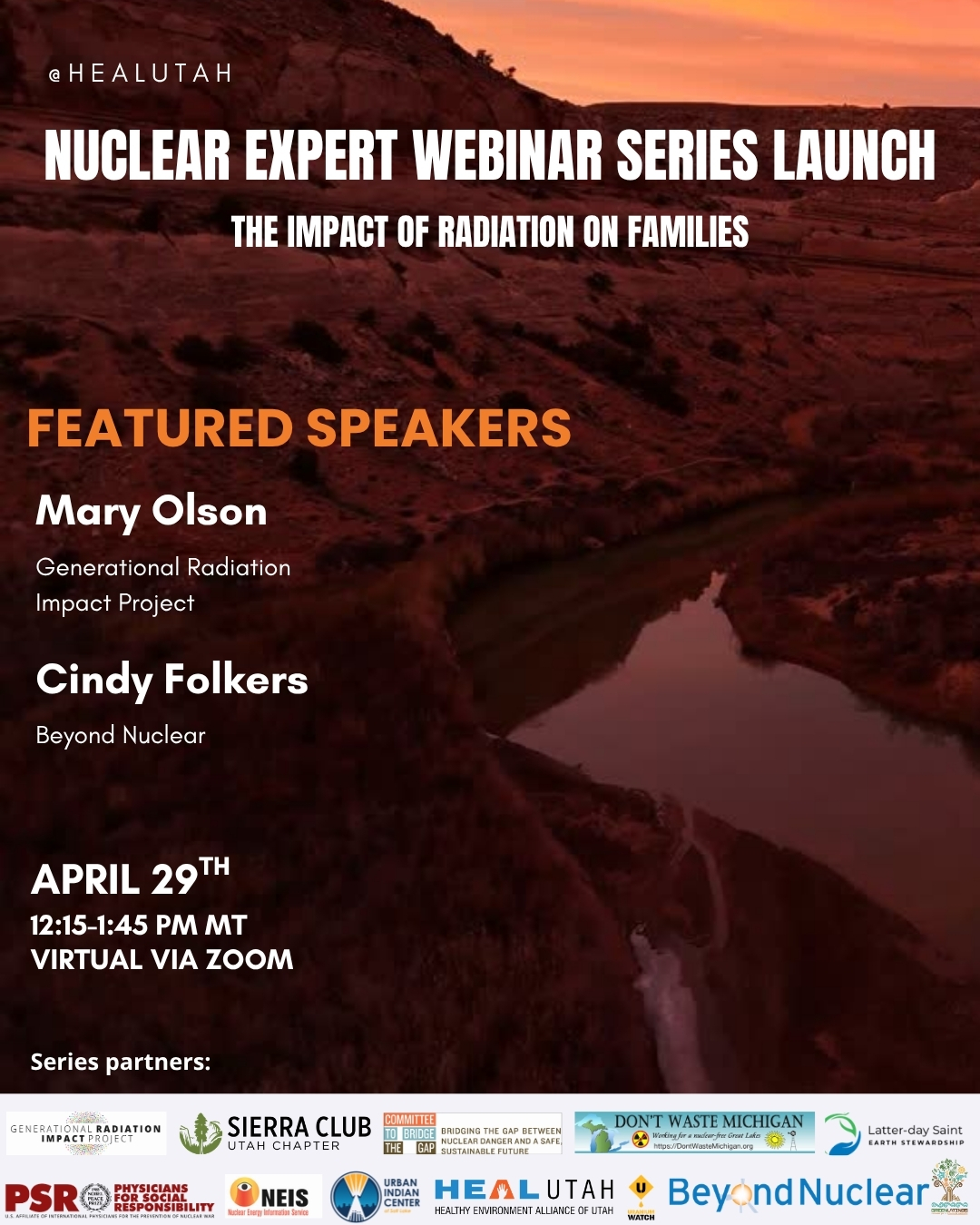
29 April – Nuclear Expert Webinar #1 – Radiation Impacts on Families with Mary Olson and Cindy Folkers
- 12:15 PM MT – 1:45 PM MT
- Location: Virtual – REGISTER TODAY

4 May -West Suburban Peace Coalition to discuss Iran war at May Educational Forum
Monday, May 4, 7:00 – 8:00 PM Central Standard Time
Title: : How Trump’s Narrative Tries to Shape the Reality of the War on Iran.
Contact Walt Zlotow, zlotow@hotmail.com 630 442 3045 for further information
14 May – online event From Bombs to Data Centres: the Face of Nuclear Colonialism

Pine Ridge Uranium is the real threat, not Tehran- Tell Burgum: Stop the Extraction.
Chernobyl: The Lost Tapes – A good documentary on Chernobyl on SBS available On Demand for the next 3 weeks– https://www.sbs.com.au/ondemand/tv-program/chernobyl-the-lost-tapes/2352741955560
To see nuclear-related stories in greater depth and intensity – go to https://nuclearinformation.wordpress.com
-
Archives
- May 2026 (12)
- April 2026 (356)
- March 2026 (251)
- February 2026 (268)
- January 2026 (308)
- December 2025 (358)
- November 2025 (359)
- October 2025 (376)
- September 2025 (257)
- August 2025 (319)
- July 2025 (230)
- June 2025 (348)
-
Categories
- 1
- 1 NUCLEAR ISSUES
- business and costs
- climate change
- culture and arts
- ENERGY
- environment
- health
- history
- indigenous issues
- Legal
- marketing of nuclear
- media
- opposition to nuclear
- PERSONAL STORIES
- politics
- politics international
- Religion and ethics
- safety
- secrets,lies and civil liberties
- spinbuster
- technology
- Uranium
- wastes
- weapons and war
- Women
- 2 WORLD
- ACTION
- AFRICA
- Atrocities
- AUSTRALIA
- Christina's notes
- Christina's themes
- culture and arts
- Events
- Fuk 2022
- Fuk 2023
- Fukushima 2017
- Fukushima 2018
- fukushima 2019
- Fukushima 2020
- Fukushima 2021
- general
- global warming
- Humour (God we need it)
- Nuclear
- RARE EARTHS
- Reference
- resources – print
- Resources -audiovicual
- Weekly Newsletter
- World
- World Nuclear
- YouTube
-
RSS
Entries RSS
Comments RSS
 nuclear-news