Plutonium secretly shipped to Nevada removed sooner than expected

By Gary Martin Las Vegas Review-Journal, September 16, 2022 –
WASHINGTON – A half-metric ton of weapons-grade plutonium secretly shipped into Nevada has been removed four years early under federal court order and an agreement reached by U.S. Sen. Catherine Cortez Masto and former Energy Secretary Rick Perry, officials said Friday.
Cortez Masto, D-Nev., first announced the removal of the plutonium, stored at the Nevada National Security Site north of Las Vegas.
She was notified by the National Nuclear Security Administration late Friday………………….
The NNSA shipped the plutonium from the Savannah River Site in South Carolina to Nevada in 2019 under federal court order.
Nevada officials, while notified it would happen, were incensed when efforts to stop the transfer through federal courts became moot after the Department of Energy disclosed the plutonium had already been shipped into the state.
Four years ahead of schedule
“When I heard that the Trump administration secretly shipped weapons-grade plutonium to our state, I acted immediately to ensure it was removed,” Cortez Masto said in a statement.
Cortez Masto also secured in writing a pledge by Perry not to send any more plutonium from South Carolina to Nevada.
“I’m proud to announce the removal has been completed four years ahead of schedule,” Cortez Masto said.
A federal judge ordered the Department of Energy to remove weapons grade plutonium from the Savannah River Site in South Carolina after a facility to turn the radioactive material into fuel for nuclear power plants was terminated.
Some of the material was sent to the Nevada facility, and some to the Pantex Plant in Texas until pits to accommodate the material at Los Alamos National Laboratory in New Mexico were completed, according to NNSA.
The material from Nevada now has been shipped to Los Alamos, a congressional aide confirmed.
Secret shipment from South Carolina draws ire
Former Gov. Brian Sandoval, a Republican, was furious that the Energy Department shipped the plutonium to Nevada when the state in May 2019 had notified the federal government of its intent to seek an injunction to prevent the transfer.
Sandoval directed then-state Attorney General Adam Laxalt to file a lawsuit in federal court in Reno to block the shipment.
But the lawsuit was dismissed after Energy Department lawyers in 2020 disclosed in court papers that the shipment had already occurred, making the state’s lawsuit moot.
Gov. Steve Sisolak and state Attorney General Aaron Ford, both Democrats, filed another lawsuit and won a ruling that would force the federal government to eventually remove the plutonium.
………. the danger of exposure to the materials prompted the federal judge to order the plutonium moved from South Carolina.
‘Beyond outrage’
The secret shipping of the plutonium, because of federal national security concerns, drew the ire of Nevada officials of both major political parties who accused Perry and the Energy Department of lying to the state about its intent…………………………….
The shipment heightened tensions between Nevada and the Trump administration, which also sought to open Yucca Mountain as a permanent nuclear waste repository, just 60 miles north of Las Vegas. https://www.reviewjournal.com/news/politics-and-government/plutonium-secretly-shipped-to-nevada-removed-sooner-than-expected-2641314/
General: Supply chain problems are hurting nuclear modernization
Defense News, By Joe Gould, 16 Sept 22,
WASHINGTON ― The nominee to lead the U.S. nuclear arsenal said Thursday that supply chain snags that are pummeling the defense industrial base are also hurting Washington’s plans to modernize its aging nuclear arsenal.
“I would venture to say that it’s probably being seen across the Department of Defense, but in particular for the nuclear portfolio,” Air Force Gen. Anthony Cotton, nominated to lead U.S. Strategic Command, told the Senate Armed Services Committee, at his confirmation hearing.
………… It’s taking some nuclear programs up to 90 days to source certain U.S.-made components that would have typically taken 10 days, he said.
Operating and modernizing the nuclear force will cost $634 billion in the 2021-2030 period, the nonpartisan Congressional Budget Office said last year. Along with the expense of the Energy Department managing nuclear stockpiles, the Defense Department is modernizing the sea, air and land-based legs of the nuclear triad.
………………………………………… Looming over the hearing was Strategic Command’s scramble to reimagine nuclear deterrence theory that simultaneously faces Russia and China……………………. more https://www.defensenews.com/pentagon/2022/09/15/general-supply-chain-problems-are-hurting-nuclear-modernization/
Lawmakers demand reparations for New Mexicans imperiled by nuclear bomb testing
Adrian Hedden, Carlsbad Current-Argus, 10 Sept 22,
When the U.S.’ first nuclear bomb was detonated in south-central New Mexico, it was believed to set off a chain of cancers and health problems suffered by the surrounding communities for generations.
People who grew up near the Trinity Test Site, near the remote communities of Carrizozo or Tularosa, were denied federal relief dollars afforded to other “downwinders” impacted by nuclear testing around the country.
Both towns were within 50 miles of the blast site, and advocates say they were exposed to radiation from the bomb testing.
They advocated for years that New Mexico’s downwinders be included in cash payments made to those affected by nuclear activities under the Radiation Exposure Compensation Act (RECA).
Members of the Tularosa Basin Downwinders Consortium advocated for such support from state lawmakers during a Tuesday meeting of the interim Radioactive and Hazardous Waste Committee.
“It’s very emotional to reflect on all we’ve lost as a result of being exposed to radiation,” said consortium founder Tina Cordova, herself a survivor of thyroid cancer who said members of her family also suffered from myriad forms of the disease.’
The committee, made up of state senators and representatives voted to send a letter to Congress, calling on the federal leaders to expand reparations to include New Mexicans…………………………..
Cordova pointed to high infant mortality rates and diseases among the people living near the site, which she said were the result of testing at the site.
She also pointed to economic depression in the rural community as its residents struggled for years with high medical bills Cordova attributed to the testing.
“We don’t have a chance in New Mexico to develop generational wealth,” Cordova said. “This has contributed greatly to the poverty we see here.”
Congress voted earlier this year to extend the RECA by two more years, via legislation introduced by U.S. Sen. Ben Ray Lujan (D-NM) and supported by the state’s entire congressional delegation and via a letter sent by the Radioactive and Hazardous Waste Committee.
But that legislation did not expand the compensation to include New Mexican downwinders, although it does give funds to some uranium miners mostly in the northern part of the state.
So far, downwinders were only federally recognized in parts of Arizona, Utah and Nevada attributed to activities at another nuclear test site in Nevada. ………………………. https://www.currentargus.com/story/news/2022/09/09/reparations-demanded-for-new-mexicans-imperiled-by-nuclear-bomb-testing/66874718007/
—
Mishandling of Classified Nuclear Documents Is Bad. Mishandling of the Sole Authority to Use Nuclear Weapons Would Be Much Worse.

Union of Concerned Scientists, Eryn MacDonald, 9 Sept 22, Headlines about the discovery of nuclear weapons-related materials in the trove of highly classified documents that former President Trump stashed at his private residence in Mar-a-Lago are not exactly confidence inspiring. The fact that a former president simply walked off with information at the highest levels of classification leaving it unguarded for more than a year should raise alarms for anyone who is concerned about national security.
But if you think it’s unbelievable that it was so easy to sidestep the safeguards and procedures in place to ensure that some of the most secret information known to our government was not packed up and stuck in a basement, I’ve got even worse news for you. Because the process to order the launch of US nuclear weapons has fewer safeguards and would require no sidestepping, leaving it even more vulnerable to the whims of an unstable leader. That decision is put in the hands of a single individual—the president—while the rest of us all just have to cross our fingers and hope that they take this responsibility more seriously than the former president took his responsibility to safeguard those classified documents.
The process that the United States has now for making decisions about the use of nuclear weapons is called “sole authority.” It is an outdated artifact of an earlier time that now carries more risks than benefits. ……………
sole authority intentionally includes no checks and balances. No requirement to consult with advisers or Congress. There is also no one with the legal authority to countermand the order if the president does decide to launch…….. And once missiles are launched, there is no going back—they cannot be called back or ordered to self-destruct.
The good news: we can fix it
Times have changed since the decision was made to give the president sole authority over the decision to launch a nuclear attack. Communications systems have improved immensely. And despite the deterioration of US-Russian relations, a surprise Russian nuclear attack on the US homeland is still not a realistic concern these days. And, the US now has a fleet of nuclear ballistic missile submarines that are essentially invulnerable when they are hidden on patrol in the ocean, rendering the need for split-second nuclear launch decisions obsolete.
Unfortunately, the nuclear launch decision-making system has not kept pace with the times. The good news, however, is that it would be an easy fix, that we could implement very quickly. There have been many suggestions of how this could be done, including a proposal by some of my colleagues at UCS.
The UCS proposal would require that the president obtain the consent of two other high-level officials in the presidential line of succession—for example, the vice president and the speaker of the House—to carry out any order to launch a nuclear attack. …………….
The time to change the system is now..…………………………….
We do not have the luxury of waiting for “lessons learned.” We must take the only opportunity we have to change this outdated, undemocratic, and dangerous system—now. Making this change permanent would require action from Congress, but that is no reason to delay the immediate steps that we can take. UCS and many others, including members of Congress, have already asked President Biden to change the decision-making procedures for using nuclear weapons.
You can join us in asking him to take his opportunity to do so, before it is too late.
https://allthingsnuclear.org/emacdonald/mishandling-of-classified-nuclear-documents/
Navy Seeks Solution for Decommissioned Nuclear Carrier USS Enterprise
SEP 9, 2022 BY THE MARITIME EXECUTIVE
The U.S Navy is grappling with a huge dilemma on what to do with the decommissioned USS Enterprise, the world’s first nuclear-powered aircraft carrier and the pride of the Navy for 50 years from her commissioning in 1961 to her deactivation in 2012. Officially decommissioned in 2017, she sits in Virginia costing millions of dollars annually in maintenance costs but could require more than a billion dollars and up to 15 years to safely dismantle.
Having been the embodiment of the U.S military might not only because of its sheer size, which earned her the nickname “Big E” she became the centerpiece of the modern Navy. ………………………………………… more https://maritime-executive.com/article/navy-seeks-solution-for-decommissioned-nuclear-carrier-uss-enterprise
Nuclear Waste: DOE Needs to Improve Transparency in Planning for Disposal of Certain Low-Level Waste
GAO-22-105636 Sep 29, 2022,
Fast Facts
The Department of Energy is responsible for disposing of certain low-level nuclear waste from medical equipment, metals in nuclear reactors, and cleanup sites. The Energy Policy Act of 2005 required DOE to assess the potential environmental effects of various disposal options. No legal options currently exist.
DOE’s assessments were extensive but didn’t give rationales for preferring certain disposal options. They also weren’t clear on the amount of waste that will need disposal—key information for decision makers.
We recommended ways to improve transparency. We also suggested that Congress consider addressing legal barriers to waste disposal……………………………………………….. more https://www.gao.gov/products/gao-22-105636
Trump’s Top-Secret Document Hoard Included Nuclear Weapons Data
William Rivers Pitt, Truthout, September 7, 2022
Donald Trump now has at least 19 attorneys defending him in eight or more investigations, according to Politico. If the revelations keep piling up, that number could double in about as much time as it takes a box of bunny rabbits to breed. Finding that help won’t be easy, either; this is an area of the law that isn’t lousy with specific experts, and the ones available have this thing about getting paid.
Plus, the latest development in the saga would have most lawyers running for the hills.
“A document describing a foreign government’s military defenses, including its nuclear capabilities, was found by FBI agents who searched former president Donald Trump’s Mar-a-Lago residence and private club last month,” reports The Washington Post. “Some of the seized documents detail top-secret U.S. operations so closely guarded that many senior national security officials are kept in the dark about them. Only the president, some members of his Cabinet or a near-Cabinet-level official could authorize other government officials to know details of these special-access programs.”………………
“A fortress mindset feeds the U.S. government’s huge ‘defense’ budget — which is higher than the military budgets of the next 10 countries combined — while the Pentagon maintains about 750 military bases overseas,” author and activist Norman Solomon writes for Truthout. “But victimology is among Washington’s official poses, in sync with a core belief that the United States is at the center of the world’s importance and must therefore police the world to the best of its capacity.”
The core nature of secrets is their importance, which is why they are usually so well guarded, and why this latest Trump debacle has so many people freaked. …………………………
Understand: No intelligence body on the planet would gladly grant top-secret access to a person like Donald Trump. He is the living embodiment of an easily compromised individual, a walking blackmail target with debts on his debts. The only reason he got his hands on all that stuff is because the country went berserk and made him president, and presidents are automatically gifted top-flight clearance by dint of electoral victory.
Yet he remains Donald Trump, the blowhard desperate to hide the small fraction of a man within.
Even being president of the United States wasn’t enough to assuage his insecurity, so, perhaps, he surrounded himself with boxes of secret documents that made him feel whatever passes for powerful in his shriveled little soul.
Who knows what country those nuke documents were describing. Israel? China? Russia? Does it even matter at this juncture? Thanks to a million profit-driven war decisions made over the last 80 years, we exist within a wildly delicate latticework of perils that are mostly left over from the Cold War. Not our fault, but all our problem. https://truthout.org/articles/trumps-top-secret-document-hoard-included-nuclear-weapons-data/?eType=EmailBlastContent&eId=df913dd0-f214-4843-a78f-46849632c0c5
WHAT HAPPENED AT CAMP LEJEUNE
I grew up drinking and bathing in the toxic waters around a military base in North Carolina. Thirty years later, I went back to investigate.
BY LORI LOU FRESHWATER, AUG 21, 2018
In the autumn of 1980, a contractor showed up to grade a parking lot. He had no idea he was about to start digging up the radioactive bodies of dead beagles. But the forked bucket on his bulldozer started pulling up more than soil, and it turned out he was digging in a pit of strontium-90 and dog carcasses that had been buried in an ash-gray tomb: a nest of dead dogs and laboratory waste labeled “Radioactive Poison.”
The new parking lot was on the site of the former Naval Research Laboratory dump and its associated incinerator in Camp Lejeune, North Carolina—and it was just one of many areas contaminated by an assortment of hazardous waste and chemicals on the base.
About half a mile away from the dump, soon to be known as Site 19, my friends and I were living in our neighborhood, called Paradise Point. We spent our time putting other girls’ bras into freezers at slumber parties, playing the Telephone Game, riding our bikes all over the place: to the golf course to steal a cart, to swim at the pool, to play soccer on Saturdays.
During the same autumn the dead beagles were found, I was sitting in front of a fake backdrop of rusty colored leaves, a slight 11-year-old girl with spaces between my teeth and freckles spritzed across my nose and cheeks, to take my school photo.
Under normal circumstances, this entirely unremarkable fifth-grade photo, in a plaid shirt and fragile gold necklace, would have likely ended up where most school photos do, in an old album or a drawer or simply lost to time. Instead, the photo would become a marker in the medical history of my family and my community, a reminder of the crime that was being committed on the day the photo was taken—and also for decades before, and for years after.
The place was Camp Lejeune, a United States Marine Corps base wrapped around the New River in Onslow County that served as an amphibious training base where Marines learned to be “the world’s best war fighters,” picking up skills that would allow them (for example) to make surprise landings on the shores of far away countries. From the 1950s until at least 1985, the drinking water was contaminated with toxic chemicals at levels 240 to 3400 times higher than what is permitted by safety standards.
There may never be a true accounting of the suffering caused at Lejeune. As with many other hometown environmental disasters, the Marines and family members poisoned on this military base were not born here, nor did they settle here to make a permanent life and raise their children. Instead, they were often here just for a short time, literally stationed at Lejeune for weeks, months, or, at most, a few years. From the 1950s through at least 1985, an undetermined number of of residents, including infants, children, and civilian workers and personnel, were exposed to trichloroethylene (TCE), tetrachloroethylene (PCE), vinyl chloride, and other contaminants in the drinking water at the Camp Lejeune. These exposures likely increased their risk of cancers, including renal cancer, multiple myeloma, leukemias, and more. It also likely increased their risk of adverse birth outcomes, along with other negative health effects. Now the sick and the dying are all over the world, and an untold number will never be notified about what happened. Instead, we are left to rely on scientific models and data trickling out of public-health agencies and the slow process of adding one story at a time, person-by-person, to the cold data representing an environmental and public-health disaster.
In 1989, the Environmental Protection Agency placed 236 square miles of North Carolina’s coastal soil and water on the list of toxic areas known as Superfund sites. The agency cited “contaminated groundwater, sediment, soil and surface water resulting from base operations and waste handling practices” as reasons for including it on the National Priorities List.
Camp Lejeune remains a sprawling Superfund site, and it is also the place where my mom and I spent years drinking a terrible mix of chemicals from our faucet. In the book A Trust Betrayed: The Untold Story of Camp Lejeune, author Mike Magner gives special attention to my mother’s story: “A woman with the ironic name of Mary Freshwater may have had the most ghastly experiences at Camp Lejeune.”
Of course, I share her ironic name, which can still seem like more of a curse. Nearly my entire childhood was consumed by tragedy. The chemical contamination can be linked to the deaths of my two baby brothers, Rusty and Charlie, and to my mom’s own difficult final years, when she was dying from two types of acute leukemia. My mother also suffered from mental illness, which was intensified—understandably—by our family’s brutal losses. Sometimes it seems that, behind me, there is nothing but inescapable grief. …………………..more https://psmag.com/.amp/environment/what-happened-at-camp-lejeune
City of Aiken provides will receive more than $168M in plutonium storage settlement
by: Dixie Dawson, Joey Gill, Aug 30, 2022 “………………………………… The community also got an update on plutonium settlement money. Aiken County will reportedly receive more than $168 million, or 30% of $525 million, from the federal government’s settlement with the state over plutonium storage.
“They secured 168-million-850-thousand dollars for projects through Aiken County from the South Carolina plutonium settlement funds,” said David Jameson, President and CEO of the Aiken Chamber of Commerce, “Aiken County citizens will benefit from the catalytic impact of your efforts to many, many years.”……………………… https://www.wjbf.com/news/aiken-county/city-of-aiken-provides-updates-on-city-will-receive-more-than-168m-in-plutonium-storage-settlement/
USA’s Inflation Reduction Act a tidy little bonanza for the nuclear industry

Nuclear Fuel for Advanced Reactors Spurred by Climate Bill Funds
https://news.bloomberglaw.com/environment-and-energy/nuclear-fuel-for-advanced-reactors-spurred-by-climate-bill-funds DEEP DIVE, Daniel Moore Aug. 29, 2022,
- Inflation Reduction Act includes $700 million for enrichment
- Energy Department still formulating plan for fuel supply
The Biden administration’s efforts to develop a more energy-dense nuclear fuel got a sudden $700 million windfall in the climate-and-tax bill signed into law this month, a boost for the agency’s plans to demonstrate two next-generation reactors before the end of the decade, energy officials and nuclear supporters said.
The funding—more than 15 times the program’s current annual appropriation—is a down payment for the Energy Department’s efforts to develop fuel supplies for advanced reactors, which are designed to be much smaller than the current fleet of nuclear plants………………..
Energy Secretary Jennifer Granholm told Congress in April the agency was “in final stages” of developing a HALEU strategy, which at that time had just $45 million appropriated by Congress for fiscal year 2022.
Mothers For Peace disappointed that California Governor supports ”lifeline” for Diablo Canyon nuclear power station
California’s governor seeks lifeline for last nuclear plant, Ft.com 29 Aug 22,
State confronts extreme weather and rising demand as it rids carbon from the electric grid
After nearly 40 years of protesting against the Diablo Canyon nuclear power plant, Linda Seeley thought victory was finally at hand. Seeley and other members of Mothers for Peace — an activist group with roots in the 1960s antiwar movement — cheered when Pacific Gas and Electric, the utility that operates California’s last nuclear power station, announced in 2016 that it would close by 2025.
But governor Gavin Newsom, a longtime proponent of shutting down the plant, has reversed course and embarked on a last-minute effort to extend its operation by a decade. Newsom’s administration has cited “unprecedented stress” on the state’s energy system as a reason for keeping open Diablo Canyon, which alone accounts for 9 per cent of the state’s generation and 17 per cent of its electricity from [ed so-called] carbon-free sources. The California legislature will need to vote on whether to extend its operating life by Wednesday.
Seeley, who lives 7 miles from the plant in San Luis Obispo County, is furious. “With this proposal, Gavin Newsom is keeping an asset that is antiquated, needs tons of upgrades [and] has a six-year history of deferred maintenance,” she said. “It would be unconscionable to allow the plant to go on operating without doing the due diligence needed to make sure the plant is safe enough to work.” Beyond those concerns, she said, are the issues that have kept her up at night for decades. Diablo Canyon’s coastal location sits on faultlines, prompting concerns that seismic activity could trigger a nuclear meltdown. The plant, Seeley said, “is precariously perched on the edge of the ocean in an earthquake zone”………………..
California is a leader in renewable generation, with a quarter of its electricity powered by solar and wind resources in 2021 compared to 12 per cent for the US as a whole. But problems in the supply chain and cost inflation threaten to impede their expansion, according to state officials. The state’s power system will hit a “critical inflection point after Diablo Canyon retires”, the California Independent System Operator (Caiso), which manages most of the state’s grid, warned in a filing last year…………………………….. https://www.ft.com/content/58dfc631-a415-4954-b845-c563c93c6ceb
Ukraine and the Politics of Permanent War
Permanent war requires permanent censorship.

Day and night, the drums of war never stop beating. Its goal: to keep billions of dollars flowing into the hands of the war industry and prevent the public from asking inconvenient questions.
Chris Hedges, 29 Aug 22. No one, including the most bullish supporters of Ukraine, expect the nation’s war with Russia to end soon. The fighting has been reduced to artillery duels across hundreds of miles of front lines and creeping advances and retreats. Ukraine, like Afghanistan, will bleed for a very long time. This is by design.
On August 24, the Biden administration announced yet another massive military aid package to Ukraine worth nearly $3 billion. It will take months, and in some cases years, for this military equipment to reach Ukraine. In another sign that Washington assumes the conflict will be a long war of attrition it will give a name to the U.S. military assistance mission in Ukraine and make it a separate command overseen by a two- or three-star general.
Since August 2021, Biden has approved more than $8 billion in weapons transfers from existing stockpiles, known as drawdowns, to be shipped to Ukraine, which do not require Congressional approval.
Including humanitarian assistance, replenishing depleting U.S. weapons stocks and expanding U.S. troop presence in Europe, Congress has approved over $53.6 billion ($13.6 billion in March and a further $40.1 billion in May) since Russia’s February 24 invasion.
War takes precedence over the most serious existential threats we face. The proposed budget for the Centers for Disease Control and Prevention (CDC) in fiscal year 2023 is $10.675 billion while the proposed budget for the Environmental Protection Agency (EPA) is $11.881 billion. Our approved assistance to Ukraine is more than twice these amounts.
The militarists who have waged permanent war costing trillions of dollars over the past two decades have invested heavily in controlling the public narrative. The enemy, whether Saddam Hussein or Vladimir Putin, is always the epitome of evil, the new Hitler. Those we support are always heroic defenders of liberty and democracy. Anyone who questions the righteousness of the cause is accused of being an agent of a foreign power and a traitor.
The mass media cravenly disseminates these binary absurdities in 24-hour news cycles. Its news celebrities and experts, universally drawn from the intelligence community and military, rarely deviate from the approved script. The mass media cravenly disseminates these binary absurdities in 24-hour news cycles. Its news celebrities and experts, universally drawn from the intelligence community and military, rarely deviate from the approved script. Day and night, the drums of war never stop beating. Its goal: to keep billions of dollars flowing into the hands of the war industry and prevent the public from asking inconvenient questions.
In the face of this barrage, no dissent is permitted. CBS News caved to pressure and retracted its documentary which charged that only 30 percent of arms shipped to Ukraine were making it to the front lines, with the rest siphoned off to the black market, a finding that was separately reported upon by U.S. journalist Lindsey Snell. CNN has acknowledged there is no oversight of weapons once they arrive in Ukraine, long considered the most corrupt country in Europe. According to a poll of executives responsible for tackling fraud, completed by Ernst & Young in 2018, Ukraine was ranked the ninth-most corrupt nation from 53 surveyed.
There is little ostensible reason for censoring critics of the war in Ukraine. The U.S. is not at war with Russia. No U.S. troops are fighting in Ukraine. Criticism of the war in Ukraine does not jeopardize our national security. There are no long-standing cultural and historical ties to Ukraine, as there are to Great Britain. But if permanent war, with potentially tenuous public support, is the primary objective, censorship makes sense.
War is the primary business of the U.S. empire and the bedrock of the U.S. economy. The two ruling political parties slavishly perpetuate permanent war,………………………………………………
An organization like NewsGuard, which has been rating what it says are trustworthy and untrustworthy sites based on their reporting on Ukraine, is one of the many indoctrination tools of the war industry. Sites that raise what are deemed “false” assertions about Ukraine, including that there was a U.S.-backed coup in 2014 and neo-Nazi forces are part of Ukraine’s military and power structure, are tagged as unreliable. Consortium News, Daily Kos, Mint Press and Grayzone have been given a red warning label. Sites that do not raise these issues, such as CNN, receive the “green” rating” for truth and credibility. (NewsGuard, after being heavily criticized for giving Fox News a green rating of approval in July revised its rating for Fox News and MSNBC, giving them red labels.)
The ratings are arbitrary. The Daily Caller, which published fake naked pictures of Alexandria Ocasio-Cortez, was given a green rating, along with a media outlet owned and operated by The Heritage Foundation. NewsGuard gives WikiLeaks a red label for “failing” to publish retractions despite admitting that all of the information WikiLeaks has published thus far is accurate. …………..
NewsGuard, established in 2018, “partners” with the State Department and the Pentagon, as well as corporations such as Microsoft. Its advisory board includes the former Director of the CIA and NSA, Gen. Michael Hayden; the first U.S. Homeland Security director Tom Ridge and Anders Fogh Rasmussen, a former secretary general of NATO………………………………
As the persecution of Julian Assange illustrates, the throttling of press freedom is bipartisan. This assault on truth leaves a population unmoored. It feeds wild conspiracy theories. It shreds the credibility of the ruling class. It empowers demagogues. It creates an information desert, one where truth and lies are indistinguishable. It frog-marches us towards tyranny. This censorship only serves the interests of the militarists who, as Karl Liebknecht reminded his fellow Germans in World War I, are the enemy within.
Bruce Gagnon Interview: An Objective Look at U.S. Foreign Policy

“Once weapons were manufactured to fight wars. Now wars are manufactured to sell weapons”.
BY JOHN RACHEL, 26 Aug 22,
Events continue to unfold at a quickening pace. Facing an alarming escalation in tensions around the world, we asked Bruce Gagnon for his most current thoughts.
Bruce Gagnon is the Coordinator of the Global Network Against Weapons & Nuclear Power in Space, and was a co-founder of the Global Network when it was created in 1992………………. He is currently an active member of Veterans for Peace.
……………Here is what Bruce had to say.
Q. We hear a lot of terms and acronyms bandied about. ‘Deep State’ … ‘MIC’ … ‘FIRE sector’ … ‘ruling elite’ … ‘oligarchy’ … ‘neocons’. Who actually defines and sets America’s geopolitical priorities and determines our foreign policy? Not “officially”. Not constitutionally. But de facto.
A. The banksters in London and Wall Street are the essential movers and shakers of US-UK-NATO foreign policy. The CIA is their primary arm of control. Add to them the burgeoning global military industrial complex and the political ‘mis-leaders’ they generously contribute to. The corporate controlled mainstream media are also accessories to the present day crimes. Together they add up to a formidable crew of what I call ‘pirates’ who are stealing the national treasures throughout the western capitalist world and using them to supress and colonize others across the Global South and here at home.
Q. We’ve had decades of international tensions. Recent developments have seen a sharp escalation in the potential for a major war. ……………….. war inevitable and peace impossible?
A. During the reign of George W. Bush in Washington, at the time of the US ‘shock and awe’ attack in Iraq, I was watching C-SPAN one evening. They introduced then Naval War College instructor Thomas Barnett (author of a book called ‘The Pentagon’s New Map’) and they announced that in the audience were hundreds of top-level Pentagon officers and CIA bigwigs. During his talk Barnett told the assembled that due to globalization of the world economy every nation would have a specific role to fill. In the US he said we won’t make ‘consumer products’ anymore because it was cheaper to send those jobs overseas. Our role in the US, Barnett said, would be ‘security export’. Thus it should be no surprise that the #1 industrial export product of the US today is weapons. When weapons are your #1 industrial export product, what is your ‘global marketing strategy’ for that product line?
Barnett (introduced as Rumsfeld’s ‘strategy guy’) also told the leading brass that the Pentagon would be endlessly fighting to take control of the ‘non-integrating gap’ around the globe – those parts of the world that were not submitting to the authority of corporate globalization. He instructed the audience to go and teach these ‘new concepts’ to those under their authority if they hoped to get promoted within the system in the years ahead.
For more than a year after this Barnett presentation I witnessed him being squired around Washington speaking to Republican and Democrat audiences on C-SPAN. It was evident to me that his ‘new doctrine’ was a bi-partisan plan. Since that time it has become quite clear that this is true as we now see the Democrats leading the proxy war on Russia – using Ukraine as the hammer in this dangerous and provocative attempt to force regime change in Moscow. Pelosi’s recent ill-fated trip to Taiwan also indicates the plan to force regime change in Beijing.
Imagine that Washington and its NATO allies, who limped out of Afghanistan after 20 years of brutal occupation there, are now planning for war with Russia and China. The absurdity is beyond imagination. It reveals much about their psychopathology.
As long as this reality persists then we will move from one war to another. Arundhati Roy says, “Once weapons were manufactured to fight wars. Now wars are manufactured to sell weapons”. She is right on the money…………………..
Q. Our leaders relentlessly talk about our “national interests” and our “national security”, warning that both are under constant assault. Yet, we spend more than the next nine countries combined on our military. Why does such colossal spending never seem to be enough?
A. When they talk about ‘national interests’ they are actually talking about the interests of the banksters. When they talk about ‘freedom’ they are talking about their freedom to steal the national wealth from nations with resources and the people around the world. Washington claims that Russia wants to re-create the former Soviet Union and take control of Europe. In 2022 Russia is spending $66 billion on their military. It is a defensive military to protect their vast border regions. The US this year is spending $800 billion plus. When you add up the hidden military spending in the other pots of gold – like the nuclear weapons spending inside the Department of Energy budget – the US total is around $1.2 trillion this year. They are robbing us blind and we keep handing over our hard-earned tax dollars. Why?………………………………………………….
- We need to convert the military industrial complex (the war machine) to build public mass transit systems, tidal power systems, solar, wind power and the like – all of which would create more jobs than weapons manufacturing does.
- We need to ban corporate funding of elections. We need to open up a multi-party system so that more voices can be heard by the voters.
- We need to end the massive poverty that exists (which will be worsening in the near future) by taxing the rich and corporations.
- Stop the massive corporate subsides – welfare for the rich.
- We need to close down the more than 800 US military bases around the world and cut the Pentagon budget by at least 80%.
- We only need a defensive military that protects our borders.
- Do all these things and we might have a chance if we don’t first perish from a red-hot nuclear war or climate crisis.We don’t have time to fool around.
- Folks need to get off their arses and speak out NOW. ………..
Biden Pledges Nearly $3 Billion To Ukraine In Largest U.S. Military Aid Package Yet

U.S. President Joe Biden has announced nearly $3 billion in new U.S. military aid for Kyiv as Ukraine marked its independence day six months after Russia invaded the country.
“On behalf of all Americans, I congratulate the people of Ukraine on their Independence Day,” Biden said in a statement on August 24.
“The United States of America is committed to supporting the people of Ukraine as they continue the fight to defend their sovereignty. As part of that commitment, I am proud to announce our biggest tranche of security assistance to date: approximately $2.98 billion of weapons and equipment to be provided through the Ukraine Security Assistance Initiative,” Biden said.
The financial package will allow Kyiv to obtain air-defense and artillery systems, ammunition, counter-unmanned aerial systems, and radars, the statement said…………….
Since Russia invaded Ukraine on February 24, the United States has provided $10.6 billion in military assistance to President Volodymyr Zelenskiy’s government.
On August 23, Germany said it will soon ship more than 500 million euros’ ($499.3 million) worth of weapons to Ukraine. https://www.rferl.org/a/biden-pledges-3-billion-military-aid-ukraine/32002639.html
All About Groundwater – Hanford part 2
In Part 1 we covered the basics of the Pacific Northwest National Laboratory report, Adaptive Site Management Strategies for the Hanford Central Plateau Groundwater, that outlines an innovative strategy to tackle the challenge of groundwater cleanup. In Part 2 we’ll cover the history of Hanford’s soil and groundwater contamination, current cleanup strategies, and the various challenges to cleaning up the soil and groundwater.
Hanford’s history of soil contamination
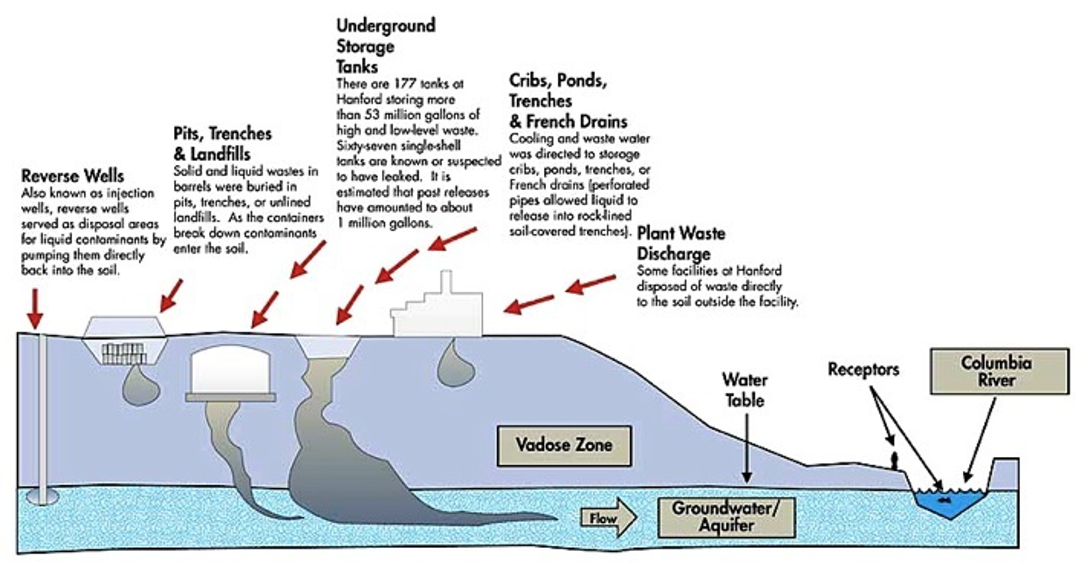
The Hanford Site has a history of dumping radioactive and chemical waste directly into the ground on site. About 450 billion gallons of nuclear and chemical waste were dumped directly into the soil during the plutonium production years—the equivalent of more than 680,000 Olympic-size swimming pools. Manhattan Project workers dumped waste in unlined cribs, ponds, ditches, and trenches—four different types of holes in the ground used for disposing of waste. Injection wells pumped the toxic waste directly into the soil to dispose of it.
Workers constructed 177 underground tanks (149 single-shell tanks and 28 double-shell tanks) to hold the most dangerous, high-level waste. However, the soil contamination didn’t stop there. These enormous underground tanks were connected in a row of three or four tanks. The Manhattan Project workers used a process called cascading—which allowed them to fill up one tank with waste, and while the waste solids settled to the bottom, the liquids would flow from one tank to another. If too much waste was added to the final tank, it would overflow to the soil. “From 1944 through the late 1980s, Hanford generated nearly 2 million cubic meters (525 million gallons) of high-level tank waste. Liquid evaporation, discharge to the ground, chemical treatment, and tank leakage reduced this volume by 90%—to 204,000 cubic meters (54 million gallons).”[1]
Cascading wasn’t the only way that waste reached the soil from the tanks. The tank farms were backfilled under an 8-to-10-foot layer of soil before waste was added. Workers built the single-shell tanks between 1943 and 1964. As their name suggests, they only have one liner of carbon steel to contain the waste. Sixty-seven single-shell tanks are known or suspected to have leaked 1 million gallons of waste into the surrounding soil. Two single-shell tanks—B-109 and T-111—are currently leaking. The single-shell tanks were designed to contain the waste for 20-25 years, and they are now more than 40 years past their design life. As these tanks get older and older, they are more likely to fail—causing the waste to leak out into the soil. Once the waste gets into the soil it may remain there—making it very hard to remove—or it may travel with water through the soil and reach the groundwater.
Current cleanup of the groundwater
Today, the soil at the Hanford Site (particularly in the Central Plateau) remains heavily contaminated. Some radioactive and chemical contaminants are more mobile in water, which means a rainstorm may cause those contaminants to move with the water through the soil—reaching the groundwater and ultimately the Columbia River.
One of the cleanup methods to prevent contaminants from spreading and reaching the groundwater is to remove contaminated soil by digging it up and disposing of it in the Environmental Restoration Disposal Facility. Hanford Challenge is concerned that USDOE will decide that it doesn’t need to dig up all of the contaminated soil and will leave it in place—which would increase the risk of harm to future generations.
USDOE implements specific strategies for cleaning up the groundwater. One of those strategies is pump and treat. Pump and treat is the process of pumping contaminated water to the surface, filtering out some of the contaminants, and injecting the water back into the ground. Monitoring wells, extraction wells, and injection wells are interspersed throughout the Hanford Site to implement the pump and treat process. There are six pump and treat facilities on site.
Soil flushing is one strategy used to enhance the pump and treat process. Some contaminants remain in the soil and may take a long time to reach the groundwater. Until the contaminants hit the groundwater, they are impossible to capture with the pump and treat system. Soil flushing speeds up the process by using 225 gallons of water per minute to force—or flush—these hard-to-reach contaminants down to the groundwater where they can be brought up to the surface with the pump and treat system. USDOE has found success using soil flushing to push hexavalent chromium to the groundwater to treat it.
An additional strategy for meeting water quality standards is monitored natural attenuation. Contamination is left to naturally attenuate, which means letting the radiation decay over time. It sounds like a do-nothing approach, and it basically is.
Challenges to groundwater cleanup
USDOE faces many challenges when pursuing groundwater cleanup. As previously mentioned, there are hundreds of contaminated soil sites at Hanford due to past dumping practices and leaking underground tanks. The extent of groundwater contamination is vast.
- There are significant data gaps regarding the number of contaminants in the vadose zone (the area of soil between the ground surface and the water table), the depth and location of the contamination, and the risk the contamination poses to groundwater.
- Some hard-to-control, persistent contaminants, such as technetium-99, iodine-129, uranium, nitrate, and chromium, are located in the deep vadose zone and pose a long-term risk to the groundwater.
- There are extensive groundwater plumes with intermixed contaminants (or contaminants located together), making it difficult to accurately measure the total amount in the aquifer and the contaminant distribution.
Depending on the contaminant, one specific treatment may work better than another. When contaminants are intermixed, the treatment process becomes more complex. Multiple technologies used in tandem or various treatment methods may need to be used to effectively treat intermixed contaminants.- The soil underneath the tank farms is contaminated by tank leaks, accidental spills, and intentional releases, which creates an additional pathway for contaminants in the soil to reach groundwater. As tanks leak—potentially more frequently—they become an additional complexity in groundwater cleanup.
- A borehole is a circular hole drilled into soil or rock that draws samples from deep below ground. USDOE uses boreholes to characterize, or identify, the physical and chemical properties of the contaminants in the vadose zone. Unfortunately, deep borehole characterization is limited in certain areas due to the high price of drilling—contributing to the lack of information regarding the amount, location, and strength of contaminants in the soil.
Geological challenges to groundwater cleanup
Hanford’s geology poses unique challenges to groundwater cleanup. Manhattan Project managers chose the site partially for its geology and proximity to the Columbia River. The reprocessing facilities were sited in certain areas at Hanford because the gravelly soil allowed them to dump waste into the ground, where it percolated down and vanished without a trace. It was a handy way of disposing of the waste—it just disappeared—but the dumped waste now requires a complicated cleanup strategy.
The 200 Area in the Central Plateau contains a high hydraulic conductivity zone that consists of porous soils and rocks that allow contaminants to quickly move through the soil to groundwater and eventually to the Columbia River. USDOE doesn’t know the exact size and location of the hydraulic conductivity zone in the 200 Area, which means that the underground movement of liquids between the Central Plateau and the Columbia River is still an area of considerable uncertainty. On the other hand, some places at Hanford’s Central Plateau have less permeable soils that trap specific contaminants, making it difficult to separate the contaminants from the soil and treat them using the most common cleanup strategies.
Ancient lake beds are hidden underneath the surface and cause contaminants to move laterally (horizontally) instead of vertically down to the groundwater. Lake beds cause contaminants to take longer to reach the groundwater because they aren’t taking the most direct route straight down, and are instead moving sideways. USDOE uses models to predict when specific contaminants will reach groundwater. USDOE bases its models on the assumption that contaminants move vertically to the groundwater. However, ancient lake beds and the lateral flow of contaminants challenge that assumption and highlight the need for USDOE to update its models to better account for the geologic conditions underneath the site.
Perched water also complicates groundwater cleanup. Imagine a bird’s nest that is perched or sitting in a tree. Now, imagine that bird’s nest perched in a tree underground and filled with water. As contaminants move through the soil they can get caught and trapped in that underground bird’s nest. The underground nest creates a pocket of contaminants that is hidden and hard to reach. USDOE is aware of several contaminated perched water areas at Hanford, but lacks information about the size, what contaminants they hold, and how full the perched water areas are. USDOE must incorporate perched water areas into its strategies to ensure a comprehensive cleanup plan for groundwater.
Groundwater cleanup at Hanford is incredibly complex due to the history of waste disposal, the inherently dangerous nature of the contaminants, and the challenges created by the site’s geology. Hanford Challenge urges USDOE to update its groundwater models to include the intricacies of Hanford’s geology, such as ancient lake beds and perched water. Hanford Challenge also encourages USDOE to recognize, investigate, and resolve the uncertainties present in groundwater cleanup.
If you are interested in learning more about Hanford’s geology, check out Tim Connor’s presentation on the cataclysmic floods that shaped the Hanford Site and Vince Panesko’s presentation on the ancient lake beds that impact cleanup.
This blog post is funded through a Public Participation Grant from the Washington State Department of Ecology. The content was reviewed for grant consistency, but is not necessarily endorsed by the agency.
[1] Gephart, Roy. E. (2003). A Short History of Hanford Waste Generation, Storage, and Release. Pacific Northwest National Laboratory, PNNL-13605.
1 This Month





PLEASE OPPOSE HR 8255 AND S.3639 – bills would accelerate satellite deployment, with no environmental review or safeguards – https://ncstd5li.quorum.us/campaign/169331/
To see nuclear-related stories in greater depth and intensity – go to https://nuclearinformation.wordpress.com
-
Archives
- October 2026 (81)
- September 2026 (339)
- August 2026 (330)
- July 2026 (355)
- June 2026 (287)
- May 2026 (306)
- April 2026 (356)
- March 2026 (251)
- February 2026 (267)
- January 2026 (308)
- December 2025 (358)
- November 2025 (359)
-
Categories
- 1
- 1 NUCLEAR ISSUES
- business and costs
- climate change
- culture and arts
- ENERGY
- environment
- health
- history
- indigenous issues
- Legal
- marketing of nuclear
- media
- opposition to nuclear
- PERSONAL STORIES
- politics
- politics international
- Religion and ethics
- safety
- secrets,lies and civil liberties
- spinbuster
- technology
- Uranium
- wastes
- weapons and war
- Women
- 2 WORLD
- ACTION
- AFRICA
- Atrocities
- AUSTRALIA
- Christina's notes
- Christina's themes
- culture and arts
- Events
- Fuk 2022
- Fuk 2023
- Fukushima 2017
- Fukushima 2018
- fukushima 2019
- Fukushima 2020
- Fukushima 2021
- general
- global warming
- Humour (God we need it)
- Nuclear
- RARE EARTHS
- Reference
- resources – print
- Resources -audiovicual
- Weekly Newsletter
- World
- World Nuclear
- YouTube
-
RSS
Entries RSS
Comments RSS

