How safe are nuclear power plants?
A new history reveals that federal
regulators consistently assured Americans that the risks of a massive
accident were “vanishingly small”—even when they knew they had
insufficient evidence to prove it.
Thomas Wellock, formerly a professor at
Central Washington University, became the historian of the U.S. Nuclear
Regulatory Commission (N.R.C.) more than a decade ago. He brought chops to
the job—training in engineering, experience testing nuclear reactors, and
a Ph.D. in history from Berkeley—and, in March of 2021, published the
sixth in a series of authorized volumes about how the agency, and its
predecessor, the U.S. Atomic Energy Commission (A.E.C.), has regulated
civilian nuclear power.
“Safe Enough? A History of Nuclear Power and
Accident Risk” is a refreshingly candid account of how the government,
from the nineteen-forties onward, approached the bottom-line question posed
in the book’s title. Technically astute insiders at the A.E.C. took it
for granted that “catastrophic accidents” were possible; the key
question was: What were the chances? The long and the short of it,
Wellock’s book suggests, is that, while many officials believed the
chances were very low, nobody really knew for sure how low they were or
could prove it scientifically.
Even as plants were being built, the numbers
used by officials to describe the likelihood of an accident were based on
“expert guesswork or calculations that often produced absurd results,”
he writes. The “guesswork” nature of such analysis was never candidly
acknowledged to either the public or the agency’s licensing boards, which
had the legal responsibility of determining that individual plants all
around the country were safe enough to be approved for operation.
New Yorker 13th Aug 2022
https://www.newyorker.com/science/elements/how-safe-are-nuclear-power-plants
President Biden’s new weapons package for Ukraine is the largest one yet, Pentagon says

President Biden has sent $9.8 billion in security aid to Ukraine since entering office, https://www.foxnews.com/politics/president-bidens-new-weapons-package-ukraine-largest-yet-pentagon By Anders Hagstrom | Fox News 10 Aug 22
The Pentagon unveiled its latest $1 billion weapons package to support Ukraine against Russia’s invasion on Monday.
The Department of Defense says the massive delivery is the largest weapons package the U.S. has sent to Ukraine under President Joe Biden’s administration. The U.S. has sent a total of $9.8 billion in security assistance for Ukraine since Biden gained office, far eclipsing the $2 billion the U.S. sent between 2014 and 2021.
“To meet Ukraine’s evolving battlefield requirements, the United States will continue to work with its Allies and partners to provide Ukraine with key capabilities calibrated to make a difference,” the Pentagon wrote in a statement.
Archbishop Wester apologizes for harms caused by nuclear weapons industry
Catholic News Service, August 10, 2022
A New Mexico archbishop whose archdiocese is home to two major federal nuclear weapons research facilities and an Air Force base apologized for the atomic bombings of Japan and to Indigenous New Mexicans, uranium miners and scientists suffering from ill health related to the nuclear weapons industry.
Archbishop John C. Wester of Santa Fe said the time has come for the world to fervently work to undertake the long process to achieve nuclear disarmament.
He made the comments in a homily during a Mass Aug. 9 marking the 77th anniversary of the bombing of Nagasaki, Japan…………………..
He called on American and Japanese people to “drive the international will to ensure that nuclear weapons are never used again.”
The appeal follows the January release of his pastoral letter, “Living in the Light of Christ’s Peace: A Conversation Toward Nuclear Disarmament.” In it, he invited people in New Mexico in particular, but around the world as well to begin conversations on how to end the nuclear threat facing the planet.
Archbishop Wester said he believes the Santa Fe Archdiocese must lead the call for nuclear disarmament because it is where the Los Alamos and Sandia national laboratories are located. The labs conducts high-level weapons research and development.
The archbishop’s apology extended to other communities of people affected by research, development and manufacturing of nuclear weapons:
— Residents of the Marshall Islands in the Pacific, where dozens of nuclear explosion tests were conducted from 1946 to 1958, drenching atolls with radiation.
— Native American communities in the Tularosa Basin of southeastern New Mexico near wear the first above-ground nuclear explosion was conducted.
— The 7,700 scientists and other lab workers who have filed claims with the government for serious illnesses linked to their work.
He called Tularosa Basin residents the “first nuclear victims.”
Radioactive fallout from the first atomic test explosion July 16, 1945, blanketed the basin. Residents have experienced high rates of cancer, including rare forms of the disease, according to numerous studies by health experts.
Archbishop Wester recognized the work of several members of Catholic parishes in the affected area who have seen family members die from cancer. He also pointed to their work for “just compensation” from the federal government for survivors and their families through the Tularosa Basin Downwinders Consortium.
He also lamented plans by the federal government to spend up to $2 trillion over the next 30 years to modernize weapons and build new missiles, submarines and bombers to deliver them.
“This is nuclear weapons forever,” he said. “We are in a new nuclear arms race that is arguably more dangerous than the first.”………………………….
A Buddhist, Roshi Joan Halifax, founder of the Upaya Zen Center in Santa Fe, urged people to understand human suffering and to strive for “being peace” in the world.
She also encouraged each person to expand their “moral circle” and “practice radical inclusion” of all life on earth to understand the imperative of acting to eliminate nuclear weapons.
https://catholicnews.com/archbishop-wester-apologizes-for-harms-caused-by-nuclear-weapons-industry/—
“Shell” companies purchase radioactive materials, prompting push for nuclear licensing reform

Defense News, By Bryant Harris, 10 Aug 22,
WASHINGTON – Late last year, government employees forged a copy of a license to buy hazardous, radioactive material. They created shell companies, then placed orders, generated invoices and paid two U.S.-based vendors.
The scheme worked. The employees successfully had the material shipped, complete with radioactive stickers on the side, then confirmed delivery.
But the workers were actually investigators from the Government Accountability Office, the congressional watchdog, and they were testing the Nuclear Regulatory Commission’s ability to regulate the sale and procurement of dangerous materials.
The act, and a subsequent report from the GAO, alarmed Rep. Ritchie Torres, D-N.Y., who is now calling on the Nuclear Regulatory Commission to overhaul its licensing system as a way to avoid a national security disaster.
“Anyone could open a shell company with a fraudulent license to obtain dangerous amounts of radioactive material that could be weaponized into a dirty bomb,” Torres told Defense News in an interview on Wednesday. “Disperse radioactive material in a city as densely populated as New York, and it could cause catastrophic damage.”
The commission classifies radioactive material into five categories of risk. Only categories one and two currently are subject to its independent license verification system – a loophole that Torres and the GAO fear that an individual or group could exploit to wreak havoc by building a dirty bomb that combines combines conventional explosives with category three radioactive materials.
Torres, who sits on the House Homeland Security Committee, is pressing the NRC to immediately expand its independent license verification system to include category three quantities of radioactive materials. He formally made the licensing overhaul request in a letter seen by Defense News on Wednesday. This request is in line with the GAO’s recommendations in what Torres called an “alarming report.”………………………
more https://www.defensenews.com/congress/2022/08/10/shell-companies-purchase-radioactive-materials-prompting-push-for-nuclear-licensing-reform/
The United States, in decline but still able to kill us all
The march of folly in American strategic policy has enshrined the madness of control by a giant defence industry and defence budget now past $800 billion.

The fiercely presented wearisome trope of commitment to a Rules Based International Order is quite suddenly unmasked as an American Establishment desire to maintain a unipolar control of the world, with violence.
The fiercely presented wearisome trope of commitment to a Rules Based International Order is quite suddenly unmasked as an American Establishment desire to maintain a unipolar control of the world, with violence.
The global dominance of the United States, in so many fields, from space, to science, to entertainment, to sport, to novelty in the development of the English language, has been taken for granted, is part of our fabric of Australian existence.
Reinforced by the Covid Era of Isolation, Netflix, Facebook, and Computer Games and inability even to get to Bali or Thailand let alone China, we are now in a noisy metal barrel where even dissident voices seem projections from the dissident voices of the US, similarly muted and squeezed. At a time when the US and its roles in the world are suddenly dramatically changing.
The undoing of the United States, the collapse of the imperial centre, is happening with little awareness in Australia. Our generally oblivious mindframes affect the capacity of political leaders to reflect upon or point to core problems of our world. Richard Adams, the author of Watership Down, that great rabbit adventure full of meaning for human society, coined the rabbit language word ‘tharn’ for the mental state of rabbits caught in the headlights and stuck. We are a tharn nation, gabbling about entertainments and irritations, eyes glued to the seatback monitor, not wanting to know that the plane is crashing.
Heed these markers:
- The Americans were first to the moon, but NASA after the retirement of the space shuttle has depended on Russian rockets to get to their joint space station. The Russians are now planning to remove the propulsion units of the station which keep it from crashing, their property, for use on a bigger new venture. America is losing in space, though US private business has appallingly taken the lead in cluttering near space with junk.
- The fiercely presented wearisome trope of commitment to a Rules Based International Order is quite suddenly unmasked as an American Establishment desire to maintain a unipolar control of the world, with violence. This is being unmasked in much of the world if not NATO and AUKUS and the conservative acolytes in Japan and ROK. Ideological assertions of democracy versus autocracy, built by vilification and isolation of China and Russia, is rotting from the head as big democracies are in serious trouble.
- We are doing OK in Australia, our minds from age 12 filled with bubblegum flavoured vape and Tiktok, graduating to Facebook and the metaverse, and with a newer, kinder, kinda-tealish government we can all go to sleep, take off our masks and order American franchised fast food. Or real Aussie drinks. But while we have had a narrow focus on bad boys in the SAS we fail to review our complicity in the great crimes of the twenty first century, led by champions of democracy, smashing the lives of people in a number of countries far more violently than has the Ukraine war so far. Biden and his Secretary of State were advocates for invasions of Afghanistan and Iraq, so appallingly bringing down bad governments and making countries ungovernable. Creating Al Qaeda and ISIS in the process, directly through funding and arming extremists (in Afghanistan beginning before the Russians were invited into Afghanistan) and via embitterment of ordinary people. The world is destabilised, American control is widely undone.
- The march of folly in American strategic policy has enshrined the madness of control by a giant defence industry and defence budget now past $800 billion. Poverty of foreign policy has led to regimes of sanctions which have been substantially shaped by Richard Nephew whose book reveals that far from focusing on potentates and oligarchs, the targets of sanctions must be ordinary people and the purpose is to inflict pain and weaken resolve (his words). Consider sanctions related deaths in Iraq Venezuela Cuba, Afghanistan Pain but no loss of resolve, hatred not submission. The US official study of the effects of strategic bombing on Germany in World War II by J K Galbraith and others long ago suggested morale and resolve were increased by the bombing of cities and civilians. And yet we have the ongoing commitment to defend and achieve democracy by mass murder, with constant focus on disruption, regime change, and violence… not on peace.
- Jeffrey Sachs has recently returned to the themes of his 2013 book on the 50th anniversary of President John Kennedy’s Commencement Speech at American University in 1963. Speaking in the aftermath of the Cuban Missile Crisis, Kennedy spoke of peace not as an event or a state but a constant process of engagement. We now have no such thing, we are in an Age of Hostility, Meanness, Folly, and Decay.right wing is fervently in support. Stanley Kubrick made a movie about such madness, we are sleeping through it.
Australia recognises, as does the United States, that Taiwan is part of China. Though the media vague up the history, China kicked the Portuguese and Dutch out of Taiwan early in the 1600s, long before the greatest land grab in history, of Britain over the Australian continent, could even be imagined as the British didn’t know it was there then. The government in Taipei is the Government of the Republic of China. The large opposition party in the National Assembly is the Kuomintang, ruling party of the government of the Republic of China that lost the revolutionary war on the mainland in 1949 and retreated to Taiwan. The ROC held the China seat in the UN until 1971 with American backing. The majority of local governments in Taiwan are governed by the KMT because the party of the national government is on the nose both because of its independence-advocating foreign policy and corruption allegations. Pelosi’s visit risks great power war as not seen since 1945. The American right wing is fervently in support. Stanley Kubrick made a movie about such madness, we are sleeping through it.
The US economy is in serious trouble………………………………….
The US campaign for unipolar dominance has included partly fabricated propaganda against China and Russia. This no longer convinces or concerns a wide sweep of the world beyond NATO, the G7, the EU and AUKUS. Mix in enough lies and it all seems lies.
The summit meeting of BRICS in June seemed a more constructive meeting than the G7. The countries of Eurasia also have the Shanghai Cooperation Organisation SCO. The Iran,Russia, Turkey summit meeting in Tehran in July 2022 seems to have been more successful than President Biden’s visit to Saudi Arabia to meet also other Arab leaders, a visit described by the Wall Street Journal as worse than an embarrassment,…………………………..more https://johnmenadue.com/the-united-states-in-decline-but-still-able-to-kill-us-all/
New Mexico’s ’s nuclear waste dump could be open ‘forever’ despite 2024 closure date.
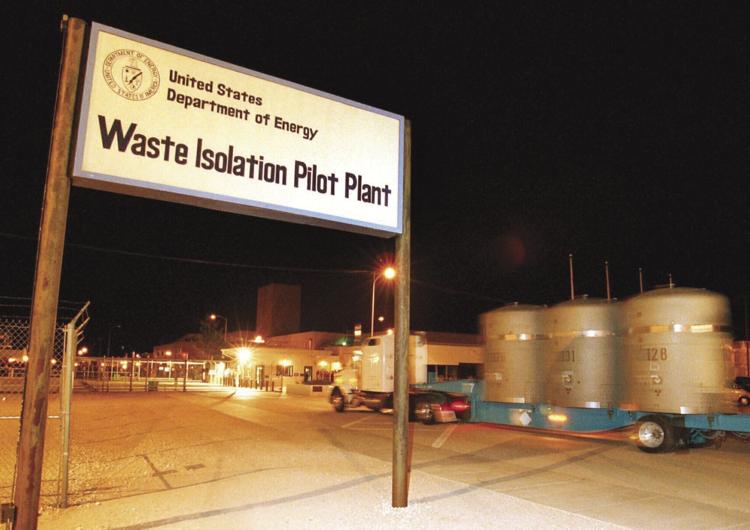
WIPP leaders also want approval for plan to increase waste storage
Source NM, BY: PATRICK LOHMANN – AUGUST 8, 2022
Shipments of nuclear waste to the nation’s only deep geological repository for the hazardous material show no signs of slowing in the coming years, despite the current permit calling for the plant to begin closing in 2024.
The future of shipments to the Waste Isolation Pilot Plant east of Carlsbad was the subject of debate and scrutiny during a meeting among a state legislative committee Friday in Clovis. The site stores waste like clothing, rags, soils and tools contaminated with radioactive elements due to nuclear weapons research and assembly in places like Los Alamos National Laboratory and Idaho National Laboratory.
WIPP leaders are seeking renewal of the 10-year permit that allows the site to continue receiving shipments, plus the state’s approval of an expansion of the plant to store more waste.
But advocates closely watching the plant for decades say such approval could open the door to an unending stream of radioactive waste transported across the country into New Mexico.
So far this fiscal year, WIPP has received 190 shipments. The material arrives from about 10 sites across the country, shipped in large drums on semi-trailers along state roads and interstates. The site has received more than 13,000 such shipments since 1999. When the waste arrives, and if it meets meets WIPP’s safety standards, the material is “emplaced” for permanent disposal in one of eight large panels a half-mile below ground that are sealed when full.
The 1990 federal law that allowed WIPP to be created and an agreement between the state of New Mexico and United States Department of Energy permits the site to permanently hold up to 175,000 cubic meters of the waste.
But WIPP needs more space to fulfill that mission, said Reinhard Knerr, manager of the DOE Carlsbad Field Office. Six of the eight panels are sealed, despite the facility having only disposed of 40% of the 175,000 cubic meters it can receive. …………………………………..
But Don Hancock, who runs the nuclear waste program at the Southwest Research and Information Center, said WIPP leaders are seeking to abandon the principles set out when WIPP began. He also fears the DOE is trying to prime the site to become the nation’s only recipient of this kind of radioactive waste for years to come.
Hancock testified Friday that WIPP was meant to be a site that would permanently dispose of waste only until new repositories would be opened up across the country. The legislation creating WIPP says it would store “up to” 175,000 cubic meters, he noted, and he said lawmakers at the time fully expected that the site could be decommissioned without being filled completely.
But instead, other potential sites across America have been identified but not opened in the intervening years, Hancock said, and an official told him recently at a public meeting that the DOE currently had “no plan” for a waste repository elsewhere.
“WIPP is the only repository. It was supposed to be the first, but not only. Other repositories are necessary for legal reasons, agreements with the state of New Mexico, technical reasons,” Hancock told lawmakers. “But now the Department of Energy is saying they have no plan for any other… waste repository.”
Hancock said the state should use its role to push the Department of Energy to open up other sites elsewhere and should push for specific closure dates when the permit comes up for renewal. He also is asking the state Legislature to push for more transparency from the DOE and more public involvement.
The state is hoping to have a revised permit for WIPP by May of 2023, a state official told the panel.
Hancock said the DOE has no longer even offered a potential closure date for WIPP in any of its recent permit applications. That’s another tell, he said, that shows the DOE no longer has any interest in finding an alternative to WIPP.
The New Mexico Environment Department recently asked the feds to provide a potential closure date. The DOE said it could take as long as 2083 for WIPP to dispose of all current and projected waste being produced across the country.
Hancock, speaking to Source New Mexico after the meeting, said the fact that DOE is being coy about the eventual closure of WIPP should concern generations of New Mexicans.
“When you’re supposed to be from 1999 to 2024 and are now say 1999 to 2083, that looks like forever,” he said. “Because if you go 60 years more, why are you not going to say again, ‘Oh, well, we don’t have any other place. So guess what?’”………………….
A 2020 analysis by the National Academies of Sciences found that all waste that has been generated or is planned to be, will exceed WIPP’s legal capacity by at least 10%. That’s another issue the DOE has not responded to publicly, Hancock said.
The bi-partisan legislative committee, made up of state senators and representatives, ultimately voted to send a letter to the Department of Energy asking questions about shipments and seeking more transparency. https://sourcenm.com/2022/08/08/nms-nuclear-waste-site-could-be-open-forever-despite-2024-closure-date-advocate-warns/
Yucca licensing a waste of money and won’t solve nuclear waste issues

What stands in the way of a solution to the high-level nuclear waste
problem in the U.S.? Answer: Yucca Mountain. For 35 years Nevadans have
fought to keep the federal government and commercial nuclear industry from
putting waste in a place that cannot safely contain it.
The only sensible action for Congress to take regarding Yucca Mountain is to end the project
officially. Once Congress does that, the nation can finally move on with a
new commitment to establish a safe and acceptable nuclear waste management
and disposal policy.
In 1987, Congress designated Yucca Mountain as the
sole site to be studied to become the nation’s high-level nuclear waste
repository. Over the strong objections of a majority of Nevadans,
investigations began. After 20 years of conflicting scientific discoveries
and opinions, opposition continued to grow.
In 2008, the Department of
Energy (DOE) submitted a license application to the Nuclear Regulatory
Commission (NRC) for a construction authorization to begin to build a
repository. The next year saw nearly 300 contentions (contentions are
specific arguments by parties opposing a license) submitted by 17 parties
— including the state of Nevada — raising red flags about the safety
and sustainability of the project. Before the project could move forward,
each contention would have to be adjudicated with evidence and witnesses
presented.
With years of litigation on the horizon and Nevada’s federal
delegation finding growing support against Yucca Mountain in Washington, in
2010, the DOE informed the NRC that it was withdrawing the license
application. There was a court challenge that concluded the application
could not be withdrawn, requiring the process to continue if there was
funding available to do so. For the past 12 years there has been no federal
money allocated for Yucca Mountain, so the project lingers.
Las Vegas Sun 7th Aug 2022
https://lasvegassun.com/news/2022/aug/07/yucca-mountain-licensing-is-a-waste-of-money-and-w/
Chinese expert from Peace Centre points out America’s hypocrisy, double standards, on Nuclear Non Proliferation

the US, which has the largest and most advanced nuclear arsenal, plans to spend over $1 trillion to maintain and modernize its nuclear triad. Furthermore, Washington withdrew from the Anti-Ballistic Missile and the Intermediate-Range Nuclear Forces treaties successively. President Joe Biden stepped back from a campaign promise that the sole purpose of nuclear weapons should be to deter nuclear attacks. All these moves may result in nuclear proliferation globally.
under AUKUS, the US and the UK are anticipated to assist Australia to have nuclear-powered submarines, which has severely violated the principles of the NPT.
Root of the grave, urgent nuclear proliferation situation lies in US.
https://www.globaltimes.cn/page/202208/1272415.shtml By Global Times, Aug 07, 2022With the 10th Review Conference of the Parties to the Treaty on the Non-Proliferation of Nuclear Weapons (NPT) being held at the United Nations headquarters in New York from August 1 to 26, the issue of nuclear non-proliferation has once again become the focus of global attention.
Washington today doesn’t let go of any occasion that can be exploited to smear and contain China. A US representative on Thursday at the NPT Review Conference baselessly criticized China for accelerating the expansion of its nuclear arsenal. And the US side also accused China of not engaging in talks on new arms control framework. China has lashed out at the rhetoric.
“By making such groundless accusations, Washington wants to deflect blame, distract attention and shun US’ due responsibility in securing global nuclear safety. Washington hopes this way can constrain the improvement of its main competitor’s nuclear capabilities,” Su Hao, founding director of the Center for Strategic and Peace Studies at the China Foreign Affairs University, told the Global Times.
China has always kept the quantity and size of its armed forces at the minimum level necessary for maintaining national security. China’s nuclear strategy focuses on self-defense, and aims to ensure the strategic security of the country by deterring the potential threat or use of nuclear weapons by others against China. And China has never taken part and will never take part in any nuclear arms race. Washington’s rhetoric is totally irrational.
In fact, the country that has blatantly violated the nuclear non-proliferation agreement is the US. Chinese Ambassador for Disarmament Affairs Li Song on Friday blasted the US for its negative moves on disarmament. He told a committee meeting of 10th NPT Review Conference that Driven by the Cold War mentality, the US has been obsessed with major-power strategic competition and has sought absolute strategic advantage, strengthened military alliances, stirred up bloc confrontation on the eastern and western sides of the Eurasia continent, and pressed ahead with the forward deployment of nuclear missiles and other strategic forces.
The landscape on international security is deteriorating and the risk of nuclear proliferation is growing. The responsibility lies with the US.
The US-led NATO’s continuous eastern expansion triggered the military clash between Russia and Ukraine, with no sign of easing up to now. In the Asia-Pacific region, Washington has provoked China’s national security in a high-profile manner for several times, in an attempt to contain China. US House Speaker Nancy Pelosi’s visit to the island of Taiwan is the latest example, which has ramped up the cross-Straits tensions.
Meanwhile, the US, which has the largest and most advanced nuclear arsenal, plans to spend over $1 trillion to maintain and modernize its nuclear triad. Furthermore, Washington withdrew from the Anti-Ballistic Missile and the Intermediate-Range Nuclear Forces treaties successively. President Joe Biden stepped back from a campaign promise that the sole purpose of nuclear weapons should be to deter nuclear attacks. All these moves may result in nuclear proliferation globally.
According to Song Zhongping, a Chinese mainland military expert and TV commentator, the US has always adopted double standards on nuclear non-proliferation. As one of the first countries to call for a nuclear non-proliferation treaty, the US is constantly setting rules on the nuclear non-proliferation to deter other countries, especially its rivals, from developing nuclear capabilities. But ironically, the US itself does not abide by these treaties and rules at all. For example, under AUKUS, the US and the UK are anticipated to assist Australia to have nuclear-powered submarines, which has severely violated the principles of the NPT. The US should not always give the green light to itself and the red light to others on this issue, as such a practice will lead to nuclear proliferation and arms race.
The biggest crisis confronted by the nuclear non-proliferation mechanism is that because of US’ double standards, distrust among countries has been rising. As a result, an increasing number of countries do not believe in the restraint mechanism brought by the NPT. It can be concluded that the root of the grave and urgent nuclear proliferation situation lies in the US.
The US-led global governance mechanism is disabled in nuclear non-proliferation. “This is because this mechanism is a unilateral, selfish, narrow-minded, bloc-political governance, to serve the US in maintaining its global hegemony. Such a global governance system will only lead the international community more tense and turbulent,” noted Su.
“The nuclear non-proliferation advocated by the US is entirely out of its geopolitical consideration. Washington’s hegemonic mindset increases the difficulty of achieving true nuclear non-proliferation. The US must take the lead in implementing the NPT; otherwise, nuclear non-proliferation cannot become a reality,” said Song.
China has always advocated building a community with a shared future for mankind. Only if the international community, including the US, can consider the nuclear non-proliferation from this perspective will such a crucial international problem be addressed.
USA hostility to China on yet another front
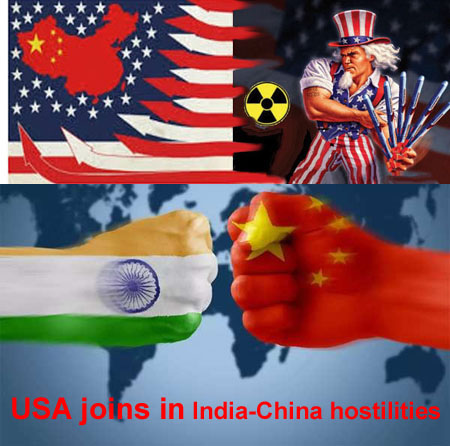
US to take part in military exercise near India’s disputed border with China
By Vedika Sud, Barbara Starr, Sahar Akbarzai and Kathleen Magramo, CNN
Updated 12:29 AM EDT, Sat August 06, 2022
(CNN)The United States is to take part in a joint military exercise with India less than 100 kilometers (62 miles) from the South Asian country’s disputed border with China.
The military drills will be held in mid-October at an altitude of 10,000 feet in Auli in the Indian state of Uttarakhand and will focus on high-altitude warfare training, according to a senior Indian Army officer with knowledge of the matter.
Auli is about 95 kilometers from the Line of Actual Control (LAC), an inhospitable piece of land where the disputed border between India and China is roughly demarcated.
The drills will take place as part of the 18th edition of an annual joint exercise known as “Yudh Abhyas” — or “War Practice”.
Relations between India and China have been strained since a bloody clash between their soldiers in the Himalayas in June 2020 left at least 20 Indian troops and four Chinese soldiers dead…………………….
Asked about the joint exercises, a US Department of Defense spokesperson told CNN that the partnership with India was “one of the most important elements of our shared vision for a free and open Indo-Pacific region.”…………..
Any military provocations between Indian and China could have grave consequences. Both have nuclear weapons……………. more https://amp.cnn.com/cnn/2022/08/06/india/india-us-military-exercise-line-of-actual-control-china-intl-hnk
Why investors should be wary of small nuclear reactors

NuScale has some big challenges.
NuScale announced that completion of the project would be delayed by three years to 2030 and estimated the cost had climbed from $4.2 billion to $6.1 billion. This is a familiar old song in the nuclear energy sector: Big schedule delays and big cost-overruns.
M. V. Ramana, a physicist at the University of British Columbia who works on public policy was not surprised that so many utilities backed-out of the project. “They (utility companies) ought to be seeing the writing on the wall and getting out by the dozens.”
at least one study says that small nuclear power plants will generate more waste than conventional reactors.
NuScale: Finally Time For Small Module Nuclear Reactors?
Summary
- Small module nuclear reactors have been discussed and researched for decades – going back to at least my college engineering days in the 1970s.
- Yet for a variety of reasons, small module reactors (“SMR”) have never become a reality.
- NuScale Power wants to change that and at the present time, the company appears to be the planet’s best chance to do so.
- Today I’ll discuss my sense of NuScale’s chances of success and whether or not the stock is a good fit for an investor’s “speculative growth” bucket.
…………………………………………. My sense is that many of NuScale’s potential utility customers are waiting for – what I consider to be the “proof-of-concept” plant – to be built in Idaho.
Valuation
After a big jump in the stock price in July, NuScale currently has a $3.3 billion market cap (and a 13.7% short position):
……………… In June, NuScale gave a financial update re-affirming guidance for (only) $16 million in FY22 revenue. For the three-month period ending March 31, 2022, the company reported:
- Total available capital was $383.7 million.
- Revenue of $2.4 million and a net loss of $(23.4) million compared to revenue of $0.7 million and a net loss of $(22.7) million for the same period in 2021.
- Research and development expenses of $24.4 million compared to $18.8 million for the same period in 2021.
Clearly the company is burning cash. However, even if the cash burn grew to, say, $30 million per quarter, the available capital would last more than three years.
Risks
However, NuScale has some big challenges. Back in 2020, several utility companies within the UAMPS group backed-out of the deal to build the first NuScale SMR power plant. Even with the infusion of U.S. federal dollars, NuScale announced that completion of the project would be delayed by three years to 2030 and estimated the cost had climbed from $4.2 billion to $6.1 billion. This is a familiar old song in the nuclear energy sector: Big schedule delays and big cost-overruns. It was a big-blow: After all, the whole idea behind a small scale modular nuclear plant was to reduce the risk of both schedule and expense.
According to the previously reference source, critics of the project said it will be “untenably expensive.” M. V. Ramana, a physicist at the University of British Columbia who works on public policy was not surprised that so many utilities backed-out of the project. “They (utility companies) ought to be seeing the writing on the wall and getting out by the dozens.”
The Department of Energy (“DOE”) previously agreed to $1.4 billion in funding for the project. However, as I reported above, the cost estimate for the project now is $6.1 billion. That’s a big gap in funding. Further, at that price, investors need to question whether or not renewable solar and wind capacity would be better back-stopped by battery backup, and more wind and solar capacity additions, as opposed to an SMR.
Meantime, I personally would be much more supportive of the effort if NuScale had a partnership of some sort, or at least a well publicized plan, to re-process or store spent radioactive fuel. That’s especially the case given that at least one study says that small nuclear power plants will generate more waste than conventional reactors. The report said SMRs would create up to 30x more radioactive waste per unit of electricity generated as compared to conventional reactors. According to Reuters, Lindsay Krall – the study’s lead author – said:
Even if (the U.S.) had a robust waste management program, we think there would be a lot of challenges to deal with some of the SMR waste.
The study said NuScale’s reactor would produce ~1.7x more waste per energy equivalent than traditional reactors. NuScale countered that the study used “outdated design information and incorrect assumptions about the plants.”
Summary and Conclusions
In theory, small module nuclear reactors sound like a great idea. And they have been sounding like a great idea for decades. Yet despite all the technology available to man, and the pressing threat of global warming, no small module nuclear reactor has yet to be built in the United States. And that should tell the investor something. https://seekingalpha.com/article/4530416-nuscale-time-for-small-module-nuclear-reacto
US regulators approve small nuclear reactors – BUT – costs, delays, too late for climate help
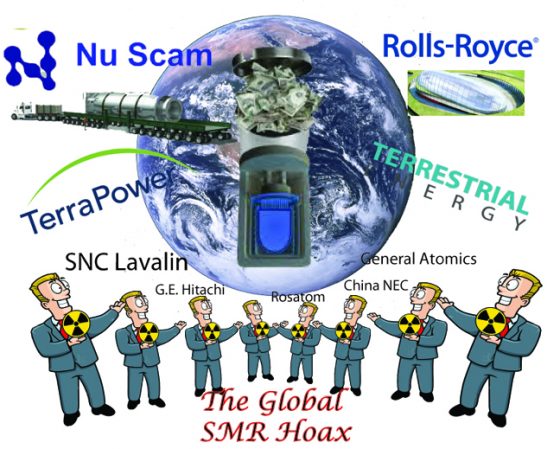
The First Small Modular Nuclear Reactor Was Just Approved by US Regulators, Singularity Hub, By Edd Gent-August 5, 2022
…………………………………… questions have been raised about whether SMRs will really live up to their billing as a cheaper, safer alternative to traditional nuclear power plants. A study published in Proceedings of the National Academy of Sciences in May found that contrary to the claims of SMR makers, these smaller reactors are actually likely to produce more radioactive waste than conventional plants.
In an article in Counterpunch, nuclear power expert M.V. Ramana also points out that the cost of renewable energy like wind and solar is already lower than that of nuclear, and continuing to fall rapidly. In contrast, nuclear power has actually become more expensive over the years.
SMRs could cost more than bigger nuclear plants, he adds, because they don’t have the same economy of scale. In theory this could be offset through mass manufacture, but only if companies receive orders in the hundreds. Tellingly, some utilities have already backed out of NuScale’s first project over cost concerns.
Perhaps even more importantly, notes Ramana, SMRs are unlikely to be ready in time to contribute to the climate fight. Projects aren’t expected to come online until the end of the decade, by which time the IPCC says we already need to have made drastic emissions reductions.
The technology has some powerful boosters though, not least President Joe Biden, who recently touted NuScale’s “groundbreaking American technology” while announcing a grant for an SMR plant the company will build in Romania. Engineering giant Rolls-Royce also recently announced a shortlist for the location of its future SMR factory, which will be used to build 16 SMRs for the UK government by 2050.
Whether SMRs can deliver on their promise remains to be seen, but given the scope of the climate challenge facing us, exploring all available options seems wise. https://singularityhub.com/2022/08/05/the-first-small-modular-nuclear-reactor-design-was-just-approved-by-us-regulators/
Nuclear energy for Colorado? The cost is one very big obstacle

Post Independent, Allen Best 6 Aug 22, A nuclear reactor might be a nice addition to the economy of Craig, the community in northwestern Colorado. But can Colorado afford nuclear power?
……………….Sen. Bob Rankin in the last legislative session tried to get fellow legislators to appropriate $500,000 (amended to $250,000) to study the potential for nuclear.
…………Conspicuously absent was support from the administration of Gov. Jared Polis. The bill failed 3-2 on a party-line vote.
Nuclear has a nagging problem, though. It’s expensive. Advocates rarely mention this. Costs of Georgia’s Plant Vogtle, the only U.S. nuclear power plant under construction, have ballooned from $14 billion to now $30 billion-plus. In South Carolina, investors pulled the plug on a nuclear power plant after spending $9 billion. It has become among the very costliest of energy sources, only slightly less than rooftop solar, according to Lazard, the financial analyst.
Modular nuclear reactors have been promoted as a way to shave costs. Specific projects have been conceived in both Idaho and Wyoming. Bill Gates is an investor in the latter. Maybe they will overcome this cost problem. We won’t really know for another 10, maybe 15 years.
State Sen. Chris Hansen remains skeptical. He has expertise unsurpassed among legislators. He set out to become a nuclear engineer after first laying eyes on a reactor when a high school junior from the farm country of Kansas. He got his degree but had already turned his attention to economics. He went on to earn degrees from the Massachusetts Institute of Technology and, from Oxford, a Ph.D. in resource economics.
Nuclear, he told a county commissioner from Sterling in 2019, when I first heard him answer this question, simply does not compete in cost. Last week, when we talked, he offered more detail.
“I think those technologies will have to prove themselves,” he said of modular nuclear reactors. “Right now, in the best-case scenario it looks like they will deliver electricity at $60 to $70 per megawatt-hour. Wind and solar are coming in at less than $20.”
……….. Hansen suggests that reliability [of rennewables] may more economically be provided by less expensive alternatives. For example, he has pushed transmission and passed legislation to create organized markets that will allow electricity to be moved across broader geographic areas in response to consumer demands. Colorado is currently an island with limited bridges to other areas………… https://www.postindependent.com/opinion/allen-best-nuclear-energy-has-obstacles-too/
NYC: Anti-Nuclear Protest at U.S. Mission to United Nations
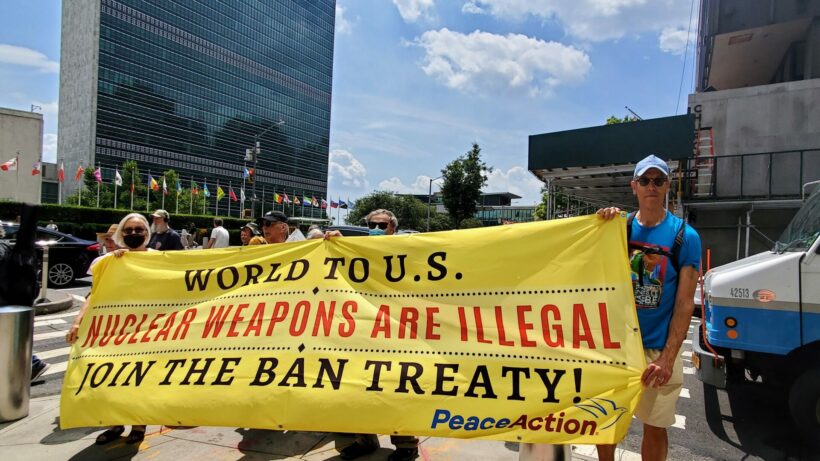
https://www.pressenza.com/2022/08/nyc-anti-nuclear-protest-at-u-s-mission-to-united-nations/ 03.08.22 – US, United States – Pressenza New York
Today, on day two of the four-week 1970 Non-Proliferation Treaty Review Conference, several hundred people marched to the US Mission from the Isaiah Wall across the street from the United Nations, passing by the Wall’s quote from the Prophet Isaaiah,
Report by Alice Slater
“He shall judge between the nations, and shall arbitrate for many peoples; they shall beat their swords into plowshares and their spears into pruning hooks; nation shall not lift up sword against nation, neither shall they learn war anymore.”
Singing peace and anti-war songs, to “lay down their swords and shields” with dramatic interventions and a multitude of posters with slogans calling for nuclear abolition in every possible way, the indomitable peace activists from every continent joined together to press the governments in the coming weeks, who promised in 1970 to make “good faith efforts” for nuclear disarmament, to “lay down their swords and shields” and make their promised “good faith” commitments to restore their tattered promises to finally ban the bomb.
Despite the 2017 enactment of the Treaty for the Prohibition of Nuclear Weapons that closed the NPT loopholes, finally saying that nuclear weapons are illegal in every way, including use, threat to use, sharing, shipping, and manufacturing– the race goes on with all the major powers expanding their arsenals and spending trillions of dollars and millions of IQ points confronting each other with their evil nuclear deterrents. Meanwhile, Mother Earth desperately needs extraordinary global cooperation to prevent a catastrophic climate collapse, a nuclear cataclysm and spreading lethal plagues. We are at a turning point, and this NPT might be the last time that people can bring their governments to their senses, instructing them to step back from the catastrophic cliff edge, towards which we are perilously and thoughtlessly careening.
Report by Anthony Donovan
When I look at the UN from the U.S. Mission today, I think of a wonderful mentor and champion for nuclear disarmament, Amb. Zenon Rossides of Cyprus. I interviewed him in 1983. He’d been challenging the nuclear countries since taking to the UN podium in 1960, to focus on common and collective security, not with nuclear arms. “Listen to the scientists!” He’d often exclaim.
I’d like to echo his public words when speaking about the negotiations for the NPT and other nuclear treaties
“The negotiations are a stagnant pretense, deceiving the people that something is being done about the nuclear arms race, a galloping reality.”
He would often also repeat
“It is not the power of weapons,
but the power of Spirit
That can save the world.”
He met and felt very close to Pres. John F. Kennedy. He said JFK was determined to end nuclear weapons and that the Herculean effort and great success of his Test Ban Treaty was meant to only be the first step toward total abolition.
My word for today’s action, when things look so dire, and heading evermore in the wrong direction, is…… community. A courageous community that sustains life, and joy.
Alice Slater is an Advisor to the Nuclear Age Peace Foundation and serves on the Coordinating Committee of World Beyond War worldbeyondwar.org
Anthony Donovan. A political campaigner and activist from the age of 12, ending up in jail three times for Vietnam War nonviolent civil disobedience.
Washington Is Making the Same Blunder Regarding Taiwan That It Did in Ukraine

y Ted Galen Carpenter Posted on
Tensions between the United States and the People’s Republic of China (PRC) are rising sharply over the Taiwan issue. House Speaker Nancy Pelosi’s stated intention to include a stop in Taipei to meet with Taiwanese officials during her forthcoming trip to East Asia is the latest source of trouble. Pelosi apparently escalated that provocation further by inviting other prominent members of Congress to join her in that stop. Her actions have caused even the staunchly pro-Taiwan Biden administration to quietly press her to change her plans. Conversely, congressional hawks are urging Pelosi not to back down.
The reason for the administration’s caution are readily apparent. Beijing has reacted with unusually intense anger to the prospective visit…………………………
For 4 decades after Washington shifted diplomatic relations from Taipei to Beijing in 1979 and passed the Taiwan Relations Act to govern reduced, informal relations with Taiwan, US administrations were careful to limit visits to the island to low-level officials.
That restraint diminished dramatically during Donald Trump’s presidency, when Congress authorized and the administration approved meetings by National Security Advisor John Bolton and other Cabinet-level officials with their Taiwanese counterparts. Those trips were part of a new policy of much stronger US diplomatic and military support for Taiwan – a course of action that the Biden administration has continued, despite insisting that the United States still adheres to a “one-China” policy.
………. The Biden administration needs to take the PRC’s warnings more seriously. In many ways, Washington’s determination to press ahead with greater support for Taiwan as part of an overall containment policy directed against China is reminiscent of the blunders US officials made with respect to NATO expansion, especially the campaign to incorporate Ukraine, and Washington’s tone-deaf response to Moscow’s escalating complaints.
Biden administration policymakers dismissed the Kremlin’s repeated warnings that trying to make Ukraine a NATO military asset would cross a red line with respect to Russia’s security interests. They discovered belatedly that Russian President Vladimir Putin was not about to cower and accept US diktats simply because the United States insisted that Ukraine had a “right” to join NATO. Nor did he accept Washington’s accelerating campaign to make Ukraine a de facto US military and intelligence ally perched on Russia’s border.
The outcome of Washington’s approach has been horrifyingly bloody and tragic for the people of Ukraine. Even more worrisome, the administration’s policies have led to an extremely dangerous confrontation between NATO and a nuclear-armed Russia, with the United States and NATO cynically using Ukraine as a pawn in a proxy war against Moscow.
Washington risks making a comparable blunder in its dealings with China. The administration must implement a quiet retreat regarding its growing political and military ties to Taipei and adopt a less confrontational approach to Beijing. Moreover, that change needs to go well beyond merely discouraging Pelosi’s provocative visit to Taipei. It has become increasingly obvious to PRC leaders that the United States is pursuing a full-blown anti-China containment policy, with Taiwan as the point of the spear, in a desperate effort to preserve Washington’s fading strategic primacy in East Asia. It is highly unlikely that Beijing will passively accept such an intrusive US presence in China’s core security sphere over the long term. As the PRC’s economic and military power continues to grow, Beijing’s resistance to Washington’s hegemonic efforts will escalate.
US arrogance and inflexibility helped lead to the current tragedy in Ukraine. Policymakers blew through red warning light after red warning light from the Kremlin. A similar approach seems to be taking place in Washington’s relations with Beijing, and it threatens to produce a similar ugly outcome in East Asia over the Taiwan issue.
Ted Galen Carpenter, a senior fellow in defense and foreign policy studies at the Cato Institute, is the author of 13 books and more than 1,100 articles on international affairs. His latest book is Unreliable Watchdog: The News Media and U.S. Foreign Policy (forthcoming, September 2022).
Senator Manchin Democrats Bill to give $30 billion lifeline to save America’s moribund nuclear industry

Manchin Deal Tosses $30 Billion Lifeline to US Nuclear Reactors,
- Tax credit for nuclear power included in Senate spending bill
- Incentive could save as much as 38% of fleet, analyst says
Bloomberg, By Ari Natter, August 4, 2022
Struggling nuclear reactors would get a $30 billion lifeline under the Democrats’ climate change and tax bill that could save dozens of nuclear power plants from an early retirement.
Included in the $433 billion Inflation Reduction Act, which is slated for a Senate vote as soon as this week, is a 10-year production tax credit for nuclear energy producers that could be a boon for reactor operators such as Southern Co., Constellation Energy Corp., Public Service Enterprise Group Inc. and Energy Harbor Corp.
The proposed $15 per megawatt-hour credit for existing nuclear plants — which provide about 19% of the nation’s electricity — will help an industry that has undergone a wave of closures. Reactors have high operating costs and are increasingly struggling to compete with cheaper electricity produced using natural gas and renewables.
Between 22% and 38% of the nation’s nuclear fleet of 93 reactors is at risk of retiring in the 2030s, depending on natural gas prices, according to an analysis by Rhodium Group…………………………
It remains to be seen whether the Inflation Reduction Act, which represents a compromise between Manchin and Senate Majority Leader Chuck Schumer, will be backed by the full Democratic caucus in the 50-50 Senate. It would also have to pass the House, where progressives sought a much more expansive plan. https://www.bloomberg.com/news/articles/2022-08-03/machin-deal-tosses-30-billion-lifeline-to-us-nuclear-reactors
1 This Month

To see nuclear-related stories in greater depth and intensity – go to https://nuclearinformation.wordpress.com
-
Archives
- September 2026 (194)
- August 2026 (330)
- July 2026 (355)
- June 2026 (287)
- May 2026 (306)
- April 2026 (356)
- March 2026 (251)
- February 2026 (267)
- January 2026 (308)
- December 2025 (358)
- November 2025 (359)
- October 2025 (375)
-
Categories
- 1
- 1 NUCLEAR ISSUES
- business and costs
- climate change
- culture and arts
- ENERGY
- environment
- health
- history
- indigenous issues
- Legal
- marketing of nuclear
- media
- opposition to nuclear
- PERSONAL STORIES
- politics
- politics international
- Religion and ethics
- safety
- secrets,lies and civil liberties
- spinbuster
- technology
- Uranium
- wastes
- weapons and war
- Women
- 2 WORLD
- ACTION
- AFRICA
- Atrocities
- AUSTRALIA
- Christina's notes
- Christina's themes
- culture and arts
- Events
- Fuk 2022
- Fuk 2023
- Fukushima 2017
- Fukushima 2018
- fukushima 2019
- Fukushima 2020
- Fukushima 2021
- general
- global warming
- Humour (God we need it)
- Nuclear
- RARE EARTHS
- Reference
- resources – print
- Resources -audiovicual
- Weekly Newsletter
- World
- World Nuclear
- YouTube
-
RSS
Entries RSS
Comments RSS
 nuclear-news