nuclear-news

The News That Matters about the Nuclear Industry Fukushima Chernobyl Mayak Three Mile Island Atomic Testing Radiation Isotope

Lies and deceptions surrounding the planned costly bailout of Ohio’s nuclear power plants

There’s still time to say no to Ohio’s costly nuclear bailout   https://www.crainscleveland.com/opinion/personal-view-theres-still-time-say-no-ohios-costly-nuclear-bailout  Jeff Barge  21 July 19, There may have been a case once for Ohio to subsidize FirstEnergy Solutions’ two nuclear plants in Ohio. But the company’s deceit and dishonesty in providing false and misleading information to the state legislature and the public now make that virtually impossible. That may be why the bailout failed to pass as scheduled on July 17 by one vote and may not be brought up again until Aug. 1.

July 22, 2019 Posted by | business and costs, Legal, secrets,lies and civil liberties, USA | Leave a comment

Nuclear industry getting its demands – to reduce safety inspections, roll back requirements

Nuclear industry has been pushing for less oversight, and it’s working. L A Times ELLEN KNICKMEYER, JULY 17, 2019

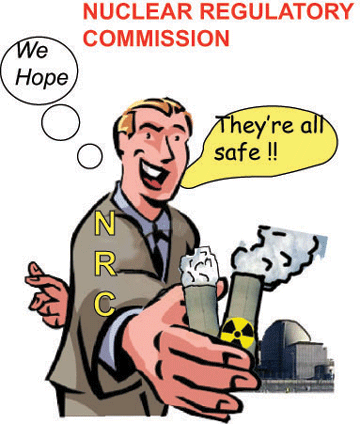
They’re part of the money-saving rollbacks sought by the country’s nuclear industry under President Trump and already approved or pending approval by the Nuclear Regulatory Commission, largely with little input from the general public.

The nuclear power industry says the safety culture in the U.S. nuclear industry — 40 years after a partial meltdown of a nuclear reactor at the Three Mile Island plant in Pennsylvania — is “exceptional” and merits the easing of government inspections.

Maria Korsnick, president of the industry’s Nuclear Energy Institute trade group, said she welcomed changes in NRC plant oversight “to ensure that it reflects a more robust understanding of the current performance of the U.S. nuclear fleet.”

Opponents say the changes are bringing the administration’s business-friendly, rule-cutting mission to an industry — nuclear reactors — in which the stakes are too high to cut corners.

While many of the regulatory rollbacks happening at other agencies under the current administration may be concerning, “there aren’t many that come with the existential risks of a nuclear reactor having a malfunction,” said Geoff Fettus, an attorney for the Natural Resources Defense Council on nuclear issues.

This week, the Nuclear Regulatory Commission released staff recommendations for rollbacks in safety inspections for the 90-plus U.S. nuclear power plants and for less flagging of plant problems for the public. Democratic lawmakers and one commissioner expressed concern about the safety risks and urged the commission to seek broader public comment before proceeding.

The country’s nuclear regulators were looking at “far-reaching changes to the NRC’s regulatory regime without first actively conducting robust public outreach and engagement,” Rep. Frank Pallone Jr. (D-N.J.), chairman of the House Energy and Commerce Committee, said in a letter to Nuclear Regulatory Commission Chairwoman Kristine Svinicki.

Svinicki and two other commissioners did not respond Wednesday to requests for comment made through the agency’s public affairs staff. Public affairs director David Castelveter said the commission would respond directly to lawmakers on Pallone’s letter.

A fourth commissioner, Jeff Baran, spoke out Tuesday, saying he opposed cutting inspections and reducing oversight. Baran called for more public input on proposed rollbacks.

Nuclear regulators post notices of meetings on proposed rollbacks of oversight of nuclear power plants on the Nuclear Regulatory Commission website. Lawmakers complained that there has been scant notice to the public at large about the meetings or proposals.

In general, according to attendance logs, the rollbacks are being hashed out at meetings attended almost solely by commission staffers and nuclear industry representatives. ……

Edwin Lyman, a nuclear safety expert with the Union of Concerned Scientists said the security changes “are jeopardizing public health and safety by restricting the NRC’s ability to ensure that nuclear plants are sufficiently protected against radiological sabotage attacks.”

In January, in one of the comparatively few widely reported changes, commissioners rejected staff recommendations for making nuclear plants harden themselves against natural disasters on the scale of the 2011 earthquake and tsunami that caused meltdowns at three nuclear reactors at the Fukushima nuclear plant in Japan……

Some rollbacks pushed by the industry have been rejected by the commission’s staff. Others are still under consideration, including one that would further cut inspections by regulators and allow more self-inspections overseen by plant operators.

This week’s staff recommendations for rollbacks in government oversight are “just the tip of the iceberg,” Lyman said. https://www.latimes.com/business/story/2019-07-17/nuclear-commission-considers-cutting-back-on-nuclear-power-plant-inspections
July 22, 2019 Posted by | safety, USA | Leave a comment

Small Modular Nuclear Reactors – at least 10 years away – Canadian Nuclear Association

July 22, 2019 Posted by | Canada, Small Modular Nuclear Reactors | 1 Comment

Port Townsend City Council passes resolution to ban nuclear weapons

Residents tout small steps in same direction , Peninsula Daily News, By Sunday, July 21, 2019 , PORT TOWNSEND — Port Townsend City Council members were moved when several residents impressed upon them the value of taking small steps toward a larger issue.

The council unanimously passed a resolution last week in support of a worldwide ban on nuclear weapons following similar actions earlier this spring by the Jefferson County commissioners and the county health department.

“My sense about what this means is not just moving away from the constant waste of money that, if it’s ever put to use, may cost us all of our lives, but also to free up the science and technology and engineering necessary to move towards a more useful strategy as a country,” said Port Townsend’s Doug Milholland, a resident who drove the efforts to pass the resolution.

“Let’s say yes to life.”

Forest Shomer, a speaker in May at the Global Earth Repair conference in at Fort Worden, said that whatever happens in the Key City reverberates.

“We’re right across the water from [Naval Magazine] Indian Island,” Shomer said. “We’ve heard the words so much, ‘Neither confirm nor deny,’ so we don’t know if, right at this moment, we’re sitting three miles away from nuclear weapons.

“It’s pretty personal to Port Townsend to make a statement of how we feel about that.”….  bmclean@peninsuladailynews.com.   https://www.peninsuladailynews.com/news/port-townsend-city-council-passes-resolution-to-ban-nuclear-weapons/

July 22, 2019 Posted by | USA, weapons and war | Leave a comment

Utah communities sign on, rather cautiously, to buy NuScale’s Small Modular Nuclear Reactors

Planned small nuclear project reaches milestone with more Utah cities signing on, Deseret News, Amy Joi O’Donoghue@amyjoi16  July 20, 2019  SALT LAKE CITY — Enough communities in Utah and elsewhere have agreed to purchase nuclear power from a small modular reactor planned at the Idaho National Laboratory, triggering a next phase in its development.

July 22, 2019 Posted by | politics, Small Modular Nuclear Reactors, USA | Leave a comment

World security needs nuclear New Start agreement – USA-Russia, not a distraction about China


July 20, 2019 Posted by | China, politics international, Russia, USA, weapons and war | Leave a comment

Repeated earthquakes all too close to proposed U.S. nuclear waste dump site

Earthquakes repeatedly striking proposed US nuclear waste site

Officials fear deadly radioactivity could seep into earth if another high-magnitude quake strikes Nevada desert, Independent, Emma Snaith, 19 July 19

Repeated earthquakes could risk releasing deadly radioactivity into the earth if plans for a nuclear waste site in go ahead in Nevada’s desert, the state’s governor has warned.

Tens of thousands of tons of highly radioactive used nuclear reactor fuel are due to be transferred from 35 US states to a new facility in the Mojave Desert.

The Yuka Mountain nuclear waste repository is set to store this material deep within the earth.  

But a series of recent earthquakes in the Mojave Desert has raised concerns about the safety of storing radioactive waste at the facility. 

On 4 July, a 7.1 magnitude earthquake ruptured the earth in the desert, which stretches across the California-Nevada border.

The force of the quake cracked buildings, sparked fires, damaged roads and caused several injuries in southern California. It was followed by a 6.4-magnitude temblor two days later.

In the wake of the earthquakes, the governor of Nevada Steve Sisolak said he was committed to “fighting any continued federal effort to use Nevada as the nation’s nuclear dumping ground”.

Mr Sisolak sent a letter to the energy secretary, Rick Perry, urging him to reconsider the location of the facility.

………. In governor of Nevada’s letter to Mr Perry, he included the opinions of James Faulds at the Nevada Bureau of Mines and Geology and Graham Kent at the seismological laboratory at the University of Nevada.

They urged for more research to be conducted into the seismic activity at the Yuka Mountain site. “The Ridgecrest earthquake sequence, which began July 4 and has yet to subside, clearly highlights the importance of such studies,” Mr Faulds and Mr Kent said. 

A recent ranking compiled by the US Geological Survey found Nevada was the US state with the fourth highest level of seismic activity after Alaska, Wyoming and Oklahoma.

Additional reporting by AP https://www.independent.co.uk/news/world/americas/earthquake-nuclear-waste-radioactive-mojave-desert-nevada-yuka-mountain-a9011051.html

July 20, 2019 Posted by | safety, USA, wastes | Leave a comment

Ohio Senate passes bill to save state’s two nuclear power plants

Ohio Senate passes bill to save state’s two nuclear power plantshttps://www.reuters.com/article/us-ohio-nuclear/ohio-senate-to-vote-on-bill-to-save-states-nuclear-power-plants-idUSKCN1UC1Y2   18 July 19 

(Reuters) – The Ohio Senate passed a bill on Wednesday that will create financial subsidies to stop the state’s two nuclear power reactors from retiring early, according to market analysts tracking the legislation.

The two reactors in Ohio, Davis-Besse and Perry, are owned by FirstEnergy Solutions, which has said it would shut the money-losing plants in 2020 and 2021 unless the state provides some financial assistance to keep them operating.

FirstEnergy Solutions is a bankrupt unit of Ohio power company FirstEnergy Corp.

The Senate version of the nuclear bill, House Bill 6 (HB6), is expected to go to the state House of Representatives for a concurrence vote on Wednesday night, one of the analysts said. The House has an “if needed” session scheduled for Thursday if members need more time to debate the Senate changes to the bill. HB6 passed the House in May.

The senate passed the bill after an amendment which postpones nuclear subsidies by one year, according to an analyst.

The earlier version of the bill was designed to reduce consumer power rates by weakening the state’s renewable and energy efficiency goals even though FirstEnergy Solutions would receive an estimated $150 million a year from 2020-2026 to keep its reactors in service.

“We expect the legislature will hit this deadline and send the bill to Governor Mike DeWine’s desk this week,” Josh Price, senior analyst at Height Capital Markets in Washington, said earlier on Wednesday.

Officials at FirstEnergy Solutions had no comment earlier Wednesday. The company has said it needed the bill to pass by July 17 to avoid shutting the Davis-Besse reactor next spring.

FirstEnergy Solutions has warned that shutting the reactors could result in the loss of 4,300 jobs.

On Monday, U.S. electric generator LS Power warned it would be forced to terminate development of an expansion of its Troy natural gas-fired power plant in Ohio if the state passes legislation to subsidize nuclear energy.

LS Power said the expansion of the Troy plant would create hundreds of jobs during construction and about 20 permanent positions. Analysts, however, said that was likely not enough to offset legislators’ concerns about the potential loss of thousands of jobs if the reactors shut.

Gas-fired plants would likely make more money if the reactors shut because they would operate more often.

Reporting by Scott DiSavino and Sumita Layek; Editing by Susan Thomas and Grant McCool

July 20, 2019 Posted by | politics, USA | Leave a comment

Ohio Delays Bill to Bail Out Nuclear and Coal Plants, Gut Renewable Spending

Ohio Delays Bill to Bail Out Nuclear and Coal Plants, Gut Renewable Spending

A setback for House Bill 6, with House and Senate versions at odds. But FirstEnergy’s threat to shutter plants without state support could force final passage next month.  GreenTech Media,  Ohio lawmakers have delayed a critical vote on a controversial energy bill that would charge the state’s utility customers hundreds of millions of dollars to subsidize two nuclear power plants that their owner, bankrupt utility FirstEnergy Solutions, has threatened to close without financial support.On Wednesday, the Ohio House of Representatives failed to bring to a vote House Bill 6, forcing the legislature to put off consideration of the bill until it reconvenes in August. House Speaker Larry Householder said the late-night decision was due to the absence of four representatives who planned to vote yes on the bill, adding that the House would “tentatively” take it up again on Aug. 1. ……

Other states, including New York, Illinois and New Jersey, have given financially struggling nuclear power plants incentives to keep their carbon-free generation capacity running, as part of a broader policy push toward decarbonizing their energy sectors.

An outlier among state nuclear bailout plans

But Ohio’s bill is different, opponents say, because it also guts the state’s energy efficiency spending and renewable energy mandates — something that Ohio’s Republican legislators have been trying to do for years.

HB 6 would also shift the costs of some of the country’s oldest coal-fired power plants from utilities to ratepayers for a decade to come. The result, opponents say, will be higher electric bills, more pollution and reduced investment and innovation in modern energy infrastructure for the state.

The bill would replace today’s monthly surcharges on utility customers’ bills, which now pay for the state’s energy efficiency and renewable energy mandates, with a new set of lower surcharges. These will pay for FirstEnergy’s two nuclear power plants, as well as two coal-fired power plants operated by Ohio Valley Electric Corp. (OVEC) and jointly owned by the state’s investor-owned utilities. …….

as opponents including the Union of Concerned Scientists, The Sierra Club and the Natural Resources Defense Council have pointed out, monthly payments for energy efficiency and renewable energy represent investments in lower bills and cleaner energy for Ohio ratepayers. HB 6 ends those investments, in exchange for monthly payments that at their best support out-of-market payments for nuclear power plants, and at their worst help keep some of the state’s worst-performing and polluting coal plants running far past their logical retirement date.

Efficiency, renewables, natural gas and consumers groups are opposed

The Senate version of HB 6 differs from the original House bill’s approach to moving utility funding away from efficiency and renewable energy and toward nuclear and coal subsidies, Neil Waggoner, Ohio campaign representative for the Sierra Club, said in a Tuesday interview.

For example, the House version of the bill would have entirely eliminated Ohio’s current 12.5-percent-by-2026 RPS and cut all the monthly surcharges paying for energy efficiency and demand-reduction programs, which have saved Ohio customers $5.1 billion from 2009 to 2017, according to the Midwest Energy Efficiency Alliance.

But the version passed by the Senate opts for changing the targets for both programs in ways that will effectively end further investment, he said. For the efficiency standard, the bill will reduce today’s top energy-efficiency targets for utilities from 22.2 percent to 17.2 percent — a measure that many of the state’s utilities have likely already achieved — while expanding options for large industrial customers to opt out of paying. …..

HB 6 is being opposed by groups representing residential ratepayers and commercial-industrial energy users that worry it will increase energy prices and undermine free-market energy competition. Competing natural-gas-fired power plant owners are also crying foul, with one, LS Power, threatening this week to end a planned 500-megawatt expansion of its Troy, Ohio facility if HB 6 is passed.

HB 6 does provide $20 million a year, amounting to a total of $140 million through 2026, to support utility-scale solar development, including six solar farms already being built that might have lost funding under previous versions of the bill. And the Senate stripped a House amendment that would have allowed county residents to block wind farm projects on unincorporated land via referendum, even if construction had already begun.

As for the argument that HB 6 was necessary to keep FirstEnergy’s carbon-free nuclear plants up and running, “if we want to have a conversation about keeping carbon emissions in Ohio low, we need to talk about how we replace these nuclear plants with clean energy,” Waggoner said. “The legislature isn’t asking that question. They have never had that question in mind. Their only concern from day one has been how…[to] increase these customer bills to bail out these plants.”

Rains noted that another amendment to HB 6 added this week would weaken the Public Utilities Commission of Ohio’s oversight of how FirstEnergy, as the company to receive the “clean air credits” to be created by HB 6, spends its money.

“Language supporting annual audits for recipients from the clean air credits program was dropped in favor of much more flexible disclosures by qualifying firms to the commission on an annual basis,” he wrote. https://www.greentechmedia.com/articles/read/ohio-delays-bill-to-bail-out-nuclear-and-coal-plants-gut-efficiency-and-ren#gs.qa5wl6

July 20, 2019 Posted by | business and costs, politics, USA | Leave a comment

What are the NRC staff recommendations for scaling back nuclear reactor inspections 

NRC Staff Recommends Scaling Back Reactor Inspections   
https://www.powermag.com/nrc-staff-recommends-scaling-back-reactor-inspections/?pagenum=1    07/18/2019 | Sonal Patel   For an in-depth analysis – read this article:

Next Steps and Pushback

The recommendations will need approval by the NRC’s commissioners. Three of the four confirmed commissioners are President Trump appointees—Chair Kristine Svinicki, Annie Caputo, David A. Wright. Only one is an Obama appointee—Jeff Baran. One seat in the five-member commission remains vacant.

However, as the Associated Press reported on July 17, and as notes in the document show, the recommendations were reached after considerable disagreement. The Associated Press quoted Baran as saying, “NRC shouldn’t perform fewer inspections or weaken its safety oversight to save money.” Baran urged the NRC to give the public an opportunity to discuss before it decides  on whether to approve the changes. 

—Sonal Patel is a senior associate editor at POWER (@sonalcpatel, @POWERmagazine)

July 20, 2019 Posted by | safety, USA | Leave a comment

Reduced U.S. nuclear safety oversight will save money for the industry

Nuclear Industry Looks to Save Money Under Reduced U.S. Safety Oversight, Insurance Journal , By Ellen Knickmeyer | July 19, 2019  Fewer mock commando raids to test nuclear power plants’ defenses against terrorist attacks. Fewer, smaller government inspections for plant safety issues. Less notice to the public and to state governors when problems arise.They’re part of the money-saving rollbacks sought by the country’s nuclear industry under President Donald Trump and already approved or pending approval by the Nuclear Regulatory Commission, largely with little input from the general public.

The nuclear power industry says the safety culture at the U.S. nuclear industry — 40 years after partial meltdown of a nuclear reactor at Three Mile Island — is “exceptional” and merits the easing of government inspections. ,,,,,

Opponents say the changes are bringing the administration’s business-friendly, rule-cutting mission to an industry — nuclear reactors — where the stakes are too high to cut corners.

While many of the regulatory rollbacks happening at other agencies under the current administration may be concerning, “there aren’t many that come with the existential risks of a nuclear reactor having a malfunction,” said Geoff Fettus, an attorney for the Natural Resources Defense Council on nuclear issues.

This week, the NRC released staff recommendations for rollbacks in safety inspections for the 90-plus U.S. nuclear power plants and for less flagging of plant problems for the public. Democratic lawmakers and one NRC commissioner expressed concern about the safety risks and urged the commission to seek broader public comment before proceeding.

The country’s nuclear regulators were looking at “far-reaching changes to the NRC’s regulatory regime without first actively conducting robust public outreach and engagement,” New Jersey Democrat Frank Pallone Jr., chairman of the House Energy and Commerce Committee, said in a letter to NRC Chairwoman Kristine Svinicki..

Svinicki and two other NRC commissioners did not respond Wednesday to requests for comment made through the agency’s public affairs staff. NRC public affairs director David Castelveter said the NRC would respond directly to lawmakers on Pallone’s letter.

A fourth commissioner, Jeff Baran, spoke out Tuesday, saying he opposed cutting inspections and reducing oversight. Baran called for more public input on proposed rollbacks.

Nuclear regulators post notices of meetings on proposed rollbacks on oversight of nuclear power plants on the NRC website. Lawmakers complained there’s been scant notice to the public at large about the meetings or proposals.

In general, according to attendance logs, the rollbacks are being hashed out at meetings attended almost solely by NRC staff and nuclear industry representatives. Occasionally, a single reporter or representative for private groups monitoring or opposing nuclear power is shown as attending.
U.S. nuclear plant operators have seen their operating costs rise as the country’s nuclear fleet ages. Competition from cheaper natural gas and renewables is increasing marketplace pressure on nuclear power providers, making the financial costs of complying with NRC regulation ever more of an issue…….

Commissioners have been moving more assertively to cut regulation requirements for the nuclear industry under the Trump administration, which has now nominated or renominated all four current members of the five-member board.

Edwin Lyman, a nuclear safety expert with the Union of Concerned Scientists non-profit group, pointed to a board move last fall, when the NRC cut the frequency of commission-run mock commando raids at nuclear power plants.

The drills are meant to test whether attackers would be able to reach the heart of a nuclear reactor.

Lyman said the security changes “are jeopardizing public health and safety by restricting the NRC’s ability to ensure that nuclear plants are sufficiently protected against radiological sabotage attacks.”

In January, in one of the comparatively few widely reported changes, commissioners rejected staff recommendations for making nuclear power plants harden themselves against Fukushima-scale natural disasters.

New recommendations by staff made public Tuesday would cut the time and scope of annual plant inspections. They also would change how the NRC flags safety issues at plants for the public and for local state officials.

Some of the changes would require a vote by NRC commissioners…….
This week’s staff recommendations for rollbacks in government oversight are “just the tip of the iceberg,” Lyman said. https://www.insurancejournal.com/news/national/2019/07/19/532838.htm

July 20, 2019 Posted by | business and costs, safety, USA | Leave a comment

Iran’s diplomatic offer on nuclear inspections meets with USA scepticism

July 20, 2019 Posted by | Iran, politics international, USA | Leave a comment

San Onofre nuclear power station: nuclear waste moves from wet pools to dry storage

Nuclear waste moves from wet pools to dry storage at San Onofre

1 down, 43 to go before the plant’s cooling pools are empty and its dry storage system is full By TERI SFORZA | tsforza@scng.com | Orange County Register July 18, 2019  It took the better part of two days, but Canister No. 30 — a 50-ton behemoth full of spent nuclear waste — was successfully moved from a fuel-handling building, rolled across the bluff on a giant transporter, then inserted into its steel-and-concrete vault in the Holtec Hi-Storm UMAX dry storage system at San Onofre Nuclear Generating Station.

The delicate, deliberate dance was originally projected to wrap up by early morning Wednesday, July 17, but finished up about 6 a.m. Thursday. And as far as majority owner and operator Southern California Edison is concerned, that’s just fine and dandy……..

Critics continue to worry about the integrity of those canisters — which have scratches from their descent into the vaults — over what could be decades in the San Onofre’s salty seaside atmosphere. They demand that the waste be moved from what they deride as a “beachfront nuclear waste dump” immediately, but that requires action from a federal government that has dithered on the issue for some 70 years.

The road to here

San Onofre’s reactors powered down in 2012 after tubes in its brand-new steam generators cracked, resulting in a small radiation leak. After local opposition to restarting it appeared insurmountable, San Onofre was shuttered for good in 2013.

The plant will be dismantled – a $4 billion job that’s expected to take at least another decade – and all the spent fuel currently cooling in its spent fuel pools will be transferred to dry storage by next year……..  https://www.ocregister.com/2019/07/18/nuclear-waste-moves-from-wet-pools-to-dry-storage-at-san-onofre/

July 20, 2019 Posted by | USA, wastes | Leave a comment

Impending nuclear disaster, catastrophic climate change: Trump must be impeached

July 20, 2019 Posted by | politics, USA | 1 Comment

U.S. Slaps Sanctions On Nuclear Supply Network for Iran’s Enrichment Program

July 20, 2019 Posted by | politics international, USA | Leave a comment