Nuclear Device Assembly Facility In Nevada Desert May Be A Ticking Time Bomb (Updated)
The fortress-like facility that holds nuclear material and high explosives wasn’t designed to take the quakes the land it sits on can dole out. The Drive , BY TYLER ROGOWAY, APRIL 4, 2019 One of the most important and high-security facilities in the Department Of Energy’s sprawling nuclear infrastructure portfolio could be a radiation hazard just waiting to occur according to the Chairman of the Defense Nuclear Facilities Safety Board.
The fortress-like Device Assembly Facility (DAF) sits about 60 miles northwest of Las Vegas within the highly-security Nevada National Security Site (NNSS)—previously called the Nevada Test Site—near Yucca Dry Lake.
It turns out that the area is at a much higher risk to powerful seismic activity than the DAF’s designers realized decades ago. Considering that the potentially seismically vulnerable installation houses nuclear material and high explosives, and these compounds are manipulated inside the facility, a large quake could have terrible consequences. The issue was first reported on by Gary Martin of the always great Las Vegas Review Journal.
In an official letter to DOE secretary Rick Perry, Chairman Bruce Hamilton states the following:
“The Defense Nuclear Facilities Safety Board is concerned that the Department of Energy has not adequately addressed the seismic hazards for the Device Assembly Facility at the Nevada Nationatinal Security Site. The DAF probabilistic seismic hazard analysis update in 2007 identified a significant seismic hazard increase… A seismically induced high explosive violent reaction could result in unmitigated dose consequences to the offsite public… The facility continues to operate without accounting for the increase in seismic hazard and without evaluating whether the credited structures, systems, and components can perform their safety function during and after a seismic event.”………..
The Device Assembly Building is a low-slung, partially buried, extremely high-security, bunker-like structure that is ringed by rows of security fencing and flanked by turrets. Internally it is comprised of various compartments including nuclear storage and device assembly areas, labs, and administrative offices…………
A Defense Nuclear Facilities Safety Board staff report dated November 27th, 2018 discusses the fact that the facility sits on ground that is more unstable than architects realized during its design and construction. It states:
“The Board’s staff review team is concerned that DAF continues to operate without incorporating the increased seismic hazard and without analyzing its credited safety-related SSCs to ensure that they can perform their safety function during and after a seismic event. In the DAF documented safety analysis, a high explosive violent reaction (HEVR), or a detonation of high explosives that are co-located with special nuclear material, has the highest public dose consequences that challenge the evaluation guideline and require safety class controls.”
The report goes on to talk about all the systems in place to help mitigate risk to the public during an accident and notes that these systems may not meet the current risk requirements. The same goes for the overhead crane systems, ducts, conduits, and other infrastructure contained in the facility.
The report includes a somewhat ominous conclusion:
“The Board’s staff review team is concerned that DAF continues to operate with the increase in seismic hazard and MSTS has not adequately evaluated credited safety-related SSCs to ensure that they can perform their safety function during and after a seismic event. Seismic accident scenarios at DAF could result in significant consequences to the offsite public. Since the impact of seismic events on DAF SSCs has not been adequately characterized, DAF continues to operate with unknown risk.”
All of this is quite timely as America’s aging nuclear infrastructure is taking center stage once again as the Pentagon pivots towards focusing on what it calls “great power competition.” This includes not just modernizing America’s existing nuclear arsenal, but also adding new nuclear capabilities like low-yield tactical nuclear warheads that can be mounted on cruise and ballistic missiles. With new nuclear weapons come the need for billions of dollars worth of testing and development and they have to be assembled and maintained somewhere over the course of their service lives.
With these developments in mind, it is quite possible, if not probable, that the DAF will see a substantial uptick in operations in the coming years, not the other way around. ……….
The potential vulnerability of the DAF to earthquakes is just another reminder of America’s rickety nuclear infrastructure that supports the strategic deterrent. Some have said it is not a matter of if but when a major nuclear issue occurs at one of these sites due to lack of maintenance, upgrades, and a robust long-term plan for storing nuclear waste. Even concerns about security in and around America’s nuclear stockpile have been raised. Scares of multiple types have occurred recently, some of which seem to underline these concerns.
The fact is that the dawn of nuclear age and the Cold War that followed has left the U.S. speckled with bizarre nuclear sites, most of which the average person would never know existed. But that could rapidly change if a major accident that could have been avoided occurs at one of them…
Nuclear power is not a viable solution for Green New Deal https://thehill.com/opinion/energy-environment/437003-nuclear-power-is-not-a-viable-solution-for-green-new-deal, BY DAMON MOGLEN, — 04/02/19The Green New Deal resolution is a bold and necessary path forward to tackle the climate crisis. To be successful, it must leave nuclear power behind. With just a decade left to stop the worst effects of climate change, we must dramatically transform how we produce, use and pay for energy. And as momentum around the Green New Deal turns into concrete proposals, we must recognize why nuclear power is a discredited and dishonest distraction, not a solution.
To reduce global greenhouse gas emissions by 40 to 60 percent by 2030, and down to zero by 2050, we need cost-effective, proven energy generation technology that can be scaled up to meet these benchmarks. Nuclear power does not and will not ever meet these criteria.
After 60 years, despite massive subsidies, the nuclear industry is dying of its own accord. Why? Because it’s too expensive, too dangerous and dirty, and takes too long to deploy. Reactors are closing across the country, and major corporations have declared bankruptcy.
Nuclear power simply cannot compete against safer, cleaner and cheaper renewable energy. Nuclear power is also expensive. Nuclear’s subsidies have been buried in hundreds of spending bills, it’s costs externalized to the environment and future generations, and its bills literally unpaid, defaulted on or passed to taxpayers. Conservative estimates suggest that the nuclear industry has received more than $85 billion in subsidies. A centrist estimate might double that.
For 60 years, nuclear power has posed a serious risk to people and our planet. It will be the same for the next 10,000 years. Our children and generations of their children will be forced to endure the radioactive pollution and fallout from devastating accidents like 3 Mile Island, Fukashima and Chernobyl, and the permanent waste that no one can safely store. The risks of nuclear proliferation and the spread of dangerous weapons and technology only adds to this.
Nuclear power is too slow to scale up to our current challenge. Far too slow. In 1997, when the historic Kyoto Protocol was signed, nuclear power’s share of electricity generation globally was around 17 percent. Now, after two decades, the aging fleet of reactors account for barely 10 percent of global electricity generation and about 4.4 percent of global commercial primary energy consumption. Even the nuclear industry’s grandiose and preposterously expensive proposal to build two new nuclear reactors a month, from now to 2050, would be far too little and far too late.
The endless talk of a new nuclear technology that will magically transform this problem is a pipe dream that has a proven record of failure. Hundreds of billions were spent on “breeder” reactors and other esoteric designs and not a single one has yielded a commercial scale reactor.
And continuing to subsidize and retool current reactors will re-direct massive resources that should be put into renewables, while doing nothing to slow global warming.
The task ahead is indeed daunting if we are to turn around global greenhouse gas emissions in the time we have. We must move from a 20th-century energy system based on dirty, dangerous and expensive fossil fuel and nuclear power to a 21st-century energy system based on renewables.
The solution is a massive commitment to ramping up renewable energy coupled with energy storage while applying modern energy efficiency technologies to decrease demand. Wind and solar are cheap, clean and proven to work. We must focus all resources on scaling those up.
Some have suggested that climate change is so dire that all options must be on the table. But that’s an ideology, not a strategy. We must choose the technologies that will not produce greenhouse gases and can be scaled up quickly, safely and at lowest cost. That means the path ahead must be based on renewable energy. If we want to stop the worse of the climate crisis and pull humanity back from the apocalypse, this is the only way forward.
Damon Moglen is a senior strategic advisor to Friends of the Earth, with over 30 years experience campaigning on climate and nuclear issues.
Deadly Dust: US Spreading Radiation and No One Wants to Raise the Issue – Author https://sputniknews.com/analysis/201904031073767110-us-radiation-spread/ In a new book named “Deadly Dust – Made in the USA: Uranium Weapons Contaminating the World” German author Frieder Wagner gives a detailed account of how the US has contaminated vast territories using depleted uranium (DU) ammunition and the cover-up strategy of the military, industry and governments, as well as those in the media and politics.
Sputnik: Mr Wagner, in your book “Deadly Dust — Made in the USA: Uranium Weapons Contaminating the World” you talk about the use of uranium ammunition. What is especially dangerous about these weapons?
Frieder Wagner: Weapons containing uranium are produced from nuclear industry’s waste (byproducts of uranium enrichment). If, for example, you want to produce a ton of natural uranium fuel rods for nuclear power plants, you get about eight tons of depleted uranium. It is a source of alpha radiation — radioactive and, moreover, very poisonous. It needs to be stored somewhere, and it is not very cheap.
Sputnik: How can it be used in weapons?
Frieder Wagner: About 30-40 years ago, military scientists made a discovery: uranium is almost twice as dense as lead. If you turn depleted uranium into a projectile and give it proper acceleration, then within a fraction of a second it will pierce through tank armor, concrete or cement.This, of course, was an important discovery. Furthermore, when a shell hits an armored tank the impact produces dust caused by the detonation and the subsequent release of heat energy causes it to ignite and it explodes at a temperature of 3000 to 5000 degrees — incinerating the tank’s interior and destroying it.
Sputnik: But what happens afterwards is also a problem — after the use of DU ammunition, isn’t it?
Frieder Wagner: Yes! After its use depleted uranium, which, as I have already said, is a source of alpha radiation (that is, a radioactive and very toxic substance), burns down to nano-particles that are a hundred times smaller than a red blood cell.
This way, I would say, a sort of metallic gas forms that people can inhale, and which is released in the atmosphere and can be carried anywhere by wind. People who inhale it are at risk for developing cancer.These nano-particles can also penetrate the body of a pregnant woman, overcoming the barrier between a child and a mother, and affect the health of an unborn baby, can infiltrate the brain and by travelling through the bloodstream end up in any human or animal organ. Everything that goes around the planet, sooner or later settles and, of course, contaminates, in particular, drinking water and everything else.
Sputnik: In what wars have DU weapons been used so far?
Frieder Wagner: It was actively used during the first Gulf war in 1991 against Iraq. The military has admitted that about 320 tons were used. Then in the second war in Iraq in 2003 over 2,000 tons were used. In between, it was used during the war in Kosovo, in Yugoslavia (1999), and in Bosnia in 1995, and after 2001 in Afghanistan, where it still used today.
Sputnik: Your book title says Made in the USA, were these weapons only used by the United States?
Frieder Wagner: They were being developed in several countries at the same time. In Germany, they were also working on these weapons, as, of course, in Russia. However, it was used and on such a large scale, only by the US. They were reckless and they did not pay attention to any possible side effects — just as it was back when the first atomic bombs were used. That’s why I called the book: “Deadly Dust — Made in the USA”.
Sputnik: How did you manage to prove the use of these ammunitions in the course of your research?
Frieder Wagner: For example, the Serbs gave us maps where they showed the locations where depleted uranium was used. When we were in Iraq, we talked to the locals. We traveled to places where large tank battles took place and took soil samples there, as well as dust samples from tanks. Looking at the tank, you can see whether it was hit by an ordinary projectile or a uranium munition.
Uranium munition leaves dust that burns everything around the hole made by the projectile. So you can determine the use of uranium ammunition. In all soil samples, we found depleted uranium. Unfortunately, uranium-236 was also found in most of the soil and dust samples — it is even more intense and poisonous. Its radiation is even stronger and does not occur in nature. It can only be produced artificially during reprocessing of fuel rods. This means that we were able to prove that the military, the United States and its coalition allies used uranium munitions made from spent uranium fuel rods.
Sputnik: Your book is based on the films The Doctor, the Depleted Uranium, and the Dying Children of Basra (Der Arzt und die verstrahlten Kinder von Basra, 2004) and Deadly Dust (Todesstaub, 2007). What did you see in Basra during your work on the documentary?
Frieder Wagner: It was horrific and still sometimes haunts me in my dreams. These were children with deformities, which we saw in orphanages in Basra and Baghdad. Some of them had such deformities that they had almost nothing human anymore.
There were children without a head or a nose, either with one eye or without eyes at all, with internal organs in a kind of “sack” outside their body. These ‘creatures’ can live only for a few hours, experiencing terrible pain, and then die.
putnik: The film “Deadly Dust” is linked to the book, but it is no longer distributed. WDR channel after this film did not make any more orders? Why is that?
Frieder Wagner: My exposes which I sent to WDR, as well as to the ZDF channels were rejected. Then I contacted an editor at WDR, for which I always made good films and with which I always had good relations with, because these films had doubled or trippled their ratings, and asked him: “What’s going on here?”” And after some hesitation he said: “Yes, Frieder Wagner, someone must tell you this. WDR considers you a ‘difficult’ person. And most importantly, the topics you suggest are especially hard. Right now I’ve got nothing more to tell you.” And that when I understood everything. It was in 2005.
I can also tell you the story of how, for example, a female editor at ZDF offered the TV channel a story on the use of these weapons during the war in Yugoslavia and also in Croatia. She wanted to talk about it with me prior so I could share my experiences. But when her boss found out that she wanted to talk to Frieder Wagner, he refused to pay for her trip — without any further explanation.
Sputnik: The so-called “deadly dust” is, as you have already described it, is spread by the wind. So should the use of uranium ammunition, in fact, be considered a war crime and banned?
Frieder Wagner: This is definitely a war crime. The dust from southern Iraq is carried to the north by the constant storms, the so-called desert storms — for example, to Erbil, where it meets the mountains and can’t travel further as the mountains make it difficult for it to go past towards Turkey. So this huge mass of dust settles in Erbil.We, for example, took samples of beef from around Erbil, and this is what we found out: depleted uranium used in ammunition has a characteristic atomic “fingerprint”. In northern Iraq we found the same “uranium fingerprint” as in the south. This means that the uranium dust that had originally settled in the south of Iraq is now also in the north, and children are now getting sick there and are born with deformities. It is now spreading all over the world.
Sputnik: Have the victims of uranium munition use in Kosovo or, for example, in Iraq, tried to go to court?
Frieder Wagner: So far no such attempts have been made in Kosovo or Iraq. Now in Kosovo, a whole group of lawyers are working on a lawsuit against NATO, because after the war they unleashed, people were injured, fell ill and died. The morbidity rate has increased by 20 to 30 percent, and there are more effected each year. So there will be an attempt to file a lawsuit.
Out of the approximately two thousand Italian soldiers stationed in Iraq and Kosovo, 109 have later developed cancer and died — this is proven information. 16 families, out of the 109 dead, filed lawsuits and won their cases. The courts ordered the Italian state or the country’s Ministry of Defence to pay them compensation. Since each cancer was of a different type, the payout amounts differed. But they ranged between 200,000 and 1,4 million euros.
Sputnik: How are things in Germany? Have there been lawsuits filed by the soldiers of the Bundeswehr?
Frieder Wagner: The German Ministry of Defense constantly denies any connection to this. Our soldiers are stationed in Afghanistan and Kosovo. About 100,000 soldiers served in Afghanistan, and we found out that about 30% of those who returned got sick, although at first, of course, they do not notice this. If they subsequently marry and have children, then there’s a great risk that their children will have disabilities.
These children will have the same toxic substances in their DNA as their parents. And this will be passed on for several generations — from children to grandchildren and to great-grandchildren.
Sputnik: But none of these people ever filed a lawsuit?
Frieder Wagner: In Germany there were no such precedents. About 600 servicemen went to court in the United States who could not appeal on their own behalf, but they filed lawsuits on behalf of their children who were born with developmental disabilities. And we’re not talking about a mere 90 or even 900 million pay out, but about billions of dollars now. The United States, of course, will try to delay the adoption of a ruling as much as it is possible and hope for a “biological” resolution of the situation — that is, that the plaintiffs will simply die.
US Senators Seek Details on Nuclear Power Cooperation with Saudi Arabia VOA News, https://www.voanews.com/a/us-senators-seek-details-on-nuclear-power-cooperation-with-saudi-arabia-/4859672.html 3 Apr 19, U.S. senators from both parties on Tuesday asked Energy Secretary Rick Perry for details about recent approvals for companies to share nuclear energy information with Saudi Arabia, with the lawmakers expressing concern about possible development of atomic weapons.
Saudi Arabia has engaged in “many deeply troubling actions and statements that have provoked alarm in Congress,” Senators Bob Menendez, a Democrat, and Marco Rubio, a Republican, told Perry in a letter, a copy of which was seen by Reuters.
The senators said Congress was beginning to re-evaluate the U.S.-Saudi relationship, and they believe Washington should not be providing nuclear technology or information to Saudi Arabia now.
The Trump administration has been quietly negotiating a deal that would potentially help Saudi Arabia build two reactors.
Last week news reports revealed that since November 2017, Perry has authorized so-called Part 810 approvals allowing U.S. companies to share sensitive nuclear information with the kingdom. The approvals were kept from the public and from Congress.
The senators asked Perry to provide them by April 10 with the names of the companies that got the 810 approvals, what was in the authorizations, and why the companies asked that the approvals be kept secret. U.S. Representative Brad Sherman, a Democrat, also asked the Energy Department in a separate letter what was in the approvals.
While 810 agreements are routine, the Obama administration made them available for the public to read at Energy Department headquarters. Lawmakers say the department is legally required to inform Congress about the approvals.
Perry approved the seven recent authorizations as the administration has tried to hash out nonproliferation standards with Saudi Arabia. Such a pact, known as a 123 agreement, would have to be agreed before U.S. companies can share physical exports of materials and equipment to build reactors.
The kingdom has resisted standards on reprocessing spent fuel and enriching uranium, two potential paths to making nuclear weapons.
The United States has been competing with South Korea, France, Russia and China on a potential deal to help build reactors in Saudi Arabia. The kingdom is expected to announce the winner this year.
Lawmakers from both parties have been concerned about Saudi Arabia’s bombing campaigns in Yemen, which is on the brink of famine, and the killing of journalist Jamal Khashoggi, a U.S. resident, last October in the Saudi consulate in Istanbul.
Concern in Congress grew last year after the kingdom’s Crown Prince Mohammed bin Salman told CBS that “Saudi Arabia does not want to acquire any nuclear bomb, but without a doubt if Iran developed a nuclear bomb, we will follow suit as soon as possible.”
Perry has said the 810 approvals were kept from the public for corporate proprietary reasons……….
At another Senate hearing, the five members of the Nuclear Regulatory Commission, including Chairman Kristine Svinicki, would not say whether the NRC raised any concerns over the 810 approvals in a required consultation with the Energy Department.
Svinicki said the NRC’s consulting role on the approvals is narrow and delegated to staff.
Senator Chris Van Hollen, a Democrat who asked the question of the NRC at the hearing, told Reuters in an interview that the commissioners’ lack of knowledge about the approvals was “stunning.”
The U.S. government, determined to extradite and try Julian Assange for espionage, must find a way to separate what Assange and WikiLeaks did in publishing classified material leaked to them by Chelsea Manning from what The New York Times and The Washington Post did in publishing the same material. There is no federal law that prohibits the press from publishing government secrets. It is a crime, however, to steal them. The long persecution of Manning, who on March 8 was sent back to jail for refusing to testify before a grand jury, is about this issue.
If Manning, a former Army private, admits she was instructed by WikiLeaks and Assange in how to obtain and pass on the leaked material, which exposed U.S. war crimes in Afghanistan and Iraq, the publisher could be tried for the theft of classified documents. The prosecution of government whistleblowers was accelerated during the Obama administration, which under the Espionage Act charged eight people with leaking to the media—Thomas Drake, Shamai Leibowitz, Stephen Kim, Manning, Donald Sachtleben, Jeffrey Sterling, John Kiriakou and Edward Snowden. By the time Donald Trump took office, the vital connection between investigative reporters and sources inside the government had been severed.
Manning, who worked as an Army intelligence analyst in Iraq in 2009, provided WikiLeaks with over 500,000 documents copied from military and government archives, including the “Collateral Murder” video footage of an Army helicopter gunning down a group of unarmed civilians that included two Reuters journalists. She was arrested in 2010 and found guilty in 2013.
The campaign to criminalize whistleblowing has, by default, left the exposure of government lies, fraud and crimes to those who have the skills or access, as Manning and Edward Snowden did, needed to hack into or otherwise obtain government electronic documents. This is why hackers, and those who publish their material such as Assange and WikiLeaks, are being relentlessly persecuted. The goal of the corporate state is to shroud in total secrecy the inner workings of power, especially those activities that violate the law. Movement toward this goal is very far advanced. The failure of news organizations such as The New York Times and The Washington Post to vigorously defend Manning and Assange will soon come back to haunt them. The corporate state hardly intends to stop with Manning and Assange. The target is the press itself………
Manning has always insisted her leak of the classified documents and videos was prompted solely by her own conscience. She has refused to implicate Assange and WikiLeaks. Earlier this month, although President Barack Obama in 2010 commuted her 35-year sentence after she served seven years, she was jailed again for refusing to answer questions before a secret grand jury investigating Assange and WikiLeaks ……
The New York Times, Britain’s The Guardian, Spain’s El País, France’s Le Monde and Germany’s Der Spiegel all published the WikiLeaks files provided by Manning. How could they not? WikiLeaks had shamed them into doing their jobs. But once they took the incendiary material from Manning and Assange, these organizations callously abandoned them. No doubt they assume that by joining the lynch mob organized against the two they will be spared. They must not read history. What is taking place is a series of incremental steps designed to strangle the press and cement into place an American version of China’s totalitarian capitalism……….
“The internet, our greatest tool of emancipation,” Assange writes, “has been transformed into the most dangerous facilitator of totalitarianism we have ever seen.”
The Hill 2nd April 2019 Rewarding failure: Taxpayers on hook for $12 billion nuclear boondoggle.
Vogtle’s nuclear expansion is billions of dollars over budget, its
completion is far from certain, and the federal government is once again
coming to the rescue. In March, Secretary Perry announced the finalization
of $3.7 billion in taxpayer-backed federal loan guarantees for the Vogtle
project. This came over repeated objections by taxpayer and consumer
watchdog organizations and despite numerous serious hurdles remaining for
the only new nuclear power project still under construction in the United
States. More importantly, these newly-finalized loan guarantees were on top
of $8.3 billion in federal loan guarantees that the project partners,
Southern Company’s Georgia Power, Oglethorpe Power Corporation, and the
Municipal Electric Authority of Georgia (MEAG Power), previously secured,
bringing the total to $12 billion.
Lawsuit filed on behalf of nuclear workers https://www.abqjournal.com/1299172/lawsuit-filed-on-behalf-of-nuclear-workers.html, BY SCOTT TURNER / JOURNAL STAFF WRITER April 2nd, 2019 ALBUQUERQUE, N.M. — James Jaramillo and Harold Archuleta are used to having to navigate through government bureaucracy to receive compensation for illnesses they said were caused by radiation exposure during their days as employees at Sandia National Laboratories and Los Alamos National Laboratory.
Both men had to wait years after filing claims for compensation through the Energy Employees Occupational Illness Compensation Program.
Jaramillo, 65, worked at Sandia for 24 years. He found out he had cancer of the small intestine in 1998. He filed for compensation in 2003 but was originally denied. Through changes in the program, he was finally awarded compensation in 2012 for medical care and lost wages since he was forced to retire.
Archuleta, 80, worked 38 years, 35 full time, at Los Alamos, where, he said, he ended up with skin cancer after years of exposure to plutonium. He’s also received compensation, but his wife, Angie, said it wasn’t an easy process.
“Congress put forth this act to help them, but then when it comes to actually paying, they put up all of these barriers,” Angie Archuleta said. “It’s just been very frustrating.”
According to a release by the Department of Labor’s Office of Workers’ Compensation Programs, changes are being made next week to update some of the regulations, with the goal of increasing efficiency and transparency and reducing administrative costs. The rules would align the regulations regarding processing and paying medical bills with the current system Office of Workers’ Compensation Programs uses to pay medical bills, and set out a new process that the office will use for authorizing in-home health care that will enable the office to better provide its beneficiaries with appropriate care, according to the release.
However, a company that provides health care to workers such as Jaramillo and Archuleta says rule changes involving the program could make it harder for nuclear workers to receive compensation and could delay the medical treatment they need.
The company, Professional Case Management, has filed suit in the District Court of Colorado against the Labor Department to keep the changes to the Energy Employees Occupational Illness Compensation Program from taking effect. Professional Case Management Vice President Tim Lerew said the new changes could cause delays of 60 days or more in treatment.
“It’s hard to know how long those delays will be,” Lerew said at a town hall meeting in Albuquerque last week. “We estimate it will be about an additional 60 days. For some people, coming out of the hospital with particular illnesses where doctors want them to have additional care … they don’t have that time to wait.”
Lerew said the new rule changes will also add 36 steps to the process between the patient, the doctor and the Labor Department to get pre-authorization for treatment and services, such as home health care.
“If they have you jump through 36 more hoops, how is a guy supposed to do that?” Jaramillo asked.
The rule changes would require patients to fill out most of the paperwork. In the past, health care providers would fill out the majority of it, Lerew and Jaramillo said.
“If you don’t dot every ‘i’ and cross every ‘t,’ they deny you,” said Jaramillo’s wife, Terry.
“Nurses take all your vitals and with the doctor come up with your plan, and send to the Department of Labor for approval,” James Jaramillo said. “Now, they want the patients to fill out a lot of the paperwork and submit it themselves, and not let medical people get involved with that.”
Lerew said he wondered how a cancer-stricken person in his or her 80s “is successfully going to navigate that process.”
Is The Nuclear Industry Abusing Subsidies? Oil Price, By Haley Zaremba – Mar 27, 2019, Although nuclear is often touted as an ultra-efficient and therefore affordable as well as clean alternative to fossil fuels, some states are beginning to discover that this is not necessarily the case as their local governments pour more and more money into nuclear plant subsidies only to see the nuclear industry come back with palms outstretched again and again.One such state is Connecticut, where local news source the Connecticut Mirror just published a direct-to-the-point op-ed aptly titled “Nuclear plants will require ever-increasing subsidies”. The author Joel Gordes, a Connecticut-based energy and environmental strategist, argues that since the very beginning of nuclear energy in their country, when the argument for the resource was that nuclear energy was dirt cheap, nuclear has been deceptively pricey and getting pricier all the time.
“Please consider,” Gordes implores the reader, “the very basic fact that we have gone from nuclear technology sold in the 70s on the basis of being ‘too cheap to meter’ to one where they have been begging and receiving for what amounts to yet more subsidies. Even with the ‘too cheap to meter’ claim, in its heyday the nuclear industry was the recipient of huge amounts of subsidy in numerous forms.”
Gordes goes on to finish his denunciation of his state’s nuclear policy by imploring the government to rethink their history handouts: “With that, I suggest our leaders and regulators very carefully consider any actions contemplated to further subsidize this technology since that might add to its eventual stranded cost that will hold up newer, lower cost decentralized, modular and more secure options. Even more important is that aging plants may, themselves, present an existential danger to the citizens of the state.”
Meanwhile, energy insiders in Illinois are singing a similar tune. Chicago-based nuclear electric power generation company Exelon won ratepayer-funded subsidies for two nuclear plants in its home state just three years ago, and now it’s back in Springfield to ask for similar monetary support for other cash-strapped nuclear plants that have not yet had the benefit of a bailout. The bill will be voted on by the State of Illinois’ House Public Utilities Committee this week.
While Exelon is lobbying hard for more government support, however, it is receiving a fair amount of scrutiny and backlash. Just this month Monitoring Analytics released a “bombshell report” with the surprising findings that all five of Exelon’s nuclear plants in Northern Illinois are not in dire financial distress, but are in fact profitable, and are projected to continue to be so through 2021–by conservative estimates.
According to the Monitoring Analytics report, Exelon’s five Illinois-based nuclear plants will see a total estimated profit of approximately $472 million this year alone. What’s more, each individual plant will turn its own profit. Even in 2021, when it is anticipated that revenue will begin to decline, altogether the plants are still projected to earn a profit of $228 million–much lower, to be sure, but still a far cry from bankruptcy. The report has thrown doubt upon Exelon’s stance that the subsidy bill up for vote this week, which would legislate a very complex matter with massive consequences for Illinois’ power industry and energy market, is a matter of both urgency and necessity…….. https://oilprice.com/Energy/Crude-Oil/Is-The-Nuclear-Industry-Abusing-Subsidies.html
As safety board cites quakes, Perry says Nevada nuke sites safe By Gary Martin/Las Vegas Review-Journal, April 2, 2019
WASHINGTON — Energy Secretary Rick Perry acknowledged Tuesday that the Nevada National Security Site — where weapons-grade plutonium is being stored — and the proposed Yucca Mountain nuclear waste repository are located in an area considered a seismic hazard.
But he insisted that the facility where the half metric ton of plutonium is being held is secure and that Yucca Mountain would be a safe site to store waste…….
Safety board report
Perry told Cortez Masto the facility was secure. Cortez Masto raised concerns by the Air Force and other entities about the safety of storing plutonium at the facility and opening a nuclear waste repository in a region with current seismic activity.
Cortez Masto grilled Perry on a report first revealed by the Review-Journal in which the Defense Nuclear Facilities Safety Board outlined risks to workers and the “offsite public” because of seismic hazards to structures at the Device Assembly Facility at the security site, located about 90 miles north of Las Vegas.
“This facility continues to operate without accounting for the increase in seismic hazard and without evaluating whether the credited structures, systems and components can perform their safety function during and after a seismic event,” wrote Bruce Hamilton, chairman of the Defense Nuclear Facilities Safety Board, in the board’s report.
The board noted that concerns about seismic hazards at the Device Assembly Facility in Nevada were first raised in 2007.
Earthquake faults near Yucca
Cortez Masto raised the most recent U.S. Geological Survey report, issued in 2008, which lists the area that includes the Nevada security site and nearby Yucca Mountain as one of moderate to high seismic hazard.
Two faults, the Northern Death Valley and the Black Mountains, are located west of the Nevada security site and the proposed nuclear waste storage facility. According to the USGS, one of the strongest recent earthquakes in the state occurred on June 29, 1992, at Little Skull Mountain in the southwest portion of the Nevada security site and about 12 miles east of Yucca Mountain. That earthquake registered magnitude 5.6.
The safety board report noted that the Device Assembly Facility has “high explosives co-located with special nuclear material.”
Cortez Masto said the seismic hazards cited in the report should also be taken into account in the administration’s attempt to restart license hearings on the Energy Department’s application for Yucca Mountain.
Site is unsafe
Sisolak agreed with Cortez Masto in a statement.
“As the Defense Nuclear Facilities Board — a federal safety board — pointed out recently, earthquake risks make the Nevada National Security Site unsuitable for plutonium and make Yucca Mountain unsuitable for nuclear waste,” he said.
Cortez Masto also asked Perry about President Donald Trump’s flip-flop on Yucca Mountain during a campaign event in Nevada last year, where he said he agreed that a nuclear waste dump should not be located in the state if the residents don’t want it.
“What we all have to recognize here is that Yucca Mountain is the law,” Perry answered. “I’m going to follow the law. The president is going to follow the law. His opinion of whether or not the people of Nevada like it or not doesn’t have anything to do with what the statute says.”
Cortez Masto replied that the Obama administration had taken a different approach, preferring a consent-based plan to store nuclear waste in an area where residents didn’t oppose it.
HANFORD, WA (AP) — A Hanford contractor is expected to avoid federal penalties for the airborne spread of radioactive particles.
The U.S. Department of Energy does not intend to fine CH2M Hill Plateau Remediation Company in Hanford for five violations connected to contamination.
The agency says it will not fine CH2M because its possible incentive pay was already docked by $1 million in fiscal 2017 and $1.8 million in fiscal 2018.
The agency says radioactive contamination was found at the site in December 2017 near administrative buildings, on employee and government cars, and in trailers where workers ate. Officials say tests found 42 workers inhaled or ingested small amounts of radioactive material and that contamination continued into 2018.
US asked North Korea to hand over all nuclear weapons: Report. Donald Trump reportedly gave Kim Jong Un a document in Hanoi calling for the transfer of nuclear materials to the US. Aljazeera, 30 Mar 2019 On the day their talks in Hanoi collapsed last month, US President Donald Trump handed North Korean leader Kim Jong Un a piece of paper that included a blunt call for the transfer of Pyongyang’s nuclear weapons and bomb fuel to the United States, according to a document seen by Reuters news agency.
Trump gave Kim both Korean and English-language versions of the US position at Hanoi’s Metropole hotel on February 28, according to a source familiar with the discussions, speaking on condition of anonymity. It was the first time that Trump himself had explicitly defined what he meant by denuclearisation directly to Kim, the source said.
On the day their talks in Hanoi collapsed last month, US President Donald Trump handed North Korean leader Kim Jong Un a piece of paper that included a blunt call for the transfer of Pyongyang’s nuclear weapons and bomb fuel to the United States, according to a document seen by Reuters news agency.
Trump gave Kim both Korean and English-language versions of the US position at Hanoi’s Metropole hotel on February 28, according to a source familiar with the discussions, speaking on condition of anonymity. It was the first time that Trump himself had explicitly defined what he meant by denuclearisation directly to Kim, the source said.
A joint lunch for the two leaders was cancelled the same day. While neither side has presented a complete account of why the summit collapsed, the document may help explain it.
The document’s existence was first mentioned by NSA John Bolton in television interviews he gave after the two-day summit. Bolton did not disclose in those interviews the pivotal US expectation contained in the document that North Korea should transfer its nuclear weapons and fissile material to the US.
The document appeared to represent Bolton’s long-held and hardline “Libya model” of denuclearisation that North Korea has rejected repeatedly. It probably would have been seen by Kim as insulting and provocative, analysts said.
Trump had previously distanced himself in public comments from Bolton’s approach and said a “Libya model” would be employed only if a deal could not be reached.
The idea of North Korea handing over its weapons was first proposed by Bolton in 2004. He revived the proposal last year when Trump named him as his national security adviser.
The document was meant to provide the North Koreans with a clear and concise definition of what the US meant by “final, fully verifiable, denuclearisation”, the source familiar with discussions said.
The White House did not immediately respond to a request for comment, while the State Department declined to comment on what would be a classified document.
After the summit, a North Korean official accused Bolton and Secretary of State Mike Pompeo of “gangster-like” demands, saying Pyongyang was considering suspending talks with the US and may rethink its self-imposed ban on missile and nuclear tests.
The English version of the document, seen by Reuters, called for “fully dismantling North Korea’s nuclear infrastructure, chemical and biological warfare program and related dual-use capabilities; and ballistic missiles, launchers, and associated facilities”.
Aside from the call for the transfer of Pyongyang’s nuclear weapons and bomb fuel, the document had four other key points.
It called on North Korea to provide a comprehensive declaration of its nuclear programme and full access to the US and international inspectors; to halt all related activities and construction of any new facilities; to eliminate all nuclear infrastructure; and to transition all nuclear programme scientists and technicians to commercial activities.
Recent comments on the proposed pit production at Savannah River Site warrant a cautionary comment. All is not wonderful news where pit production is concerned. It has a very dirty past. Awareness of that past is paramount to the protection of CSRA public health and safety.
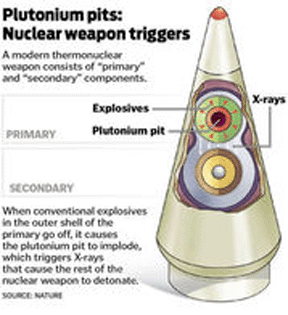
The primary U.S. plant to smelt plutonium, purify it and shape it into “triggers” (pits) for nuclear bombs was Rocky Flats Nuclear Weapons Site. From 1952 to 1989, Rocky Flats manufactured more than 70,000 pits at a cost of nearly $4 million apiece. Each one contained enough breathable plutonium particles to kill every person on earth. Virtually all of the waste produced there remains on-site. As we have learned through the SRS waste storage struggles, there is no place for it to go and no government plan to develop a repository. What’s made at a nuclear processing plant, stays at the nuclear processing plant.
Much went wrong at Rocky Flats due to mismanagement, criminal government indifference and public complacency. It took more than 30 years for the public to become so concerned with the pollution hazards issuing from the plant before the Department of Energy (DOE) was forced to hold a public meeting in 1988 to address the problems. One example: The plant produced one boxcar a week packed with 140 drums of radioactive waste. They were parked on site. Moisture penetration of a drum could have triggered an explosion. Ground water, soil and air pollution were also major hazards. A subsequent DOE study indicated that Rocky Flats was the most dangerous site in the country.
On June 6, 1989 more than 70 FBI and EPA agents raided the plant to begin an official investigation of the contractor and DOE for environmental crimes. The plant manager acknowledged that problems were solved “when DOE wanted to pay for them.” The final FBI/EPA allegations included concealment of environmental contamination, false certification of federal environmental reports, improper storage and disposal of hazardous and radioactive waste, and illegal discharge of pollutants into creeks flowing to drinking water supplies. Another independent study found there was enough lost plutonium in the plant exhaust ducts to create the possibility of an accidental nuclear reaction. According to a later DOE report, about 62 pounds of plutonium was lost in the plant air ducts; enough for seven nuclear bombs.
A grand jury was convened to hear the case on Aug. 1, 1989. The contractor argued in court that it could not fulfill its DOE contract without also violating environmental laws. In order to remediate the damage, on Sept. 28, 1989, EPA added Rocky Flats to its Superfund cleanup list. The grand jury worked until May 1991, then voted to indict the plant contractor, five employees and three individuals working for DOE.
The Department of Justice refused to sign the indictments despite more than 400 environmental violations that occurred during the decades of pit production at the plant. All charges were dropped. A settlement guaranteed the contractor and all indicted individuals immunity. Although the contractor pleaded guilty to criminal violations of the federal hazardous waste law and the Clean Water Act, the fine was only $18.5 million, less than the corporation had collected in bonuses for meeting production quotas that year. The contractor’s annual fee to run the site was estimated at $10 million, with an additional $8.7 million paid from DOE for management and safety excellence.
The contractor was also allowed to sue for reimbursement of $7.9 million from taxpayers for fees and costs related to its case. In addition, the contractor’s plea agreement indemnified it from further claims and all future prosecution, criminal or civil. The trial records are permanently sealed. Further, the contractor argued that everything it did at Rocky Flats was at the behest of DOE and maintained the right to receive future government contracts.
Grand jury members asked to write their own report but the judge refused to read it or release it to the public. Not surprisingly, the report was leaked to the press and printed in a Denver newspaper and Harper’s magazine. In January 1993, a Congressional committee finally issued a report revealing evidence of high-level intervention by Justice Department officials for the purpose of reducing the contractor’s fines.
DOE has estimated that it will take until 2065 to clean up Rocky Flats, at a cost to American taxpayers of more than $40 billion. One DOE official testified to the Senate Armed Services Committee that some weapons plants, like Rocky Flats, may never be cleaned up because we lack the technology to do so at a reasonable cost. Another investigator, testifying before the U.S. Senate’s Governmental Affairs Committee, stated he did not believe it possible to reverse the harm done at Rocky Flats.
Could this history repeat itself at SRS? Without a comprehensive cradle to grave plan with built-in irrevocable government funding and independent oversight, including citizen stakeholder input, SRS could become the next Rocky Flats. How likely is the government to attach such planning and funding to an SRS pit processing campaign? Past experience at SRS includes years of having to do best guess planning under continuing resolution funding and government failures to pass a budget, decades of “temporarily” storing deadly radioactive waste due to the government’s failure to meet off-site disposition commitments, budget reductions, program cancellations (most recently, the MOX project), and more.
Plutonium pit production waste is not just radioactive. It is nuclear waste on steroids. If produced here, it will likely remain in our backyard, along with all the decades old waste at SRS. There is no place for it to go. Looming large as examples of the dangers and difficulties SRS will face in having pit production waste moved off-site are the explosion and prolonged closure at the New Mexico Waste Isolation Pilot Plant (the government’s only operating repository) and the abandonment of the Yucca Mountain project.
Is it the CSRA’s responsibility to take on this mission? Pit production, while bringing jobs to the Aiken/Augusts area, will add to the decades old SRS hazards waiting for DOE remediation. SRS is already part of the DOE nuclear complex cleanup program. That mission, 30 some years old, drags on under the burden of DOE mismanagement and variable federal funding. Estimates are it will take another 70 years to clean up the DOE nuclear complex and cost about $500 billion more. Celebration of plans to add U.S. pit production to SRS is a rush to judgement. Only the usual corporations, living large off gigantic federal awards, stand to benefit.
Dr. Rose O. Hayes is a medical anthropologist who spent her career in public health. She holds a B.S., M.S., M.A., and Ph.D. from SUNY and completed post-doctoral work in skeletal biology at The George Washington University. From 2009 to 2015, she served on the U.S. Department of Energy Site-Specific Advisory Board for the Savannah River plant, chairing its Nuclear Materials Committee.
LeRoy Moore: Low-dose radiation can be more dangerous,http://www.dailycamera.com/letters/ci_32543151/leroy-moore-low-dose-radiation-can-be-more31 Mar 19 Though Maddie Nagle’s beautifully written column of March 8 criticizes me, more important is that she downplays the significance of low-dose exposure to the alpha radiation of plutonium at Rocky Flats. This could harm people unaware of the danger. Carl Morgan, the “Father of Health Physics,” studied the effects of radiation for those building Manhattan Project nuclear weapons. He knew that the alpha particles released by plutonium cannot be harmful unless inhaled or taken into the body through an open wound.
Toward the end of his life he spoke to Robert Del Tredici. He said “down at the low doses you actually get more cancers per person rem than you do at the high doses … because the high levels will often kill cells outright, whereas the low levels of exposure tend to injure cells rather than kill them and it is the surviving injured cells that are the cause for concern.” The effects of a small exposure “will be much more severe than had been anticipated.”(Del Tredici, “At Work in the Fields of the Bomb,” 1987, p. 133)
Nagle also makes misleading remarks about Tom K. Hei of Columbia University. Hei and colleagues demonstrated that a single plutonium alpha particle induces mutations in mammal cells. Cells receiving very low doses are more likely to be damaged than destroyed. Replication of these damaged cells constitutes genetic harm, and more such harm per unit dose occurs at very low doses than would occur with higher dose exposures. “These data provide direct evidence that a single alpha particle traversing a nucleus will have a high probability of resulting in a mutation and highlight the need for radiation protection at low doses.” (Hei et al., Proceedings of the National Academy of Sciences, vol. 94, April 1997, pp. 3765-3770.)
The demise of the only U.S.-Russia arms control pact limiting deployed nuclear weapons would make it harder for each to gauge the other’s intentions, giving both incentives to expand their arsenals, according to a study to be released on Monday.
The expiration of the New START accord also may undermine faith in the Nuclear Non-Proliferation Treaty, which calls on nuclear states such as the United States and Russia to work toward nuclear disarmament, as well as influence China’s nuclear posture, historically one of restraint.
The study, produced by the CNA Corp non-profit research group and seen by Reuters, is the most comprehensive public examination to date of the consequences of New START’s demise. It argues for extending the 2011 treaty, which expires in February 2021 but can be extended for five years if both sides agree.
The Trump administration is deliberating whether to extend the pact, which President Donald Trump has reviled as a bad deal and his national security adviser, John Bolton, has long opposed. Russia has said it is prepared to extend New START but wants to discuss what it regards as U.S. violations first.
The State Department did not immediately respond to a request for comment on the administration’s deliberations.
Trump has said Washington will withdraw from another arms pact, the 1987 Intermediate-range Nuclear Forces Treaty, this summer unless Moscow ends its alleged violations, compounding tense ties. Russia denies violating the INF treaty.
The New START treaty required the United States and Russia to cut their deployed strategic nuclear warheads to no more than 1,550, the lowest level in decades, and limit delivery systems – land- and submarine-based missiles and nuclear-capable bombers.
It also includes extensive transparency measures requiring each side to allow the other to carry out 10 inspections of strategic nuclear bases each year; give 48 hours notice before new missiles covered by the treaty leave their factories; and provide notifications before ballistic missile launches.
Both sides must also exchange data declaring their deployed strategic nuclear warheads, delivery vehicles and launchers, as well as breakdowns of how many of each are located at individual bases.
All of that would end if the treaty expires.
“Neither country would have the same degree of confidence in its ability to assess the other’s precise warhead levels,” CNA’s Vince Manzo wrote in the study. “Worst-case planning is also more likely as a result.
“Increased opacity between U.S. and Russian strategic nuclear forces would unfold within the broader context of growing mistrust and diverging perceptions about strategy, intentions, and perceptions,” he added.
Without the data, the United States would have to reassign its overworked satellites, possibly devoting more surveillance to Russia and less to China, Iran and North Korea.
Another casualty of the treaty’s expiration could be global nonproliferation, making non-nuclear states doubt the United States and Russia will keep working toward nuclear disarmament under the NPT, the study said.
While it was impossible to predict how China – estimated to have about 280 nuclear warheads – would react to New START’s expiry, the study cites factors that could make Beijing expand its capability.
Without a treaty limiting U.S. and Russian nuclear forces, China could overestimate their arsenals. Unconstrained U.S. and Russian forces could also strengthen voices in China that view a large arsenal as symbolically important, as well as those already advocating for more nuclear weapons.
The study recommends steps for the United States and Russia to mitigate the risks from the treaty’s expiration, including voluntarily sticking to its limits and continuing to exchange data. It also recommends Washington propose annual exchanges of nuclear weapons information and dialogue with Beijing.
Researchers under gag order couldn’t investigate true health impacts after Three Mile Island nuclear disaster
Residents around Three Mile Island were exposed to much more radiation from the nuclear disaster than was claimed by officials, a fact that was kept from researchers and the public for years.
After the Three Mile Island reactor core melted and radioactivity was released to the surrounding population, researchers were not allowed to investigate health impacts of higher doses because the TMI Public Health Fund, established to pay for public health research related to the disaster, was under a research gag order issued by a court. If a researcher wanted to conduct a study using money from this Fund, they had to obey two main parameters set forth by Federal Judge Sylvia Rambo, who was in charge of the Fund.*
Those studying the health impact of Three Mile Island radiation emissions were prohibited from assessing “worst case estimates” of radiation releases unless such estimates would lead to a conclusion of insignificant amount of harm — that being “less than 0.01 health effects”.
If a researcher wanted to claim more harm or investigate a worst-case scenario, an expert selected by nuclear industry insurers would have to “concur on the nature and scope of the [dosimetry] projects.”
We don’t know how much radiation was released because monitors were non-functional
Data from radiation monitors from the time were unreliable. The Kemeny Commission concluded “An exceptional percentage (well over half) of health physics and monitoring instruments were not functional at the time of the accident . . .” (from Beyea) Without properly functioning monitoring equipment, dose reconstruction — the method used to figure out how much radiation people were exposed to — is at best unreliable, at worst, deceptive.
Luckily, biology doesn’t lie
Biological data show some residents’ exposures were much higher — 60–90 rads — than officials or industry admitted at the time. To arrive at these doses, researchers (see the Wing study, below) used meteorological data to establish where the radiation plumes traveled that were released from TMI. Researchers then drew blood from people in these plume pathways who complained of symptoms associated with higher radiation exposure: vomiting, diarrhea, skin reddening (erythema). Using a chromosome test initially established in the 1960s and honed during examination of Chernobyl liquidators, researchers determined that the public in these plumes received 600-900 milligrays of radiation exposure — thousands of times higher than annual natural background doses; and very much higher than research paid for by the Fund could ever have assessed. Where mechanical dosimeters failed, residents’ blood did not.
Increases of disease with no cause
Studies conducted by three universities (Columbia, Pittsburgh, North Carolina Chapel Hill) on the impacts of the Three Mile Island disaster show breast, lung, leukemia and general cancer increases, some associated with proximity to the reactors, some in the pathways of the radioactive plumes. However, because of the proscriptive court order governing the TMI Public Health Fund, the two studies that were funded by it (Hatch, et al. from Columbia and Talbott, et al. from Pittsburgh) were unable to associate the disease increases in their studies to radiation exposure. These two investigators were forced to conclude “Radiation emissions, as modeled mathematically, did not account for the observed increase.” (emphasis added) Their compromised study conclusions help to prop up the continuing mirage that TMI did not damage health.
Independent research pointed to radiation as culprit
Only the research paper by Wing, et al., University of North Carolina Chapel Hill, was able to associate the cancer increases of lung and leukemia to radiation from Three Mile Island. These researchers had obtained independent funding, allowing them to not only investigate health outcomes, but to correlate them with radiation exposure, rather than rely on court-ordered restraints and industry-collected data. Lending further credibility to their research, Wing et al., examined bioindicators in the blood of residents. (See above).
Health studies need to focus on health outcomes, not dose
As demonstrated by the TMI Health Fund debacle, the starting point for any health study should NOT have been an assumption of dose, but an examination of disease increases in the surrounding community after TMI’s radiation releases. Assumptions, codified in the Fund, that doses were too low to cause health impacts were proved wrong by blood examinations. Yet, Judge Rambo decided, against this blood evidence, that higher doses from TMI were not worthy of study because they didn’t happen. This placed the researchers taking Fund money in a position of compromising their scientific integrity, and allowed the TMI Public Health Fund to serve as an instrument of obfuscation, rather than information.
Recent research points to continued concern
Current research has found that thyroid cancers in members of the TMI community carry a biological mark specific to radiation exposure, are more aggressive and appear earlier, than thyroid cancers outside of the TMI community. Although research is ongoing, these studies reveal that radiation from TMI may be implicated in thyroid disease – a correlation never admitted to by officials or industry.
Compromised science still with us
Despite the evidence in human blood, lived experience of the exposed, recognition of faulty monitors, and increases of cancers, the constant false narrative that TMI caused no harm remains. The faulty science that plagues the residents around TMI also pervades other radiation studies assessing health impact, including those following explosions at Chernobyl and Fukushima. We are still all impacted by this scientific and legal failing surrounding TMI, which makes it much harder to assess radiation’s impact on human health.
*“Radiation doses were calculated under an order from the court governing the TMI Public Health Fund. This order prohibited ‘upper limit or worst case estimates of releases of radioactivity or population doses . . . [unless] such estimates would lead to a mathematical projection of less than 0.01 health effects’. The order also specified that ‘a technical analyst . . . designated by counsel for the Pools [nuclear industry insurers] concur on the nature and scope of the [dosimetry] projects’” from Wing, 1997.
Cindy Folkers is the radiation and health specialist at Beyond Nuclear.
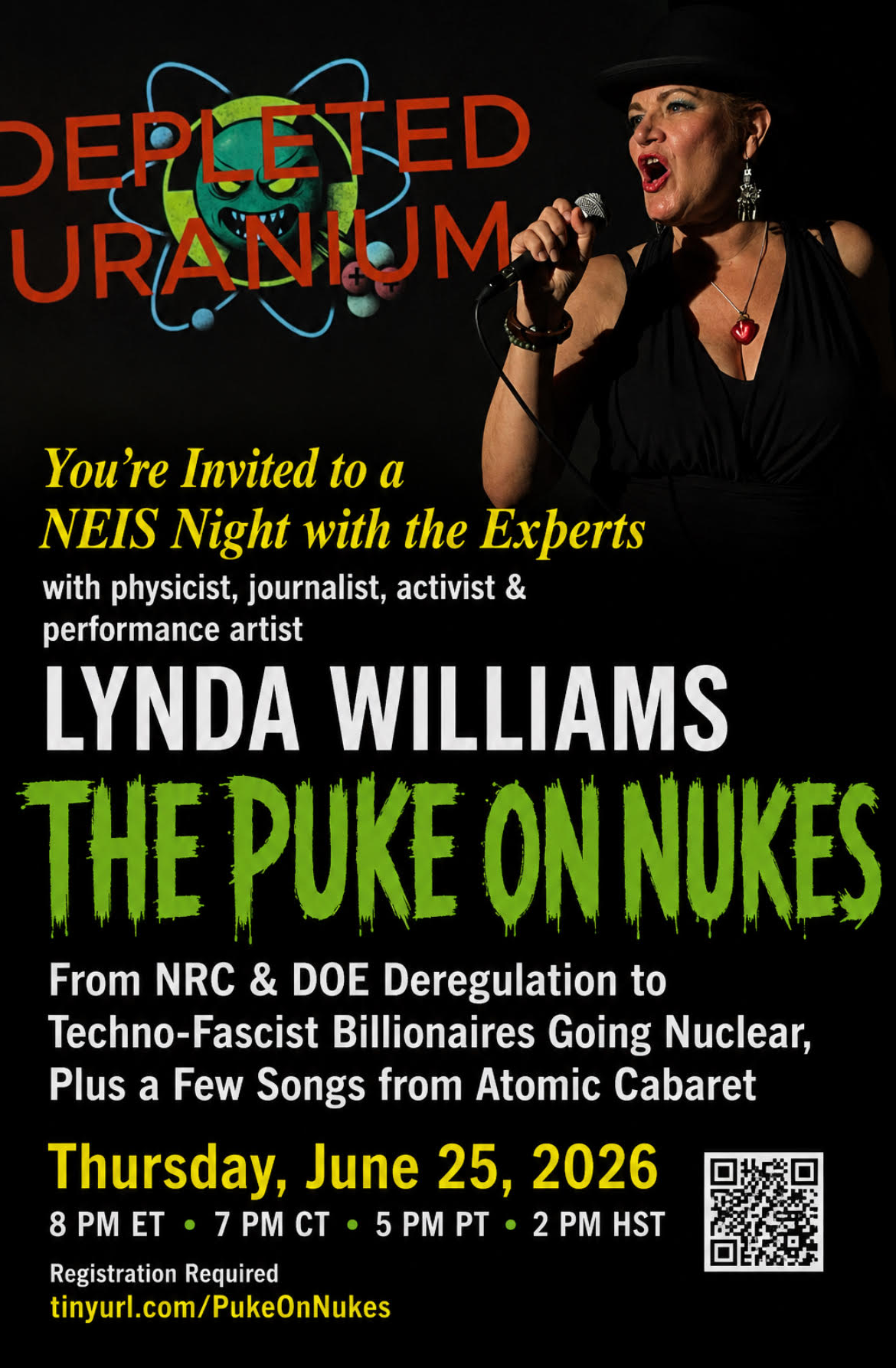
7pm Central Time (8pm ET, 6pm MT, 5pm PT) UTC – 5 From NRC & DOE Deregulation to Techno-Fascist Billionaires Going Nuclear, Plus a Few Songs from Atomic Cabaret REGISTER




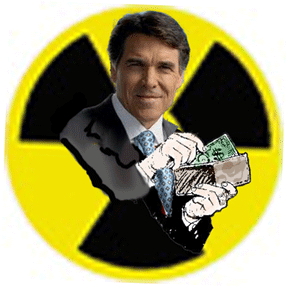 WASHINGTON — Energy Secretary Rick Perry acknowledged Tuesday that the Nevada National Security Site — where weapons-grade plutonium is being stored — and the proposed Yucca Mountain nuclear waste repository are located in an area considered a seismic hazard.






 nuclear-news