Nuclear energy and Price Anderson Act – too risky for insurance companies – just too dangerous
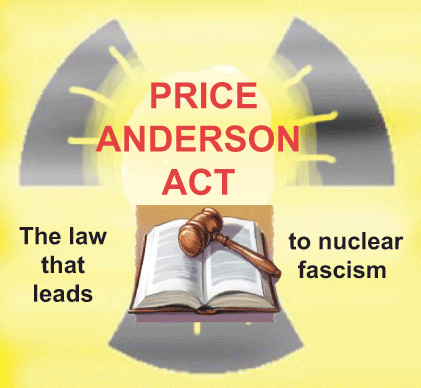
Should the U.S. Revive Nuclear Energy?, NYT Len Charlap, 10 Apr 19, Princeton, N.J. I will support nuclear power the day after the Price-Anderson Nuclear Industries Indemnity Act is repealed. If insurance company actuaries consider nuclear power to be so dangerous that they cannot compute premiums that the industry can afford, then that industry is not economically viable. If the government (i.e., taxpayers) has to cover the industry with catastrophic insurance, then the government should own the reactors and provide nonprofit energy.
We were lucky at Three Mile Island. We were minutes away from a complete meltdown that given the plant’s location would have killed thousands and done billions in damage. Investigations of Three Mile Island showed that, like the Deepwater Horizon disaster, extremely dangerous processes cannot be allowed to remain in control of people whose first responsibility is profit or return to shareholders…. https://www.nytimes.com/2019/04/09/opinion/letters/nuclear-energy.html
Indian Point nuclear station shut down for nearly two weeks: electricity maintained by gas and renewables
|
Behind the scenes, though, something occurred that made all that possible. In the days after Indian Point powered down — a rare occurrence prompted by a malfunction in one reactor and scheduled spring maintenance in the other — the state’s electric grid pivoted. With an assist from the grid’s overseers, the state’s energy resources shifted in a way that could offer a preview of what’s to come in the years ahead when Indian Point is scheduled to shut down for good…….. Nuclear power generated by three upstate plants decreased to 2,711 megawatts on March 18 from 4,240 megawatts on March 13, the data show. On just two of the seven days, the contribution from solar and wind power was more than 1,000 megawatts. “Natural gas is filling the gap,” said Darren Suarez, who keeps track of the state’s daily energy mix for the Business Council of New York state. “It’s the largest dispatchable resource that’s available at that point in time and we’d expect it to fill the gap.”…… those who monitor the state’s fuel mix say Indian Point’s shutdown provided a rare opportunity for a glimpse at what lies ahead unless renewable sources of power gain a larger percentage of the state’s energy mix. A snapshot in time taken from NYISO’s real-time dashboard, which is updated every five minutes, offers some insight into the state’s current fuel mix. For example, on April 1, wind and solar contributed about 6.5 percent of the state’s energy mix while another renewable, hydropower, was at 28.43 percent, NYISO data show. New York has the largest hydroelectric plant east of the Rockies in Niagara Falls……. Transmission of power problemGrid watchers say in order to add more renewables to the downstate grid, the state will need to resolve a transmission bottleneck that prevents upstate power from getting down into the Lower Hudson Valley and points south……… https://www.poughkeepsiejournal.com/story/news/2019/04/10/indian-point-shutdown-natural-gas-filled-nuclear-energy-gap/3417635002/ |
|

SNC-Lavalin nuclear contracts at risk if it’s convicted
https://www.hilltimes.com/2019/04/10/snc-lavalin-nuclear-contracts-at-risk-if-its-convicted/195245
Pompeo avoids questions on ending waivers permitting Iran’s ongoing nuclear work
|
Pompeo Won’t Commit to Shutting Down Iran’s Contested Nuclear Work
Pompeo avoids questions on ending waivers permitting Iran’s ongoing nuclear work Washington Free Beacon, BY: April 10, 2019 Secretary of State Mike Pompeo would not commit to ending a series of waivers issued by the Trump administration that have permitted Iran to engage in some its most contested nuclear work, including at a secretive military site that once housed the Islamic Republic’s nuclear weapons program. In an exchange with Sen. Ted Cruz (R., Texas), Pompeo declined to commit to canceling the disputed waivers, which have sparked an inter-administration battle, as first reported by the Washington Free Beacon. The issue of these waivers—which have been granted to Iran so that it can continue its lucrative oil trade, as well as nuclear research work—has generated a growing rift between Iran hawks on Capitol Hill and within the administration and Pompeo’s State Department. Sources have identified those in the State Department as the reason several policies that have kept the landmark Iran nuclear deal on life support have continued, despite President Donald Trump’s decision to walk away from the pact. Cruz and other Iran policy hawks have gone on record in recent weeks, including in interviews with the Free Beacon, to demand that Pompeo stop issuing both the oil and nuclear waivers. Multiple sources inside and outside the administration have described to the Free Beacon a widening fight between those U.S. officials who aim to keep the nuclear deal alive and those who see an opportunity to tighten the noose on Tehran and potentially collapse its hardline ruling regime……. The issue of these waivers—which have been granted to Iran so that it can continue its lucrative oil trade, as well as nuclear research work—has generated a growing rift between Iran hawks on Capitol Hill and within the administration and Pompeo’s State Department. Sources have identified those in the State Department as the reason several policies that have kept the landmark Iran nuclear deal on life support have continued, despite President Donald Trump’s decision to walk away from the pact…….. https://freebeacon.com/national-security/pompeo-wont-commit-to-shutting-down-irans-contested-nuclear-work/ |
|
Mesothelioma Compensation Center to the rescue of nuclear workers affected by mesothelioma
Mesothelioma Compensation Center Now Offers to Make Certain That a Nuclear Power Worker with Mesothelioma or Asbestos Exposure Lung Cancer Gets Accelerated Compensation with The Help of Attorney Erik Karst and His Colleagues at Karst von Oiste, Mesothelioma Compensation Center
PR NewswireApr 10, 2019, NEW YORK, The Mesothelioma Compensation Center is incredibly passionate about making certain that a person who was exposed to asbestos at any type of nuclear power plant and now has mesothelioma or asbestos exposure lung cancer receives the very best possible financial compensation. The group recommends the law firm of Karst von Oiste to assist people like this because they so much experience with power plants and asbestos exposure that would have occurred at these types of facilities as they would like to discuss at 800-714-0303. www.karstvonoiste.com
Rather than offering a free book about mesothelioma or asbestos exposure lung cancer the Mesothelioma Compensation Center offers direct access to attorney Erik Karst the founding partner of the law firm Karst von Oiste. The law firm of Karst von Oiste is one of the nation’s leading legal experts on mesothelioma or asbestos exposure lung cancer.
If the family of a nuclear power worker or a Navy Veteran who was exposed to asbestos on a nuclear submarine or aircraft carrier is concerned about compensation, they are urged to call the Mesothelioma Compensation Center anytime at 800-714-0303 for direct access to attorney Erik Karst for answers to questions about compensation and or how the compensation process works. http://MesotheliomaCompensationCenter.Com……
Rather than offering a free book about mesothelioma or asbestos exposure lung cancer the Mesothelioma Compensation Center offers direct access to attorney Erik Karst the founding partner of the law firm Karst von Oiste. The law firm of Karst von Oiste is one of the nation’s leading legal experts on mesothelioma or asbestos exposure lung cancer.
If the family of a nuclear power worker or a Navy Veteran who was exposed to asbestos on a nuclear submarine or aircraft carrier is concerned about compensation, they are urged to call the Mesothelioma Compensation Center anytime at 800-714-0303 for direct access to attorney Erik Karst for answers to questions about compensation and or how the compensation process works. http://MesotheliomaCompensationCenter.Com https://www.prnewswire.com/news-releases/mesothelioma-compensation-center-now-offers-to-make-certain-that-a-nuclear-power-worker-with-mesothelioma-or-asbestos-exposure-lung-cancer-gets-accelerated-compensation-with-th
General Electric avoids class action from Japanese homeowners and businesses affected by the 2011 Fukushima nuclear disaster
|
GE ducks lawsuit over Fukushima disaster https://www.reuters.com/article/generalelectric-fukushima-lawsuit/ge-ducks-lawsuit-over-fukushima-disaster-idUSL1N21R1REDena Aubin, 10 Apr 19A federal judge in Boston has dismissed a proposed class action against General Electric Co by Japanese homeowners and businesses affected by the 2011 Fukushima nuclear disaster, ruling that Japan is a better forum for the lawsuit.
In a decision on Monday, U.S. District Judge Patti Saris said a trial in the United States would burden the court, raise complex questions about nuclear plant design in Japan and require the translation of reams of documents into English. To read the full story on WestlawNext Practitioner Insights, click here: bit.ly/2KxaQxQ
|
|
The growing threat of nuclear confrontation
“Storm clouds are gathering”: Nuclear expert warns of new arms race
A New Nuclear Arms Race: As NATO Marks 70th Anniversary, Threat of Nuclear Confrontation Grows
JOE CIRINCIONE: We’re cursed in this discussion by a very narrow definition of national security. We’ve all come to accept that national security equals military forces and weapons, when, in fact, as you point out, a national security is more often determined by the health and welfare of its citizenry, the system of justice, whether citizens feel that they’re engaged in the country and have a role in the governance of that country. And spending on military is just one small part of national security, but this has become the test of whether a country is carrying its fair burden. So, burden sharing with NATO countries has been an issue in this town for decades. Republicans and Democrats have both harped on it, because it’s kind of an easy way for them to show that they’re tough, that they’re strong.
But let’s put this in perspective. What are we talking about here? The world as a whole, every year, spends about $1.7 trillion on military weapons and forces. One-point-seven. The United States and our NATO allies account for $1 trillion of that. So more than half of all global spending is spent by the United States and our NATO allies. The NATO allies alone account for about $240 billion. That’s what they spend. What are they spending it to guard against? Well, if you think that Russia is the main threat, Russia only spends about $66 billion every year on defense. In fact, its spending dropped by 20% between 2016 and 2017, the last year we have figures for. So, its spending is going down.
So why this demand for the NATO allies to spend more, when they’re beset with all kinds of problems that have nothing to do with military, all kinds of internal, economic, immigration problems, social justice problems, health and welfare problems? Why? Well, one, it’s simple. The 2% solution, it’s a simple mantra that is repeated. And, two, this directly benefits military contractors.
Who makes the money off of this? Well, most of the money that we spend in this country on defense, and that the Europeans spend, go to a relative handful of defense contractors: Boeing, Lockheed Martin, Northrop Grumman, Raytheon, etc. And they lobby incessantly for these kind of increases, in Washington, in NATO headquarters, in the capitals of Europe.
And now we have the absurd situation where a 31-year veteran of Boeing, a corporate executive, Patrick Shanahan, is the acting secretary of defense. I mean, this is such an obvious conflict of interest, you would think that people would say, “Well, no, you can’t do that.” But, of course, this is Trump’s Washington, where oil industry executives are running the EPA, and pharmaceutical companies run the FDA, so it’s become accepted. But it’s not right. It’s not fair. And it distorts us.
And it’s dangerous. Just one last fact: If you take Trump at his word that he wants them to contribute 4%, well, that means you want Europe to double their defense spending, from about $230 billion to $460 billion. For what? To do what? What does this go towards? We’ve lost track of the real security needs we face, and we’ve become obsessed with spending more and more on military weapons that in fact have only a minor role to play in the national security of a country.-year veteran of Boeing, a corporate executive, Patrick Shanahan, is the acting secretary of defense. I mean, this is such an obvious conflict of interest, you would think that people would say, “Well, no, you can’t do that.” But, of course, this is Trump’s Washington, where oil industry executives are running the EPA, and pharmaceutical companies run the FDA, so it’s become accepted. But it’s not right. It’s not fair. And it distorts us.
And it’s dangerous. Just one last fact: If you take Trump at his word that he wants them to contribute 4%, well, that means you want Europe to double their defense spending, from about $230 billion to $460 billion. For what? To do what? What does this go towards? We’ve lost track of the real security needs we face, and we’ve become obsessed with spending more and more on military weapons that in fact have only a minor role to play in the national security of a country…….
AMY GOODMAN: Joe, you’ve written several books, one of them Nuclear Nightmares: Securing the World Before It Is Too Late, and Bomb Scare: The History and Future of Nuclear Weapons. Do you think it’s too late? And what do you think needs to happen?
JOE CIRINCIONE: All the arrows are pointing in the wrong direction, so nuclear storm clouds are gathering. For example, John Bolton, the national security adviser, has been very successful in sabotaging talks with North Korea. The one benefit of the Trump presidency might be that he could negotiate a solid deal with Kim Jong-un. It now appears, according to reports this week, that at the Hanoi summit John Bolton sabotaged those talks by presenting a list of unacceptable demands, an all-or-nothing offer to the North Koreans that caused them to call off the talks.
He has killed the Intermediate Nuclear Forces Treaty. This is a Ronald Reagan treaty, that successfully pulled out and destroyed 3,000 nuclear weapons from Europe. You may have been covering this in the ’80s, Amy. When we were pouring nuclear weapons into Europe, massive demonstrations. The biggest rift in the NATO alliance until this point was that crisis. Ronald Reagan and Mikhail Gorbachev negotiated a treaty. Bolton never liked it. He killed it.
And why did he kill it? He used the excuse of a Russian violation, which I believe is real but the kind of thing that can be fixed within the treaty framework. And what—but why did they kill it? Because there are elements in the U.S. military and the defense industry that want to build new nuclear weapons that were prohibited by that treaty, to deploy against China and to put into Europe.
So, weeks after we announced we were withdrawing from the treaty, it was revealed that the Department of Defense is starting manufacturing, research and development and production of a new ground-launched cruise missile, a so-called GLCM. You may remember this phrase from the ’80s. It was GLCMs and Pershing IIs that we were pouring into Europe. And so, Secretary General Stoltenberg sought to assure the Congress that NATO would not accept a new intermediate nuclear forces nuclear weapon in Europe.
So Bolton is doing this a little cleverly. It’s like a Trojan horse. It’s going to be a conventionally armed ground-launched cruise missile, a conventionally armed GLCM, that will go into Europe, perhaps in the next couple of years. But, of course, you can easily swap out the conventional warhead for a nuclear warhead. So I think they’re planning to put these weapons in to avoid the kind of mass demonstrations, and later, possibly, equip them with nuclear weapons.
This is the kind of Cold War policy that we thought was behind us. We thought the arms race was over. It’s not over. We are in a new arms race. Every single nuclear-armed country is building new nuclear weapons and heading towards a confrontation point. You’ve got to be a real optimist to think that you can keep thousands of nuclear weapons in fallible human hands indefinitely and something terrible is not going to happen. I am very worried about the direction of the arms race, the direction of our policies.
AMY GOODMAN: Joe Cirincione, president of Ploughshares Fund, author of Nuclear Nightmares: Securing the World Before It Is Too Late and Bomb Scare: The History and Future of Nuclear Weapons. To see Part 1 of our interview, go to democracynow.org. This is Democracy Now!
https://www.democracynow.org/2019/4/8/trump_calls_for_growing_nato_budgets
“Northern Canada has warmed and will continue to warm at more than double the global rate.”
 Canada Warming Twice as Fast as World, Report Warns https://www.usnews.com/news/best-countries/articles/2019-04-05/global-warming-is-twice-as-fast-in-canada-as-rest-of-the-world-report-says?int=98f508
Many environmental effects being seen in the country are ‘effectively irreversible, say authors of study.
The North American nation is warming on average at twice the rate of the rest of the world, according to a new scientific report produced by the Environment and Climate Change Canada, the national government agency responsible for coordinating the country’s environmental policies. The average temperature in Canada today is 1.7 degrees Celsius (3 degrees Fahrenheit) higher than 70 years ago, according to the report. By comparison, the average global temperature increase during the same period is 0.8 degrees Celsius.
Both past and future warming in Canada is, on average, about double the magnitude of global warming,” say the authors of the report. “Northern Canada has warmed and will continue to warm at more than double the global rate.”
Additionally, the warming produced from carbon dioxide emissions from human activity is “effectively irreversible,” the report’s authors warn.
Among some of the report’s major findings:
- Changes in temperature already show in various areas of the country and scientists say they will only intensify.
- Precipitation is projected to increase, on average, yet summer rainfall may decrease in particular regions.
- The Canadian Arctic and Atlantic Oceans have been the most impacted, with both experiencing “longer and more widespread sea-ice-free conditions”, the report says.
- The availability of freshwater is changing, the report says, with the risk of water supply shortages expected to increase in the summer.
The magnitude of climate change in high versus low emission scenarios paint two future scenarios for the country, according to the scientists. If large and rapid warming occurs, Canada’s climate with be severely affected as greenhouse gas emissions will grow. Limited warming may only occur, the report notes, if Canada and the rest of the world work on eliminating carbon emissions early in the second half of the century and on substantially lowering other greenhouse gases
Research for the report began in February 2017 and draws “primarily from existing sources of information that have been peer-reviewed and are publicly available,” the authors say.
The report’s authors also say human influence on climate change is clear. “It is likely that more than half of the observed warming in Canada is due to the influence of human activities.”
Earlier this year a global survey of people in 26 countries named climate change as the greatest threat to international security.
Kings Bay Plowshares: Peace Activists Face 25 Years for Action at U.S. Nuclear Submarine Base
NY Radiation Specialists Unveils State-of-the-Art Linear Accelerator at NYCBS
NY Radiation Specialists Unveils State-of-the-Art Linear Accelerator at NYCBS benzinga, 8 Apr 19, Port Jefferson Station, NY, April 08, 2019 –(PR.com)– On Tuesday, March 25, New York Radiation Specialists unveiled its brand new Varian Halcyon Linear Accelerator, at New York Cancer & Blood Specialists’ Eastchester Center for Cancer Care. The “NYCBS” Eastchester location is a multi-lingual facility located at 2330 Eastchester Road in the Bronx, just minutes from the Pelham Parkway. The Halcyon makes the NYCBS Eastchester Center for Cancer Care the most state-of-the-art radiation site in the region.
Concern in both Democrats and Republicans about Hanford nuclear waste, as costs escalate, and Trump administration cuts back the budget
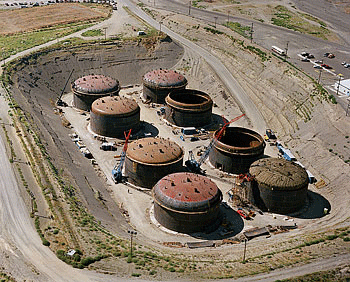 The Columbian 6th April 2019 The slow pace of cleaning up the nation’s largest cache of radioactive
waste left over from the production of nuclear weapons is frustrating state
officials from both major political parties, who blame the Trump
administration for not doing more.
The U.S. Department of Energy recently
proposed hundreds of millions of dollars in budget cuts for cleaning up the
vast Hanford Nuclear Reservation in southeastern Washington, even though
the estimated cost of the cleanup has at least tripled and could reach more
than $600 billion.
“That’s a huge, huge cost increase,” said Tom
Carpenter, director of the watchdog group Hanford Challenge. At a hearing
in Washington, D.C., last week, Democratic Sen. Patty Murray questioned
Energy Secretary Rick Perry’s assertion that his agency can still meet a
legally-binding cleanup schedule despite the proposed budget cuts. Much of
the site’s aging infrastructure is deteriorating, including underground
waste storage tanks and tunnels.
Concern over Chalk River Nuclear Site’s radioactive wastes
How safe is the Ottawa River from nuclear waste? Canada’s National Observer April 8th 2019 “……..Canada’s first nuclear reactor began operating at Chalk River, about 160 kilometres northwest of Ottawa. Since 1944, the facility has served as Canada’s major nuclear science hub. Researchers at CRL have studied reactors, nuclear energy and weaponry and produced medical isotopes for patients around the world.
“It is crucial to protect the drinking water source of over two million people,” says Ottawa Riverkeeper, a full-time, non-profit organization that serves as a public advocate for the watershed and is a key intervenor in the environmental assessment of the waste proposal.
The Chalk River site resembles an old university campus. It’s cut out of a thick and isolating forest spanning about 10,000 acres, with neatly trimmed patches of grass, and a regimented mix of large brick and smaller white structures.
The facilities owned by Canadian Nuclear Laboratories (CNL) are about seven kilometres from the gate at the border of Chalk River, a community of fewer than 1,100 residents, some of whom work at the lab which has about 2,800 employees.
Signs on a chain link fence and tree trunks along the perimeter indicate the grounds are protected by armed officers. Surveillance cameras cast a visual blanket over the road to the security clearance booth and over much of the site.
Chalk River Laboratories has for decades faced questions over the way it deals with its radioactive waste. Environmentalists have decried the facility for discharging waste into the river and for leaks. CNL says its methods for treating waste are sound and the regular liquid effluent discharges into the river have no significant public health or environmental impact on drinking water. It reports a steady evolution of environmental stewardship.
Fresh concern erupted after CNL announced detailed plans to build a nuclear disposal facility to permanently house one million cubic metres of radioactive waste — about 400 Olympic-sized swimming pools worth.
In May 2016, the Canadian Nuclear Safety Commission launched the environmental assessment process for the disposal project with an initial call for public comment.
Environmentalists and concerned citizens questioned how nuclear waste can remain securely contained for hundreds of years, and how it might endanger water quality if any leaks.
The waste has accumulated over decades of Chalk River’s operations. It includes low-level material, such as equipment from operations that has been irradiated and buildings that housed the reactors, and intermediate-level waste, such as filters used to purify reactor water systems and reactor core components. The irradiated material sits anywhere from a few metres to a few kilometres from the Ottawa River. ……..
Canadian Nuclear Laboratories (CNL) promotes itself as a global leader in developing applications for nuclear technology through research, engineering and waste management services.
It is a subsidiary of Atomic Energy of Canada Limited (AECL), a federal Crown corporation, and operated by the Canadian National Energy Alliance, a private consortium. Its operations are licensed by the Canadian Nuclear Safety Commission, the nation’s nuclear regulator.
What do water quality tests near Chalk River say?
Some nearby residents and environmental groups have argued that, while CNL says it is committed to safeguarding the health of the Ottawa River during the decommissioning process, questions remain about the lab’s ability to safely dispose of radioactive waste.
The lab’s history is peppered with minor leaks and malfunctions – and a few major ones. Critics worry that the organization’s confidence in the safety of decommissioning efforts is misplaced.
For instance, critics claim the lab is not fully transparent about its water quality testing methods and has not properly informed the public on plans for permanent storage and disposal of the radioactive material.
Ottawa resident Ole Hendrickson is a member of the Concerned Citizens of Renfrew County and Area, an Ottawa-based environmental activist group whose volunteers have worked for the clean-up and prevention of radioactive pollution from the nuclear industry in the Ottawa Valley for more than 40 years. He’s also a member of CRL’s environmental stewardship council, which convenes company officials, community representatives and other stakeholders several times a year to discuss updates from the lab.
Hendrickson said in an interview that CNL is stingy about providing environmental monitoring data, and that many of the documents with information on testing he has received through access to information requests include significant redactions.
Yet authorities in nearby towns appear unconcerned.
Brenda Royce works at the Ontario Clean Water Agency in Petawawa, about 20 kilometres downstream from Chalk River. It is a provincial Crown agency that the town contracts to do its water quality testing and water system maintenance.
In addition, Royce said her office collects a water sample from the Ottawa River at Petawawa every day for CNL to conduct its own tests. But the office does not get the results of the tests back from the private lab.
Every year, Petawawa’s water agency publishes its own report on the town’s drinking water quality and treatment system. The agency’s report includes testing for many chemicals — including uranium — but not for the two main radionuclides that might be discharged from Chalk River Laboratories operations: tritium and strontium. “It’s just what we do,” Royce said, adding she has never been curious to see results on radioactive waste in the water system.
Petawawa’s director of public works said he has never met with Chalk River officials over potential water quality hazards in the area……..
In 2012, the site’s former Crown operator contracted Université Laval to conduct independent environmental tests of the water, air and vegetation around Chalk River Laboratories and the municipalities of Petawawa and Pembroke, just south of the facility, which would be most directly affected by any potential nuclear contamination in the river. The results for 2012, 2013 and 2015 have been posted on the nuclear industry regulator’s website, and results for 2018 will be published. As of yet, no tests returned results that were expected to cause adverse health effects.
Canada’s Nuclear Safety Commission did not provide data or respond to technical questions before publication and was not available for an interview.
Test results from 2015 show levels of radioactive isotopes present in the river, such as strontium and tritium, were far below the threshold that would affect human health.
Health Canada guidelines state the maximum concentrations of strontium and tritium in drinking water are seven milligrams per litre, and 7,000 becquerels per litre, respectively.
Independent tests for strontium and tritium in the Ottawa River at Rolphton, Petawawa, and Pembroke were conducted specifically for this story. The results found strontium and tritium were not at dangerous levels in the water, as of November 2018. All indicated waste levels in the river were similar to results found by researchers from Université Laval in 2015, and reported last year by the lab itself.
While some local opponents believe there is no safe dose of radiation or safe level of radioactive waste, CNL says it abides by the standards set by the Canadian Nuclear Safety Commission and the International Atomic Energy Agency, a United Nations body.
Members of CNL’s team acknowledge there are differences in international standards when it comes to certain substances, including tritium and strontium………..
When it comes to its own environmental monitoring, CNL releases a monthly performance report that indicates routine groundwater sampling at 170 locations across the site. The report does not include detailed results for the specific radioactive substances tested.
The Ontario Ministry of Environment conducts water quality tests at Petawawa every year and has never shown any concern over potential nuclear material in the water. As part of its Nuclear Reactor Surveillance Program, the Ontario Ministry of Labour published reports in 2011 and 2012 that show very low tritium levels in Ottawa’s water. No further reports have been published since.
This publication contacted recently elected municipal and provincial representatives, and the local federal politician whose seat will be up for election in 2019.
None of the representatives for the Chalk River area commented on the proposed waste facility or its possible impact on water quality. Renfrew-Nippising-Pembroke MPP John Yakabuski did not provide an interview. The area’s federal MP, Cheryl Gallant, was not available. Laurentian Hills mayor John Reinwald, the chief administrative officer and all council members did not respond to interview requests………..https://www.nationalobserver.com/2019/04/08/features/how-safe-ottawa-river-nuclear-waste
Many obstacles to small modular nuclear reactors, but U.S. Nuclear Regulatory Commission recommends them, anyway
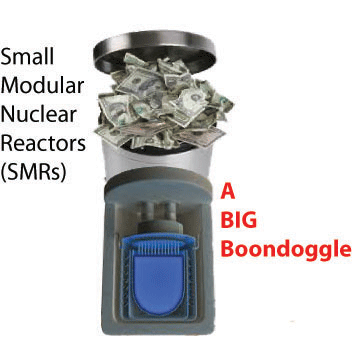 NRC recommends issuing early site permit for Clinch River Nuclear Site, OAK RIDGE TODAY, APRIL 8, 2019BY The U.S. Nuclear Regulatory Commission has issued a final environmental impact statement, and the staff has recommended, based upon the environmental review, issuing an early site permit for the Clinch River Nuclear Site in west Oak Ridge, where two or more small modular nuclear reactors could be built.The final environmental impact statement, or EIS, was issued by the NRC on April 3. A notice of the EIS and the staff’s recommendation were published in the Federal Register on Monday, April 8.
The 935-acre Clinch River Nuclear Site is located in Roane County along the Clinch River……….
An early site permit is the NRC’s approval of a site for one or more nuclear power facilities. It does not authorize the actual construction and operation of a new nuclear power plant. That requires a construction permit and an operating license, or a combined license. ………
The Clinch River Nuclear Site could be used to demonstrate small modular reactors with a maximum total electrical output of 800 megawatts………
Now that the final EIS has been published, there will be a mandatory hearing with the NRC after a final safety evaluation report is issued. The NRC expects that report to be published in June. The five-member commission will make a decision after the hearing about whether to issue the early site permit.
A contested hearing could be held by the Atomic Safety and Licensing Board panel if a member of the public or an organization successfully files a petition that raises safety or environmental concerns about granting the site a permit, the NRC said.
The NRC said an authorization for the construction or operation of new nuclear units at the Clinch River site is not being sought at this time.
The potential timing of any reactors being built at the site is not clear. Among other things, TVA doesn’t control the reactor certification process.
“There are currently no certified small modular reactor designs available, but TVA will continue working to ensure we are ready to fully evaluate them when they are available,” Hopson said.
Financial considerations would have to be evaluated, and the TVA board of directors would have the final decision “based on what they believe will be in the best interest of the people of the Tennessee Valley,” Hopson said.
Since a design hasn’t been certified for a small modular reactor, TVA used what is known as a “plant parameter envelope” as a surrogate for a nuclear power plant and its facilities when applying for the early site permit. The “plant parameter envelope” estimated the potential environmental impacts of building and operating two or more small modular reactors at the site. TVA used information from four small modular reactor vendors to develop the “plant parameter envelope.”
A reader has asked why TVA might consider adding new generating capacity at the Clinch River site even as it plans to retire coal-fired units like the Bull Run Fossil Plant in Claxton, citing flat or declining demand………https://oakridgetoday.com/2019/04/08/nrc-recommends-issuing-early-site-permit-clinch-river-nuclear-site/
SCANA ends internal investigation into failed nuclear reactor project
SCANA ends internal investigation
https://www.counton2.com/news/south-carolina-news/scana-ends-internal-investigation-into-f
Jail for hospital manager who took $10 million bribe from SNC Lavalin.
Former hospital manager who took $10 million bribe to favour SNC Lavalin bid sentenced to 39 months in prison https://business.financialpost.com/news/fp-street/ex-manager-sentenced-to-39-months-prison-in-hospital-corruption-fraud?fbclid=IwAR35AX1LrS6gLpVV1uHbnxVV1YmiImTnfFhjQHKAlpUe_n_4VInQAx9ksv4#comments-area 8 Apr 19, MONTREAL — A former hospital manager who pocketed a $10-million bribe in return for helping SNC-Lavalin win a Montreal hospital-building contract has been sentenced to 39 months in prison.
Quebec court Judge Claude Leblond sentenced Yanai Elbaz today in Montreal in a case that has been described as the greatest corruption fraud in Canadian history.
The judge rejected an argument from the McGill University Health Centre, which claimed it was entitled to compensation as a victim of the fraud. He ruled the question should be dealt with through civil proceedings.
In an agreed statement of facts tied to Elbaz’s plea, the former MUHC manager admitted to giving privileged information to engineering firm SNC-Lavalin to help its submission for the contract to build a massive hospital complex in west-end Montreal.
Elbaz, who has been detained since his Nov. 26 guilty plea, also admitted to denigrating SNC’s competitors in front of the hospital’s selection committee.
Elbaz and Arthur Porter, the ex-CEO of the MUHC who died a fugitive in Panamanian custody in 2015, received a total of $22.5 million to rig the bidding process to favour SNC-Lavalin, the statement of facts said.
1 This Month

22 June – Virtual Event –Climate Change: New Data, New Debate

Monday, June 22, 2026 2:30 p.m. – 3:15 p.m. CT
YouTube. Register here
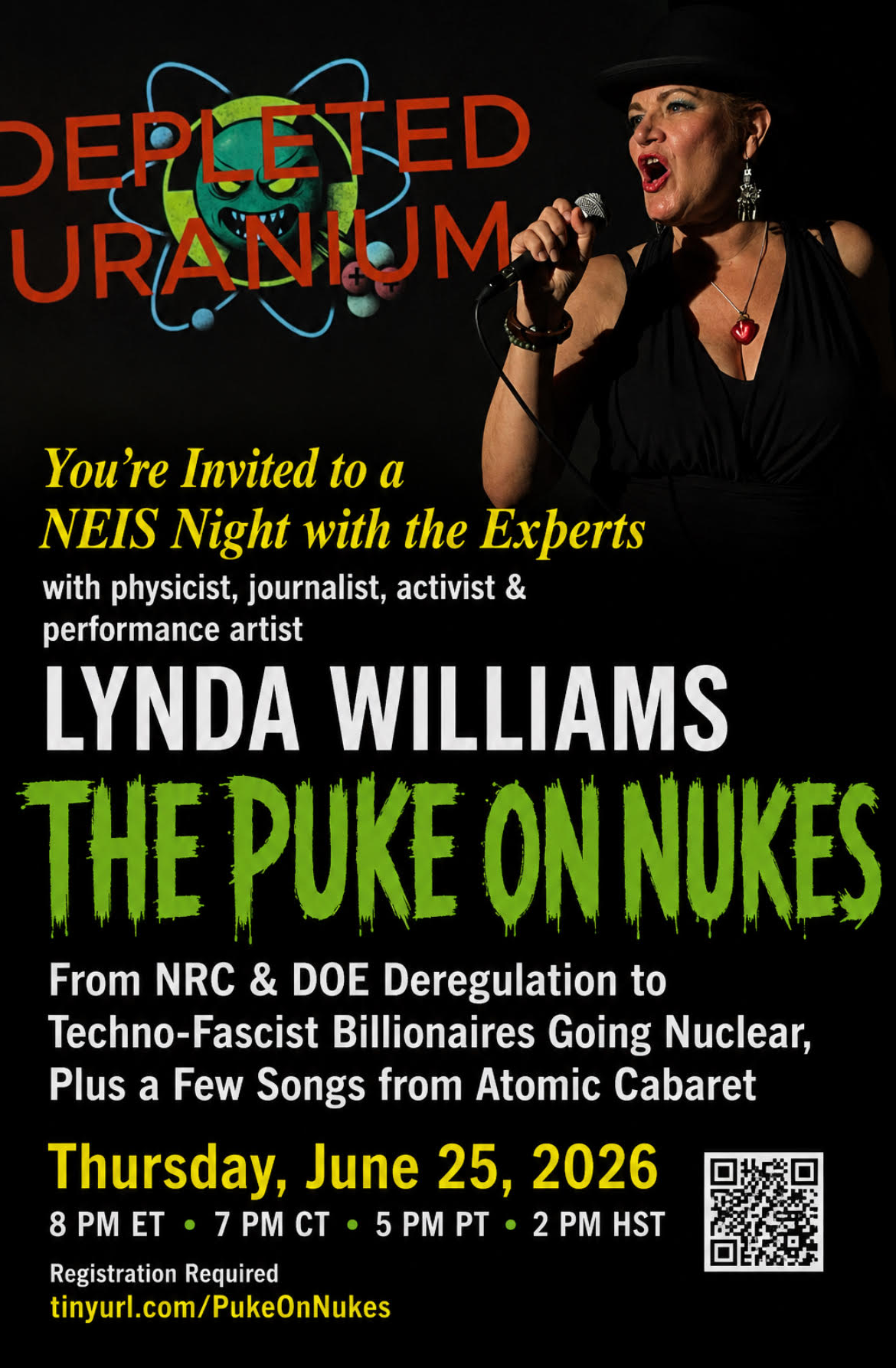
25 June- THE PUKE ON NUKES
Thursday, June 25, 2026
7pm Central Time (8pm ET, 6pm MT, 5pm PT) UTC – 5
From NRC & DOE Deregulation to Techno-Fascist Billionaires Going Nuclear, Plus a Few Songs from Atomic Cabaret REGISTER
26 June – Radiation Trainwreck at the NRC / Join the Protect Better Campaign – https://us02web.zoom.us/meeting/register/4ZlZ5_qLSHGiLSCg8FF6Bg#/registration
1st July – Webinar Waste of Space: The Environmental Harm of Military and Civil Space Activity st July, 7 pm

Report Launch Online: We are seeing an increasing exploitation of space for military and commercial purposes. This must change.

Protect Sazan Island from the Trump family! https://secure.avaaz.org/campaign/en/protect_sazan_island_from_the_trump_family_loc/?bqFCVab&v=174511&cl=22707147157&_checksum=5e9dde668860e8231c33699735e16a1fbf22ab2cb01da50c999fe8732b9775ef&utm_source=email&utm_medium=blast_email&utm_campaign=174511


Cuba Is Not a Failed State – It Is a Besieged State
PETITION: “Global Appeal to Endorse Palestinian Right of Return of Refugees”
To see nuclear-related stories in greater depth and intensity – go to https://nuclearinformation.wordpress.com
-
Archives
- June 2026 (227)
- May 2026 (306)
- April 2026 (356)
- March 2026 (251)
- February 2026 (268)
- January 2026 (308)
- December 2025 (358)
- November 2025 (359)
- October 2025 (376)
- September 2025 (257)
- August 2025 (319)
- July 2025 (230)
-
Categories
- 1
- 1 NUCLEAR ISSUES
- business and costs
- climate change
- culture and arts
- ENERGY
- environment
- health
- history
- indigenous issues
- Legal
- marketing of nuclear
- media
- opposition to nuclear
- PERSONAL STORIES
- politics
- politics international
- Religion and ethics
- safety
- secrets,lies and civil liberties
- spinbuster
- technology
- Uranium
- wastes
- weapons and war
- Women
- 2 WORLD
- ACTION
- AFRICA
- Atrocities
- AUSTRALIA
- Christina's notes
- Christina's themes
- culture and arts
- Events
- Fuk 2022
- Fuk 2023
- Fukushima 2017
- Fukushima 2018
- fukushima 2019
- Fukushima 2020
- Fukushima 2021
- general
- global warming
- Humour (God we need it)
- Nuclear
- RARE EARTHS
- Reference
- resources – print
- Resources -audiovicual
- Weekly Newsletter
- World
- World Nuclear
- YouTube
-
RSS
Entries RSS
Comments RSS
 nuclear-news