Florida nuclear station gets license for 80 Years
| D |
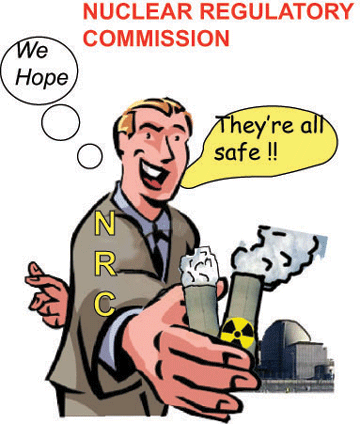
FPL’s Turkey Point first US nuclear plant to get license out to 80 years, Utility Dive, By Kavya Balaraman Dec. 7 2019,
Dive Brief:
The majority of nuclear power plants in the U.S. are currently on a renewed license — extending their initial 40-year operational lifespan to 60 — but as more reach the 60-year mark, the NRC is gearing up for “subsequent license renewals,” which would authorize the plants to operate for another two decades. …….
Damon Moglen, senior strategic advisor of the Climate and Energy Program at Friends of the Earth, called the development “a licensing disaster waiting to happen.” The Turkey Point facility remains vulnerable to climate change, he said, and the region is expected to experience rising sea levels by the 2050s.
This decision in no way serves the public and the environment, it only serves the interest of a very precise industry looking to protect its profits,” he said. https://www.utilitydive.com/news/fpls-turkey-point-first-us-nuclear-plant-to-get-license-out-to-80-years/568593/
|
|
Paducah, Kentucky – its nuclear waste tragedy is compounded by climate change
“I never said a bad thing about the plant the whole time I was growing up,” Lamb said. “It made the economy good. But then we got sick.”
“People who were not highly educated could make really good money working in these industries
“Not only that but the government was saying, this is your patriotic duty. We need this. So everybody just went along because the compensation was pretty good.”
a GAO report released in November showed that 60 percent of U.S. Superfund sites are at risk from the impacts of climate change.
Instead of focusing on cleanup plans, some state lawmakers and federal agencies are loosening regulations on hazardous sites…… Last year, the DOE also moved to relax restrictions on the disposal and abandonment of radioactive waste
|
For over half a century, the plant was Paducah’s main employer, providing up to 7,000 jobs in a place where nearly a quarter of people now live in poverty. But poor working conditions and unregulated waste disposal also harmed Paducah residents. The legacy of these problems have cost the town and taxpayers. Despite multiple recommendations from a watchdog government agency, the Department of Energy is decades behind schedule on cleanup efforts.
Some experts say the federal government doesn’t know the full cost or scope of what cleaning them up will entail, and that becomes more complicated with more frequent extreme weather. It’s a problem Superfund sites — and especially nuclear waste sites — around the country face.Lynn said there’s a lot of secrecy surrounding the cleanup, as well as the health risks that may be associated with it. He’s just one Paducah resident, along with a slew of former workers, who say they’ve been left in the dark about problems with a complex cleanup. ….
There are 16 nuclear sites still managed by the U.S. Department of Energy (DOE) across the country — from Vermont to Washington, Nevada to South Carolina — most of them built between the 1940s and 1950s. Some created nuclear defense materials like plutonium — a core ingredient in atomic bombs that is 100,000 times as radioactive as uranium and can cause liver, lung, and bone cancer.
The Paducah Gaseous Diffusion Plant was one of the smallest projects in the U.S. When the plant was built in 1952, the town proudly adopted a new moniker: “Atomic City.” While gaseous diffusion was the public face of the plant, there were other operations, including programs with NASA, storing defunct materials from Oak Ridge, and work for Sandia, a nuclear security laboratory. By the early 1990s, many of the plants, including Paducah, had started transitioning to produce uranium for the nuclear power reactors that now provide a fifth of U.S. electricity generation.
“People who were not highly educated could make really good money working in these industries so you could have a good house, a boat, a couple of cars, raise your kids and send them to college,” said Mark Donham, who used to manage the DOE’s Citizens Advisory Board, which helps the agency monitor the plant’s environmental remediation. “Not only that but the government was saying, this is your patriotic duty. We need this. So everybody just went along because the compensation was pretty good.” However, a 1999 investigation by The Washington Post revealed the federal government used the plant to illegally recycle over 103,000 tons of used nuclear reactor fuel containing plutonium and other transuranics — man-made heavy metals derived from splitting atoms. The same year, workers filed a $10 billion class action lawsuit against three federal government contractors that led to the passage of a federal law intended to compensate current and former employees (or their survivors) for exposure to cancer-causing radiation.
Greg Landhorff, a utilities worker at the plant for 30 years, wasn’t involved in the lawsuit, but said he was exposed to “all kinds of different chemicals.” He said the exposure was an open secret, and workers weren’t given proper equipment or training. He claims operators told him about the exposure when he was hired, but didn’t report it because they didn’t want to lose their jobs. Landhorff now rattles off his health issues like a grocery list: beryllium disease, COPD, chronic bronchitis, and skin cancer.
Although the plant closed in 2013, hundreds of people still work on site. Nuclear sites often function like small towns, with wastewater treatment and steam plants, sewers, landfills and lagoons, administrative offices, enormous water towers, and medical centers. David Trimble, director of the Government Accountability Office, or GAO, said 30 to 60 percent of the DOE’s cleanup budget goes toward these “recurring activities.” The same is true for Paducah: Dawn Harris-Young, a spokesperson for the southeast regional EPA, said that only a “small fraction” goes toward environmental cleanup post-closure. This means that until the site is torn down, day-to-day operation often takes up more of the DOE’s cleanup budget than the necessary environmental remediation.
The DOE has demolished 84 facilities, removed over 66 million pounds of contaminated scrap material, and dug up over a million cubic feet of contaminated soil. While there is no official estimation of how much contaminated material remains, at least 400 buildings — and everything inside them — still need to be decontaminated and demolished at the Paducah site. The DOE requested $277 million specifically for Paducah in 2020, despite its budget for nuclear cleanup shrinking by $50 million in the last five years. But it’s still a small fraction of the budget DOE will need: cleanup isn’t expected to be completed until 2065, and the EPA has said it could take even longer because of the lack of knowledge about sources of contamination and the vast size of the facility. The waste at Paducah includes the gaseous diffusion plant, buried radioactive disposal sites, and waste leftover from neighboring nuclear sites in Ohio and Tennessee. It also includes over 52,000 cylinders of uranium hexafluoride, or spent uranium fuel, much of it from Oak Ridge. But there is still no solution for how to dispose of spent nuclear fuel, except to bury it. In recent decades, federal and state regulators have strategized for the remediation of these sites. But some have faced major problems like fires, radioactive leaks, and spills. According to Rodney Ewing, nuclear security expert at Stanford University, “there’s no path forward” to dispose of uranium hexafluoride, either. “That’s why they’re still stored in tanks out back,” he said. When the leaves fall on Ronald Lamb’s property, he can see the water tower and the grey siding of facility buildings at the Paducah plant just two miles away. On the road near Big Bayou Creek, which runs through both the plant and his 120-acre property, signs warn against getting in the water. His well is padlocked because of groundwater contamination from trichloroethylene, or TCE — a degreaser used to clean uranium equipment — which can impact childhood development, damage the central nervous system, and is linked to cancer. Lamb said the well water left his family with severe gastrointestinal problems. “I never said a bad thing about the plant the whole time I was growing up,” Lamb said. “It made the economy good. But then we got sick.” DOE officials report that the agency has cleaned over four billion gallons of contaminated groundwater through a pump and treat system, but two toxic plumes of TCE still flow through four miles of groundwater that lead to the Ohio River. The DOE lacks a national strategy for nuclear cleanup, instead relying on site managers to contract with companies that manage, operate, and cleanup nuclear facilities. The Paducah cleanup is now being managed by Four Rivers Nuclear Partnership, a conglomeration of companies hired by the DOE for soil and groundwater remediation. One of them is Jacobs Engineering, a contractor that was sued for exposing hundreds of workers to toxic substances during cleanup of the nation’s largest coal ash spill in Tennessee; more than 40 have died. At least three other nuclear sites — Oak Ridge, Hanford in Washington, and Savannah River in South Carolina — have also contracted with Jacobs. (Jacobs Engineering declined an interview for this story.) The DOE also declined to answer questions but said the agency was committed to the safe remediation of the plant and that they “look forward to continuing successful cleanup efforts in the future.” The agency works with the Citizens Advisory Board — a group of community members who apply and are appointed as well as liaisons from Kentucky and the regional EPA office — on environmental management at the Paducah site, including the monitoring of groundwater and planning for the site’s future use. Lamb advocated for the board many years ago, and the bi-monthly meetings are supposed to serve as a public comment period. The board doesn’t have any power beyond giving recommendations to the agency, and current and former members are divided about its effectiveness. Lesley Davis joined for about a year in 2016; her grandfather had worked at the plant and died of cancer. “It was informational at times, but it didn’t feel like it was making much of a difference,” she said. “In hindsight, it felt like they were trying to keep a good public face.”…….. In February, Paducah put up its floodgates, families stacked sandbags, and the bridge over the Ohio River to Illinois closed as floodwaters as rains drowned the region. According to local news stations, highway crews reported so much water they had trouble setting up warning signs. Former Kentucky Gov. Matt Bevin declared a statewide emergency due to heavy rainfall and flooding. The Ohio River, three miles north of the Paducah plant, had record flooding in 2018 and 2019. Record flooding this year across the Midwest hit eight Superfund sites, and a GAO report released in November showed that 60 percent of U.S. Superfund sites are at risk from the impacts of climate change. By mid-century, there will be heavier rainfall, increased flooding, and more intense hurricanes in the Southeast, which has nearly a quarter of the 1,335 active Superfund sites on the EPA’s National Priority List. ……… The Green New Deal resolution, which has not yet passed through the U.S. House of Representatives, identified cleaning up brownfields — contaminated sites previously used for development — and hazardous waste sites like Paducah as a key priority in restoring the American landscape — but there’s not yet a road map for that plan. While underground waste repositories may provide a solution, Ewing said that over the long term, the changing climate could make it more challenging: in a wetter environment, the amount of water leaking through the rock over the repository could be expected to increase. Instead of focusing on cleanup plans, some state lawmakers and federal agencies are loosening regulations on hazardous sites. In 2017, Kentucky passed a bill lifting a nuclear moratorium, a move that some hope will turn the site into a research facility or nuclear reactor; the law loosens the requirements for toxic waste management. Last year, the DOE also moved to relax restrictions on the disposal and abandonment of radioactive waste………..https://www.scalawagmagazine.org/2019/12/nuclear-waste-paducah-kentucky/ . |


Small Modular Nuclear Reactors – many pitfalls, including security risks
 ‘Many issues’ with modular nuclear reactors says environmental lawyer, https://www.cbc.ca/news/canada/new-brunswick/many-issues-modular-nuclear-1.5381804
Three premiers have agreed to work together to develop the technology, Jordan Gill · CBC News Dec 03, 2019 Modular nuclear reactors may not be a cure for the nation’s carbon woes, an environmental lawyer said in reaction to an idea floated by three premiers.
Theresa McClenaghan, executive director of the Canadian Environmental Law Association, said the technology surrounding small reactors has numerous pitfalls, especially when compared with other renewable energy technology.
This comes after New Brunswick Premier Blaine Higgs, Saskatchewan Premier Scott Moe and Ontario Premier Doug Ford agreed to work together to develop the technology.
The premiers say the smaller reactors would help Canada reach its carbon reduction targets but McClenaghan, legal counsel for the environmental group, disagrees.
“I don’t think it is the answer,” said McClenaghan. “I don’t think it’s a viable solution to climate change.”
McClenaghan said the technology behind modular reactors is still in the development stage and needs years of work before it can be used on a wide scale.
“There are many issues still with the technology,” said McClenaghan. “And for climate change, the risks are so pervasive and the time scale is so short that we need to deploy the solutions we already know about like renewables and conservation.”
Waste, security concerns: lawyer
While nuclear power is considered a low-carbon method of producing electricity, McClenaghan said the waste that it creates brings its own environmental concerns.
“You’re still creating radioactive waste,” said McClenaghan.
“We don’t even have a solution to nuclear fuel waste yet in Canada and the existing plans are not taking into account these possibilities.”
McClenanghan believes there are national security risks with the plan as well. She said having more reactors, especially if they’re in rural areas, means there’s a greater chance that waste or fuel from the reactors could be stolen for nefarious purposes.
“You’d be scattering radioactive materials, potentially attractive to diversion, much further across the country,” said the environmental lawyer.
Chaos ahead in international relations due to Trump’s chaotic nuclear weapons policies
 Trump runs dangerous and chaotic approach toward nuclear weapons, https://thehill.com/opinion/international/472841-trump-runs-dangerous-and-chaotic-approach-toward-nuclear-weapons Trump runs dangerous and chaotic approach toward nuclear weapons, https://thehill.com/opinion/international/472841-trump-runs-dangerous-and-chaotic-approach-toward-nuclear-weapons
BY LAURA KENNEDY, — 12/03/19 The decision to abruptly withdraw United States forces from Syria is one of the most recent dangerous illustrations of the flawed foreign policy of President Trump and the chaos it has generated abroad. As a diplomat who served for nearly 40 years and under seven presidents, I am aware of how these impulsive and undisciplined actions have left allies reeling with American interests hobbled. His approach toward nuclear weapons and arms control is similar, but with even graver possible consequences.
His nuclear agenda reflects the same pattern of alliance mismanagement, American unreliability, and chaotic decision making. Instead of bailing on bilateral and multilateral arms control efforts, the United States should preserve remaining treaties like the New Strategic Arms Reduction Treaty and the observation regime offered by the Open Skies Treaty, which promote our interests abroad and avoid introducing destabilizing and unnecessary nuclear weapons in a heated international competition. The Iran nuclear deal was the first nonproliferation agreement to be axed by Trump, followed by the Intermediate Range Nuclear Forces Treaty. By recklessly withdrawing from the successful limits imposed on the Iranian nuclear program, Trump undercut our reliability with some of our closest allies and raised global tensions. Withdrawing from the latter agreement rather than continuing efforts to resolve violations by Moscow has shifted the onus away from Russia while removing constraints. The insecurity from withdrawal of these agreements is exacerbated by the prospect of blowing up the other key foundations of our arms control architecture. Next may be the Open Skies Treaty. It is a useful transparency regime which was instituted by the United States and 33 other nations. The agreement allows these nations to conduct observation flyovers of the territories of each of the signatories, providing critical insight into military deployments and possible military buildups. While some might argue that new technology makes such flyovers unnecessary, that overlooks the advantage offered by the framework. It is difficult to ignore evidence when all states have access to the same intelligence. Leaving this deal would end those benefits, poorly serve Ukraine, and send yet another message to our allies and adversaries of our diplomatic unsteadiness. Such a counterproductive step would be massively compounded if the United States does not extend the New Strategic Arms Reduction Treaty, which caps American and Russian deployed strategic nuclear weapons and is set to expire in early 2021. The predictability, transparency, and access it provides is unparalleled.While some might argue that new technology makes such flyovers unnecessary, that overlooks the advantage offered by the framework. It is difficult to ignore evidence when all states have access to the same intelligence. Leaving this deal would end those benefits, poorly serve Ukraine, and send yet another message to our allies and adversaries of our diplomatic unsteadiness. Such a counterproductive step would be massively compounded if the United States does not extend the New Strategic Arms Reduction Treaty, which caps American and Russian deployed strategic nuclear weapons and is set to expire in early 2021. The predictability, transparency, and access it provides is unparalleled. Its regime of notifications, information exchange, and onsite inspections has been lauded on both sides of the aisle and by numerous military and civilian officials. In addition to losing this level of certainty on Russian strategic nuclear weapons, the United States could face an expensive and destabilizing arms race, beyond the major $1 trillion nuclear program already authorized by President Obama. In fact, the Trump administration has called for the development of a new “low yield” submarine launched ballistic missile deemed more “usable” for the military. Critics argue it would be difficult to distinguish from existing high yield variants and would increase the risk of nuclear miscalculation. The House has included a provision in the annual defense authorization bill earlier this year that prohibits the deployment of such a submarine weapon. As the conference negotiations continue, the Senate ought to recognize the risks of this unnecessary and destabilizing addition to our already massive nuclear arsenal and ensure it remains in the final bill. Russia and China indeed pose risks, and we must seek to have serious strategic dialogues with both. But as we pursue such talks, we should use them to build on existing agreements, most notably the New Strategic Arms Reduction Treaty, and not scrap historical agreements in favor of a complex new effort to include additional weapons and actors such as China. Such a comprehensive deal, which the Trump administration says it is pursuing, would take years to negotiate. Russia does not believe there is time to negotiate a new arms control agreement prior to the expiration of the New Strategic Arms Reduction Treaty, and China has emphatically rejected joining such a trilateral endeavor. Any potential negotiations are further complicated by the fact that the State Department has dumped its under secretary and assistant secretary in charge of arms control policy. When it comes to international agreements, ignoring legislative, military, and civilian expert advice and picking fights with American allies leads to chaos, frayed alliances, and increased instability, as we have witnessed in Syria, Ukraine, Turkey, and across the world. The United States simply cannot afford to let that happen when it comes to nuclear weapons. Laura Kennedy is a member of the board of directors of Foreign Policy for America. She served as United States permanent representative to the Conference on Disarmament in Geneva, was a diplomat for the United States Mission to International Organizations, and served as the deputy assistant secretary for European Affairs with the Department of State. |
|
NRC Approves Transfer of Nuclear Plant Operating Licenses From FirstEnergy Solutions to Energy Harbor,
On November 25, FES announced that it will change its corporate name to Energy Harbor when its restr
completed…..https://finance.yahoo.com/news/nrc-approves-transfer-nuclear-plant-140000164.html
Support candidates in 2020 who will work for nuclear disarmament
 Support candidates in 2020 who will work for nuclear disarmament, https://www.thetimesnews.com/opinion/20191202/letter-support-candidates-in-2020-who-will-work-for-nuclear-disarmament?utm_source=dlvr.it&utm_medium=twitter Anne Cassebaum It was good to hear Mikhail Gorbachev given some air time to speak of the unspoken. Current tension and permanent war, he warned, make the danger of nuclear weapons “colossal.”Nuclear weapons rarely make the news; recent worry about ours in Turkey was fleeting, so the danger is pushed back in many Americans’ consciousness. The result: Pentagon spending balloons, and the Trump administration carries forward President Obama’s plan to modernize our nuclear forces. Support candidates in 2020 who will work for nuclear disarmament, https://www.thetimesnews.com/opinion/20191202/letter-support-candidates-in-2020-who-will-work-for-nuclear-disarmament?utm_source=dlvr.it&utm_medium=twitter Anne Cassebaum It was good to hear Mikhail Gorbachev given some air time to speak of the unspoken. Current tension and permanent war, he warned, make the danger of nuclear weapons “colossal.”Nuclear weapons rarely make the news; recent worry about ours in Turkey was fleeting, so the danger is pushed back in many Americans’ consciousness. The result: Pentagon spending balloons, and the Trump administration carries forward President Obama’s plan to modernize our nuclear forces.
Modernization may sound good and even inevitable; it is neither. In fact, it will set off a new arms race of smaller nuclear weapons that are, imagine, “more usable.” And smaller means reduced to Hiroshima and Nagasaki-sized bombs that killed more than 200,000 people. The price tag for this 30-year modernization is $1.2 trillion and rising. The beneficiaries will be weapons producers, such as Lockheed Martin and Boeing, for whom the Pentagon budget acts as an ATM, as one researcher quipped. We could be pursuing disarmament treaties and diplomacy. Money siphoned for endless oil wars and weapons buildup could instead create jobs in green energy and deal with climate change, which, like radioactivity, respects no borders. Any nuclear exchange would be a climate crisis of its own. As Gorbachev put it, ” … nuclear weapons should be destroyed. This is to save ourselves and our planet.” The 2020 elections offer a time to consider candidates who see a new arms race as insanity, not security.
|
|
|
Prominent Americans to wage ‘World War Zero’ against climate change
 John Kerry Launches Star-Studded Climate Coalition, NYT, By Lisa Friedman, Nov. 30, 2019 WASHINGTON — John Kerry, the former senator and secretary of state, has formed a new bipartisan coalition of world leaders, military brass and Hollywood celebrities to push for public action to combat climate change.
The name, World War Zero, is supposed to evoke both the national security threat posed by the earth’s warming and the type of wartime mobilization that Mr. Kerry argued would be needed to stop the rise in carbon emissions before 2050.
The star-studded group is supposed to win over those skeptical of the policies that would be needed to accomplish that.
Former presidents Bill Clinton and Jimmy Carter are part of the effort. Moderate Republican lawmakers like Arnold Schwarzenegger, the former governor of California, and John Kasich, the former governor of Ohio, are on the list. Stars like Leonardo DiCaprio, Sting and Ashton Kutcher round out the roster of more than 60 founding members.
The star-studded group is supposed to win over those skeptical of the policies that would be needed to accomplish that.
Former presidents Bill Clinton and Jimmy Carter are part of the effort. Moderate Republican lawmakers like Arnold Schwarzenegger, the former governor of California, and John Kasich, the former governor of Ohio, are on the list. Stars like Leonardo DiCaprio, Sting and Ashton Kutcher round out the roster of more than 60 founding members.
“We’re going to try to reach millions of people, Americans and people in other parts of the world, in order to mobilize an army of people who are going to demand action now on climate change sufficient to meet the challenge,” Mr. Kerry said in an interview.
The launch of the new group on Sunday comes as diplomats gather in Madrid on Monday for global climate negotiations aimed at strengthening the 2015 Paris Agreement, from which President Trump has vowed to withdraw next year. Earlier this week the United Nations found that the world’s richest countries, responsible for emitting more than three-fourths of planet-warming pollution, are not doing enough to keep Earth’s temperature from rising to dangerously high levels. Net carbon emissions from the two largest polluters, the United States and China, are expanding……….. https://www.nytimes.com/2019/11/30/climate/john-kerry-climate-change.html?smid=tw-nytclimate&smtyp=cur
USA will send no senior government official to COP25 climate conference
 US will ‘protect its interests’ at COP25 climate conference, No senior members of Donald Trump’s administration will attend COP25. https://www.sbs.com.au/news/us-will-protect-its-interests-at-cop25-climate-conference 2 Dec 19, The US will send a diplomatic team but no senior members of Donald Trump’s administration to a global climate change conference starting in Spain on Monday, according to a statement.However, in an effort to raise the US profile in Madrid, House speaker Nancy Pelosi will led a 15-member congressional delegation to “reaffirm the commitment of the American people to combating the climate crisis”.
The US, at Mr Trump’s direction, is withdrawing from the Paris climate accord, which set a goal of limiting global temperature rises to well within two degrees Celsius from pre-industrial levels.
Spain stepped in to host the COP25 meeting, which seeks to boost commitments to fight climate change, after Chile pulled out due to civil unrest.
“The United States will continue to participate in ongoing climate change negotiations and meetings – such as COP25 – to ensure a level playing field that protects US interests,” the US State Department said Saturday.
The US team will be headed by ambassador Marcia Bernicat, principal deputy assistant secretary of state for oceans and international environmental and scientific affairs.
Ms Pelosi, calling climate change “the existential threat of our time,” announced a delegation of Democrats drawn from both the House and the Senate, with no members of Mr Trump’s Republican party.
The president has cast the Paris climate accord as elitist and unfair to the US, saying when announcing his decision to withdraw that he was “elected to represent the citizens of Pittsburgh, not Paris”.
But scientists say the accord is vital to check the worst damage from global warming, such as increasing droughts, rising floods and intensifying storms.
The US is the world’s second biggest emitter of greenhouse gases after China, and is the only country to pull out of the Paris agreement.
The final US withdrawal from the landmark accord is scheduled for 4 November, 2020, a day after the next presidential election.
Several Democratic presidential aspirants have said that, if elected, they would immediately return to the agreement.
No president should have the absolute authority to launch nuclear weapons
|
Joseph Cirincione is a nuclear weapons policy expert and president of the Ploughshares Fund, a global security foundation. Impeachment has a way of bringing out a president’s worst instincts — and the world could end up paying the price. As impeachment hearings intensified, an increasingly erratic president appeared to finally snap. “I can go into my office and pick up the telephone,” he told visiting lawmakers, “and in 25 minutes, 70 million people will be dead.” It was 1974, and the president was Richard Nixon. He was right. U.S. policy, then and now, gives the president absolute authority to launch nuclear weapons whenever they want, for whatever reason. No consensus is required. No one else need approve. Indeed, no other official even need know. The president, on their own, can simply summon the “nuclear football,” open binders of attack options and relay orders to the National Military Command Center. The orders would be sent down to missile control officers — where intercontinental ballistic missiles are primed on “hair-trigger” alert — and 30 minutes later you’d have nuclear explosions over the targets, just as Nixon claimed.
It was 1974, and the president was Richard Nixon. He was right. U.S. policy, then and now, gives the president absolute authority to launch nuclear weapons whenever they want, for whatever reason. No consensus is required. No one else need approve. Indeed, no other official even need know. The president, on their own, can simply summon the “nuclear football,” open binders of attack options and relay orders to the National Military Command Center. The orders would be sent down to missile control officers — where intercontinental ballistic missiles are primed on “hair-trigger” alert — and 30 minutes later you’d have nuclear explosions over the targets, just as Nixon claimed……
Procedures adopted in the fearful days of the Cold War — including the first use of nuclear weapons in a conventional conflict, the sole authority of the president to fire these weapons and keeping our missiles ready to launch in minutes — combine now to present an unacceptable risk of nuclear disaster. Little can be done now to reduce these risks. If we do escape catastrophe, it should be the first order of business in a new administration to declare new nuclear guidance and adjust nuclear alert postures accordingly. Legislators, including House Armed Services Committee Chairman Adam Smith (D-Wash.), have already introduced bills to prevent presidents from acting solely on their own to launch nuclear weapons and to make it official policy that America will never initiate a nuclear war. These provide a sound basis for a new president to revamp nuclear doctrine and to prevent, as President John F. Kennedy said, that slender thread holding the nuclear sword of Damocles from being cut by “accident or miscalculation or madness.” We must prepare to do all we can to ensure that no one individual — sane or insane — can ever start a nuclear war on their own. This column was produced in collaboration with The WorldPost, a publication of the Berggruen Institute. https://www.washingtonpost.com/opinions/2019/12/01/no-president-should-have-absolute-authority-launch-nuclear-weapons/ |
|
Premiers of Ontario, Saskatchewan, New Brunswick to plan development of Small Modular Nuclear Reactors
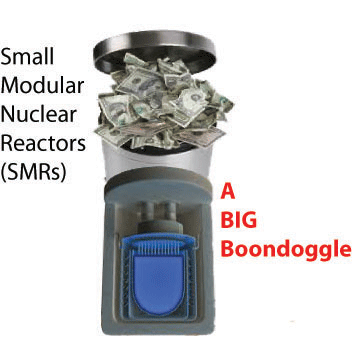
 Ontario, Saskatchewan, N.B. premiers to announce nuclear reactor deal, Global News BY STAFF THE CANADIAN PRESS November 30, 2019 “….. The Ontario government said Premier Doug Ford will meet with Saskatchewan Premier Scott Moe and New Brunswick Premier Blaine Higgs for an announcement at a hotel near Pearson International Airport on Sunday afternoon.
A spokesman with Moe’s office confirmed the announcement is connected to an agreement on technology for small modular reactors, while a spokeswoman for Ford’s office said it’s an agreement to work together to determine the best technologies for the deployment of small modular reactors in Canada……
Moe has said that Saskatchewan will address climate change over the next decade by looking to carbon capture and storage technology and by increasing research efforts around small modular nuclear reactors.
However, the possibility of bringing nuclear power to Saskatchewan could still be years away https://globalnews.ca/news/6239231/premiers-nuclear-reactor-deal/
Nuclear waste Bill in U.S. House of Representatives – resistance in New Mexico to nuclear waste dump
 Nuclear waste bill advances to House, could push forward storage site in New Mexico Adrian Hedden, Carlsbad Current-Argus Nov. 27, 2019 A federal bill to alter policy for nuclear waste advanced to the full U.S. House of Representatives and could support the case for temporary storage of temporary storage of high-level waste at a facility like the one Holtec International proposed to build in southeast New Mexico.
The Nuclear Waste Policy Amendments Act was advanced by a unanimous voice vote to the House by the Energy and Commerce Committee on Nov. 20.
The bill, if passed, would move forward with safety licensing for a permanent nuclear waste repository at Yucca Mountain, Nevada, while providing the U.S. Department of Energy the authority to proceed with a program for consolidated interim storage (CIS) while the Yucca Mountain project progresses.
It also prioritized the transportation of spent nuclear fuel from generator sites in seismically active areas, and ensured the DOE has the funds to build and operate a repository
U.S. Rep. Ben Ray Lujan (D-NM), the only representative from New Mexico who sits on the committee, introduced an amendment that was approved to create a grant program to study the impacts radiation exposure including family members and non-workers resulting from uranium mining.
“Though we have a responsibility to address the waste issues that result from our country entering the atomic age, I am deeply concerned that this bill makes it more likely that a future interim storage site — potentially one in New Mexico — becomes a permanent home for nuclear waste,” he said.
One such interim facility, proposed by Holtec to be built in a remote, desert area near the Eddy-Lea county line, drew concerns from New Mexico environmentalist groups as it could put local communities at risk as well.
Don Hancock, nuclear waste program director at the Southwest Research and Information Center in Albuquerque cited a clause in the bill that required the governor of a state that would host a CIS facility to consent before moving forward.
New Mexico Gov. Michelle Lujan Grisham voiced her opposition to the Holtec project earlier this year, calling it “economic malpractice” as it could negatively impact two of the state’s biggest industries: oil and gas and agriculture.
“The bill says you must have approval from the state’s governor,” Hancock said. “New Mexico would be a non-starter. She (Lujan Grisham) has said she’s opposed to it.”
Hancock said he also opposed the project and the bill over the suggestion of transporting the waste hundreds or thousands of miles away from generator sites where it is currently stored.
Even if the waste approved to be shipped to a remote location like southeast New Mexico, Hancock argued it would take years for the infrastructure to be built and the waste to be moved.
“This approach doesn’t make any sense,” he said. “Why not do it in places that already have storage sites? It’s going to sit there for years. Let’s make that less dangerous. It can be done without massive transportation around the country.”…….. https://www.currentargus.com/story/news/local/2019/11/27/nuclear-waste-bill-advances-house-may-support-new-mexico-holtec-site/4297822002/
Persistent outages plaguing Grand Gulf nuclear plant are adding millions to the bills of New Orleans customers
Grand Gulf is supposed to run almost every single day at full capacity, acting as a foundational “base load” plant in the region’s energy system. It represents roughly one-fifth of all the generation that Entergy New Orleans owns or has purchase agreements for.
But over the last few years, Grand Gulf has been beset by a series of planned and unplanned outages that have made it the least reliable nuclear generator in the US, according to the Nuclear Energy Institute, an industry trade group. In fact, the plant was in the middle of an outage this week.
These outages cost New Orleans residents millions of dollars, according to figures Entergy has provided the City Council…. …..https://thelensnola.org/2019/11/27/persistent-outages-plaguing-grand-gulf-nuclear-plant-are-adding-millions-to-the-bills-of-new-orleans-customers/
US Bishops stand with the Pope calling for a world without nuclear arms
A statement issued by the Chairman of the US Conference of Catholic Bishops calls for action on the path to nuclear disarmament. Vatican News, By Linda Bordoni , 27 Nov 19, In the wake of Pope Francis’s powerful appeal for a world that is free from atomic warfare, and his affirmation that not only the deployment, but also the possession of nuclear weapons is immoral, the Catholic Bishops of the United States issued a statement calling on their nation “to exercise global leadership for mutual, verifiable nuclear disarmament”……. https://www.vaticannews.va/en/church/news/2019-11/us-bishops-statement-nuclear-weapons.html
Further debunking of the conspiracy nonsense about a nuclear explosion in the South China Sea
 A nuclear detonation in the South China Sea? No, more Twitter conspiracy nonsense, Bulletin of the Atomic Scientists, By Matt Field, November 25, 2019 The Twitter account @IndoPac_Info pushes out news at a relentless pace; it’s a seemingly good feed to follow for those interested in military issues in Asia. By Friday afternoon last week, the account had posted dozens of tweets over a 36-hour-or-so period linking to stories from outlets such as Reuters and Foreign Policy on topics ranging from US naval activity in contested waters to Pentagon drone policy. Oh yeah, and then there was the one about a nuclear detonation in the South China Sea.
The big news that China had perhaps exploded a tactical nuclear weapon in the ocean originated with a man labeled by the Southern Poverty Law Center as a former federal convict, white supremacist, and FBI informant named Hal Turner. Turner posted the story on his website and touted the supposed scoop further on his nighttime AM radio show, attributing the information to military sources. On Friday, a Pentagon spokesperson called Turner’s article “silly fiction.” And the man behind @IndoPac_Info himself—he describes himself as a Spanish man living in Vietnam—now seems to agree. “Without further evidence or independent corroboration of Hal Turner’s article, it may not be credible at this point,” he tweeted. “Apologies.”
A laudable course correction, no doubt, but it came after one of @IndoPac_Info’s tweets on the Turner story was retweeted almost 2,000 times. And in an age when online disinformation campaigns like the Russian government effort to sway the 2016 US presidential election are a major feature of public discourse, it’s an open question: Could an online conspiracy theory about nuclear weapons gain traction and have a real-world impact?
The @IndoPac_Info account helped give Turner traction, but as far as impact goes, the radio host’s nuclear story failed to launch, in part because it was so easily debunked.
The idea that a 10 to 20 kiloton explosion, possibly a nuclear one, could have occurred in the busy and contested South China Sea and not been widely observed was laughable to Bulletin of the Atomic Scientists’ Science and Security Board chair Bob Rosner. The physicist and former director of the Argonne National Laboratory told Gizmodo, “There is so much surveillance that it would be stunning if no one had noticed that.”……..
Despite Turner’s serious dearth of credibility, he was able to piggyback on @IndoPac_Info’s. That account, after all, is followed, by journalists, academics, and others from reputable organizations like Reuters and the University of Pennsylvania. Indeed, the @IndoPac_Info account user was concerned that he’d helped promote Turner’s wild story. “I was not aware of his record,” he said.
“A follower sent me his story and I went with it.” https://thebulletin.org/2019/11/a-nuclear-detonation-in-the-south-china-sea-no-more-twitter-conspiracy-nonsense/
Nuclear deterrence is weakened by the absence of diplomacy, and the demise of arms control.
Trump’s Track Record Of Nuclear Deterrence Without Reassurance Is Dangerous, Forbes, Michael Krepon, 25 Nov 19, The first time President Ronald Reagan announced that “A nuclear war can never be won and must never be fought” was before the Japanese Diet on November 11, 1983. Reagan was sensitive to public concerns over the rocky state of U.S.-Soviet relations. His speech came nine days before the airing of an ABC movie, “The Day After,” depicting the impact on Lawrence, Kansas, of a nuclear strike against nearby Kansas City. The “Day After” was watched by 100 million viewers. Reagan had an advance screening. It’s hard to identify a television program that has had a more dramatic impact on public and presidential consciousness of nuclear danger.
There is only one sane policy, for your country and mine, to preserve our civilization in this modern age: A nuclear war cannot be won and must never be fought. The only value in our two nations possessing nuclear weapons is to make sure they will never be used.”
When Reagan and Mikhail Gorbachev jointly repeated this formulation at their Geneva summit in 1985, skeptics began to take notice. The canonical affirmation by then had congealed into “A nuclear war cannot be won and must never be fought.” When Reagan and Gorbachev began to act in accordance with this belief, scales fell from before our eyes. Defenders of deterrence orthodoxy became alarmed. Both men meant what they said.
1 This Month

Protect Sazan Island from the Trump family! https://secure.avaaz.org/campaign/en/protect_sazan_island_from_the_trump_family_loc/?bqFCVab&v=174511&cl=22707147157&_checksum=5e9dde668860e8231c33699735e16a1fbf22ab2cb01da50c999fe8732b9775ef&utm_source=email&utm_medium=blast_email&utm_campaign=174511


Cuba Is Not a Failed State – It Is a Besieged State
PETITION: “Global Appeal to Endorse Palestinian Right of Return of Refugees”
To see nuclear-related stories in greater depth and intensity – go to https://nuclearinformation.wordpress.com
-
Archives
- June 2026 (129)
- May 2026 (306)
- April 2026 (356)
- March 2026 (251)
- February 2026 (268)
- January 2026 (308)
- December 2025 (358)
- November 2025 (359)
- October 2025 (376)
- September 2025 (257)
- August 2025 (319)
- July 2025 (230)
-
Categories
- 1
- 1 NUCLEAR ISSUES
- business and costs
- climate change
- culture and arts
- ENERGY
- environment
- health
- history
- indigenous issues
- Legal
- marketing of nuclear
- media
- opposition to nuclear
- PERSONAL STORIES
- politics
- politics international
- Religion and ethics
- safety
- secrets,lies and civil liberties
- spinbuster
- technology
- Uranium
- wastes
- weapons and war
- Women
- 2 WORLD
- ACTION
- AFRICA
- Atrocities
- AUSTRALIA
- Christina's notes
- Christina's themes
- culture and arts
- Events
- Fuk 2022
- Fuk 2023
- Fukushima 2017
- Fukushima 2018
- fukushima 2019
- Fukushima 2020
- Fukushima 2021
- general
- global warming
- Humour (God we need it)
- Nuclear
- RARE EARTHS
- Reference
- resources – print
- Resources -audiovicual
- Weekly Newsletter
- World
- World Nuclear
- YouTube
-
RSS
Entries RSS
Comments RSS
 nuclear-news