U.S. Democrats cave in to a weak compromise National Defense Authorization Act
 Democrats Retreat on Nuclear Policy Defense One, 13 Dec 19, The 2020 authorization bill fails to check Trump’s worst impulses. Democrats Retreat on Nuclear Policy Defense One, 13 Dec 19, The 2020 authorization bill fails to check Trump’s worst impulses.Question: How do you go from a National Defense Authorization Act that in July was opposed by every House Republican to one that was approved by more GOP votes than Democratic ones and that President Donald Trump called a huge win that he cannot wait to sign? Answer: Add Space Force and parental family leave and take out all of the progressive national security provisions. The House passed the compromise NDAA last night; President Trump has said he will sign it. This final bill is a world apart from the version passed by House Democrats in July. The House version, ably led by Rep. Adam Smith, D-Washington, chair of the House Armed Services Committee, prohibited deployment of Trump’s new “low-yield” nuclear weapon for Trident submarines, which defense experts called “a gateway to nuclear catastrophe.” It prohibited unauthorized U.S. military action against Iran, which Trump came within 10 minutes of ordering in June, and prohibited U.S. military support for the Saudi-led intervention in Yemen. And it supported extension of the New START treaty, which Trump seems to have every intention of sacking even though Russia supports keeping the crucial pact. The list goes on. In other words, the House bill would have constrained the most dangerous tendencies of an out-of-control White House. This is exactly what you would expect Democrats to do when faced with a President that they firmly believe is a danger to U.S. national security—and are now seeking to impeach on that basis. Not surprisingly, Republicans do not share this impression of the President, and they deeply opposed the nuclear policy provisions in the House NDAA……. The outcome was a disaster. The topline budget rose to $738 billion and the major constraints on Trump were ripped out. Others were watered down. The most we can say about the final NDAA is that it includes some useful language on arms control and missile defense, but nothing major. Such weak tea certainly does not justify supporting a bill that funds Trump’s excessive $2 trillion program to rebuild the nuclear arsenal, among other things. Rep. Ro Khanna, D-California, a member of the House Armed Services Committee and a vice-chair of the progressive caucus issued a joint statement with Sen. Bernie Sanders, D-Vermont, a presidential candidate, calling the final agreement “a bill of astonishing moral cowardice.” Over 30 progressive national security organizations (including Ploughshares Fund) sent a letter to Congress opposing the final bill as doing “almost nothing to constrain the Trump administration’s erratic and reckless foreign policy.” Senator and presidential candidate Elizabeth Warren said she would oppose the bill, calling it a “$738 billion Christmas present to giant defense contractors.” ….. Democrats cannot seek to impeach Trump and yet sometimes act as if he is a normal president. They cannot attempt to remove him from office as a danger to national security and yet hand him $738 billion in military spending with no limits on his nuclear weapons development, ability to attack Iran, freedom to abandon arms control treaties, and so much more. Trump is nothing if not a disrupter. The Democrats must give the president a taste of his own medicine. https://www.defenseone.com/ideas/2019/12/democrats-retreat-nuclear-policy/161855/ |
|
|
Sound the alarm on deadly US-Russia nuclear threat
 Sound the alarm on deadly US-Russia nuclear threat, by Jill Dougherty December 12, 2019 CNN, As I looked around the large square conference table, I watched the faces settle into worried frowns. Russians and Americans, several of whom once had responsibility for their nations’ nuclear weapons, all members of the Dartmouth Conference, the oldest continual bi-lateral dialogue between Americans and Russians, founded almost 60 years ago during one of the darkest periods of the Cold War.
Prairie Island Indian Community – nuclear refugees
|
Environmental, nuclear worries force Prairie Island tribe to seek new lands, MPR News, Catharine Richert, Welch, Minn. December 13, 2019 Schyler Martin’s job calls for him to worry each day about things that could cripple or destroy the Prairie Island Indian Community, but that he can’t control.The nearby Xcel Energy nuclear power plant that towers over the reservation is high on that list, as is an Army Corps of Engineers lock and dam on the Mississippi River that regularly floods tracts of tribal land upstream.
Martin, the tribe’s emergency management director, can rattle off a list of flooding headaches the tribe faces annually — closing roads, building and maintaining berms, diverting water from Prairie Island’s casino and outdoor amphitheater. This year has been especially difficult with flooding lasting deep into the fall, closing roads to hunting grounds and damaging hay that feeds the tribe’s buffalo herd. “The soil,” said Martin, “is inundated with water.” Prairie Island leaders understand that the dam, the flooding and the nuclear plant will not be leaving anytime soon, which is why they’re taking an extraordinary step — expanding the reservation inland, away from their home on the Mississippi River. Prairie Island last year bought 1,200 acres near Pine Island, Minn., about 35 miles south on U.S. Highway 52. The tribe wants Congress to put the land into trust, adding it to the reservation. In return, the tribe would give up rights to sue the government over flooding caused by the lock-and-dam system. While it’s a logical step for a tribe that continues to grow and prosper, the relocation plan has reopened old wounds over the displacement of Native American people and white encroachment on Native lands. That includes environmental problems on tribal lands created by nonNative people. ……….. Jackson said, the community once again was thrown into upheaval when the Army Corps of Engineers built a lock-and-dam system just downstream to accommodate commercial navigation. The structure flooded reservation land and shrank its footprint to 300 livable acres. “You have a federal undertaking that is proposing to take more land and again displace Dakota people,” said Jackson. “It’s just another example of the encroachment the tribe was facing at that time.” It’s a project that continues to trouble the reservation. The flooding has swamped traditions that help younger generations connect with their history. Floodwaters this year canceled a maple syrup harvesting event for kids. “This is something that the children’s ancestors have been doing for hundreds of years,” Martin said. But it’s the threat of a nuclear disaster that keeps him up at night. Martin said a routine Federal Emergency Management Agency exercise in 2018 opened his eyes to how a mishap at the nuclear power plant could upend the day-to-day operations of the Treasure Island Resort and Casino, the tribe’s primary source of income for years. “How do you relocate a reservation? These are federal trust lands. How do you relocate that?” he said. “And then how do you make up for the economic viability for the tribe? ….. The nuclear plant’s towers rise about 600 yards away from where Lucy “Lu” Taylor played as a kid. Back then, she didn’t understand the potential dangers of living near the plant. As tribal vice president, she understands it well. “Now, I’m an elder and I have grandchildren now, and it could be devastating to my grandchildren,” she said. “It’s not right for our kids to grow up here.” A very powerful thing’The eye-opening worries that surfaced in the 2018 FEMA drill led Prairie Island to buy the Pine Island property, said Shelley Buck, the tribal council’s president. “Part of our culture is you’re supposed to look out for the next seven generations. So, as tribal leaders, we have to do that. With every decision, we need to look out for that and have that in the back of our minds,” said Buck, who also counts among Prairie Island’s potential dangers a nearby rail line that regularly carries hazardous materials……. the Pine Island land and its potential for housing and economic development is so important. Local officials in Pine Island, Rochester and Olmsted County all support Congress putting the land into trust — a necessary step to make the Pine Island land part of the reservation and subject to tribal law. A bipartisan group of lawmakers from Minnesota’s delegation has introduced a bill that would put the Pine Island land into trust. So far, the bill has not been debated in Congress……. Tribal general counsel Jessie Seim said her research suggested the tribe had strong legal claims against the federal government for both the land lost due to flooding and for siting the nuclear power plant so close to the reservation. Rather than pursue that, however, the tribe is ready to drop those legal claims to get the congressional approval needed to move forward on the Pine Island plan. “We wanted to fashion a settlement, sovereign to sovereign,” Seim said. “We wanted the governing bodies of both of these governments to come together and try to resolve the series of wrongs that have happened here at Prairie Island.”………. https://www.mprnews.org/story/2019/12/13/environmental-nuclear-worries-force-prairie-island-tribe-to-seek-new-lands |
|
Muons: probing the depths of nuclear waste
Muons: probing the depths of nuclear waste, physicsworld, 12 Dec 2019
Having used them to look through rock, physicists are now exploiting muons to peer inside canisters of radioactive waste. The ability could prove very handy for nuclear inspectors, as Edwin Cartlidge reports
……muons – energetic subatomic particles that can pass through thick layers of dense material and which the scientists in Egypt used to look inside the limestone and granite pyramid.
Muons are generated routinely in particle colliders, where physicists use them to identify other, potentially more exotic, particles within the debris. But they are also produced naturally in the atmosphere, and an ever-growing range of researchers are using these commonly occurring muons as highly penetrating probes. Beyond archaeologists, geologists, for example, are developing muon detectors to establish when magma might be on the rise within a volcano……..
Muons offer a way to establish how much waste there is in a container without having to open or move the container in question. That capability would become vital, according to Matt Durham of Los Alamos National Laboratory in the US, should inspectors or the countries involved ever lose confidence in their monitoring. “This issue is only getting worse as more plutonium piles up around the world,” he says.
Muons offer a way to establish how much waste there is in a container without having to open or move the container in question……… https://physicsworld.com/a/muons-probing-the-depths-of-nuclear-waste/
USA’s Patriot Act destroys civil liberties
 Who Will Protect Us From an Unpatriotic Patriot Act?
 https://www.counterpunch.org/2019/12/11/who-will-protect-us-from-an-unpatriotic-patriot-act/ by JOHN W. WHITEHEAD
While Congress subjects the nation to its impeachment-flavored brand of bread-and-circus politics, our civil liberties continue to die a slow, painful death by a thousand cuts.
Case in point: while Americans have been fixated on the carefully orchestrated impeachment drama that continues to monopolize headlines, Congress passed and President Trump signed into law legislation extending three key provisions of the USA Patriot Act, which had been set to expire on December 15, 2019.
As Congressman Thomas Massie (R-Ky.) predicted:
Today, while everyone is distracted by the impeachment drama, Congress will vote to extend warrantless data collection provisions of the #PatriotAct, by hiding this language on page 25 of the Continuing Resolution (CR) that temporarily funds the government. To sneak this through, Congress will first vote to suspend the rule which otherwise gives us (and the people) 72 hours to consider a bill. The scam here is that Democrats are alleging abuse of Presidential power, while simultaneously reauthorizing warrantless power to spy on citizens that no President should have… in a bill that continues to fund EVERYTHING the President does… and waiving their own rules to do it. I predict Democrats will vote on a party line to suspend the 72 hour rule. But after the rule is suspended, I suspect many Republicans will join most Democrats to pass the CR with the Patriot Act extension embedded in it.
Los Alamos National Laboratory lost 250 barrels of nuke waste
The contractor that’s been in charge of Los Alamos National Laboratory’s operations for the past year lost track of 250 barrels of waste, while the company heading the legacy cleanup mislabeled and improperly stored waste containers and took months to remedy some infractions, according to the state’s yearly report on hazardous waste permit violations.
Triad National Security LLC, a consortium of nonprofits that runs the lab’s daily operations, had 19 violations of its permit from the New Mexico Environment Department. Newport News Nuclear BWXT Los Alamos, also known as N3B, which is managing a 10-year cleanup of waste generated at the lab, was cited 29 times.
Triad’s most notable violation was shipping 250 barrels of mostly mixed waste to the Waste Isolation Pilot Plant in Carlsbad without tracking them. Mixed waste contains low-level radioactive waste and other hazardous materials. Inspectors found records still listed the waste at the national lab. …..
A disastrous “kitty litter” incident happened under Los Alamos National Security, in which a waste barrel was packaged in error with a volatile blend of organic cat litter and nitrate salts, causing the container to burst and leak radiation at the Southern New Mexico storage site. WIPP closed for almost three years, and the cleanup cost about $2 billion.
The National Nuclear Security Administration, a division of the U.S. Department of Energy that oversees the lab, declined to renew LANS’ contract in 2015. Triad took over operations in November 2018. Among Triad’s duties is to dispose of waste at the lab generated from 1999 to the present.
N3B won a $1.4 billion contract in December 2017 to clean up waste produced at the lab before 1999.
The company was cited for a slew of mislabeled waste containers during the year. Inspectors also found some waste barrels, which are stored under tent-like domes, coated with snow or rainwater.
N3B also failed to remedy within 24 hours the flaws that inspectors found in equipment or structures that could present an environmental or human-health hazard, the report said. Inspectors discovered N3B took as long as 18 months to fix cracks in concrete and asphalt surfaces…….. https://www.santafenewmexican.com/news/local_news/state-report-lanl-lost-track-of-barrels-of-nuke-waste/article_e9de8348-17cc-11ea-bae3-c71a1aadd222.html
Devastating array of craters on the ocean floor, from nuclear tests
Enormous Craters Blasted in Seafloor by Nuclear Bombs Mapped for the First Time, Live Science, By Mindy Weisberger – Senior Writer 11 Dec FRANCISCO — Today, all seems quiet in the remote Bikini Atoll, a chain of coral reef islands in the central Pacific. But more than 70 years ago, this region’s seafloor was rocked by powerful atomic bombs detonated by the U.S. Army.
For the first time, scientists have released remarkably detailed maps of this pockmarked seabed, revealing two truly massive craters. This new map shows that the seabed is still scarred by the 22 bombs detonated at Bikini Atoll between 1946 and 1958.
The map was presented yesterday (Dec. 9) at the annual meeting of the American Geophysical Union.
During the 1946 nuclear weapons test known as “Operation Crossroads,” the U.S. wanted to test the impact of nuclear bombs on warships. To that end, the Army assembled more than 240 ships — some of which were German and Japanese — that held different amounts of fuel and munitions, then deployed two nuclear weapons to destroy them, researcher Arthur Trembanis, an associate professor with the College of Earth, Ocean, and Environment at the University of Delaware, said in the presentation.
At the time of the tests, Trembanis said, comedian Bob Hope joked grimly:
“As soon as the war ended, we found the one spot on Earth that had been untouched by war and blew it to hell.”……….
But as powerful as the early atomic tests were, they were dwarfed by the later blasts caused by hydrogen and fusion bomb tests in the 1950s. The researchers investigated a crater that was 184 feet (56 m) deep and had an unusual oblong shape; they determined that it was a composite crater from multiple blasts: “Castle Bravo,” a 15-megaton bomb that was the largest ever detonated by the U.S., and “Castle Romeo,” the first deployed thermonuclear bomb.
These tests left behind a uniquely devastating array of shipwrecks and craters, and the first detailed map of their aftermath will help scientists to tell this untold story and connect to “a moment at the dawn of the nuclear age,” Trembanis said. “Our new findings provide insights into previously unknown conditions at Bikini and allow us to reflect on the lasting consequences from these and other tests.” https://www.livescience.com/mapping-reveals-bikini-atoll-nuclear-craters.html
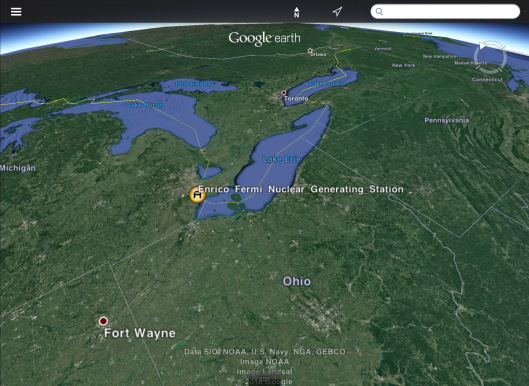
U.S. Congress members call on Trudeau to stop nuclear waste dumping near Great Lakes
|
Upton, Dingell, Kildee and Mitchell Appeal to Trudeau: No Nuclear Waste In the Great Lakes Basin, https://whtc.com/news/articles/2019/dec/10/upton-dingell-kildee-and-mitchell-appel-to-trudeau-no-nuclear-waste-in-the-great-lakes-basin/965368/ When U.S. Representatives Fred Upton and Debbie Dingell joined with a handful of other House members last Friday, Dec. 6, 2019, to decry plans by Canadian officials to put a nuclear waste storage site in the Great Lakes basin, they were hoping to shame Canadian Prime Minister Justin Trudeau into some kind of protective action.
Tuesday, December 10, 2019 But something else happened, Upton explained.
“We’ve got other members now, on a bipartisan basis, coming to us saying, ‘Hey, we want to sign that same letter,'” he said. “So we’re going to be doing another letter, a little bit later this week, that’ll have broader appeal. Because we were sort of under the gun when we learned the news late Friday afternoon.” Upton and Dingell joined two other Michigan representatives, Paul Mitchell and Dan Kildee in signing a letter appealing to Trudeau to oppose any nuclear waste storage plans near the Great Lakes. The complete text of last week’s letter: Dear Prime Minister Trudeau: We write to you out of deep concern regarding reports that Canada is moving closer to selecting a permanent national repository for harmful nuclear waste along the shores of the Great Lakes. Allowing a permanent nuclear waste storage facility anywhere near the Great Lakes basin, for any amount of time, is a risk we cannot afford to take. The recent reporting also has us greatly concerned that the highest levels of radioactive waste would ultimately be stored at the proposed site. We know that there are other Members of Congress representing districts in the Great Lakes basin who are most concerned by this development and will certainly be joining with us in the days ahead. This is a grave concern. These waters have long united us—they should not divide us. In November, the Energy and Commerce Committee favorably advanced H.R. 2699, the Nuclear Waste Policy Amendments Act of 2019, to the House for final consideration and it included an important bipartisan amendment that expresses the Sense of Congress that the governments of the United States and Canada should not allow permanent or long-term storage of spent nuclear fuel or other radioactive waste near the Great Lakes. This amendment was unanimously supported and adopted. We stand in strong opposition to any decision by the Canadian government to select or consider a permanent national repository for nuclear waste storage anywhere near the Great Lakes. This is a treasured natural resource each of our countries share and we urge you to stand with us to protect these waters for future generations. Thank you for your consideration of this important request and we look forward to a timely response. |
Flammable hazard stalls LANL’s plutonium operations, waste shipments
Flammable hazard stalls LANL’s plutonium operations, waste shipments, Sante Fe New Mexican , By Scott Wyland , swyland@sfnewmexican.com
-
- Dec 9, 2019 Concerns that a calcium residue might be flammable prompted officials at Los Alamos National Laboratory to curtail plutonium operations and suspend waste shipments in early November, according to a federal report.
The lab suspended most waste generation and certification at its plutonium facility and halted all waste shipments after officials questioned the accuracy of documentation, particularly on how much calcium-and-salt residue remained in transuranic waste after processing, the Defense Nuclear Facilities Safety Board, an independent oversight panel, said in a Nov. 15 report that was publicly released Friday.
Calcium is used to help reduce oxidation in plutonium. Traces of the substance typically linger after processing, and if they are too high, they can ignite when exposed to open air, the report says…… https://www.santafenewmexican.com/news/local_news/flammable-hazard-stalls-lanl-s-plutonium-operations-waste-shipments/article_dad5a96c-186c-11ea-ac96-a345865823f1.html
The Santa Susana nuclear waste scandal

The Santa Susana Field Laboratory was established seventy years ago as a remote site for work too dangerous to conduct near communities. It’s situated on a rise on the north-west end of the Los Angeles Valley. What was once sparsely inhabited is now a packed community of 150,000 living within five miles of the site and more than half a million people living within 10 miles.
To the north, the community of Simi Valley. To the south-west, Thousand Oaks. And to the east, Chatsworth, Canoga Park, and West Hills. From these suburban streets, the hills around Santa Susana provide a beautiful backdrop of round sandstone and golden grass. But the picturesque view hides a secret—the fact that Santa Susana Field Laboratory is one of the most contaminated sites in California.
The site is no longer active; that doesn’t mean it’s benign. Over the years Santa Susana hosted a variety of activities, including ten nuclear reactors, a rocket engine testing facility, and multiple open-air “burn pits” where radioactively and chemically contaminated items were “disposed of” through burning. These activities left their mark. In 1959, one of the nuclear reactors partially melted down, an incident that scientists estimate may have released more radioactive iodine than Three Mile Island. And rocket-engine testing released toxic chemicals like TCE, dioxins, PCBs, and heavy metals. Wind and rain, and fires like the Woolsey Fire that burned 80 percent of the site in 2018, continue to carry contaminates from the site into the neighborhoods that have grown up around it.
All of this history is known, and really, none of these facts are in dispute. That’s why community members like Melissa Bumstead and Lauren Hammersley (both of whose daughters had rare forms of cancer), community organizations like Physicians for Social Responsibility–Los Angeles and Committee to Bridge the Gap, and celebrities like Kim and Kourtney Kardashian have all been advocating on this issue. The Santa Susana Laboratory must be cleaned up, and cleaned up quickly. But the Trump administration is trying to walk away from its commitments, and that’s a clear danger to nearby residents.
Today, responsibility for the site is shared by Boeing, the Department of Energy, and NASA. Back in 2010, the Energy Department and NASA both signed legally binding agreements with California setting strict levels of cleanup to “background levels.” Essentially, this means cleanup to the condition the site was in before all of the pollution. The agreements also require the federal agencies obtain approval from California for all aspects of the cleanup. This was the right deal to make; NRDC strongly supported the deal then, and still does to this day.
But now the Department of Energy and NASA seem to be trying to shirk their obligations.
First, the Energy Department issued a Final Environmental Impact Statement for remediation of the areas of the Field Lab it is responsible for. This is a legally required document designed to set forth the harms for the public, as well as the plan to mitigate those harms. In this document, the Department acknowledges that most of what it is considering violates its agreement with California, but it provides one-sided assurance that it will negotiate these points with California. Then in September, the Energy Department issued decisions to demolish multiple buildings without California’s consent, directly contradicting the cleanup obligations spelled out in the agreement.
NASA seems to be taking a similar course; in October it published a supplemental environmental impact statement proposing alternatives that would leave most of the contamination not cleaned up, in violation of its agreement with California. Absurdly, NASA argues that each of the alternatives it considers provides the same health benefits even though all but one of the alternatives would abandon in place most of the contaminated soil. It presented this information at “public meetings” in November but called the police when members of the public tried to share their concerns that NASA’s alternatives would breach the agreement to reach the required “background levels.” In short, NASA is setting itself up to violate the binding cleanup standards set by California and doesn’t seem to want the public to know that’s what it’s doing.
But under their agreements with California, and also under the primary hazardous waste law, the Resource Conservation and Recovery Act (RCRA), the Energy Department and NASA don’t have the authority to choose how much they must clean up and how much contamination they can abandon in place. This authority is California’s alone.
Luckily, the state of California is on top of it, closely monitoring the situation. Both the California EPA and the Department of Toxic Substances Control strongly reminded the Energy Department of its obligations and that the state would enforce the cleanup agreement. Should NASA follow through on any of the alternatives it has considered that would ignore its obligations, we are hopeful California stands ready again.
But enough is enough for all of this. The cleanup agreements are well thought out documents, have broad public support, and it’s readily apparent that the neighbors of Santa Susana Field Laboratory will continue to be at risk until the Department of Energy, NASA, and Boeing meet their full obligations to clean up the site. We stand beside California, local organizations, and community members to ensure that these toxic remnants will be removed and the site cleaned up so the nearby residents can live in safety and peace.
It’s time to reset US nuclear waste policy
 Life after Yucca Mountain: The time has come to reset US nuclear waste policy, The Hill, BY DAVID KLAUS AND ROD EWING, 12/09/19 After decades of inaction and stalemate, there are small but significant signs that the U.S. government may finally be ready to meet its legal commitment to manage and dispose of the more than 80,000 metric tons of used nuclear fuel at 74 operating and shut-down commercial nuclear reactors sites in 35 states across the country. The signs of progress include: Life after Yucca Mountain: The time has come to reset US nuclear waste policy, The Hill, BY DAVID KLAUS AND ROD EWING, 12/09/19 After decades of inaction and stalemate, there are small but significant signs that the U.S. government may finally be ready to meet its legal commitment to manage and dispose of the more than 80,000 metric tons of used nuclear fuel at 74 operating and shut-down commercial nuclear reactors sites in 35 states across the country. The signs of progress include:
While the debate over the fate of Yucca Mountain is primarily responsible for the current standoff, pressure for action is increasing at the local level where closed plants and what to do with the spent fuel stored on site has become a particularly hot political issue. Seven U.S. reactors were permanently closed from 2013 through 2018 and an additional 13 are set to close by 2025. There are now 21 “stranded sites” scattered across the country – closed reactor sites with no ongoing reactor operations. Moreover, the number of plant closures is expected to increase as plants age and state regulators refuse to adopt rate structures that value the type of base load power provided by nuclear reactors.
There also is pressure for action at the national level. The failure of the U.S. government to take ownership of the spent fuel has cost the taxpayers $7.4 billion in damages paid to utilities for continued storage at their reactor sites — and costs are projected to increase as more reactors close. With government payments to utilities already running some $600 million per year, the government estimates the total cost may ultimately be as high as $34 billion. Industry estimates are in the range of $50 billion……
Perhaps most significant obstacle is the dysfunction in our current political system. In normal times, political compromise to address the most significant current problem – the growing amounts of spent fuel at closed reactor sites around the country – should be in reach. It is time to reset U.S. policy and accept that the Yucca Mountain site is not going to be licensed and built. Legislators working in good faith should be able to resolve the funding issue, develop a fair, consent-based process for selecting a site for a long-term spent fuel repository and amend federal law to no longer hold the development of a consolidated interim storage facility hostage to that process. David Klaus formerly served, among other positions, as Deputy Under Secretary at the U.S. Department of Energy and Counsel to the Energy and Commerce Committee of the U.S. House of Representatives. He is an Affiliate of the Center for International Security and Cooperation at Stanford University. Professor Rod Ewing is the co-director of the Center for International Security and Cooperation at Stanford University and led a recent initiative – Reset of America’s Nuclear Waste Management Strategy and Policy. https://thehill.com/blogs/congress-blog/energy-environment/473627-life-after-yucca-mountain-the-time-has-come-to-reset#.Xe6gyaz6YH4.twitter
|
|
|
Pentagon to get more control over the news? Is this a GOOD idea?
 The Pentagon Wants More Control Over the News. What Could Go Wrong?The Pentagon is using a moral panic over “fake news” to gain influence over the domestic news landscape, Rolling Stone The Pentagon Wants More Control Over the News. What Could Go Wrong?The Pentagon is using a moral panic over “fake news” to gain influence over the domestic news landscape, Rolling Stone
By MATT TAIBBI 9 Dec 19, If there’s a worse idea than the Pentagon becoming Editor-in-Chief of America, I can’t remember it. But we’re getting there:
From Bloomberg over Labor Day weekend: Fake news and social media posts are such a threat to U.S. security that the Defense Department is launching a project to repel “large-scale, automated disinformation attacks,” as the top Republican in Congress blocks efforts to protect the integrity of elections. One of the Pentagon’s most secretive agencies, the Defense Advanced Research Projects Agency (DARPA), is developing “custom software that can unearth fakes hidden among more than 500,000 stories, photos, video and audio clips.” Once upon a time, when progressives still reflexively distrusted the military, DARPA was a liberal punchline, known for helping invent the Internet but also for developing lunatic privacy-invading projects like LifeLog, a program to “gather in a single place just about everything an individual says, sees, or does.” DARPA now is developing a semantic analysis program called “SemaFor” and an image analysis program called “MediFor,” ostensibly designed to prevent the use of fake images or text. The idea would be to develop these technologies to help private Internet providers sift through content. ….. Stories about the need for such technologies are always couched as responses to the “fake news” problem. Unfortunately, “fake news” is a poorly-defined, amorphous concept that the public has been trained to fear without really understanding. ……. Fake news has a long history in America. Its most pernicious incarnation is never the work of small-time scam artists. The worst “fake news” almost always involves broad-scale deceptions foisted on the public by official (and often unnamed) sources, in conjunction with oligopolistic media companies, usually in service of rallying the public behind a dubious policy objective like a war or authoritarian crackdown. From the sinking of the Maine in 1898, to rumors of a union-led socialist insurrection before the Palmer raids in 1919, to the Missile Gap in the late fifties and early sixties (here is the CIA’s own website admitting that one was “erroneous”), to the Gulf of Tonkin lie that launched the Vietnam War, to the more recent WMD fiasco, true “fake news” is a concerted, organized, institutional phenomenon that involves deceptions cooked up at the highest levels. …… the final, omnipresent ingredient in most major propaganda campaigns is the authoritarian solution. Here, it’s unelected, unsupervised algorithmic control over media. We’ve never had a true news regulator in this country, yet the public is being conditioned now to accept one, without thinking of the consequences. The most enormous issue posed by the modern media landscape is the industry’s incredible concentration, which allows a handful of private platforms – Facebook, Twitter, Google – to dominate media distribution. This makes it possible to envisage direct levers of control over the public’s media habits that never existed back when people got much of their news from local paper chains with individual distribution networks. We’ve already seen scary examples of misidentified foreign subversion, from the Washington Post’s repeat editorials denouncing Bernie Sanders as a useful idiot for the Kremlin to the zapping of hundreds of domestic political sites as “coordinated inauthentic behavior.” What if the same people who can’t tell the difference between Truthdig and Pravda get to help design the new fake news algorithms? That’s a much bigger worry than the next Paul Horner or even, frankly, the next Russian Facebook campaign. While Donald Trump is in the White House, progressives won’t grasp how scary all of this is, but bet on it: In a few years, we’ll all wish we paid more attention when the Pentagon announced it wanted in on the news regulation business. https://www.rollingstone.com/politics/political-commentary/darpa-fake-news-internet-censorship-879671/ |
|
Ontario’s First Nations to vote on nuclear waste plan near Lake Huron
|
First Nation vote on nuclear waste DGR set for Jan. 31 https://london.ctvnews.ca/first-nation-vote-on-nuclear-waste-dgr-set-for-jan-31-1.4718866 Scott MillerVideographer @ScottMillerCTV Contact
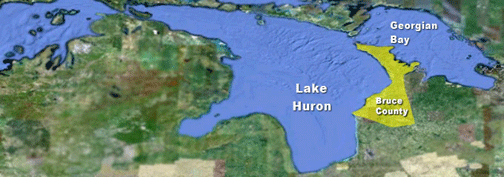
Friday, December 6, 2019 WINGHAM, ONT. — The Saugeen Ojibway Nation (SON) will decide if nuclear waste is buried along the shores of Lake Huron in a little over a month.The First Nation band of approximately 5,000 will hold a binding vote on Jan. 31, 2020 to find out if their members want Ontario Power Generation (OPG) to bury 230,000 cubic metres of low- and intermediate-level nuclear waste under part of the Bruce Power site near Kincardine, or not.
Officials say whatever the people decide, that will be the band’s position on the proposed Deep Geological Repository (DGR). If they vote yes, OPG would still require federal government approval to move forward with the project. If SON votes no, OPG says they’ll start looking for an alternative site in Ontario. There are over 200 resolutions opposing the project, from municipal councils within the Great Lakes Basin, in Canada and the United States. Councils in nearby Bruce County have declared their support for the project. |
|
To store Canada’s nuclear wastes close to Lake Huron – the worst of the worst
|
Site near Lake Huron one of two finalists to store Canada’s nuclear waste, Herald Mail Media, By Keith Matheny Detroit Free Press (TNS), Dec 8, 2019
Canada has narrowed to two communities its list of potential hosts for a permanent national repository for its most radioactive waste — spent fuel from nuclear power generation. And one of those two finalists is on the shores of Lake Huron. If chosen, Huron-Kinloss/South Bruce, in Bruce County, Ontario, could host a large repository, 1,650 feet or more underground, to which the entire nation’s spent nuclear fuel supply would be transported and stored, essentially forever. “This is the worst of the worst” waste, said Kevin Kamps, radioactive waste specialist with the nonprofit Beyond Nuclear, based in Tacoma Park, Md. “It’s highly radioactive irradiated nuclear fuel. It is dangerous forever.”……
Canada has an inventory of almost 2.9 million used nuclear fuel bundles currently stored above-ground in wet pools and dry containers at the nuclear plant sites where the waste is generated. That’s about 128 million pounds of highly radioactive material, a number that is growing. The site along Lake Huron is in the same county where another underground storage facility — this one for low-to-intermediate-level radioactive waste from Ontario’s 19 nuclear reactors — was proposed. That plan, still under consideration, generated loud opposition throughout the Great Lakes Basin beginning about five years ago, especially in Michigan. Michigan’s Democratic U.S. senators, who were among those urging a halt to the lower-radiation waste storage on the Great Lakes, expressed alarm that Canada is now considering putting its most dangerous nuclear wastes along the Great Lakes as well. “This makes no sense,” U.S. Sen. Debbie Stabenow said. “Canada has as much at stake as we do in protecting our Great Lakes. There is no justification for a nuclear waste site so close to Lake Huron to even be under consideration.” Stabenow said she would reach out to the Canadian government regarding the issue. U.S. Sen. Gary Peters noted that the Great Lakes provide drinking water to 40 million people on the U.S. and Canadian sides. “That’s why we need to do everything we can to protect the Great Lakes for future generations,” he said. “I am extremely concerned about the possibility of hazardous nuclear waste being stored near the Great Lakes. Any accident could have catastrophic and long-term consequences to the health and well-being of Michigan and the country. I urge the Nuclear Waste Management Organization in Canada to reconsider naming a finalist location so close to the Great Lakes.” The finalist decision was made by the Nuclear Waste Management Organization, which consists of the nation’s generators of nuclear power and its wastes: Ontario Power Generation, New Brunswick Power Corp. and Hydro-Quebec. Under an act of Canada’s parliament in 2002, the organization is tasked with designing and implementing Canada’s plan for the safe, long-term management of used nuclear fuel. …… The sites were winnowed to five last month, and last week, the organization decided on its two finalists: Huron-Kinloss/South Bruce and Ignace, a rural community in northwest Ontario about 150 miles north of western Lake Superior….. Bruce County is home to Ontario Power Generation’s Bruce Nuclear Generation Station, which has eight reactors. “You have a company town, Kincardine Ontario, with one of the largest nuclear plants on Earth,” said Brennain Lloyd, project coordinator for NorthWatch, a regional coalition in northeast Ontario that works on regional issues.Many area residents, with family ties to the nuclear plant, expressed support for the low-to-intermediate radioactive waste repository, and would have an economic interest in the spent fuel disposal site, Lloyd noted. “Everybody who drinks Great Lakes water is being held hostage to the decision-making of these few thousand people,” she said. While several nations, including France, Sweden and Finland, are at various stages of designing deep geologic repositories for their spent nuclear fuel, there has not yet been any proof, anywhere, that the concept works over the very long term, said Gordon Edwards, president of the nonprofit Canadian Citizens for Environmental Responsibility, based in Montreal. ….. Belfadhel said the completed repository site would have on-site monitoring for “over 100 years.” Edwards said that’s a pittance of what will be needed. “The pyramids of Egypt are only 5,000 years old; the Great Lakes are only about 10,000 years old, created by the last Ice Age,” he said. “The idea that we can create structures that can last longer than the lifetime of the Great Lakes since they were first created is very presumptuous.” Another problem is transporting highly radioactive spent fuel to the site, Kamps said. “Are they going to use barges on the Great Lakes? What if they sink?” he said. “If not barges, are they going to use trains and trucks? What if they crash? What if they are attacked by terrorists? If there are releases, it’s probably going into the lakes. “You’re talking about concentrating 22 reactors’ worth of spent fuel. If you’re going to concentrate that much radioactivity in one place, terrorists might consider attacking it for the ultimate dirty bomb on the planet. …… The proposal to store the most dangerous waste in the world near the Great Lakes should not even be considered, Edwards said. “The people who previously expressed themselves against the low and intermediate-level waste dump need to rise up again,” he said. “All of the high-level waste from all of Canada’s nuclear reactors, it’s ridiculous to put it right beside the Great Lakes. It’s millions of times more radioactive than the low and intermediate level waste.” https://www.heraldmailmedia.com/news/nation/site-near-lake-huron-one-of-two-finalists-to-store/article_a98ff7b8-3b2f-52e7-b55c-c21a6e9d12ca.html |
|
Magical thinking of the nuclear lobby as it jumps on the Green New Deal bandwagon
Unfortunately, the case for nuclear as a green technology is not so simple—the technology faces a spate of environmental and economic challenges, while its track record as a bridge fuel shows it may be more rivalrous than concomitant with renewables. In fact, it may be the nuclear industry that needs the Green New Deal, not the other way around.
For as long as it’s existed, nuclear has been an aspirational technology as much as an extant one
the magical thinking of the nuclear industry has taken different forms. Over decades, breeder reactors, salt reactors, large-scale fusion have all been the nuclear future just over the horizon. “The industry that people talk about is a theoretical industry,” says Jaczko. “The actual industry is not that.”
So the enthusiasm for the public investment of the Green New Deal is primarily a tactical one, with the promise of a massive outlay of public funds enticing an industry in need of a lifeline.

The Tantalizing Nuclear Mirage, Many see nuclear power as a necessary part of any carbon-neutral mix. The reality isn’t so simple. The American  Prospect, BY ALEXANDER SAMMON DECEMBER 5, 2019
It took seven months on the campaign trail for Cory Booker to emerge as the Democratic Party’s foremost champion of nuclear power. In September, after he unveiled a signature climate plan replete with “$20 billion dedicated to research, development and demonstration of next-generation advanced nuclear energy,” he embraced the technology with unprecedented ardor. “I didn’t come to the United States Senate as a big nuclear guy,” Booker told Grist in an interview. “But when I started looking at the urgency of climate change … nuclear has to be a part of the blend.”
To hear Booker tell it, his evolution on the subject was the product of scientific rigor and anti-ideological clarity on decarbonization. He related this narrative during a media blitz, comparing anti-nuclear Democrats to Republican climate deniers over their rejection of an incontrovertible science, while pledging to usher in a nuclear future that no right-minded person could deny. “Where the science is going, to me, at first sounded like science fiction … new nuclear actually portends of exciting things where you have no risk of the kinds of meltdowns we’re seeing,” he proclaimed at CNN’s climate town hall.
Grandiosity aside, Booker isn’t alone in his nuclear embrace. He’s part of an unlikely pro-nuclear political alliance, an emergent accord that spans the centrist think tank Third Way, Andrew Yang, Jay Inslee, environmental activists, and progressive commentators alike. “The left should stop worrying and learn to love existing nuclear power plants,” wrote New York’s Eric Levitz in a subsequent send-up of Bernie Sanders’s and Elizabeth Warren’s twin commitments to phase out the technology.
In a world where the rapid deployment of zero-carbon energy production is urgent, nuclear power, the argument goes, represents the only proven bet.
……..With 11 years, per the U.N.’s 2018 IPCC report, to overhaul our energy system, to be serious about decarbonization is to find a place at the table for nuclear.
It’s an alluring idea. Already, this logic has been embraced in states like Ohio and Booker’s New Jersey, which have been allocating green tax subsidies to nuclear projects. And while it’s largely played out in the background, the question of what to do about nuclear has vexed Green New Dealers since the rollout of Alexandria Ocasio-Cortez’s framework in February. While plane travel and hamburgers raised hackles in the press, one of the first clauses to be deleted from the initial proposal pledged to phase out the technology altogether.
So does the Green New Deal need nuclear to achieve its lofty goals? Does zero-carbon energy infrastructure necessitate a nuclear buildout, or at least an embrace of already-existing nuclear as a bridge fuel, as countries like Sweden have done? Unfortunately, the case for nuclear as a green technology is not so simple—the technology faces a spate of environmental and economic challenges, while its track record as a bridge fuel shows it may be more rivalrous than concomitant with renewables. In fact, it may be the nuclear industry that needs the Green New Deal, not the other way around.
DESPITE THE NEWFOUND exigency of overhauling the country’s energy mix, this is not the first time America’s energy system has arrived at a crossroads in the last ten years, nor is it the first time nuclear has been trotted out as its last, best hope. In the late aughts, with oil prices soaring and production stagnant, policymakers made a commitment to expanding American nuclear generation. An era of so-called “nuclear renaissance” began, with four next-generation reactors commissioned at two plants, one in Georgia and the other in South Carolina.
Now, over a decade later, that project managed to bankrupt its construction company, Westinghouse, nearly taking down the entire Toshiba conglomerate, Westinghouse’s parent company, with it. The two reactors in South Carolina were abandoned, while the Southern Nuclear and Georgia Power utility companies assumed control of the remaining two reactors in Georgia, the Vogtle 3 and 4. But even a cash infusion from Georgia ratepayers, who began subsidizing the completion of the project in 2011, was not enough to keep the project close to its budget or timeline. Initially expected to come online in 2016-2017, the Vogtle plant has run some $14 billion over budget. Its completion dates have been deferred to 2021-2022. There’s currently no other active nuclear development in the United States.
That timeline should be particularly alarming for nuclear enthusiasts………
WHEN DID NUCLEAR get this environmental rebrand? Until very recently, the industry hadn’t led with its environmental chops. In fact, for years, nuclear buddied up with the coal industry, courting the Trump administration for subsidies, while the Nuclear Energy Institute supported the Department of Energy’s failed coal and nuclear bailout, and lauded Ohio’s controversial coal and nuclear subsidy package earlier this year.
For as long as it’s existed, nuclear has been an aspirational technology as much as an extant one. Since Eisenhower first announced nuclear energy generation as a civilian project in 1953, its promises of worldwide abundance have far outpaced its production. Twenty years later, in 1973, Richard Nixon pledged to have 1,000 nuclear plants online by 1980, a goal that never approached realization. Since then, the magical thinking of the nuclear industry has taken different forms. Over decades, breeder reactors, salt reactors, large-scale fusion have all been the nuclear future just over the horizon. “The industry that people talk about is a theoretical industry,” says Jaczko. “The actual industry is not that.” Since the development of nuclear weapons, the non-military nuclear energy program has always been a PR charge as much as it was a serious proposal. “Historians have determined that the rollout of civilian nuclear power in the 1960s had as much to do with Cold War PR as the need for electricity,” says Brown.
Nuclear’s pivot to unlikely environmental champion and running mate of the Green New Deal is far from a happy accident. It’s a deliberate posture, informed as much by shrewd marketing as Booker’s data-driven rationale. With the rapid development of solar and wind, nuclear is now far more expensive to produce in terms of dollars per kilowatt hour. With the rapid growth of renewables, nuclear now finds itself on the wrong side of free-market forces, in dire need of public subsidy to stay afloat.
So the enthusiasm for the public investment of the Green New Deal is primarily a tactical one, with the promise of a massive outlay of public funds enticing an industry in need of a lifeline. “Of course the nuclear industry is trying new alliances; they are desperate.” says Bill Snape, senior counsel at the Center for Biological Diversity. Cutting them in would be an unforced error for GND legislation—the money that would be spent making nuclear viable, shielding it from an array of climate disasters, and figuring out what to do with its waste would be much better spent figuring out battery storage or something else to stitch in the gaps in renewable generation.
Looking closer at Booker’s proposal, it’s not clear even he believes the sales pitch he’s making. Despite his lofty pronouncements, the climate plan, which sums to $3 trillion, allocates just two-thirds of 1 percent to nuclear development. The $20 billion is barely enough to cover the cost overruns of the two reactors at Georgia’s Vogtle plant. The notion that such a paltry sum would finally put the industry over the top after decades of malaise, indeed, sounds like science fiction. https://prospect.org/greennewdeal/the-tantalizing-nuclear-mirage/
1 This Month

Protect Sazan Island from the Trump family! https://secure.avaaz.org/campaign/en/protect_sazan_island_from_the_trump_family_loc/?bqFCVab&v=174511&cl=22707147157&_checksum=5e9dde668860e8231c33699735e16a1fbf22ab2cb01da50c999fe8732b9775ef&utm_source=email&utm_medium=blast_email&utm_campaign=174511


Cuba Is Not a Failed State – It Is a Besieged State
PETITION: “Global Appeal to Endorse Palestinian Right of Return of Refugees”
To see nuclear-related stories in greater depth and intensity – go to https://nuclearinformation.wordpress.com
-
Archives
- June 2026 (129)
- May 2026 (306)
- April 2026 (356)
- March 2026 (251)
- February 2026 (268)
- January 2026 (308)
- December 2025 (358)
- November 2025 (359)
- October 2025 (376)
- September 2025 (257)
- August 2025 (319)
- July 2025 (230)
-
Categories
- 1
- 1 NUCLEAR ISSUES
- business and costs
- climate change
- culture and arts
- ENERGY
- environment
- health
- history
- indigenous issues
- Legal
- marketing of nuclear
- media
- opposition to nuclear
- PERSONAL STORIES
- politics
- politics international
- Religion and ethics
- safety
- secrets,lies and civil liberties
- spinbuster
- technology
- Uranium
- wastes
- weapons and war
- Women
- 2 WORLD
- ACTION
- AFRICA
- Atrocities
- AUSTRALIA
- Christina's notes
- Christina's themes
- culture and arts
- Events
- Fuk 2022
- Fuk 2023
- Fukushima 2017
- Fukushima 2018
- fukushima 2019
- Fukushima 2020
- Fukushima 2021
- general
- global warming
- Humour (God we need it)
- Nuclear
- RARE EARTHS
- Reference
- resources – print
- Resources -audiovicual
- Weekly Newsletter
- World
- World Nuclear
- YouTube
-
RSS
Entries RSS
Comments RSS
 nuclear-news