USA’s “Senate Climate Caucus” full of climate deniers, funded by dirty industries
 New Senate Climate Caucus Is Filled With Climate Deniers and Climate “Delayers”, BY Sharon Zhang, Truthout, 14 Nov 19, What’s climate change to a senatorial non-believer? The new Senate Climate Solutions Caucus might soon answer that question.
Formed late last month, the caucus’s aim is to hold hearings with climate experts, educate fellow senators and introduce unanimously agreed-upon legislation. The caucus’s founders — Delaware Democrat Christopher Coons and Indiana Republican Mike Braun — boast of the mandated bipartisanship of the caucus. For every Democrat, there must be a Republican, and vice versa.
Floridian Sen. Marco Rubio, a former hardline climate denier, is the group’s latest addition. He joins fellow Republicans Lisa Murkowski, Mitt Romney (a former climate waffler) and Lindsey Graham, who once said that greenhouse gas emissions are bad but probably don’t warm the planet all that much.
“In its current state, our national conversation on this issue is too polarized, toxic, and unproductive,” Braun and Coons said in an op-ed about the caucus for The Hill. “Our caucus seeks to take the politics out of this important issue.”
Setting aside that the climate conversation isn’t as polarized among voters as Coons and Braun might think — in fact, an overwhelming majority of voters agree that global warming is happening — it’s strange that they think that bipartisanship on climate can be apolitical. For the last couple of decades, the Republican Party has been nearly united on the climate change denial front, and, in the name of compromise, Democrats have largely been hesitant to move to the left on climate — or make any moves at all.
RL Miller, political director of Climate Hawks Vote, a grassroots climate super PAC, calls bipartisanship in the caucus “a joke.”………
the biggest threat to any progress for the caucus isn’t necessarily the Republicans on it. The biggest threat may be the amount of fossil fuel money accepted by members on both sides of the aisle. Only one member so far has signed the No Fossil Fuel Money Pledge: Colorado’s Michael Bennet, a Democratic presidential candidate, non-supporter of the Green New Deal, and recipient of over $320,000 worth of oil and gas money in his time in Congress, according to the Center for Responsive Politics. The other three Democrats in the caucus – Jeanne Shaheen, Angus King and Coons — have received over $200,000 combined. Meanwhile, the Republican members of the caucus have received over $9.5 million combined, $7 million of which went to Romney alone.
the biggest threat to any progress for the caucus isn’t necessarily the Republicans on it. The biggest threat may be the amount of fossil fuel money accepted by members on both sides of the aisle. Only one member so far has signed the No Fossil Fuel Money Pledge: Colorado’s Michael Bennet, a Democratic presidential candidate, non-supporter of the Green New Deal, and recipient of over $320,000 worth of oil and gas money in his time in Congress, according to the Center for Responsive Politics. The other three Democrats in the caucus – Jeanne Shaheen, Angus King and Coons — have received over $200,000 combined. Meanwhile, the Republican members of the caucus have received over $9.5 million combined, $7 million of which went to Romney alone.
A starting point for bipartisan legislation would be some sort of carbon fee — an idea legislators on both sides of the aisle have been bouncing around for a while –which environmental experts consider to be a bare minimum requirement for the path to net-zero emissions. Considering all of the members of the caucus have to agree on any policy they write, however, even a carbon fee will likely be an uphill battle. Rubio derides the idea of a carbon tax and conflates it with the Green New Deal in a recent op-ed for USA Today; Murkowski has refused to endorse a carbon tax; and Graham has supported one in the past, but reneged on that view earlier this year. Even Braun says that he doesn’t want a carbon fee to be a focus of the caucus.
To say that the country needs to act on climate and then reject the most basic policy to address climate change appears to be a new form of climate denial among centrists and the right — they may not outright deny the existence of climate change, but refuse to acknowledge the all-encompassing scale of the problem. In March, when a video clip of Sen. Dianne Feinstein shows her dismissing Sunrise Movement activists circulated, Rep. Alexandria Ocasio-Cortez tweeted that Feinstein was a “climate delayer.”……..
Even if the caucus does produce legislation, “the very existence of something like this, with so many senators that have taken money from the fossil fuel industry — it risks locking us into inadequate policies,” Billings says. For instance, not only would a carbon tax alone be insufficient climate policy, but it may also contain covert fossil fuel riders. There’s a reason that ExxonMobil, BP and Shell have been pushing for the passage of a carbon tax; Exxon’s carbon tax proposal last year contained a liability waiver, granting the company immunity for any climate change lawsuits brought against it.
Most of the Republicans in the caucus and at least one of the Democrats have shown to be susceptible to fossil fuel industry messaging that’s disguised as “climate-friendly.” Climate plans with an emphasis on carbon capture are a dead giveaway on this. In the current political sphere, carbon capture primarily refers to a technology that, yes, captures carbon as it’s emitted, but also sequesters that carbon in depleted oil wells, helping the fossil fuel companies to extract more oil. Funding carbon capture research is bipartisan, too, but as its used currently, it’s as useful for the climate as using kerosene to put out a fire.
Some may hail the bipartisanship of this climate caucus as a step forward. But as long as the majority of the committee is taking fossil fuel money, any supposed progress is dubious at best, and stifling at worst. After all, there’s no way of telling what’s happening behind closed doors. https://truthout.org/articles/new-senate-climate-caucus-is-filled-with-climate-deniers-and-climate-delayers/?eType=EmailBlastContent&eId=5dfc1357-c5ab-4a92-a995-92190dbe348e
For the 8th time this year, a Hanford worker exposed to nuclear radiation
The 324 Building sits over a leak of radioactive cesium and strontium into the soil beneath it at the site about one mile north of Richland and about 300 yards west of the Columbia River.
“Although individually the contamination levels (on workers) have been low and no dose has been assigned to workers, collectively the number of personnel contamination events indicate a negative trend in contamination control that corrective actions taken to date have been inadequate to address,” the Department of Energy wrote in a Nov. 14 letter to its contractor on the project, CH2M Hill Plateau Remediation Co.
Earlier the same day that DOE sent the letter, CH2M had stopped work at the Hanford nuclear reservation’s 324 Building — one of several temporary halts to at least some of the work there this year.
Joe Franco, the DOE deputy manager at the DOE Richland Operations Office, told CH2M in the letter that he would not allow work to resume in the highly contaminated areas of the 324 Building until the company had developed a plan of correction and DOE had agreed on the path forward……. https://www.tri-cityherald.com/news/local/hanford/article237601614.html?fbclid=IwAR2PEXSoItPKGXYQxV0lOc3NJ2-KFlstPIvbdexqiIgP_i23UgMl9bBqGg4
Safety problems with Holtec’s dry canisters for nuclear wastes
Georgia’s Nuclear Plant Vogtle behind schedule, with costs escalating

State staff: Georgia Power nuclear timeline ‘significantly challenged’ AJC CONTINUING COVERAGE Nov 23, 2019, By Matt Kempner
Georgia Power’s nuclear expansion of Plant Vogtle is falling further behind schedule, according to a filing Friday by Georgia Public Service Commission staff and consultants.
Unless performance improves considerably, the latest deadlines for commercial operation of two new reactors by November 2021 and November 2022 are “significantly challenged,” according to the filing. It also flagged safety risks for workers.
The project is already years behind its original schedule and billions of dollars over budget. More delays could add costs. And if the price tag rises, electric consumers in much of Georgia could be at risk of increases in their monthly bills. Ultimately, elected members of the PSC will decide how much of the costs get passed along to Georgia Power customers. Many electric membership corporations and city utilities in Georgia are also connected to the project and will have to make decisions about how to recoup costs.…….
Georgia Power already has spent 10 years and incurred billions of dollars in costs to get as far as it has. That includes $2 billion in financing costs already recovered from customers through a special fee in monthly bills, years before the new reactors produce power. https://www.ajc.com/news/state-staff-georgia-power-nuclear-timeline-significantly-challenged/i1Ff7BnBp6grU5ht1WBHeO/
New Mexico not keen to take South Carolina’s plutonium wastes
|
LETHAL LEGACY, The US wants to bury SC’s plutonium stockpile forever. Its new home isn’t sure it wants it. Post and Courier, By Thad Moore tmoore@postandcourier.com Nov 23, 2019 In the time it will take for South Carolina’s stockpile of weapons-grade plutonium to decay, you could repeat most of human history, starting back in the Stone Age.
By the time its byproducts lose the explosive potential to be used in nuclear weapons, some 7 billion years will have passed. The Earth itself will have doubled in age, and then some. The U.S. government will officially decide in the next few years where the plutonium — the metal used to trigger nuclear weapons — will spend that eternity. And when it does, it will ask another part of the country to bear a profound burden: to house thousands of barrels filled with scraps of the Cold War and America’s nuclear arms race, a legacy that may well outlast our civilization.
That question will soon be posed to New Mexico, where the U.S. Department of Energy has excavated cavernous vaults deep below the ruddy soil in the state’s southeastern corner. The government hopes it will eventually hold tons of plutonium it has decided it no longer needs — enough to build a few thousand bombs the size of the one dropped over Nagasaki, Japan.
If it says yes, trucks will carry the plutonium load by load down Interstate 20 for the next three decades, and workers will lower it almost half a mile underground, where it will await its final fate: the mine’s slow collapse, and salt entombing it forever.
If New Mexico says yes, the Energy Department will bury some 20,000 steel drums deep underground there, in a ribbon of salt as thick as Charleston’s Ashley River is wide. And if New Mexico says yes, South Carolina will secure a new home for a nuclear stockpile it was wary of taking in the first place. The problem is, New Mexico isn’t sure if it will say yes. A new path The U.S.’s policy for disposing of plutonium has been in limbo for years. Congress had long planned to burn the material in commercial power plants, altering its atomic structure and making it harder to use in bombs. But the Energy Department’s project to convert plutonium into reactor fuel was deeply flawed: It started building a factory to do that work before it had a complete design, and it later discovered that finishing the plant would cost billions more than expected and stretch into the middle of the century. So the department proposed an alternative. It would convert its plutonium into a fine powder, and it would hire dozens of people in South Carolina to dilute it by hand, working in shifts around the clock. They would blend it with a secret combination of chemicals called “stardust,” designed to make it difficult to get the plutonium back out. When mixed with plutonium, stardust is said to foam up, create a gel and harden like concrete. Department officials have said the final product looks like sand on the beach. They’ve said it would save billions of dollars………. A long decay The Department of Energy grappled in the early 1990s with just how long WIPP’s legacy would survive. It hadn’t decided yet that plutonium should spend an eternity in the New Mexico desert, but it knew that America’s other nuclear waste would persist as long as anyone could comprehend. And it worried that some far-off civilization would find WIPP without understanding the invisible danger of radiation inside………When the calendar reaches the year 12000 — around the end of the team’s 10,000-year mandate — the plutonium underground will be less than halfway through its first half-life. The stockpile that currently sits in South Carolina will still be more than 200,000 years from completing its transformation into a potent type of uranium that is capable of powering cities or destroying them…… https://www.postandcourier.com/news/the-us-wants-to-bury-sc-s-plutonium-stockpile-forever/article_cbe6029e-07eb-11ea-9622-639a44471d1a.html |
|
Ohio: the nuclear industry’s violent assault on democracy

Ohio’s GOP secretary of state has now asked the Ohio Supreme Court NOT to provide a federal judge with answers about key procedural questions surrounding the state’s referendum process.
The short-term issue is about a billion-dollar bailout for two nuke reactors and two coal burners.
Long-term it asks whether targeted violence perpetrated by paid thugs will now define our election process. And whether the public referendum will remain a workable part of our democracy.
The battle starts with House Bill 6, the now-infamous billion-dollar nuke bailout approved by the corrupt, gerrymandered Ohio legislature in late July.
HB6 forces all Ohio ratepayers to subsidize two crumbling nukes on Lake Erie, along with two decrepit coal burners, one of them in Indiana. It helps underwrite ten small solar farms, but undercuts much larger subsidies for other wind and solar facilities.
The Perry reactor east of Cleveland, and Davis-Besse near Toledo, are among the world’s most dangerous, decrepit reactors. Both were set to shut because they cannot compete with wind and solar, as well as fracked gas.
But Akron-based FirstEnergy spent millions to “persuade” the legislature to hand them a billion dollars to keep their uncompetitive, uninsured and essentially unregulated reactors on line.
When the bailout passed, a statewide group called Ohioans Against Corporate Bailouts turned in a petition for a repeal referendum on the 2020 ballot. The law allows 90 days for referendum sponsors to gather signatures to get on the ballot. In this case 265,711 would be required.
Ohio’s Attorney General David Yost sat on the request for 19 days, then rejected it. OACB filed a second application, which the AG sat on for another 19 days before approving it.
That left the petitioners just 52 days to gather signatures.
But signature gatherers were immediately attacked with violent threats and bribery offers. In the field, they (and potential signatories) were physically assaulted by “blockers” hired by the nuclear industry. Sworn testimony about these attacks was filmed at a public gathering in Columbus and can be seen here:
https://freepress.org/article/free-press-second-saturday-petition-blockers-threaten-our-democracy
Bailout opponents then went to federal court to ask that the 38 days consumed by the AG be restored to the petition campaign, which came up short at the 90-day deadline. A federal judge asked for guidance from the Ohio Supreme Court and submitted five questions for the Justices to answer.
And here things have leapt to another level. Frank LaRose, the Ohio Secretary of State, has now asked the Ohio Supreme Court NOT to respond to the federal judge’s queries.
In other words: the Republican attorney general killed nearly half the allotted signature gathering time for the repeal of this bailout. A federal judge has asked to hear from the state Supreme Court. And now Ohio’s Republican secretary of state has asked that Court NOT to comply, in a direct attempt to prevent Ohioans from voting on whether they’re to be forced to pay a billion dollar subsidy for two lethal, money losing atomic reactors.
This shocking combination of overt threats, bribery and outright physical violence, combined with judicial stall tactics by elected Ohio officials, breaks new ground in the assault on democracy itself in the American heartland.
The issue cuts to the core of the 2020 election. Donald Trump has met personally with at least one principal lobbyist for FirstEnergy, the prime beneficiary of the bailout. At least one of his associates lobbied at least five legislators in its behalf.
But a statewide referendum for repeal could be catastrophic for the GOP. Polls show more than 60% of Ohioans opposed. That includes much of the normally corporate statewide media. Many big industrial organizations have joined the fossil fuel industry here in fighting it.
If the referendum does get on the 2020 ballot, it will clearly energize a strong progressive voter turnout. Outraged ratepayers could very easily make the difference in a closely divided swing state. So for Trump and his minions, killing a vote on this billion-dollar rip-off is vital.
Their assault must be seen as part of a larger attack on democracy itself. The right to referendum has been established in numerous states for a century or more. That physical violence, choreographed bribery and official legal manipulation would now be used to kill it bodes badly for our future.
From the rise in violent white supremacist bigotry, to unaccountable police murders, to Charlottesville, to the recent attack on Code Pink’s Medea Benjamin to the concerted Republican assault on paper ballots and fair, inclusive voting practices, it’s clear the GOP intends to gut democracy in 2020 and beyond.
This all-out utility and official attack on the referendum process in Ohio has put a billion-dollar price tag on two nukes capable of doing trillions in damage to human health and the eco-systems of the Great Lakes region.
But it also signals a broader war against both democracy and truth, one we must all take very, very seriously.
—————-
Attorney Bob Fitrakis, Ph.D., is publisher of the Columbus Free Press. He’s co-author
A call for John Hopkins University to stop helping nuclear weapons industry

Hopkins must take a stand against its nuclear weapons production, https://www.jhunewsletter.com/article/2019/11/hopkins-must-take-a-stand-against-its-nuclear-weapons-production
By THE EDITORIAL BOARD | November 21, 2019 After years of protests from students, the University continues to invest in fossil fuel companies. It has an exclusivity contract with PepsiCo, a company that uses suppliers who violate child labor laws, going against ethical and sustainable business practices. Most recently, the University was slow to end contracts with Immigration and Customs Enforcement, the government agency that is responsible for separating families at the U.S.-Mexico border.
The University’s involvement in these contracts has been well publicized and heavily criticized by students and professors alike. Adding to this list of questionable practices is a partnership that is less well-known, but just as problematic: a contract with the U.S. government to take part in nuclear weapons research.
On Nov. 13, the International Campaign to Abolish Nuclear Weapons (ICAN) published a report stating that 49 U.S. universities are complicit in the production of nuclear weapons. The group calls on students and faculty to “demand their universities stop helping to build weapons of mass destruction.”
The report is scathing. It repeatedly mentions Hopkins, highlighting its involvement in creating nuclear weapons for the U.S. ICAN notes that Hopkins receives twice as much funding as any other university from the Department of Defense (DOD) largely because of the work of its renowned Applied Physics Laboratory (APL). Created in 1942 for weapons development in World War II, the APL has since served as a technical resource for the U.S. government, developing numerous technologies for air and missile defense, naval warfare, computer security and space science.
In 2017, the APL received a seven year contract with the DOD for $93 million to continue the Air Force Nuclear Weapons Center’s strategic partnership. This contributes to the multi-year contract with the agency that is now worth more than $7 billion.
The research involved in this deal is largely classified. On the surface, this seems to contradict the University’s policy against classified research. However, the APL is exempt from this policy, as it is the only part of the University listed as a “non-academic division.”
The University continues to brand itself as an ethical research institution. However, its direct involvement with the development of weapons of mass destruction is contradictory to these actions.
We believe that Hopkins should remove itself from all contracts associated with nuclear weapons. Instead, the APL should focus on research that does not have the same devastating and inhumane implications that nuclear weapons do.
Those who support the University’s work with nuclear weapons may argue that Hopkins receives a high monetary benefit from their partnership with the Department of Defense. They may also claim that Hopkins, which is just one of nearly 50 universities conducting research, can’t make any difference on its own. Even if Hopkins ends the contracts, why would other schools do the same?
These arguments are valid, and we understand the concerns that are associated with terminating the contracts. It is true that Hopkins receives a hefty sum for its involvement with the DOD. According to ICAN, “the funding ceiling for its ongoing contract was extended beyond $7 billion” in 2019.
There is also a turning tide against nuclear weapons development across the world. The Treaty on the Prohibition of Nuclear Weapons, introduced to the United Nations in 2017, bans the development and use of nuclear weapons by signatories. So far, 122 countries have signed on, though the U.S. and most western countries have not. If Hopkins and other reputable institutions take a stand against nuclear weapons development, it will send a sign to the world at large that we want to move on from using these weapons of mass destruction.
Large scale change starts small, and it starts with us. We encourage students to take a stand for what they believe in. As with any other issue, there are multiple ways to tell Hopkins that it’s time for a change. On their website, ICAN outlines three ways that students can speak out. They recommend publicizing the issue, demanding transparency from universities and calling on them to end their work with nuclear weapons.
We know that there’s no guarantee that Hopkins will end its contracts and stop working on nuclear weapons development. But by speaking out, we can initiate the change. Activists who are part of sustainability and pro-peace groups can protest against nuclear weapons production. Students who are majoring in STEM fields can take a stand against working at the associated departments at the APL, and should be aware of the larger implications of any research they are involved in. All students can tell Hopkins that we demand an explanation and that we take issue with the greater mission behind the research.
The University’s mission statement, in part, mentions that its goal is “To educate its students and cultivate their capacity for lifelong learning, to foster independent and original research, and to bring the benefits of discovery to the world.” We hope that the University will refocus its attention on these goals. If Hopkins turns away from nuclear weapons research, other institutions may follow in our path. Making the world a safer place is the best way to bring the benefits of our discovery to everyone.
What possible excuse is there for such monstrous, nation-destroying weaponry?
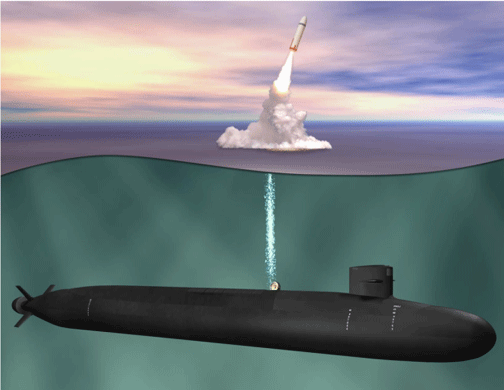 The U.S. Submarine That Could Bring Nuclear Doomsday With It, One sub to end a country. National Interest by Sebastien Roblin– 22 Nov 19 The U.S. Submarine That Could Bring Nuclear Doomsday With It, One sub to end a country. National Interest by Sebastien Roblin– 22 Nov 19
Key Point: The Ohio-class could pull it off. “…… The most deadly of the real-life kaiju prowling the oceans today are the fourteen Ohio-class ballistic-missile submarines, which carry upwards of half of the United States’ nuclear arsenal onboard. If you do the math, the Ohio-class boats may be the most destructive weapon system created by humankind. Each of the 170-meter-long vessels can carry twenty-four Trident II submarine-launched ballistic missiles (SLBMs) which can be fired from underwater to strike at targets more than seven thousand miles away depending on the load. As a Trident II reenters the atmosphere at speeds of up to Mach 24, it splits into up to eight independent reentry vehicles, each with a 100- or 475-kiloton nuclear warhead. In short, a full salvo from an Ohio-class submarine—which can be launched in less than one minute—could unleash up to 192 nuclear warheads to wipe twenty-four cities off the map. This is a nightmarish weapon of the apocalypse. The closest competitor to the Ohio-class submarine is the Russia’s sole remaining Typhoon-class submarine, a larger vessel with twenty ballistic-missile launch tubes. However, China, Russia, India, England and France all operate multiple ballistic-missile submarines with varying missile armaments—and even a few such submarines would suffice to annihilate the major cities in a developed nation………..
the New START treaty which came into effect in 2011 imposes additional limits on the number of deployed nuclear weapons. The current plan is to keep twelve Ohio-class subs active at time with twenty Trident IIs each, while two more boomers remain in overhaul, keeping a total of 240 missiles active at a time with 1,090 warheads between them. Don’t worry, restless hawks: that’s still enough to destroy the world several times over! ………. https://nationalinterest.org/blog/buzz/us-submarine-could-bring-nuclear-doomsday-it-98332
What possible excuse is there for such monstrous, nation-destroying weaponry?
|
|
France’s company EDF selling out of USA nuclear plants, Exelon to buy.
EDF Will Bail on Three Nuclear Plants, Exelon Holds the Bag, Power Mag 11/21/2019 | Aaron Larson Exelon Generation said EDF Group—a French integrated electricity company—is exercising a put option to sell its 49.99% interest in the R.E. Ginna, Nine Mile Point, and Calvert Cliffs nuclear energy facilities. The two companies will now begin negotiations for Exelon to acquire full ownership of the plants.
EDF’s involvement in the facilities was through the Constellation Energy Nuclear Group (CENG), a joint venture between it and Constellation Energy, which was negotiated in 2009. Exelon acquired its majority stake in the plants as part of a merger with Constellation Energy, a deal that closed in March 2012.
EDF said the disposal of CENG shares is part of a previously announced non-core-asset disposal plan. The put option could have been exercised by EDF anytime between Jan. 1, 2016, and June 30, 2022. A transaction price will follow from the determination of the fair market value of CENG shares pursuant to the contractual provisions of the put option agreement, EDF said.
…….. The facilities consist of the single-unit 576-MW R.E. Ginna Nuclear Power Plant (Figure 1) and the dual-unit 1,907-MW Nine Mile Point Nuclear Station, which are both in upstate New York, and the dual-unit 1,756-MW Calvert Cliffs Nuclear Power Plant in Maryland. The upstate New York plants were under economic pressure and faced possible closure a few years ago, but subsidies approved by the state have kept the units financially viable.
John Hopkins University prominent in helping the nuclear weapons industry
 Johns Hopkins University among schools furthering nuclear weapons, BALTIMORE SUN |NOV 20, 2019 When choosing a university, students should be weighing class sizes, major options or even the dining hall food quality. But what they shouldn’t have to consider is if their dream school helps to build nuclear weapons.
A new report reveals that nearly 50 U.S. colleges and universities contribute to building and maintaining U.S. nuclear weapons, in direct contradiction to their mission statements and often without the knowledge of their students and faculty. Three local universities are among these schools of mass destruction: Johns Hopkins University in Baltimore and George Washington University and Georgetown University in Washington, D.C.
Johns Hopkins’ Applied Physics Laboratory is a Defense Department-affiliated research center that works on nuclear weapons, which helped Johns Hopkins receive $828 million in research and development grants from the Defense Department for Fiscal Year 2017 — more than twice as much any other American university. The laboratory renewed a seven-year contract in 2017 to continue a strategic partnership with the Air Force Nuclear Weapons Center.
The laboratory operates away from the prying eyes of most students and faculty in a 453-acre, off-campus location. While Johns Hopkins generally exempts classified research, there is a blanket exemption policy for classified research at the Applied Physics Laboratory.
George Washington University maintains a Stockpile Stewardship Academic Alliance Center of Excellence, receiving $12.5 million in grants over five years for research relevant to the nation’s nuclear stockpile.
Georgetown University is a university partner of Lawrence Livermore National Laboratory. While the details of the partnership are not public, Lawrence Livermore receives 86% of its funding from the U.S. National Nuclear Security Administration Weapons Activities Appropriations for the design, engineering and evaluation of nuclear warheads.
College students should learn how to make the world a better place, not how to develop the tools to end it. Universities themselves make this point in their mission statements. Johns Hopkins sums up its mission as “knowledge for the world.” The mission of George Washington University is to “educate individuals in liberal arts, languages, sciences, learned professions, and other courses and subjects of study, and to conduct scholarly research and publish the findings of such research.” Georgetown University’s website states that at the core of its Jesuit tradition are “transcendent values, including the integration of learning, faith and service; care for the whole person; character and conviction; religious truth and interfaith understanding; and a commitment to building a more just world.”
It is time for these universities to live up to their own moral objectives.
As a first step, universities must provide more clarity about their work to support U.S. nuclear weapons so that students and faculty can make informed choices about where they would like to invest their intellectual capital. Johns Hopkins should reconsider whether permitting classified research at the Applied Physics Laboratory is in line with its “commitment to openness in documentation and dissemination of research results.”
George Washington University should shut down its “Stockpile Stewardship Academic Alliance Center of Excellence,” unless it receives a legally-binding guarantee that none of the basic research the center conducts will be applied to maintaining and expanding the U.S. nuclear weapons arsenal.
Georgetown may continue to partner with Lawrence Livermore on the minority of the laboratory’s research that contributes to “building a more just world.” But it must explicitly reject research for the laboratory’s main objective — building and maintaining nuclear weapons.
Universities can play a key role to equip the next generation of leaders with the knowledge and skills to make the world better a place. Nuclear weapons don’t belong there.
Alicia Sanders-Zakre (alicia@icanw.org) is policy and research coordinator of ICAN, Winners of the 2017 Nobel Peace Prize. https://www.baltimoresun.com/opinion/op-ed/bs-ed-op-1121-universities-nuclear-weapons-20191120-m77eyfshsngizdmsbl64z3mm7a-story.html
Toxic flushing of nuclear poisons into Lake Winnepeg
 Pinawa’s toxic predicament hurts Lake Winnipeg https://www.winnipegfreepress.com/opinion/analysis/pinawas-toxic-predicament-hurts-lake- Pinawa’s toxic predicament hurts Lake Winnipeg https://www.winnipegfreepress.com/opinion/analysis/pinawas-toxic-predicament-hurts-lake- winnipeg-564698971.html By: Dave Taylor 11/9/2019 winnipeg-564698971.html By: Dave Taylor 11/9/2019 How on Earth did humans ever think nature would absorb the nasty poisons we generate?
By now, we should realize that to bury or flush these toxins will not make them simply disappear. Many are insidious and will be back to bite us in the future. Putting a stop to these practices is paramount considering efforts to ameliorate past mistakes is such an onerous proposition, one that is even more demanding when the original polluter and their profits have disappeared.
We persist in flushing sewage into Lake Winnipeg and resist efforts to reduce phosphorus loads all in the name of financial savings. Ironically, there are no savings to be had, just a deferred payment plan. People will pay, it’s just a matter of when. The nuclear facility near Pinawa was built in the 1960s upon this very strategy of flushing wastes into the Winnipeg River and ultimately Lake Winnipeg, and continues to this day. The justification at that time was that they could dilute the radioactivity to levels that met their vague “as low as reasonably achievable” policy. Efforts continue to clean up the mess left behind in trenches, standpipes and bunkers, many of which are in disrepair and lead to the river. The subcontracting consortium that is attempting to deal with defunct sites across the country is Canadian Nuclear Labs (CNL). It is funded by the federal government and is led by SNC-Lavalin, whose lobbying efforts of the federal government are renowned and include bribery and fraud charges, as well as illegal election financing. The off-loading of the site and its problems have significantly altered the original decommissioning plans of 2001 and expedient shortcuts are being slipped by Canada’s nuclear regulator, the Canadian Nuclear Safety Commission, which we are obliged to trust to provide scrutiny of the cleanup and the ever-changing plans. CNL has applied for a 10-year licence and is being paid a king’s ransom ($1 billion annually) to restore the lands messed up by Atomic Energy of Canada at sites across the country. Placing our trust in CNL or the regulatory watchdog, commission, has never been more difficult. Not only are they administered by the same natural resources minister who advocates the expansion of nuclear power in Canada, but they have received a chastising by the International Atomic Energy Agency (IAEA) for what can only be described as a substandard approach to radioactive-waste disposal. The IAEA conducted a review mission in September and concluded the commission should enhance its policies and “should consider better aligning its radiation-protection requirements with IAEA safety standards.” In other words, shape up. At the very least, the federal watchdog should be placed under the environment portfolio so there is no perception of conflict of interest. The challenges for Pinawa are substantial as radioactive waste has been disposed of in decaying installations, some of which have required significant patching for cracks and, in a recent report made available to the public, they have discovered evidence of plutonium in the sewage lagoon not intended to receive radioactive materials. There are also the remains of Whiteshell Reactor No. 1 this consortium plans to seal up with concrete in hopes that the inevitable leaks will be absorbed by the river. Indigenous elders, including Dave Courchene, have taken a collaborative approach to dealing with this toxic predicament, which is upstream from them and entirely related to the concept of “flushing” wastes into a sacred river. Representatives of the Sagkeeng, Hollow Water and Peguis communities held a ceremony at Pinawa in September in hopes of changing the paradigm and promoting a much better solution. Since there is no solution to the problem of nuclear waste, they advocate isolating, containing, repackaging and consistent monitoring of these poisons over hundreds of years, a proposal that CNL is not likely to embrace as it will cut into their profits. Sagkeeng Chief Derrick Henderson stated: “We must be very careful with what we do to our land; we will be here forever and we all have that responsibility and duty.” Until the federal government assumes this duty of stewardship toward the Winnipeg River, “flushing” of radioactive waste will continue. The elders are sending SNC-Lavalin and friends a clear message. If they aren’t willing to adhere to traditional wisdom, keep them on a short leash with a year-to-year licence. Dave Taylor teaches at the University of Winnipeg.
|
|

Holtec’s proposed nuclear storage facility of little benefit to New Mexico
“There is no guarantee that high-level nuclear waste can be safely transported to and through New Mexico.”
“There is no guarantee that this site will truly be ‘interim’ and won’t become the permanent dumping ground for our nation’s nuclear waste.”
“I’ve never understood what the rationale was for transporting this nuclear waste for these many miles all the way down to New Mexico. I don’t have an answer as to why it can’t be stored close to where it was created,”
“We really have to think about our land use, to think about being able to build other kinds of businesses that don’t end up spoiling the land and air,”

|
Not much benefit to the state’: Legislators scrutinize details of Holtec’s proposed nuclear storage facility, New Mexico Political Report, By Kendra Chamberlain 20 Nov 19, “……. The firm Holtec International, which specializes in spent nuclear fuel storage, has applied for a license from the federal Nuclear Regulatory Commission to construct and operate the facility in southeastern New Mexico. The proposal, which is still moving through the licensing application process established by the NRC for consolidated interim storage, would house up to 120,000 metric tons of high-level waste at capacity — more nuclear waste than currently exists in the country.
During his presentation to the committee, Mayer pitched the project as an economic boon to the state that would not affect oil and gas activity in the area and assured committee members the facility would not threaten water resources in the area. But legislators at the meeting weren’t completely sold on the project. “I’m reminded of how [much] of a long-term legacy this project is creating for fellow New Mexicans,” said state Sen. Jeff Steinborn, D-Las Cruces. “We’re dealing with something that our successors’ successors’ successors will be dealing with, with not much benefit to the state and a very significant upfront cost.” Continue reading |
US presidential candidate Deval Patrick’s ignorance about nuclear weapons
 Deval Patrick: the latest presidential candidate to be uninformed on nuclear weapons, Bulletin of the Atomic Scientists, By John Krzyzaniak, November 20, 2019 Deval Patrick, the former governor of Massachusetts, became the latest latecomer to the 2020 presidential campaign when he entered the fray last week. At the time of this writing, he does not have very many clear policy positions, or even a campaign website. But anyone running for president—even someone who’s still on the honeymoon period of his announcement—should expect to be asked tough policy questions, especially on important issues like nuclear weapons. Was Patrick prepared? Well, not really………. Deval Patrick: the latest presidential candidate to be uninformed on nuclear weapons, Bulletin of the Atomic Scientists, By John Krzyzaniak, November 20, 2019 Deval Patrick, the former governor of Massachusetts, became the latest latecomer to the 2020 presidential campaign when he entered the fray last week. At the time of this writing, he does not have very many clear policy positions, or even a campaign website. But anyone running for president—even someone who’s still on the honeymoon period of his announcement—should expect to be asked tough policy questions, especially on important issues like nuclear weapons. Was Patrick prepared? Well, not really……….
Overall, Patrick is woefully uninformed about what is a hugely important—dare I say existential—issue. But he’s not alone: A whole slew of 2020 candidates have either pleaded ignorance on certain nuclear policies or given answers that were borderline incomprehensible. In 2016 things were hardly different. In a debate with Hillary Clinton, then-candidate Donald Trump made two contradictory statements on this issue in almost the same breath, saying both that he would “certainly not do a first strike” and that he “can’t take anything off the table.” The next Democratic presidential debate is on Wednesday evening. If we’ve learned anything from the debates, it’s that disproportionate attention to one or two issues, such as healthcare or immigration, has driven candidates to put serious thought into their own stance on those issues. If the moderators can carve out 10 minutes for a question or three on America’s nuclear weapons policies, it would mark a welcome change. https://thebulletin.org/2019/11/deval-patrick-the-latest-presidential-candidate-to-be-uninformed-on-nuclear-weapons/ |
|
If You Can’t Do Nuclear, Try (Concentrating) Solar Power Instead
|
If You Can’t Do Nuclear, Try (Concentrating) Solar Power Instead, https://cleantechnica.com/2019/11/19/concentrating-solar-power-breakthrough/ Some great news for concentrating solar power fans sailed in over the transom this morning. Mega wealthy person and famed US investor Bill Gates may be chasing the nuclear unicorn with his startup Terrapower, but meanwhile his other startup Heliogen — his secret one! — has just burst out of stealth mode with a new concentrating solar power breakthrough in its pocket.
A Concentrating Solar Power Breakthrough Grows In Lancaster, CAWhile TerraPower has been pitching nukes, the Heliogen research team has been hammering away in deepest secrecy at its research facility in Lancaster, California, with the aim of developing a concentrating solar power system that can deliver temperatures of more than 1,000 degrees Celsius.
Reading between the lines of Heliogen’s first ever press release, that puts the new solar system in direct competition with fossil fuels for high-heat industrial processes including cement and steel production. If all goes according to plan, the new system will also breathe new, lower-carbon life into the petrochemical industry. That’s great news for ExxonMobil and other petroleum (and natural gas) stakeholders, though it’s not so great news for the “keep it in the ground” approach to averting climate global disaster. The Concentrating Solar Power SolutionA typical concentrating solar power system works by collecting sunlight from arrays of specialized mirrors called heliostats (so Heliogen, get it?), and focusing the energy on a central point, where it heats molten salt or another medium, which then gets put to use. Boiling water for steam to run a generator is one such example. If that sounds complicated, it is. Concentrating solar power has had its critics in past years, mainly due to its relatively high cost and complexity. Nevertheless, the Department of Energy has been a big supporter of the technology here in the US, and it has been catching on elsewhere around the globe as the technology improves and costs come down. The Energy Department has also been zeroing in on research that leads to new record-setting heat levels, just as Heliogen is claiming. Here’s Heliogen on that topic: “Previous commercial concentrating solar thermal systems have been designed to reach temperatures of up to only 565 degrees Celsius – useful for power generation, but insufficient for many industrial processes. Many of these processes require much higher temperatures, which have traditionally been reached through the burning of fossil fuels.” That’s nothing. Heliogen is looking at temperatures up to 1,500 degrees. If you’re thinking what Heliogen is thinking, run right out and buy yourself a cigar. Among other uses, the technology could be deployed to “split” hydrogen from water. Hydrogen is a zero emission fuel but the primary source of hydrogen today is fossil natural gas, so the prospect of switching to water as a feedstock is a big deal. In terms of staving off catastrophic climate change, devoting energy to water-splitting systems makes sense only if the energy comes from renewable resources like solar, so if you hear the sound of popping in the distance, that would be renewable hydrogen fans breaking out the bubbly in celebration. How Does It Work?So far so good, but the devil is in the details. Other teams are pursuing high heat solar power systems. What puts Heliogen ahead of the rest of the concentrating solar power pack? The company isn’t saying much, except that it has something to do with an “advanced computer vision software to hyper-accurately align a large array of mirrors to reflect sunlight to a single target.” So far that sounds like a typical concentrating solar power system, with an extra punch provided by maneuvering the array of heliostats with extreme accuracy, enabling them to reflect more sunlight than other systems. There is probably a lot more to the picture, but that’s all Heliogen is giving out for now. Come to think of it, though, Heliogen has something in common with another company that has a concentrating solar power research site in Lancaster, California, called Edisun Microgrids. The thing in common is visionary innovator Bill Gross, who is listed as the CEO of Edisun, and who is also the CEO and co-founder of Heliogen. Gross has several other solar startups under his belt, but let’s zero in on Edisun. Last spring the Energy Department included Edisun in a group of research teams aiming to bring down the cost of concentrating solar power. Here’s the rundown from the Energy Department: “Traditional cost reduction strategies have focused on developing larger heliostats with more mirror surface area on each unit, making the mirrors even more susceptible to wind. This project will pair smaller mirrors that can more precisely track the sun with an inexpensive novel gear train as the foundation of the heliostat.” Stay tuned as CleanTechnica checks in with Heliogen for more details on its technology. Whatever Happened To TerraPower?Meanwhile, speaking of arrays, Heliogen has an impressive array of researchers, partners, and investors behind it, but Bill Gates sticks out in terms of name recognition so let’s hear what he has to say (via Heliogen’s press release): “…If we’re going to get to zero-carbon emissions overall, we have a lot of inventing to do. I’m pleased to have been an early backer of Bill Gross’s novel solar concentration technology. Its capacity to achieve the high temperatures required for these processes is a promising development in the quest to one day replace fossil fuel.” So, where does that leave TerraPower? The nuclear industry still has potential for growth in some parts of the world. TerraPower initially had China in its sights, although that avenue has reportedly been closed, at least temporarily, due to the President* Trump’s trade policies. Here in the US the prospects for finding news sites for nuclear power plants are zero to none within the foreseeable future, despite an assist from President* Trump’s so-named Affordable Clean Energy plan. Nevertheless, there are still 98 nuclear power plants in the US. Some of them could potentially house new technology as their licenses come up for renewal. As of last year the Energy Department was still cheerleading for TerraPower’s molten salt nuclear technology, and TerraPower continues to soldier on with R&D. The company has been working on a lab expansion and last September it also passed an important milestone in its work with the Energy Department’s Idaho National Laboratory. Since some concentrating solar systems also use molten salt as a medium, it’s also possible that some of TerraPower’s R&D could transfer to the concentrating solar power field, even if the nuclear thing doesn’t work out so well. |
|
|
Desperate times for the nuclear industry – could Australia be its saviour?
the number one goal of the nuclear lobby is to remove Australia’s national and state laws that prohibit the nuclear industry.
the campaign by the global nuclear industry, particularly the American industry, to kickstart another “nuclear renaissance”, before it’s too late.

Australia is the great ‘white’ hope for the global nuclear industry, Independent Australia, By Noel Wauchope | 19 November 2019, The global nuclear industry is in crisis but that doesn’t stop the pro-nuclear lobby from peddling exorbitantly expensive nuclear as a “green alternative”. Noel Wauchope reports.
The global nuclear industry is in crisis. Well, in the Western world, anyway. It is hard to get a clear picture of Russia and China, who appear to be happy putting developing nations into debt, as they market their nuclear reactors overseas with very generous loans — it helps to have stte-owned companies funding this effort.
But when it comes to Western democracies, where the industry is supposed to be commercially viable, there’s trouble. The latest news from S&P Global Ratings has made it plain: nuclear power can survive only with massive tax-payer support. Existing large nuclear reactors need subsidies to continue, while the expense of building new ones has scared off investors.
So, for the nuclear lobby, ultimate survival seems to depend on developing and mass marketing “Generation IV” small and medium reactors (SMRs). …..
for the U.S. marketers, Australia, as a politically stable English-speaking ally, is a particularly desirable target. Australia’s geographic situation has advantages. One is the possibility of making Australia a hub for taking in radioactive wastes from South-East Asian countries. That’s a long-term goal of the global nuclear lobby. …..
In particular, small nuclear reactors are marketed for submarines. That’s especially important now, as a new type of non-nuclear submarine – the Air Independent Propulsion (AIP) submarine, faster and much cheaper – could be making nuclear submarines obsolete. The Australian nuclear lobby is very keen on nuclear submarines: they are now promoting SMRs with propagandists such as Heiko Timmers, from Australian National University. This is an additional reason why Australia is the great white hope.
I use the word “white” advisedly here because Australia has a remarkable history of distrust and opposition to this industry form Indigenous Australians…..
The hunt for a national waste dump site is one problematic side of the nuclear lobby’s push for Australia. While accepted international policy on nuclear waste storage is that the site should be as near as possible to the point of production, the Australian Government’s plan is to set up a temporary site for nuclear waste, some 1700 km from its production at Lucas Heights. The other equally problematic issue is how to gain political and public support for the industry, which is currently banned by both Federal and state laws. SMR companies like NuScale are loath to spend money on winning hearts and minds in Australia while nuclear prohibition laws remain.
 Ziggy Switkowski, a long-time promoter of the nuclear industry, has now renewed this campaign — although he covers himself well, in case it all goes bad, noting that nuclear energy for Australia could be a “catastrophic failure“. ……
his submission (No. 41) to the current Federal Inquiry into nuclear power sets out only one aim, that
‘… all obstacles … be removed to the consideration of nuclear power as part of the national energy strategy debate.’
So the Environmental Protection and Biodiversity Conservation Act (EPBC Act) should be changed, according to Switkowski. In an article in The Australian, NSW State Liberal MP Taylor Martin suggested that the Federal and state laws be changed to prohibit existing forms of nuclear power technology but to allow small modular reactors.
Switkowski makes it clear that the number one goal of the nuclear lobby is to remove Australia’s national and state laws that prohibit the nuclear industry. And, from reading many pro-nuclear submissions to the Federal Inquiry, this emerges as their most significant aim.
It does not appear that the Australian public is currently all agog about nuclear power. So, it does seem a great coincidence that so many of their representatives in parliaments – Federal, Victorian, New South Wales, South Australia and members of a new party in Western Australia – are now advocating nuclear inquiries, leading to the repeal of nuclear prohibition laws.
We can only conclude that this new, seemingly coincidental push to overturn Australia’s nuclear prohibition laws, is in concert with the push for a national nuclear waste dump in rural South Australia — part of the campaign by the global nuclear industry, particularly the American industry, to kickstart another “nuclear renaissance”, before it’s too late.
Despite its relatively small population, Australia does “punch above its weight” in terms of its international reputation and as a commercial market. The repeal of Australia’s laws banning the nuclear industry would be a very significant symbol for much-needed new credibility for the pro-nuclear lobby. It would open the door for a clever publicity drive, no doubt using “action on climate change” as the rationale for developing nuclear power.
In the meantime, Australia has abundant natural resources for sun, wind and wave energy, and could become a leader in the South-East Asian region for developing and exporting renewable energy — a much quicker and more credible way to combat global warming. https://independentaustralia.net/politics/politics-display/australia-is-the-great-white-hope-for-the-global-nuclear-industry,13326
1 This Month

Protect Sazan Island from the Trump family! https://secure.avaaz.org/campaign/en/protect_sazan_island_from_the_trump_family_loc/?bqFCVab&v=174511&cl=22707147157&_checksum=5e9dde668860e8231c33699735e16a1fbf22ab2cb01da50c999fe8732b9775ef&utm_source=email&utm_medium=blast_email&utm_campaign=174511


Cuba Is Not a Failed State – It Is a Besieged State
PETITION: “Global Appeal to Endorse Palestinian Right of Return of Refugees”
To see nuclear-related stories in greater depth and intensity – go to https://nuclearinformation.wordpress.com
-
Archives
- June 2026 (129)
- May 2026 (306)
- April 2026 (356)
- March 2026 (251)
- February 2026 (268)
- January 2026 (308)
- December 2025 (358)
- November 2025 (359)
- October 2025 (376)
- September 2025 (257)
- August 2025 (319)
- July 2025 (230)
-
Categories
- 1
- 1 NUCLEAR ISSUES
- business and costs
- climate change
- culture and arts
- ENERGY
- environment
- health
- history
- indigenous issues
- Legal
- marketing of nuclear
- media
- opposition to nuclear
- PERSONAL STORIES
- politics
- politics international
- Religion and ethics
- safety
- secrets,lies and civil liberties
- spinbuster
- technology
- Uranium
- wastes
- weapons and war
- Women
- 2 WORLD
- ACTION
- AFRICA
- Atrocities
- AUSTRALIA
- Christina's notes
- Christina's themes
- culture and arts
- Events
- Fuk 2022
- Fuk 2023
- Fukushima 2017
- Fukushima 2018
- fukushima 2019
- Fukushima 2020
- Fukushima 2021
- general
- global warming
- Humour (God we need it)
- Nuclear
- RARE EARTHS
- Reference
- resources – print
- Resources -audiovicual
- Weekly Newsletter
- World
- World Nuclear
- YouTube
-
RSS
Entries RSS
Comments RSS
 nuclear-news