Nuclear power is never safe or economical
Nuclear power is never safe or economical
I hope Sen. Durbin changes his mind about promoting nuclear energy. The real carbon-free sources of electricity are wind and solar. Chicago Sun Times George Milkowski, West Ridge Nov 27, 2021 ”’
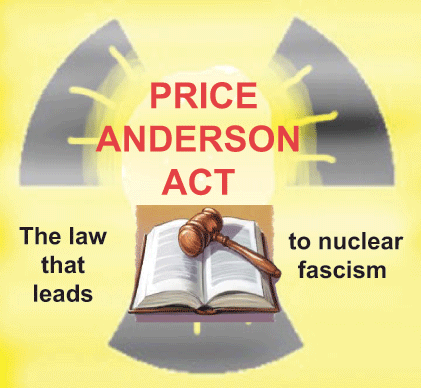
……….. When nuclear power plants were first touted in the 1950s as a new and safe method for producing electricity, it was said the electricity would be “too cheap to meter.” This is pure nonsense! If it was so safe, why weren’t any power plants built and put on line until passage of the Price-Anderson Act? The law has been amended a number of times and greatly limits the liability of operators of nuclear power plants.
Anything paid out beyond the limits set in Price-Anderson would take years of lawsuits.
Sen. Durbin wrote “It is past time for Congress to step up and develop a comprehensive, consent-based plan to store nuclear waste.” That’s an understatement. Nuclear waste is stored within a half-mile of Lake Michigan at the now-closed Zion nuclear power plant. Why is it close to the source of our drinking water? Because there is nowhere to ship it! Plans to ship such waste to a depository in Yucca Mountain in the southwest fell through when some improperly stored barrels burst into flames, releasing large amounts of high-level radioactive material.
Who does the senator think will agree to a “consent-based plan” when there is no known method of safely storing these dangerous materials for thousands of years, the time it takes for radioactive decay to make it safe for the environment?
Sen. Durbin argued that “we must ensure the nuclear fleet remains safe and economical,” but nuclear power has never been economical. As far as I know, the last time a permit was approved for a new nuclear plant was during the Obama administration. That plant in Georgia is only about half complete, although it was to be finished by now and the cost is already double the initial estimate.
The current “fleet,” as Sen. Durbin called them, of nuclear power plants were designed and engineered to last about 30 to 40 years. Most of our country’s plants are near that age. Their internal systems are constantly bombarded by radioactive particles, making the metal in the systems more brittle and prone to failure every year. Subsidizing them is a waste of taxpayer money and a dangerous gamble with our lives.
I hope Sen. Durbin changes his mind. The real carbon-free sources of electricity are renewables: wind and solar.
Hundreds of Scientists Ask Biden to Cut the U.S. Nuclear Arsenal

Hundreds of Scientists Ask Biden to Cut the U.S. Nuclear Arsenal, New York Times,
In a letter, the scientists also urged President Biden to declare that the United States would never be the first to use nuclear weapons in a conflict., By David E. Sanger 17 Dec 21,
WASHINGTON — Nearly 700 scientists and engineers, including 21 Nobel laureates, asked President Biden on Thursday to use his forthcoming declaration of a new national strategy for managing nuclear weapons as a chance to cut the U.S. arsenal by a third, and to declare, for the first time, that the United States would never be the first to use nuclear weapons in a conflict.
The letter to Mr. Biden also urged him to change, for the first time since President Harry S. Truman ordered the dropping of the atomic bomb over Hiroshima, the American practice that gives the commander in chief sole authority to order the use of nuclear weapons. The issue gained prominence during the Trump administration, and the authors of the letter urged Mr. Biden to make the change as “an important safeguard against a possible future president who is unstable or who orders a reckless attack.”
But while Mr. Biden has often declared that he will be guided by scientific advice alone when it comes to managing the Covid-19 pandemic, he has made no such pledge in the nuclear arena, where strategists, allies protected by the American nuclear umbrella and members of Congress all have views — many of them diametrically opposed to the ones described by scientists………………….. https://www.nytimes.com/2021/12/16/us/politics/scientists-letter-nuclear-arsenal.html
Small nuclear reactors for military use would be too dangerous – excellent targets for the enemy

In normal operation, they release potentially hazardous quantities of fission products that would be widely distributed by any penetration of the reactor vessel. More worryingly, the resiliency of tri-structural isotropic particles to kinetic impact is questionable: The silicon carbide coating around the fuel material is brittle and may fracture if impacted by munitions.
Further, graphite moderator material, which is used extensively in most mobile power plant cores, is vulnerable to oxidation when exposed to air or water at high temperatures, creating the possibility of a catastrophic graphite fire distributing radioactive ash. Even in the case of intact (non-leaking) fuel fragments being distributed by a strike, the radiological consequences for readiness and effectiveness are dire.
Given these vulnerabilities, sophisticated adversaries seeking to hinder U.S. forces are likely to realize the utility of the reactor as an area-denial target…….. , a reactor strike offers months of exclusion at the cost of only a few well-placed high-explosive warheads, a capability well within reach of even regional adversaries
Even an unsuccessful or minimally damaging attack on a reactor could offer an adversary significant benefits…………..placing these reactors in combat zones introduces nuclear reactors as valid military targets,
MOBILE NUCLEAR POWER REACTORS WON’T SOLVE THE ARMY’S ENERGY PROBLEMS, War on the Rocks, 14 Dec 21, JAKE HECLA ”………… As China and Russia develop microreactors for propulsion, the U.S. Army is pursuing the ultimate in self-sufficient energy solutions: the capability to field mobile nuclear power plants. In this vision of a nuclearized future, the Army will replace diesel generator banks with microreactors the size of shipping containers for electricity production by the mid-2020s.
……. the question is whether or not reactors can truly be made suitable for military use. Are they an energy panacea, or will they prove to be high-value targets capable of crippling entire bases with a single strike?
nuclear power program is confidently sprinting into uncharted territory in pursuit of a solution to its growing energy needs and has promised to put power on the grid within three years. However, the Army has not fielded a reactor since the 1960s and has made claims of safety and accident tolerance that contradict a half-century of nuclear industry experience.
The Army appears set to credulously accept industry claims of complete safety that are founded in wishful thinking and characterized by willful circumvention of basic design safety principles………..
Biden administration must end the environmental injustices of the nuclear era
 | |||
Biden administration must end the environmental injustices of nuclear era https://chicago.suntimes.com/2021/12/14/22827937/renewable-energy-nuclear-biden-executive-order-chiefs-raiders-person-year-letters
If nuclear energy can’t be changed into something safe, it’s a bad idea to produce it in the first place Stephanie Bilenko, La Grange Park, Dec 14, 2021, President Joe Biden’s executive order, Tackling the Climate Crisis at Home and Abroad, created the White House Environmental Justice Advisory Council (WHEJAC) to advise the federal government’s efforts to address environmental injustice.
In a May report, WHEJAC recommended ruling out nuclear power under the council’s criteria for federal investments that maximize benefits and avoid harm. WHEJAC concluded that nuclear power is not beneficial to communities that have suffered from environmental injustice and are on the frontlines of radioactive exposure, contamination and environmental degradation across the entire nuclear fuel chain and radioactive waste streams.
Instead of propping up aging reactors and perpetuating injustices, the Biden administration must implement policies that end injustice. Congress and the Biden administration should commit to phasing out nuclear power, cleaning up radioactive sites, making reparations to impacted communities and transitioning to 100% renewable energy — now.
The more nuclear power we generate now, the more radioactive waste will be stockpiled for generations far into the future. An essential boundary of appropriate tech is the boundary between matter you can change with tools on hand, and matter you can’t change. If it can’t be changed to something safe, it’s a bad idea to produce it in the first place.
Basic morality teaches us that we ought to leave the world a better place for those who come after us. If we know better, we have to do better.
Federal inspector falsified safety reports at North Anna nuclear plant.

Federal inspector falsified safety reports at North Anna nuclear plant, https://www.wric.com/news/virginia-news/breaking-federal-inspector-falsified-safety-reports-at-north-anna-nuclear-plant/by: Jakob CordesPosted: Dec 14, 2021 CHARLOTTESVILLE, Va. (WRIC) — A federal inspector who led safety efforts at the North Anna Nuclear Power Plant in Louisa County plead guilty this week to falsifying safety inspection reports.
The charges were filed after Gregory Croon’s retirement from the Nuclear Regulatory Commission (NRC) in 2020. In a press release, the Department of Justice’s (DOJ) Office of the Inspector General (OIG) said the charges were a result of a joint investigation between the OIG and NRC.
According to court documents obtained by 8News, Croon worked at the power plant for four years and was the senior inspector at the North Anna facility, overseeing safety inspections for the entire plant.
Over three separate quarterly reports in 2017, Croon was found to have lied about on-site inspections of key fire and flood safety systems, describing the completion of inspections that never actually took place. The systems in question included fire suppression mechanisms and flood barriers protecting key equipment.
While only a few specific instances of falsification were described in court documents, a statement of facts signed by Croon stated that for years he “allowed days or even weeks to pass without entering North Anna.”
Court documents go on to say that his immediate supervisor told him on several occasions to conduct physical inspections more frequently, but that Croon continued to avoid the plant.
The North Anna Nuclear Nuclear Generating Station is a 1892 Megawatt plant located on the shores of Lake Anna in Louisa County. It’s situated near major population centers in Central Virginia, about 60 miles from Richmond and 50 miles from Charlottesville.
“The accuracy of NRC inspection reports is critical to the NRC’s oversight of licensees’ safe operation of nuclear power plants around the nation,” said NRC Inspector General Robert J. Feitel. “Croon’s false statements could have jeopardized that safety oversight function.”
At a Dec. 13 hearing before the Hon. Judge Norman K. Moon in the Western District Court of Virginia, Croon submitted a guilty, signing a plea agreement with prosecutors that would allow him to avoid jail time but carries a term of probation and a potential fine of up to $9,500.
Croon was released on bond but will reappear before the court in Charlottesville for a sentencing hearing on March 7, 2022.
15 minutes to save the world’: a terrifying Virtual Reality journey into the nuclear bunker
15 minutes to save the world’: a terrifying VR journey into the nuclear bunker, Guardian Julian Borger in WashingtonTue 14 Dec 2021 Nuclear Biscuit, a simulated experience, allows US officials to wargame a missile attack and see the devastating consequences of their choices…………
I was experiencing what a US president would have to do in the event of a nuclear crisis: make a decision that would end many millions of lives – and quite possibly life on the planet – with incomplete information and in less than 15 minutes……………
The VR simulation has been developed by a team from Princeton, American and Hamburg universities, based on extensive research, including interviews with former officials, into what would happen if the US was – or believed itself to be – under nuclear attack. They have called their project the Nuclear Biscuit, after the small card bearing the president’s launch authorization codes.
……………………….. In 1979, the world came within minutes of nuclear war because someone had left a training tape simulating a Russian attack in the early warning system monitors. In September 1983, Russian computers erroneously showed incoming US missiles. Armageddon was only averted because the duty officer, Lieutenant Colonel Stanislav Petrov, went against protocols and decided not to act on the alert because his gut told him it was a glitch……….
…………… The pressure to take one of the options presented by the Pentagon felt almost overwhelming. At one point an aide asked how I would be able to face my country if I failed to respond. The simulation raises the question of who chooses those options in the first place. In the 15 minutes available, it would be impossible to put all feasible alternatives in front of a president, so whoever whittles them down holds a huge amount of power. All we know is that it is someone from the US military. Diplomats, politicians or ethicists are not part of the process.
…………… Shockingly, the researchers found no evidence that any US president except Jimmy Carter, had taken part in realistic drills to practise potentially world-ending decisions. Other presidents occasionally participated in table-top exercises with aides to discuss options but more often sent surrogates in their place.
In January, the research team will take their experiment to Capitol Hill, with the aim of provoking some contemplation about the realities underlying US nuclear planning.
“Hopefully members of Congress will come to experience this and at least see the consequences of the choices they’ve made about nuclear weapons issues,” Weiner said. “They will see everybody in that virtual room is trying to do their job, but it’s an impossible job.” https://www.theguardian.com/technology/2021/dec/14/vr-game-simulating-nuclear-attack-tests-decision-making-skills
Westinghouse keen get new 40-year operating license for nuclear fuel plant, despite pollution, leakscand spills.
Westinghouse investing $131 million at nuclear fuel plant after recent leaks and spills, The State, BY NOAH FEIT AND SAMMY FRETWELL DECEMBER 15, 2021
Westinghouse will invest $131 million in its troubled nuclear fuel factory on Bluff Road under a plan that includes improving pollution controls at the facility, which has been plagued by leaks and spills and recently has drawn scrutiny from federal agencies about environmental problems…………..
Wednesday’s announcement is a potentially significant step in the company’s effort to gain a new 40-year operating license, which is critical to keeping the plant open.The current license expires in 2027, but Westinghouse is seeking a new license now to help ensure future stability of its business to customers. An environmental study for the U.S. Nuclear Regulatory Commission — a report criticized by some federal agencies as inadequate — recommended the 40-year license, as did an advisory panel to McMaster. But the U.S. Department of the Interior recommended a 20-year license because of pollution that has seeped into groundwater at the plant, a problem the department said could threaten nearby Congaree National Park. Making substantial improvements at Westinghouse could mollify some concerns about future environmental threats………..
According to plans, the company’s $131 million investment includes upgrades to equipment and procedures, increasing the company’s capacity and future growth………
Westinghouse’s fuel plant, which employs about 1,000 workers, has been under intense scrutiny the past five years because of spills and leaks, and information has surfaced about contaminated groundwater that had been unknown for years to regulators and the public. Among other troubles, uranium, a radioactive material, leaked through a hole in the plant’s floor and uranium built up in an air pollution control device, a problem that could have sent a burst of radiation inside the plant. Leaking containers also allowed toxins to dribble into the ground.
The U.S. Department of the Interior and the U.S. Environmental Protection Agency recently voiced concerns about the plant in comment letters to the U.S. Nuclear Regulatory Commission, which is weighing whether to grant the 40-year license. The S.C. Department of Natural Resources also expressed reservations.
Bob Guild, a veteran environmental lawyer and local Sierra Club member, questioned the impact of the $131 million plant announcement. The news release did not explain in detail how much of the investment would be for specific improvements to protect the environment. It also did not address the legacy of pollution on the property. “I’m very skeptical that there is significant investment in pollution control,’’ he said.“To the extent they are committing resources to improving processes to ensure this doesn’t happen again, all the better,’’ Guild said. “But none of that addresses cleaning up contamination that is historic at the site.’’………….Read more at: https://www.thestate.com/news/business/article256614776.html#storylink=cpy
Buyer beware: NuScale tries a new way to get funding for its small nuclear reactor plan

An Oregon company is going public to raise money for nuclear power ambitions, OPD, 15 Dec 21,
……………NuScale, headquartered in the Portland suburb of Tigard, will go public by merging with what’s known as a special purpose acquisition company, or SPAC. The company, Spring Valley Acquisition Corporation, is already publicly traded. Such mergers have recently gained popularity on Wall Street by allowing private companies the option to go public without the costs or risks associated with the more conventional initial public offering, or IPO.
Other Oregon businesses like the vacation rental company Vacasa and battery manufacturer ESS Tech have also gone public by merging with so-called “blank check” companies. In each of those cases, some investors pulled out when news of the mergers dropped, leaving each company with less money than they’d initially hoped……………
Editorial: No, California shouldn’t extend the life of its last nuclear plant. There are better ways to fight climate change

We can and should curb the dangers of fossil fuel combustion and nuclear fission at the same time, not use the threat of one to prop up the other.
Editorial: No, California shouldn’t extend the life of its last nuclear plant. There are better ways to fight climate change https://www.latimes.com/opinion/story/2021-12-12/diablo-canyon-nuclear-closure BY THE TIMES EDITORIAL BOARD, DEC. 12, 2021
California is approaching an energy crossroads. In three years, its last nuclear plant will begin to power down and the state will lose its largest single source of emissions-free electricity.
A 2018 law requires state regulators to “avoid any increase in greenhouse gases” as a result of closing the Diablo Canyon nuclear power plant on the Central Coast. But if they don’t move more quickly to replace its electricity with renewable energy from wind, solar and geothermal, the void will almost certainly be filled by burning more natural gas, which increased last year to account for nearly half of California’s in-state electricity generation.
California can’t allow the retirement of Diablo Canyon’s nuclear reactors to prolong its reliance on gas plants or increase planet-warming and health-damaging emissions. But the state’s preparations for shutdown of an around-the-clock power source that supplies more than 8% of California’s in-state electricity generation have not inspired confidence; there have been no assurances that an uptick in carbon emissions will be avoided.
That uncertainty has created an opening for a new push to extend Diablo Canyon’s life. A recently launched campaign, whose supporters include former U.S. Energy secretaries Steven Chu and Ernest Moniz, and fashion model and nuclear influencer Isabelle Boemeke, wants California to abruptly reverse course and keep Diablo Canyon operating for another 10 or even 20 years.
Proponents say this would reduce climate pollution, bolster grid reliability and buy time during a crucial period in the state’s transition toward solar, wind and other renewable energy sources, citing a recent report by Stanford University and MIT scientists that lends support to the idea. The Biden administration has chimed in receptively, with Energy Secretary Jennifer M. Granholm suggesting in a recent interview that California might reconsider closing the facility to avoid losing an always-on source of clean electricity.
But the idea is misguided, and at this point remains largely divorced from reality. The plant’s closure should instead serve as an impetus for California do more to accelerate the shift to renewable energy and set a realistic course to meet the state’s target of getting 100% of its electricity from carbon-free sources by 2045
Those floating the idea of keeping Diablo Canyon open seem to ignore many practical considerations, including how to address seismic risks, the ecological harm of using seawater for cooling, and what to do with spent nuclear fuel. The cooling system and earthquake safety upgrades that would be required for the facility to keep operating after 2025 are so extensive they would likely exceed $1 billion, according to the Public Utilities Commission.
The plant’s operator, Pacific Gas and Electric Co., agreed in 2016 not to pursue license renewal, in part because closing the plant and replacing it with other zero-carbon energy sources and storage would cost less than keeping it open. The utility has shown no interest in reconsidering, nor has the Public Utilities Commission received any proposals to revisit its 2018 decision to allow the plant to shut down.
Still, the pro-nuclear camp is right in pointing out that the urgency of fighting global warming has only increased in the five years since the decision to close Diablo Canyon. Wildfires and other climate impacts are worsening at an alarming clip. Last year, California experienced its first rolling blackouts in nearly two decades thanks to climate-fueled heat waves that forced the state to burn more planet-warming gas to keep the power on. And the recent global climate summit in Glasgow, Scotland, showed that world leaders aren’t yet acting with the urgency needed to avert catastrophic warming.
But there are good reasons to eschew nuclear power as a solution. The world is still dealing with repercussions from the Chernobyl and Fukushima nuclear disasters, which rendered huge zones uninhabitable and spread radioactive isotopes across the globe; and closer to home, the cleanup of the 1959 partial nuclear meltdown at the Santa Susana Field Laboratory near Simi Valley. Because the United States has no designated repository for high-level radioactive waste, spent nuclear fuel is stored on site at power plants across the country, posing ongoing risks. We can and should curb the dangers of fossil fuel combustion and nuclear fission at the same time, not use the threat of one to prop up the other.
U.S. government struggles with the ever-accumulating nuclear waste problem
Government launches push that may remove Maine Yankee’s nuclear waste from Wiscasset
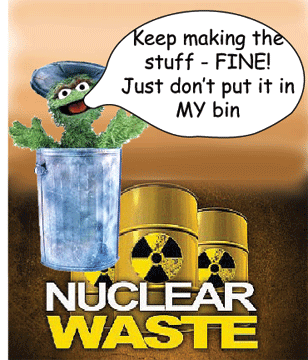
The U.S. Department of Energy wants to know whether communities would be willing to store nuclear waste temporarily while the government finds a permanent solution.
BY KATHLEEN O’BRIEN, TIMES RECORD, 2 Dec 21, The federal government has taken the first step in an effort to move the nation’s spent nuclear fuel, like the 542 metric tons of nuclear waste at the long-decommissioned Maine Yankee facility in Wiscasset, but a Maine Yankee official said that waste likely isn’t going anywhere any time soon.
On Nov. 30, the U.S. Department of Energy released a request for information on a consent-based effort to move the nation’s spent nuclear fuel to other communities willing to hold onto it until the government finds a permanent storage solution for the waste. The DOE is collecting feedback from stakeholders on the effort until March 4, 2022, at 5 p.m
This action is considered long overdue because the Nuclear Waste Policy Act of 1982 required the federal government to remove the radioactive waste from sites including Maine Yankee by 1998, but that commitment was never fulfilled.
Maine Yankee operated from 1972 to 1996 when the company’s board voted to cease operations rather than invest in fixing expensive safety-related problems to keep the plant running. The plant was fully decommissioned in 2005. Since then, the nuclear waste has sat there, waiting for the government to remove it.
Maine Yankee’s spent nuclear fuel is housed in 64 dry storage casks, which stand on 16 3-foot-thick concrete pads. Each concrete cask is comprised of a 2.5-inch-thick steel liner surrounded by 28 inches of reinforced concrete. The site takes up 820-acres on Wiscasset’s Bailey Point.
Maine Yankee Public and Government Affairs Director Eric Howes said moving the nuclear waste elsewhere will be a years-long process, but this movement is, “a positive development, but much more needs to be done to resolve the spent nuclear fuel issue.”
…….. “It’s going to be difficult to get a community willing to be an interim storage facility because what does interim mean?” Howes said. “What’s meant by interim when, at this point, there is no plan for a permanent geologic repository?”………..
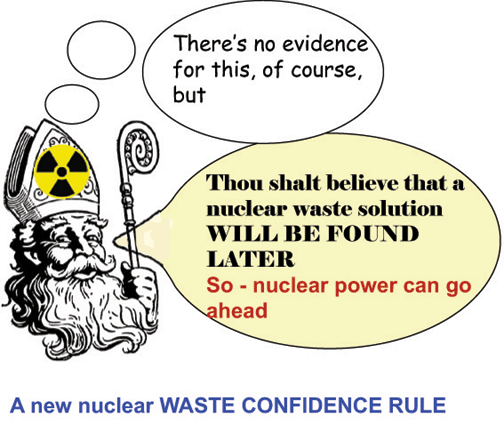
Kathryn Huff, principal deputy assistant secretary for nuclear energy at the Department of Energy, said the department recognizes it needs to take responsibility for the 86,000 metric tons of spent nuclear fuel in sites across the country.
………. Huff said it needs to be removed because “the communities that have that spent nuclear fuel never agreed to host the material long-term.”
“We cannot continue to defer the problem for future generations to figure out,” Huff said during a public information session Tuesday. “Inaction on this issue has already cost U.S. taxpayers nearly $9 million on settlements and judgements.”…………
Howes says it costs Maine Yankee roughly $10 million annually to store the nuclear waste safely while waiting for the government to remove it. He said the company pays to store it with funds won in lawsuits against the DOE.
Maine Yankee and its two sister sites, Connecticut Yankee and Yankee Rowe in Mass., have collectively won about $575.5 million in lawsuits and is now in its fifth round of litigation with the department. The money the government concedes in those lawsuits, however, comes from The Judgement Fund, which is funded by U.S. taxpayers………… https://www.pressherald.com/2021/12/12/government-launches-push-that-may-remove-maine-yankees-nuclear-waste-from-wiscasset/
Are We Forever Captives of America’s Forever Wars? This is what needs to be done to finally end our forever wars.
Are We Forever Captives of America’s Forever Wars? This is what needs to be done to finally end our forever wars.
KAREN GREENBERG December 10, 2021 by TomDispatch As August ended, American troops completed their withdrawal from Afghanistan almost 20 years after they first arrived. On the formal date of withdrawal, however, President Biden insisted that “over-the-horizon capabilities” (airpower and Special Operations forces, for example) would remain available for use anytime. “[W]e can strike terrorists and targets without American boots on the ground, very few if needed,” he explained, dispensing immediately with any notion of a true peace. But beyond expectations of continued violence in Afghanistan, there was an even greater obstacle to officially ending the war there: the fact that it was part of a never-ending, far larger conflict originally called the Global War on Terror (in caps), then the plain-old lower-cased war on terror, and finally—as public opinion here soured on it—America’s “forever wars.”
As we face the future, it’s time to finally focus on ending, formally and in every other way, that disastrous larger war. It’s time to acknowledge in the most concrete ways imaginable that the post-9/11 war on terror, of which the bombing and invasion of Afghanistan was the opening salvo, warrants a final sunset.
True, security experts like to point out that the threat of global Islamist terrorism is still of pressing—and in many areas, increasing—concern. ISIS and al-Qaeda are reportedly again on the rise in the Middle East, South Asia, and Africa.
Nonetheless, the place where the war on terror truly needs to end is right here in this country. From the beginning, its scope, as defined in Washington, was arguably limitless and the extralegal institutions it helped create, as well as its numerous departures from the rule of law, would prove disastrous for this country. In other words, it’s time for America to withdraw not just from Afghanistan (or Iraq or Syria or Somalia) but, metaphorically speaking at least, from this country, too. It’s time for the war on terror to truly come to an end.
With that goal in mind, three developments could signal that its time has possibly come, even if no formal declaration of such an end is ever made. In all three areas, there have recently been signs of progress (though, sadly, regress as well).
Repeal of the 2001 AUMF
First and foremost, Congress needs to repeal its disastrous 2001 Authorization for the Use of Force (AUMF) passed—with Representative Barbara Lee’s single “no” vote—after the attacks of 9/11. Over the last 20 years, it would prove foundational in allowing the U.S. military to be used globally in essentially any way a president wanted.
That AUMF was written without mention of a specific enemy or geographical specificity of any kind when it came to possible theaters of operation and without the slightest reference to what the end of such hostilities might look like. As a result, it bestowed on the president the power to use force when, where, and however he wanted in fighting the war on terror without the need to further consult Congress. Employed initially to root out al-Qaeda and defeat the Taliban in Afghanistan, it has been used over the last two decades to fight in at least 19 countries in the Greater Middle East, Africa, and Asia. Its repeal is almost unimaginably overdue…………….
At the moment, some efforts towards repeal again seem to be gaining momentum, with the focus now on the more modest goal of simply reducing the blanket authority the authorization still allows a president to make war as he pleases, while ensuring that Congress has a say in any future decisions on using force abroad……………..
Closing Gitmo
A second essential act to signal the end of the war on terror would, of course, be the closing of that offshore essence of injustice, the prison at Guantánamo Bay, Cuba (aka Gitmo) that the Bush administration set up so long ago. …………
some progress is being made, but as long as Gitmo remains open, our own homemade version of the war on terror will live on.
Redefining the Threat
Another admittedly grim sign that the post-9/11 war on terror could finally fade away is the pivot of attention in this country to other far more pressing threats on a planet in danger and in the midst of a desperate and devastating pandemic. Notably, on the 20th anniversary of those attacks, even former President George W. Bush, whose administration launched the war on terror and its ills, acknowledged a shift in the country’s threat matrix: “[W]e have seen growing evidence that the dangers to our country can come not only across borders, but from violence that gathers within.”
some progress is being made, but as long as Gitmo remains open, our own homemade version of the war on terror will live on.
Redefining the Threat
Another admittedly grim sign that the post-9/11 war on terror could finally fade away is the pivot of attention in this country to other far more pressing threats on a planet in danger and in the midst of a desperate and devastating pandemic. Notably, on the 20th anniversary of those attacks, even former President George W. Bush, whose administration launched the war on terror and its ills, acknowledged a shift in the country’s threat matrix: “[W]e have seen growing evidence that the dangers to our country can come not only across borders, but from violence that gathers within.”
Each of these potential pivots suggest the possible end of a war on terror whose casualties include essential aspects of democracy and on which this country squandered almost inconceivable sums of money while constantly widening the theater for the use of force. It’s time to withdraw the ever-expansive war powers Congress gave the president, end indefinite detention at Gitmo, and acknowledge that a shift in priorities is already occurring right under our noses on an ever more imperiled planet. Perhaps then Americans could turn to short-term and long-term priorities that might truly improve the health and sustainability of this nation. https://www.commondreams.org/views/2021/12/10/are-we-forever-captives-americas-forever-wars
Saudi Arabia Arms Sale Is One of Biden’s Many Militaristic Actions in First Year.
Saudi Arabia Arms Sale Is One of Biden’s Many Militaristic Actions in First Year, Khury Petersen-Smith, Truthout, 12 Dec 21,
Given the brutish approach of his predecessor, many expected President Joe Biden to shift away from the worst practices in U.S. foreign policy and at the border in the previous four years. Indeed, in the first weeks of his presidency, the Biden administration signaled changes. In Secretary of State Antony Blinken’s first press briefing, the State Department announced that it was reviewing weapons sales to Saudi Arabia and the United Arab Emirates (UAE) — which have led the catastrophic war on Yemen with essential U.S. partnership.
A week later, Biden declared in his first foreign policy address as president that “We are ending all American support for offensive operations in the war in Yemen, including relevant arms sales.”
Regarding its practices at the border, Biden administration officials promised a shift away from Trump’s practices of separating families and caging children, calling them a “moral failing.” He said that the new White House would “deal with immigration comprehensively, fairly, and humanely.”
As 2021 comes to a close, however, we are seeing the latter part of a trajectory that settles into familiar, disastrous militarism.
The U.S. is selling Saudi Arabia $650 million worth of missiles and providing $500 million worth of maintenance for U.S.-made aircraft, training and other support for its military operations.
These arrangements come as Saudi Arabia is escalating its devastating bombing in Yemen. In November, Saudi forces carried out the largest number of air strikes since Trump’s last year in office.
These bookends — Biden’s early announcement of an end to U.S. support for the war in Yemen and his subsequent robust material support of that war — capture the set of practices that the Biden White House is settling into, not only in Yemen, but also in the realm of war and imperialism more broadly.
Consider the White House’s approval of a $23 billion weapons sale to the U.A.E., which provides the Emirates with attack drones and F-35 fighter jets. The arrangement was negotiated under the Trump administration as the prize for the U.A.E.’s role in leading the normalization of diplomatic relations between Israel and itself, Bahrain, Morocco and Sudan, despite Israel’s deepening violence against Palestinians.
The Biden administration embraced the normalization agreements, along with Trump’s other actions meant to consolidate U.S. support and extend legitimacy to Israel in a time when Palestinian protest presents a steady challenge to Israeli apartheid, and global Palestine solidarity campaigns have gained more traction than ever……………………. https://truthout.org/articles/saudi-arabia-arms-sale-is-one-of-bidens-many-militaristic-actions-in-first-year/?eType=EmailBlastContent&eId=4190f671-99bd-42a7-a84d-db9a6d698398
Russia Angered by Senator Roger Wicker’s Nuclear Strike Remarks on Ukraine
Russia Angered by Senator Roger Wicker’s Nuclear Strike Remarks on Ukraine, NewsWeek, BY BRENDAN COLE ON 12/9/21 Russia has condemned GOP Senator Roger Wicker for suggesting that the U.S. should consider launching a nuclear strike to defend Ukraine.
The Russian embassy in Washington also hinted that Wicker was championing businesses in his home state of Mississippi when he called for U.S. military intervention over Moscow’s buildup of troops close to the Ukrainian border.
Wicker provoked the stern Russian response after telling Fox News host Neil Cavuto: “I would not rule out American troops on the ground. We don’t rule out first-use nuclear action.”……
The statement added that “long-term security guarantees” between the U.S. and Russia required “a demonstration of readiness to compromise. It is unlikely that Roger Wicker’s ill-considered statements will help us get out of the current acute phase of Russian-American relations.”……….. https://www.newsweek.com/russia-nuclear-ukraine-roger-wicker-embassy-irresponsible-putin-biden-summit-1657634
Options for the future of the US intercontinental ballistic missile (ICBM) programme -the Carnegie Endowment fo International Peace.
The Pentagon has asked a Washington thinktank to draw up a report on the
future of the US intercontinental ballistic missile (ICBM) programme and
deliver it before the end of January. The Carnegie Endowment for
International Peace (CEIP) will present options based on three rounds of
virtual consultations, which began on Tuesday, between Pentagon officials,
nuclear weapons experts and arms control advocates.
Guardian 9th Dec 2021
1 This Month

4 May -West Suburban Peace Coalition to discuss Iran war at May Educational Forum
Monday, May 4, 7:00 – 8:00 PM Central Standard Time
Title: : How Trump’s Narrative Tries to Shape the Reality of the War on Iran.
Contact Walt Zlotow, zlotow@hotmail.com 630 442 3045 for further information
14 May – online event From Bombs to Data Centres: the Face of Nuclear Colonialism
To see nuclear-related stories in greater depth and intensity – go to https://nuclearinformation.wordpress.com
-
Archives
- May 2026 (37)
- April 2026 (356)
- March 2026 (251)
- February 2026 (268)
- January 2026 (308)
- December 2025 (358)
- November 2025 (359)
- October 2025 (376)
- September 2025 (257)
- August 2025 (319)
- July 2025 (230)
- June 2025 (348)
-
Categories
- 1
- 1 NUCLEAR ISSUES
- business and costs
- climate change
- culture and arts
- ENERGY
- environment
- health
- history
- indigenous issues
- Legal
- marketing of nuclear
- media
- opposition to nuclear
- PERSONAL STORIES
- politics
- politics international
- Religion and ethics
- safety
- secrets,lies and civil liberties
- spinbuster
- technology
- Uranium
- wastes
- weapons and war
- Women
- 2 WORLD
- ACTION
- AFRICA
- Atrocities
- AUSTRALIA
- Christina's notes
- Christina's themes
- culture and arts
- Events
- Fuk 2022
- Fuk 2023
- Fukushima 2017
- Fukushima 2018
- fukushima 2019
- Fukushima 2020
- Fukushima 2021
- general
- global warming
- Humour (God we need it)
- Nuclear
- RARE EARTHS
- Reference
- resources – print
- Resources -audiovicual
- Weekly Newsletter
- World
- World Nuclear
- YouTube
-
RSS
Entries RSS
Comments RSS
 nuclear-news