U.S. can get to 100% clean energy with wind, water, solar and zero nuclear, Stanford professor says

U.S. can get to 100% clean energy with wind, water, solar and zero nuclear, Stanford professor says, CNBC DEC 21 2021 Catherine Clifford, @IN/CATCLIFFORD
- Stanford professor Mark Jacobson sees a way for the U.S. to meet its energy demands by 2050 with 100% wind, water and solar.
- His models use no fossil fuels, carbon capture, direct air capture, bioenergy, blue hydrogen or nuclear power.
- Jacobson’s roadmap is different from many clean-energy proposals, which advocate using all technologies possible.
A prominent Stanford University professor has outlined a roadmap for the United States to meet its total energy needs using 100% wind, water and solar by 2050.
Mark Jacobson, a Stanford professor of civil and environmental engineering and the director of its Atmosphere/Energy Program, has been promoting the idea of all renewable energy as the best way forward for more than a decade. His latest calculations toward this ambitious goal were recently published in the scientific journal Renewable Energy.
Transitioning to a clean-energy grid should happen by 2035, the study advises, with at least 80% of that adjustment completed by 2030. For the purposes of Jacobson’s study, his team factored in presumed population growth and efficiency improvements in energy to envision what that would look like in 2050.
Jacobson first published a roadmap of renewable energy for all 50 states in 2015.This recent update of that 2015 work has a couple of notable improvements.First, Jacobson and his colleagues had access to more granular data for how much heat will be needed in buildings in every state for the coming two years in 30-second increments. “Before we didn’t have that type of data available,” Jacobson told
Also, the updated data makes use of battery storage while the first set of calculations he did relied on adding turbines to hydropower plants to meet peak demand, an assumption that turned out to be impractical and without political support for that technology, Jacobson said.
Reliability of four-hour batteries
In the analysis, Jacobson and his team used battery-storage technology to compensate for the inherent intermittency of solar and wind power generation — those times when the sun doesn’t shine and the wind doesn’t blow.
The Achilles’ heel of a completely renewable grid, many argue, is that it is not stable enough to be reliable. Blackouts have become a particular concern, notably in Texas this year and during the summer of 2020 in California.That’s where four-hour batteries come in as a way to generate grid stability. “I discovered this all just because I have batteries in my own home,” Jacobson told CNBC. “And I figured, oh, my God, this is so basic. So obvious. I can’t believe nobody has figured this out.”
Jacobson said that he observed his batteries stayed charged if they weren’t plugged in when they are off.
o get more than four hours of charge, multiple four-hour batteries can be stacked to discharge sequentially. If a battery needs more charge output at one time than the battery can provide, then the batteries need to be used simultaneously, Jacobson told CNBC.
With this observation, Jacobson and his colleagues at Stanford produced scenarios showing it is possible to transition to a fully renewable system without any blackouts or batteries with ultra-long-duration battery technology.
That’s key because technology for ultra-long-duration batteries that would hold energy for several days have yet to be commercialized. Start-ups like Form Energy are working to bring such batteries to market.
Planning, of course, is also key to keeping the grid stable. “Wind is variable, solar is variable,” Jacobson said. “But it turns out, first of all, when you interconnect wind and solar over large areas, which is currently done, you smooth out the supply quite a bit. So it’s because, you know, when the wind is not blowing in one place, it’s usually blowing somewhere else. So over a large region, you have a smoother supply of energy.”
Similarly, wind and solar power are complimentary. And hydropower “is perfect backup, because you can turn it on and off instantaneously,” he said.
Also, there needs to be changes in pricing structures to motivate customers to do high energy demand activities at off-peak times.“Demand response is a very big component of keeping the grid stable,” Jacobson said. “It’s used some today. But a lot of places a lot of states in the US right now, the electricity price is constant all day … and that’s a problem.”
Calculating the breakdowns………………..
The resulting models use no fossil fuels, carbon capture, direct air capture, bioenergy, blue hydrogen or nuclear power.And in that, Jacobson’s roadmaps are different from many clean-energy proposals, which advocate for using all technologies possible.
“So we’re trying to eliminate air pollution and global warming, and provide energy security. So those are the three purposes of our studies,” Jacobson told CNBC. And that “is a little different than a lot of studies that only focus on greenhouse gases. So we’re trying to eliminate air pollution as well, and also provides energy security.”………..
Combating fears of blackoutsJacobson knows that his viewpoint is not the loudest. The promise of next-generation nuclear power plants, for example, has gotten government and private funding of late.Nuclear innovation is “pushed mostly by the industry people, people like Bill Gates, who has a huge investment in small modular reactors,” Jacobson said. “He has a financial interest. And he wants to be known as somebody who tries to help solve the problem.”
Gates addressed the criticism that he’s a “technocrat” looking to solve climate change with new innovations, instead of with political legislation supporting technology like wind and solar which already exists, in an interview with Anderson Cooper on CBS’ “60 Minutes” earlier in the year. “I wish all this funding of these companies wasn’t necessary at all. Without innovation, we will not solve climate change. We won’t even come close,” Gates said.Also, the timeline for getting some of these technologies to commercialization is too long to be useful. Gates’ advanced reactor company, TerraPower, announced in November that it has chosen the frontier-era coal town Kemmerer, Wyoming, as the preferred location for its first demonstration reactor, which it aims to build by 2028.
“Even if it’s seven years, that’s just a demonstration plant,” Jacobson said. “That’s not even close to a commercial plant and on the scale we need.”……………
Education is a key hurdle, as Jacobson sees it. “I am optimistic. But the thing I find that’s the biggest difficulty is the fact that it is an information issue, because most people are not aware, most people are not aware of what’s possible,” he said. https://www.cnbc.com/2021/12/21/us-can-get-to-100percent-clean-energy-without-nuclear-power-stanford-professor-says.html?utm_term=Autofeed&utm_medium=Social&utm_content=Main&utm_source=Twitter#Echobox=1640127800
Inept cover-up of faulty nuclear work – Nuclear Regulatory Commission gives no penalty
 | |||
This one has to be read to be believed. An @NRCgov investigation has found that two former technicians at the Grand Gulf #nuclear plant in #Mississippi installed an incorrectly manufactured gasket on an important valve–and then staged an inept cover-up.
NRC INVESTIGATION REPORT 4-2019-021 – DATED DECEMBER 15, 2021 RidsOpaMail Resource; RidsOgcMailCenter R
Mr. Maurice Omaits [NOTE: HOME ADDRESS DELETED UNDER 10 CFR 2.390] SUBJECT: NOTICE OF VIOLATION, NRC INVESTIGATION REPORT 4-2019-021 Dear Mr. Omaits: This letter refers to the investigation completed on September 14, 2020, by the U.S. Nuclear Regulatory Commission (NRC) Office of Investigations at the Grand Gulf Nuclear Station. The investigation was conducted, in part, to determine whether you, a senior engineering training instructor employed by Entergy Operations, Inc. (licensee) at the Grand Gulf Nuclear Station, willfully compromised an engineering support qualification exam by providing additional information to students in the form of diagrams and verbal cues.A factual summary of the investigation, as it pertains to your actions, was issued as an enclosure to our letter dated February 24, 2021, Agencywide Documents Access and Management System (ADAMS) Accession No. ML21055A000.
In the letter transmitting the factual summary of the Office of Investigations report, we provided you with the opportunity to address the apparent violation identified in the letter by attending a predecisional enforcement conference, participating in an alternative dispute resolution mediation session, or providing a written response before we made our final enforcement decision. Your attorney indicated to an NRC enforcement representative that you do not intend to provide additional information regarding this matter. Since you have not requested a predecisional enforcement conference nor replied in writing, the NRC is proceeding with its enforcement action based on the results of the investigation.
Based on the information developed during the investigation, the NRC concluded that a deliberate violation of NRC requirements occurred. The violation is cited in Enclosure 1, “Notice of Violation” (Notice). The Notice states that you deliberately violated a licensee quality-related procedure when, as an exam proctor, you provided inappropriate assistance to students in the form of verbal and nonverbal cues regarding their selection of exam answers.
Your deliberate actions placed the licensee in violation of Title 10 of the Code of Federal Regulations (10 CFR) 50.120, “Training and qualification of nuclear power plant personnel,” and you in violation of 10 CFR 50.5, “Deliberate misconduct.” Enclosure 2 includes a copy of the letter and Notice issued to the licensee. Given the significance of the underlying issue and the deliberate nature of your actions, your violation has been categorized in accordance with the NRC Enforcement Policy at Severity Level Ill. The NRC Enforcement Policy is included on the NRC’s website at http://www.nrc.gov/about-nrc/regulatory/enforcement/enforce-pol.html. You should be aware that if you are involved in NRC licensed activities in the future, additional deliberate violations could result in more significant enforcement action or referral to the U.S. Department of Justice for potential criminal prosecution……………… Scott A. MorrisRegional Administrator 15 Dec 21
https://www.nrc.gov/docs/ML2134/ML21349B336.pdf
NASA seems to be struggling with the fact that ionising radiation is a greater risk to women, than to men

The committee also recommended NASA provide all its astronauts with individual radiation risk assessment (based on age and sex), communicate a comprehensive picture of an astronaut’s own cancer risk, and continue to discuss changes in radiation risk during routine health briefings.
New NASA radiation exposure limit would bring equality to female, male astronauts, Healio.com, Ryan Lawrence 20 Dec 21,
“Experts in oncology help advise NASA on space radiation health standard for astronauts”A committee of experts from science, medicine and academia, among other fields, has recommended NASA proceed with a proposal for a universal, career-long radiation dose limit for all astronauts
The Committee on Assessment of Strategies for Managing Cancer Risks Associated with Radiation Exposure During Crewed Space Missions, convened at the request of NASA, concluded that the career-long dose limit should apply to both men and women, a change from previous standards, and recommended improved communication methods for advising astronauts on cancer risks.
“The old radiation standards were very restrictive for women astronauts,” Amy Berrington de González, DPhil, senior investigator and chief of the radiation epidemiology branch at the NCI and a member of the committee, told Healio | HemOnc Today. “There has been a lot of progress in understanding of radiation risk in the last few decades, so bringing that in to see whether you could make the flying time more equitable for women astronauts, I think was really important.”
Berrington de González said the universal dose was established “for the most protective case” and applied to all astronauts.
As it currently stands, men and women have different allowable doses of radiation in space travel with NASA, which were based on reported relative susceptibilities to different radiation-induced cancers. The report recommends NASA move forward with its proposed single standard dose limit for all astronauts.
“I think NASA got worried because they saw some data from the Japanese atomic bomb survivors, who we use as our primary group for determining [radiation] risk, and it looked like there was an increased risk for lung cancer among women,” committee member Gayle E. Woloschak, PhD, associate dean for graduate student and postdoctoral affairs and professor of radiation oncology and radiology at Feinberg School of Medicine at Northwestern University, told Healio | HemOnc Today. “
“Then the question was, ‘Should we have a different risk level for women than for men, considering Mars missions might limit a woman from going into space at all?’ And, you can imagine, there are ethical issues with that, too. Basically, we said there should be the same risks across the board for everybody.”
Before these proposals, the current standard set career exposure to radiation to not exceed 3% risk for exposure-induced death (REID) for cancer mortality at a 95 percent confidence level, to limit the cumulative effective dose received throughout an astronaut’s career.
NASA called for an independent review of the validity of the 3% REID, which has been the standard since 1989, because it is for low-Earth orbit missions exclusively. An update was necessary as NASA plans for longer-duration missions farther in the solar system.
“The radiation in deep space is different,” committee member Carol Scott-Conner, MD, PhD, MBA, emeritus professor of surgery in surgical oncology and endocrine surgery at Carver College of Medicine at University of Iowa, told Healio | HemOnc Today. “Once you get beyond the Earth’s magnetosphere, you get highly energetic particles from the sun. And these are things like the nuclei of iron. You can think of them as like cannon balls going through cells, as opposed to protons, electrons or gamma rays that we think of here on Earth. … If you go to Mars, and let’s say it takes you about 6 months, you’re exposed that whole time to this radiation.”
The committee also recommended NASA provide all its astronauts with individual radiation risk assessment (based on age and sex), communicate a comprehensive picture of an astronaut’s own cancer risk, and continue to discuss changes in radiation risk during routine health briefings.
.
Holtec, owner of closed Oyster Creek nuclear station faces security violation fine.
Owner of closed nuclear plant faces security-violation fine, KPVI, Dec 22, 2021
LACEY TOWNSHIP, N.J. (AP) — The U.S. Nuclear Regulatory Commission said Wednesday it plans to fine the owners of the shuttered Oyster Creek nuclear power plant $150,000 for security violations at the New Jersey site.
The agency would not reveal the nature of the violations, citing security concerns, but said the site’s overall security program “remains effective.”
Holtec Decommissioning International LLC has 30 days to pay the fine or contest it.
The company issued a statement saying that “protecting the security and safety of the public is the number one priority of Holtec International at all our facilities. ……………. The NRC said Holtec has taken steps to address the violations. https://www.kpvi.com/news/national_news/owner-of-closed-nuclear-plant-faces-security-violation-fine/article_4188ac82-323a-505e-90ff-77aabac4ca6b.html
Bill Gates’ sodium-cooled ‘Natrium’ nuclear reactor design – strikingly like the disastrous reactors at Santa Susana Field Lab.
Most striking of all is the success of official campaigns asserting that even the most serious accidents have caused little or no harm

Spent Fuel, Harpers, by Andrew Cockburn, 20 Dec 21, The risky resurgence of nuclear power ” …………………………. Gates and other backers extoll the promise of TerraPower’s Natrium reactors, which are cooled not by water, as commercial U.S. nuclear reactors are, but by liquid sodium. This material has a high boiling point, some 1,600 degrees Fahrenheit, which in theory enables the reactor to run at extreme temperatures without the extraordinary pressures that, in turn, require huge, expensive structures……………….

Prosperous and 70 percent white, West Hills, California, is one of the communities that have sprouted near the Santa Susana Field Laboratory in the decades since the 1959 meltdown. Unlike the poor, sick, and embittered residents of Shell Bluff, people living in West Hills had until recently only the barest inkling that nuclear power in the neighborhood might have had unwelcome consequences. “Almost no one knew about the Santa Susanna Field Lab, or they thought it was an urban legend,” Melissa Bumstead, who grew up in nearby Thousand Oaks, told me recently. In 2014, Bumstead’s four-year-old daughter, Grace, was diagnosed with an aggressive form of leukemia. “This has no environmental link,” her pediatric oncologist told her firmly. Childhood cancers were rare, and this was just cruel luck.
Then, while taking Grace to Children’s Hospital Los Angeles, Bumstead ran into a woman who recognized her from the local park where their young daughters played. The woman’s child had neuroblastoma, another rare cancer, as did another from nearby Simi Valley, whom they encountered while the children were getting chemo. Back at home, someone on her street noticed the childhood cancer awareness sticker on Bumstead’s car and mentioned that another neighbor had died of cancer as a teenager.
Bumstead began to draw a map detailing the cluster of cancer deaths in small children just in the previous six years, but stopped working on it in 2017. “I had such severe PTSD when I added children onto it, my therapist told me to stop.” But it is still happening, she said, mentioning the unusual number of bald children she had noticed in local elementary schools in recent years, as well as the far-above-average rate of breast cancer cases recorded in the area. A cleanup of the field lab was due to be completed in 2017, but it has yet to begin.

I called Bumstead because I had been struck by the fact thatTerraPower’s Natrium reactor resembles in its basic features the long-ago Sodium Reactor Experiment at Santa Susana. (Natrium is Latin for sodium.) “That’s exactly what we had!” Bumstead exclaimed when I mentioned that liquid sodium is integral to TerraPower’s project. “The meltdown was in the sodium reactor.” As her comment made clear, such liquid sodium technology is by no means innovative.
Nor, in an extensive history of experiments, has it ever proved popular—not least because liquid sodium explodes when it comes into contact with water, and burns when exposed to air. In addition, it is highly corrosive to metal, which is one reason the technology was rapidly abandoned by the U.S. Navy after a tryout in the Seawolf submarine in 1957.
That system “was leaking before it even left the dock on its first voyage,” recalls Foster Blair, a longtime senior engineer with the Navy’s reactor program. The Navy eventually encased the reactor in steel and dropped it into the sea 130 miles off the coast of Maryland, with the assurance that the container would not corrode while the contents were still radioactive. The main novelty of the Natrium reactor is a tank that stores molten salt, which can drive steam generators to produce extra power when demand surges. “Interesting idea,” Blair commented. “But from an engineering standpoint one that has some real potential problems, namely the corrosion of the high-temperature salt in just about any metal container over any period of time.”
TerraPower’s Jeff Navin assured me in response that Natrium “is designed to be a safe, cost-effective commercial reactor.” He added that Natrium’s use of uranium-based metal fuel would increase the reactor’s safety and performance. Blair told me that such a system had been tried and abandoned in the Fifties because the solid fuel swelled and grew after fissioning.
As the sodium saga indicates, the true history of nuclear energy is largely unknown to all but specialists, which is ironic given that it keeps repeating itself. The story of Santa Susana follows the same path as more famous disasters, most strikingly in the studious indifference of those in charge to signs of impending catastrophe.The operators at Santa Susana shrugged off evidence of problems with the cooling system for weeks prior to the meltdown, and even restarted the reactor after initial trouble. Soviet nuclear authorities covered up at least one accident at Chernobyl before the disaster and ignored warnings that the reactor was dangerously unsafe. The Fukushima plant’s designers didn’t account for the known risk of massive tsunamis, a vulnerability augmented by inadequate safety precautions that were overlooked by regulators. Automatic safety features at Santa Susana did not work. This was also the case at Fukushima, where vital backup generators were destroyed by the tidal wave.
No one knows exactly how much radiation was released by Santa Susana—it exceeded the scale of the monitors. Nor was there any precise accounting of the radioactivity released at Chernobyl. Fukushima emitted far less, yet the prime minister of Japan prepared plans to evacuate fifty million people, which would have meant, as he later recounted, the end of Japan as a functioning state. Another common thread is the attempt by overseers, both corporate and governmental, to conceal information from the public for as long as possible. Santa Susana holds the prize in this regard: its coverup was sustained for twenty years, until students at UCLA found the truth in Atomic Energy Commission documents.
Most striking of all is the success of official campaigns asserting that even the most serious accidents have caused little or no harm……………………
“The right not to know” about the effects of nuclear power is currently embraced far beyond Fukushima. In the face of escalating alarm about climate change, the siren song of “clean and affordable and reliable” power finds an audience eager to overlook a business model that is dependent on state support and often greased with corruption; failed experiments now hailed as “innovative”; a pattern of artful disinformation; and a trail of poison from accidents and leaks (not to mention the 95,000 tons of radioactive waste currently stored at reactor sites with nowhere to go) that will affect generations yet unborn. Arguments by proponents of renewables that wind, solar, and geothermal power can fill the gap on their own have found little traction with policymakers. Ignoring history, we may be condemned to repeat it. Bill Gates has bet a billion dollars on that. https://harpers.org/archive/2022/01/spent-fuel-the-risky-resurgence-of-nuclear-power/
Holtec gets approval to acquire and dismantle Palisades nuclear plant: not everyone is happy.
Holtec receives NRC approval to acquire Michigan nuclear plant
Jim Walsh, Cherry Hill Courier-Post 20 Dec 21, CAMDEN – Holtec International has received an initial approval to acquire a nuclear power plant that it plans to decommission and dismantle.
The Nuclear Regulatory Commission said the Camden firm “met the regulatory, legal, technical and financial requirements” to obtain the license for the Palisades plant in Covert, Michigan.
The NRC similarly supported a license transfer for a second Michigan site, the Big Rock Point facility. The Hayes Township plant has already been decommissioned, with only a fuel storage facility remaining, according to the NRC…………
opponents of the license transfer will “seriously consider” a court appeal of the NRC’s “shocking” decision, said Terry Lodge, an attorney for a coalition of environmental groups.
“We have been denied our due process rights,” claimed Michael Keegan of Don’t Waste Michigan, who said the NRC had denied a hearing “on our very serious environmental, health, safety, and fiscal concerns.”
Among other points, the critics question whether the power plants’ decommissioning trust funds will cover needed expenses. They also assert Holtec is tapping the trust funds for unrelated costs. https://www.courierpostonline.com/story/news/2021/12/20/holtec-nrc-nuclear-power-plant-palisades-big-rock-point-michigan/8963723002/
Establishment support, secrecy and corruption, in the promotion of dangerous nuclear power.
For all the hopeful talk about new technology, however, the industry’s principal concern is to keep aging reactors running long after their original life spans, even where this poses serious safety risks. In a process known as embrittlement, for example, vital components such as containment vessels crack following decades of neutron bombardment, leading to the release of lethal radiation. Nonetheless, the Nuclear Regulatory Commission appears happy to grant extensions: plants originally designed to last forty years are being authorized to run for sixty or eighty in total.
Spent Fuel, Harpers, by Andrew Cockburn, 20 Dec 21, The risky resurgence of nuclear power ”………………………………………….Even groups long noted for opposing nuclear power, such as the Union of Concerned Scientists and the Sierra Club, seem quietly ready to temporize on practical matters, such as allowing existing plants to continue as transitional energy sources………..
The nuclear-power industry has long enjoyed establishment support. Navin was acting chief of staff at the Department of Energy under Barack Obama. The current energy secretary, Jennifer Granholm, says that the Biden Administration plans to launch more nuclear energy projects across the country, and touts in particular Natrium’s promise of “345 megawatts of clean and affordable and reliable baseload power.” The White House climate czar, Gina McCarthy, stresses the need to keep existing plants in operation, as well as the prospects for “these small nuclear reactors, these modular reactors,” in which “people are really investing significant resources.” ……..
The State Department has launched an effort to foster similar small reactor programs abroad. Most significantly, even amid bitter fights over the administration’s infrastructure and social-reform bills, the inclusion of $41 billion of industry subsidies in the legislation has received unquestioning bipartisan backing. “………..
Dwight Eisenhower’s “Atoms for Peace” program, unveiled in 1953, set the optimistic tone for nuclear power:……………..

No such lyrical announcement marked the day in July 1959 when the Santa Susana Field Laboratory plant’s coolant system failed and its uranium oxide fuel rods began melting down. With the reactor running out of control and set to explode, desperate operators deliberately released huge amounts of radioactive material into the air for nearly two weeks, making it almost certainly the most dangerous nuclear accident in U.S. history. The amount of iodine-131 alone spewed into the southern California atmosphere was two hundred and sixty times that released at Three Mile Island, which is generally regarded as the worst ever U.S. nuclear disaster.
None of this was revealed to the public, who were told merely that a “technical” fault had occurred, one that was “not an indication of unsafe reactor conditions.” As greater Los Angeles boomed in the following years, the area around the reactor site—originally chosen for its distance from population centers—was flooded with new residents. No one informed them of the astronomical levels of radioactive contaminants seeded deep in the soil.
Meanwhile, utilities were commissioning scores of nuclear plants across the country and promising electricity “too cheap to meter,” incentivized by the 1957 Price-Anderson Act, which shifted financial liability in the event of a serious accident onto taxpayers. Rapid development throughout the Sixties engendered hopeful predictions from the AEC that more than a thousand reactors would be operating in the United States by the turn of the century. But it was not to be. As the environmental movement gathered strength in the Seventies, the dangers associated with nuclear power—from the routine disposal of radioactive waste to the risk of catastrophic meltdowns—galvanized a determined, informed, and organized opposition. Then, in 1979, one of two reactors at Three Mile Island had a partial meltdown. Officials from the president on down issued soothing reassurances, downplaying the health risks. Negative assessments were discouraged; when the Pennsylvania state health secretary, Gordon MacLeod, criticized the state’s response, he was promptly fired by the governor. MacLeod later revealed that child-mortality rates had doubled within a ten-mile radius of the plant. Cost overruns in plant construction, sometimes two times above industry estimates, were a further deterrent to expansion. Ultimately, more than 120 projects were canceled, and construction ground to a halt. “The failure of the U.S. nuclear power program ranks as the largest managerial disaster in business history, a disaster on a monumental scale,” Forbes magazine commented in 1985, a year before Chernobyl. “Only the blind, or the biased, can now think that most of the money has been well spent.”……….
In 1988, Hans Blix, the chairman of the International Atomic Energy Agency, told the United Nations that “the public should be aware that nuclear energy emits . . . no carbon dioxide whatever.” Given this assumption (which discounts the enormous quantities of carbon dioxide generated during plant construction), nuclear power’s high cost could be offset by rewarding its low emissions.
Other partisans of nuclear power also recognized the relevance of climate alarms. This included Alex Flint,…….. In 2000, following a traditional trajectory for well-connected congressional staffers, he moved over to the private sector as a lobbyist and quickly recruited an impressive list of nuclear-industry clients, including Exelon Corporation………………..
Exelon was not alone in securing presidential favor. In February 2010, Obama announced $8.3 billion in loan guarantees for two new reactors known as Vogtle 3 and 4, to be built in Burke County, Georgia. “We will not achieve a big boost in nuclear capacity,” declared the president, “unless we also create a system of incentives to make clean energy profitable.” As is traditional with the placement of such industrial facilities, the new reactors were to be constructed adjacent to a poor black community. The neighborhood, Shell Bluff, was already racked by cancers that residents ascribed to existing nuclear facilities. Not surprisingly, they vehemently opposed the project. “We voiced our opinion,” one local resident told CNN. “We didn’t want them, but we’re just the little peons.” The president, they said, “doesn’t know we’re down here.”
Eleven years later, the Vogtle plants are still under construction……………..
Passing off additional costs to utility customers would appear to be a standard business model. It tends to require the complaisance of state legislators, who can demand and receive a high price for their favors—unseemly transactions that call into question the notion of “clean” nuclear energy. In November 2016, senior executives at Ohio’s FirstEnergy hatched plans to shunt more of the operating costs of their two nuclear plants onto individual customers.

As later detailed by an FBI criminal complaint, the scheme involved lubricating the election of a cooperative Republican legislator named Larry Householder as speaker of the Ohio House of Representatives. To this end, $61 million moved via a series of dark money cutouts to Householder, who used the funds both for personal needs and for financing his campaign and those of allies who could supply the necessary votes for the rate increase.
It proved a sound investment. Householder was duly elected speaker and proceeded to pass a bill in 2019, with bipartisan support, that authorized $1 billion in rate supplements to bail out the company’s two Ohio plants. (One of these, Davis-Besse, outside Toledo, has a hair-raising safety record, including a hole in the reactor vessel and cracks in its concrete containment shell.) Although the bill canceled existing mandates for renewable energy, proponents were eloquent in their concern for the climate. Representative Jamie Callender, for example, who got just under $25,000 from FirstEnergy and served as a primary sponsor of the bill, spoke piously of the need to encourage “zero carbon emissions.” A FirstEnergy spokesman applauded Callender and other sponsors “for their efforts in recognizing the important and vital role nuclear energy, along with many other clean energy sources, plays in providing clean, safe, and reliable carbon-free energy to Ohioans.”
Unfortunately for the plotters, the FBI had monitored their deliberations. Following disclosure of the bribery scheme, public outrage led to a repeal of the bailout. Householder, indicted along with four associates, denies the charges and has yet to go to trial. FirstEnergy, none of whose employees faced criminal charges, agreed to a $230 million fine, and its generating unit was spun off under the name Energy Harbor. (“We call it Pirates’ Cove,” joked the Toledo attorney Terry Lodge, who has been litigating cases related to Davis-Besse since 1979.)
While Energy Harbor saw its scheme collapse, Exelon has suffered no such setback in pursuit of bailouts through similar means. A federal investigation revealed that an Exelon subsidiary lavished favors in the form of jobs and contracts on associates of Illinois House Speaker Mike Madigan, long the most powerful politician in the state, and was rewarded with beneficial legislation, most notably a $2.35 billion subsidy enacted in 2016, for two money-losing reactors that the company had discussed closing. The subsidiary agreed to pay a $200 million fine, which was more than balanced by the $694 million subsidy signed into law by J. B. Pritzker in September 2021, a response to Exelon’s threats to close two other aging plants—one of which appears to have generated a significant cancer cluster in its neighborhood. Though the Sierra Club opposes nuclear energy, the Illinois chapter supported that legislation because of the measures it included to phase out coal and gas sources. The Illinois bailout is far eclipsed, however, by the federal largesse promised by the Biden Administration’s infrastructure and climate legislation. An analysis by the Nuclear Information and Resource Service suggests that 54 percent of the $41 billion will be split between just three companies, with Exelon set to receive $15 billion. (Energy Harbor is the runner-up, with $5 billion.)
For all the hopeful talk about new technology, however, the industry’s principal concern is to keep aging reactors running long after their original life spans, even where this poses serious safety risks. In a process known as embrittlement, for example, vital components such as containment vessels crack following decades of neutron bombardment, leading to the release of lethal radiation. Nonetheless, the Nuclear Regulatory Commission appears happy to grant extensions: plants originally designed to last forty years are being authorized to run for sixty or eighty in total. Point Beach 2, a reactor on Lake Michigan that the NRC itself listed in 2013 among the most embrittled plants in the country, is applying to be relicensed to operate for eighty years. The reactor and its twin, Point Beach 1, have been cited for safety violations and equipment malfunctions more than 130 times. At the NRC, there is even discussion of allowing plants to run for a century, long after their designers and builders are dead. “None of these extreme extensions have addressed critical ‘knowledge gaps’ for the reliability of major irreplaceable and inaccessible systems,” said Paul Gunter of Beyond Nuclear, a tireless watchdog group working to challenge the extensions. In his view, the industry is being allowed to head blindly into the unknown, with no idea how or when age-related cracking and embrittlement will lead to component failure and potential meltdown………………. https://harpers.org/archive/2022/01/spent-fuel-the-risky-resurgence-of-nuclear-power/
USA has 85,000 metric tons of spent fuel from nuclear power plants, 90 million gallons of weapons wastes – robots to the rescue.
There’s over 85,000 metric tons of spent nuclear fuel from commercial
nuclear power plants, and 90 million gallons of waste from government
weapons programs in the U.S. today, according to the Government
Accountability Office.
That number is rapidly growing. Every year, we add
2,000 metric tons of spent nuclear fuel. Disposing and handling nuclear
waste is a dangerous task that requires precision and accuracy. Researchers
from the National Centre for Nuclear Robotics led by the Extreme Robotics
Lab at the University of Birmingham in the UK are finding ways to help
humans and robots work together to get the job done.
The researchers have
developed a system using a standard industrial robot that uses a parallel
jaw gripper to handle objects and an Ensenso N35 3D cameras to see the
world around it. The team’s system involves allowing humans to make more
complex decisions that AI isn’t equipped to do, while the robot
determines how to best perform the tasks. The team uses three kinds of
shared control.
The Robot Report 18th Dec 2021
Archbishop calls for nuclear disarmament
Archbishop calls for nuclear disarming, Santa fe New Mexican By Robert Nott rnott@sfnewmexican.com, Dec 20 , 2021
Looking up at the sky as a young teen one day in Daly City, Calif., Archbishop John C. Wester had one thought as he saw military planes overheard.
Were they ours, or were they Russian planes?
The year was 1962, perhaps the first time nuclear war between the two superpowers seemed likely to erupt as the Cuban Missile Crisis played out and students were taught to prepare for an atomic attack by diving under their desks at schools.
“I don’t think going under our desks was very helpful,” Wester said Sunday in Santa Fe, moments before issuing a call for the world to rid itself its nuclear weapons.
Now, some 60 years later, he said he wants to do more to end the threat of an atomic war. Wester spoke and prayed during a 30-minute prayer service and ceremony at the Shrine of Our Lady of Guadalupe before he unveiled a sign bearing an image of Pope Francis and a quote uttered by the pope in Hiroshima in 2020: “The possession of nuclear arms is immoral.”
Wester said “our archdiocese needs to be facilitating, encouraging an ongoing conversation” about nuclear disarmament.
He urged people to “pray for God’s intervention” to keep that conversation going.
At least 125 people were present for the service, many bearing roses in honor of the Lady of Guadalupe. Among them was Karen Weber, who said it’s “highly symbolic” for Wester to speak out on the “abolishment of nuclear weapons.”
The shrine is across the street from the Firestone building at West Alameda and Guadalupe streets in downtown Santa Fe, where Los Alamos National Laboratory recently opened a small office. The proximity of the two locales was not lost on Mary Riseley, who described herself as a Quaker and an Episcopalian and who handed out roses to participants in Sunday’s event.
Calling Wester a “prophet in the Catholic Church,” she said it’s important for him to stand up “for peace and understanding” during these times of turmoil.
In his comments, Wester alluded to the growing tension around the Russia-Ukraine border and said there are at least “40 active conflicts in the world.”
“We need to be instruments of peace,” he said, especially as we head into the Christmas season, a “season of peace.”
The current arms race, he said “is more ominous” than any that came before…….. https://www.santafenewmexican.com/news/local_news/archbishop-calls-for-nuclear-disarming/article_0aabf9f0-60e8-11ec-9e5f-5f7820707fca.html
Nuclear Plants Masquerading as Climate-Friendly Shouldn’t Qualify for Green Finance

Nuclear Plants Masquerading as Climate-Friendly Shouldn’t Qualify for Green Finance
December 17, 2021 Gaye Taylor,
Bruce Power’s recent issuance of C$500 million in green bonds to help extend the life of Ontario’s biggest nuclear power plant is being touted as a critical step toward decarbonization. But it could also be seen as a dangerous and time wasting dead-end, a corruption of the very notion of green financing.
According to Jonathan Hackett, head of sustainable finance at BMO Capital Markets and co-lead green structuring agent for Bruce Power, nuclear is necessary to the net-zero transition, writes the Globe and Mail.
According to Hackett, the urgent need to green the energy and power sectors means nuclear power is a worthy recipient of green finance.
But confronting the notion that nuclear power is “green” are unresolved concerns about what to do with reactor waste products, as well as the acute dangers inherent in nuclear power plants, with the tragedy at Japan’s Fukushima plant the most recent example.
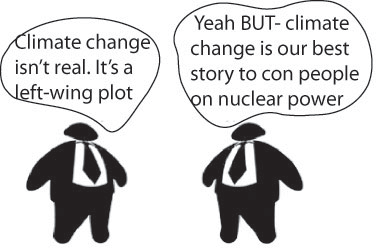
As for the claim that nuclear is essential to avoiding climate meltdown, independent experts say the world has neither the time, the funds, nor the expertise to bring the expensive and notoriously slow sector to bear in time to shift the climate crisis in any meaningful way.
And this reality doesn’t change as the hype around small modular nuclear reactors (SMRs) ramps up. “There is no SMR promoter suggesting a prototype could be licenced, built, and operating by the end of this decade,” said Mycle Schneider, author of the annual World Nuclear Industry Status Report, at a webinar hosted by University of British Columbia in October. “That means—if ever, likely not—a commercialization could start only in the second half of the 2030s.”

Noting that “the industry has never kept its promises on schedules and budgets,” Schneider added, “we have no time, money, and brainpower to waste on fantasy PowerPoint designs.”
Early this month, Ontario Power Generation and GE Hitachi triumphantly announced plans to bring an SMR into service at the Darlington nuclear generating station “as early as 2028”. But even if they managed to bring the project in on time and on budget—a practice that has never been the industry’s strong suit—the project would just be one expensive generation source in a decarbonizing economy that needs far more electricity, and vastly more energy efficiency, far faster than SMRs can deliver.
And this year’s WNISR report was only the latest to conclude that the nuclear industry outside China is already in decline, with its output in the United States dropping to its lowest level since 1995. In France, a former nuclear leader, atomic generation dropped to 1985 levels.
Faced with such an implosion in the prospects of its traditional reactors, the nuclear industry has seized upon SMRs as a ticket to a new revenue track. But SMRs will never be ready in time to shift the trajectory of the climate crisis. Even if they worked, “it would take centuries to build enough to make a difference,” Schneider said.

Schneider is not alone that view.
“Betting on nuclear as a climate solution is just sticking our heads in the sand because SMR technology is decades away, extremely expensive, and comes with a nasty pile of security and waste headaches,” Ontario Clean Air Alliance Chair Jack Gibbons wrote last year, responding to then-natural resources minister Seamus O’Regan’s full-throated endorsement of the SMR storyline.
“That our government would be this gullible is distressing, especially given the havoc already being wreaked by a changing climate,” he added.
Jonathan Porritt, founder of the UK’s Forum4theFuture, echoed Gibbons’ view in a March opinion piece for The Guardian. He warned of a nuclear sector now “straining every sinew to present itself as an invaluable ally” in the global push for net-zero by 2050.” Yet the problems that have long dogged the industry remain unchanged: “ever-higher costs, seemingly inevitable delays, no solutions to the nuclear waste challenge, security and proliferation risks.”
The reasons for the USA’s persecution of Julian Assange : Glenn Greenwald spells it out
“much of the conduct described in the indictment is conduct that journalists engage in routinely — and that they must engage in in order to do the work the public needs them to do.”
Julian Assange Loses Appeal: British High Court Accepts U.S. Request to Extradite Him for Trial
Press freedom groups have warned Assange’s prosecution is a grave threat. The Biden DOJ ignored them, and today won a major victory toward permanently silencing the pioneering transparency activist.
| Glenn Greenwald 11 December In a London courtroom on Friday morning, Julian Assange suffered a devastating blow to his quest for freedom. A two-judge appellate panel of the United Kingdom’s High Court ruled that the U.S.’s request to extradite Assange to the U.S. to stand trial on espionage charges is legally valid. |
As a result, that extradition request will now be sent to British Home Secretary Prita Patel, who technically must approve all extradition requests but, given the U.K. Government’s long-time subservience to the U.S. security state, is all but certain to rubber-stamp it. Assange’s representatives, including his fiancee Stella Morris, have vowed to appeal the ruling, but today’s victory for the U.S. means that Assange’s freedom, if it ever comes, is further away than ever: not months but years even under the best of circumstances…………
In response to that January victory for Assange, the Biden DOJ appealed the ruling and convinced Judge Baraitser to deny Assange bail and ordered him imprisoned pending appeal. The U.S. then offered multiple assurances that Assange would be treated “humanely” in U.S. prison once he was extradited and convicted. They guaranteed that he would not be held in the most repressive “supermax” prison in Florence, Colorado — whose conditions are so repressive that it has been condemned and declared illegal by numerous human rights groups around the world — nor, vowed U.S. prosecutors, would he be subjected to the most extreme regimen of restrictions and isolation called Special Administrative Measures (“SAMs”) unless subsequent behavior by Assange justified it. American prosecutors also agreed that they would consent to any request from Assange that, once convicted, he could serve his prison term in his home country of Australia rather than the U.S. Those guarantees, ruled the High Court this morning, rendered the U.S. extradition request legal under British law.
What makes the High Court’s faith in these guarantees from the U.S. Government particularly striking is that it comes less than two months after Yahoo News reported that the CIA and other U.S. security state agencies hate Assange so much that they plotted to kidnap or even assassinate him during the time he had asylum protection from Ecuador. Despite all that, Lord Justice Timothy Holroyde announced today that “the court is satisfied that these assurances” will serve to protect Assange’s physical and mental health.
The effective detention by the U.S. and British governments of Assange is just months shy of a full decade. ……………………….. Assange has been imprisoned in the high-security Belmarsh prison, described in the BBC in 2004 as “Britain’s Guantanamo Bay.” He has thus spent close to seven years inside the embassy and two years and eight months inside Belmarsh: just five months shy of a decade with no freedom………..
………. In May 2019,the British government unveiled an 18-count felony indictment against him for espionage charges, based on the role he played in WikiLeaks’ 2010 publication of the Iraq and Afghanistan War Logs and diplomatic cables, which revealed multiple war crimes by the U.S. and U.K. as well as rampant corruption by numerous U.S. allies throughout the world. Even though major newspapers around the world published the same documents in partnership with WikiLeaks — including The New York Times, The Guardian, El Pais and others — the DOJ claimed that Assange went further than those newspapers by encouraging WikiLeaks’ source, Chelsea Manning, to obtain more documents and by trying to help her evade detection: something all journalists have not only the right but the duty to their sources to do.
Because the acts of Assange that serve as the basis of the U.S. indictment are acts in which investigative journalists routinely engage with their sources, press freedom and civil liberties groups throughout the West vehemently condemned the Assange indictment as one of the gravest threats to press freedoms in years. In February, following Assange’s victory in court, “a coalition of civil liberties and human rights groups urged the Biden administration to drop efforts to extradite” Assange, as The New York Times put it.
That coalition — which includes the ACLU, Amnesty International, the Knight First Amendment Institute at Columbia University and the Committee to Protect Journalists — warned that the Biden DOJ’s ongoing attempt to extradite and prosecute Assange is “a grave threat to press freedom,” adding that “much of the conduct described in the indictment is conduct that journalists engage in routinely — and that they must engage in in order to do the work the public needs them to do.” Kenneth Roth, Director of Human Rights Watch, told The New York Times that “most of the charges against Assange concern activities that are no different from those used by investigative journalists around the world every day.” ………………
But the Biden administration — led by officials who, during the Trump years, flamboyantly trumpeted the vital importance of press freedoms — ignored those pleas from this coalition of groups and instead aggressively pressed ahead with the prosecution of Assange. The Obama DOJ had spent years trying to concoct charges against Assange using a Grand Jury investigation, but ultimately concluded back in 2013 that prosecuting him would pose too great a threat to press freedom. But the Biden administration appears to have no such qualms, and The New York Times made clear exactly why they are so eager to see Assange in prison:
Democrats like the new Biden team are no fan of Mr. Assange, whose publication in 2016 of Democratic emails stolen by Russia aided Donald J. Trump’s narrow victory over Hillary Clinton.
In other words, the Biden administration is eager to see Assange punished and silenced for life not out of any national security concerns but instead due to a thirst for vengeance over the role he played in publishing documents during the 2016 election that reflected poorly on Hillary Clinton and the Democratic National Committee. Those documents published by WikiLeaks revealed widespread corruption at the DNC, specifically revealing how they cheated in order to help Clinton stave off a surprisingly robust primary challenge from Sen. Bernie Sanders (I-VT). WikiLeaks’ reporting led to the resignation of the top five DNC officials, including its then-Chair, Rep. Debbie Wassserman Schultz (D-FL). Democratic luminaries such as Sen. Elizabeth Warren (D-MA) and Al Gore’s 2000 campaign chair Donna Brazile both said, in the wake of WikiLeak’s reporting, that the DNC cheated to help Clinton……………………………
It is difficult at this point to avoid the conclusion that Julian Assange is not only imprisoned for the crime of journalism which exposed serious crimes and lies by the west’s most powerful security state agencies, but he is also a classic political prisoner. When the Obama DOJ was first pursuing the possibility of prosecution, media outlets and liberal advocacy groups were vocal in their opposition. One thing and only one thing has changed since then: in the interim, Assange published documents that were incriminating of Hillary Clinton and the Democratic Party, and Democrats, as part of their long list of villains who they blamed for Clinton’s defeat (essentially everyone in the world except Clinton and the Democratic Party itself), viewed WikiLeaks’ reporting as a major factor in Trump’s victory.
That is why they and their liberal allies in corporate media harbor so much bloodlust to see Assange imprisoned. Julian Assange is a pioneer of modern journalism, a visionary who was the first to see that a major vulnerability of corrupt power centers in the digital age was mass data leaks that could expose their misconduct. Based on that prescient recognition, he created a technological and journalistic system to enable noble sources to safely blow the whistle on corrupt institutions by protecting their anonymity: a system now copied and implemented by major news organizations around the world.
Assange, over the last fifteen years, has broken more major stories and done more consequential journalism than all the corporate journalists who hate him combined. He is not being imprisoned despite his pioneering journalism and dissent from the hegemony of the U.S. security state. He is imprisoned precisely because of that. The accumulated hostility toward Assange from employees of media corporations who hate him due to professional jealousy and the belief that he undermined the Democratic Party, and from the U.S. security state apparatus which hates him for exposing its crimes and refusing to bow to its dictates, has created a climate where the Biden administration and their British servants feel perfectly comfortable imprisoning arguably the most consequential journalist of his generation even as they continue to lecture the rest of the world about the importance of press freedoms and democratic values.
No matter the outcome of further proceedings in this case, today’s ruling means that the U.S. has succeeded in ensuring that Assange remains imprisoned, hidden and silenced into the foreseeable future. If they have not yet permanently broken him, they are undoubtedly close to doing so. His own physicians and family members have warned of this repeatedly. Citizens of the U.S. and subjects of the British Crown are inculcated from birth to believe that we are blessed to live under a benevolent and freedom-protecting government, and that tyranny only resides in enemy states. Today’s judicial approval by the U.K. High Court of the U.S.’s attack on core press freedom demonstrates yet again the fundamental lie at the heart of this mythology. https://greenwald.substack.com/p/julian-assange-loses-appeal-british
Independent advice to British government said that no further nuclear plant is needed, beyond Sizewell C
In July 2021, the Commission was asked to offer advice to government on whether an additional new nuclear plant, beyond the proposed Sizewell C project, is needed to deliver the sixth Carbon Budget. The advice not linked to below concludes that such a new plant is not necessary to achieve the rapid deployment of new low carbon capacity over the next 15 years.
This advice was provided to government ahead of the Budget and Spending
Review in autumn 2021.
National Infrastructure Commission 19th Nov 2021
How to keep US-China rivalry from starting a nuclear arms race
The US needs to understand the Chinese government’s deeply anxious view of its own nuclear and wider geostrategic vulnerability.
China’s strategic culture is deeply realist. Moral appeals to China about doing the right thing will not get American negotiators anywhere, but cold, pragmatic arguments can.
The deepening US-China rivalry might itself create an incentive for Beijing to come to the table. That is provided the US can convince China it would be less vulnerable with an arms-control agreement than without one.
How to keep US-China rivalry from starting a nuclear arms race, https://www.scmp.com/comment/opinion/article/3159963/how-keep-us-china-rivalry-starting-nuclear-arms-race
With tensions threatening to undermine strategic nuclear stability, talks are urgently needed to prevent the situation from spinning out of controlEven if the relationship is destined to be marked by mutual suspicion, establishing strategic transparency is still possible Kevin Rudd
19 Dec, 2021 China’s recently reported tests of a nuclear-capable hypersonic missile in July and August, though officially denied, are threatening to undermine strategic nuclear stability. They have already added to escalating tensions between the United States and China.
Throughout the summer, satellite images revealed that China was in the process of building as many as 300 new missile silos in its northern deserts. Some of these silos are likely to be used merely as empty decoys. But, if even half of them become sites for nuclear-armed missiles, it would represent a near-tripling of China’s nuclear arsenal.
China’s recently reported tests of a nuclear-capable hypersonic missile in July and August, though officially denied, are threatening to undermine strategic nuclear stability. They have already added to escalating tensions between the United States and China.
Following these revelations, the US State Department warned that, “This build-up is concerning. It raises questions about the PRC’s intent … We encourage Beijing to engage with us on practical measures to reduce the risks of destabilising arms races and conflict.”
China’s ambassador for disarmament affairs, Li Song, responded the same day. He described the new Aukus pact between Australia, Britain and the US to help Australia acquire nuclear submarines as a “textbook case” of nuclear proliferation spurring a regional arms race.
Continue readingWe the People: What led to the Cold War?

We the People: What led to the Cold War? Fear of nuclear weapons annihilating all life on Earth, for one thing https://www.spokesman.com/stories/2021/dec/19/we-the-people-what-led-to-the-cold-war-fear-of-nuc/ 19 Dec 21 By Pip CawleyFor The Spokesman-Review
Each week, The Spokesman-Review examines one question from the Naturalization Test immigrants must pass to become United States citizens.
Today’s question: During the Cold War, what was one main concern of the United States?
There are two official answers to this question. One is that the U.S. was concerned about the spread of communism. The other is that the U.S. was concerned with the possibility of nuclear war. The myriad ways the fear of communism influenced the United States are too numerous and complex for this brief article.
Instead, I want to discuss the fear of nuclear war. It is easy to forget that since the invention and proliferation of nuclear weapons, we now have the technology available to exterminate our entire species. The fear of nuclear war was ever-present and influenced every aspect of American life. In his Nobel Prize acceptance speech, the celebrated author William Faulkner stated, “Our tragedy today is a general and universal physical fear so long sustained by now that we can even bear it. There are no longer problems of the spirit. There is only the question: When will I be blown up?”
Let’s discuss how we got to this point.
The Cold War, so named because the two major powers, the United States of America and the Union of Soviet Socialist Republics, never “heated up” or fought open war in Europe, lasted from 1945 to 1990.
Some historians argue the Cold War started during the end of World War II and that the use of the first nuclear weapons on Japan was intended, among other things, to intimidate the Soviets.
The Cold War impacted not just military concerns but was a ubiquitous concern for everyday Americans. A real fear of nuclear war was ever-present in American society. Government-backed films like “The Red Menace” reminded the public of the threat of nuclear war, and families built bomb shelters in their yards and basements.
Schools practiced drills where children were taught to hide under their desks in the case of nuclear war. Obviously, a small desk won’t protect a child from nuclear bombs, but it was part of what is called “security theater.” Security theater is the performance of security or safety measures that realistically do nothing to increase the individual’s safety but give a small sense of control and comfort. They are doing something, and even if what they’re doing is useless, it still helps them feel better.
In reality, there is nothing we could do to protect ourselves from the devastation nuclear weapons bring. Those not killed in the blast instead die of radiation exposure. If enough nuclear weapons are detonated, it will cause a nuclear winter in which the sun’s rays are blocked by clouds of dust and debris. Without warmth from the sun, temperatures on Earth would radically drop, killing all plant and animal life on the planet. This was, and still is, a new and frightening reality.
We arrived at this new reality thanks to what is called the arms race. The U.S. and the USSR sought to get or maintain a technological and tactical advantage over each other. Both countries invested immense amounts of resources to develop new and more powerful weapons. For example, if the U.S. built one aircraft carrier, the USSR would build two, which would prompt the U.S. to build three more even larger aircraft carriers, and so on. The constant one-upmanship of the arms race led to the development of nuclear weapons, first in the U.S. and then in the USSR.
Eventually, these stockpiles of weapons became so large that the two countries each had the capability of destroying all human life on Earth. If one country attacked, the other would retaliate and the conflict could eventually escalate to the use of nuclear weapons, which would then lead to our own extinction.
For that reason, the two countries agreed not to directly attack each other in what is called Mutually Assured Destruction.
Since neither side wanted to end all life on Earth, they agreed not to directly attack each other. This kept an all-out war from breaking out between the two countries.
They did wage proxy wars against each other all over the globe. The U.S. and the USSR demanded that other countries pick a side, theirs or their enemy’s. The USSR expanded its sphere of influence toward Europe, drawing an Iron Curtain across the territory.
The Soviets invaded Afghanistan and spent 10 years fighting for control of the country. On the other hand, the U.S. invaded Korea and later Vietnam in order to prevent the countries from “falling to communism.” Meanwhile, the push for decolonization in Africa led to armed conflicts, often funded or supplied by one of the major powers. In Iran and several South American countries, clandestine plans and espionage were used to unseat governmental leaders, some of whom were democratically elected, and replace them with new leaders who would be friendly to U.S. interests.
Today, the U.S. and Russia possess the most nuclear weapons, and despite disarmament treaties and downsizing of stockpiles, both still possess enough nuclear devices to destroy the planet several times over. In the years since the Cold War ended, other countries have obtained nuclear capabilities. There are nine countries with nuclear weapons; some others are seeking to obtain their own.
While fear of nuclear war no longer influences our daily lives, as it did during the Cold War, it remains a real concern in international relations.
Pip Cawley received her Ph.D. in political science from Washington State University in Pullman. This article is part of a Spokesman-Review partnership with the Thomas S. Foley Institute of Public Policy and Public Service at Washington State University
USA govt moves towards getting an interim storage for nuclear wastes
The feds have collected more than $44 billion for a permanent nuclear waste dump — here’s why we still don’t have one, CNBC, DEC 18 2021 KEY POINTS
- The federal government has more than $44 billion collected from energy customers since the 1980s specifically to be spent on a permanent nuclear waste disposal in the United States.
- Currently, nuclear waste is mostly stored in dry casks on the locations of current and former nuclear power plants around the country.
- On Nov. 30, the Office of Nuclear Energy at the U.S. Department of Energy took a preliminary step towards establishing an interim repository for nuclear waste. Some see this as a reason for optimism, others as kicking the can down the road.
The federal government has a fund of $44.3 billion earmarked for spending on a permanent nuclear waste disposal facility in the United States.
It began collecting money from energy customers for the fund in the 1980s, and the money is now earning about $1.4 billion in interest each year.
But plans to build a site in Yucca Mountain, Nevada, were scuttled by state and federal politics, and there’s been a lack of political will to find other solutions. The result is that the U.S. does not have the infrastructure to dispose of radioactive nuclear waste in a deep geologic repository, where it can slowly lose its radioactivity over the course of thousands of years without causing harm………………………………………….
After 2014, the federal government was forced to stop collecting money for the Nuclear Waste Fund because of a legal ruling. Owners and operators of nuclear power plants had challenged Department of Energy’s collection of fees, arguing that ratepayers should not be paying into a fund when the United States had no viable options for where the used fuel permanent disposal should go.
Amid all the stops and starts, the money in the Nuclear Waste Fund has been put back into the general fund and is being used for other purposes, Frank Rusco of the Government Accountability Office says. To use the funds for their original purpose would require new authorization and appropriation by Congress, he said.
“This will potentially cause a difficulty in getting a repository built,” Rusco said.
Since the federal government has not established a permanent repository for its radioactive nuclear waste, it’s had to pay utility companies to store it themselves. Currently, nuclear waste is mostly stored in dry casks on the locations of current and former nuclear power plants around the country. So far, the system is working, and in 2014, the Nuclear Regulatory Commission (NRC), the lead oversight body for the industry, has said that current storage technology would be sufficient for 100 years……………………
As of Sept. 30, the government has paid $9 billion to utility companies for their interim storage costs and the Department of Energy’s Agency Finance Report estimates it will cost another $30.9 billion until a permanent waste disposal option is completed in the United States.
hat estimate could prove to be low, Rusco said.
However, the tide may be turning back toward finding longer-term solutions.
On Nov. 30, the Office of Nuclear Energy at the U.S. Department of Energy put out a formal “request for information” for a temporary, but consolidated, nuclear waste storage in the U.S.
Unlike a permanent storage facility, which involves digging deep into the ground, a temporary facility would simply keep all the dry casks together in one place, as opposed to distributed around the country. In some cases, the local nuclear plants have been completely disassembled — but the waste is still stored on site. Consolidating it would at least save on costs.
1 This Month

4 May -West Suburban Peace Coalition to discuss Iran war at May Educational Forum
Monday, May 4, 7:00 – 8:00 PM Central Standard Time
Title: : How Trump’s Narrative Tries to Shape the Reality of the War on Iran.
Contact Walt Zlotow, zlotow@hotmail.com 630 442 3045 for further information
14 May – online event From Bombs to Data Centres: the Face of Nuclear Colonialism
To see nuclear-related stories in greater depth and intensity – go to https://nuclearinformation.wordpress.com
-
Archives
- May 2026 (37)
- April 2026 (356)
- March 2026 (251)
- February 2026 (268)
- January 2026 (308)
- December 2025 (358)
- November 2025 (359)
- October 2025 (376)
- September 2025 (257)
- August 2025 (319)
- July 2025 (230)
- June 2025 (348)
-
Categories
- 1
- 1 NUCLEAR ISSUES
- business and costs
- climate change
- culture and arts
- ENERGY
- environment
- health
- history
- indigenous issues
- Legal
- marketing of nuclear
- media
- opposition to nuclear
- PERSONAL STORIES
- politics
- politics international
- Religion and ethics
- safety
- secrets,lies and civil liberties
- spinbuster
- technology
- Uranium
- wastes
- weapons and war
- Women
- 2 WORLD
- ACTION
- AFRICA
- Atrocities
- AUSTRALIA
- Christina's notes
- Christina's themes
- culture and arts
- Events
- Fuk 2022
- Fuk 2023
- Fukushima 2017
- Fukushima 2018
- fukushima 2019
- Fukushima 2020
- Fukushima 2021
- general
- global warming
- Humour (God we need it)
- Nuclear
- RARE EARTHS
- Reference
- resources – print
- Resources -audiovicual
- Weekly Newsletter
- World
- World Nuclear
- YouTube
-
RSS
Entries RSS
Comments RSS
 nuclear-news