Ontario Power Generation says ‘no’ to proposed nuclear waste disposal site following opposition from Saugeen FN
Ontario Power Generation says ‘no’ to proposed nuclear waste disposal site following opposition from Saugeen FN Manitoulin Expositor, By Michael Erskine, February 5, 2020 SAUGEEN FIRST NATION – The Saugeen Ojibway Nation (comprised of the Chippewas of Saugeen First Nation and the Chippewas of Nawash Unceded First Nation) were asked to vote on a proposal to host a deep geologic repository (DGR) close to the shores of Lake Huron on the site of the Bruce nuclear power station. The response of the band membership was a resounding no, with 1,058 no votes out of 1,232 total votes (170 voted yes, with four spoiled ballots).
“This vote was an historic milestone and momentous victory for our people,” said Ogimaa Lester Anoquot in a release following the vote on Saturday. “We worked for many years for our right to exercise jurisdiction in our territory and the free, prior and informed consent of our people will be recognized.”
Ontario Power Generation (OPG) spokesperson Fred Kuntz accepted the result, noting that “OPG respects the decision of the SON community. We followed the SON process. So we will uphold our 2013 commitment not to proceed with the DGR at the Bruce site without their support, and now we will move forward to develop an alternate solution.”
Indigenous tribe, Saugeen Ojibway Nation, has voted down plans for nuclear waste dump near Lake Huron
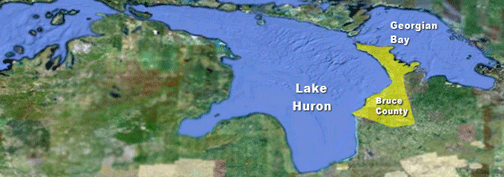
Hervé Courtois to C.A.N. Coalition Against Nukes, 1 Feb 2020, Members of  the Saugeen Ojibway Nation (SON) have voted down plans to bury Ontario’s low- and intermediate-level nuclear waste within 1.2 kilometres of Lake Huron….On Friday, 1,232 members of the First Nation band voted. The vote results saw 1,058 ‘no’ votes, with 170 ‘yes’ and 4 spoiled ballots…It means Canada’s first permanent nuclear waste facility will need to be built somewhere else in Ontario…OPG will now have to start searching for a new host community to house over 200,000 cubic metres of low- and intermediate- level nuclear waste…OPG says finding a new site may set the project back 20 to 30 years….https://www.facebook.com/groups/C.A.N.CoalitionAgainstNukes
Opposition to Nuclear Waste Storage Plan Near Lake Huron
|
Canada Nuclear Waste Storage Plan Near Lake Huron Faces Vote, Bloomberg, Jan. 31, 2020,
U.S. lawmakers from the Great Lakes region are weighing in on the fate of two major Canadian nuclear waste facilities, which could hinge on a vote in a First Nation community in western Ontario on Friday. The 4,500-member Saugeen Ojibway Nation, based on Lake Huron’s Bruce Peninsula, is voting on whether to support construction of Ontario Power Generation Inc.’s C$2.4 billion ($1.8 billion) deep geological repository for low- and intermediate-level nuclear waste near the shore of Lake Huron. But several U.S. members of Congress oppose it, claiming it could endanger drinking water for millions. Ontario Power Generation pledged not to move ahead if the First Nation community votes against the repository. The Nuclear Waste Management Organization, which could build a much larger C$23 billion repository for more radioactive spent nuclear fuel in the same region, won’t proceed in the area if it doesn’t have a partnership with the nation. The vote on Friday doesn’t deal with its proposal directly. The two projects together represent the bulk of Canada’s long-term plan to store nuclear waste. Canada has 2.9 million bundles of highly radioactive used nuclear fuel, according to 2015 data, and around 100,000 cubic meters of low and intermediate nuclear waste, according to 2016 figures, the most recent available. U.S. Lawmakers Oppose Both SitesU.S. lawmakers from across Lake Huron in Michigan have long opposed both projects, and environmental groups say storing radioactive materials deep underground near large bodies of water isn’t safe. “Storing high-level nuclear waste could threaten the well-being of the Great Lakes for generations to come and undo progress made to preserve them,” Sen. Gary Peters (D-Mich.) said in a statement Thursday. “This makes no sense,” said Sen. Debbie Stabenow (D-Mich.). “Canada has as much at stake as we do in protecting our Great Lakes. There is no justification for a nuclear waste site so close to Lake Huron to even be under consideration.” At its closest point, the low- and intermediate-level nuclear waste could be stored underground within a mile of the lake’s shoreline. Peters and seven other senators from the Great Lakes region introduced a resolution in the Senate on Jan. 15 calling on Canada’s federal government to stop both projects and for the Trump administration to help find a solution. An identical resolution was introduced in the House of Representatives Jan. 17. The U.S. Environmental Protection Agency has shared concerns about the project’s potential impact on the U.S. and the Great Lakes, the agency said in a statement Thursday. Highly Radioactive Waste SiteThe Nuclear Waste Management Organization repository would be built to store 5.2 million bundles of used nuclear fuel Canada is projected to produce. It could be built in South Bruce, Ontario, or farther north in Ignace, the organization said Jan. 24. The waste is currently stored outside nuclear facilities across four provinces, with 90% of it in Ontario. “We’re working to identify a single, preferred location for a deep geological repository to be located in an area with informed and willing hosts,” spokesperson Bradley Hammond wrote in an email Wednesday. Landowners in South Bruce gave the organization the go-ahead to dig bore holes to test the area’s suitability this month. The joint private-federal agency wants to pick its site by 2023. The U.S. has long wrestled with its own plan to store nuclear waste. First Nation VoteThe vote by the Saugeen Ojibway Nation on the site for low- and intermediate-level nuclear waste is a monumental accomplishment for First Nations having a say over major decisions, the nation’s environment office said in a statement in December. “Never before has a First Nation secured this level of consent on a project of this magnitude,” the nation said. It declined to comment further. Ontario Power Generation has proposed a financial benefit for the nation, but details aren’t public. A Canadian federal review panel approved the Ontario Power Generation project in May 2015, but the then environment minister asked the company to get more information on impacts to the Saugeen Ojibway Nation’s cultural heritage and wait for the results of the community vote. After receiving the new information, the Impact Assessment Agency will write a draft report on the project’s community impacts, Alison Reilander, agency spokeswoman, wrote in an email Jan. 21. Underground StorageCanada’s existing low- and intermediate-level nuclear waste is currently stored at the surface of where the repository will be located, which is also home to the eight-reactor Bruce Power plant……… https://news.bloombergenvironment.com/environment-and-energy/canada-nuclear-waste-storage-plan-near-lake-huron-faces-vote |
|
Historic vote on nuclear waste underway in Bruce County, Ontario
|
Historic vote on nuclear waste underway in Bruce County, Ont.London CTV News, Scott MillerVideographer @ScottMillerCTV Contact, January 31, 2020 SOUTHAMPTON, ONT. — Plans to build Canada’s first permanent home to nuclear waste are being decided by a local First Nations band Friday. Over 4,500 members of the Saugeen Ojibway Nation (SON) were eligible to vote on whether to approve the plan to bury Ontario’s low- and intermediate-level nuclear waste along the shores of Lake Huron. Ontario Power Generation (OPG) plans to bury 200,000 cubic metres of nuclear waste in a facility, 680 metres under the Bruce Power site, north of Kincardine, Ont. The Deep Geological Repository or DGR falls within the traditional territory of the SON, so OPG has committed to not moving forward without the band’s support. Whatever SON members decide, it will have far-reaching impacts. There are over 230 resolutions by various levels of government around the Great Lakes, including London, Sarnia and Toronto, opposing the plan. In Michigan, Congressman Dan Kildee has been leading the charge against the DGR. “Permanently storing nuclear waste less than a mile from Lake Huron just doesn’t make sense. Surely in the vast land mass that comprises Canada, there is a better place to permanently store nuclear waste than on the shores of the world’s largest supply of fresh water,” he says…….. https://london.ctvnews.ca/historic-vote-on-nuclear-waste-underway-in-bruce-county-ont-1.4792113 |
|
Ontario landowners sign deal with agency looking to store used nuclear fuel
|
Ontario landowners sign deal with agency looking to store used nuclear fuel https://www.660citynews.com/2020/01/24/ontario-landowners-sign-deal-with-agency-looking-to-store-used-nuclear-fuel/ BY COLIN PERKEL, THE CANADIAN PRESS
TORONTO — Landowners in a rural Ontario municipality about two hours northwest of Toronto have signed an agreement that will allow authorities to soon start doing site tests for a proposed facility to store high-level nuclear waste. The agreement with the Nuclear Waste Management Organization leaves South Bruce as one of two possible sites for a deep geological repository, along with an area near Ignace in northern Ontario. Darren Ireland, a local farmer, said in a statement on Friday that the project “has the potential to bring long-term benefits to the area.” About three-million highly radioactive used fuel bundles from reactors are currently stored at existing nuclear generating stations in Canada, including at the Bruce Nuclear Generating Station on the shores of Lake Huron near Kincardine, Ont. Authorities have long contended the current storage system is not sustainable and have been searching for a permanent solution, with the aim of finding a single site for storage by 2023.
The proposed repository is separate from a proposed massive underground bunker for low and intermediate radioactive waste at the Bruce plant near Kincardine. That multibillion-dollar project has drawn fierce opposition both in Canada and the U.S. because of its proximity to Lake Huron. Although Ontario Power Generation insists its studies show the underground facility would safely contain waste that remains hazardous for thousands of years, the project has been stalled for years awaiting federal government approval. One condition Ottawa has set is for Indigenous groups in the area to give their blessing, which has not happened. The Nuclear Waste Management Organization has similarly been searching for a place to store used nuclear fuel, which is far more toxic. The organization said Friday it now has deals in place for about 526 hectares of land northwest of Teeswater, Ont., although Indigenous groups have yet to support the project. The deals with landowners include a combination of option and purchase arrangements to allow the waste organization to do studies while allowing landowners to keep using their land, the organization said. If the site is ultimately selected to host the repository, the organization would buy the optioned land. It would also then look to acquite more land in the area to form a site of about 607 hectares. Mahrez Ben Belfadhel, a vice-president with the waste management organization, said they were pleased landowners were on board, and called identification of the South Bruce site an important milestone. “With agreements in place and access to land in South Bruce, we expect to begin studies such as borehole drilling and baseline environmental monitoring in the coming months to assess the suitability of the area,” Ben Belfadhel said in a release. The Bruce County municipality of South Bruce, south of Walkerton, Ont., has about 5,600 residents. Its main centres are the villages of Mildmay and Teeswater. The organization also said the adjacent township of Huron-Kinloss, Ont., would no longer be considered a potential host for the project. The waste organization was set up at the direction of the federal government in 2002 by Ontario Power Generation, N.B. Power and Hydro-Quebec. The three producers and Atomic Energy of Canada Limited, a federal Crown corporation, fund its operations. |
|
Over 32,000 potassium iodide pills ordered in 2 days after Pickering nuclear power plant alert error
|
Typically, between 100 and 200 orders are placed per month, CBC News · January 15 Tens of thousands of people have placed orders for free potassium iodide pills in the days following a false alert from the province about an incident at a nuclear plant in Pickering, Ont. Sunday’s alert, which was sent to mobile phones across Ontario, shocked those within a 10-kilometre radius of the Durham Region plant and even those living farther away. About an hour after the 7:24 a.m. ET alert, Ontario Power Generation (OPG), the plant’s operator, tweeted without explanation that the warning “was sent in error.” The Ontario government also later acknowledged the mistake, blaming human error, and issued an apology. Although the mistake left some people fuming, others stepped up their planning for a real emergency. Between Sunday morning and Monday afternoon, 32,388 orders were placed for potassium iodide tablets through Durham Region’s Prepare To Be Safe website, which is jointly managed by the City of Toronto and OPG. Typically, OPG says, between 100 and 200 orders are placed per month. ……https://www.cbc.ca/news/canada/toronto/potassium-iodide-pills-nuclear-power-plant-pickering-1.5426044 |
|
The fallout from a false nuclear alarm
Associate Professor of Disaster and Emergency Management, York University, CanadaJanuary 14, 2020 On Sunday at 7:23 a.m., residents of the Greater Toronto Area were abruptly awakened by an alert issued by Ontario’s Emergency Alert Ready System stating: “An incident was reported at the Pickering Nuclear Generating Station. There has been NO abnormal release of radioactivity from the station and emergency staff are responding to the situation.”At 8:06 a.m., the Ontario Power Generation released a statement that the alert was issued in error and that there was no danger to the public or the environment. At 9:11 a.m., another message from the Provincial Alert Ready System stated that the initial nuclear alert was “in error.”………..
Other false nuclear alerts This false alarm is not the first time that a nuclear-related alert has been issued during in error during an exercise. In January 2018, an alert was issued in Hawaii warning of an impending ballistic missile attack. Thirty-eight minutes later, the alert was rescinded as a false alarm.
In the Hawaii case, similar to what happened in Ontario on January 12, a public alert was accidentally issued during a routine internal test of the Emergency Alert System. The Hawaii Emergency Management Agency released a statement that the false alert was due to human error.
Jeopardizing trust
Within hours of the false nuclear alarm, the office of Ontario’s Solicitor General released a statement of apology and said a full investigation has been launched into the error made during the routine training exercise. Those initial actions are only the first steps in attempting to repair the damage.
If we take the incident in Hawaii as a guide, the fallout was far-reaching. In the immediate term, all upcoming emergency drills and exercises were suspended. Changes were put in place, such as a two-person verification rule along with a new cancellation command system for public alerts. As the false alarm became a scandal, state-level emergency management officials resigned. Human error and poor software design were identified as root causes, and investigations suggested revamping the system, specifically in terms of oversight of the Integrated Public Alert & Warning System in the United States.
The bottom line is that a false alarm for an incident at a nuclear power station erodes public safety efforts. Fortunately, the risks realized from the Ontario emergency alert were not related to actual radioactive fallout. The fallout from the false alarm is that the public’s trust in emergency alert systems was jeopardized. https://theconversation.com/the-fallout-from-a-false-nuclear-alarm-129766
Canadians got a false alert about a nuclear power plant incident
|
Canadians got an emergency alert about a nuclear power plant incident. It was sent in error, the plant says By Matthew Friedman, Elizabeth Joseph and Eric Levenson, CNN January 12, 2020 An emergency alert sent to residents of Canada’s Ontario province that warned about an “incident” at a nuclear power plant was sent in error, the Ontario Power Generation said. On Sunday morning at about 7:20 a.m., an “incident” was reported at the Pickering Nuclear Generating Station near Toronto, triggering the government to send an emergency alert to local residents. The bulletin, sent to people within 10 kilometers of the nuclear plant, did not offer details about the incident.
“There has been NO abnormal release of radioactivity from the station and emergency staff are responding to the situation. People near the Pickering Nuclear Generating Station DO NOT need to take any protective actions at this time,” said a mobile alert seen by CNN.
The Province of Ontario urged residents to turn to local media for further information and instructions.
But shortly afterward, officials said the alert had been sent in error.
“There is no danger to the public or environment,” Ontario Power Generation said in a tweet sent at 8:06 a.m……. https://edition.cnn.com/2020/01/12/world/pickering-nuclear-power-plant-alert/index.html
|
|
Small Modular Nuclear Reactors’ costs and toxicity

Small modular nuclear reactors – a case of wishful thinking at best, NB Media Cop. by Gordon Edwards, Michel Duguay, Pierre Jasmin, 21 Dec 19
“……….4 Small Modular – Nuclear – Reactors’ costs & toxicity
That Carnegie-Mellon report includes Small Modular Nuclear Reactors in its analysis, without being any more hopeful than we are. This is mainly because a new generation of smaller reactors, such as those promised for New Brunswick, will necessarily be more expensive per unit of energy produced, if manufactured individually. The sharply increased price can be partially offset by mass production of prefabricated components; hence the need for selling hundreds or even thousands of these smaller units in order to break even and make a profit. However, the order book is filled with blank pages — there are no customers. This being the case, finding investors is not easy. So entrepreneurs are courting governments to pony up with taxpayers’ money, in the hopes that this second attempt at a Nuclear Renaissance will not be the total debacle that the first one turned out to be.
Chances are very slim however. There are over 150 different designs of “Small Modular Reactors.” None of them have been built, tested, licensed or deployed. At Chalk River, Ontario, a consortium of private multinational corporations, comprised of SNC-Lavalin and two corporate partners, operating under the name “Canadian Nuclear Laboratories” (CNL), is prepared to host six or seven different designs of Small Modular Nuclear Reactors — none of them being identical to the two proposed for New Brunswick – and all of these designs will be in competition with each other. The Project Description of the first Chalk River prototype Small Modular Reactor has already received over 40 responses that are posted on the CNSC web site, and virtually all of them are negative comments.
The chances that any one design will corner enough of the market to become financially viable in the long run is unlikely. So the second Nuclear Renaissance may carry the seeds of its own destruction right from the outset. Unfortunately, governments are not well equipped to do a serious independent investigation of the validity of the intoxicating claims made by the promoters, who of course conveniently overlook the persistent problem of long-lived nuclear waste and of decommissioning the radioactive structures. These wastes pose a huge ecological and human health problem for countless generations to come.
Finally, in the list of projects being investigated, one finds a scaled-down “breeder reactor” fuelled with plutonium and cooled by liquid sodium metal, a material that reacts violently or explodes on contact with air or water. The breeder reactor is an old project abandoned by Jimmy Carter and discredited by the failure of the ill-fated French SuperPhénix because of its extremely dangerous nature. In the event of a nuclear accident, the Tennessee Clinch River Breeder Reactor was judged capable of poisoning twelve American states and the SuperPhénix half of France.
One suspects that our three premiers are only willing to revisit these bygone reactor designs in order to obtain funding from the federal government while avoiding responsibility for their inaction on more sensible strategies for combatting climate changes – cheaper, faster and safer alternatives, based on investments in energy efficiency and renewable sources.
By Gordon Edwards PhD, President of the Canadian Coalition for Nuclear Responsibility; with assistance by Michel Duguay, PhD, professor at Laval University & Pierre Jasmin, UQAM, Quebec Movement for Peace and Artiste pour la Paix. https://nbmediacoop.org/2019/12/21/small-modular-nuclear-reactors-a-case-of-wishful-thinking-at-best/
Gordon Edwards, PhD ccnr@web.ca
Michel Duguay, PhD michel.duguay@gel.ulaval.ca
Pierre Jasmin, jasmin.pierre@uqam.ca
This article is also published in French, link here.

Small Modular Nuclear Reactors – a wasteful distraction from real efforts to combat climate change

Small modular nuclear reactors – a case of wishful thinking at best, NB Media Cop. by Gordon Edwards, Michel Duguay, Pierre Jasmin, 21 Dec 19“…….3 Climate changes’ valid preoccupation (1)
Many people concerned about climate change want to know more about the moral and ethical choices regarding low-carbon technologies: “Don’t we have a responsibility to use nuclear?” The short reply is: nuclear is too slow and too expensive. The ranking of options should be based on what is cheapest and fastest — beginning with energy efficiency, then on to off-the-shelf renewables like wind and solar energy.
In Germany, Dr. David Jacobs, founder of International Energy Transition Consulting, is proudly mentioning the green energy sector’s contribution in achieving the lowest unemployment rate since reunification of his country in the early 1990s. Post-Fukushima Angela Merkel’s decision to close down all of its nuclear reactors by 2022 has pushed the country to purchase photovoltaic solar panels and 30,000 megawatts of wind energy capacity in only 8 years: an impressive achievement – more than twice the total installed nuclear capacity of Canada. It would be impossible to build 30,000 megawatts of nuclear in only 8 years. By building wind generators, Germany obtained some carbon relief in the very first year of construction, then got more benefit in the second year, even more benefit in the third, and so on, building up to a cumulative capacity of 30,000 MWe after 8 years.
With nuclear, even if you could manage to build 30,000 megawatts in 8 years, you would get absolutely no benefit during that entire 8-year construction period. In fact you would be making the problem worse by mining uranium, fabricating fuel, pouring concrete and building the reactor core and components, all adding to greenhouse gas emissions – earning no benefit until (and IF) everything is finally ready to function. In the meantime (10 to 20 years), you will have starved the efficiency and renewable alternatives of the funds and political will needed to implement technologies that can really make an immediate and substantial difference.
In Saskatchewan, professor Jim Harding, who was director of Prairie Justice Research at University of Regina where he headed up the Uranium Inquiries Project, has offered his own reflection; here is the conclusion of his December 2, 2019 comment:
““In short, small reactors are another distraction from Saskatchewan having the highest levels of GHGs on the planet – nearly 70 metric tonnes per capita. While the rest of Canada has been lowering emissions, those here, along with Alberta with its high-carbon tar sands, have continued to rise. Saskatchewan and Alberta’s emissions are now almost equal to all the rest of Canada. Shame on us!”
In the USA, engineers and even CEOs of some of the leading nuclear companies are admitting that the age of nuclear energy is virtually over in North America. This negative judgment is not coming from people who are opposed to nuclear power, quite the opposite — from people lamenting the decline. See, for example, one major report from the Engineering faculty at Carnegie-Mellon University.
As conventional nuclear reactors fail economically, the pro nuclear turn to the fantasy of small nuclear reactors

Small modular nuclear reactors – a case of wishful thinking at best, NB Media Coop, by Gordon Edwards, Michel Duguay, Pierre Jasmin, 21 Dec 19
On Friday the 13th, September 2019, the Saint John Telegraph-Journal’s front page was dominated by what many readers hoped will be a good luck story for New Brunswick – making the province a booming and prosperous Nuclear Energy powerhouse for the entire world. After many months of behind-the-scenes meetings throughout New Brunswick with utility company executives, provincial politicians, federal government representatives, township mayors and First Nations, two nuclear entrepreneurial companies laid out a dazzling dream promising thousands of jobs – nay, tens of thousands! – in New Brunswick, achieved by mass-producing and selling components for hitherto untested nuclear reactors called SMNRs (Small Modular Nuclear Reactors) which, it is hoped, will be installed around the world by the hundreds or thousands!
On December 1, the Saskatchewan and Ontario premiers hitched their hopes to the same nuclear dream machine through a dramatic tripartite Sunday press conference in Ottawa featuring the premiers of the provinces. The three amigos announced their desire to promote and deploy some version of Small Modular Nuclear Reactors in their respective provinces. All three claimed it as a strategy to fight climate change, and they want the federal government to pledge federal tax money to pay for the R&D. Perhaps it is a way of paying lip service to the climate crisis without actually achieving anything substantial; prior to the recent election, all three men were opposed to even putting a price on carbon emissions.
Motives other than climate protection may apply. Saskatchewan’s uranium is in desperate need of new markets, as some of the province’s most productive mines have been mothballed and over a thousand uranium workers have been laid off, due to the global decline in nuclear power. Meanwhile, Ontario has cancelled all investments in over 800 renewable energy projects – at a financial penalty of over 200 million dollars – while investing tens of billions of dollars to rebuild many of its geriatric nuclear reactors. This, instead of purchasing surplus water-based hydropower from Quebec a lot less expensive and more secure.
In a December 2 interview on QUB radio, Gilles Provost, spokesperson for the Ralliement contre la pollution radioactive (Movement against radioactive pollution, a Quebec-based group) and former environmental journalist at Le Devoir, criticized the announcement of the three premiers as ill-considered and premature, since none of the conjectural nuclear reactor prototypes exist in reality. Quite a contrast to the three premiers’ declarations, boldly claiming that “SMRs” (they leave out the “N” to minimize public opposition) will help solve climate change, knowing full well that it will take a decade or more before any benefits can possibly be realized – IF EVER.
These new nuclear reactors are so far perfectly safe, because they exist only on paper and are cooled only by ink. Declaring them a success before they are built is quite a leap of faith, especially in light of the three previous Canadian failures in this field of “small reactors.” Two 10-megawatt MAPLE reactors were built at Chalk River and never operated because of insuperable safety concerns, and the 10-megawatt “Mega-Slowpoke” district heating reactor never earned a licence to operate, again because of safety concerns. The Mega-Slowpoke was offered free of charge to two universities – Sherbrooke and Saskatchewan –both of whom refused the gift. And a good thing too, as the only Mega-Slowpoke ever built (at Pinawa, Manitoba) is now being dismantled without ever producing a single useful megawatt of heat.
2 “Nuclear renaissance” – clambering out of the dark ages?
This current media hype about modular reactors is very reminiscent of the drumbeat of grandiose expectations that began around 2000, announcing the advent of a Nuclear Renaissance that envisaged thousands of new reactors — huge ones! — being built all over the planet. That initiative turned out to be a complete flop. Only a few large reactors were launched under this banner, and they were plagued with enormous cost-over-runs and extraordinarily long delays, resulting in the bankruptcy or near bankruptcy of some of the largest nuclear companies in the world – such as Areva and Westinghouse – and causing other companies to retire from the nuclear field altogether – such as Siemens.
Speculation about that promised Nuclear Renaissance also led to a massive (and totally unrealistic) spike in uranium prices, spurring uranium exploration activities on an unprecedented scale. It ended in a near-catastrophic collapse of uranium prices when the bubble burst. Cameco was forced to close down several mines. They are still closed. The price of uranium has still not recovered from the plunge.
Large nuclear reactors have essentially priced themselves out of the market. Only Russia, China and India have managed to defy those market forces with their monopoly state involvements. Nevertheless, the nuclear contribution to world electricity production has plummeted from 17 percent in 1997 to about 10 percent in 2018. In North America and Western Europe, the prospects for new large reactor projects are virtually nil, and many of the older reactors are shutting down permanently without being replaced. By Gordon Edwards PhD, President of the Canadian Coalition for Nuclear Responsibility; with assistance by Michel Duguay, PhD, professor at Laval University & Pierre Jasmin, UQAM, Quebec Movement for Peace and Artiste pour la Paix. https://nbmediacoop.org/2019/12/21/small-modular-nuclear-reactors-a-case-of-wishful-thinking-at-best/
Small Modular Nuclear Reactors – just a speculative technology, no use against climate change

|
Environmentalists Say Small Nuclear Reactors Aren’t A Climate Change But David Thompson of Leap4ward says the technology is too new and won’t be implemented soon enough to have an impact on climate change. Thompson says the province shouldn’t be investing in “speculative technology” and should instead be focusing renewable energy sources that have been proven to work in New Brunswick, such as wind, solar and hydro. “The renewable sources of energy that we’ve talked about to the premier, some of them can be put in place and operating in maybe three, three and a half years,” he said. Thompson says in comparison, SMRs could take 10 years or more to perfect. “We haven’t got 10 years for something that might work, and another 10 years to build it after it’s proven to work, or even longer than that to put in place enough of it so that it’ll make some kind of difference,” he said. “At the end of it we still have the problem of nuclear waste and we will have the problem of radiation.” Interest in SMR and nuclear energy has been growing in recent months as a green energy alternative, but the modular reactor technology is still in the very early stages. Thompson says climate change is a growing issue and more needs to be done sooner rather than later. “Climate change can’t wait for something that might work, and what if it doesn’t work? What if it isn’t economically feasible after 10 years?” he said. He says not only have wind, solar, and hydro been proven to work, but they’re low-cost and easy to implement. Thompson has sent a letter to Premier Blaine Higgs outlining his concerns and asking him to pull funding from SMRs. “We applaud him for the decision he made to cut all funding to the speculative Joi [Scientific] hydrogen fuel project, but we’re even more concerned about these companies who are getting government money—and attempting to get more—to build these modular reactors,” he said. “By not putting renewable energy in place now in New Brunswick, we’re not doing the right thing. We need action on climate change now.” |
|
How Ontario can get out of nuclear power, and reduce carbon emissions
Ontario can phase out nuclear and avoid increased carbon emissions, The Conversation, January 6, 2020 MV Ramana, Simons Chair in Disarmament, Global and Human Security at the Liu Institute for Global Issues, University of British Columbia, Xiao Wei, MITACS Globalink Research Intern, University of British Columbia As wind and solar energy have become cheaper, they’ve become a more prominent and important way to generate clean electricity in most parts of the world.The Ontario government, on the other hand, is cancelling renewable energy projects at a reported cost of at least $230 million while reinforcing the province’s reliance on nuclear power via expensive reactor refurbishment plans.
As researchers who have examined the economics of electricity generation in Ontario and elsewhere, we argue that this decision is wasteful and ill-advised, and the unnecessary cost differential will rise further in the future.
One concern about renewables has been the intermittency of these energy sources. But studies have shown it’s feasible to have an all-renewable electric grid.
These feasibility studies, however, are always location specific. In that spirit, we have carried out detailed modelling and found that it’s possible to meet Ontario’s electricity demands throughout the year with just a combination of renewables, including hydropower, and storing electricity in batteries.
We also found that dealing with the intermittency of wind and solar energy by adding batteries would be more economical than refurbishing nuclear plants in the foreseeable future, well before the current refurbishment projects are completed.
That’s because of the expected decline in the cost of batteries used to store the electricity during the hours when the wind is blowing or the sun is shining in order to supply electricity during the periods when they aren’t. The cost of different kinds of battery technologies, such as lithium-ion or flow batteries, have come down rapidly in recent years.
Essential results
In all scenarios, the bulk of the demand was met by solar and wind power, with a lower fraction met by hydropower. Even in the scenarios with no batteries, less than 20 per cent of the electricity demand was met by nuclear power…….
In summary, our results show that for reasonable assumptions about future battery costs and the current price tag for solar and wind power, scenarios involving nuclear power are more than 20 per cent higher than the cheapest scenario involving only batteries, solar, wind and the current hydropower capacity. …
nuclear power isn’t needed to meet Ontario’s electricity needs. And the absence of nuclear power won’t have any impact on emissions in Ontario’s energy sector.https://theconversation.com/ontario-can-phase-out-nuclear-and-avoid-increased-carbon-emissions-128854?fbclid=IwAR20ANW_yAmpR7zZVw113hUp9bl7Xt2h0v1XiB1K815lFIKctZiaR8xB5Ew
Renewable energy to fight climate change, – NOT Small Modular Nuclear Reactors
|
Renewables – Not Small Modular Nuclear Reactors – Are the Solution to Climate Change, https://cela.ca/renewables-not-small-modular-nuclear-reactors-are-the-solution-to-climate-change/ December 4, 2019 By Theresa McClenaghan, Kerrie Blaise (CELA) and Guest Author Chris Rouse (New Clear Free Solutions) The idea of Small Modular Reactors (“SMRs”) was in the news this week with the federal government being urged to provide even more research money to develop this “new” nuclear power technology. The premise is that SMR’s are a needed, cost effective, safe and realistic solution to climate change. However, SMRs are not the answer or even part of the answer to climate change given the problematic environmental, social and economic attributes of the proposed technology. Instead, in our view, investment is urgently needed in Canada’s vast and enviable renewable energy resources which are already scalable and provide safer, less costly, and more socially acceptable means of energy generation.
SMRs are not yet commercially available. Indeed, Canada’s SMR Roadmap, produced by the Canadian Nuclear Association, only sets out a path for having a commercial demonstration unit in the 2030s. To contend that SMR technology can aid in combatting climate change is potentially damaging to climate action, as it misses the 10-year window we have to reverse emissions and decarbonize. It also distracts from the urgent work needed to respond to the climate emergency. We already have many tools in our renewable energy toolbox. Canada’s electricity grid is 65% renewable, mainly from our vast hydro resources. These resources, used in combination with 30% to 35% wind and solar, makes a renewable grid achievable. Several jurisdictions have already achieved or surpassed this threshold, such as Prince Edward Island, where 43% of its power comes from wind alone. We also have access to other renewable energy resources such as biomass, geothermal, and tidal to assist in our transition to a low-carbon economy. Studies also continue to demonstrate viable pathways to a renewable grid, which are both technically and economically feasible. One report from Nova Scotia provides a pathway to reach a 90% renewable grid by 2030 and a study from New Brunswick plots a cost effective solution to achieve a 95% renewable grid. While work is needed to achieve the remaining 5% over time, the immediate need – and the focus of governmental efforts – should be on prioritizing the first 90% to 95% shift to renewables. Despite what appears as widespread interest in SMRs, very few countries have been willing to invest in their construction. Apart from technology’s risks, the problem is one of poor economics: nuclear energy is already known to be expensive and the cost-competitiveness of SMRs is contingent upon their mass fabrication. Hundreds if not thousands of SMRs would need to be deployed in order to be economically viable. Past experience also dictates this new reactor technology may never become commercially available. For instance, after two decades and hundreds of millions of taxpayer dollars, the two prototype MAPLE reactors were abandoned in 2008 because they could not be safely operated. The Gentilly 1 prototype reactor in Quebec which received similar investment, also failed and after 180 days of operation was mothballed. Despite public assurances of SMRs’ ‘passive’ and ‘inherent’ safety, SMR operators and suppliers would be protected from liability in the event of an accident under the current rules; the current nuclear liability rules are a concession by governments to the nuclear industry because of the inherent hazard that private nuclear investors do not want to underwrite. Furthermore, after 50 years of nuclear energy production, we still do not have an approved plan for Canada’s high, intermediate and low-level radioactive waste stockpiles. Because of the diverse range of fuels which can be used by SMRs, new radioactive waste streams will be created, thus increasing the complexity of the used nuclear fuel waste problem, with new types of nuclear waste hazards being introduced. The touted benefit of SMRs for use in remote and rural regions would also mean increased transport of radioactive substances on roads and railways across the country. This poses unique proliferation risks since the waste from enriched fuels can produce quantities of plutonium that could be attractive for diversion to malicious purposes. The greater the number of sites and communities with SMRs, the greater the proliferation risks because of challenges in monitoring, keeping track and measuring plutonium in spent fuel, which must be kept secure. Furthermore, Canada’s nuclear safety regulator advocated with the federal government to remove SMRs from public, more rigorous forms of decision-making under Canada’s new Impact Assessment Act (IAA). Despite requirements for wind and solar farms to undergo environmental assessments, either provincially or federally, SMRs would not trigger an environmental assessment under the current federal IAA Project List regulation. The coming into force of the Impact Assessment Act in June 2019 wholly exempts SMRs from environmental, or impact assessment review. Investment in nuclear power at the 11th hour is a distraction from real climate action when scalable, cost-effective renewable solutions could and need to be employed. Already climate-burdened future generations should not have new risks imposed on them, due to SMR’s radioactive waste and accompanying proliferation risk. We need to invest in known renewable energy solutions, and not the promise of a hypothetical and risky technology. |
|
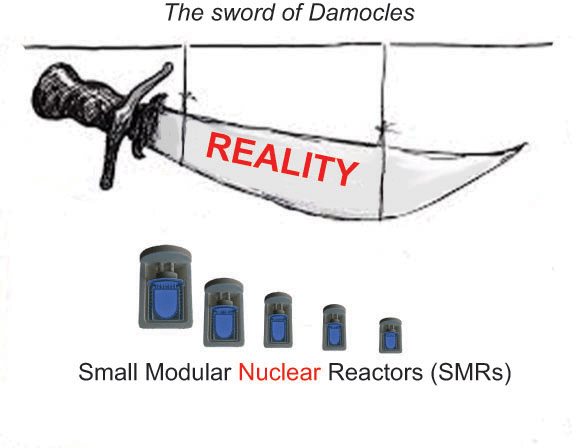
Nuclear power the worst, most unsuitable, most expensive power option for Ontario
|
GIBBONS: Hydro power, not nuclear, is best for Ontario, BY JACK GIBBONS https://torontosun.com/opinion/columnists/gibbons-hydro-power-not-nuclear-is-best-for-ontario (Regarding Lorrie Goldstein’s column, “Nuclear power key to solving climate change,”Dec. 2.) 12 Dec 19, Using nuclear energy to address climate change is like offering every Toronto commuter a limo ride to work instead of building subways.
It’s simply the most expensive way to reduce greenhouse gas pollution. Every nuclear project in Ontario’s history has run massively over budget. Remember the debt retirement charge on your hydro bill? You can thank bloated nuclear projects that left the old Ontario Hydro essentially bankrupt. Ontario is one of the few places left that still sees nuclear as a viable way to keep the lights on. And that’s going to hit you where it hurts – in the wallet. Ontario Power Generation has stated it needs to double the price it charges for nuclear energy to rebuild the Darlington nuclear station. Ontario has many better ways to simultaneously tackle climate change and lower electricity bills, something Premier Doug Ford has promised, but failed thus far to deliver. Quebec has the lowest electricity prices on the continent thanks to its cost-efficient, water-power system. It also has a large and growing power surplus and is keen to make export deals. Quebec has offered to sell Ontario power at half the cost of what we are paying for nuclear power today – one-third the cost of what we will be paying for nuclear power in five years. Both the Kathleen Wynne and Doug Ford governments have turned up their noses at this offer to protect our high-cost nuclear industry. Combine Quebec water power with energy efficiency programs in Ontario and you have the lowest-cost option for keeping the fridges humming. Ontario pays, on average, two cents per kilowatt hour for efficiency measures that reduce the need to generate electricity in the first place. You may have doubts about solar and wind energy, but one thing is certain — prices for these sources are plummeting as costs for nuclear rise. Quebec, by using its ability to store water, can act as a giant battery to smooth out the peaks and troughs of green energy in Ontario. It can supply Ontario with plenty of power virtually every hour of the year. And it has that power right now – it doesn’t need to build new dams. In the few hours a year when Quebec’s own demand maxes out, Ontario has plenty of gas-fired power plants that can fill the brief gap. For a fraction of the cost of rebuilding one nuclear reactor, we can upgrade our transmission links to get even more low-cost power from Quebec. Instead of banking on phantom solutions like non-existent “small modular reactors” that, if they are ever built, will have all the waste, cost and security problems of conventional nuclear plants, Ontario should make a money-saving deal with Quebec. As the people of Pickering are now discovering, Ontario has no long-term facility to store the huge pile of radioactive waste that has been built up over 50 years of nuclear operations. |
|
1 This Month


Tell the Ukrainian Government to Drop Prosecution of Peace Activist Yurii Sheliazhenko

Petition to revoke the licensing of the Near Surface Nuclear Disposal Facility (NSDF) at Chalk River. https://www.ourcommons.ca/petitions/en/Petition/Details?Petition=e-7247


of the week – STOP SMALL MODULAR REACTORS IN CANADA
To see nuclear-related stories in greater depth and intensity – go to https://nuclearinformation.wordpress.com
-
Archives
- March 2026 (204)
- February 2026 (268)
- January 2026 (308)
- December 2025 (358)
- November 2025 (359)
- October 2025 (376)
- September 2025 (258)
- August 2025 (319)
- July 2025 (230)
- June 2025 (348)
- May 2025 (261)
- April 2025 (305)
-
Categories
- 1
- 1 NUCLEAR ISSUES
- business and costs
- climate change
- culture and arts
- ENERGY
- environment
- health
- history
- indigenous issues
- Legal
- marketing of nuclear
- media
- opposition to nuclear
- PERSONAL STORIES
- politics
- politics international
- Religion and ethics
- safety
- secrets,lies and civil liberties
- spinbuster
- technology
- Uranium
- wastes
- weapons and war
- Women
- 2 WORLD
- ACTION
- AFRICA
- Atrocities
- AUSTRALIA
- Christina's notes
- Christina's themes
- culture and arts
- Events
- Fuk 2022
- Fuk 2023
- Fukushima 2017
- Fukushima 2018
- fukushima 2019
- Fukushima 2020
- Fukushima 2021
- general
- global warming
- Humour (God we need it)
- Nuclear
- RARE EARTHS
- Reference
- resources – print
- Resources -audiovicual
- Weekly Newsletter
- World
- World Nuclear
- YouTube
-
RSS
Entries RSS
Comments RSS
 nuclear-news