Canada’s nuclear regulator updates its drug and alcohol testing requirements.
Canada’s nuclear regulator updates its drug and alcohol testing requirements. 22 Jan 21, ………Depending on the nature of their job, nuclear workers may be tested:
- Before being hired
- After an incident has occurred
- Randomly
- If a supervisor has cause to believe there is a reason to test (also known as ‘reasonable grounds’)
- Follow-up after confirmation of a substance use disorder…… https://www.miragenews.com/canada-s-nuclear-regulator-updates-its-drug-and-alcohol-testing-requirements…..
We need parliamentarians to stop project, prevent Ottawa River from being permanently contaminated — Concerned Citizens of Renfrew County and Area

January 18, 2021 Re “CNL working to accomplish responsible action in managing Canada’s nuclear research and development legacy” (The Hill Times, Letters to the Editor, December 14, 2020). This letter from Joe McBrearty, President and CEO of Canadian Nuclear Laboratories (CNL) deepens my concern about the handling of Canada’s $8 billion nuclear waste liability. Mr. […]
Hill Times Letter to the Editor ~ We need parliamentarians to stop project, prevent Ottawa River from being permanently contaminated — Concerned Citizens of Renfrew County and Area
………….Last month CNL published its final environmental impact statement listing a partial inventory of radionuclides that would go into the gigantic five-to-seven story radioactive mound (aka the “NSDF”).Twenty-five out of the 30 radionuclides listed in the inventory are long-lived, with half-lives ranging from four centuries to more than four billion years. To take just one example, the man-made radionuclide, Neptunium-237, has a half-life of 2 million years such that, after 2 million years have elapsed, half of the material will still be radioactive.
The inventory includes four isotopes of plutonium, one of the most deadly radioactive materials known, if inhaled or ingested.
It is incorrect to say that these materials “require isolation and containment for only a few hundred years.” Many of them will be dangerously radioactive for more than one hundred thousand years. The International Atomic Energy Agency states that materials like this must be stored tens of meters or more underground, not in an above-ground mound.
The CNL inventory also includes a very large quantity of cobalt-60, a material that gives off so much strong gamma radiation that lead shielding must be used by workers who handle it in order to avoid dangerous radiation exposures. The International Atomic Energy Agency considers high-activity cobalt-60 sources to be “intermediate-level waste” and specifies that they must be stored underground. Addition of high-activity cobalt-60 sources means that hundreds of tons of lead shielding would be disposed of in the mound along with other hazardous materials such as arsenic, asbestos, PCBs, dioxins and mercury.
CNL’s environmental impact statement describes several ways that radioactive materials would leak into surrounding wetlands that drain into the Ottawa River during filling of the mound and after completion. It also describes CNL’s intent to pipe water polluted with tritium and other radioactive and hazardous substances from the waste treatment facility directly into Perch Lake which drains into the Ottawa River.
I stand by my original conclusion: We need parliamentarians to step up now to stop this deeply flawed project and prevent the Ottawa River from being permanently contaminated by a gigantic, leaking radioactive landfill that would do little to reduce Canada’s $8 billion nuclear waste liability.
Why Won’t Canada Back a Nuclear Weapons Ban?

Government uses NATO as an excuse not to sign treaty
Why Won’t Canada Back a Nuclear Weapons Ban? — Beyond Nuclear International
Why Won’t Canada Back a Nuclear Weapons Ban?The UN nuclear ban treaty becomes international law on January 22, but the Trudeau government won’t sign, January 17, 2021 by beyondnuclearinternational By Bianca Mugyenyi 17 Jan 21, In a win for the long-term survival of humanity, the United Nations’ treaty banning nuclear weapons was ratified by the 50th country, Honduras, allowing the pact to pass.But any celebration in Canada should be muted by embarrassment at our government’s indifference to the threat nukes pose to humankind.
The Treaty on the Prohibition of Nuclear Weapons was negotiated at a 2017 UN conference, creating a legally binding agreement that would ban nuclear weapons and lead toward their total elimination.
Rather than showing support for this important meeting, Canada was in a minority of countries that voted against even holding this conference at a General Assembly vote in autumn 2016. (More than 120 countries were in favour of holding the conference; just 38 were opposed.)
Additionally, Prime Minister Justin Trudeau refused to send a representative to the 2017 conference, where two-thirds of the world’s countries were represented.
Trudeau was dismissive of the conference: “There can be all sorts of people talking about nuclear disarmament, but if they do not actually have nuclear arms, it is sort of useless to have them around, talking.”
Around the same time, Trudeau made no effort to congratulate Canadian activist Setsuko Thurlow, a survivor of the atomic bombing of Hiroshima, who co-accepted the 2017 Nobel Peace Prize on behalf of the International Campaign to Abolish Nuclear Weapons.
The Trudeau government has failed to join the 86 countries that have already signed the nuclear weapons treaty, described by UN Secretary-General Antonio Guterres as “a very welcome initiative.”
Mexico and New Zealand, an ally with Canada in the Five Eyes security network, as well as European Union members Ireland and Austria have ratified the treaty. With Honduras becoming the 50th nation to ratify it, the treaty will enter into force on January 22, 2021.
In a last-ditch attempt to block the accord from reaching the required 50 member states, the Trump administration delivered a letter calling on countries that had signed to withdraw their support.
According to an Associated Press report, the letter claimed U.S. NATO allies — like Canada — “stand unified in our opposition to the potential repercussions” of the treaty…….
Canada’s defence policy, “Strong, Secure, Engaged,” makes two dozen references to Canada’s commitment to the nuclear-armed NATO alliance. According to NATO, “nuclear weapons are a core component of the Alliance’s overall capabilities.” Canada contributes personnel and funds to NATO’s Nuclear Policy Directorate and Nuclear Planning Group.
The Liberal government says it cannot ratify the UN nuclear ban treaty because of Canada’s membership in NATO.
Rather than offer this excuse to avoid signing a treaty opposed by powerful allies and Canada’s military, it could instead be used as a moment to consider re-evaluating Canada’s involvement in NATO.
The Canadian Foreign Policy Institute initiated an open letter to Trudeau after Canada’s second consecutive defeat for a seat on the UN Security Council.
The letter asked: “Should Canada continue to be part of NATO or instead pursue non-military paths to peace in the world?” It has been signed by Greenpeace Canada, 350.org, Idle No More, Vancouver and District Labour Council and 50 other groups, as well as four sitting MPs and David Suzuki, Naomi Klein, Stephen Lewis and more than 2,000 others.
The NDP, Greens and Bloc Québécois have all called for Canada to adopt the UN nuclear ban treaty. Thousands of Canadians have also signed petitions calling on the government to join the initiative.
Nuclear weapons will soon be banned under international law. The government needs to be challenged to get on the right side of history and sign the Treaty on the Prohibition of Nuclear Weapons.
Only then can Canadians proudly celebrate the critical effort under way to protect the future of humanity.
Bianca Mugyenyi is an author and former co-executive director of The Leap. She currently directs the Canadian Foreign Policy Institute.https://beyondnuclearinternational.org/2021/01/17/why-wont-canada-back-a-nuclear-weapons-ban/
New consultations in Ignace, Ontario, over nuclear waste site

 New consultations in Ignace over nuclear waste site, Residents asked to fill out survey from Nuclear Waste Management Organization between Jan. 18 and Feb. 26 By: IGNACE, Ont. – Residents in Ignace, one of two remaining candidates to serve as a repository for Canada’s nuclear’s waste, are being asked to weigh in as the Nuclear Waste Management Organization’s site selection process continues.
Beginning Monday, residents can fill out a short survey created by the NWMO and the Township of Ignace that will help guide how the agency engages the public as it conducts numerous studies in the area in early 2021.
The agency narrowed its list of candidate sites to two – Ignace and South Bruce – in January of 2020. Final site selection was scheduled for 2023, with construction of a nuclear waste repository expected to take another 10 years to complete.
……….. Some experts and civil society groups have raised serious concerns over “deficient” federal nuclear waste policies, calling for an overhaul before moving forward.https://www.tbnewswatch.com/local-news/new-consultations-in-ignace-over-nuclear-waste-site-3268753
”Small Modular Reactors”’- governments are being sucked in by the ”billionaires’ nuclear club”

SNC-Lavalin Scandal-ridden SNC-Lavalin is playing a major role in the push for SMRs.
Terrestrial Energy….. Terrestrial Energy’s advisory board includes Dr. Ernest Moniz, the former US Secretary of the Dept. of Energy (2013-2017) who provided more than $12 billion in loan guarantees to the nuclear industry. Moniz has been a key advisor to the Biden-Harris transition team, which has come out in favour of SMRs.
The “billionaires’ nuclear club” …“As long as Bill Gates is wasting his own money or that of other billionaires, it is not so much of an issue. The problem is that he is lobbying hard for government investment.”
Going after the public purse
Bill Gates was apparently very busy during the 2015 Paris climate talks. He also went on stage during the talks to announce a collaboration among 24 countries and the EU on something called Mission Innovation – an attempt to “accelerate global clean energy innovation” and “increase government support” for the technologies.
Gates’ PR tactic is effective: provide a bit of capital to create an SMR “bandwagon,” with governments fearing their economies would be left behind unless they massively fund such innovations.
governments “are being suckers. Because if Wall Street and the banks will not finance this, why should it be the role of the government to engage in venture capitalism of this kind?”
It will take a Herculean effort from the public to defeat this NICE Future, but along with the Assembly of First Nations, three political parties – the NDP, the Bloc Quebecois, and the Green Party – have now come out against SMRs.
|
Mini-Nukes, Big Bucks: The Interests Behind the SMR Push https://watershedsentinel.ca/articles/mini-nukes-big-bucks-the-money-behind-small-modular-reactors/
It’s remarkable that only five years ago, the National Energy Board predicted: “No new nuclear units are anticipated to be built in any province” by 2040.So what happened? The answer involves looking at some of the key influencers at work behind the scenes, lobbying for government funding for SMRs. |

Big doubts on small nuclear reactors – on economics, on waste problems
 Former U.S. regulator questions small nuclear reactor technology, Business case for small reactors ‘doesn’t fly,’ says expert on nuclear waste, Jacques Poitras · CBC News Jan 15, 2021 A former head of the United States’ nuclear regulator is raising questions about the molten-salt technology that would be used in one model of proposed New Brunswick-made nuclear reactors.
The technology pitched by Saint John’s Moltex Energy is key to its business case because, the company argues, it would reuse some of the nuclear waste from Point Lepreau and lower the long-term cost and radioactivity of storing the remainder.
But Allison Macfarlane, the former chairperson of the U.S. Nuclear Regulatory Commission and a specialist in the storage of nuclear waste, said no one has yet proven that it’s possible or viable to reprocess nuclear waste and lower the cost and risks of storage.
“Nobody knows what the numbers are, and anybody who gives you numbers is selling you a bridge to nowhere because they don’t know,” said Macfarlane, now the director of the School of Public Policy and Global Affairs at the University of British Columbia.
“Nobody’s really doing this right now. … Nobody has ever set up a molten salt reactor and used it to produce electricity.”
Macfarlane said she couldn’t comment specifically on Moltex, calling information about the company’s technology “very vague.”
But she said the general selling point for molten-salt technology is dubious.
“Nobody’s been able to answer my questions yet on what all these wastes are and how much of them there are, and how heat-producing they are and what their compositions are,” she said.
“My sense is that all of these reactor folks have not really paid a lot of attention to the back end of these fuel cycles,” she said, referring to the long-term risks and costs of securely storing nuclear waste.
Moltex is one of two Saint John-based companies pitching small nuclear reactors as the next step for nuclear power in the province and as a non-carbon-dioxide emitting alternative to fossil fuel electricity generation.
Moltex North America CEO Rory O’Sullivan said the company’s technology will allow it to affordably extract the most radioactive parts of the existing nuclear waste from the Point Lepreau Generating Station.
The waste is now stored in pellet form in silos near the plant and is inspected regularly.
The process would remove less than one per cent of the material to fuel the Moltex reactor and O’Sullivan said that would make the remainder less radioactive for a much shorter amount of time.
Existing plans for nuclear waste in Canada are to store it in an eventual permanent repository deep underground, where it would be secure for the hundreds of thousands of years it remained radioactive………..
Shorter-term radioactivity complicates storage
Macfarlane said a shorter-term radioactivity life for waste would actually complicate its storage underground because it might lead to a facility that has to be funded and secured rather than sealed up and abandoned.
“That means that you believe that the institutions that exist to keep monitoring that … will exist for hundreds of years, and I think that is a ridiculous assumption,” she said.
“I’m looking at the United States, I’m seeing institutions crumbling in a matter of a few years. I have no faith that institutions can last that long and that there will be streams of money to maintain the safety and security of these facilities. That’s why you will need a deep geologic repository for this material.”
And she said that’s assuming the technology will successfully extract all of the most radioactive material.
“They are assuming that they remove one hundred per cent of the difficult, radionuclides, the difficult isotopes, that complicate the waste,” she said.
“My response is: prove it. Because if you leave five per cent, you have high-level waste that you’re going to be dealing with. If you leave one per cent, you’re going to have high-level waste that you’re going to be dealing with. So sorry, that one doesn’t fly with me.”
Macfarlane, a geologist by training, raised doubts about molten-salt technology and waste issues in a 2018 paper she co-authored for the Bulletin of the Atomic Scientists………. https://www.cbc.ca/news/canada/new-brunswick/nuclear-waste-reactors-new-brunswick-allison-macfarlane-moltex-arc-1.5873542
Small modular reactor plan bolsters nuclear industry’s future, but renewables could address energy issues now,
Small modular reactor plan bolsters nuclear industry’s future, but renewables could address energy issues now, https://www.cbc.ca/news/opinion/opinion-small-modular-reactor-strategy-1.5869623
While SMRs are hailed as start of a nuclear renaissance, there are big questions about costs and timeframe, Eva Schacherl · CBC News Jan 15 In late December, as many Canadians were easing into a low-key holiday break, Minister of Natural Resources Seamus O’Regan pulled out a bag of goodies for the nuclear industry. It was the much-hyped Small Modular Reactor Action Plan for Canada.
Small modular reactors (SMRs) are experimental nuclear technologies that are still on the drawing board. They are the nuclear power industry’s hope for overcoming the problems that have plagued it: high costs, radioactive waste, and risks of accidents.
Public interest groups across the country, however, argue that SMRs won’t solve these issues.
The dozen SMR vendors backing the technology include GE-Hitachi, Westinghouse, and SNC-Lavalin (which, along with two U.S. corporations, already holds a multibillion-dollar contract with the federal government to run Canadian Nuclear Laboratories at Chalk River, Ont.). O’Regan’s plan did nothing to clarify the price tag of a nuclear renaissance, but it says the federal government expects to share the cost and risks of SMR projects with the private sector.
Proponents say that SMRs will cost less than conventional nuclear and be flexible enough to serve remote communities reliant on costly and polluting diesel. O’Regan has also said that SMRs are necessary to fight climate change: in short, a utopia of “clean, affordable, safe and reliable power,” as he told a nuclear conference last year.
But is this any more than a dream? The enthusiasm for SMRs sometimes sounds like a New Age cult — let’s examine the claims.
First, must we have a new generation of nuclear reactors to get to the promised land of net-zero emissions?
Many studies show a path to net-zero without nuclear energy. Energy scientists who modelled a 100 per cent renewable energy system for North America, for example, concluded that nuclear energy “cannot play an important role in the future” because of its high cost and safety issues. Closer to home, it has been shown how Ontario can meet its electricity demand without nuclear, using renewables, hydro and storage.
Meanwhile, a new study in Nature Energy uses data from 123 nations to show that countries focused on renewables do much better at reducing emissions.
Can SMRs one day be cost-competitive with renewable energy?
Right now, the cost difference between nuclear power and other low-carbon alternatives is growing because renewables and energy storage keep getting cheaper.
Meanwhile, the estimated cost of the most advanced SMR project, in Idaho, has increased from $4.2 billion to $6.1 billion before shovels are even in the ground. That’s nearly $12,000 per kilowatt of generation capacity.
an small reactors wean off-grid communities and mines from diesel fuel?
Finally, nuclear energy is neither green nor clean. All reactors produce radioactive waste that will need to be kept out of the biosphere for hundreds of thousands of years.
The proposal that some SMR models would reuse highly radioactive CANDU fuel and plutonium will only create worse problems in the form of radioactive wastes that are even more dangerous to manage.
For a livable future, Canada has pledged to get to net-zero emissions by 2050. Will we get a bigger bang for our buck from reactors that are still just design concepts? Or by retrofitting buildings, improving energy efficiency, and building solar, wind, geothermal and tidal power with existing technology?
Clearly, the latter. And it needs to be done now.
Creating jobs and community opportunities -Pickering City Council wants immediate dismantling of nuclear station
Clean Air Alliance (accessed) 8th Jan 2021, Ontario’s new Minister of Finance, Peter Bethlenfalvy, can create 16,000 person-years of employment in Pickering by directing Ontario Power Generation (OPG) to immediately dismantle the Pickering Nuclear Station after its operating licence expires in December 2024.
According to the International Atomic Energy Agency, immediate dismantling is “the
preferred decommissioning strategy” for nuclear plants. In fact, dismantling is the one area of employment growth in the nuclear industry.
Immediate dismantling will permit most of the 600-acre site to be returned to the local community by 2034 for parkland, recreational facilities, dining, entertainment, housing and other employment uses. That is among the reasons why Pickering City Council unanimously supports having the plant dismantled as “expeditiously as possible” after it is shut down.
Unfortunately, OPG wants to delay dismantling until 2054 to put off its
dismantling costs for 30 years despite the fact that it already has more
than $7.5 billion in its decommissioning and dismantling fund.
Canada shows how nuclear reactors are not needed for production of technetium-99m
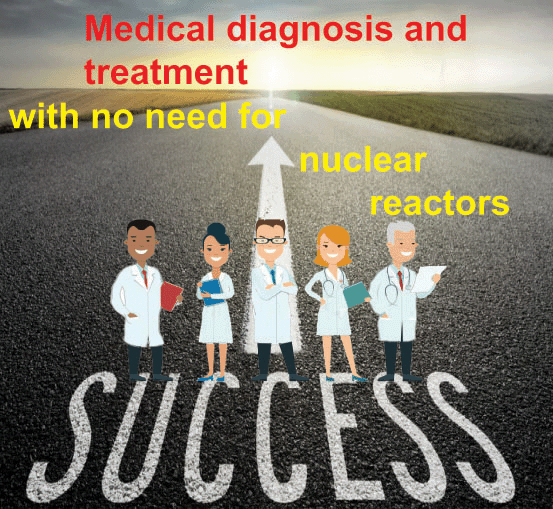
these cyclotrons can be used to reliably create technetium-99m regionally and without the need for reactor-based materials.
Cyclotron-produced technetium-99m approved by Health Canada, TRIUMF,
Now, a new cyclotron-based approach to producing this critical diagnostic tool has received Health Canada approval, greenlighting the made-in-Canada technology for national implementation and opening the door to a greener, more reliable way to make technetium-99m.
The approval represents a critical milestone for the TRIUMF-led Cyclomed99 consortium, which spearheaded the innovative research effort. The consortium, including partners BC Cancer, the University of British Columbia (UBC), the Lawson Health Research Institute, and the Centre for Probe Development and Commercialization, is the first in the world to obtain full regulatory approval for cyclotron-based production.
It also a turning point for the consortium‘s licensee ARTMS Inc., the TRIUMF spin-off company bringing this technology to market. ARTMS’ technology makes technetium-99m production possible on many of the world’s most common medical cyclotrons, enabling regional production of this critical isotope within local communities.
“Medical isotopes help so many people every day. It’s critical to have a stable, multi-faceted supply chain to avoid unexpected disruptions to their availability,” said Paul Schaffer, Associate Laboratory Director, Life Sciences at TRIUMF and Associate Professor at UBC’s Faculty of Medicine. “The approval of cyclotron-produced technetium-99m by Health Canada is an important milestone for this Canadian innovation that will ultimately deliver direct benefit for Canadian patients.”
While the Health Canada approval brings new promise for patients and researchers, it also highlights an important chapter in Canadian innovation, one which saw a focused national research effort produce an effective solution to a global problem.
The path towards cyclotron-produced technetium-99m ……
In 2009, following unplanned disruptions at NRU (which historically provided up to half of the world’s technetium-99m via molybdenum-99 generators), the Government of Canada initiated the Non-reactor-based Isotope Supply Contribution Program (NISP) which challenged researchers to find a new way to produce critical medical isotopes—in particular, technetium-99m.
Led by Schaffer and TRIUMF‘s Dr. Tom Ruth, scientists and engineers from TRIUMF joined partners at BC Cancer, the Centre for Probe Development Commercialization (CPDC), the Lawson Health Research Institute, and the University of British Columbia to launch a national collaboration to answer the NISP call: the ‘CycloMed99‘ consortium.‘
A new way to produce technetium-99m
The consortium’s proposal detailed a new and innovative technology to enable the production of technetium-99m using medical cyclotrons. These compact particle accelerators already operate in regional healthcare centres worldwide, producing isotopes by bombarding a target material with a proton beam and extracting the desired species. The process is safe and precise, employing stable targets and producing little to no long-lived radioactive waste. And, with the right target and extraction systems, these cyclotrons can be used to reliably create technetium-99m regionally and without the need for reactor-based materials.
“Cyclotron centres across Canada can produce these isotopes locally and on-demand, and we have shown the path that can be used to achieve regulatory approval,” said Francois Bénard, senior executive director of research at BC Cancer, professor of radiology and associate dean of research at UBC’s faculty of medicine. “The same approach can be followed at other sites in Canada and internationally. This has been a shared vision of many researchers across the country, and we have to recognize the many collaborators who worked for years to make this announcement possible.”
This bright future will first take shape at TRIUMF‘s Institute for Advanced Medical Isotopes (IAMI), where a state-of-the-art TR-24 medical cyclotron will offer production capacity for the Lower Mainland‘s technetium-99 needs. In addition, IAMI will serve as a hub for radiopharmaceutical research, providing access to leading-edge facilities and expertise in accelerator technology and isotope science. The Institute will further catalyze the Vancouver region’s diverse nuclear medicine sector by convening researchers, students, academic collaborators, not-for-profits, government, and industry partners.
“With support from the Canadian government and our partners, we have developed an effective solution to the medical isotope crisis, one that will improve health outcomes and reaffirm Canada’s role as a global leader in isotope production and research. … …https://www.triumf.ca/headlines/cyclotron-produced-technetium-99m-approved-health-canada?fbclid=IwAR1d-vA4gmCfoY1HWJqwPBs_KkmGHMfwxGKVK41bnPNeD2I7Yr-vHkaVf4o
Canada vocal about nuclear disarmament, but silent about the Treaty for Prohibition of Nuclear Weapons
 Canada reaffirms support to advance nuclear disarmament Mirage News, 5 Jan 21, On behalf of the Honourable François-Philippe Champagne, Minister of Foreign Affairs, Rob Oliphant, Parliamentary Secretary to the Minister of Foreign Affairs, today reaffirmed Canada’s unwavering support for advancing nuclear non-proliferation and disarmament during the third meeting of foreign ministers of the Stockholm Initiative for Nuclear Disarmament. Canada reaffirms support to advance nuclear disarmament Mirage News, 5 Jan 21, On behalf of the Honourable François-Philippe Champagne, Minister of Foreign Affairs, Rob Oliphant, Parliamentary Secretary to the Minister of Foreign Affairs, today reaffirmed Canada’s unwavering support for advancing nuclear non-proliferation and disarmament during the third meeting of foreign ministers of the Stockholm Initiative for Nuclear Disarmament.
Co-hosted by Jordan, Germany and Sweden, the meeting brought together international partners advocating for action-oriented steps on nuclear disarmament. Participants called on all nuclear weapon states to show leadership in advancing nuclear disarmament and to take meaningful steps to implement all commitments under the Treaty on the Non-Proliferation of Nuclear Weapons (NPT). ………https://www.miragenews.com/canada-reaffirms-support-to-advance-nuclear-disarmament/
|
|
|
This is the sort of letter that citizens need to be writing – in support of the nuclear weapons ban
 Sudbury letter: Council should support banning of nuclear weapons, https://www.thesudburystar.com/opinion/letters/sudbury-letter-council-should-support-banning-of-nuclear-weaponsAuthor of the article:
The United Nations has passed the Treaty on the Prohibition of Nuclear Weapons and it will become international law on Jan. 22, 2021. Some 86 countries have signed this agreement. Unfortunately, Canada is not one of them.
As it is cities that will be targeted by nuclear weapons, Sudbury, a producer of nickel, would likely be a target. The International Campaign Against Nuclear Weapons (ICANw) is asking cities to support the Treaty on the Prohibition of Nuclear Weapons by passing the following motion (many Canadian cities have already passed this motion including Toronto, Halifax, Vancouver and Victoria):
“Our city of Sudbury, Ont., is deeply concerned about the grave threat that nuclear weapons pose to communities throughout the world. We firmly believe that our residents have a right to live in a world free from this threat. Any use of nuclear weapons, whether deliberate or accidental, would have catastrophic, far-reaching and long-lasting consequences for people and the environment. Therefore, we support the Treaty on the Prohibition of Nuclear Weapons and call on our governments to sign and ratify it.”
The world has about 14,000 nuclear weapons with about 1,500 on hair-trigger alert. The firing of these weapons could happen by accident, miscalculation, terrorism or an unstable government. The catastrophe would be immediate.
I would urge Sudbury city council to pass the motion and support the United Nations Treaty on the Prohibition of Nuclear Weapons.
Richard Denton
Sudbury
Small modular reactor plan – a dangerous distraction from climate change action
 Feds’ Small Modular Reactor Action Plan is a dangerous distraction from climate change mitigation, Corporate Knights BY RICK CHEESEMAN, December 29, 2020
Canada can be a world leader in this promising, innovative, zero-emissions energy technology, and this is our plan to position ourselves in an emerging global market,” Natural Resources Minister Seamus O’Regan said in a statement.
The governments of New Brunswick, Ontario, Saskatchewan and Alberta, together with the federal government, advocate that small modular reactors (SMRs) are essential if Canada is to achieve a net-zero economy by 2050. According to the feds’ 2018 Call to Action report on the mini nuclear reactors, “SMRs are a reliable, clean, non-emitting source of energy, with costs that are predictable and competitive with other alternatives.”
The first problem with these claims is that SMRs don’t yet exist and aren’t expected to exist for a decade, making these claims dubious. It’s not the only questionable claim made by proponents.
Are SMRs a clean, zero-emission source of power?
Nuclear reactors emit much lower concentrations of carbon than fossil fuels, so one could claim they are zero-emission. But they have their own, uniquely harmful, emissions. From thousands of tonnes of spent fuel to hundreds of thousands of tonnes of mine tailings, nuclear power leaves a radioactive trail that is an immediate threat to waterways and water tables and is lethal for hundreds of thousands of years. SMRs will only add to that.
In 2010, Ad Standards Canada ruled that an ad claiming CANDU reactors were emission-free was “inaccurate and unsupported.” The Power Workers’ Union was expected to remove all ads containing the “emission-free” statement and to qualify any future claims. ……
After 70 years, the nuclear industry still hasn’t found a way to keep habitable environments safe from spent fuel for anything close to the time frames required for it to be harmless. There have been many plans in the past and there are current plans but all have one thing in common: they are unfit for purpose.
Some SMR technologies promise to use CANDU spent fuel in the SMR, claiming this will reduce both the radioactivity and quantity of the spent fuel. This claim is theoretical, based on proprietary data, and a report published by the Bulletin of the Atomic Scientists said doing so would be “playing with fire,” noting that the process, called pyroprocessing, will exacerbate the spent fuel storage and disposal challenges, not mitigate them.
Will SMRs be safe?
A range of power-generation and storage technologies that are clean, emissions-free, safe and low cost, is imminent. Within 10 years, these technologies will be widespread, fully incorporated into all levels of society, and deployed to all regions – all before the first SMR comes online. In all likelihood, by the time an SMR comes to market, there will be a more economical and environmentally responsible alternative in place.
While the rhetoric is persuasive, the case for SMRs doesn’t stand up to objective scrutiny. Allocating climate-change funds to them is a travesty.
Small Nuclear Reactor unicorns for Canada

Canada’s SMR ‘Action Plan’ banks on private sector nuclear pipe dreams, Burgess Langshaw-Power / December 21, 2020 For many kids who grew up in the 1980s and 1990s, Star Trek was a big part of our childhoods. The series is filled with strange new worlds, futurist politics, and advanced technology that is almost indistinguishable from magic. Yet even as a child I knew the show was a work of science fiction. Warp speed, transporters and phasers were all gadgets I could comprehend, but in my rational mind I knew they would never exist within my lifetime.
Unfortunately, recent announcements by Canada’s Natural Resources Minister Seamus O’Regan—a self-professed fan of science fiction—demonstrate that the government has yet to arrive at the same conclusion I did as a kid watching Star Trek.
On December 18, the Trudeau government launched Canada’s Small Modular Reactor (SMR) Action Plan, to great fanfare. This new action plan builds on the 2018 SMR Roadmap, which made the promise that, “SMRs are a re-scaling and repurposing of nuclear technology for wider markets. They represent a paradigm shift for nuclear reactor technology—analogous to the shift of steam engines from mineshafts into ships and vehicles, or the movement of computers from mainframe to desktop and then to laptop.”
This idea of a paradigm shift channels Star Trek-level aspirations, yet the new Action Plan is significantly more hesitant: “Small modular reactors (SMRs) could be a source of clean, safe and affordable energy, opening opportunities for a resilient, low-carbon future and capturing benefits for Canada and Canadians while supporting reconciliation with Indigenous peoples as essential enabling partners.”
In just two years, from the launch of the Roadmap to the announcement of the Action Plan, the government has gone from a paradigm shift to the possibility that SMRs could be a source of clean energy. It’s as though there is something else about SMRs that the government doesn’t want us to consider in more depth.
Before we go any further, what are SMRs, anyway? Well, it turns out that’s a very good question. In fact, the Globe and Mail notes that “SMR lacks a universally agreed definition, and the Canadian Nuclear Safety Commission regards it as a marketing rather than a technical term.” In other words, SMRs are a group of many different technologies, none of which have actually been proven or tested, with only one project proposed and no timeframe for its realization. None of the technologies currently under consideration have solved any major issues with nuclear energy, including the problem of high-level radioactive waste management, however some are less likely to have meltdown-like events and cannot produce isotopes for creating weapons.
The Statement of Principles section of the Action Plan notes that, “Markets around the globe are signalling a need for smaller, simpler, and cheaper nuclear energy.” However, there is simply no evidence to support this claim. In fact, the polar opposite is true, with many major governments and large corporations exiting the nuclear sector entirely. Meanwhile, German experts have stated that, “SMRs are always going to be more expensive than bigger reactors due to lower power output at constant fixed costs, as safety measures and staffing requirements do not vary greatly compared to conventional reactors.”
The British press is even more blunt about the prospects of a more ‘tactile’ nuclear future: “There is no commercial case for giant new reactors in any developed country. They cannot meet post-Chernobyl and post-Fukushima safety demands at viable cost and have been priced out of the global energy market. Precipitous falls in renewable costs over the last five years have rendered the technology effectively obsolete in the West.”
This doesn’t sound like a bold future to me………..
The theory is that SMRs will be cheaper and safer than conventional nuclear reactors. Again, German experts disagree on the cost front. In terms of levelized energy costs, says Nicolas Wendler of industry association Nuclear Technology Germany (KernD), SMRs will always be more expensive than big plants. Moreover, he says, “nuclear power plant owners have repeatedly rejected the idea that the nuclear exit be reversed, arguing the technology is no longer economically viable anyway.”
In the United States, some nuclear plants are being decommissioned early, while other projects are being cancelled at a huge financial loss. Why? They aren’t competitive. This does not even account for the fact that we have yet to successfully build even a single SMR. Yet, if we were to, how much would they cost? The record for delays and cost overruns in Canada is not positive, and nuclear facilities have an unusually poor record in this regard. After 1970, the average nuclear facility saw cost overruns exceed 241 percent (not including the added burden of construction delays).
This does not even begin to address the costs and hazards associated with cleaning up nuclear sites, such as expensive remediation projects now underway in the US and the UK. Perhaps unsurprisingly, these failures and cost overruns sound a lot like the last major federal investment in the energy sector—the Trans Mountain pipeline fiasco.
There is no doubt Canada will need new energy sources for our clean energy transition to address the climate crisis. The Government of Canada claims, “At the same time, international experts are telling us that new nuclear energy, together with the full range of low-carbon technologies, are needed to combat global climate change and meet federal, provincial and territorial emissions targets for 2030 and 2050.”
However, international examples do not inspire confidence that nuclear needs to be a part of this solution. Germany is close to achieving half its energy supply from renewables excluding nuclear. In the UK, some estimates show that not including nuclear energy in the mix will save hundreds of millions of pounds and that the only justification for pursuing nuclear energy in the UK or France is to support a nuclear military strategy (which Canada obviously does not have).
At least the UK is putting its money where its mouth is, with over half a billion pounds invested into nuclear, while Canada’s new SMR Action plan includes precisely $0 of investment, as opposed to our new federal hydrogen strategy, which received $1.5 billion.
Why would we choose nuclear over other cheaper and readily available renewable technologies? It is true that there are still major flaws with renewables, but given that most SMRs are a decade away (at least), and the cost of solar has already dropped 89 percent in the last decade, it seems unlikely that SMRs—whenever they are ready—will be competitive.
One of the theoretical selling points is the deployment of SMRs in rural and remote communities to replace diesel. Yet, many Indigenous and northern communities have expressed trepidation towards SMRs dotting their territory, and are building solar arrays instead. Another argument is that SMRs could be used for industrial facilities such as those in the mining sector, or the Alberta oil sands (this was a terrible idea in the past, and its terrible idea now). However, others suggest that SMRs are only capable of, “ticking off the Financial and Consumer Services Commission’s checklist on how to spot a scam.”
Canada’s SMR Action Plan is nothing more than science fiction: idle dreams of an indefinite group of technologies which may be ready in a decade, with no financial support or investment by the government. In the meantime, renewable energy continues to leap ahead, mostly without any federal support.
One can only imagine how government investment, if effectively pursued, could push our renewable energy potential by the time the first SMRs are ready for deployment. Given these considerations, perhaps the reason this “Action Plan” is so empty, is that the federal government is in fact aware of how little potential SMRs hold. Like nuclear fusion, maybe SMRs will always be just around the corner. In which case, why bother launching this plan at all? Let’s save our time and investment for renewable energy projects that have viability today, not somewhere down the road.
Burgess Langshaw-Power is a former policy analyst currently completing his PhD in Global Governance at the Balsillie School, University of Waterloo. His policy expertise includes energy technologies, regulatory approvals, climate change, and energy infrastructure. Views expressed here are his own and not necessarily those of his employer. https://canadiandimension.com/articles/view/canadas-smr-action-plan-banks-on-private-sector-nuclear-pipe-dreams
“Mutual admiration society” -between civilian and military nuclear experts
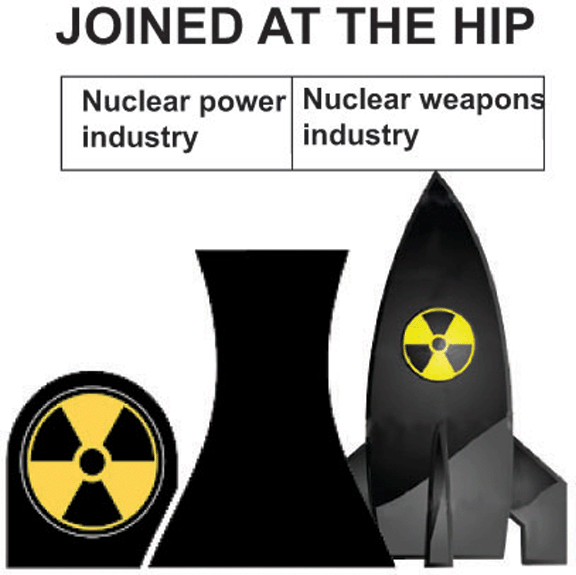 Civilian nuclear and military nuclear members of a “mutual admiration society” ~ Dr. Gordon Edwards, https://concernedcitizens.net/2020/12/19/civilian-nuclear-and-military-nuclear-members-of-a-mutual-admiration-society/ Dr. Gordon Edwards, President of the Canadian Coalition for Nuclear Responsibility, December 19, 2020
Civilian nuclear and military nuclear have always been friendly room-mates, members of a “mutual admiration” society. In today’s announcement of an SMR Action Plan, Natural Resources Minister Seamus O’Regan said that nuclear power in Canada is a “home-grown” technology and referred to C. D. Howe’s role in this connection. In fact C.D. Howe arranged for all Canadian uranium extracted from Canadian mines to be sold to the US military for use in tens of thousands of nuclear weapons from 1945 to 1965. C D Howe was also on the Committee that met in Washington DC in 1944 to approve the first nuclear reactors to be built in Canada (at Chalk River) as part of the ongoing effort to produce plutonium for use as a nuclear explosive. Mr. Howe approved of the policy of selling plutonium produced at Chalk River to the US military for weapons use, a practice that continued until 1975 and beyond. Plutonium from Chalk River was sent to Britain (it was the first sample of plutonium that Britain had ever obtained) just a few months before Britain detonated its first A-Bomb in the Monte Bello Islands off Australia.
To the best of my knowledge, no civilian nuclear power agency – not the Canadian Nuclear Association, nor the Canadian Nuclear Society, nor the Canadian Nuclear Safety Commission, nor Atomic Energy of Canada Limited, nor Canadian Nuclear Laboratories, NOBODY – has ever issued a clear statement denouncing nuclear weapons or even calling for a nuclear weapons free world. Most nuclear scientists and engineers feel a strong kinship and camaraderie with those who are in the nuclear weapons business. The same goes for those in the nuclear division of Natural Resources Canada. I remember on one occasion (prior to the exchange of nuclear tests between India and Pakistan) I expressed alarm at the fact that both neighbours are developing a nuclear war-fighting capability and a couple of senior civil servants said “Would that be so bad? Maybe that’s just what the world needs. More deterrence. Creates stability”
Despite regular denials from our puppet masters that civilian nuclear has nothing to do with military nuclear, it is clear that civilian nuclear (including the frankly discriminatory provisions of the NPT) has adopted an appeasement policy that will never succeed in bringing about a nuclear weapons free world. Why does Canada continue to sell uranium to countries that are in the process of investing hundreds of billions to improve and modernize the nuclear arsenals in utter defiance of the NPT, knowing that the vast bulk of Canadian uranium that is rejected from enrichment plants as DU end up as the raw material for producing plutonium for Bombs, and that the lion’s share of the explosive power – and the overwhelming share of the radioactive fallout – of every H-bomb comes from the fissioning of DU atoms that are freely accessed by the military even if they are the leftovers of “peaceful” fuel production for nuclear power plants?
“See ‘The Nuclear Fudge’ at https://www.youtube.com/watch?v=0lK65S5eHRQ&feature=youtu.be“. This 16-minute W5 segment from the Regan era is very informative.
Many Canadian organisations dispute the government’s plan for small nuclear reactors
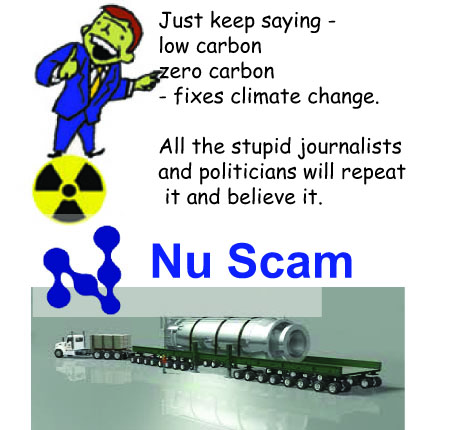 Feds throw support behind development of mini nuclear reactors; action plan released, Saskatoon / 650 CKOM Feds throw support behind development of mini nuclear reactors; action plan released, Saskatoon / 650 CKOMThe Canadian PressDec 18, 2020 “……. Among steps in the plan is developing prototypes and demonstration models.,,,,,
Dozens of groups, including opposition parties, some Indigenous organizations and environmentalists, want the government to fight climate change by investing more in renewable energy and energy efficiency rather than in the new reactors. They argue nuclear energy costs far too much money and is far from clean given the growing mound of radioactive waste it generates. O’Regan said the government is actively trying to figure out what do with the dangerous material….. The federal government estimates the global market for SMRs will be worth between $150 billion and $300 billion a year by 2040 but critics question the validity of the estimate. They also wonder who exactly might want one. …https://www.ckom.com/2020/12/18/feds-throw-support-behind-development-of-mini-nuclear-reactors/ |
|
1 This Month



Shut down the radiation-damaged Heysham nuclear reactors now
To see nuclear-related stories in greater depth and intensity – go to https://nuclearinformation.wordpress.com

Say No to NASA’s Reckless Nuclear Reactor on the Moon
Say No to NASA’s Reckless Nuclear Reactor on the Moon
-
Archives
- October 2026 (247)
- September 2026 (339)
- August 2026 (330)
- July 2026 (355)
- June 2026 (287)
- May 2026 (306)
- April 2026 (356)
- March 2026 (251)
- February 2026 (267)
- January 2026 (308)
- December 2025 (358)
- November 2025 (359)
-
Categories
- 1
- 1 NUCLEAR ISSUES
- business and costs
- climate change
- culture and arts
- ENERGY
- environment
- health
- history
- indigenous issues
- Legal
- marketing of nuclear
- media
- opposition to nuclear
- PERSONAL STORIES
- politics
- politics international
- Religion and ethics
- safety
- secrets,lies and civil liberties
- spinbuster
- technology
- Uranium
- wastes
- weapons and war
- Women
- 2 WORLD
- ACTION
- AFRICA
- Atrocities
- AUSTRALIA
- Christina's notes
- Christina's themes
- culture and arts
- Events
- Fuk 2022
- Fuk 2023
- Fukushima 2017
- Fukushima 2018
- fukushima 2019
- Fukushima 2020
- Fukushima 2021
- general
- global warming
- Humour (God we need it)
- Nuclear
- RARE EARTHS
- Reference
- resources – print
- Resources -audiovicual
- Weekly Newsletter
- World
- World Nuclear
- YouTube
-
RSS
Entries RSS
Comments RSS

