MPs and activists push back as Ottawa pitches expansion of nuclear energy -“a dirty dangerous distraction”
Prime Minister Justin Trudeau says Canada is ‘going to have to be doing much more nuclear’
John Paul Tasker · CBC News · April 26 2023
Anti-nuclear activists and a cross-partisan group of MPs urged the federal government Tuesday to drop its support for nuclear energy projects, calling the energy source a “dirty, dangerous distraction” from climate action.
…………………………………… SMR technology is still in its infancy and it isn’t widely used around the world.
As of 2022, there were only three SMR projects in operation — one each in Russia, China and India — according to the International Energy Agency.
There are dozens of others under construction or in the design and planning phase — including one at Ontario Power Generation’s Darlington nuclear site.
Finance Minister Chrystia Freeland’s recent federal budget included a generous tax credit to spur clean energy development, including SMRs.
The industry lobby group, the Canadian Nuclear Association, has said the 15 per cent refundable tax credit is a recognition by Ottawa that nuclear power is “a fundamental and necessary component of Canada’s low carbon energy system.”
Susan O’Donnell, a professor and a member of the Coalition for Responsible Energy Development in New Brunswick, said Prime Minister Justin Trudeau and his cabinet are getting bad advice about nuclear energy.
“The nuclear industry, led by the U.S. and the U.K., has been lobbying and advertising heavily in Canada, trying to convince us that new SMR designs will somehow address the climate crisis,” O’Donnell told a press conference on Parliament Hill on Tuesday.
She said SMRs will produce “toxic radioactive waste” and could lead to serious “accidents” while turning some communities into “nuclear waste dumps.”
She also said there’s “no guarantee these nuclear experiments will ever generate electricity safely and affordably,” since SMRs are still relatively untested.
“Canada is wasting time that must be urgently spent on genuine climate action,” she said. “This is a dirty, dangerous distraction. We don’t need nuclear power.”
Asked how Canada would meet its baseload power requirements — the power that is needed 24 hours a day without fluctuation — without nuclear power or fossil fuel sources like natural gas, O’Donnell pointed to promising developments in energy storage technology.
Liberal MP Jenica Atwin was at the anti-nuclear press event.
“I want to be clear, I’m here as an individual, a concerned individual and a mother,” she said — before launching into remarks that raised questions about the “associated risks” and “many unknowns” of nuclear energy development, which is expected to see a sharp increase in activity due to her government’s proposed tax policies.
“When it comes to nuclear, there’s no margin for error,” Atwin said. “This is a time of action. We don’t have the luxury of waiting to see if things will pan out.”
Green Party Leader Elizabeth May, who once sat in caucus with Atwin before she decamped to the Liberals, said government funding for nuclear projects is a “fraud.”
“It has no part in fighting the climate emergency. In fact, it takes valuable dollars away from things that we know work, that can be implemented immediately, in favour of untested and dangerous technologies that will not be able to generate a single kilowatt of electricity for a decade or more,” May said……………………………………………………https://www.cbc.ca/news/politics/anti-nuclear-activists-ottawa-1.6821807
Canada’s push for small nuclear reactors will be costly, ineffective, some MPs warn
By David Fraser, The Canadian Press, Tue., April 25, 2023
Prime Minister Justin Trudeau has asserted that Canada is “very
serious” about developing nuclear technology across the country to meet
growing power needs, but some members of Parliament are warning the
technology could be costly and ineffective.
A Liberal MP is among the critics who say Ottawa is looking at an expensive investment into an unproven and potentially dangerous technology. The federal government
started actively exploring small modular reactor technology in 2018, and
released an action plan in 2020 that dubbed them a strategic Canadian asset
that could leverage significant economic, geopolitical, social and
environmental benefits.
But Green Party Leader Elizabeth May says other
renewable energy sources are getting cheaper, so there’s not much of a case
for Canada to expand its capacity on that technology, which she said is
being pushed by powerful lobbyists.
Liberal MP Jenica Atwin, who was first
elected under the Green banner, said she is used to being an outlier in her
caucus, but the party has allowed her to express her concerns about the
unknowns of emerging nuclear technologies. Four nuclear energy stations are
generating about 15 per cent of Canada’s electrical grid today, mostly in
Ontario and New Brunswick, and as the facilities age more attention is
being paid to the potential of smaller, more-portable reactors.
Toronto Star 25th April 2023
Terrestrial Energy’s molten-salt reactor gets over one hurdle – but many more to come. Will it be a lemon?

Terrestrial Energy’s molten-salt reactor clears prelicensing review, Globe and Mail, MATTHEW MCCLEARN, APRIL 19, 2023
Nuclear-reactor developer Terrestrial Energy has completed a prelicensing review by the Canadian Nuclear Safety Commission, an early milestone along the road to commercialization of its next-generation product.
The Integral Molten Salt Reactor (IMSR) is the first of its kind to finish the CNSC process known as a vendor design review. Whereas conventional reactors use solid fuel, this novel variety features liquid fuel dissolved in molten salt that’s heated to temperatures above 600 degrees.
The review, which began in 2016, is intended to provide feedback to reactor vendors in the early stages of development, but does not confer a licence to build one. CNSC staff found “no fundamental barriers to licensing,” signalling their willingness to entertain next-generation designs radically different from Canada’s aging fleet of Candu reactors………..
the CNSC’s high-level findings, published Tuesday, highlight the challenges ahead. It called on Terrestrial to provide more information to confirm that the IMSR meets safety requirements. Sensors, monitoring equipment, instrumentation and control systems all need to be further developed……………
” you see a lot of engineering questions that have to be followed up on.” -Akira Tokuhiro, a professor at Ontario Tech’s energy and nuclear engineering department.
Prof. Tokuhiro said answering those questions means Terrestrial (which currently employs about 100 people) will need to grow its engineering staff. NuScale Power, an early developer of small modular reactors (SMR) founded in 2007, stands alone in achieving certification from the U.S. Nuclear Regulatory Commission. It needed 500 staff and US$1-billion to accomplish that, said Prof. Tokuhiro, who previously served as an engineer at NuScale.
“There have been SMR startups – I won’t name names – where the company and investors quit when they got to the point of going from 50 engineers to 500 engineers on payroll,” he said.
Prof. Tokuhiro estimated that fewer than 20 people throughout North America possess deep experience with molten salt technologies, making it difficult to find qualified workers. Moreover, Terrestrial will likely need to build a demonstration unit – another expensive undertaking.
“It has to be a facility that’s quality assured and quality controlled,” he said. “And it has to be able to produce data that the regulator accepts.”……..
nitially developed in the 1950s and 60s, molten salt reactors never operated commercially but have lately enjoyed renewed interest. The U.S. Department of Energy funded two small demonstration projects, and the Canadian government provided tens of millions of dollars to each of Terrestrial and Moltex Energy, another startup, based in New Brunswick, that’s marketing a model known as the Stable Salt Reactor – Wasteburner (SSR-W).
According to a 2021 report about advanced nuclear reactors by the Union of Concerned Scientists, molten salt reactors are “even less mature” than other novel designs such as sodium-cooled and gas-cooled reactors.
That report – entitled Advanced Isn’t Always Better– concluded they were “significantly worse” than traditional light-water reactors in terms of safety and the risk of nuclear proliferation and terrorism, but acknowledged that some molten salt reactors would generate less hazardous waste than conventional models.
“MSR fuels pose unique safety issues,” the report concluded. “Not only is the hot liquid fuel highly corrosive, but it is also difficult to model its complex behaviour as its flows through a reactor system. If cooling is interrupted, the fuel can heat up and destroy an MSR in a matter of minutes.
“Perhaps the most serious safety flaw is that, in contrast to solid-fuelled reactors, MSRs routinely release large quantities of gaseous fission products, which must be trapped and stored.”
The nuclear industry has precious few small modular reactors available for sale today, but is under intense pressure to bring new ones to market quickly to capitalize on an anticipated surge in demand for low-carbon electricity. Yet recent reactors based on conventional technologies took longer than 30 years to develop, license and build, and some ran disastrously overbudget……………………………………. https://www.theglobeandmail.com/business/article-terrestrial-energys-molten-salt-reactor-clears-prelicensing-review/
Nuclear waste abandonment risks the dangers of amnesia
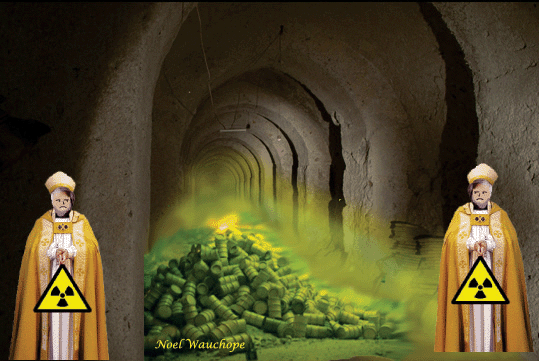
Broad-stroke reassurances from supporters of a proposed deep geological repository for Canada’s nuclear waste have failed to allay important environmental and security concerns.
The Hill Times, BY ERIKA SIMPSON | April 13, 2023
A plan to store Canada’s nuclear waste deep underground in northern Ontario raises serious safety concerns for current and future generations.
In light of this, the Nuclear Waste Management Organization (NWMO)—which is responsible for developing and implementing the plan—should reconsider other options, such as a rolling stewardship model, which actively plans for retrieval and periodic repackaging of nuclear waste.
From April 4-5, the South Bruce Nuclear Exploration Forum considered the NWMO plan to store all of Canada’s high-level nuclear waste in one deep geological repository (DGR). An earlier plan had proposed burying intermediate- and low-level nuclear waste in limestone caverns constructed under the Bruce reactor, but was met with a “no” vote from members of the Saugeen-Ojibway Nation. That led to Bruce Power withdrawing its own proposal in June 2020.
The current proposal for a $23-billion DGR project at Teeswater, Ont., may be constructed 50 km away from the Bruce Nuclear Generating Station, the world’s largest operating nuclear site that supplies 30 per cent of Ontario’s power. Whether the proposal goes ahead in partnership with a willing host community will be decided by the Governor in Council. Once one of the two remaining possible host communities—either Teeswater or Ignace, Ont.—is selected, the Canadian Nuclear Safety Commission (CNSC) and the Impact Assessment Agency of Canada will continue to lead decades-long consultation processes…………………………..
the broad-stroke reassurances of the DGR proponents have failed to allay concerns.
There are questions about how 700 engineers and construction workers could possibly be housed. I have written about SNC-Lavalin—an engineering company that was prosecuted internationally for corruption—yet remains the leading contractor and possible steward of Canada’s nuclear wastes. Heavily subsidized by Canadian tax dollars, the company is driven by the quest for money, not the quest for nuclear security. Although no questions were publicly asked about SNC-Lavalin, a project officer from the Wastes and Decommissioning Division at CNSC explained each engineering and closure stage could be halted, if deemed necessary.
There are also questions about impacts on future generations. Would the underground nuclear waste containers be monitored, in perpetuity, and what might be safety concerns about situating any such site in the Great Lakes’ water basin, the world’s largest body of fresh water and the drinking water for up to 40 million people? The hydrogeologists and geologists were confident that the DGR concept—possibly the first or fourth underground nuclear waste site in the world—would not be beyond Canada’s engineering and scientific capabilities.
I asked DGR proponents about four U.S. Senators who asked President Joe Biden to raise the issue with Prime Minister Justin Trudeau last month. I was told this would be a local decision—made by area residents in next year’s referendum—combined somehow with a municipal town council majority decision, and a possible veto by First Nations—and therefore the United States would have nothing to do with it, even though Canada’s federal cabinet would have the final say.
I asked Tiina Jalonen, the senior vice president of development at Posiva Oy about Finland’s proposed used-fuel disposal facility and her government’s plans for “signage.” It could be important to warn our great-great-great-grandchildren to refrain from curiously digging out whatever leaks into rock formations below.
What about the legacy of strikes on nuclear sites, like the Russian assault on Ukraine’s Zaporizhzhia nuclear plant, that has made evident that nuclear power plants and waste disposal sites could become targets in conflict zones? Nobody publicly asked about terrorist threats, and whether the site could become hostage to nefarious bargaining.
What else might go wrong? I asked two fire chiefs, but they had not heard about the fire at the Waste Isolation Pilot Plant in New Mexico that shut down the site in 2014 due to a major radiation release that contaminated workers at the surface. I asked a geologist about Germany’s Asse Salt Mine that still leaks water into radioactive containers.
Perhaps continual monitoring and the ‘rolling stewardship’ concept—that actively plans for retrieval and periodic repackaging—would be most effective, because wholesale abandonment could lead to amnesia.
Erika Simpson is an associate professor of international politics at Western University, the author of Nuclear Waste Burial in Canada? The Political Controversy over the Proposal to Construct a Deep Geologic Repository and Nuclear waste: Solution or problem? and the president of the Canadian Peace Research Association.
https://www.hilltimes.com/story/2023/04/13/nuclear-waste-abandonment-risks-the-dangers-of-amnesia/384800/
Local Indigenous peoples protest possible licence renewal for world’s largest uranium mine.
In June, the Canadian Nuclear Safety Commission will hold hearings about renewing the licence for Cameco’s McArthur River uranium mine, located in the Athabasca basin in Saskatchewan’s rugged far north.
Davis Legree, Apr 13, 2023 https://www.ipolitics.ca/news/local-indigenous-peoples-protest-possible-licence-renewal-for-worlds-largest-uranium-mine
The operator of the world’s largest uranium mine is seeking a new 20-year licence from Canada’s nuclear regulator but some Indigenous peoples in northern Saskatchewan are calling for the application to be rejected or scaled back, citing health concerns.
“The Athabasca River basin is under siege,” said Candyce Paul, outreach coordinator for the advocacy group Committee for Future Generations. “The people here have had enough of this industrial colonialism that is going on.”
In June, the Canadian Nuclear Safety Commission will hold hearings about renewing the licence for Cameco’s McArthur River uranium mine, located in the Athabasca basin in Saskatchewan’s rugged far north.
Paul, a member of English River First Nation, on whose territory several of Cameco’s mining sites are located, said her community is frustrated by the company’s lack of transparency, as well as human health concerns associated with uranium mining.
“Quite frankly, some of the community members are getting really fed up with the footprint this industry is having on the land and there’s been actual talk of blocking the main road from the mine,” said Paul.
Uranium, which ranges in use from atomic weapons to powering nuclear reactors, was initially discovered in the Athabasca Basin in the late 1960s. According to Gordon Edwards, president of the Canadian Coalition for Nuclear Responsibility, the volume and grade of the deposits found in northern Saskatchewan have led those in the industry to dub the area “the Saudi Arabia of uranium.”
“Canada has the richest uranium mines in the world around the Athabasca Basin,” said Edwards, who explained uranium ‘richness’ refers to the grade and what percentage of uranium there is in a ton of ore.
According to Edwards, uranium in the Athabasca Basin is considerably richer than uranium deposits found elsewhere in Canada, which makes it more lucrative. However, Edwards continued, mining rich uranium deposits can be problematic for the health of local communities.
“When you mine uranium, since it’s radioactive, there’s a chain of progeny, which are radioactive by-products of uranium,” explained Edwards. “These include radium, radon gas, certain isotopes of thorium, and polonium – all highly toxic materials.”
Edwards said that around 85 per cent of the radioactivity in mined uranium ore is left behind in “voluminous sand, like tailings from a mill,” adding that Canada has around “220 million tonnes of this stuff.”
These radioactive and toxic tailings areas should be of concern to communities in the Athabasca Basin, said Edwards, because richer uranium ore means the radioactivity is more concentrated in the waste.
Paul believes her community has been adversely affected from living in close proximity to large-scale uranium mining activities. She cited issues regarding increased cancer rates among English River members, which she said “could be related to radiation exposure.”
Paul said her community has contacted Health Canada, Saskatchewan’s Ministry of Health, and several epidemiologists about conducting health studies in the area, only to be told that their population is too small to justify an assessment.
That being said, Cameco’s licence renewal application to the CNSC referenced a federally funded human health risk evaluation that was conducted in the English River First Nation in 2017.
Regardless, Paul said she would intervene in the upcoming licence renewal hearings, which are scheduled to be held June 7-8 in Saskatoon. Initially, Cameco had requested an indefinite licence term for McArthur River and several other sites, but, following Indigenous consultation activities, the company has since walked back their application to 20 years.
When asked if local Indigenous communities were satisfied with a 20-year term, Cameco spokesperson Veronica Baker said in an email that the application for an indefinite licence was abandoned because “communities expressed uncertainty with what an indefinite licence term means and how it fits within existing regulatory and engagement frameworks.” However, she did not clarify whether these communities approved of the 20-year application.
According to Paul, the CNSC would set a dangerous precedent by granting Cameco a 20-year licence.
“Twenty years is too long,” she told iPolitics. “It would be nice to see the CNSC reject a 20-year licence and go for something for reasonable, like five or ten years, although even ten is too much.”
Neither Paul nor Edwards has much confidence that the CNSC will reject Cameco’s 20-year application.
“From our perspective, it will look like a rubber stamp,” said Paul.
According to Edwards, the current iteration of the CNSC, which has only existed since 2000, has “never refused to grant a licence to any major nuclear facility in their entire existence.”
“The public has very little opportunity to question the practices going on,” he continued. “There’s a widespread feeling in the NGO community that we have a captured regulator in the CNSC, which reports to the natural resources minister, who is also responsible for promoting uranium mining and exports.”
A review of Lobby Canada’s registry reveals Cameco officials met in recent months with Rumina Velshi, the CNSC’s president and CEO, and Ramzi Jammal, the regulator’s executive vice-president. However, both Cameco and the CNSC denied that the upcoming licence renewal hearing was discussed.
Edward said Cameco’s initial attempt at securing an indefinite licence term is indicative of an industry trend that is seeing longer licensing periods being granted and, as a result, less public oversight, and [fewer opportunities] for accountability.
“Unfortunately, that’s the direction they’re moving in,” he said.
According to CNSC spokesperson Renée Ramsey, individuals and organizations who want to intervene in the hearing have until April 24 to submit their requests, at which point the submissions from intervenors will be made publicly available. Ramsey also said the CNSC panel that will be leading the upcoming hearing has yet to be appointed.
The coming war on China: the real target is the American people
“If tyranny and oppression come to this land, it will be in the guise of fighting a foreign enemy.” – James Madison
ALEX KRAINER, Substack, APR 15, 2023
Empire’s proxy war on Russia is rapidly coming to a head in Ukraine and the imperial guard might urgently need a new war. Their next target is China and once more we witness a relentless escalation of provocations and hostility. In his Wall Street Journal column this week, former National Security Advisor John Bolton laid out his “grand strategy” to confront Russia and China. His genius idea is to give Taiwan “much more military aid” from western nations and “embed Taipei into collective-defense structures.”
Preparations for war
Bolton’s warmongering is only the last in the long sequence of proclamations by US officials indicating the direction of their foreign policy. Last month, U.S. Secretary of the Army Christine Wormuth told an audience at the American Enterprise Institute (AEI) that the United States has “to prepare, to be prepared to fight and win that war” against China. This is not just idle talk: they really are preparing.
On Sunday, 10 January, Lieutenant General James Bierman, the commanding general of the Third Marine Expeditionary Force gave an interview to the Financial Times in which he said that his command is working hard to replicate the empire’s military success (!) in Ukraine. Bierman explained that the US and its allies in Asia were recreating the groundwork that had enabled western countries to support Ukraine’s resistance to Russia in preparing for scenarios such as Chinese invasion of Taiwan:
“Why have we achieved the level of success we’ve achieved in Ukraine? … because after Russian aggression in 2014 and 2015, we earnestly got after preparing for future conflict: training for the Ukrainians, pre-positioning of supplies, identification of sites from which we could operate support, sustain operations. We call that setting the theatre. And we are setting the theatre in Japan, in the Philippines, in other locations.”
In other words, the US is creating the same conditions to draw China into a war over Taiwan in order to replicate the success they’ve had in Ukraine. Truly, whom gods would destroy, they first make them mad.
The war addiction
Jest aside, why is the US establishment ever so keen on waging wars? Consider the finding that, “Since the end of World War II, there have been 248 armed conflicts in 153 locations around the world. The United States launched 201 overseas military operations between the end of World War II and 2001, and since then, others, including Afghanistan and Iraq.”
Stated otherwise, one nation has launched more than 80% of all overseas military operations since WWII. Is this because the American people are so consistently belligerent? That’s clearly not the case: for as long as I’d observed American politics, the people always vote for anti-war candidates. Somehow however, they always get more war. How can that be? In fact, causes of war are systemic and they emanate from the fraudulent money system that’s been foisted on us all. This can’t be explained in just a few paragraphs, but for all who are inclined to explore this relationship further, I summarized it in this article: “Deflationary gap and the west’s war addiction.”
China, China, China!
Alongside military preparations, the imperial guard is also working hard to create consent for war with relentless anti-China propaganda. The unsubtle messaging is that the CCP is coming for our freedoms and has evil designs to dominate the world. Much of the commentariat blames the Chinese for all the dark globalist agendas to enslave humanity.
The relentless fearmongering often resorts to propagating outright fabrications which are then replicated ad nauseum as hard facts. Repetition turns these fabrications into culturally accepted truths. The most dismaying example of this is the western invention of the “Chinese Social Credit System.”……………………………………………………………………………………
China is not the enemy and consenting to a war against China would be the greatest possible gift we could give to the occult oligarchy that rules in the west and has been in charge for over a century. It is they who have given us a century of perpetual wars. The reason why the American people are under such relentless attacks is because they are still one of the most important bulwarks of freedom https://alexkrainer.substack.com/p/the-coming-war-on-china-the-real
 | |||
| |||
Saskatchewan must remember opposition to nuclear waste

A reader wants Saskatchewan people to recall a protest against nuclear waste 12 years ago now that nuclear power is being debated.
Don Kossick, Saskatoon, Apr 09, 2023 https://thestarphoenix.com/opinion/letters/letter-saskatchewan-must-remember-opposition-to-nuclear-waste
The recent 2023 federal budget showed clear support for small modular nuclear reactors or SMRs. It introduces a new 15 per cent refundable clean electricity investment tax credit.
Nuclear projects — both large-scale and SMRs — are eligible for the credit, which is available to both new projects and the refurbishment of existing facilities.
For Saskatchewan, it emboldens government, universities, institutions and uranium companies that have been pressuring for SMRs to be built in Saskatchewan.
With the SMRs will come the push for nuclear waste sites in Saskatchewan. Unfortunately, there is a short memory about the response of many communities in northern Saskatchewan who have rejected nuclear waste sites.
A north to south, community to community walk of 800 kilometres was organized in 2011, by the northern based Committee for Our Future Generations that opposed nuclear waste sites and presented the concerns of northern and southern communities to the Saskatchewan legislature.
The consideration of a nuclear waste dump site at Creighton was officially withdrawn by the federal Nuclear Waste Management Organization in 2015. The Creighton area had “geological complexities.”
The nuclear consortium and their friends need to back off trying to impose energy sources such as nuclear power that has its own deadly impact and is not sustainable.
Our governments need to put monies into renewable, sustainable alternatives that do not involve ripping up and polluting the environment for, in some cases, hundreds upon hundreds of years.
Busting the spin about nuclear wastes – a Letter to the editor of the Hill Times.
(Not sure whether or not the Hill Times will publish this letter)
from: Angela Bischoff Director, Ontario Clean Air Alliance, 5 Apr 23
More happy talk from nuclear advocates is not what Canadians need when it comes to understanding the issue of how to deal with the hundreds of thousands of highly radioactive bundles currently stored in pools and warehouses at Canadian nuclear plants.
In their letter of April 5, two nuclear advocates from the industry-aligned Canadian Nuclear Society trot out the usual assurances that this waste can be safely stored underground for hundreds of thousands of years. That no country has actually done this, and that the industry-owned Canadian Nuclear Waste Management Organization is still struggling to identify a “willing host” community for such a facility in the face of adamant community and First Nation opposition, is blithely ignored.
There have been nuclear power operations in Canada for over 60 years now, yet the industry still has not managed to execute on its preferred strategy of dump-and-run. Comparing deadly radioactive waste to materials like niobium and cadmium is like comparing the likelihood of surviving a multi-vehicle car crash with falling off your bicycle. No one ever died from standing next to a wind turbine magnet.
Trying to paper over the level of risk involved in handling, transporting, and disposing of waste that must remain completely isolated for hundreds of thousands of years, just exposes how the nuclear industry would prefer to avoid hard questions about why it has been allowed to carry on without having an implementable plan for dealing with its deadly toxic waste. What other industry is given a huge free pass like this?
Moltex vows to help Canada recycle its nuclear waste. Critics say the byproducts would be even worse.
“At best, they’ll end up with a small amount of various types of waste before the project is terminated, that will just create a bigger disposal hazard. And if it’s stuck in the province of New Brunswick, it will be their problem. But there’s zero chance of this cockamamie contraption being useful for generating electricity, or treating radioactive waste in a sound way.”
The Globe and Mail, MATTHEW MCCLEARN, 2 Apr 23,
Less than a kilometre from the western shore of the Bay of Fundy, the Point Lepreau Solid Radioactive Waste Management Facility temporarily houses about 160,000 spent fuel assemblies from New Brunswick’s only nuclear power reactor. Moltex Energy, a Saint John-based startup, proposes to recycle that radioactive waste into fresh fuel for a new 300-megawatt reactor called the Stable Salt Reactor-Wasteburner, or SSR-W.
Moltex promises these facilities will greatly diminish the waste inventory of NB Power, the province’s primary electric utility, beginning in the early 2030s, while at the same time producing electricity. Critics, however, warn the resulting wastes would be harder to dispose of than the assemblies themselves.
Criticisms notwithstanding, Moltex’s proposal appears to be gaining momentum. It has partnered with SNC-Lavalin Group, which holds a minority ownership stake and provides many of Moltex’s 35 employees through secondments – a vote of confidence from a company with deep roots in Canada’s nuclear sector…………….
Premier Blaine Higgs hailed Moltex in a speech in February, stating his government’s support “is positioning New Brunswick as a leader in development of new nuclear.” Mike Holland, Minister of Natural Resources and Energy Development, has extended what he described as “unwavering commitment to seeing this project become a reality.” The province has already supplied $10-million toward that end, while the federal government, through its Strategic Innovation Fund and other channels, has provided $50.5-million.
What these supporters have signed up for, however, isn’t entirely clear. Moltex’s technologies are embryonic; emphasizing that fact, partners that would play crucial roles in implementing them refused to discuss the implications with The Globe and Mail. Citing the need for commercial confidentiality, Moltex chief executive officer Rory O’Sullivan acknowledges the company hasn’t revealed many details about its reprocessing technology (known as Waste To Stable Salts, or WATSS).
Critics, though, say they’ve seen enough to recognize WATSS as merely the latest variations on nuclear waste reprocessing experiments dating back decades. Those experiences revealed reprocessing to be not a solution, they claim, but a curse.
About the size of a fire log, fuel assemblies from Canada’s CANDU reactors consist of rods known as “pencils” that are welded together; each contains cylindrical uranium pellets. Highly radioactive upon removal from a reactor, assemblies are stored in pools of water for about a decade before being warehoused at nuclear power plants in shielded containers. There are now about 3.2 million spent assemblies, which if stacked like cordwood would fill nine hockey rinks up to the boards……………..
WATSS would produce new wastes. By mass, the largest would be leftover uranium plus the metal cladding from CANDU fuel bundles, Mr. O’Sullivan said. This would be placed in the DGR, but in volumes greatly reduced than CANDU fuel bundles.
Then there’s fission products, a term encompassing hundreds of substances produced by nuclear fission inside a reactor. Though some are stable, others (such as cesium, technetium and strontium) are radioactive. These would be contained in salts that could be placed in canisters the same size as CANDU fuel bundles, facilitating storage in the DGR; Mr. O’Sullivan said they’d remain radioactive for up to 300 years………….
critics accuse Moltex of misleading the public. Gordon Edwards, a nuclear consultant and president of the Canadian Coalition for Nuclear Responsibility, said the company’s claim that the fission products would remain radioactive for only three centuries is “outrageous.”
“There are several radioactive materials which are very, very long-lived in the fission products, that have half-lives of not just thousands, but millions of years.”
The leftover uranium would contain leftover plutonium and fission products: “Experience has shown that this uranium is not clean, it’s contaminated,” he said. “You can’t just separate all of the fission products.”
WATSS wouldn’t significantly reduce storage volumes, Mr. Edwards added, as it’s the heat generated by radioactive waste – not the physical space occupied – that determines how large a DGR must be.
Ed Lyman, director of nuclear power safety with the Union of Concerned Scientists, has studied nuclear fuel reprocessing technologies since the 1980s. He said Moltex’s proposal is a variation on schemes that have been explored over many decades.
“All of the available evidence in the whole history of technology development in this area, as well as attempts to commercialize reprocessing in various ways, points to the fact that this is not going to work,” he said.
“At best, they’ll end up with a small amount of various types of waste before the project is terminated, that will just create a bigger disposal hazard. And if it’s stuck in the province of New Brunswick, it will be their problem. But there’s zero chance of this cockamamie contraption being useful for generating electricity, or treating radioactive waste in a sound way.”…………………
M.V. Ramana, a professor at the University of British Columbia’s public policy and global affairs school who researches nuclear issues, said Moltex’s $500-million estimate is highly optimistic. He pointed to Portland, Ore.-based NuScale Power, an early SMR developer, which spent US$1.1-billion over more than two decades developing what is essentially a scaled-down version of light water reactors common in the U.S.
As a molten salt reactor, the SSR-W should be far more difficult to license, Prof. Ramana said. Only two such reactors have ever been built, the last one closing in 1969, and neither generated electricity commercially.
Additionally, a sister company of Moltex, called MoltexFlex, is marketing another molten salt reactor in the Britain. (The companies share key personnel.) And Moltex must separately develop and license the WATSS process…………………..
“While we’re in early discussions with Moltex, they are still in the development phase, so we don’t have sufficient data at this time to respond to your technical questions about fuel waste,” NWMO spokesperson Russell Baker wrote in an e-mail.
All that adds up to a heap of unanswered questions. But having already spent $50-million on the project, Prof. Ramana said the federal government will be under considerable pressure to contribute more. He questioned the due diligence it has conducted to date.
“It’s not clear to me that the Trudeau government is interested in asking some of these hard questions,” he said. https://www.theglobeandmail.com/business/article-moltex-canada-nuclear-waste/
An obnoxious clause in Canada’s draft Act for Implementing the United Nations Declaration on the Rights of Indigenous Peoples (UNDRIP)

First -let’s see what the Assembly of First Nations of Canada (AFN) say about Small Modular Nuclear Reactors
The AFN resolution from 2018 against SMRs, available HERE says:
THEREFORE BE IT RESOLVED that the Chiefs-in-Assembly:
1. Demand that free, prior and informed consent is required to ensure that no storage or disposal of hazardous
materials shall take place in First Nations lands and territories.
2. Demand that the Nuclear Industry abandon its plans to operate Small Modular Nuclear Reactors in Ontario and
elsewhere in Canada.
3. Demand that the Government of Canada cease funding and support of the Small Modular Nuclear Reactors
program.
4. Direct that the National Chief and appropriate staff work to ensure that the Nuclear Industry and the Canadian Government abandon this program.
Now see what the Government includes in this draft Act
In the Environment section of Canada’s draft Act for Implementing the United Nations Declaration on the Rights of Indigenous Peoples (UNDRIP)- the specific SMRs text is found, in Chapter 1, Shared priorities. https://www.justice.gc.ca/eng/declaration/ap-pa/ah/p3.html
The Government of Canada will take the following actions……………
44. Increase capacity for Indigenous peoples to meaningfully engage, make informed decisions, and participate financially in clean energy alternatives like Small Modular Reactors (SMRs). SMRs in Canada are developing along three parallel streams including near-term on-grid, next generation and micro/off-grid, and there is potential for multiple benefits including use in remote Indigenous communities for abating emissions of heavy industry and increasing energy security. (Natural Resources Canada)
Canadian First Nations do not want small nuclear reactors on their lands

Decolonizing energy and the nuclear narrative of small modular reactors https://policyoptions.irpp.org/magazines/february-2022/decolonizing-energy-and-the-nuclear-narrative-of-small-modular-reactors/
Kebaowek First Nation is calling for an alternative to a planned SMR project, one that won’t undermine proper consultation and leave a toxic legacy.
by Lance Haymond, Tasha Carruthers, Kerrie Blaise, February 7, 2022 In early 2021, the Canadian Nuclear Safety Commission began reviewing the application from a company called Global First Power to build a nuclear reactor at the Chalk River Laboratories site about 200 kilometres northwest of Ottawa.
This project, known as a micro modular reactor project, is an example of the nuclear industry’s latest offering – a small modular reactor (SMR).SMRs are based on the same fundamental physical processes as regular (large) nuclear reactors; they just produce less electricity per plant. They also produce the same dangerous byproducts: plutonium and radioactive fission products (materials that are created by the splitting of uranium nuclei). These are all dangerous to human health and have to be kept away from contact with people and communities for hundreds of thousands of years. No country has so far demonstrated a safe way to deal with these.
Despite these unsolved challenges, the nuclear industry promotes SMRs and nuclear energy as a carbon-free alternative to diesel for powering remote northern communities. The Canadian government has exempted small modular reactors from full federal environmental assessment under the Impact Assessment Act. Many civil society groups have condemned this decision because it allows SMRs to escape the public scrutiny of environmental, health and social impacts.
The proposed new SMR in Chalk River, like the existing facilities, would be located on Algonquin Anishinabeg Nation territory and the lands of Kebaowek First Nation – a First Nation that has never been consulted about the use of its unceded territory and that has been severely affected by past nuclear accidents at the site.
At this critical juncture of climate action and Indigenous reconciliation, Kebaowek First Nation is calling for the SMR project at Chalk River to be cancelled and the focus shifted to solutions that do not undermine the ability of First Nations communities to be properly consulted and that do not leave behind a toxic legacy.
While these reactors are dubbed “small,” it would be a mistake to assume their environmental impact is also “small.” The very first serious nuclear accident in the world involved a small reactor: In 1952, uranium fuel rods in the NRX reactor at Chalk River melted down and the accident led to the release of radioactive materials into the atmosphere and the soil. In 1958, the same reactor suffered another accident when a uranium rod caught fire; some workers exposed to radiation continue to battle for compensation.
What makes these accidents worse – and calls into question the justification for new nuclear development at Chalk River – is that this colonized land is the territory of the Algonquin Anishinabeg Nation territory (which consists of 11 First Nations whose territory stretches along the entire Ottawa River watershed straddling Quebec and Ontario). Kebaowek First Nation, part of the Algonquin Nation, was among those First Nations never consulted about the original nuclear facilities on their unceded territory, and is still struggling to be heard by the federal government and nuclear regulator. Its land has never been relinquished through treaty; its leaders and people were never consulted when Chalk River was chosen as the site for Canada’s first nuclear reactors; and no thought was given to how the nuclear complex might affect the Kitchi Sibi (the Ottawa River).
History is being repeated at Chalk River today as the government pushes ahead with the micro modular reactor project without consent from Kebaowek. Assessments of the project have been scoped so narrowly that they neglect the historical development and continued existence of nuclear facilities on Kebaowek’s traditional territory. The justification for an SMR at this location without full and thorough consideration of historically hosted nuclear plants – for which there was no consultation nor accommodation – is a tenuous starting point and one that threatens the protection of Indigenous rights.
The narrative of nuclear energy in Canada is one of selective storytelling and one that hides the reality of the Indigenous communities that remain deeply affected, first by land being taken away for nuclear reactor construction, and later by the radioactive pollution at the site. All too fitting is the term radioactive colonialism coined by scholars Ward Churchill and Winona LaDuke, to describe the disproportionate impact on Indigenous people and their land as a result of uranium mining and other nuclear developments. In country after country, the uranium that fuels nuclear plants has predominantly been mined from the traditional lands of Indigenous Peoples at the expense of the health of Indigenous Peoples and their self-determination.
Kebaowek First Nation has been vocal in its objection to the continuation of the nuclear industry on its lands without its free prior and informed consent, as is its right under the United Nations Declaration on the Rights of Indigenous Peoples (UNDRIP). Despite requests for the suspension of the SMR project, pending adequate provisions for Indigenous co-operation and the Crown’s legal duty to initiate meaningful consultation, Kebaowek has yet to see its efforts reflected in government decisions and Crown-led processes.
Nuclear is a colonial energy form, but it is also bio-ignorant capitalism – a term coined by scholars Renata Avila and Andrés Arauz to describe the ways in which the current economic order ignores the planetary climate emergency, human and ecological tragedies, and the large-scale impact on nature. The narrative of nuclear as a “clean energy source” is a prime example of this bio-ignorance. Decision-makers have become fixated on carbon emissions as a metric for “clean and green,” ignoring the radioactive impacts and the risks of accidents with the technology.
It is more than 70 years since Chalk River became the site for the splitting of the nucleus. The continuation of nuclear energy production on unceded Indigenous territory without meaningful dialogue is a telling example of continued colonial practices, wherein companies extract value from Indigenous land while polluting it; offer little to no compensation to impacted communities; and abide by timelines driven by the project’s proponents, not the community affected. We need to move away from this colonial model of decision-making and decolonize our energy systems.
The challenge of climate change is urgent, but responses to the crisis must not perpetuate extractivist solutions, typical of colonial thinking, wherein the long-term impacts – from the production of toxic waste to radioactive releases – lead to highly unequal impacts.
The authors thank Justin Roy, councilor and economic development officer at Kebaowek First Nation, and M.V. Ramana, professor at the School of Public Policy and Global Affairs at the University of British Columbia, for contributing to this article.
Canada’s “peaceful” nuclear program intimately involved in selling Plutonium For American Bombs

Canadians have been told repeatedly by spokespersons from Atomic Energy of Canada Limited, the Canadian Nuclear Association and the Government of Canada
- that the Canadian nuclear program has nothing to do with atomic bombs,
- that plutonium produced in Canadian reactors is unfit for military use, and
- that Canada has a strict policy that all nuclear materials supplied to other countries must be used for peaceful, non-explosive purposes.
What they don’t say is
that the Canadian nuclear program was born as part of the Manhattan Project — the secret project which produced the world’s first atomic bombs;
that the Canadian role in the atomic bomb project was focussed on basic research into the production and separation of plutonium for use in atomic bombs;
that the Chalk River Nuclear Establishment was built following a military decision in 1944 in Washington D.C. to utilize Canada’s plutonium research;
that for thirty years after the bombing of Hiroshima and Nagasaki, Canada sold plutonium to the Americans for use in their nuclear weapons program.
Recently, the U.S. Department of Energy published its stockpiles of plutonium, and revealed exactly how much plutonium was sent to or received from other countries. For the first time, through this letter dated March 4 1996, Canadians learned how much plutonium Canada contributed to the U.S. nuclear weapons program.
…………………………………………….. more http://www.ccnr.org/DOE.html
“Clean, clean, clean!”-says Canada’s budget – But still, nuclear power is still dirty

It is time to formally (and very publicly) demand an end, with public retraction, of the false and misleading use of the term “clean” when referring to nuclear energy on the part of provincial and federal levels of government as well as members of the nuclear industry and their advertising media (many articles we see are actually paid advertisements looking like news reports).
The nuclear energy generation’s constant production and release of Category 1 carcinogens and having perpetually poisonous wastes as byproducts completely disqualifies nuclear energy from being described as “clean”
Page 81:
“Budget 2023 announces that the Canada Infrastructure Bank will invest
at least $10 billion through its Clean Power priority area, and at least
$10 billion through its Green Infrastructure priority area. This will allow
the Canada Infrastructure Bank to invest at least $20 billion to support
the building of major clean electricity and clean growth infrastructure
projects. These investments will be sourced from existing resources.
These investments will position the Canada Infrastructure Bank as the
government’s primary financing tool for supporting clean electricity generation,
transmission, and storage projects, including for major projects such as the
Atlantic Loop.“
We’ve been focused on funds coming from the Strategic Innovation Fund (SIF) that has an $8 billion envelope and has been the main source of direct funding to SMR companies so far.
However it was the Canada Infrastructure Bank (CIB) that gave a $970 million “low interest loan” to Ontario Power Generation for its SMR last October.
So the CIB now has $20 billion to spend on ‘clean’ projects? OMG.
We know through an Access to Information request that Moltex made its sales pitch to the CIB and most probably others have been lining up at the CIB trough. Normally we would assume the CIB could not lend money to Moltex because it’s a startup with no funds of its own aside from previous public grants. But who knows? Now after the announcement a few hours before the budget that SNC Lavalin is a minority partner in Moltex, maybe they would qualify for a CIB “loan.” Follow the money, follow the money…..
To be continued, obviously…
the alarming news is that these fiscal incentives include “processing or recycling of nuclear fuels” which is currently not permitted in Canada. We are expecting the new radioactive waste management policy to be released in the next few days. If the policy has changed to allow plutonium reprocessing, it will be indicated there.
We need to shine some light on SNC-Lavalin and SMRs
Video above – 8 March 2019
Here’s the other thing we would have discovered: SNC Lavalin does not need to lobby government at all. It has tentacles that reach deeply into our civil service. What SNC Lavalin wants, SNC Lavalin gets.
SNC-Lavalin got the sweetheart deal of all time when then-prime minister Stephen Harper ‘sold’ Atomic Energy of Canada to SNC-Lavalin. Over the years, AECL had received at least $20-billion in public funds for the bargain basement price of $15-million, writes Green Party Leader Elizabeth May. Image courtesy of Wikimedia Commons
OPINION | BY GREEN PARTY LEADER ELIZABETH MAY | March 27, 2023
I am cursed with an excellent memory which makes me hang on to the unanswered questions. It also makes me want more sunlight, more inquiries, and more answers.
I wish we had had that public inquiry into the SNC-Lavalin Group Inc. scandal and I wish the RCMP had not dropped the matter.
My hunch is that we would have discovered two important things.
In December 2018, then-PCO clerk Michael Wernick did not inappropriately pressure former justice minister Jody Wilson-Raybould at the request of the prime minister. Wernick inappropriately pressured Wilson-Raybould as a favour to his old boss, former clerk of PCO, Kevin Lynch, then chair of the board of SNC Lavalin. I may be quite wrong, but this scenario better fits the facts. Wernick denied he inappropriately pressured Wilson-Raybould and said he told Lynch he would have to talk directly to Wilson-Raybould or to the director of public prosecutions about the matter. SNC Lavalin said Lynch requested a call with Wernick to convey that the company remained open to a deferred prosecution agreement.
But here’s the other thing we would have discovered. SNC-Lavalin does not need to lobby government at all. It has tentacles that reach deeply into our civil service. What SNC-Lavalin wants, SNC-Lavalin gets.
This is a statement that remains true whether the occupant of the Prime Minister’s Office is Liberal or Conservative.
SNC-Lavalin got the sweetheart deal of all time when then-prime minister Stephen Harper “sold” Atomic Energy of Canada to SNC-Lavalin. Over the years, AECL had received at least $20-billion in public funds for the bargain basement price of $15-million.
SNC-Lavalin is the driving force behind the new mania for so-called “small modular reactors”—SMRs.
The two SMRs slated for New Brunswick—ARC and Moltex—keep their promotional materials free of SNC-Lavalin references. You have to dig.
Here, for example, is the lead from this industry press release: “Canadian Nuclear Laboratories (CNL), Canada’s premier nuclear science and technology organization, is pleased to announce that it has entered into a collaboration agreement with ARC Clean Energy Canada (ARC Canada), a New Brunswick-based team working to develop and licence its sodium-cooled advanced small modular reactor (SMR) technology.”
Looking for details in the release, you get this: Canadian Nuclear Laboratories is a world leader in nuclear science and technology offering unique capabilities and solutions across a wide range of industries. Actively involved with industry-driven research and development in nuclear, transportation, clean technology, energy, defence, security and life sciences, we provide solutions to keep these sectors competitive internationally.
It’s the same thing with the Moltex announcement. You have to go to SNC-Lavalin’s website to find its central role in CNL and CNEA: “Canadian Nuclear Laboratories (CNL) is a world leader in nuclear science and technology. … We (SNC-Lavalin) are a majority partner in a consortium which manages and operates CNL, which is currently managing its ageing infrastructure and renewing its laboratories. This investment will ensure the organization stays at the top of its field while strengthening Canada’s status in the international scientific community.”
Looking at other SMR announcements, such as the Bruce Power BWRX-300 small modular reactor (SMR) at Darlington, Ont., SNC Lavalin is again a key player with partners Ontario Power Generation (OPG), GE Hitachi Nuclear Energy (GEH), and Aecon.
Thanks to The Hill Times for publishing Ole Hendrickson’s critical research in December 2020. That article established the links between SNC-Lavalin, its commercial partners, and the nuclear weapons industry.
“In 2015, the Harper government contracted a multinational consortium called Canadian National Energy Alliance—now comprised of two U.S. companies, Fluor and Jacobs, along with Canada’s SNC-Lavalin—to operate AECL’s nuclear sites, the main one being at Chalk River. Fluor operates the Savannah River Site, a South Carolina nuclear-weapons facility, under contract to the U.S. Department of Energy. Jacobs also has contracts at DOE weapons facilities and is part of a consortium that operates the U.K. Atomic Weapons Establishment.”
It is never too late to peel back the layers and ask some hard questions. As federal and provincial governments shovel more millions into unproven technology and false claims of SMRs as a climate solution, shouldn’t we demand transparency on where the new bodies are being buried? And should we not inquire into the deeply buried responsibility of a single corporation for its continual engagement in manipulating federal and provincial policies away from renewable energy resources towards that corporation’s publicly developed, but now privately owned, nuclear technologies?
Green Party Leader Elizabeth May represents Saanich-Gulf Islands, B.C.
The legal tangle of corruption and CANDU nuclear company SNC Lavalin
 Inside the ‘clandestine world’ of SNC-Lavalin’s fallen star Riadh Ben Aissa, Financial Post, Brian Hutchinson, Financial Post Staff | March 18, 2015 “……..This is one of the details revealed in a 98-page document prepared by Swiss prosecutors (called an acte d’accusation en procédure simplifiée, it is comparable to a North American plea bargain agreement) and obtained by the Financial Post. It brings to light previously unknown details of how Mr. Ben Aissa, a 56-year-old citizen of both Tunisia and Canada, and now facing charges in Canada on a different matter, directed 12.5 million euros and US$21.9 million into Swiss bank accounts controlled by Saadi Gaddafi, from 2001 to 2007.
These were kickbacks, paid to Saadi by Mr. Ben Aissa in return for certain Libyan contracts awarded to SNC. According to Swiss authorities, tens of millions more dollars moved through Mr. Ben Aissa’s own Swiss accounts, from September 2001 to March 2011. The money came from SNC……..
the Swiss proceedings raise new questions about SNC, its vulnerability, and its future, which even its current CEO, Robert Card, has publicly worried may be at risk of either breaking up, ceasing to exist or being taken over. Since it found itself embroiled in scandal, the company has seemed in perpetual crisis, with more drama this week in its boardroom, with the sudden resignation of its chairman, and in a Montreal courtroom, where Mr. Ben Aissa and another former SNC executive began a preliminary hearing over allegations of bribery in a Canadian hospital deal.
While some might question how SNC did not know about Mr. Ben Aissa’s conduct in Libya, some insiders still seem inclined to blame him alone for setting into motion the company’s stunning fall from grace.
“Good luck sorting out Riadh Ben Assia’s clandestine world,” former SNC chairman Gwyn Morgan wrote in a brief response to questions put to him by email about certain activities that allegedly took place during his leadership……..
SWwiss authorities identified five specific areas of corruption where SNC cash was used to obtain contracts in Libya. ……
Last month, the RCMP laid criminal charges against SNC Lavalin itself, in connection to allegedly corrupt activities in Libya. The charges came as a blow; sources claim the company’s management and its lawyers had negotiated with Canadian authorities for two years, in an attempt to avoid prosecution. A criminal conviction for corruption could result in the company being prohibited — “debarred” — from bidding on public works projects in Canada…….
On Monday, SNC announced the resignation of Ian Bourne, its board chairman, effective immediately. He’d been in the position just two years, having replaced Mr. Morgan in 2013. SNC did not give specific reasons why Mr. Bourne decided to leave.
The same morning, two former SNC executives walked into a Montreal courtroom for the start of a preliminary hearing on other corruption-related matters. One was Pierre Duhaime, SNC’s former CEO and president. The second was Mr. Ben Aissa, back in Canada after his Swiss incarceration and extradition. Both are charged with fraud, related to alleged construction bid-rigging in Montreal, in what one police investigator has called the “biggest corruption fraud in Canadian history.”
Mr. Duhaime, Mr. Ben Aissa, former SNC controller Stéphane Roy and five other men, among them Canada’s former spy watchdog, Arthur Porter, allegedly participated a corrupt scheme that saw an international consortium led by SNC win a $1.34-billion hospital construction and maintenance contract for the McGill University Health Centre (MUHC), in 2010. Dr. Porter has publicly refuted the allegations and none have been proven in court. Mr. Duhaime has pleaded not guilty. Mr. Ben Aissa is also in court fighting the allegations………. http://business.financialpost.com/legal-post/inside-the-clandestine-world-of-snc-lavalins-fallen-star-riadh-ben-aissa
1 This Month
23-25 October – on Zoom – World BEYOND War’s annual global conferenc


Shut down the radiation-damaged Heysham nuclear reactors now
To see nuclear-related stories in greater depth and intensity – go to https://nuclearinformation.wordpress.com

Say No to NASA’s Reckless Nuclear Reactor on the Moon
Say No to NASA’s Reckless Nuclear Reactor on the Moon

-
Archives
- October 2026 (247)
- September 2026 (339)
- August 2026 (330)
- July 2026 (355)
- June 2026 (287)
- May 2026 (306)
- April 2026 (356)
- March 2026 (251)
- February 2026 (267)
- January 2026 (308)
- December 2025 (358)
- November 2025 (359)
-
Categories
- 1
- 1 NUCLEAR ISSUES
- business and costs
- climate change
- culture and arts
- ENERGY
- environment
- health
- history
- indigenous issues
- Legal
- marketing of nuclear
- media
- opposition to nuclear
- PERSONAL STORIES
- politics
- politics international
- Religion and ethics
- safety
- secrets,lies and civil liberties
- spinbuster
- technology
- Uranium
- wastes
- weapons and war
- Women
- 2 WORLD
- ACTION
- AFRICA
- Atrocities
- AUSTRALIA
- Christina's notes
- Christina's themes
- culture and arts
- Events
- Fuk 2022
- Fuk 2023
- Fukushima 2017
- Fukushima 2018
- fukushima 2019
- Fukushima 2020
- Fukushima 2021
- general
- global warming
- Humour (God we need it)
- Nuclear
- RARE EARTHS
- Reference
- resources – print
- Resources -audiovicual
- Weekly Newsletter
- World
- World Nuclear
- YouTube
-
RSS
Entries RSS
Comments RSS

