USA’s Inflation Reduction Act is a game-changer for the nuclear industry -says Public Service Enterprise Group
PSEG to consider nuclear plant investments, capitalizing on the IRA’s production tax credits, CEO says
Utility Dive, Feb. 22, 2023, Stephen Singer
Dive Brief:
- Public Service Enterprise Group will consider “small but important value-added investments” at its nuclear plants, capitalizing on production tax credits in the Inflation Reduction Act, President and CEO Ralph LaRossa said Tuesday…………………
Dive Insight:
The passage of the IRA last August will “help to preserve the financial viability of our carbon-free nuclear fleet into the next decade,” the Newark, New Jersey-based parent company of Public Service Electric and Gas said in a statement.
“While the industry waits for clarifications, we believe the Inflation Reduction Act is a game-changer that should provide the stability required for long-term viability of the U.S. nuclear fleet,” LaRossa said.
Guggenheim analyst Shahriar Pourreza said in a client note Tuesday that “longer term upsides for nuclear” could come from U.S. Treasury Department guidance on production tax credits. Guidance will take time and “further drive strategic decision-making,” he said……….
Daniel Cregg, executive vice president and chief financial officer, said PSEG is engaged in a “waiting game” as the Treasury Department provides details on the nuclear production tax credits. “I don’t even have a date to tell you when Treasury is going to come out with it,” he told analysts.
The IRA, with $369 billion in climate provisions, provides tax credits for existing nuclear power plants and new facilities, advanced reactors and small modular reactors. The law provides a choice between a technology-neutral production tax credit of $25/MWh for the first 10 years of plant operation or a 30% investment tax credit on new zero-carbon power plants that begin operating in 2025 or later.
Tax credits have drawn interest from other energy companies. Constellation announced Tuesday it will spend $800 million for new equipment to increase the output of two nuclear generating stations in Illinois by about 135 MW.
“Support for nuclear in the IRA has made extending the lives of U.S. nuclear assets to 80 years more likely assuming continued support,” Constellation said. “It has caused Constellation to examine nuclear uprate opportunities that were canceled a decade ago due to market forces.”
LaRossa reiterated PSEG’s decision to exit offshore wind generation………… -more https://www.utilitydive.com/news/pseg-ira-nuclear-production-tax-credits/643221/—
Coalition for Responsible Energy Development in New Brunswick (CRED-NB) informs Senate with analysis of “advanced” small nuclear reactors
On Feb. 14, our Coalition made our case against SMRs to the MLAs on the Climate Change and Environmental Stewardship committee of the Legislative Assembly of New Brunswick. Our presentation used the best scientific analysis to critique the “advanced” SMRs for development in New Brunswick. CRED-NB core member Susan O’Donnell presented on behalf of the Coalition. Our written presentation in English is HERE (and HERE in French). The video of the session is on YouTube, HERE. Check out the video to learn more about the SMR plans and what our elected representatives have to say about them.
There were 13 presentations over two days. Other presentations to watch for are, on Feb. 14: J.P. Sapinski, M.V. Ramana. On Feb. 15: Gordon Edwards, Chief Hugh Akagi + Chief Ron Tremblay + Kim Reeder, and Louise Comeau + Moe Quershi. Each has a one-hour time slot, with 20 minutes by presenters followed by 40 minutes of Q&A with the MLAs on the committee. The full schedule of presentations is HERE. The link to the video archive is HERE (scroll through or search to find the webcast archive from Feb. 14 and 15).
*on Thursday, the House of Commons Standing Committee on Science and Research released the report from the SMR study:
The link to the national report is here:
tiny pdf button top right of this page:
https://www.ourcommons.ca/DocumentViewer/en/44-1/SRSR/report-3/
The report recommends that the federal government pay half the development costs of SMRs
*Today the front page of the business section of New Brunswick’s Telegraph Journal has this story, attached:
Moltex wants $250 million in public funds (half its development costs)
Some, but not all, First Nations support small nuclear reactors in New Brunswick

Moltex CEO says company has full support of all 15 First Nations in N.B. to develop SMRs
Jennifer Sweet · CBC News Feb 15, 2023
Companies trying to develop small modular nuclear reactors in New Brunswick are getting some support from an unlikely source.
An energy crisis is looming large, and SMRs have better potential than renewables in the short term, said Chief Terry Richardson of Pabineau First Nation, near Bathurst.
Richardson said he sees nuclear power as consistent with his cultural values.
“As First Nations, we are stewards of the land. Well, when we look at nuclear technology, it’s not a carbon emitter. So it’s not going to cause a problem. It’s going to actually solve the problem of carbon.
“If we don’t do something, we all know what’s happening with climate change.”
Pabineau has signed memoranda of understanding to work with two companies that have SMR projects under way at Point Lepreau — Moltex and ARC, said Richardson.
He describes the MOUs as “non-contractual, binding documents” that state a willingness to work together on development.
Details of exactly how his community and potentially other First Nations in the province may take part in SMR projects have yet to be negotiated, said Richardson.
“There’s going to be an opportunity to be involved on the equity side and that’s where we have to sit down and talk and discuss it and see where we’re going to go.”
After the initial development at Lepreau, ARC is talking about installing more SMRs in Belledune, Richardson noted, which could mean job opportunities in northern New Brunswick.
He also likes that Moltex is looking at reusing spent fuel rods, which it says would reduce the amount of toxic nuclear waste that already exists.
Study looks at SMR waste
A Canadian peer-reviewed study that came out last summer found the volume of waste from SMRs would be between double and 30 fold that from a typical reactor and that its chemical complexity would make it more difficult to manage.
Richardson said he is satisfied that plans are in place to deal with nuclear waste and added that maybe in the future there will be a way to recycle it…..
Moltex CEO Rory O’Sullivan told the legislative committee Wednesday that his company has the support of all 15 First Nations in the province to develop SMRs.
However, some other Indigenous leaders addressed the committee who have concerns about the SMR plans and the public investment in development.
Chief Hugh Akagi represents the Peskotomuhkati Nation at Skutik, which doesn’t have official recognition as a First Nation in Canada. https://www.cbc.ca/news/canada/new-brunswick/first-nations-small-modular-nuclear-reactors-1.6749808
The Unwarranted Ukraine Proxy War: A Year Later

US Big Defence will be the only winner of the proxy war in Ukraine. Not only do these global military contractors arm Ukraine, but they stand to benefit from the re-militarisation of Western European countries, Japan, and new NATO members.
In the view of Big Defence, peace is just a bad business proposition. There’s no money in it.
The World Financial Review, By Dr Dan Steinbock, 27 Jan 23
To Russia and Ukraine, the crisis is an existential issue. To the US and NATO, it’s a regime-change game. To Europe, it means the demise of stability – in the world economy, lost years (and that’s the benign scenario).
That’s how I characterised the US/NATO-led proxy war against Russia in Ukraine back in early March 2022. I argued that it was an “avoidable war that will penalise severely Ukraine, Russia, the US and the NATO, Europe, developing countries and the global economy”.[1]
At the time, the prediction was seen as contrarian. But it has prevailed. However, on January 25 the Ukraine proxy war entered a new, still more dangerous phase. The commitment of some 70 US, German, UK and Polish battle tanks herald lethal escalation, although hundreds more are needed to defeat Russia. For the first time since World War II, German tanks will be sent to the “Eastern front.” In Moscow, it will foster those voices who see the stakes of the war as existential.
Not only will economic and human costs climb even further, but strategic risks, including the potential of nuclear confrontation, will soar. With such escalation in high-tech arms sales to Ukraine, regional and military spillovers are no longer a matter of principle, but a matter of time.
Russia’s economic resilience
In early 2022, Western observers, with rare exceptions, predicted that the Russian economy would default within months as a net effect of sanctions. “Putin’s war” was doomed, they said. Obviously, the sanctions, which have been fuelled by might and economic coercion, have not been inconsequential. But nor were they new.
Already in February 2014, following the Russian annexation of Crimea, international sanctions were imposed against Russia and Crimea by the US, Canada, the EU, and the international organisations they dominate. While the West’s sanctions contributed to the fall of the Russian ruble, they also caused significant economic damage to the EU economy, with total losses at €100 billion in 2015. By mid-2016, Russia had lost an estimated $170 billion due to financial sanctions and another $400 billion in revenues from oil and gas.[2]………………………….
In fact, the Russian economy plunged 3.5 per cent in 2022, whereas inflation amounted to 5.4 per cent. In other words, Western institutions dramatically overestimated the GDP impact. Discrepancies of such magnitude are hard to explain away as simple prediction errors (figure 1 on original).
Proxy war united Russia
Officially, the invasion of Ukraine began as Russia’s “special military operation”. Unofficially, it soon morphed into a US/NATO-led proxy war against Russia in Ukraine. The true political objective of this war has been regime change. Hence the goal “to weaken Russia”, as Secretary of Defence Lloyd Austin acknowledged later. Hence, too, the international media predictions that the Russian economy would “inevitably” default and Putin be overthrown……………………
Today, in the view of ordinary Russians, Russia’s invasion of Ukraine is a defensive response to NATO’s offensive eastward enlargement. They see their country fighting for survival. That’s why the war caused Putin’s ratings to soar to the low 80s. That’s also why over 60 to 70 per cent of Russians support their government and believe the country is on the right track, despite extraordinary hardships. ……………………………………..
Amid this collapse of trust in the US and the EU, it certainly did not help that the Minsk peace process proved to be another Western ruse. Last December, German ex-Chancellor Angela Merkel disclosed in the Zeit newspaper that “the 2014 Minsk agreement was an attempt to give time to Ukraine.” That is, to make Ukraine stronger and for NATO to increase its support to the country in the face of Russia.[4]……………………
In the view of ordinary Russians, there is now a long continuum of betrayals from the pledge that NATO would never expand eastward in the early 1990s to Minsk today. In their view, the West’s recent arms escalation only confirms their worst suspicions.
Contradictory realities
Right before Christmas, President Volodymyr Zelenskyy delivered an emotional wartime appeal to a joint meeting of US Congress, pleading for more military assistance from the lawmakers, who were about to approve $45 billion in additional aid. It was necessary for “eventual victory”.[6]
Yet, there was a huge disconnect between the triumphant declaration and the realities. Earlier in the month, European Commission President Ursula von der Leyen had acknowledged that Ukraine’s losses in the war amounted to 100,000 soldiers and 20,000 civilians, though her tweet was quickly deleted and a new one was released without the true death count (figure 3 on original).[7
Behind the choreographed photo ops and bold sound bites, devastation had been expansive, progressive, and relentless…………..
In September 2022, a month before the Russian winter offensive, a World Bank report estimated that Russia’s invasion had caused over $97 billion in direct damage to Ukraine and it could cost $350 billion to rebuild the country. Worse, Ukraine had also suffered $252 billion in losses through disruptions to its economic flows and production, as well as extra expenses linked to the war.[8] (The report was quiet about the economic and human costs on the Russian side.)
In other words, what Zelenskyy asked in the Congress was less than one-tenth of what is actually needed to rebuild Ukraine.
Ukrainian nightmare
In effect, even as the international media was touting the mirage of Ukraine’s military triumph, the country’s real GDP declined over 35 per cent on an annual basis in the third quarter of 2022; that is, before Russia’s massive infrastructure attack.
Starting on 10 October, Russia’s waves of missile and drone attacks opened a new phase of the war.
The direct physical damage to infrastructure soared to $127 billion already in September; that’s over 60 per cent of Ukraine’s pre-war GDP. The impact on the productive capacity of key sectors, due to damage or occupation, is substantial and long-lasting.[9]
The population share with income below the national poverty line in Ukraine may more than triple, reaching nearly 60 per cent in 2022. Poverty will increase from 5.5 per cent in 2021 to 25 per cent in 2022, with major downside risks if the war and energy security situations worsen.[10] As casualties continue to mount, over a third of the population has been displaced and over half of all Ukrainian children have been forced to leave their homes. The nine months of war have caused massive population displacement. As of October 2022, the number of Ukrainian refugees recorded in Europe was over 7.8 million, and the number of internally displaced people was 6.5 million (figure 4 on original).[11]
As former Pentagon adviser Col. (ret.) Douglas Macgregor has argued, “Washington’s refusal to acknowledge Russia’s legitimate security interests in Ukraine and negotiate an end to this war is the path to protracted conflict and human suffering.”[12]
As former Pentagon adviser Col. (ret.) Douglas Macgregor has argued, “Washington’s refusal to acknowledge Russia’s legitimate security interests in Ukraine and negotiate an end to this war is the path to protracted conflict and human suffering.”[12]
West’s tough 2022 and darker 2023
Currently, the risk of recession casts a dark shadow over the US economy, ……………………………………………..
US and international war funding
In the proxy war, economic and humanitarian aid to Ukraine has been abundant………………………..
Internationally, the US provides the bulk of total aid to Ukraine (62 per cent). Aid from non-US sources amounts to $41.4 billion. The international total of more than $110 billion accounts for more than half of Ukraine’s pre-war GDP ($200 billion).[17] Effectively, these funding arrangements aim to sustain the hostilities and destruction not just in 2023, but at least until the late 2020s.[18] A scenario the West’s recent arms sales escalation could reinforce.
Ailing and indebted, the West cannot afford the proxy war in Ukraine. Hence, the frantic debt-taking. In the Eurozone, government debt to GDP remains close to 100 per cent. Ironically, that’s 40 percentage points higher than the region’s own debt limit. In the UK, the figure has doubled since 2008 to almost 100 per cent. In Japan, it is the worst among all high-income economies – close to 265 per cent, thanks to over two decades of secular stagnation. In the US, the debt ratio has also doubled and is inching toward 140 per cent. (That’s over 20 percentage points higher than that of Italy amid Rome’s 2010 debt crisis.) The rising debt as a percentage of the GDP will slow economic growth, push up interest payments to foreign holders of US debt, and heighten the risk of a fiscal crisis. The periodic debt-limit debacle in the US is just a minor political sideshow to the West’s future debt crisis, which will leave no economy, not even the major ones, unscathed (figure 5 on original).
The post-9/11 wars: the Big Defence bonanza
Ukraine is “absolutely a weapons lab in every sense because none of this equipment has ever actually been used in a war between two industrially developed nations,” said one source familiar with Western intelligence to CNN. “This is real-world battle testing.” Or as Zelenskyy put it more recently, arming Ukraine is a “‘big business opportunity,” as evidenced by his government’s new ties with Blackrock, Goldman Sachs and JP Morgan. In December 2022, he revealed that Ukraine had hired Blackrock to “advice” Kyiv on how to use the West’s reconstruction funds, which he then estimated would have to increase at least to $1 trillion.[19]
As I predicted in March 2022, US Big Defence will be the only winner of the proxy war in Ukraine. Not only do these global military contractors arm Ukraine, but they stand to benefit from the re-militarisation of Western European countries, Japan, and new NATO members. Washington has a great economic interest in such geopolitics. Brussels’ incentives are harder to fathom, especially as the euro area will pay a hefty premium on energy and food, which will also benefit Washington…………………………..
Military Keynesianism to rescue
From the economic standpoint, these military expenditures, including US Ukrainian aid, should be seen as massive, recurrent, multi-year bastard Keynesianism. That is, as a series of military stimulus packages to prop up the American economy (not Ukraine’s). Unlike Keynesian stimuli that can have an accelerator effect in the civilian economy, these packages benefit mainly the Pentagon and Big Defence; that is, the military industrial complex and its revolving-door elites.
Take, for instance, President Biden, Secretary of State Antony Blinken, National Security advisor Jake Sullivan and Blinken’s right-hand, Victoria Nuland. All four were key actors already in the 2014 Ukraine crisis. In one way or another, all are also linked with the Center for a New National Security (CNAS) and its consulting arm WestExec Advisors, which in turn is funded particularly by Big Defence. The same goes for Secretary of Defence Lloyd Austin, a veteran of the US Army and ex-board member of Raytheon, one of the largest defence giants and a big beneficiary of the Ukraine devastation.[22]
what’s good for Big Defence is not necessarily good for either the American people or the global economy. It aggravates income polarisation in America and between the high-income West and the developing Global South, while escalating geopolitical risks worldwide…………………………………
Plunging global growth
Unsurprisingly, global growth is now expected to decelerate sharply to 1.7 per cent in 2023…………………………
The unwarranted war
A year ago, I characterised the Ukraine conflict as an “unwarranted war” because it was avoidable. As declassified files show, a series of security assurances were given to Mikhail Gorbachev and other Soviet leaders against NATO’s eastward expansion at the turn of the 1990s, starting with President George H.W. Bush, followed by a cascade of assurances by German, French, British, and NATO leaders. The betrayal of these pledges was widely condemned already in 1997 by 50 US foreign policy authorities, including the leading Cold War hawks, in an open letter to President Clinton. What has ensued is three decades of NATO eastward expansion, which has made the world poorer and less secure, just as these US experts predicted over 25 years ago.[28]
If in 2022 the proxy war’s costs were disastrous in the West and Russia, 2023 will be worse…………………………….
- The year 2022 turned the Ukrainians’ dream of peace and development to ashes, as over a third of their economy disappeared, perhaps a quarter of the population fled and a generation of young men was sacrificed for the West’s geopolitics. What’s ahead in 2023 will be worse. Reconstruction will require a lot more than $1 trillion, according to Zelenskyy. That’s over five times Ukraine’s pre-war GDP.
- US Big Defence is the big winner of 2022 and, thanks to the military aid arrangements, could reap war profits well into the late 2020s. By then, new big “weapons labs” will be needed elsewhere – North Korea, Taiwan, Iran, perhaps even China, where there’s a will, there’s a way – to ensure new wars that will generate adequate returns.
…………………………………….. In the view of Big Defence, peace is just a bad business proposition. There’s no money in it.
………………………………….. Even in April 2022, after a month of hostilities, Russia and Ukraine tentatively agreed to end the war. Yet, that decision was undermined by former British Prime Minister Boris Johnson. His carefully timed Ukraine visit was designed to stop the talks, which were not acceptable to the US and its allies.[30] Today, in Pentagon, Defense Secretary Lloyd Austin sees the escalation as “a window of opportunity here, between now and the spring.”[31]
Only a year ago, Ukraine, under Zelenskyy’s leadership, was still positioned to play a constructive role as a bridge between Eastern and Western Europe, thanks to its vital position in China’s Bridge and Belt Initiative. Had that future prevailed, Ukraine might today be peaceful. Its GDP would be a third bigger. As a neutral country, its trading relationships would have thrived and it would have attracted investment from Russia and both Western and Eastern Europe. Young men would have good jobs. And Ukrainian refugees would be returning for new opportunities at home. When old sectarian conflicts dissipate, escaping abroad is no longer a necessity and even little children sleep their nights rather than being haunted by nightmares, overshadowed by post-traumatic stress.
Today, all those dreams, too, are in ashes. The proxy war is aimed against Russia. The Ukrainians’ role is to die in it. The puppet masters are the primary beneficiaries.
Canada: Federal gifts for the nuclear and mining industries
The government needs a more transparent and evidence-based approach to decision-making when assessing choices for decarbonization.
Policy Options, by Mark Winfield, January 25, 2023
Canada’s nuclear industry got an important pre-Christmas gift from the federal government in the form of the announcement of its decision not to conduct an assessment under the 2019 Impact Assessment Act of a proposed small modular nuclear reactor (SMR) at the Point Lepreau site in New Brunswick.
The Lepreau SMR proposal has been highly controversial, given its reliance on technologies where the performance, costs and risks are essentially unknown. Moreover, serious questions have even been raised about whether the project, intended to reprocess fuel from the Lepreau CANDU reactors, would violate the Treaty on the Non-Proliferation of Nuclear Weapons. It would have seemed precisely the kind of situation where a very thorough, public review is needed before a project can proceed. The federal government has chosen otherwise.
The Lepreau decision capped a string of federal decisions and multi-billion-dollar announcements around technologies claimed to be essential to decarbonizing Canada’s economy. There was the $970-million investment through the Canada Infrastructure Bank in another SMR project at Ontario Power Generation’s Darlington facility. A “critical minerals strategy,” also released in December, reads like a mining industry wish list. Billions had already been committed to “critical minerals” projects and infrastructures. A tax credit for carbon capture, utilization and storage (CCUS), with a value in the range of $1.5 billion per year, was introduced in the March 2022 budget. Hundreds of millions more have gone into fossil-fuel-based “blue hydrogen-related” technologies…………………………………………………………………
The SMR component of the federal government’s approach to “clean” electricity, for its part, carries high trade-off risks, ranging from direct impacts to questions of geopolitical security. At the same time, the technology remains immature and unlikely to make any contribution to the achievement of Canadian or global emission-reduction targets for 2030 or even by mid-century. Rather, it may represent a “dead-end” pathway – albeit one with very significant risks of major legacy costs and impacts………… more https://policyoptions.irpp.org/magazines/january-2023/federal-gifts-for-the-nuclear-and-mining-industries/
Canadian MP Charlie Angus Questions the Claims of SMRs (Small Modular Reactors)
Proponents of SMRs are on a major spin campaign. None of them have been approved for licensing. The Toronto Star calls them a “boutique boondoggle”. The IPCC raises serious questions about the dangers of nuclear proliferation. Chris Keefer is their big proponent. Here is the exchange at the Natural Resources Committee.
“Proponents of SMRs are on a major spin campaign. None of them have
been approved for licensing. The Toronto Star calls them a “boutique
boondoggle”. The IPCC raises serious questions about the dangers of
nuclear proliferation.”
Shouldn’t a new and experimental reactor deserve a federal impact assessment?
These risks are all new to Canada. No sodium-cooled reactor has ever been built here.
BY M.V. RAMANA AND SUSAN O’DONNELL | January 12, 2023 The Hill Times https://www.hilltimes.com/story/2023/01/12/shouldnt-a-new-and-experimental-reactor-deserve-a-federal-impact-assessment/360512/
Towards the end of December 2022, Environment and Climate Change Minister Steven Guilbeault chose to ignore public concerns about small modular nuclear reactors (SMRs), rejecting a request to put a project through an additional federal impact assessment, favouring the nuclear industry and weakening oversight of an untested and risky technology.
When the revised Impact Assessment Act (IAA) became law in 2019, new nuclear reactors were exempted from assessment if they met certain conditions. Those pushing the exemption aimed to open the path to building new reactors. No surprise, then, that the conditions for exemption apply to almost all the SMR designs being considered for construction, even though Canada has no experience with them whatsoever.
The first SMR officially deemed exempt under the IAA is the ARC-100 sodium-cooled fast reactor proposed by NB Power for the Point Lepreau site on the Bay of Fundy in New Brunswick. Given the ecological sensitivity of the site and inherent problems with such reactors, the Coalition for Responsible Energy Development in New Brunswick (CRED-NB) formally requested Guilbeault to designate the project for a full impact assessment. The minister rejected the request on Dec. 22, claiming that a review by the Canadian Nuclear Safety Commission (CNSC) and the New Brunswick government would be adequate.
The federal impact assessment is the most rigorous form of public review available under law, seeking inputs from multiple stakeholders with different forms of expertise and outlooks. Ideally, the review panel would not be solely constituted by CNSC personnel and staff of the provincial government, a project funder. Indigenous nations and public interest groups had clearly stated their concerns to Guilbeault. Letters of support for CRED-NB’s request were submitted by the Wolastoq Grand Council, and Indigenous organizations representing the Peskotomuhkati Nation and the Mi’gmaq First Nations in New Brunswick, as well as more than 300 groups and individuals.
Why the public concern? Unlike the CANDU reactors operating in Ontario and New Brunswick, the ARC-100 design uses molten sodium instead of heavy water to transfer the intense heat produced by nuclear fission. Sodium reacts badly with air or water, burning or exploding upon such contact. Japan’s Monju demonstration reactor was shut down in 1995 within a few months of the reactor starting to generate power because of a sodium fire; it was reactivated in 2010 but was shut down again after another accident. The total price tag for this reactor and its cleanup is upwards of $10-billion.
Sodium also tends to leak out of pipes and vessels because of chemical interactions with the stainless steel in reactors. France’s Superphénix, the world’s largest sodium-cooled reactor, suffered numerous operational problems, including a major sodium leak. When put out of its misery in 1998, its load factor was under eight per cent, a fraction of the 80 to 90 per cent typical of commercial reactors.
Sodium-cooled reactors have also had numerous accidents, starting with the 1955 partial core meltdown of the EBR-1 in Idaho. A decade later, the Fermi-1 demonstration fast reactor near Detroit, Michigan suffered a similar but more devastating accident, leading to the book We Almost Lost Detroit and a song by Gil Scott Heron.
Sodium-cooled reactors have never been successfully commercialized despite numerous attempts over decades. Shut-down sodium-cooled reactors have proven difficult to decommission. In the U.S., the EBR-II reactor was shut down in 1994, but to date it has been unfeasible to extract the sodium metal from the highly radioactive spent fuel. The challenge is to dispose of this material without causing underground explosions due to a sodium-water reaction, as happened with the sodium-cooled Dounreay reactor in Scotland.
Radioactive particles are still being found on the Dounreay foreshore, more than four decades after the reactor waste exploded. A similar accident with the proposed ARC-100 reactor could result in widely spread radioactive contamination next to the Bay of Fundy.
These risks are all new to Canada. No sodium-cooled reactor has ever been built here. The Canadian Nuclear Safety Commission has never evaluated such reactors, one reason why the CNSC’s claim that its regulatory process provides sufficient oversight for SMR development rings hollow. What’s more, the CNSC’s active lobbying to speed up the regulatory process so SMRs could be more quickly brought to market suggests a fundamental conflict of interest by an “independent” regulator.
The ARC-100 project requires federal oversight and assessment. Its impacts on Indigenous rights as well as socio-economic factors and alternatives to the project will not be within the remit of either a CNSC review or a provincial assessment. The opportunities for an independent and official review of public concerns on these issues have now been significantly curtailed.
Susan O’Donnell is an adjunct professor at the University of New Brunswick and St. Thomas University, and a member of the Coalition for Responsible Energy Development in New Brunswick. M.V. Ramana is the Simons Chair in Disarmament, Global and Human Security and professor at the School of Public Policy and Global Affairs, University of British Columbia.
Canada: Pressure tubes at two nuclear reactors deteriorated far too quickly
Early in the summer of 2021, Canada’s nuclear safety regulator received
alarming news. Inspections had revealed that two pressure tubes from
different reactors at Canada’s largest nuclear power plant, the Bruce
Nuclear Generating Station, had deteriorated far more quickly than
expected.
This meant the station’s operator, Bruce Power, had violated the
terms of its operating licence. The revelation put the Canadian Nuclear
Safety Commission in a tight spot. How were its leaders to respond?
Globe & Mail 5th Jan 2023
https://www.theglobeandmail.com/canada/article-canada-nuclear-power-plants-candu-tubes/
What’s an SMR? Canada’s bet on the contentious next-gen nuclear tech, explained.
National Observer Cloe Logan | News | January 4th 2023
What is an SMR?
An SMR, or small modular reactor, is a nuclear power unit used to produce energy. As of now, SMRs don’t technically exist; no unit has been fully built. But like nuclear energy in general, the tech is especially polarizing: while many — including the federal government — tout SMRs as a way to reach net-zero greenhouse gas emissions and achieve our climate goals, others say the risk they pose heavily outweighs any potential reward.
SMRs create energy through nuclear fission, similar to traditional nuclear reactors. That process creates heat, which generates electricity but doesn’t create greenhouse gas emissions, unlike fossil fuel energy sources such as coal and natural gas.
What does SMR stand for, and how are they different from existing reactors?
SMR stands for small modular reactor. Here’s a word-by-word definition……………………
Small: SMRs have a smaller energy output compared to traditional nuclear reactors…………..
Modular: According to the federal government, this means the reactors “are factory constructed, portable and scalable.” Compared to traditional nuclear plants, which are built from the ground up, SMRs can be constructed in a central factory and shipped elsewhere as a whole. However, that process will rely on how much demand there is for SMRs and how feasible it is to ship the units once they’re built. Because SMR technology is still in its early stages, this is still to be determined.
Reactor: The type of reactor an SMR uses can vary.
Why do we need SMRs?…………………………………. According to the federal government, SMRs could be used to help achieve our climate goal in three ways: by replacing coal plants, powering heavy industry operations in places like the oilsands and remote mines, and providing electricity for remote communities reliant on diesel.
……………………………… An analysis published in Policy Options found that as of 2018, 24 remote mines reliant on diesel were potential candidates for SMRs by 2030. However, the authors concluded the cost of producing an SMR was too high to justify an electricity demand of this magnitude. Rather, wind and solar are more affordable
The role of SMRs in powering remote, mostly Indigenous communities that now rely on diesel has also been contested. Research has shown SMRs to be one of the least desirable energy options to those communities, who are concerned with being left with nuclear waste and the high costs of SMRs compared to cheaper renewables.
Why are people against SMRs?
Those against SMRs often oppose them for three main reasons:
1. They will be in operation too late to address the climate crisis.
In Canada, the first SMR is supposed to be ready by 2028 for the Darlington Nuclear Generating Station in Ontario. However, some say that goal is unrealistic. An early SMR built by Oregon’s NuScale was originally supposed to generate electricity by 2016, but the completion date has since been pushed to 2029 or 2030. A new report by the Institute for Energy Economics and Financial Analysis described the project as “too late, too expensive, too risky and too uncertain.”
Meanwhile, renewable sources of energy like wind and solar already have technology that is developed and proven.
2. They’re too expensive.
Since SMRs haven’t yet been built, it’s hard to say how much they will ultimately cost, but it’s in the billions. Don Morgan, minister responsible for SaskPower in Saskatchewan, said a small reactor would cost around $5 billion. And the costs of projects underway have often ballooned: the NuScale project went from costing $3.1 billion in 2014 to $6.1 billion in 2020. As a result, the power generated by SMRs is expensive. A 2015 report from the International Energy Agency and the OECD Nuclear Energy Agency found electricity costs from SMRs are predicted to be 50 to 100 per cent higher than typical nuclear reactors.
3. They create harmful nuclear waste.
According to research from Stanford University and the University of British Columbia, SMRs are actually set to produce more nuclear waste than conventional plants. As of now, Canada’s nuclear waste is stored on site at facilities, but all of the locations are designed to be temporary. There is no waste disposal plan for nuclear waste from SMRs, and Canada has been struggling with where to dispose of the nuclear waste already created from existing and past reactors for around a decade. The Canadian Environmental Law Association notes: “SMR wastes will also have higher concentrations of radiation and the SMR designs that claim to ‘burn up’ existing radioactive waste will create new, even more toxic waste streams.”
Who is building SMRs in Canada and how far along are they?
In Canada, the federal government is currently backing SMR technology through its action plan, as are the provinces of Alberta, Ontario, Saskatchewan and New Brunswick, all of which signed a memorandum of understanding expressing support for SMRs.
According to provincial SMR plans, the first one in operation will be at the Darlington nuclear site in Ontario in 2028. Plans are also underway in Alberta and New Brunswick, where ARC Clean Energy is aiming to have an SMR in operation by 2029, and Moltex Energy says its spent fuel recovery system and reactor will come online in the early 2030s. Four more SMRs will follow between 2034 and 2042 in Saskatchewan.
In the plans, they also note another type of SMRs which would be smaller and have less power generation. Rather than supplying grids, they’re designed “primarily to replace the use of diesel in remote communities and mines.” The plan also notes the nuclear research facility at Chalk River, Ont., which is aiming to be in operation by 2026.
Are SMRs viable?
That is the biggest question surrounding SMRs. Although the plans for these next-generation nuclear units might hypothetically work, their viability hasn’t been proven anywhere. Proponents of the tech don’t let that get them down: they say the proposals are strong and are the key to reducing emissions.
But there is no sign that opponents will back down, either. In Canada, numerous Indigenous, scientific, environmental and citizen groups have called the technology a “dirty, dangerous distraction” from real climate action. https://www.nationalobserver.com/2023/01/04/news/what-is-an-smr-canada
Civil society groups urge feds to ban reprocessing used nuclear fuel.

Natasha Bulowski / Local Journalism Initiative / Canada’s National Observer, 30 Dec 22,
Canada’s forthcoming radioactive waste policy should include a ban on plutonium reprocessing, a national alliance of civil society organizations says.
Plutonium — a radioactive, silvery metal used in nuclear weapons and power plants — can be separated from spent nuclear reactor fuel through a process known as “reprocessing” and reused to produce weapons or generate energy.
The federal government is expected to release its policy for managing radioactive waste early next year. On Dec. 15, a handful of organizations urged Ottawa to include a ban on plutonium reprocessing because of its links to nuclear weapons proliferation and environmental contamination.
The World Nuclear Association says reprocessing used fuel to recover uranium and plutonium “avoids the wastage of a valuable resource.”
Ottawa has yet to take a definitive stance on the process. A draft policy released last February said: “Deployment of reprocessing technology … is subject to policy approval by the Government of Canada.”
But in 2021, a New Brunswick company, Moltex Energy, received $50.5 million from the federal coffers to help design and commercialize a molten salt reactor and spent fuel reprocessing facility. Commercial plutonium reprocessing has never been carried out in Canada, and we should not start now, according to Nuclear Waste Watch, a national network of Canadian organizations concerned about high-level radioactive waste and nuclear power. The group is among those pushing for a plutonium reprocessing ban.
More than 7,000 Canadians submitted letters including a demand to ban plutonium reprocessing throughout the consultation process, according to a Nuclear Waste Watch news release.
The group points to a 2016 report by Canadian Nuclear Laboratories stating reprocessing would “increase proliferation risk.”
“There is no legitimate reason to support technologies that create the potential for new countries to separate plutonium and develop nuclear weapons,” Susan O’Donnell, spokesperson for the Coalition for Responsible Energy Development in New Brunswick, said in Nuclear Waste Watch’s news release. “The government should stop supporting this dangerous technology.”
China, India, Japan, Russia, the United Kingdom and some European countries, like France, reprocess their spent nuclear fuel.
Canada’s forthcoming radioactive waste policy should include a ban on plutonium reprocessing, a national alliance of civil society organizations says. Plutonium separated from used nuclear fuel can be reused in power generation or nuclear weapons
Canada’s first new nuclear power reactor in 30 years has embarked on a crucial review. Can it pass quickly?

GE says it’s the simplest reactor it has ever designed. Such claims are common among SMR developers, and are almost entirely untested.
“The vendors would really like to have basically no guards with guns at a reactor site, if they can avoid it,”
While a solar or wind farm can typically be built in a few years, nuclear reactors have been known to take a decade or longer. With governments and utilities pondering how to achieve net-zero greenhouse emissions by mid-century, this has proved to be a significant competitive disadvantage for nuclear power.
Globe and Mail, Dec. 28, 2022, Matthew McClearn
On the shores of Lake Ontario, about 70 kilometres east of Toronto, something is happening that hasn’t happened in Canada in well over a generation: Workers are breaking ground for a new nuclear reactor.
Ontario Power Generation plans to construct a GE-Hitachi BWRX-300 at its Darlington Nuclear Generating Station in Clarington. To do that it needs permission from the Canadian Nuclear Safety Commission (CNSC)
The utility’s application to the CNSC, which it submitted in the fall, will be the first real test of GE-Hitachi’s claims about the reactor, a new model that is not yet used anywhere else in the world. The uncertain process could have dramatic implications for what this new reactor will ultimately cost, how long it will take to build – and whether anyone else will want to build one.
The reactor’s design is novel in several respects. At 300 megawatts, the BWRX-300 is marketed as a small modular reactor, or SMR. (Darlington’s existing four reactors each produce 935 megawatts.) In considering the application, the CNSC will be the first regulator in the world to review an SMR for large-scale power generation.
This will be the first large nuclear power reactor the CNSC has reviewed since 1993. And, if built, it would be the first nuclear power reactor in Canadian history that wasn’t of the homegrown CANDU design.
GE-Hitachi has said the BWRX-300 will be 60 per cent less expensive per megawatt than a typical reactor, making it the cheapest SMR on the market, and that it can be built in as few as 24 months. And the company has touted “passive safety systems.” Even if operators walked away, it has said, the reactor would cool itself without power for a whole week, at minimum. The company also claims the BWRX-300′s environmental footprint is less than that of larger reactors. GE says it’s the simplest reactor it has ever designed.
Such claims are common among SMR developers, and are almost entirely untested. The BWRX-300 “has not gone through any licensing review anywhere, in any country,” said M.V. Ramana, a professor at the University of British Columbia’s School of Public Policy and Global Affairs who researches nuclear energy. “When a design is submitted to a regulator for safety review, the regulators ask questions, and the design starts being changed. And so there is going to be this process of evolution.”…………………………………
Allison Macfarlane, director of UBC’s School of Public Policy and Global Affairs, said SMR vendors have also sought smaller emergency-planning zones in the U.S. And she noted that some vendors argue that SMRs will require less physical security than larger reactors. “The vendors would really like to have basically no guards with guns at a reactor site, if they can avoid it,” she added.
Acquiring regulatory approval to build a newly designed reactor within two or three years is not the norm.
Prof. Macfarlane said there is no hard rule on how long the process takes. The fastest application she has seen before the NRC was a request by the U.S. Navy for an informal review of a reactor for a nuclear aircraft carrier. (The Navy didn’t actually require NRC approval.) The NRC’s review took 18 months, she said.
For a power reactor, the best case scenario before the NRC is three to four years. At worst, the process can stretch out for a decade.
“Usually, there’s just this endless back and forth,” she said.
Prof. Ramana is also skeptical of OPG’s timeline. Most nuclear projects suffer delays, he said. “When it comes to a new reactor design, those delays tend to be much larger. … It should not be a surprise to anyone if this design is going to be quite delayed.”
That accords with GE-Hitachi’s own experiences in the U.S. The company applied to the NRC for final design approval for its Economic Simplified Boiling Water Reactor in 2005. The reactor wasn’t certified until nine years later, in 2014. In 2011, the company applied to the NRC to renew the design certification for its Advanced Boiling Water Reactor, which had first been certified in the 1990s. That process took about a decade.
Even if the CNSC does grant OPG its construction license in record time, delays are not uncommon after construction has commenced. One notorious example is Westinghouse’s AP1000 reactor, which made an outsized contribution to that company’s filing for bankruptcy protection in 2017.
“In the case of the AP1000, the delays happened well after the design was licensed to be constructed,” Prof. Ramana said.
That historical experience notwithstanding, OPG, various levels of government and voices from across the nuclear industry have said that this new reactor will be in service as early as 2028. Meeting that deadline is a matter of no small urgency for the nuclear industry. While a solar or wind farm can typically be built in a few years, nuclear reactors have been known to take a decade or longer. With governments and utilities pondering how to achieve net-zero greenhouse emissions by mid-century, this has proved to be a significant competitive disadvantage for nuclear power…………………..
The CNSC is an administrative tribunal that reports to Parliament through the Minister of Natural Resources. While it doesn’t answer to him, that minister, Jonathan Wilkinson, has promoted SMRs in recent statements. By adopting them early, he said in October, “Canada could realize a significant share of the global exports of technology, goods and services.” In its most recent budget, the federal government earmarked nearly $51-million to improve the CNSC’s capacity to regulate SMRs.
CNSC president Rumina Velshi is also a vocal supporter. She declared in October that SMRs “are likely to be an important part of the next generation of nuclear” and that they “will need to be deployed quicker, less expensively and much more widespread than reactors of the past.” The CNSC has established a new group focused exclusively on SMRs, which will “guide the entire organization on SMR readiness.”
Earlier this year, Ms. Velshi told attendees of a summit on advanced reactors that the CNSC would rise “to the challenge of conducting SMR licensing reviews efficiently and effectively.”
Ms. Velshi is enthusiastic about the CNSC harmonizing its codes and standards with those of regulators of other countries. She has said this is “essential” for SMR deployment worldwide, and has signalled her intent to work closely with the NRC.
In September, the two regulators signed an agreement to collaborate on reviewing the BWRX-300.
Allison Macfarlane, director of UBC’s School of Public Policy and Global Affairs, said SMR vendors have also sought smaller emergency-planning zones in the U.S. And she noted that some vendors argue that SMRs will require less physical security than larger reactors. “The vendors would really like to have basically no guards with guns at a reactor site, if they can avoid it,” she added.
Acquiring regulatory approval to build a newly designed reactor within two or three years is not the norm.
Prof. Macfarlane said there is no hard rule on how long the process takes. The fastest application she has seen before the NRC was a request by the U.S. Navy for an informal review of a reactor for a nuclear aircraft carrier. (The Navy didn’t actually require NRC approval.) The NRC’s review took 18 months, she said.
For a power reactor, the best case scenario before the NRC is three to four years. At worst, the process can stretch out for a decade.
“Usually, there’s just this endless back and forth,” she said.
Prof. Ramana is also skeptical of OPG’s timeline. Most nuclear projects suffer delays, he said. “When it comes to a new reactor design, those delays tend to be much larger. … It should not be a surprise to anyone if this design is going to be quite delayed.”
That accords with GE-Hitachi’s own experiences in the U.S. The company applied to the NRC for final design approval for its Economic Simplified Boiling Water Reactor in 2005. The reactor wasn’t certified until nine years later, in 2014. In 2011, the company applied to the NRC to renew the design certification for its Advanced Boiling Water Reactor, which had first been certified in the 1990s. That process took about a decade.
Even if the CNSC does grant OPG its construction license in record time, delays are not uncommon after construction has commenced. One notorious example is Westinghouse’s AP1000 reactor, which made an outsized contribution to that company’s filing for bankruptcy protection in 2017.
“In the case of the AP1000, the delays happened well after the design was licensed to be constructed,” Prof. Ramana said.
That historical experience notwithstanding, OPG, various levels of government and voices from across the nuclear industry have said that this new reactor will be in service as early as 2028. Meeting that deadline is a matter of no small urgency for the nuclear industry. While a solar or wind farm can typically be built in a few years, nuclear reactors have been known to take a decade or longer. With governments and utilities pondering how to achieve net-zero greenhouse emissions by mid-century, this has proved to be a significant competitive disadvantage for nuclear power.
A successful, quick application would bode well for further BWRX-300 construction, in Canada and beyond. OPG’s environmental impact statement suggests the utility could deploy up to four at Darlington, with the last one completed in 2035.
Earlier this year, SaskPower, Saskatchewan’s main electric utility, selected the BWRX-300 for “potential” deployment in the province in the mid-2030s. (It won’t make a firm decision until 2029.) A U.S. utility, the Tennessee Valley Authority, also plans to build a BWRX-300.
The CNSC is an administrative tribunal that reports to Parliament through the Minister of Natural Resources. While it doesn’t answer to him, that minister, Jonathan Wilkinson, has promoted SMRs in recent statements. By adopting them early, he said in October, “Canada could realize a significant share of the global exports of technology, goods and services.” In its most recent budget, the federal government earmarked nearly $51-million to improve the CNSC’s capacity to regulate SMRs.
CNSC president Rumina Velshi is also a vocal supporter. She declared in October that SMRs “are likely to be an important part of the next generation of nuclear” and that they “will need to be deployed quicker, less expensively and much more widespread than reactors of the past.” The CNSC has established a new group focused exclusively on SMRs, which will “guide the entire organization on SMR readiness.”
Earlier this year, Ms. Velshi told attendees of a summit on advanced reactors that the CNSC would rise “to the challenge of conducting SMR licensing reviews efficiently and effectively.”
Ms. Velshi is enthusiastic about the CNSC harmonizing its codes and standards with those of regulators of other countries. She has said this is “essential” for SMR deployment worldwide, and has signalled her intent to work closely with the NRC.
In September, the two regulators signed an agreement to collaborate on reviewing the BWRX-300.
| Reply |
Canada’s Feds forgo environmental assessment for controversial nuclear project
By Cloe Logan | News | December 23rd 2022
The federal government has decided not to require a controversial nuclear project to undergo an environmental assessment, prompting criticism from experts opposed to the technology who fear the rejection sets an “unfortunate precedent.”
New Brunswick’s primary energy provider, Énergie NB Power, has proposed the project, which relies on a small modular reactor (SMR) — a portable nuclear technology still in the development stage. The federal government and some provincial governments are betting on SMRs, which don’t produce greenhouse gas emissions, to replace coal and other fossil fuels as an energy source. However, many experts say the risks heavily outweigh the benefits: SMRs are expensive, experimental, produce toxic nuclear waste and are unlikely to be financially viable.
NB Power has plans to operate two SMRs and a spent fuel reprocessing facility at its current site on the Bay of Fundy, the Point Lepreau Nuclear Generating Station. The Moltex SMR and spent fuel reprocessing unit are expected to be in operation by the early 2030s, while the ARC SMR will be up and running by 2029, according to the company. The latter project was being considered for federal assessment after a request from the Coalition for Responsible Energy Development in New Brunswick (CRED-NB) since it does not automatically fall under the federal assessment process. The Moltex project does because it will require recycling nuclear waste, according to CBC News.
The federal government is currently pushing the new technology through its SMR Action Plan, touting its ability to play an essential role in the pathway to net-zero greenhouse gas emissions. Likewise, the provinces of Alberta, Ontario, Saskatchewan and New Brunswick have signed a memorandum of understanding expressing support for SMR technology.
However, because SMRs are still in the development stage, any potential benefits they might have in slashing greenhouse gas emissions wouldn’t happen soon enough to contribute to Canada’s goal of cutting emissions 40 per cent below 2005 levels by 2030, CRED-NB told Canada’s National Observer in March.
CRED-NB, comprised of 20 citizen groups and businesses and more than 100 individuals across the province, asked federal Environment and Climate Change Minister Steven Guilbeault in July to consider the importance of evaluating the SMR project under the Impact Assessment Act, a federal process that examines the environmental impacts of major projects, including all oil and gas, refineries, pipelines and liquefied natural gas (LNG) facilities. The group raised concerns about its potential impacts to the surrounding environment, nuclear waste and Indigenous treaty rights.
The Passamaquoddy Recognition Group, representing the Peskotomuhkati Nation and the Wolastoq Grand Council, which has spoken out about how the storage of nuclear waste and continued funding for nuclear goes against the United Nations Declaration on the Rights of Indigenous Peoples Act (UNDRIP), also sent letters of support.
In the initial request, CRED-NB notes concerns with “project splitting,” which is the “intentional breaking up of the project in its components parts” in order to get around the need for an impact assessment. In 2019, the federal government exempted nuclear reactors with fewer than 200 megawatts of thermal power and SMRs on pre-existing nuclear sites with fewer than 900 megawatts from the Impact Assessment Act. This came after lobbying from the Canadian Nuclear Safety Commission, the federal-level independent regulator of nuclear power, which raised concerns the assessment process would hurt the SMR industry in briefing notes obtained by Greenpeace.
Since there are two SMRs slated for the Point Lepreau site, the coalition argues they are essentially one project with different operators. However, assessing the ARC SMR individually means it falls under the megawatt limit.
In Guilbeault’s decision, he said an impact assessment for the SMR project was “unwarranted” because current legislative processes will address the issues raised by CRED-NB and that his decision was based on analysis from the Impact Assessment Agency. The project is set to undergo provincial assessment and will need to be licensed by the Nuclear Safety and Control Act, he noted.
In a submission to the Impact Assessment Agency, New Brunswick’s environmental assessment branch said concerns raised “would be expected to be addressed as part of the provincial [environmental impact assessment] review.”
However, CRED-NB stressed the federal government process is more thorough than a provincial assessment, which will come in 2023.
“The mechanism we had to uphold environmental justice has been denied,” said Kerrie Blaise, an environmental lawyer who assisted CRED-NB with the impact assessment request.
“The many unknowns and the potential for not only severe but irreversible impacts to the health of communities and the environment will not be subject to a rigorous public and cumulative effects assessment that an IA (impact assessment) provides. This is quite simply something that cannot be achieved by the nuclear regulator in their licence-specific assessment.”
Canada’s Federal environment minister rejects impact assessment for small modular nuclear reactor on the Bay of Fundy.
Coalition for Responsible Energy Development in New Brunswick (CRED-NB), December 23, 2022
SAINT JOHN, NEW BRUNSWICK – In a deeply disappointing decision for the environment and public oversight, Steven Guilbeault, federal Minister of Environment and Climate Change, has ruled against a full federal Impact Assessment (IA) for a small modular nuclear reactor (SMR) proposed by New Brunswick Power at Point Lepreau in New Brunswick.
This decision comes in response to a request submitted by the Coalition for Responsible Energy Development in New Brunswick (CRED-NB) on July 4, 2022, calling for an IA for this first-of-its-kind nuclear project in Canada. Letters of support for CRED-NB’s request were submitted by the Wolastoq Grand Council, and Indigenous organizations representing the Peskotomuhkati Nation and the Mi’gmaq First Nations in New Brunswick and over 300 public interest groups and individuals.
In rejecting the need for an IA for the proposed SMR project, the Minister found it would be “unwarranted” as the concerns raised by Indigenous peoples and members of the public would be considered as part of the licensing process by the nuclear regulator and within New Brunswick’s Clean Environment Act.
“The Minister’s choice not to designate the SMR for an assessment goes against their commitments to sound, science-based decision-making and public participation,” noted Ann McAllister of CRED-NB, reacting to the news of the Minister’s decision. “This lack of a precautionary approach is especially dismaying given that sodium-cooled nuclear technology – of which this SMR is one – has a known history of accidents and has never been successfully commercialized, despite repeated attempts over the decades.”
“The mechanism we had to uphold environmental justice has been denied,” reacted Kerrie Blaise, an environmental lawyer who assisted CRED-NB with the IA request. “The many unknowns and the potential for not only severe but irreversible impacts to the health of communities and the environment will not be subject to a rigorous public and cumulative effects assessment that an IA provides. This is quite simply something that cannot be achieved by the nuclear regulator in their license-specific assessment.”
“By refusing an IA for the SMR project at Point Lepreau, the Minister suggested the concerns about the project raised by CRED-NB would be dealt with by a provincial Environmental Impact Assessment,” said Dr. Susan O’Donnell,Adjunct Professor at the University of New Brunswick and St. Thomas University, and CRED-NB member. “The provincial process is not as comprehensive as the federal IA. However in its submission, the Government of New Brunswick stated that a provincial EIA would address all the concerns raised in the CRED-NB request, and that the premier has confirmed that a provincial EIA review, including public consultation, will be required before the project can proceed. We look forward to that comprehensive provincial review in the new year.”
Pressure from the nuclear industry lobby changed federal environmental assessment law in 2019, exempting SMRs below a certain threshold from undergoing a full environmental IA. The only way for thisproject to have undergone an IA, was at the direction of the Minister. The Minister’s decision sets an unfortunate precedent, weakening our impact assessment laws and ability for broad public participation.
Point Lepreau nuclear plant taken offline after power loss
Bobbi-Jean MacKinnon · CBC News · Dec 14, 2022
The Point Lepreau nuclear generating station has been taken offline, following a partial loss of power.
The Canadian Nuclear Safety Commission was informed of the incident Wednesday around 5:30 a.m. and has staff onsite, closely monitoring the situation, according to a news release late Wednesday afternoon..
“At the time of this update, NB Power has not identified any reports of injuries, radiation contamination or spills into environment,” said the commission, whose mandate includes protecting health, safety, security and the environment.
N.B. Power says further assessments are underway to perform the maintenance required to reconnect the station to the grid…….. N.B. Power spokesperson Dominique Couture did not immediately respond to a request for more information, such as when and why the power loss occurred, or how long it’s expected to take to get the plant back online……………
‘Major equipment replacement’ delayed until April
Point Lepreau was shut down for a week in August due to an undisclosed “equipment issue.”
That outage came only five days after the generating station came back online following scheduled spring maintenance, which dragged on for more than 100 days and wasn’t completed as planned.
Supply and personnel shortages and more significant problems with station equipment than anticipated all contributed to the delay, Couture had said.
She said a 22-day outage is planned for April 2023 to deal with the unfinished work — a “major equipment replacement … to ensure predictable, reliable station operations going forward.”
According to N.B. Power’s annual reports, unscheduled outages at the nuclear plant cost the utility between $28,500 and $45,700 per hour, depending on the time of year and market conditions, plus the cost of any required repairs.
According to filings with the New Brunswick Energy and Utilities Board, Lepreau has experienced 8,000 more hours of downtime than projected since it underwent a 4½-year, $2.4-billion refurbishment in late 2012, not including the spring outage.
Lepreau’s operating licence was renewed by the Canadian Nuclear Safety Commission in June for 10 years. N.B. Power had sought an unprecedented 25-year licence renewal. https://www.cbc.ca/news/canada/new-brunswick/point-lepreau-offline-power-loss-canadian-nuclear-safety-commission-nb-power-1.6686212
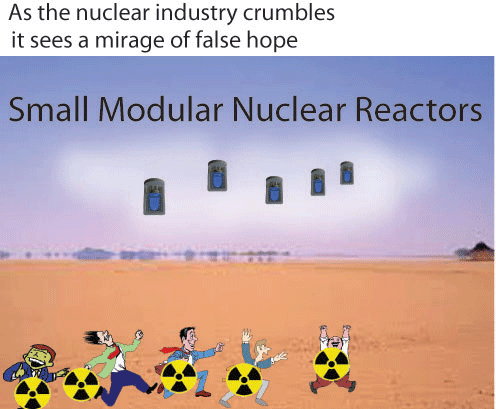
Will small modular reactors seed a nuclear renaissance?
Corporate Knights does not consider new nuclear power projects to be “green” i
However, big questions remain about SMRs as the technology is largely untested. It’s unclear what the electricity from SMRs will cost and whether the technology can compete with cheap renewable sources like wind and solar backed up by storage. The prospect of micro reactors dotting remote Canadian landscapes also raises serious issues around safety and management of highly radioactive wastes.
Four Canadian provinces are banking on SMRs to help decarbonize their electricity grids, but critics argue the technology is unproven
Corporate Knights, BY SHAWN MCCARTHY, DECEMBER 8, 2022
It’s been more than a decade since Atomic Energy of Canada Ltd. (AECL) pulled the plug on its advanced CANDU reactor – a newly designed mega-reactor that industry said would usher in a “nuclear renaissance.”
Now Canada is seeing yet another promised resurgence for the nuclear industry. And this time, it comes in a size small. On December 1, Ontario Premier Doug Ford participated in a groundbreaking at Darlington nuclear facility, where provincially owned Ontario Power Generation (OPG) plans to build a small modular reactor (SMR).
If the Darlington project gets a green light on the final investment decision, the unit will be the first new reactor built in Canada in nearly 40 years, as other companies are pursuing plans to build SMRs across the country. (The nuclear sector has, however, been buoyed by massive reactor refurbishment projects at Darlington and Bruce Power’s eight-reactor site on Lake Huron.)
The industry’s latest hope, SMRs have a capacity of up to 300 megawatts and modular design features that are meant to keep construction costs under control (nuclear projects are notorious for their multibillion-dollar cost overruns). Micro reactors can be as small as five megawatts and are touted as an energy solution for remote communities and industrial sites like mines.
That’s in sharp contrast with the 1,000-megawatt behemoths that were marketed around the world in the first decade of the century by reactor manufacturers, including then federally owned AECL, Westinghouse Electric Co. and others.
The federal government and four provinces – Ontario, New Brunswick, Saskatchewan and Alberta – are lining up to support the commercial deployment of SMRs as low-carbon sources of electricity.
However, big questions remain about SMRs as the technology is largely untested. It’s unclear what the electricity from SMRs will cost and whether the technology can compete with cheap renewable sources like wind and solar backed up by storage. The prospect of micro reactors dotting remote Canadian landscapes also raises serious issues around safety and management of highly radioactive wastes.
Corporate Knights does not consider new nuclear power projects to be “green” in its Sustainable Economy Taxonomy. In July, the European Union overturned a draft proposal and included nuclear in its taxonomy for the purposes of green investing, though that controversial decision is being challenged in court by Austria, backed by several environmental groups.
In its fall fiscal update, the federal government introduced an investment tax credit of up to 30% for clean energy technologies, including SMRs. Ottawa has also committed $970 million in low-interest financing through the Canada Infrastructure Bank for the Darlington SMR project.
A bad day to go nuclear
Last decade was not kind to the nuclear industry, as Japan’s Fukushima meltdown after a tsunami in 2011 was the worst nuclear disaster since the Chernobyl accident of 1986 and led to the shutdown of all the country’s reactors. Those safety threats loom large today as Russia has attacked Ukraine’s nuclear energy site.
As well, the economic case for large new reactors has taken a beating over the years, as projects have been plagued by delays and cost overruns………………………….
At the National Energy Roundtable’s conference at the end of November, several speakers argued for the inclusion of nuclear in Canada’s strategy to electrify the economy. Energy ministers from Ontario and New Brunswick touted the benefits of SMRs, saying the technology can provide affordable, continuous, non-emitting power.
The two provinces – in addition to Alberta and uranium-rich Saskatchewan – have agreed to work together on the commercialization of SMRs……………………………….
At Darlington, OPG expects to receive a construction licence in 2024 and will release detailed cost estimates as design and regulatory work proceeds, OPG spokesman Neal Kelly said in an email.
Former mayor of Iqaluit Madeleine Redfern said at the roundtable discussion that SMRs can help northern communities and industry end their reliance on expensive, dirty and often unreliable diesel generators. Small reactors, she said, would be more reliable than intermittent electricity production from wind or solar projects. (Redfern is also chief operating officer of CanArctic Inuit Networks and an Indigenous advisor to nuclear energy developer USNC-Power, which is partnering with OPG on a demonstration reactor project, as it seeks approvals from the federal nuclear regulator.)…………………………………
Critics argue that SMRs pose the same problems of safety and waste disposal that have bedevilled the nuclear industry for decades. The future “lies in capturing the sun and wind, not in splitting atoms,” Greenpeace campaigner Keith Stewart said in an email. “SMRs have been a decade away from deployment for the last 30 years, while wind and solar are actually being deployed.”…………………….
Ontario Energy Minister Todd Smith
aid Ontario is committed to electrification but will need the federal government to be a reliable partner to help keep costs down. “If the price of electricity soars, we’re not going to see electrification unfold,” he said.
However, whether SMRs can be a timely source of cheap and low-carbon electricity for Ontario and beyond remains to be seen. https://www.corporateknights.com/category-climate/will-smrs-bring-nuclear-renaissance/
—
1 This Month

Protect Sazan Island from the Trump family! https://secure.avaaz.org/campaign/en/protect_sazan_island_from_the_trump_family_loc/?bqFCVab&v=174511&cl=22707147157&_checksum=5e9dde668860e8231c33699735e16a1fbf22ab2cb01da50c999fe8732b9775ef&utm_source=email&utm_medium=blast_email&utm_campaign=174511

25 June- THE PUKE ON NUKES
Thursday, June 25, 2026
7pm Central Time (8pm ET, 6pm MT, 5pm PT) UTC – 5
From NRC & DOE Deregulation to Techno-Fascist Billionaires Going Nuclear, Plus a Few Songs from Atomic Cabaret REGISTER
26 June – Radiation Trainwreck at the NRC / Join the Protect Better Campaign – https://us02web.zoom.us/meeting/register/4ZlZ5_qLSHGiLSCg8FF6Bg#/registration


Cuba Is Not a Failed State – It Is a Besieged State
PETITION: “Global Appeal to Endorse Palestinian Right of Return of Refugees”
To see nuclear-related stories in greater depth and intensity – go to https://nuclearinformation.wordpress.com
-
Archives
- June 2026 (138)
- May 2026 (306)
- April 2026 (356)
- March 2026 (251)
- February 2026 (268)
- January 2026 (308)
- December 2025 (358)
- November 2025 (359)
- October 2025 (376)
- September 2025 (257)
- August 2025 (319)
- July 2025 (230)
-
Categories
- 1
- 1 NUCLEAR ISSUES
- business and costs
- climate change
- culture and arts
- ENERGY
- environment
- health
- history
- indigenous issues
- Legal
- marketing of nuclear
- media
- opposition to nuclear
- PERSONAL STORIES
- politics
- politics international
- Religion and ethics
- safety
- secrets,lies and civil liberties
- spinbuster
- technology
- Uranium
- wastes
- weapons and war
- Women
- 2 WORLD
- ACTION
- AFRICA
- Atrocities
- AUSTRALIA
- Christina's notes
- Christina's themes
- culture and arts
- Events
- Fuk 2022
- Fuk 2023
- Fukushima 2017
- Fukushima 2018
- fukushima 2019
- Fukushima 2020
- Fukushima 2021
- general
- global warming
- Humour (God we need it)
- Nuclear
- RARE EARTHS
- Reference
- resources – print
- Resources -audiovicual
- Weekly Newsletter
- World
- World Nuclear
- YouTube
-
RSS
Entries RSS
Comments RSS
 nuclear-news