A closer look at SNC-Lavalin’s sometimes murky past CBC, 12 Feb 19 One of Canada’s biggest engineering companies is at the centre of what appears to be a growing scandal engulfing Prime Minister Justin Trudeau and his government.
The Globe and Mail reported Thursday that SNC-Lavalin lobbied the government to agree to a deferred prosecution agreement or remediation agreement. The company faces charges of fraud and corruption in connection with nearly $48 million in payments made to Libyan government officials between 2001 and 2011.
Trudeau denies he directed his former justice minister and attorney general, Jody Wilson-Raybould, to intervene in the prosecution. Wilson-Raybould was shuffled out of her position last month and has refused to comment on the story. Days after the story broke, the federal ethics commissioner confirmed he will investigate claims the prime minister’s office pressured Wilson-Raybould to help SNC-Lavalin avoid prosecution.
SNC-Lavalin has pleaded not guilty to the charges. The case is at the preliminary hearing stage. If convicted, the company could be banned from bidding on any federal government contracts for 10 years.
But the Libya case is just one scandal among many linked to SNC-Lavalin in the past decade.
Allegations of criminal activity are what led to the resignations in February 2012 of top executives Riadh Ben Aïssa and Stéphane Roy. CEO Pierre Duhaime followed them out the door the following month.
MUHC contract scandal…….
Corruption scandal in Bangladesh …….
Libya scandal……
Elections Financing
In late November 2018, former SNC-Lavalin vice-president Normand Morin quietly pleaded guilty to charges of violating Canada’s election financing laws.
According to the compliance agreement reached with the company in 2016, Morin orchestrated a scheme between 2004 and 2011 that used employees to get around the restrictions on companies donating directly to federal political parties. Morin would get employees to donate to political parties, riding associations or Liberal leadership candidates. The company would then reimburse them for their donations through false refunds for personal expenses or fictitious bonuses.
In total, $117,803 flowed from SNC-Lavalin to federal party funds during that period. The Liberal Party of Canada got the lion’s share — $83,534 to the party and $13,552 to various riding associations. Another $12,529 went to contestants in the 2006 Liberal Party leadership race won by Stephane Dion. The Conservative Party of Canada received $3,137 while Conservative riding associations got $5,050.
Ottawa, Monday, March 27, 2023 – Environmental and civil society groups are giving a thumbs-down after the federal government announced new funding on Friday towards the development of small modular nuclear reactors (SMRs). The groups will be looking closely at the numbers in Tuesday’s budget.
The “Prime Minister Trudeau and President Biden Joint Statement,“ issued on Friday March 24, committed Canada to provide funding and in-kind support for a US-led program to promote SMRs.
The Canadian government’s Strategic Innovation Fund has already given close to $100 million to corporations working on experimental SMR technologies. In addition, the Canada Infrastructure Bank has committed $970 million to Ontario Power Generation’s plan for a 300-megawatt SMR at Darlington. Federal funding is benefiting US-based companies GE-Hitachi and Westinghouse, and Canada’s SNC-Lavalin, among others.
All the funded SMR projects are still in the research and development phase. Worldwide, no SMRs have ever been built for domestic use.
In addition, the federal government is giving Atomic Energy of Canada Limited $1.35 billion a year to conduct nuclear research and development and to manage its toxic radioactive waste. Nearly all this funding is transferred to a consortium of SNC-Lavalin and two US-based companies (Fluor and Jacobs) that that are heavily involved in nuclear weapons and SMR research.
Over 100 groups from all across Canada have criticized the federal government’s plan to promote SMR nuclear technology, stating that:
SMRs are a dirty, dangerous distraction that will produce radioactive waste of many kinds. Especially worrisome are those proposed reactors that would extract plutonium from irradiated fuel, raising the spectre of nuclear weapons proliferation.
SMRs will take too long to develop to address the urgent climate crisis in the short time frame necessary to achieve Canada’s goals.
SMRs will be much more expensive than renewable energy and energy efficiency. Small reactors will be even more expensive per unit of power than the current large ones, which have priced themselves out of the market.
Nuclear power creates fewer jobs than renewable energy and efficiency. Solar, wind and tidal power are among the fastest-growing job sectors in North America. The International Energy Agency forecasts that 90% of new electrical capacity installed worldwide over the next five years will be renewable.
The federal government needs to invest urgently in renewables, energy conservation and climate action, not slow, expensive, speculative nuclear technologies.
QUOTES:
“Taxpayer dollars should not be wasted on a future technology whose time is past, like nuclear reactors, when truly clean renewable solutions are up-and-running and getting more affordable all the time.” – Dr. Gordon Edwards, Canadian Coalition for Nuclear Responsibility
“Let’s compete to be world leaders in renewables. Pouring public funding into speculative reactor technologies is sabotaging our efforts to address the climate crisis.” – Dr. Ole Hendrickson, Sierra Club Canada Foundation
The SMR technologies are all at the early R&D stage, yet the funding is not following good governance practices by requiring high standards of peer review.“ – Dr. Susan O’Donnell, Coalition for Responsible Energy Development in New Brunswick
Depleted uranium, used in some types of ammunition and military armour, is the dense, low-cost leftover once uranium has been processed….
A high-ranking official from Veterans Affairs says a handful of vets mistakenly believe their bodies have been damaged by depleted uranium…..
the Federal Court of Canada has found depleted uranium to be an issue. The court ruled the Veterans Affairs Department must compensate retired serviceman Steve Dornan for a cancer his doctors say resulted from exposure to depleted uranium residue.
Poisoned soldier plans hunger strike at minister’s office in exchange for care, Montreal CTV.ca Andy Blatchford, The Canadian Press, 30 Oct 11, MONTREAL — An ex-soldier who says he was poisoned while serving overseas is planning to go on a hunger strike outside the office of Canada’s veterans affairs minister until he gets medical treatment.
Washington ― A bipartisan group of Great Lakes lawmakers introduced a resolution in Congress on Wednesday to oppose a Canadian proposal to permanently store spent nuclear fuel waste in the Great Lakes Basin.
The move comes ahead of President Joe Biden’s first trip to Canada as president this week to meet with Prime Minister Justin Trudeau.
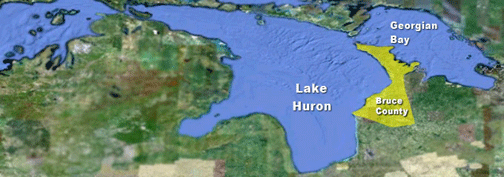
The resolution is concerned with Canada’s Nuclear Waste Management Organization, which plans to decide next year on one of two potential sites for a nuclear waste facility, either Ignace, Ontario, or South Bruce, which is in the Great Lakes basin and less than 40 miles from Lake Huron.
The resolution says that Biden and Secretary of State Antony Blinken should ensure that the government of Canada does not permanently store nuclear waste in the Great Lakes Basin.
It goes on to warn that a “spill” of such waste into the lakes during transit to a deep geological repository “could have lasting and severely adverse environmental, health and economic impacts on the Great Lakes and the individuals who depend on the Great Lakes for their livelihoods.”
The measure is led by U.S. Reps. Dan Kildee, D-Flint Township, and John James, R-Farmington Hills, in the House and U.S. Sen. Debbie Stabenow, D-Lansing, in the Senate.
“Storing hazardous nuclear waste in our shared waterways threatens the drinking water of millions of people in the United States and Canada, and jeopardizes jobs in the fishing, boating and tourism industries,” Kildee said in a statement. “I urge President Biden to address Canada’s plan to permanently bury nuclear waste in the Great Lakes basin as he meets with Canadian Prime Minister Trudeau.”
The resolution has 15 other House co-sponsors including Michigan Reps. Jack Bergman of Watersmeet, John Moolenaar of Caledonia, Bill Huizenga of Holland, Lisa McClain of Bruce Township, Debbie Dingell of Ann Arbor, Elissa Slotkin of Lansing, Hillary Scholten of Grand Rapids, Haley Stevens of Birmingham and Shri Thanedar of Detroit as well as five Senate co-sponsors, including Sen. Gary Peters of Bloomfield Township………………………………………………………………………………. https://www.detroitnews.com/story/news/politics/michigan/2023/03/22/measure-opposes-canadian-plan-to-store-nuclear-waste-near-lake-huron/70036108007/
Nuclear power became an unstoppable force, immune to scrutiny by civil society. Its regulation was entrusted to the same government bureaucracy responsible for its promotion.”
Canada has not heeded these warnings. ……. The CNSC, mandated to protect the public and the environment, lobbied government to abolish full impact assessments for most “small modular nuclear reactors” (SMN
This month marks the 12th anniversary of the Fukushima disaster, when three nuclear reactors in Japan suffered catastrophic meltdowns.
A tsunami knocked out the reactors’ cooling systems. The plant was shut down, but radioactivity sent temperatures soaring past the melting point of steel.
Radioactive gases mingled with superheated steam and explosive hydrogen gas, which detonated, spreading radioactive contamination over a vast area; 120,000 people were evacuated and 30,000 are still unable to go home.
Radioactively contaminated water from the stricken reactors has accumulated in 1,000 gigantic steel tanks, and despite objections from China, Korea and local fishers, Japan plans to dump it into the Pacific Ocean soon.
What caused this catastrophe? Most people blame the tsunami. The commission of investigation in Japan concluded otherwise. In its report to the National Diet, the commission found the root cause was a lack of good governance.
The accident “was the result of collusion between the government, the regulators and TEPCO [the nuclear company], and the lack of governance by said parties. They effectively betrayed the nation’s right to be safe from nuclear accidents. Therefore, we conclude that the accident was clearly ‘man-made.’ We believe that the root causes were the organizational and regulatory systems that supported faulty rationales for decisions and actions…”
The commission chairman wrote: “What must be admitted — very painfully — is that this was a disaster ‘made in Japan.’ Its fundamental causes are to be found in the ingrained conventions of Japanese culture: our reflexive obedience; our reluctance to question authority; our devotion to ‘sticking with the program’; our groupism; and our insularity… Nuclear power became an unstoppable force, immune to scrutiny by civil society. Its regulation was entrusted to the same government bureaucracy responsible for its promotion.”
Canada has not heeded these warnings. After Justin Trudeau was elected in 2015, his government did away with environmental assessments for any new reactors below a certain size, thus eliminating scrutiny by civil society. This leaves all decision-making in the hands of the Canadian Nuclear Safety Commission (CNSC) — an agency previously identified by an expert review panel as a captured regulator.
The CNSC, mandated to protect the public and the environment, lobbied government to abolish full impact assessments for most “small modular nuclear reactors” (SMNRs).
Back in 2011, in the midst of the media frenzy about the triple meltdown, Canadians were testifying at federal environmental assessment hearings for up to four large nuclear reactors to be built by Ontario Power Generation (OPG) at Darlington, about 50 kilometres east of Toronto’s edge. The Fukushima disaster was cited repeatedly as a warning.
The panel approved OPG’s plan, but the Ontario government was thunderstruck by the price tag, reputed to be over $14 billion per unit, and cancelled the project.
Now OPG wants to build a smaller reactor at the Darlington site. Since a full impact assessment has been ruled out, CNSC is using the report from 12 years ago as the basis for public interventions. The reactor now proposed (the BWRX-300) has no similarity to any of the reactors that were under consideration then or to any operating today in Canada. Ironically, it is a “miniaturized” version of those that melted down at Fukushima.
CNSC is legally linked to the minister of Natural Resources, who is also tasked with promoting the nuclear industry at home and abroad. The International Atomic Energy Agency (IAEA) warns that regulators must be independent of any agency promoting the industry.
One day after Canada’s Infrastructure Bank gave OPG a $970-million “low-interest loan” to develop the BWRX-300 at Darlington, the minister boasted to a Washington audience that it would soon become Canada’s first commercial SMNR.
CNSC president Rumina Velshi lauded the speed at which the licensing is proceeding, saying that Canada would be the first western country to approve an SMNR built for the grid.
CNSC is at least two years from approving the reactor. Nevertheless, OPG held a ground-breaking ceremony at Darlington in December. The licence to construct seems a foregone conclusion. When asked, CNSC freely admitted that from the day of its inception, it has never refused to grant a licence for any major nuclear facility.
Government, regulator and industry are already on board. Collusion? Or just co-operation?
Gordon Edwards is president and co-founder of the Canadian Coalition for Nuclear Responsibility, a not-for-profit corporation established in 1975. He is a retired professor of mathematics and science at Vanier College in Montreal.
Le Regroupement des organismes environnementaux en énergie (ROEE) is a voluntary association of Quebec groups with a fine professional team:
ROEE is funded to intervene in hearings of the Régie de l’Énergie on matters related to energy and the environment and toeducate the public on such matters in a regular way. The ROEE was founded in 1997 following a public debate on energy policy in Quebec that led to the creation of the
Régie de l’Énergie on matters related to energy and the environment and to educate the public on such matters in a regular way.
The ROEE was founded in 1997 following a public debate on energy policy in Quebec that led to the creation of the Régie.
The Canadian Coalition for Nuclear Responsibility, known in Quebec as le Regroupement pour la surveillance du nucléaire, is one of the founding members of the ROEE.
The ROEE is a champion of “soft energy paths” based on energy efficiency and renewable energy sources, and has recently decided to adopt a policy on nuclear power although Quebec phased out of nuclear power in 2012 with the closure of the only operating nuclear power reactor in Quebec called “Gentilly-2”. (Gentilly-1 was retired many years beforehand).
Quebec also adopted a one-year moratorium on uranium mining in 2014, leading to a year-long series of hearing in Quebec conducted by the BAPE (Bueau des audiences publiques sur l’environnement), who recommended in 2015 that the moratorium on uranium exploration and mining be made permanent. So far this has not been done but uranium exploration has been terminated in the province of Quebec – hence we have an informal moratorium in effect.
Membres du ROEE (2023)
Association madelinienne pour la sécurité énergétique et environnementale Canot Kayak Québec Écohabitation Fondation Coule pas chez nous Fondation Rivières Nature Québec Draft Policy on nuclear power (English original and French translation are copied below).
ROEE does not support the expansion of nuclear power based on the fissioning of uranium or plutonium as an energy source. The unsolved problems associated with nuclear fission technology are far more significant than any benefits it is supposed to offer, and there are now more affordable alternatives such as energy efficiency and renewable energy sources that are easier and faster to deploy than nuclear.
Background
•Nuclear fission inevitably creates a long-lived legacy of human-made radioactive wastes that will continue to challenge the health and safety of humans and the environment for hundreds of thousands of years. By far the most intensely radioactive wastes are contained in the used nuclear fuel. These wastes cannot be eliminated or neutralized but only contained, and safe containment over such long time periods cannot be assured.
•Materials such as stainless steel and concrete in the core area of a nuclear reactor also become long-lived radioactive wastes and therefore cannot be recycled. This debris cannot be decontaminated, it must be kept out of the environment for many generations after dismantling the reactors, which is delayed for decades to protect workers from excessive exposure. Canada has no strategy for dealing with these wastes over the very long term.
The risk of catastrophic nuclear accidents cannot be eliminated. Even if the risk is small, the consequences can be unacceptable, leading to radioactive contamination of large land areas and large volumes of water, as well as the permanent evacuation of large populations.
• The risk of proliferation of nuclear weapons using plutonium created in nuclear reactors, as India did in 1974, is not negligible. Such proliferation remains a significant danger for thousands of years after the last reactor is shut down.
• The proliferation risk becomes more acute when “advanced” nuclear reactors require the extraction of plutonium from used nuclear fuel to create more nuclear fuel – an operation called “reprocessing”. Reprocessing is now being considered by the Canadian government in coinnection with new reactors proposed for New Brunswick.
• ROEE supports the movement to ban reprocesssing – plutonium extraction – in Canada. Non-proliferation experts are agreed that ready access to plutonium should not be encouraged. In 1977, US President Carter banned reprocessing in the USA because of the proliferation risk.
• ROEE opposes uranium mining as well. The only significant uses of uranium are as an explosive for nuclear weapons and as a fuel for nuclear reactors. ROEE is opposed to both.
• Uranium mining also leaves a long-lived radioactive waste legacy. Canada currently has over 120 million tonnes of radioactive waste left over from uranium mining. These wastes will rmain danberous for hundreds of thousands of years.
• Uranium wastes, called “tailings”, contain some of the deadliest naturally occurring toxic materials known to science, such as radium, polonium, and radon gas. Mining brings these materials to the surface and makes them much more accessible to the environment.
ROEE Positions
ROEE disagrees wth the promotion of a new generation of nuclear reactors to deal with the climate emergency. Compared with energy efficiency and renewables such as solar and wind, nuclear power is at least 4 to 7 times more costly and much too slow to reduce greenhouse gas emissions in a timely fashion. In contrast to the proven performance and declining price of alternatives, new nuclear reactors are uncertain in performance and sometimes are completely unusable, while experience has shown a pattern of major price escalations and construction delays for nuclear projects.
ROEE applauds the decision to close down the Gentilly-2 reactor at Bécancour in 2012, thereby phasing out nuclear power in Québec. ROEE urges government to make this phase-out permanent by banning the construction of any new nuclear power reactors in the province.
A severe nuclear accident in either Ontario or New Brunswick can have serious airborne and water-borne consequences in Quebec as well as in those provinces. ROEE urges the government to encourage the phaseout of nuclear power in neighbouring provinces for safety reasons, while continuing to offer them sales of excess hydroelectric power from Quebec.
ROEE welcomes the 2015 recommendation of the BAPE for the government to declare a permanent moratorium on uranium mining in Quebec. ROEE urges the government to accept this recommendation fully by passing a law that bans uranium exploration and mining in the province, similar to the law passed by Nova Scotia on the same matter.
ROEE supports Quebec’s determination not to accept the import of long-lived radioactive waste from other jurisdictions for permanent storage in Quebec.
In addition, ROEE opposes current federal plans to construct a permanent radioactive storage facility on the surface at Chalk River, just one kilomete from the Ottawa River, close to the Quebec border. This landfill operation is intended to house one million cubic metres of radioactive wastes and other toxic materials such as asbestos and lead, some of it imported from as far away as Manitoba. As of 2022, over 130 municipalities, including the members of the Montreal Agglomeration Council, have opposed the planned Chalk River dump. ROEE supports their efforts to prevent it also urges the government of Quebec to do likewise.
Ontario sites short-listed for nuclear waste storage, The organization developing a place to store spent nuclear fuel in Canada has settled on two potential sites in Ontario. The move rules out 20 other potential sites across Canada, including three in northern Saskatchewan.
The Nuclear Waste Management Organization recently announced the Wabigoon Lake Ojibway Nation-Ignace area in northwestern Ontario, and the Saugeen Ojibway Nation-South Bruce area in southern Ontario, are both under consideration.
“These communities are now working through their timelines to determine willingness,” Russell Baker, manager of media relations for the NWMO, said in an e-mail.
Baker said the NWMO hopes to settle on one of the two Ontario sites by the fall of 2024, but only “with informed and willing hosts, where the municipality, First Nation and Métis communities are working together to implement it.”
Disposing of spent nuclear fuel has been an issue for the nuclear industry for decades. A variety of countries, including Canada, are looking at deep geological repositories, where the waste can be safely stored for thousands of years within stable rock formations, like the Precambrian Shield. Finland is already building one.
Back in 2010, the NWMO announced there were 22 potential sites for underground storage across Canada, including sites near Pinehouse, English River First Nation, and Creighton, in northern Saskatchewan.
According to Guy Lonechild, executive director of the First Nations Power Authority (FNPA), coming up with a shortlist of potential sites is another step.
“There were some previous sites looked at in northern Saskatchewan but there’s been a lot of time and energy put into a deep geological repository in the province of Ontario. And those are the two viable options that that we would support for further study,” Lonechild, who is also a former FSIN chief, said.
Lonechild added the FNPA has been looking seriously at the possibility of Small Modular Nuclear Reactors (SMNR) for Indigenous and northern communities for several years.
……………. However, even though SMR’s are relatively small, the cost could easily be a billion dollars or more. Which is why FNPA would be looking for partnerships to help Indigenous communities get involved.
“So it is going to take a significant amount of capital. And so we’re looking at developing consortium groups to participate on an equity basis.”
………………….. “The only way we’re going to get there is if First Nations that are informed, that give free prior informed consent. And they identify ways that they want to participate in, in clean energy jobs and in the nuclear industry,” he said.
Canada is launching a new funding program to help promote the commercial deployment of small modular reactors (SMRs). The announcement was made Feb. 23 at the Canadian Nuclear Association’s annual conference.
The program would provide $29.6 million over four years to develop supply chains for SMR manufacturing and fuel supply and security. Funding would also be used for research on safe SMR waste management solutions.
Eligible applicants could include private companies, utilities, provinces and territories, universities and Indigenous groups………………………………….
A few months prior to the contract signing, the Canada Infrastructure Bank (CIB) committed C$970 million ($708 million) in debt financing toward the Darlington SMR. This is the bank’s largest investment in clean [?] power to date.
Today, the Canadian Coalition for Nuclear Responsibility and researchers from five universities are urging Ottawa to reconsider its financial and political support for reprocessing in Canada – extracting plutonium from used nuclear fuel.
Plutonium is one of the key materials needed to make nuclear weapons—the other alternative is highly enriched uranium. Plutonium is created as a byproduct in nuclear reactors. Once extracted, plutonium can be used either as a nuclear fuel or as a nuclear explosive. The chemical process used to separate plutonium from other radioactive substances produced in nuclear reactors is called reprocessing
In 1974 India used plutonium from a Canadian reactor to explode an atomic bomb in an underground test. The entire world was shocked to realize that access to plutonium and the making of an atomic bomb may be separated only by an act of political will.
Last week, a House of Commons committee released a report recommending that the government “work with international and scientific partners to examine nuclear waste reprocessing and its implications for waste management and [nuclear weapons] proliferation vulnerability.
The recommendation by the House of Commons committee echoes numerous calls by civil society groups and by U.S. and domestic researchers after Canada announced a $50.5 million grant to the Moltex corporation in March 2021 for a New Brunswick project to develop a plutonium reprocessing facility at the Point Lepreau nuclear site on the Bay of Fundy.
Allowing plutonium reprocessing in Canada sends a dangerous signal to other countries that it is OK to for them to extract plutonium for commercial use. Such a practice increases the risk of spreading nuclear weapons capabilities to countries that currently do not possess the means to make nuclear weapons. The risk is that much greater if Canada sells the technology, as is currently envisaged.
“By supporting the implementation of reprocessing technology intended for export, in connection with a plutonium-fuelled nuclear reactor, without regard for the weapons implications, Canada may be once again spreading the bomb abroad,” says Dr. Gordon Edwards, President of the Canadian Coalition on Nuclear Responsibility.
Reprocessing is often justified as a solution to the problem of dealing with nuclear waste, but in reality, it only makes the challenge even harder. Instead of having all the radioactive materials produced in solid spent fuel, these get dispersed into multiple solid, liquid and gaseous waste streams.
Researchers from the University of British Columbia, Princeton University and three New Brunswick universities are supporting the call for an international review. “We’re heartened that the House of Commons Committee listened to the concerns about plutonium reprocessing raised by numerous experts and concerned citizens,” says Dr. Susan O’Donnell, Adjunct Professor at the University of New Brunswick.
Dr. Edwards cited three letters written to Prime Minister Justin Trudeau by nine prominent nonproliferation experts, including plutonium expert Dr. Frank von Hippel. “The Prime Minister’s failure to respond indicates an appalling lack of good governance on the proliferation of nuclear weapons,” said Dr. Edwards.
To date the government has not responded to the letters or even acknowledged the monumental significance of the nuclear weapons connection with reprocessing. The House of Commons Science and Research Committee cited the letters by Dr. von Hippel and others as rationale for their recommendation to conduct the review.
Commercial reprocessing has never been carried out in Canada but in the past, Canada has been complicit in the production of nuclear weapons. During the Cold War some reprocessing was done at the federal government’s Chalk River Nuclear Laboratory, at a time when Canada sold both uranium and plutonium to the US army for use in nuclear weapons. These operations resulted in a permanent legacy of nuclear waste and radioactive contamination in Canada.
The first reactors were built to produce plutonium for bombs. The first reprocessing plants were built to extract plutonium to be used as a nuclear explosive. Following India’s use of plutonium from a nuclear reactor supplied by Canada in its 1974 weapon test, the United States banned commercial plutonium reprocessing in 1977 to reduce the danger of weapons proliferation.
Canada has had an informal ban on reprocessing since the 1970s. A 2016 Canadian Nuclear Laboratories report stated that reprocessing used CANDU fuel would “increase proliferation risk.” That CNL admission was fully confirmed in a major report (330 pages) released three months ago by a U.S. National Academy of Sciences. The expert panel reached a consensus that the reprocessing technology proposed for New Brunswick by the Moltex corporation “does not provide significant proliferation resistance.”
The need for an independent international review is urgent, as Moltex announced just last week that the company is seeking an additional $250 million in government funding.
The researchers supporting the call for an international review of plutonium reprocessing in relation to the spread of nuclear weapons are:
Dr. Susan O’Donnell, Adjunct Professor and Principal Investigator of the Rural Action and Voices for the Environment [RAVEN] project, University of New Brunswick
Dr. Janice Harvey, Assistant Professor, Environment & Society Program, St. Thomas University
Dr. M.V. Ramana, Professor and Simons Chair in Disarmament, Global and Human Security, School of Public Policy and Global Affairs, University of British Columbia
Dr. Frank von Hippel, Senior Research Physicist and Professor of Public and International Affairs Emeritus, Program on Science & Global Security, Princeton University
Public Service Enterprise Group will consider “small but important value-added investments” at its nuclear plants, capitalizing on production tax credits in the Inflation Reduction Act, President and CEO Ralph LaRossa said Tuesday…………………
Dive Insight:
The passage of the IRA last August will “help to preserve the financial viability of our carbon-free nuclear fleet into the next decade,” the Newark, New Jersey-based parent company of Public Service Electric and Gas said in a statement.
“While the industry waits for clarifications, we believe the Inflation Reduction Act is a game-changer that should provide the stability required for long-term viability of the U.S. nuclear fleet,” LaRossa said.
Guggenheim analyst Shahriar Pourreza said in a client note Tuesday that “longer term upsides for nuclear” could come from U.S. Treasury Department guidance on production tax credits. Guidance will take time and “further drive strategic decision-making,” he said……….
Daniel Cregg, executive vice president and chief financial officer, said PSEG is engaged in a “waiting game” as the Treasury Department provides details on the nuclear production tax credits. “I don’t even have a date to tell you when Treasury is going to come out with it,” he told analysts.
The IRA, with $369 billion in climate provisions, provides tax credits for existing nuclear power plants and new facilities, advanced reactors and small modular reactors. The law provides a choice between a technology-neutral production tax credit of $25/MWh for the first 10 years of plant operation or a 30% investment tax credit on new zero-carbon power plants that begin operating in 2025 or later.
Tax credits have drawn interest from other energy companies. Constellation announced Tuesday it will spend $800 million for new equipment to increase the output of two nuclear generating stations in Illinois by about 135 MW.
“Support for nuclear in the IRA has made extending the lives of U.S. nuclear assets to 80 years more likely assuming continued support,” Constellation said. “It has caused Constellation to examine nuclear uprate opportunities that were canceled a decade ago due to market forces.”
On Feb. 14, our Coalition made our case against SMRs to the MLAs on the Climate Change and Environmental Stewardship committee of the Legislative Assembly of New Brunswick. Our presentation used the best scientific analysis to critique the “advanced” SMRs for development in New Brunswick. CRED-NB core member Susan O’Donnell presented on behalf of the Coalition. Our written presentation in English is HERE (and HERE in French). The video of the session is on YouTube, HERE. Check out the video to learn more about the SMR plans and what our elected representatives have to say about them.
There were 13 presentations over two days. Other presentations to watch for are, on Feb. 14: J.P. Sapinski, M.V. Ramana. On Feb. 15: Gordon Edwards, Chief Hugh Akagi + Chief Ron Tremblay + Kim Reeder, and Louise Comeau + Moe Quershi. Each has a one-hour time slot, with 20 minutes by presenters followed by 40 minutes of Q&A with the MLAs on the committee. The full schedule of presentations is HERE. The link to the video archive is HERE(scroll through or search to find the webcast archive from Feb. 14 and 15).
*on Thursday, the House of Commons Standing Committee on Science and Research released the report from the SMR study:
Companies trying to develop small modular nuclear reactors in New Brunswick are getting some support from an unlikely source.
An energy crisis is looming large, and SMRs have better potential than renewables in the short term, said Chief Terry Richardson of Pabineau First Nation, near Bathurst.
Richardson said he sees nuclear power as consistent with his cultural values.
“As First Nations, we are stewards of the land. Well, when we look at nuclear technology, it’s not a carbon emitter. So it’s not going to cause a problem. It’s going to actually solve the problem of carbon.
“If we don’t do something, we all know what’s happening with climate change.”
Pabineau has signed memoranda of understanding to work with two companies that have SMR projects under way at Point Lepreau — Moltex and ARC, said Richardson.
He describes the MOUs as “non-contractual, binding documents” that state a willingness to work together on development.
Details of exactly how his community and potentially other First Nations in the province may take part in SMR projects have yet to be negotiated, said Richardson.
“There’s going to be an opportunity to be involved on the equity side and that’s where we have to sit down and talk and discuss it and see where we’re going to go.”
After the initial development at Lepreau, ARC is talking about installing more SMRs in Belledune, Richardson noted, which could mean job opportunities in northern New Brunswick.
He also likes that Moltex is looking at reusing spent fuel rods, which it says would reduce the amount of toxic nuclear waste that already exists.
Study looks at SMR waste
A Canadian peer-reviewed study that came out last summer found the volume of waste from SMRs would be between double and 30 fold that from a typical reactor and that its chemical complexity would make it more difficult to manage.
Richardson said he is satisfied that plans are in place to deal with nuclear waste and added that maybe in the future there will be a way to recycle it…..
Moltex CEO Rory O’Sullivan told the legislative committee Wednesday that his company has the support of all 15 First Nations in the province to develop SMRs.
However, some other Indigenous leaders addressed the committee who have concerns about the SMR plans and the public investment in development.
US Big Defence will be the only winner of the proxy war in Ukraine. Not only do these global military contractors arm Ukraine, but they stand to benefit from the re-militarisation of Western European countries, Japan, and new NATO members.
In the view of Big Defence, peace is just a bad business proposition. There’s no money in it.
To Russia and Ukraine, the crisis is an existential issue. To the US and NATO, it’s a regime-change game. To Europe, it means the demise of stability – in the world economy, lost years (and that’s the benign scenario).
That’s how I characterised the US/NATO-led proxy war against Russia in Ukraine back in early March 2022. I argued that it was an “avoidable war that will penalise severely Ukraine, Russia, the US and the NATO, Europe, developing countries and the global economy”.[1]
At the time, the prediction was seen as contrarian. But it has prevailed. However, on January 25 the Ukraine proxy war entered a new, still more dangerous phase. The commitment of some 70 US, German, UK and Polish battle tanks herald lethal escalation, although hundreds more are needed to defeat Russia. For the first time since World War II, German tanks will be sent to the “Eastern front.” In Moscow, it will foster those voices who see the stakes of the war as existential.
Not only will economic and human costs climb even further, but strategic risks, including the potential of nuclear confrontation, will soar. With such escalation in high-tech arms sales to Ukraine, regional and military spillovers are no longer a matter of principle, but a matter of time.
Russia’s economic resilience
In early 2022, Western observers, with rare exceptions, predicted that the Russian economy would default within months as a net effect of sanctions. “Putin’s war” was doomed, they said. Obviously, the sanctions, which have been fuelled by might and economic coercion, have not been inconsequential. But nor were they new.
Already in February 2014, following the Russian annexation of Crimea, international sanctions were imposed against Russia and Crimea by the US, Canada, the EU, and the international organisations they dominate. While the West’s sanctions contributed to the fall of the Russian ruble, they also caused significant economic damage to the EU economy, with total losses at €100 billion in 2015. By mid-2016, Russia had lost an estimated $170 billion due to financial sanctions and another $400 billion in revenues from oil and gas.[2]………………………….
In fact, the Russian economy plunged 3.5 per cent in 2022, whereas inflation amounted to 5.4 per cent. In other words, Western institutions dramatically overestimated the GDP impact. Discrepancies of such magnitude are hard to explain away as simple prediction errors (figure 1 on original).
Proxy war united Russia
Officially, the invasion of Ukraine began as Russia’s “special military operation”. Unofficially, it soon morphed into a US/NATO-led proxy war against Russia in Ukraine. The true political objective of this war has been regime change. Hence the goal “to weaken Russia”, as Secretary of Defence Lloyd Austin acknowledged later. Hence, too, the international media predictions that the Russian economy would “inevitably” default and Putin be overthrown……………………
Today, in the view of ordinary Russians, Russia’s invasion of Ukraine is a defensive response to NATO’s offensive eastward enlargement. They see their country fighting for survival. That’s why the war caused Putin’s ratings to soar to the low 80s. That’s also why over 60 to 70 per cent of Russians support their government and believe the country is on the right track, despite extraordinary hardships. ……………………………………..
Amid this collapse of trust in the US and the EU, it certainly did not help that the Minsk peace process proved to be another Western ruse. Last December, German ex-Chancellor Angela Merkel disclosed in the Zeit newspaper that “the 2014 Minsk agreement was an attempt to give time to Ukraine.” That is, to make Ukraine stronger and for NATO to increase its support to the country in the face of Russia.[4]……………………
In the view of ordinary Russians, there is now a long continuum of betrayals from the pledge that NATO would never expand eastward in the early 1990s to Minsk today. In their view, the West’s recent arms escalation only confirms their worst suspicions.
Contradictory realities
Right before Christmas, President Volodymyr Zelenskyy delivered an emotional wartime appeal to a joint meeting of US Congress, pleading for more military assistance from the lawmakers, who were about to approve $45 billion in additional aid. It was necessary for “eventual victory”.[6]
Yet, there was a huge disconnect between the triumphant declaration and the realities. Earlier in the month, European Commission President Ursula von der Leyen had acknowledged that Ukraine’s losses in the war amounted to 100,000 soldiers and 20,000 civilians, though her tweet was quickly deleted and a new one was released without the true death count (figure 3 on original).[7
Behind the choreographed photo ops and bold sound bites, devastation had been expansive, progressive, and relentless…………..
In September 2022, a month before the Russian winter offensive, a World Bank report estimated that Russia’s invasion had caused over $97 billion in direct damage to Ukraine and it could cost $350 billion to rebuild the country. Worse, Ukraine had also suffered $252 billion in losses through disruptions to its economic flows and production, as well as extra expenses linked to the war.[8] (The report was quiet about the economic and human costs on the Russian side.)
In other words, what Zelenskyy asked in the Congress was less than one-tenth of what is actually needed to rebuild Ukraine.
Ukrainian nightmare
In effect, even as the international media was touting the mirage of Ukraine’s military triumph, the country’s real GDP declined over 35 per cent on an annual basis in the third quarter of 2022; that is, before Russia’s massive infrastructure attack.
Starting on 10 October, Russia’s waves of missile and drone attacks opened a new phase of the war.
The direct physical damage to infrastructure soared to $127 billion already in September; that’s over 60 per cent of Ukraine’s pre-war GDP. The impact on the productive capacity of key sectors, due to damage or occupation, is substantial and long-lasting.[9]
The population share with income below the national poverty line in Ukraine may more than triple, reaching nearly 60 per cent in 2022. Poverty will increase from 5.5 per cent in 2021 to 25 per cent in 2022, with major downside risks if the war and energy security situations worsen.[10]As casualties continue to mount, over a third of the population has been displaced and over half of all Ukrainian children have been forced to leave their homes. The nine months of war have caused massive population displacement. As of October 2022, the number of Ukrainian refugees recorded in Europe was over 7.8 million, and the number of internally displaced people was 6.5 million (figure 4 on original).[11]
As former Pentagon adviser Col. (ret.) Douglas Macgregor has argued, “Washington’s refusal to acknowledge Russia’s legitimate security interests in Ukraine and negotiate an end to this war is the path to protracted conflict and human suffering.”[12]
As former Pentagon adviser Col. (ret.) Douglas Macgregor has argued, “Washington’s refusal to acknowledge Russia’s legitimate security interests in Ukraine and negotiate an end to this war is the path to protracted conflict and human suffering.”[12]
West’s tough 2022 and darker 2023
Currently, the risk of recession casts a dark shadow over the US economy, ……………………………………………..
US and international war funding
In the proxy war, economic and humanitarian aid to Ukraine has been abundant………………………..
Internationally, the US provides the bulk of total aid to Ukraine (62 per cent). Aid from non-US sources amounts to $41.4 billion. The international total of more than $110 billion accounts for more than half of Ukraine’s pre-war GDP ($200 billion).[17] Effectively, these funding arrangements aim to sustain the hostilities and destruction not just in 2023, but at least until the late 2020s.[18] A scenario the West’s recent arms sales escalation could reinforce.
Ailing and indebted, the West cannot afford the proxy war in Ukraine. Hence, the frantic debt-taking. In the Eurozone, government debt to GDP remains close to 100 per cent. Ironically, that’s 40 percentage points higher than the region’s own debt limit. In the UK, the figure has doubled since 2008 to almost 100 per cent. In Japan, it is the worst among all high-income economies – close to 265 per cent, thanks to over two decades of secular stagnation. In the US, the debt ratio has also doubled and is inching toward 140 per cent. (That’s over 20 percentage points higher than that of Italy amid Rome’s 2010 debt crisis.) The rising debt as a percentage of the GDP will slow economic growth, push up interest payments to foreign holders of US debt, and heighten the risk of a fiscal crisis. The periodic debt-limit debacle in the US is just a minor political sideshow to the West’s future debt crisis, which will leave no economy, not even the major ones, unscathed (figure 5 on original).
The post-9/11 wars: the Big Defence bonanza
Ukraine is “absolutely a weapons lab in every sense because none of this equipment has ever actually been used in a war between two industrially developed nations,” said one source familiar with Western intelligence to CNN. “This is real-world battle testing.” Or as Zelenskyy put it more recently, arming Ukraine is a “‘big business opportunity,” as evidenced by his government’s new ties with Blackrock, Goldman Sachs and JP Morgan. In December 2022, he revealed that Ukraine had hired Blackrock to “advice” Kyiv on how to use the West’s reconstruction funds, which he then estimated would have to increase at least to $1 trillion.[19]
As I predicted in March 2022, US Big Defence will be the only winner of the proxy war in Ukraine. Not only do these global military contractors arm Ukraine, but they stand to benefit from the re-militarisation of Western European countries, Japan, and new NATO members. Washington has a great economic interest in such geopolitics. Brussels’ incentives are harder to fathom, especially as the euro area will pay a hefty premium on energy and food, which will also benefit Washington…………………………..
Military Keynesianism to rescue
From the economic standpoint, these military expenditures, including US Ukrainian aid, should be seen as massive, recurrent, multi-year bastard Keynesianism. That is, as a series of military stimulus packages to prop up the American economy (not Ukraine’s). Unlike Keynesian stimuli that can have an accelerator effect in the civilian economy, these packages benefit mainly the Pentagon and Big Defence; that is, the military industrial complex and its revolving-door elites.
Take, for instance, President Biden, Secretary of State Antony Blinken, National Security advisor Jake Sullivan and Blinken’s right-hand, Victoria Nuland. All four were key actors already in the 2014 Ukraine crisis. In one way or another, all are also linked with the Center for a New National Security (CNAS) and its consulting arm WestExec Advisors, which in turn is funded particularly by Big Defence. The same goes for Secretary of Defence Lloyd Austin, a veteran of the US Army and ex-board member of Raytheon, one of the largest defence giants and a big beneficiary of the Ukraine devastation.[22]
what’s good for Big Defence is not necessarily good for either the American people or the global economy. It aggravates income polarisation in America and between the high-income West and the developing Global South, while escalating geopolitical risks worldwide…………………………………
Plunging global growth
Unsurprisingly, global growth is now expected to decelerate sharply to 1.7 per cent in 2023…………………………
The unwarranted war
A year ago, I characterised the Ukraine conflict as an “unwarranted war” because it was avoidable. As declassified files show, a series of security assurances were given to Mikhail Gorbachev and other Soviet leaders against NATO’s eastward expansion at the turn of the 1990s, starting with President George H.W. Bush, followed by a cascade of assurances by German, French, British, and NATO leaders. The betrayal of these pledges was widely condemned already in 1997 by 50 US foreign policy authorities, including the leading Cold War hawks, in an open letter to President Clinton. What has ensued is three decades of NATO eastward expansion, which has made the world poorer and less secure, just as these US experts predicted over 25 years ago.[28]
If in 2022 the proxy war’s costs were disastrous in the West and Russia, 2023 will be worse…………………………….
The year 2022 turned the Ukrainians’ dream of peace and development to ashes, as over a third of their economy disappeared, perhaps a quarter of the population fled and a generation of young men was sacrificed for the West’s geopolitics. What’s ahead in 2023 will be worse. Reconstruction will require a lot more than $1 trillion, according to Zelenskyy. That’s over five times Ukraine’s pre-war GDP.
US Big Defence is the big winner of 2022 and, thanks to the military aid arrangements, could reap war profits well into the late 2020s. By then, new big “weapons labs” will be needed elsewhere – North Korea, Taiwan, Iran, perhaps even China, where there’s a will, there’s a way – to ensure new wars that will generate adequate returns.
…………………………………….. In the view of Big Defence, peace is just a bad business proposition. There’s no money in it.
………………………………….. Even in April 2022, after a month of hostilities, Russia and Ukraine tentatively agreed to end the war. Yet, that decision was undermined by former British Prime Minister Boris Johnson. His carefully timed Ukraine visit was designed to stop the talks, which were not acceptable to the US and its allies.[30] Today, in Pentagon, Defense Secretary Lloyd Austin sees the escalation as “a window of opportunity here, between now and the spring.”[31]
Only a year ago, Ukraine, under Zelenskyy’s leadership, was still positioned to play a constructive role as a bridge between Eastern and Western Europe, thanks to its vital position in China’s Bridge and Belt Initiative. Had that future prevailed, Ukraine might today be peaceful. Its GDP would be a third bigger. As a neutral country, its trading relationships would have thrived and it would have attracted investment from Russia and both Western and Eastern Europe. Young men would have good jobs. And Ukrainian refugees would be returning for new opportunities at home. When old sectarian conflicts dissipate, escaping abroad is no longer a necessity and even little children sleep their nights rather than being haunted by nightmares, overshadowed by post-traumatic stress.
Today, all those dreams, too, are in ashes. The proxy war is aimed against Russia. The Ukrainians’ role is to die in it. The puppet masters are the primary beneficiaries.
Canada’s nuclear industry got an important pre-Christmas gift from the federal government in the form of the announcement of its decision not to conduct an assessment under the 2019 Impact Assessment Act of a proposed small modular nuclear reactor (SMR) at the Point Lepreau site in New Brunswick.
The Lepreau SMR proposal has been highly controversial, given its reliance on technologies where the performance, costs and risks are essentially unknown. Moreover, serious questions have even been raised about whether the project, intended to reprocess fuel from the Lepreau CANDU reactors, would violate the Treaty on the Non-Proliferation of Nuclear Weapons. It would have seemed precisely the kind of situation where a very thorough, public review is needed before a project can proceed. The federal government has chosen otherwise.
The Lepreau decision capped a string of federal decisions and multi-billion-dollar announcements around technologies claimed to be essential to decarbonizing Canada’s economy. There was the $970-million investment through the Canada Infrastructure Bank in another SMR project at Ontario Power Generation’s Darlington facility. A “critical minerals strategy,” also released in December, reads like a mining industry wish list. Billions had already been committed to “critical minerals” projects and infrastructures. A tax credit for carbon capture, utilization and storage (CCUS), with a value in the range of $1.5 billion per year, was introduced in the March 2022 budget. Hundreds of millions more have gone into fossil-fuel-based “blue hydrogen-related” technologies…………………………………………………………………
Proponents of SMRs are on a major spin campaign. None of them have been approved for licensing. The Toronto Star calls them a “boutique boondoggle”. The IPCC raises serious questions about the dangers of nuclear proliferation. Chris Keefer is their big proponent. Here is the exchange at the Natural Resources Committee.
“Proponents of SMRs are on a major spin campaign. None of them have been approved for licensing. The Toronto Star calls them a “boutique boondoggle”. The IPCC raises serious questions about the dangers of nuclear proliferation.”