U.S. To Boost Saudi Nuclear Power Development. Lobe Log., DECEMBER 14, 2017, THOMAS LIPPMAN Almost a decade has passed since President George W. Bush promised that the United States would help Saudi Arabia develop commercial nuclear energy plants. When he visited Riyadh in May 2008, he pledged to sign a “memorandum of understanding,” or MOU, committing the United States to “assist the Kingdom of Saudi Arabia to develop civilian nuclear power for use in medicine, industry and power generation” and “establish a comprehensive framework for cooperation in the development of environmentally sustainable, safe, and secure nuclear energy.”
In return, Saudi Arabia, a signatory to the Nuclear Nonproliferation Treaty, would also join the worldwide Proliferation Security Initiative, a U.S.-sponsored program to confront the threat of nuclear proliferation.
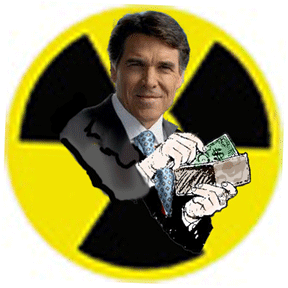
The text of that MOU has never been made public, and nothing much happened as a result of it until last week. Then, Energy Secretary Rick Perry, after meeting senior officials in the kingdom, urged the Saudis to choose a U.S.-based vendor, Westinghouse Electric Co., to participate in the nuclear energy program to which the Saudis have long been committed.
The Energy Department’s official statement about Perry’s talks with Khalid Al-Falih, Saudi Minister of Energy, Industry, and Mineral Resources, did not use the word “nuclear,” but numerous reports from the region said the Saudis heard Perry’s arguments for Westinghouse and were receptive to them.
“We heard that message that … ‘we want the United States to be our partner in this’,” Perry told the Reuters news agency. Westinghouse spokeswoman Sarah Casella said in a statement to Bloomberg News that “Westinghouse is pleased that Saudi Arabia has decided to pursue nuclear energy. We are fully participating in their request for information and are pleased to provide the AP1000 plant, the industry’s most advanced technology.” The Energy Department did not respond to several requests to go beyond its original statement or to confirm Perry’s reported remarks, but neither has it denied them.
There was a time when the words “nuclear” and “Saudi Arabia” in the same sentence would set off alarms all over Washington, because any such development in Saudi Arabia is bound to raise fears that the Saudis would use their program to develop nuclear weapons to counter what they fear is happening in Iran……….
Saudi Arabia has discussed nuclear development with China, Russia, and France, among other potential suppliers.
Under U.S. law, Westinghouse or any other U.S.-based vendor can sell material and technology to Saudi Arabia only after the two countries negotiate a nuclear cooperation agreement, known as a 123 Agreement for the section of the law setting the requirement. The U.S.-Abu Dhabi agreement is known in the industry as the “gold standard,” because the government of the United Arab Emirates agreed to forgo both ends of the nuclear fuel cycle–it will neither enrich its own uranium nor reprocess its spent fuel to extract the plutonium.
The Saudis have made clear that they do not want to accept the same restrictions because their country has extensive uranium resources, which they want to process domestically. In articles in the trade press in 2010, an executive of a Finnish firm that was consulting with the Saudis on their program said that it could eventually include enrichment of uranium.
That was a non-starter while Barack Obama was president, but reports of Perry’s commitment to expedite an agreement have ignited speculation that the United States is preparing to soften its terms to accommodate the Saudis on this point, especially because of the close ties that have developed between the Trump administration and Crown Prince Mohammed bin Salman, the kingdom’s de facto ruler…….
Daryl Kimball, executive director of the Arms Control Association, said in a statement that “The Trump administration’s willingness bend key rules and standards designed to restrict the spread of sensitive nuclear technologies that can be used to make nuclear weapons to in order to help U.S. companies profit from nuclear commerce with Saudi Arabia is disturbing and counterproductive.” He said Congress, “which will have to review any such agreement, should insist on the highest possible nonproliferation standards for nuclear commerce, especially in a troubled and unstable region.”……..https://lobelog.com/u-s-to-boost-saudi-nuclear-power-development/
Westinghouse is looking for new markets after bankruptcy
Past deals barred uranium enrichment for overseas projects
The Trump administration is encouraging Saudi Arabia to consider bids by Westinghouse Electric Co. and other U.S. companies to build nuclear reactors in that country and may allow the enrichment of uranium as part of that deal, according to three people familiar with the plans.
Energy Secretary Rick Perry visited Saudi Arabia this month where the projects were discussed, according to two people. The people familiar asked not to be identified discussing the confidential negotiations.
Previous U.S. agreements have prohibited the enrichment and reprocessing of uranium, and that had scuttled negotiations to use U.S. technology in Saudi nuclear projects during the Obama administration. The administration is mulling easing that requirement now as a way to help Westinghouse and other companies win Saudi Arabian contracts, two people said.
A meeting to hammer out details of the nuclear cooperation agreement, known as a 123 Agreement for the section of the U.S. Atomic Energy Act that requires it, will be held at the White House Wednesday, two administration officials said.
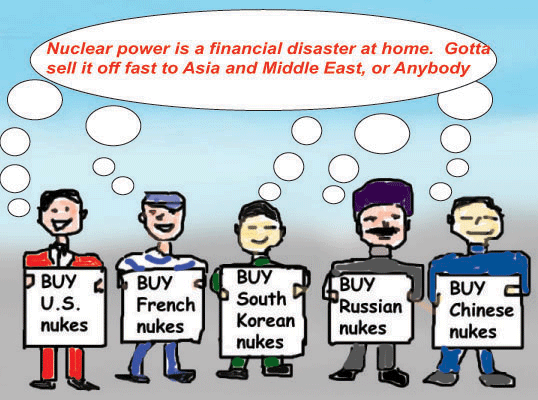
A successful U.S. bid would help deliver on President Donald Trump’s promise to revive and revitalize the domestic nuclear industry, helping American companies edge out Russian and Chinese competitors to build new fleets around the world. Saudi Arabia plans to construct 16 nuclear power reactors over the next 20 to 25 years at a cost of more than $80 billion, according to the World Nuclear Association.
Westinghouse, the nuclear technology pioneer that is part of Toshiba Corp., went bankrupt in March, after it hit delays with its AP1000 reactors at two U.S. plants. After it declared bankruptcy, Westinghouse — whose technology is used in more than half the world’s nuclear power plants — said it shifted its focus to expanding outside the U.S.
Winning contracts in Saudi Arabia could provide a new market that Westinghouse needs and provide at least a partial vindication for the investment in the AP1000 technology.
“Westinghouse is pleased that Saudi Arabia has decided to pursue nuclear energy,” Sarah Cassella, a spokeswoman, said in a emailed statement. “We are fully participating in their request for information and are pleased to provide the AP1000 plant, the industry’s most advanced technology.”
Daryl Kimball, executive director of the Washington-based Arms Control Association, said weakening the prohibition against enrichment and reprocessing, often referred to as “the gold standard,” is disturbing given what he said was Saudi Arabia’s “sub-par nuclear nonproliferation record.”
“We shouldn’t compromise our longstanding efforts to stop the spread of nuclear weapons in order to play favorites with certain companies or countries,” he said in an email, calling the idea “disturbing and counterproductive.”
Beyond Nuclear 6th Dec 2017, Saudi Arabia’s Energy Minister Khalid al-Falih is extending invitations
to the U.S. nuclear industry to launch the Gulf Region’s most ambitious
nuclear power program. The Saudi atomic energy plan is to build as many as
17 nuclear power plants by 2032. The Saudi Arabia government has stated
that its atomic power program will be “self-sufficient” in the
production of nuclear fuel at 5% enriched uranium-235 and purely directed
for civilian power development.
The pronouncement comes as Saudi energy officials remain silent on their past refusal to not pursue high-grade
uranium enrichment and plutonium reprocessing technologies as military
weapons production facilities. In any case, the introduction of nuclear
materials will significantly increase instability and tensions in the
region. http://www.beyondnuclear.org/home/2017/12/6/us-nuclear-companies-invited-to-help-launch-saudi-arabias-da.html
U.S. Firms Courting Saudi Arabia to Build Nuclear Reactors; Rick Perry to Visit Riyadh, Haaretz, 3 Dec 17, One of the sources also said Riyadh had told Washington it does not want to forfeit the possibility of one day enriching uranium – a process that can have military uses.
U.S. firms attracted by Saudi Arabia’s plans to build nuclear reactors are pushing Washington to restart talks with Riyadh on an agreement to help the kingdom develop atomic energy, three industry sources said.
Saudi Arabia has welcomed the lobbying, they said, though it is likely to worry regional rival Iran at a time when tensions are already high in the Middle East.
One of the sources also said Riyadh had told Washington it does not want to forfeit the possibility of one day enriching uranium – a process that can have military uses – though this is a standard condition of U.S. civil nuclear cooperation pacts. “They want to secure enrichment if down the line they want to do it,” the source, who is in contact with Saudi and U.S. officials, said before U.S. Energy Secretary Rick Perry, the former Governor of Texas and “Dancing with the Stars” contestant, holds talks in Riyadh early next week.
Another of the industry sources said Saudi Arabia and the United States had already held initial talks about a nuclear cooperation pact. U.S. officials and Saudi officials responsible for nuclear energy issues declined to comment for this article. The sources did not identify the U.S. firms involved in the lobbying.
Under Article 123 of the U.S. Atomic Energy Act, a peaceful cooperation agreement is required for the transfer of nuclear materials, technology and equipment. In previous talks, Saudi Arabia has refused to sign up to any agreement with the United States that would deprive the kingdom of the possibility of one day enriching uranium. Saudi Arabia, the world’s top oil producer, says it wants nuclear power solely for peaceful uses – to produce electricity at home so that it can export more crude. It has not yet acquired nuclear power or enrichment technology.
Riyadh sent a request for information to nuclear reactor suppliers in October in a first step towards opening a multi-billion-dollar tender for two nuclear power reactors, and plans to award the first construction contract in 2018.
Reuters has reported that Westinghouse is in talks with other U.S.-based companies to form a consortium for the bid. A downturn in the U.S. nuclear industry makes business abroad increasingly valuable for American firms.
Reactors need uranium enriched to around 5 percent purity but the same technology in this process can also be used to enrich the heavy metal to a higher, weapons-grade level. This has been at the heart of Western and regional concerns over the nuclear work of Iran, which enriches uranium domestically.
Riyadh’s main reason to leave the door open to enrichment in the future may be political – to ensure the Sunni Muslim kingdom has the same possibility of enriching uranium as Shi’ite Muslim Iran, industry sources and analysts say.
Potential problem for Washington
Saudi Arabia’s position poses a potential problem for the United States, which has strengthened ties with the kingdom under President Donald Trump……….https://www.haaretz.com/us-news/1.826436
Saudi Arabia has welcomed the lobbying, they said, though it is likely to worry regional rival Iran at a time when tensions are already high in the Middle East.
One of the sources also said Riyadh had told Washington it does not want to forfeit the possibility of one day enriching uranium – a process that can have military uses – though this is a standard condition of U.S. civil nuclear cooperation pacts.
“They want to secure enrichment if down the line they want to do it,” the source, who is in contact with Saudi and U.S. officials, said before U.S. Energy Secretary Rick Perry holds talks in Riyadh early next week.
Another of the industry sources said Saudi Arabia and the United States had already held initial talks about a nuclear cooperation pact.
U.S. officials and Saudi officials responsible for nuclear energy issues declined to comment for this article. The sources did not identify the U.S. firms involved in the lobbying.
Under Article 123 of the U.S. Atomic Energy Act, a peaceful cooperation agreement is required for the transfer of nuclear materials, technology and equipment.
In previous talks, Saudi Arabia has refused to sign up to any agreement with the United States that would deprive the kingdom of the possibility of one day enriching uranium.
Saudi Arabia, the world’s top oil producer, says it wants nuclear power solely for peaceful uses – to produce electricity at home so that it can export more crude. It has not yet acquired nuclear power or enrichment technology.
Riyadh sent a request for information to nuclear reactor suppliers in October in a first step towards opening a multi-billion-dollar tender for two nuclear power reactors, and plans to award the first construction contract in 2018.
Reuters has reported that Westinghouse is in talks with other U.S.-based companies to form a consortium for the bid. A downturn in the U.S. nuclear industry makes business abroad increasingly valuable for American firms.
Reactors need uranium enriched to around 5 percent purity but the same technology in this process can also be used to enrich the heavy metal to a higher, weapons-grade level. This has been at the heart of Western and regional concerns over the nuclear work of Iran, which enriches uranium domestically.
Riyadh’s main reason to leave the door open to enrichment in the future may be political – to ensure the Sunni Muslim kingdom has the same possibility of enriching uranium as Shi‘ite Muslim Iran, industry sources and analysts say.
POTENTIAL PROBLEM FOR WASHINGTON
Saudi Arabia’s position poses a potential problem for the United States, which has strengthened ties with the kingdom under President Donald Trump.
Washington usually requires a country to sign a nuclear cooperation pact – known as a 123 agreement – that forfeits steps in fuel production with potential bomb-making uses.
“Doing less than this would undermine U.S. credibility and risk the increased spread of nuclear weapons capabilities to Saudi Arabia and the region,” said David Albright, a former U.N. weapons inspector and president of the Washington-based Institute for Science and International Security (ISIS).
It is not clear whether Riyadh will raise the issue during Perry’s visit, which one of the industry sources said could include discussion of nuclear export controls.
Under a nuclear deal Iran signed in 2015 with world powers – but which Trump has said he might pull the United States out of – Tehran can enrich uranium to around the level needed for commercial power-generation.
It would be “a huge change of policy” for Washington to allow Saudi Arabia the right to enrich uranium, said Mark Fitzpatrick, executive director of the Americas office at the International Institute for Strategic Studies think tank.
“Applying the ‘golden standard’ of not allowing enrichment or preprocessing (of spent fuel) has held up a 123 agreement with Jordan for many years, and has been a key issue in U.S. nuclear cooperation with South Korea,” said Fitzpatrick, a nuclear policy expert.
The United States is likely to aim for restrictions, non-proliferation analysts say.
These could be based on those included in the 123 agreement Washington signed in 2009 with the United Arab Emirates, which is set to start up its first South Korean-built reactor in 2018 and has ruled out enrichment and reprocessing.
“Perhaps Saudi Arabia is testing the Trump administration and seeing if the administration would be amenable to fewer restrictions in a 123 agreement,” ISIS’s Albright said.
It would be “a huge change of policy” for Washington to allow Saudi Arabia the right to enrich uranium, said Mark Fitzpatrick, executive director of the Americas office at the International Institute for Strategic Studies think tank.
“Applying the ‘golden standard’ of not allowing enrichment or preprocessing (of spent fuel) has held up a 123 agreement with Jordan for many years, and has been a key issue in U.S. nuclear cooperation with South Korea,” said Fitzpatrick, a nuclear policy expert.
The United States is likely to aim for restrictions, non-proliferation analysts say.
These could be based on those included in the 123 agreement Washington signed in 2009 with the United Arab Emirates, which is set to start up its first South Korean-built reactor in 2018 and has ruled out enrichment and reprocessing.
“Perhaps Saudi Arabia is testing the Trump administration and seeing if the administration would be amenable to fewer restrictions in a 123 agreement,” ISIS’s Albright said.
Is Saudi Arabia also amongst the terrorists? The News, Nigeria Dec 1 2017 By Owei Lakemfa.
I am fascinated by Saudi Arabia. It does not care what others say or think. It simply pursues its own goals and policies, submitting to no other than its master, the United States of America. To it, women are legally inferior to men and no amount of human or women rights campaigns will change that………
When I was in the International Labour Organisation (ILO) Governing Body, there were constant complaints against Saudi Arabia violating all known labour laws against migrant workers. They simply sack or deport tens of thousands especially Indians, Filipinos, Ethiopians and Pakistanis, without paying them backlog of salaries. In one operation, after rounding up migrant workers for deportation without salaries, the Saudis simply forgot them for days, leaving them stranded without water or food.
Many do not sanction capital punishment, but for the Saudis, it is a way of life. A human being can be beheaded for a sundry of reasons including murder, treason, espionage and rape. But there are others like apostasy and blasphemy. If you are an atheist, and so disclose, your head is severed. It is difficult to prove sorcery and witchcraft, but if a person is in possession of talisman, according to the Saudis, he is guilty, and is a candidate for execution. Execution is primarily, beheading with a sword called SULTHAN and the most infamous star in that art is Muhammad Saad al-Beshi, who described his first execution in 1998: “The criminal was tied and blindfolded. With one stroke of the sword I severed his head. It rolled metres away…People are amazed how fast [the sword] can separate the head from the body.”……….
the Israeli Energy Minister, Yuval Steinitz disclosed that Israel had held covert meetings with Saudi Arabia on how to jointly fight Iran. There is no love lost between Saudi Arabia which sees itself as the custodian of the Sunni Movement, and Iran which sees itself as the guardian of the Shiite Movement. So can this be the policy of ‘My enemy’s enemy, is my friend’? It should come as a surprise that a Muslim country is working out an alliance with a Jewish state to attack a sister Muslim country.
Saudi Arabia does not waste time rolling out its military might to achieve political goals. For this, it invaded Bahrain in 1994, and when there was a popular revolt against the Al-Khalifa Monarchy, Saudi Arabia on March 14, 2011, again invaded Bahrain and crushed the protests.
But it is in Yemen Saudi Arabia has most displayed it its military prowess. There had been an uprising against the government of President Abed Rabbo Mansour Hadi. A combination of Houthi rebels and Yemeni military loyal to former President Ali Abdullah Saleh, had removed Hadi. An angry Saudi Arabia fell on Yemen bombing large parts into near extinction. Everything is game to the Saudi bombers which first obliterated schools and hospitals then turned its fury on any gathering; markets, weddings, even funerals. It also imposed a blockade. Over 12,000 Yemeni civilians have been killed. 3.3 million children and nursing mothers are suffering from acute malnutrition, and cholera is rampant, yet Saudi Arabia and its allies will not relent. The cemeteries are over flowing so much that a good foreign investment in Yemen would be the building of new cemeteries.
Nobody is talking about crimes against humanity because the Saudis have powerful friends in the United Nations and “international community’ Many want a slice of the huge Saudi arms budget. When American President Donald Trump visited Riyadh this May, he smiled home with a $350 Billion arms contract for his country. With this, it was not difficult to get America endorse Saudi Arabia’s illegal blockade and sanctions against tiny Qatar who was told to either accept a 13-Point Saudi Demand including the closure of Al Jazeera, or face annihilation………. http://thenewsnigeria.com.ng/2017/12/is-saudi-arabia-also-amongst-the-terrorists/
White House May Share Nuclear Power Technology With Saudi Arabia, The overture follows an intense and secretive lobbying push involving Michael Flynn, Tom Barrack, Rick Gates and even Iran-Contra figure Robert McFarlane. Pro Publica by Isaac Arnsdorf, The Trump administration is holding talks on providing nuclear technology to Saudi Arabia — a move that critics say could upend decades of U.S. policy and lead to an arms race in the Middle East.
The Saudi government wants nuclear power to free up more oil for export, but current and former American officials suspect the country’s leaders also want to keep up with the enrichment capabilities of their rival, Iran.
Saudi Arabia needs approval from the U.S. in order to receive sensitive American technology. Past negotiations broke down because the Saudi government wouldn’t commit to certain safeguards against eventually using the technology for weapons.
Now the Trump administration has reopened those talks and might not insist on the same precautions. At a Senate hearing on Nov. 28, Christopher Ford, the National Security Council’s senior director for weapons of mass destruction and counterproliferation, disclosed that the U.S. is discussing the issue with the Saudi government. He called the safeguards a “desired outcome” but didn’t commit to them.
Abandoning the safeguards would set up a showdown with powerful skeptics in Congress. “It could be a hell of a fight,” one senior Democratic congressional aide said.
The idea of sharing nuclear technology with Saudi Arabia took an unlikely path to the highest levels of government. An eccentric inventor and a murky group of retired military brass — most of them with plenty of medals but no experience in commercial nuclear energy — have peddled various incarnations of the plan for years.
Many U.S. officials didn’t think the idea was serious, reputable or in the national interest. “It smelled so bad I said I never wanted to be anywhere close to that,” one former White House official said. But the proponents persisted, and finally found an opening in the chaotic early days of the Trump administration, when advisers Michael Flynn and Tom Barrack championed the idea……
In 2008, the Saudi government made a nonbinding commitment not to pursue enrichment and reprocessing. They then entered negotiations with the U.S. for a pact on peaceful nuclear cooperation, known as a 123 agreement, after a section of the Atomic Energy Act of 1954. A 123 agreement is a prerequisite for receiving American technology.
The talks stalled a few years later because the Saudi government backed away from its pledge not to pursue enrichment and reprocessing, according to current and former officials. “They wouldn’t commit, and it was a sticking point,” said Max Bergmann, a former special assistant to the undersecretary of state for arms control and international security at the time those negotiations occurred……..
The Obama administration held firm with the Saudis because it’s one thing to cap nuclear technology where it already exists, but it’s longstanding U.S. policy not to spread the technology to new countries. As Saudi Arabia and Iran — ideological and religious opponents — increasingly squared off in a battle for political sway in the Middle East, Republicans argued that the Obama administration had it backwards: It was enshrining hostile Iran’s ability to enrich uranium while denying the same to America’s ally Saudi Arabia.
One such critic of Obama’s Iran policy was Michael Flynn, a lieutenant general who was forced out as head of the Defense Intelligence Agency in 2014. Flynn quickly took up a variety of consulting assignments and joined some corporate boards. One of the former was an advisory position for a company called ACU Strategic Partners, which, according to a later financial disclosure, paid Flynn more than $5,000.
Flynn was one of many retired military officers whom ACU recruited. ACU’s chief was a man named Alex Copson, who is most often described in press accounts as a “colorful British-American dealmaker.” Copson reportedly made a fortune inventing a piece of diving equipment, may or may not have been a bass player in the band Iron Butterfly, and has been touting wildly ambitious nuclear-power plans since the 1980s. (He didn’t answer repeated requests for comment.)
By 2015, Copson was telling people he had a group of U.S., European, Arab and Russian companies that would build as many as 40 nuclear reactors in Egypt, Jordan and Saudi Arabia. Copson’s company pitched the Obama administration, but officials figured he didn’t really have the backers he claimed. “They would say ‘We have Rolls-Royce on board,’ and then someone would ask Rolls-Royce and they would say, ‘No, we took a meeting and nothing happened,’” recalled a then-White House official.
In his role with ACU, Flynn flew to Egypt to convince officials there to hold off on a Russian offer (this one unrelated to ACU) to build nuclear power plants. Flynn tried to persuade the Egyptian government to consider Copson’s proposal instead, according to documents released by Rep. Elijah Cummings, the ranking Democrat on the House Oversight and Government Reform Committee. Flynn also tried to persuade the Israeli government to support the plan and spoke at a conference in Saudi Arabia. (The trip would later present legal problems for Flynn because he didn’t report contacts with foreign officials on his application to renew his security clearance, according to Cummings. Cummings referred the information to Robert Mueller, the special counsel investigating Trump’s associates and Russia’s interference in the 2016 election. Flynn’s lawyer declined to comment.)
Copson’s outfit eventually splintered. A retired admiral named Michael Hewitt, who was to head up the security services part of the project, struck out on his own in mid-2016. Flynn went with him.
Hewitt’s new company is called IP3 International, which is short for “International Peace Power & Prosperity.” IP3 signed up other prominent national security alumni including Gens. Keith Alexander, Jack Keane and James Cartwright, former Middle East envoy Dennis Ross, Bush Homeland Security adviser Fran Townsend, and Reagan National Security adviser Robert “Bud” McFarlane.
IP3’s idea was a variation on ACU’s. Hewitt swapped out one notional foreign partner for another (Russia was out, China was in), then later shifted to an all-American approach. That idea resonated with the U.S. nuclear-construction industry, which never recovered from the Three Mile Island disaster in the 1970s and was looking to new markets overseas.
But nuclear exports are tightly controlled because the technology is potentially so dangerous. A 123 agreement is only the first step for a foreign country that wants to employ U.S. nuclear-power technology. In addition, the Energy Department has to approve the transfer of technology related to nuclear reactors and fuel. The Nuclear Regulatory Commission licenses reactor equipment, and the Commerce Department reviews exports for equipment throughout the rest of the power plant.
IP3 — whose sole project to date is the Saudi nuclear plan — never went through those normal channels. Instead, the company went straight to the top.
At the start of the Trump administration, IP3 found an ally in Tom Barrack, the new president’s close friend and informal adviser and an ultra-wealthy investor in his own right. During the campaign, Barrack wrote a series of white papers proposing a new approach to the Middle East in which economic cooperation would theoretically reduce the conditions for breeding terrorism and lead to improved relations.
Barrack wasn’t familiar with nuclear power as an option for the Middle East until he heard from Bud McFarlane. McFarlane, 80, is most remembered for his role in the defining scandal of the Reagan years: secretly selling arms to Iran and using the money to support Nicaraguan rebels. He pleaded guilty to withholding information from Congress but was pardoned by George H.W. Bush.
Nevertheless, Barrack was dazzled by McFarlane and his IP3 colleagues. “I was like a kid in a candy shop — these guys were all generals and admirals,” Barrack said in an interview. “They found an advocate in me in saying I was keen on trying to establish a realignment of U.S. business interests with the Gulf’s business interests.”
McFarlane followed up the meeting by emailing Flynn in late January, according to six people who read the message or were told about it. McFarlane attached two documents. One outlined IP3’s plan, describing it as consistent with Trump’s philosophy. The second was a draft memo for the president to sign that would officially endorse the plan and instruct his cabinet secretaries to implement it. Barrack would take charge of the project as the interagency coordinator. Barrack had discussions about becoming ambassador to Egypt or a special envoy to the Middle East but never committed to such a role. (McFarlane disputed that account but repeatedly declined to specify any inaccuracies. IP3 declined to comment on the memos.)
Flynn, now on the receiving end of IP3’s lobbying, told his staff to put together a formal proposal to present to Trump for his signature, according to current and former officials.
The seeming end run sparked alarm. National Security Council staff brought the proposal to the attention of the agency’s lawyers, five people said, because they were concerned about the plan and how it was being advanced. Ordinarily, before presenting such a sensitive proposal to the president, NSC staff would consult with experts throughout government about practical and legal concerns. Bypassing those procedures raised the risks that private interests might use the White House to their own advantage, former officials said. “Circumventing that process has the ability not only to invite decisions that aren’t fully vetted but that are potentially unwise and have the potential to put our interests and our people at risk,” said Ned Price, a former CIA analyst and NSC spokesman.
Even after those concerns were raised, Derek Harvey, then the NSC’s senior director for the Middle East, continued discussing the IP3 proposal with Barrack and his representative, Rick Gates, according to two people. Gates, a longtime associate of former Trump campaign chief Paul Manafort, worked for Barrack on Trump’s inaugural committee and then for Barrack’s investment company, Colony NorthStar.
By then, Barrack was no longer considering a government position. Instead, he and Gates were seeking investment ideas based on the administration’s Middle East policy. Barrack pondered the notion, for example, of buying a piece of Westinghouse, the bankrupt U.S. manufacturer of nuclear reactors. (Harvey, now on the staff of the House intelligence committee, declined to comment through a spokesman. In October, Mueller charged Manafort and Gates with 12 counts including conspiracy against the U.S., unregistered foreign lobbying, and money laundering. They both pleaded not guilty. Gates’ spokesman didn’t answer requests for comment.)
Ultimately, it wasn’t the NSC staff’s concerns that stalled IP3’s momentum. Rather, Jared Kushner, the president’s son-in-law and senior aide tasked with reviving a Middle East peace process, wanted to table the nuclear question in favor of simpler alliance-building measures with the Saudis, centered on Trump’s visit in May, according to a person familiar with the discussions. (A spokesperson for Kushner, asked for comment, had not provided one at the time this article was published; we’ll update the article if he provides one later.)
In recent months, the proposal has stirred back to life as the Saudi government kicked off a formal process to solicit bids for their first reactors. In October, the Saudis sent a request for information to the U.S., France, South Korea, Russia and China — the strongest signal yet that they’re serious about nuclear power.
The Saudi solicitation also gave IP3 the problem its solution was searching for. The company pivoted again, narrowing its pitch to organizing a consortium of U.S. companies to compete for the Saudi tender. IP3 won’t say which companies it has signed up. IP3 also won’t discuss the fees it hopes to receive if it were part of a Saudi nuclear plan, but it’s vying to supply cyber and physical site security for the plants. “IP3 has communicated its strategy to multiple government entities and policy makers in both the Obama and Trump administrations,” the company said in a statement. “We view these meetings and any documents relating to them as private, and we won’t discuss them.”
The Saudi steps lit a fire under administration officials. Leading the charge is Rick Perry, the energy secretary who famously proposed eliminating the department and then admitted he didn’t understand its function. (It includes dealing with nuclear power and weapons.) Perry had also heard IP3’s pitch, a person familiar with the situation said. In September, Perry met with Saudi delegates to an international atomic energy conference and discussed energy cooperation, according to a photo posted on his Facebook page. Perry’s spokeswoman didn’t answer requests for comment.
Other steps followed. Soon after, a senior State Department official flew to Riyadh to restart formal 123 negotiations, according to an industry source. (A State Department spokeswoman declined to comment.) In November, Energy and State Department officials joined a commercial delegation to Abu Dhabi led by the Nuclear Energy Institute, the industry’s main lobby in Washington. Assistant Secretary for Nuclear Energy Edward McGinnis said the administration wants to revitalize the U.S. nuclear energy industry, including by pursuing exports to Saudi Arabia. The Department of Commerce’s International Trade Administration and the Energy Department are organizing another industry visit in December to meet with Saudi officials, according to a notice obtained by ProPublica. And in the days before Thanksgiving, senior U.S. officials from several agencies met at the White House to discuss the policy, according to current and former officials.
The Trump administration hasn’t stated a position on whether it will let the Saudis have enrichment and reprocessing technology. An NSC spokesman declined to comment. But administration officials have begun sounding out advisers on how Congress might react to a deal that gives the Saudis enrichment and reprocessing, a person familiar with the discussions said.
Senators have started demanding answers. At the Nov. 28 hearing before the Senate Foreign Relations Committee, Ford, the NSC nonproliferation official who has been nominated to lead the State Department’s Bureau of International Security and Nonproliferation, testified that preliminary talks with the Saudis are underway but declined to discuss the details in public. As noted, Ford wouldn’t commit to barring the Saudi government from obtaining enrichment and reprocessing technology. “It remains U.S. policy, as it has been for some time, to seek the strongest possible nonproliferation protections in every instance,” he told the senators. “It is not a legal requirement. It is a desired outcome.” Ford added that the Iran deal makes it harder to insist on limiting other countries’ capabilities.
Sen. Ed Markey, the Massachusetts Democrat who led the questioning of Ford on this topic, seemed highly resistant to the idea of the U.S. helping Saudi Arabia get nuclear technology. “If we continue down this pathway,” he said, “then there’s a recipe for disaster which we are absolutely creating ourselves.” Markey also accused the administration of neglecting its statutory obligation to brief the committee on the negotiations. (The White House declined to comment.)
Any agreement, in this case with Saudi Arabia, would not require Senate approval. However, should an agreement be reached, Congress could kill the deal. The two houses would have 90 days to pass a joint resolution disapproving it. The committee’s ranking Democrat, Ben Cardin, suggested they wouldn’t accept a deal that lacked the same protections as the ones in the UAE’s agreement. “If we don’t draw a line in the Middle East, it’s going to be all-out proliferation,” he said. “We need to maintain the UAE’s standards in our 123 agreements. There’s just too many other countries that could start proliferating issues that could be against our national interest.”
Bob Corker, the committee’s chairman, has been a stickler on nonproliferation in the past; he criticized the Obama administration for not being tough enough. Corker isn’t running for reelection and has criticized Trump for being immature and reckless in foreign affairs, so he’s unlikely to shy away from a fight. (A spokesman declined to comment.) “The absence of a consistent policy weakens our nuclear nonproliferation efforts, and sends a mixed message to those nations we seek to prevent from gaining or enhancing such capability,” Corker said at a hearing in 2014. “Which standards can we expect the administration to reach for negotiating new agreements with Jordan or Saudi Arabia?” https://www.propublica.org/article/white-house-may-share-nuclear-power-technology-with-saudi-arabia
Reuters 29th Nov 2017, French state-controlled utility EDF intends to take part in a tender to
build two nuclear reactors in Saudi Arabia, two sources familiar with the
situation told Reuters.
Saudi Arabia, which wants to reduce domestic oil
consumption, is considering building 17.6 gigawatts of nuclear-fuelled
power generation capacity by 2032 and has sent a request for information to
international suppliers to build two reactors
Russia’s Rosatom hopes to win Saudi nuclear plants’ tender, DANANG, Vietnam, Nov 10 (Reuters) – Russian state nuclear company Rosatom hopes to win a tender announced by Saudi Arabia to build nuclear plants in the kingdom, Alexei Likhachyov, head of Rosatom, told reporters.
“As far as I understand, they (Saudi Arabia) should make a decision next year about the construction and a constructor. We hope it will be us,” he said.
Rosatom has sent initial proposals to Saudi Arabia for nuclear power generation and would make a bid if a tender is announced, the company said earlier this month.
Saudi Arabia is considering building 17.6 gigawatts of nuclear capacity by 2032, the equivalent of about 17 reactors, making it one of the biggest prospects for an industry struggling after the 2011 nuclear disaster in Japan. (Reporting by Denis Pinchuk; writing by Katya Golubkova; editing by Vladimir Soldatkin)DANANG, Vietnam, Nov 10 (Reuters) – Russian state nuclear company Rosatom hopes to win a tender announced by Saudi Arabia to build nuclear plants in the kingdom, Alexei Likhachyov, head of Rosatom, told reporters.
“As far as I understand, they (Saudi Arabia) should make a decision next year about the construction and a constructor. We hope it will be us,” he said.
Rosatom has sent initial proposals to Saudi Arabia for nuclear power generation and would make a bid if a tender is announced, the company said earlier this month.
Saudi Arabia is considering building 17.6 gigawatts of nuclear capacity by 2032, the equivalent of about 17 reactors, making it one of the biggest prospects for an industry struggling after the 2011 nuclear disaster in Japan. (Reporting by Denis Pinchuk; writing by Katya Golubkova; editing by Vladimir Soldatkin)
SAUDI Arabia has announced plans to go nuclear and extract uranium domestically in order to develop its nuclear power programme amid rising tensions over North Korea’s missile ambitions. Express UK By WILL KIRBYA senior government official insisted the uranium would only be used for “peaceful purposes” to allow the oil-rich nation to diversify its energy supply.
It comes amid soaring tensions on the Korean peninsula as Kim Jong-un continues to build his nuclear arsenal threatening the outbreak of World War 3.
But Saudi Arabia insists its nuclear power plans are for peaceful purposes.
Saudi Arabia is working towards “self-sufficiency” in producing atomic fuel, a senior official explained, and extracting its own uranium makes economic sense before it starts building its first nuclear reactors next year.
by Utilities ME Staff on Oct 3, 2017Saudi Arabia is said to be seeking out international partners to further its development plans within the nuclear and atomic energy sector.
The president of King Abdullah City for Atomic and Renewable Energy (KACARE) is reported to have held “high-level meetings with representatives of Russian, US, Japanese, and South Korean delegations” to review how they may support the kingdom’s plans to implement the National Atomic Energy Project.
Kingdom launched a renewable energy programme this year, and winning bid for first utility-scale solar project is due in November
Khobar, Saudi Arabia: Saudi Arabia and China are to cooperate on nuclear energy projects following discussions between the two countries this week on ways to support the kingdom’s nuclear energy programme, state news agency SPA reported.
Saudi Arabia has been for years trying to diversify its energy mix so that it can export more of its oil, rather than burning it at power and water desalination plants.
It launched a renewable energy programme this year with the announcement of the winning bid for its first utility-scale solar project due in November.
In addition to that programme, Riyadh is in the early stages of feasibility and design studies for its first two commercial nuclear reactors, which will total 2.8 gigawatts.
China’s leading state nuclear project developer China National Nuclear Corp (CNNC) has now signed a memorandum of understanding with the Saudi Geological Survey (SGS) to promote further existing cooperation between the two sides to explore and assess uranium and thorium resources, SPA said…….
the genius idea developed by Flynn and Co. was a U.S.-Russian partnership to build and operate nuclear plants and export the dangerous spent fuel under strict controls
It would be “funded entirely by Saudi Arabia and other Gulf countries”The kingdom’s upfront cost? “Close to a trillion dollars”
the Saudis would recoup their costs by selling energy to Egypt, Jordan, Yemen and Gulf Cooperation Council (GCC) members Kuwait, Bahrain, Oman, the United Arab Emirates and Qatar—
MICHAEL FLYNN, RUSSIA AND A GRAND SCHEME TO BUILD NUCLEAR POWER PLANTS IN SAUDI ARABIA AND THE AND THE ARAB WORLD http://www.newsweek.com/flynn-russia-nuclear-energy-middle-east-iran-saudi-arabia-qatar-israel-donald-623396 BY JEFF STEIN ON 6/9/17 By the time Michael Flynn was fired as President Donald Trump’s nationalsecurity adviser in February, he had made a lot of bad decisions. One was taking money from the Russians (and failing to disclose it); another was taking money under the table from the Turks. But an overlooked line in his financial disclosure form, which he was forced to amend to detail those foreign payments, reveals he was also involved in one of the most audacious—and some say harebrained—schemes in recent memory:
a plan to build scores of U.S. nuclear power plants in the Middle East. As a safety measure.
In 2015 and 2016, according to his filing, Flynn was an adviser to X-Co Dynamics Inc./Iron Bridge Group, which at first glance looks like just another Pentagon consultancy that ex-military officers use to fatten their wallets. Its chairman and CEO was retired Admiral Michael Hewitt; another retiredadmiral, Frank “Skip” Bowman, who oversaw the Navy’s nuclear programs, was an adviser. Other top guns associated with it were former National Security Agency boss Keith Alexander and retired Marine Corps General James “Hoss” Cartwright, former vice chief of the Joint Chiefs of Staff, whose stellar career was marred when he was prosecuted last year for lying to the FBI during a leak investigation.
In the summer of 2015, knowledgeable sources tell Newsweek, Flynn flew to Egypt and Israel on behalf of X-Co/Iron Bridge. His mission: to gauge attitudes in Cairo and Jerusalem toward a fantastical plan for a joint U.S.-Russian (and Saudi-financed) program to get control over the Arab world’s rush to acquire nuclear power. At the core of their concern was a fear that states in the volatile Middle East would have inadequate security for the plants and safeguards for their radioactive waste—the stuff of nuclear bombs.
But no less a concern for Flynn and his partners was the moribund U.S. nuclear industry, which was losing out to Russian and even South Korean contractors in the region. Or as Stuart Solomon, a top executive along with Hewitt at his new venture, IP3 (International Peace, Power and Prosperity), put it in a recent speech to industry executives, “We find ourselves…standing on the sidelines and watching the competition pass us by.”
That the oil-rich, sun-soaked Arab Middle East would pursue nuclear energy seems paradoxical. But as The Economist noted in 2015, “Demand for electricity is rising, along with pressure to lower carbon emissions; nuclear plants tick both boxes.” And some of the region’s major players, like Egypt and Jordan, don’t have oil and gas resources and “want nuclear power to shore up the security of their energy supplies,” The Economist said.
So the genius idea developed by Flynn and Co. was a U.S.-Russian partnership to build and operate plants and export the dangerous spent fuel under strict controls. Flynn’s role would be helping X-Co/Iron Bridge design and implement a vast security network for the entire enterprise, according to an internal memo by ACU Strategic Partners, one of the lead companies involved, obtained by Newsweek.
Not only would the project revive the U.S. nuclear industry, but it would cost American taxpayers nothing, its principals asserted. It would be “funded entirely by Saudi Arabia and other Gulf countries,” according to the ACU memo. The kingdom’s upfront cost? “Close to a trillion dollars,” says a project insider, who asked for anonymity in exchange for discussing internal matters. Theoretically, the Saudis would recoup their costs by selling energy to Egypt, Jordan, Yemen and Gulf Cooperation Council (GCC) members Kuwait, Bahrain, Oman, the United Arab Emirates and Qatar—which hosts the largest U.S. military base in the region. (Qatar doesn’t seem to be an option for the moment, since six of the Arab states, led by the Saudis, severed diplomatic relations with it on June 5 over its alleged support of terrorism.)
Left out of this grand nuclear scheme: Iran (along with Syria, its war-ravaged Shiite proxy). In fact, “it was always part of the project that Russia’s involvement…would tilt Russia away from Iran,” Fred Johnson, ACU’s chief economist, wrote in an email to his advisers obtained by Newsweek. Not only would Russia earn cash for being a dumping ground for radioactive waste, Johnson wrote, but the consortium would purchase “Russian military hardware” to compensate Moscow for losing military sales to Iran.
“Further plans to sideline Iran,” Johnson wrote, included “the development of X-Co,” the Hewitt company that Flynn was advising, “with its very visible deployment of Sea Launch,” a Russian company “that would provide a platform for rockets.”
Attorney General Jeff Sessions talks with former National Security Advisor Michael Flynn inside of the inaugural parade reviewing stand in front of the White House on January 20, 2017 in Washington,
It’s unclear whether Flynn was involved in negotiating with Sea Launch. The former general, now being pursued by federal investigators probing contacts between Russian officials and Trump’s inner circle, did not respond to an inquiry from Newsweek. People associated with the Middle East project say they thought Flynn’s involvement was limited to sounding out the Egyptians and Israelis on security aspects of the enterprise. He listed no income from X-Co/Iron Bridge on his financial disclosure form and “was not paid,” except for his travel expenses, according to Thomas Cochran, a prominent scientist and nuclear nonproliferation proponent involved with the project. (The cost of business-class round-trip airfare and exclusive hotels for the trip would have ranged between $10,000 and $15,000.)
Hewitt denied that isolating Iran was part of the plan. “X-Co wasn’t created to simply ‘sideline Iran,’” he responded to Johnson and their associates in an email. “It was designed to set the conditions for stability which were the precursors to building 40 plants” and to “solidify the GCC, Jordan, Egypt under a security construct, led by two superpowers, using state of the art capability.”
But the project faced opposition from the Obama administration, Cochran says. “They didn’t want to do it with the Russians and didn’t want to do it while they were negotiating the Iran deal,” he tells Newsweek.
Trump’s embrace of Russian President Vladimir Putin, on the other hand, offered an attractive possibility. And when Flynn, who had connections to the Russians, became the candidate’s national security adviser, the ACU team, led by British-American dealmaker Alex Copson, suddenly seemed to have an inside man. Last year, Copson was touting such connections when he tried to buy an unfinished nuclear plant in Alabama in concert with the Russians, telling a Huntsville reporter that “Alabama’s two senators”—both Republicans, and one, Jeff Sessions, then a top Trump campaign adviser—“can help the next administration move this project forward.” Copson’s bid for the plant failed.
When reports surfaced that the FBI was investigating possible collusion between the Russians and the Trump campaign, however, some of Copson’s partners and advisers decided it was time to walk away. “When Copson decided he was going to saddle up with the Trump team, that was the last straw for me,” the insider says. “I said it’s time to regroup.”
The Saudis hadn’t shown much interest anyway, the insider says. “Copson was promising the advisers lots of money if the Saudis put up money,” but it failed to materialize. “And so there’s nothing that anyone was going to gain unless the project was a success,” he tells Newsweek.
Hewitt and his associates also split from ACU to pursue their own path toward a nuclear-powered Middle East, one that would swap in China for Russia as a nuclear partner, two sources close to the project say. (Hewitt declined to discuss plans for IP3, telling Newsweek he was “working hard to create our public persona right now.”)
But the highly regarded Cochran stayed with ACU. A longtime senior scientist at the Natural Resources Defense Council, where he was director of its nuclear program, Cochran was the author of countless studies and articles over the decades and had initiated with Moscow the U.S.-Soviet nuclear test ban verification project in 1986. He “has extraordinary chutzpah,” a writer for Scientific American observed in 1998. “He is willing to take on what most people wouldn’t bother with because they assume it’s hopeless.”
Or nuts. In 2001, a writer for the left-wing In These Times weekly got hold of a draft proposal for a 1990s-era project that Cochran was involved in, the Nuclear Proliferation Trust, which envisioned taking control of spent fuel from reactors around the world and shipping it to Russia “on large ships mounted with an arsenal of weapons designed to ward off nuclear pirates,” wrote Jeffrey St. Clair. “The big question is what happens to the waste after it arrives in Russia.” Would NPT guards be authorized to fire on rogue Russian soldiers or Chechen rebels? And what would stop corrupt Russians from selling weapons-grade uranium to anyone who could pony up the cash?
Similar concerns are all the more reason to partner with the Russians today in an ironclad security arrangement, Hewitt says. “We’re always going to be engaged in the security of the Middle East,” he told a May gathering at the Nuclear Energy Institute. “It is in our best interests to ensure that nuclear power is introduced with all of the safety [standards of the U.S.].”
Cochran urges critics not to lose focus on the big picture, which he alternately likens to launching the U.S. Marshall Plan, which rebuilt Europe after World War II, and the Tennessee Valley Authority, which tamed rivers and brought electricity and industrial development to the American South in the 1930s. “It would provide energy and jobs and so forth for countries like Egypt and others in the region,” he says, “so that these young men have got something more useful to do than go out and shoot each other.”
For a project fraught with such diplomatic and logistical minefields, however, Copson is an odd choice to lead ACU into the Middle East. “A sometime bass player with the British rock band Iron Butterfly,” according to Time, Copson once famously “described the natives of the Marshall Islands as ‘fat, lazy fucks’ when they nixed one of his nuke dump schemes” in the Central Pacific Ocean, the muckraking journalist Greg Palast wrote in 2001. (The islands are now disappearing under rising seas.)
Copson did not respond to several calls and emails asking for comment. But it’s not likely the Trump team, many of whom are under close scrutiny for their undisclosed Russian contacts, will be any help to Copson now. And the Saudis aren’t “taking the kind of steps that would be required to really get serious about setting up a civil nuclear-energy infrastructure,” says Tristan Volpe, a fellow in the Nuclear Policy Program of the Carnegie Endowment for International Peace in Washington, D.C.
Others suspect the Saudis are up to something more nefarious because of the U.S.-led nuclear deal with Iran. The Saudis “have big ambitions for nuclear,” says David Albright, president of the Institute for Science and International Security in Washington, D.C. “The issue is whether they cross over into any processing or enrichment” with secret partners like Pakistan or China, he says.
Flynn once expressed deep worries about a Saudi-Iranian nuclear arms race. In a January 2016 interview with Al-Jazeera, he sounded like Cochran, the elder statesman of the nonproliferation movement. “An entirely new economy is what this region needs,” he said, especially for the millions of unemployed young men living under corrupt autocracies and tempted by extremism. “You’ve got to give them something else to do. If you don’t, they’re going to turn on their own governments.”
But that was before he hitched up with Trump, who has embraced the Saudi monarchy and ratcheted up his rhetoric against Iran. Talk of a grand scheme to create jobs in the Middle East, meanwhile, has evaporated, with the Russia scandal enveloping not only Flynn but Trump’s entire presidency.
Correction: An earlier version of this story called Thomas Cochran a onetime president of the Natural Resources Defense Council. He was director of its nuclear program.
Saudis welcome Trump with gold medal, receive arms package, By JULIE PACE and JONATHAN LEMIRE, RIYADH, Saudi Arabia (AP), 21 May 17 — President Donald Trump basked in Saudi Arabia’s lavish royal welcome Saturday as he left behind, at least temporarily, the snowballing controversies dogging him in Washington. Trump rewarded his hosts with a $110 billion arms package aimed at bolstering Saudi security and a slew of business agreements.
“That was a tremendous day, tremendous investments in the United States,” Trump said during a meeting with Crown Prince Mohammed bin Nayef……..
Trump made no substantial remarks on his first day abroad and spent most of his time shuttling between opulent palace ballrooms with the king. The two were overheard discussing natural resources and arms, and Salman bemoaned the destruction caused by Syria’s civil war.
The most tangible agreement between the two leaders was the $110 billion sale of military equipment to Saudi Arabia that is effective immediately and could expand up to $350 billion over 10 years. The deal includes tanks, combat ships, missile defense systems, radar and communications, and cybersecurity technology. The State Department said the agreement could support “tens of thousands of new jobs in the United States.”
Trump was joined on the trip by the CEOs of several major U.S. companies, which announced their own agreements with the Saudis. Among them was a $15 billion arrangement with GE focused on power, oil and gas, and health care.
The president was trailed on the trip by a large number of advisers, including Tillerson, chief of staff Reince Priebus and chief strategist Steve Bannon. Trump’s son-in law, Jared Kushner, and daughter Ivanka, both senior advisers, were also part of the official delegation………https://www.apnews.com/0f8266623c3548e1952525d93011bd56
Saudis to Seek Bids for 700-Megawatt Wind and Solar Projects, Bloomberg, by Anthony Dipaola
April 11, 2017
Energy Ministry qualifies 51 companies to bid for power plants
First Solar, renewables unit of EDF among qualified companies
Saudi Arabia will begin seeking bids next week from renewable-energy companies to build wind and solar plants with a combined capacity of 700 megawatts as part of the kingdom’s $50 billion program to boost power generation and cut its oil consumption.
Energy Minister Khalid Al Falih will announce a request for proposals for the projects, the next phase in the country’s bidding process, at a conference next week in Riyadh, the ministry said Monday in an emailed statement. The ministry qualified 27 companies to bid for a 300-megawatt solar plant and 24 firms for a 400-megawatt wind farm.
The project is part of a plan to transform the Saudi economy by weaning it off oil and creating new industries. Other Middle Eastern countries including the United Arab Emirates, Jordan and Morocco are also developing renewable energy to curb fuel imports or conserve crude oil for export. Saudi Arabia plans to develop almost 10 gigawatts of renewables by 2023, requiring investment of $30 billion to $50 billion, Al-Falih said in January…….https://www.bloomberg.com/news/articles/2017-04-10/saudis-to-seek-bids-for-700-megawatt-wind-and-solar-projects





 It launched a renewable energy programme this year with the announcement of the winning bid for its first utility-scale solar project due in November.