Iran nuclear deal points to a better nuclear order
 The Iran Deal’s Building Blocks of a Better Nuclear Order, Carnegie Endowment For International Peace, GEORGE PERKOVICH June 9, 2016 The U.S. debate over the Iran nuclear deal focused primarily on whether the agreement’s terms were sufficient to prevent Iran from acquiring nuclear weapons, whether Iran would cheat, and whether Iran would use gains from sanctions relief to fund aggression against its neighbors and Israel. Practically no attention was paid in the media or in Congress to the possibility that the nuclear agreement, known as the Joint Comprehensive Plan of Action (JCPOA), could provide opportunities to strengthen the global nonproliferation regime. Of course, the potential to build on the agreement depends on its being successfully implemented; the deal’s collapse would create an international crisis that would subsume efforts to adopt its salutary provisions elsewhere.
It will take considerable time and patient give-and-take bargaining to persuade Russia and other influential players in nuclear diplomacy to build on the JCPOA, but there is no need to rush. Beyond the Republic of Korea, there are no other states on the near horizon that have the capability and intention to initiate a new fuel-cycle program.
The JCPOA innovatively fills in each of these lacunae in the NPT. While it does not settle or fully address these complex issues, it offers potentially important building blocks for doing so. For example, the JCPOA, in practice, establishes that the NPT does not a priori deny states the “right” to acquire and utilize capabilities to produce fissile materials for peaceful purposes. Critics have identified this as a major shortcoming. The agreement makes it easier for other states to insist that they, too, should be allowed to enrich uranium, which many observers fear could exacerbate proliferation risks. But the JCPOA also defines conditions, as well as monitoring and verification mechanisms, that would significantly bolster international confidence that a state’s fuel-cycle activities are exclusively peaceful.
Russia pushing United Arab Emirates to buy nuclear technology

 Nuclear power key for UAE energy security, Khaleej Times Sarakshi
  Rai/moscow June 5, 2016 Nuclear power is the best way for the world and the UAE to meet its energy demands, according to top nuclear energy professionals at the recently concluded Rosatom Atomexpo 2016.
Atomexpo is the largest exhibition venue for meetings and negotiations between world leaders in the nuclear power sector. This year’s exhibition and conference focused on new players entering the nuclear energy sector.
Mohamed Shaker, minister of electricity and mineral resources, Egypt; Hassan Mahmoud Hassanein, first deputy minister of electricity and mineral resources, Egypt; Khaled Toukan, chairman of Jordan Atomic Energy Commission; and Hashem Yamani, president of King Abdullah City for Atomic and Renewable Energy, Saudi Arabia; featured in day two of the conference at a panel discussion highlighting the future of nuclear power and new players…….
UN Agency Reports Iran Has Complied With Nuclear Deal

 UN Agency Reports Iran Has Complied With Nuclear Deal abc news, by GEORGE JAHN, ASSOCIATED PRESS VIENNA — May 27, 2016 Iran has corrected one violation of its landmark nuclear deal with six world powers and is honoring all other major obligations, the U.N. atomic energy agency reported Friday.
The U.N’s International Atomic Energy Agency is responsible for monitoring the agreement Iran signed last year with the United States, Russia, China, Britain, France and Germany that reduces and limits Tehran’s nuclear activities in exchange for sanctions relief…….http://abcnews.go.com/International/wireStory/agency-reports-iranian-violations-nuclear-deal-39423725
United Arab Emirates setting a solar power trend in the Gulf
 Could UAE solar push lead a trend for the Gulf? BY SAKET S. DUBAI (Thomson Reuters Foundation), 23 May 16 – As the Gulf states take steps to expand their use of clean energy, a bold plan by the United Arab Emirates to boost its use of renewable electricity from less than 1 percent to 24 percent in the next five years could be a game-changer for the region, experts say.
Much of the world is moving away from oil for its electricity generation, according to the International Energy Agency (IEA), which says that globally the fossil fuel has dropped from a 25 percent share to 3.6 percent over the last four decades…….
dropping oil prices and growing concerns about climate change have exposed the downsides of relying on oil. As the Gulf’s demand for power continues to rise, the UAE is leading the way in shifting to greener energy resources .
.
“The implications of unmitigated climate change for the UAE make its cities unbearably hot, water even more scarce and the region more unstable,” Rachel Kyte, the CEO of the United Nations’ Sustainable Energy for All initiative, told the Thomson Reuters Foundation.
“Action alone and collectively to live in balance with the planet is fundamental for UAE’s future prosperity,” she said.
SOLAR GIANT?
At the Middle East and North Africa Renewable Energy Conference in Kuwait last month, the Gulf Cooperation Council (GCC) states – Bahrain, Kuwait, Oman, Qatar, Saudi Arabia and the UAE – pledged to mobilize $100 billion into renewable energy projects over the next 20 years.
One of the projects in the UAE’s renewables push is the $13.6 billion Mohammed bin Rashid Al Maktoum Solar Park in Dubai, which aims to become the biggest solar power plant in the Middle East.
It is expected to generate 5 gigawatts of electricity – enough to power 1.5 million homes – by 2030.
Dubai also plans to install around 100 electric car charging stations as part of its Green Charger Initiative.
By 2050, Dubai wants to reduce its carbon emissions by 6.5 million tons every year, with the aim of becoming the city with the world’s lowest carbon footprint, according to the Dubai Electricity and Water Authority.
Meanwhile, Saudi Arabia has said it wants to add another 9.5 GW of renewable energy capacity to its current capacity of 80 GW by 2030, And Oman’s power sector regulator, the Authority for Electricity Regulation Oman, has announced it will expand rooftop soar installations across residential homes, industrial and commercial buildings.
In Qatar, French energy giant Total SA has announced a joint venture worth $500 million with state-run petroleum, electricity and water companies to develop a solar-power project with a capacity of 1,000 megawatts (MW).
And with a 70 MW solar project due to be operational by 2017, Kuwait plans to meet 15 percent of its energy needs with renewables by 2030, according to the Kuwait Institute of Scientific Research…..
The region already has some of the infrastructure it needs to become a major clean-power hub. The Gulf Cooperation Council countries are linked by a 1,200-km electrical grid, built to help provide backup power in case of a blackout in one part of the system.
Expanded to other countries, that electricity highway could be the backbone of future power trading, experts say.
“The Gulf has an exportable resource in solar energy that could eventually be on a comparable level to oil and gas,” said Jonathan Walters, a former director at the World Bank……..(Reporting by Saket S.; editing by Jumana Farouky and Laurie Goering http://www.reuters.com/article/us-emirates-solar-electricity-idUSKCN0YE1SJ
Middle Eastern nuclear stations and radioactive materials – a cause for anxiety
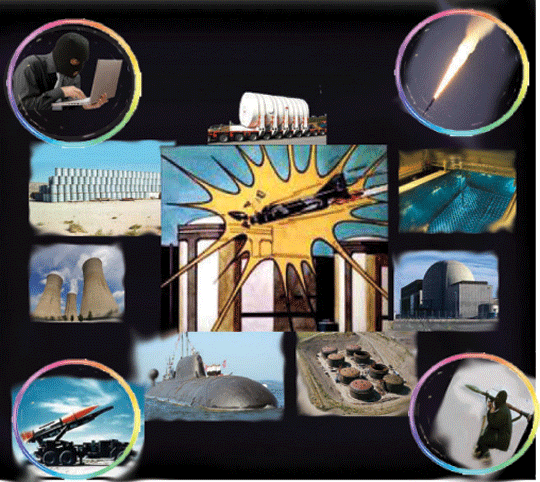 The Middle East: Culprit for my nuclear security insomnia http://thebulletin.org/what-path-nuclear-security-beyond-2016-summit/middle-east-culprit-my-nuclear-security-insomnia Nilsu Goren, 24 May 16,
What keeps me up at night—US East Coast time—is reading Turkey’s morning news concerning Syria and Iraq. The insomnia is especially severe when my thoughts turn to nuclear security not just in Syria and Iraq but in countries throughout the Middle East.
All participants in this roundtable agree that, despite the achievements of the Nuclear Security Summits, the threat of nuclear terrorism is not necessarily diminishing. In the Middle East, nuclear terrorism seems a particularly immediate concern. True, the region lacks large quantities of highly enriched uranium and plutonium. But its political instability and its tendency toward violent extremism are conditions that can enable nuclear terrorism.
According to the 2016 Nuclear Security Index, published by the Nuclear Threat Initiative (NTI), Middle Eastern nations rank poorly when it comes to safeguarding their nuclear materials from theft. Of the 24 countries that possess at least 1 kilogram of weapons-usable nuclear materials, two are Middle Eastern: Israel and Iran. The Index ranks these countries near the bottom of the theft-protection list. Israel comes in at number 20 and Iran at 23.
Among the 152 countries with less than 1 kilogram of weapons-usable nuclear materials, about a dozen are Middle Eastern. They are all over the lot in their vulnerability to theft—from the United Arab Emirates at number 24 to Syria at 151 (just above Somalia). Clearly, the region’s efforts to prevent nuclear theft are not strong enough.
Where vulnerability to nuclear sabotage is concerned, the Middle East does even worse. Of the 45 countries in NTI’s sabotage index, five are Middle Eastern. Israel—the highest-ranking of the five—comes in at number 36. Iran is tied with North Korea for last place.
And as my roundtable colleague Hubert Foy has discussed, concern about nuclear materials is not limited to fissile materials. Radiological sources are also an issue of pressing concern. The Middle East’s generally lax security environment, along with its political instability, makes the misuse of radiological sources more likely in this region than in many other places.
Civilian radiological sources are ubiquitous, particularly in medicine. They would be relatively easy to access in children’s hospitals, for example. Luckily, most radioactive sources are not easily dispersible. Their half-lives are short. They could contaminate only limited areas. Moreover, anyone attempting to steal an unshielded source might die from acute radiation exposure. Still, using a radiological source in a “dirty bomb” could create panic and terror in local populations. A dirty bomb would turn affected areas into no-go zones for a number of years, which would have profound economic repercussions.
Another reason to be concerned about Middle Eastern nuclear security is the planned expansion of nuclear power in the region. Some nations, pointing toward Iran’s limited right to enrich uranium under the Joint Comprehensive Plan of Action, will also wish to enrich uranium domestically. To be sure, such nations have the right to pursue the peaceful uses of nuclear energy, including uranium enrichment. But in order to alleviate international concerns about their enrichment capacity, these nations must develop robust laws regarding nuclear security. They must establish procedures for secure interim storage of nuclear materials. And they must make final disposition plans for spent fuel and radioactive waste.
The International Atomic Energy Agency can help with all of those tasks. It has the authority, resources, and expertise for the job. But a lot of work will nonetheless fall to state regulatory authorities. A key challenge will be for regulators to establish independence from political authorities. A key component of success, meanwhile, will be identifying nuclear security approaches appropriate to the region—via close cooperation between regulators and the nuclear industry. Here the Nuclear Security Summits can extend their legacy. The Nuclear Industry Summits that ran parallel to the Nuclear Security Summits offer a valuable model for including industry in the dialogue toward establishing good nuclear security practices in the Middle East.
No, the Iran nuclear deal is not unraveling
Is the Iran deal unraveling? Think again. Brookings, Suzanne Maloney | May 20, 2016Are the wheels coming off the Iran deal? Less than a year after Iran, America, and five other world powers inked a comprehensive nuclear accord, a debate over its terms has erupted anew.
In Washington, the braggadocio of a prominent White House aide is fueling Republican accusations thatPresident Obama deliberately deceived the Congress and the country about Iran and the deal. And in Tehran, frustration over the residual impact of American sanctions has prompted increasingly resentful accusations from Iranian leaders that the United States has failed to live up to its end of the bargain. As a result, some are fretting that the deal is “at risk” and are laying blame on the White House doorstep.
Both claims are spurious, and deserve a more forceful rebuttal from the Obama administration. In the end, however, the ruckus over recent comments by Deputy National Security Advisor Ben Rhodes is largely an inside-the-Beltway drama—one that provides endless entertainment for Washington insiders but has little real significance for deal or American diplomacy.
By contrast, Iran’s dissatisfaction presents a serious diplomatic dilemma for Washington. But it should not be interpreted as evidence that the deal is “unraveling.” Rather, the chorus of complaints from Tehran demonstrates the accord signed in July 2015 is working exactly as it was intended—forestalling Iranian nuclear ambitions while amplifying the incentives for further reintegration into the global economy. Continue reading
Russia to build Bushehr Nuclear Plant in Iran
 ‘A Partner We Can Trust’: Iran Chooses Russia to Build Bushehr Nuke Plant Russia’s State Atomic Energy Corporation, Rosatom, will start work on Iran’s Bushehr-2 nuclear power plant by the end of this year after the construction site preparations are completed……
Solar power for making fresh water
To Make Fresh Water without Warming the Planet, Countries Eye Solar Power https://www.technologyreview.com/s/601419/to-make-fresh-water-without-warming-the-planet-countries-eye-solar-power/ 20 may 16
In drought-ridden California, a $1 billion plant at Carlsbad, north of San Diego, will produce 54 million gallons of fresh water a day. The giant Sorek plant in Israel can crank out more than 160 million gallons a day (see “Megascale Desalination” and “Desalination Out of Desperation”). But these plants are a devil’s bargain; they use power from plants that, in most cases, emit greenhouse gases, ultimately worsening the problem of drought. Saudi Arabia, for instance, uses around 300,000 barrels of oil every day to desalinate seawater, providing some 60 percent of its fresh water supply. That’s not sustainable. Finding a way to produce fresh water without burning fossil fuels is critical not just for the desert countries of the Middle East but for a growing number of places around the world.
While the new solar-powered desalination plant in Dubai is quite small, next year a much larger one, at Al Khafji City in Saudi Arabia, is scheduled to come online. The Al Khafji plant will produce nearly 16 million gallons of fresh water a day, enough to supply the local population. The Spanish solar company Abengoa, which is building the plant along with the state-owned Saudi company Advanced Water Technology, calls it “the world’s first large-scale desalination plant to be powered by solar energy.”
Unfortunately, solar-powered desalination is expensive: as much as three times the cost of water from grid-powered plants, according to a World Bank report. Desalination plants need to run 24 hours a day, requiring expensive battery packs to supplement solar power when the sun’s not shining. Thanks to increased efficiency and the falling price of solar power, costs are expected to fall rapidly: from more than $50 per 1,000 gallons today, in the Middle East, to half of that by midcentury. But that’s still likely too much to make solar-powered desalination economically viable without government subsidies, even in places such as the Middle East that are optimal for solar power.
Another reason it’s so expensive is that big solar arrays need a lot of space. That means, though, that solar-powered desalination could be more economical in small settings. For example, in California’s drought-ridden Central Valley, the Water Technology Research Center at UCLA is building several solar-powered facilities that will desalinate brackish agricultural wastewater for towns that lack sufficient supplies of clean water. These facilities “are small enough for solar energy usage,” says UCLA professor Yoram Cohen, who heads the project. “You couldn’t do this in Carlsbad because real estate is too expensive.”
Advanced technologies could alter the equation as well. The Al Maktoum and Al Khafji plants simply substitute solar power for grid power in plants that use reverse osmosis, which pushes salt water through polymer membranes that trap salt ions while allowing water molecules to pass through. That’s an energy-intensive process. Plants that use heat generated by concentrated solar power arrays to distill seawater into fresh water could be comparable in cost and output to some grid-powered plants, according to the World Bank analysis.
One of the world’s oldest nuclear plants helped build the Jewish state’s secret nuclear arsenal
A textile factory with a differenceOne of the world’s oldest nuclear plants helped build the Jewish state’s secret nuclear arsenal

WITH its cupola dully glinting in the sun across kilometres of an exclusion zone in the Negev Desert, the nuclear reactor near the Israeli town of Dimona has for decades been the subject of intense speculation. Its bland official name, the Centre for Nuclear Research, belies a martial purpose. Foreign intelligence services, atomic scientists and a former Israeli employee claim that it is the source of fissile material used to make Israel’s nuclear weapons.
The country’s atomic secrets have always been closely guarded, so little is known about the plant at Dimona. However, officials at the Israel Atomic Energy Commission (IAEC) admitted at a scientific conference last month that the reactor is showing its age. An ultrasound inspection of the aluminium core found 1,537 small defects and cracks, they said. The lifetime of such a reactor is usually around 40 years. At 53, Dimona is one of the world’s oldest operating nuclear plants.
The reactor, which was supplied by France, was switched on 15 years after the establishment of the state of Israel. The embattled country’s first prime minister, David Ben-Gurion, insisted that Israel needed a nuclear deterrent. The programme was spearheaded by his assistant, Shimon Peres, and the main components were first activated in 1963. The government claimed that Dimona was a “textile plant”.
Many of the ancillary systems in the reactor have been renewed or replaced, but the core itself cannot be swapped out. The flaws that have been detected are closely monitored and there is no serious suggestion that the reactor is unsafe. Yet in most other countries it would have been deactivated long ago. Safety concerns will only increase with time.
Israel has never used its reactors for generating electricity. Along with the United States, France, Russia and China, it is one of the few countries believed to have acquired the nuclear “triad”. It can deliver nuclear weapons as bombs dropped from an aircraft, as warheads on a land-launched missile (since the 1970s) and on missiles fired from submarines.
The third leg of the triad is thought to have been added in 1999, when Israel received the first of six planned submarines. These were built and largely paid for by Germany. If, as reported, they can launch nuclear-tipped cruise missiles, this would give Israel a “second-strike” capability, allowing it to retaliate even if an enemy were to destroy its air bases and missile silos in a nuclear “first strike”. In January Prime Minister Binyamin Netanyahu said: “Our submarine fleet will act as a deterrent to our enemies who want to destroy us.”
Dimona’s defenders say it has both symbolic value (as a reminder that Israel will defend itself fiercely) and practical uses, too. It is a source of materials needed to maintain nuclear warheads, such as tritium (which decays, but could theoretically be produced or procured by other means). It is also the centre of a “secret kingdom” of scientists whose capabilities the government is loath to give up.
For nearly six decades, Israel’s policy of “nuclear opacity” has served it well. Its Arab neighbours are convinced it is a nuclear power, but Israel clings to the ambiguous formulation that it “will not be the first to introduce nuclear weapons to the region”, neither acknowledging nor denying its capabilities. With powerful neighbours still openly advocating its destruction, the Jewish state will keep its doomsday weapons. But its ageing reactor? Perhaps not.
Egypt goes into $25 billion nuclear debt to Russia
 Egypt gets $25 billion loan from Russia for nuclear plant http://www.theprovince.com/business/egypt+gets+billion+loan+from+russia+nuclear+plant/11930248/story.html BY THE ASSOCIATED PRESS MAY 19, 2016 CAIRO – Egypt has announced a $25 billion loan from Russia for the building of a nuclear power plant.
Thursday’s announcement came in a decree by President Abdel-Fattah el-Sissi. The Russian loan will cover 85 per cent of the expenses of the plant’s construction.
Egypt, which will cover the other 15 per cent, is to repay the loan over a 22-year period, starting in 2029, with a 3 per cent annual interest rate.
Egypt and Russia agreed in February 2015 to build the plant together and signed a memorandum of understanding on the project. But the relations between the two nations were badly impacted after the horrific Russian passenger plane crash in Sinai last October, when all 224 people on board were killed.
Egypt’s economy has plummeted amid a slump in the tourism sector.
United Arab Emirates sets up firm to operate first nuclear power plants
UAE sets up firm to operate first nuclear power plants, Arabian Business, 17 May 16, By Staff writer The Emirates Nuclear Energy Corporation (ENEC) has announced the formation of a new subsidiary called Nawah Energy Company to operate and maintain the UAE’s first nuclear reactors at Barakah.
The ENEC board of directors have mandated ENEC management to proceed with the formation of the operating company and to ensure the transfer and provision of all required resources to form the operating subsidiary, a statement said.
“The formation of Nawah as ENEC’s subsidiary operating company will bring greater focus towards the safe and quality delivery of Units 1-4 at Barakah,” the statement said.
It added that Nawah’s mission will be to “safely and reliably generate electricity from nuclear energy”, and aims to become a globally recognized nuclear utility in the safe operation of nuclear energy plants…….http://www.arabianbusiness.com/uae-sets-up-firm-operate-first-nuclear-power-plants-632003.html#.VzuUJjV97Gg
Nuclear Whistleblower Mordechai Vanunu – indicted yet again!
 Israel Indicts Nuclear Whistleblower Mordechai Vanunu http://www.nytimes.com/aponline/2016/05/08/world/middleeast/ap-ml-israel-nuclear-whistleblower.html?_r=0 By THE ASSOCIATED PRESS MAY 8, 2016, JERUSALEM — Israel has indicted Israeli nuclear whistleblower Mordecai Vanunu for meeting with American citizens in Jerusalem and violating other court-ordered restrictions.
When he was released from prison in 2004, Israel banned him from speaking with foreigners and leaving Israel, among other restrictions.
According to Sunday’s indictment, Vanunu met two Americans at a hotel in east Jerusalem in 2013, moved apartments without notifying Israeli authorities in 2014, and in 2015 told an Israeli TV anchor information related to his work at the nuclear reactor that he is forbidden from speaking about.
Saudi prince hints at possibility of getting nuclear weapons
Officials from the kingdom, which is party to the nuclear nonproliferation treaty, have raised that possibility in the past. However, they have more strongly stressed the need for the Middle East to be a “weapons of mass destruction free zone,” as Turki did at the event. …….http://www.wmtw.com/politics/saudi-prince-getting-nuclear-weapons-possible/39420576
50% fall in solar power price, over 16 months

 The price of solar power just fell 50% in 16 months – Dubai at $.0299/kWh!, Electrec, John Fitzgerald Weaver 2 May 16, Dubai received bid of $.0299/kWh for 800MW of solar power. This price represents the lowest yet recorded for solar power (and might not represent the end of the price drops…).
Dubai Electricity and Water Authority (DEWA) has received 5 bids from international organisations for the third phase of the Mohammed bin Rashid Al Maktoum Solar Park, said HE Saeed Mohammed AlTayer, MD & CEO of DEWA. The lowest recorded bid at the opening of the envelopes was US 2.99 cents per kilowatt hour. The next step in the bidding process will review the technical and commercial aspects of the bids to select the best one.
In the USA, in 2014 and with incentives, utility scale solar projects averaged $.05/kWh. On this bid alone, five companies bid below $.045/kW – without subsidies!
In 2015, we saw Dubai sign a deal at a fixed rate of $0.0584 cents over 25 years with no incentives. In the summer of 2015 Autin, TX received almost 1,300MW`of bids at under $.04/kWh. Shortly afterwards, we saw Berkshire Hathaway Inc.’s NV Energy agreed to pay $.0387/kWh for power from a 100-megawatt project that First Solar Inc. is developing. Lastly, just this month Enel Green powersigned contracts for $.036/kWh in in Mexico and $.03/kWh in Morroco.
The price per kWh just fell 50% – and it did it in less than sixteen months…….http://electrek.co/2016/05/02/price-solar-power-fell-50-16-months-dubai-0299kwh/
Over 1,500 defects at aging Israeli nuclear plant
Report finds more than 1,500 defects at aging Israeli nuclear plant April 26, 2016 by JNS.org.A recent examination of Israel’s nuclear reactor site in Dimona has revealed signs of 1,537 defects to the site’s aging aluminum core, according to a study released at a scientific forum held in Tel Aviv, Haaretz reported.
According to the report, the reactor core, which houses the fuel rods where nuclear fission takes place, has absorbed a great deal of heat and radiation over the years, raising questions over its ability to operation.
Israel’s nuclear reactor was supplied by France in the late 1950s and became active in 1963. According to manufacturer standards, the reactors were intended to be operational for only 40 years. …..http://www.jns.org/news-briefs/2016/4/26/report-finds-more-than-1500-defects-at-aging-israeli-nuclear-plant#.VyAwOdR97Gg=
1 This Month
26 September – International Day for the Total Elimination of Nuclear Weapons





PLEASE OPPOSE HR 8255 AND S.3639 – bills would accelerate satellite deployment, with no environmental review or safeguards – https://ncstd5li.quorum.us/campaign/169331/
To see nuclear-related stories in greater depth and intensity – go to https://nuclearinformation.wordpress.com
-
Archives
- September 2026 (323)
- August 2026 (330)
- July 2026 (355)
- June 2026 (287)
- May 2026 (306)
- April 2026 (356)
- March 2026 (251)
- February 2026 (267)
- January 2026 (308)
- December 2025 (358)
- November 2025 (359)
- October 2025 (375)
-
Categories
- 1
- 1 NUCLEAR ISSUES
- business and costs
- climate change
- culture and arts
- ENERGY
- environment
- health
- history
- indigenous issues
- Legal
- marketing of nuclear
- media
- opposition to nuclear
- PERSONAL STORIES
- politics
- politics international
- Religion and ethics
- safety
- secrets,lies and civil liberties
- spinbuster
- technology
- Uranium
- wastes
- weapons and war
- Women
- 2 WORLD
- ACTION
- AFRICA
- Atrocities
- AUSTRALIA
- Christina's notes
- Christina's themes
- culture and arts
- Events
- Fuk 2022
- Fuk 2023
- Fukushima 2017
- Fukushima 2018
- fukushima 2019
- Fukushima 2020
- Fukushima 2021
- general
- global warming
- Humour (God we need it)
- Nuclear
- RARE EARTHS
- Reference
- resources – print
- Resources -audiovicual
- Weekly Newsletter
- World
- World Nuclear
- YouTube
-
RSS
Entries RSS
Comments RSS

