Iran has respected nuclear deal, says Israeli Minister

 Israel minister admits Iran has respected nuclear deal, Yahoo 7 News, AFP on August 7, 2016 Jerusalem Israel’s energy minister on Sunday criticised a landmark nuclear accord between the Jewish state’s arch-foe Iran and world powers but said Tehran had so far respected the deal.
The agreement, which was signed in July 2015 and came into force in January, saw Tehran accept curbs to its nuclear programme in exchange for a lifting of economic sanctions by world powers.
“It’s a bad deal but it’s an accomplished fact and during the first year we spotted no significant breach from the Iranians,” said Youval Steinitz, who is close to Prime Minister Benjamin Netanyahu.
“But it’s still too early to conclude that this 12-year deal is a success,” he told public radio.
Steinitz’s comments came after US President Barack Obama on Thursday defended the accord…..https://au.news.yahoo.com/world/a/32262076/israel-minister-admits-iran-has-respected-nuclear-deal/#page1
Iran’s execution of nuclear scientist
Iran executes nuclear scientist who returned to country from US Iranian judiciary confirms hanging of Shahram Amiri who it claims was a spy who had given away state secrets, Guardian, Saeed Kamali Dehghan, 7 Aug 16 Iran An Iranian nuclear scientist, whose disappearance in Saudi Arabia in 2009 and subsequent return to Tehran a year later from Washington was shrouded in mystery, has been executed in his home country.
The family of Shahram Amiri, an expert in radioactive isotopes at Tehran’s Malek Ashtar University, which is affiliated to Iran’s ministry of defence, told two overseas Persian-language TV networks at the weekend that he had been executed earlier in the week at an unknown location.
The spokesman for the Iranian judiciary confirmed on Sunday that Amiri had been hanged, claiming he had given away state secrets. The semi-official Tasnimnews agency quoted Gholam-Hossein Mohseni-Eje’i as saying that Amiri had been convicted of spying and put to death after his sentence was upheld by the supreme court.
“This person had obtained top secret information and established contacts with our number one sworn enemy, America, and passed on our country’s most crucial intelligence to the enemy,” Mohseni-Eje’i said.
Amiri’s execution marks the final dark chapter in a real-life spy drama that was the subject of much speculation. It also gives more weight to claims that he defected to the US after going missing on a pilgrimage to Mecca some time in spring 2009.
A few months after Amiri’s disappearance, Iran’s then foreign minister Manouchehr Mottaki accused the US of abducting the scientist. But ABC News reported in March 2010 that he had defected to the US as part of an intelligence coup aimed at undermining Iran’s nuclear programme. That report said he had been extensively debriefed by the US authorities……..https://www.theguardian.com/world/2016/aug/07/iran-executes-nuclear-scientist-shahram-amiri-returned-country-from-us
Disappearance of documents disclosing UK’s involvement in Israel’s alleged nuclear arsena
 Documents detailing UK’s involvement in Israel’s alleged nuclear arsenal vanish, Jerusalem Post, 5 Aug 16 Israel maintains a policy of ambiguity concerning nuclear weapons, neither confirming nor denying publicly that it has the capability. The United Kingdom on Thursday said that records detailing the UK’s involvement in Israel’s alleged nuclear arsenal have gone missing over the last four years, according to London based internet publication, The Independent.
World Powers Must Fulfill Nuclear Deal with Iran
 Iranian President Says World Powers Must Fulfill Nuclear Deal Radio Free Europe, August 02, 2016
Iranian President Hassan Rohani has criticized world powers for not fulfilling all of their commitments under a historic nuclear deal signed last year.
Rohani said on state television on August 2 that the failure to lift all sanctions against Iran had harmed the country’s economic growth.
He said that “if the other party had acted properly we would be in a better [economic] situation today.”
Rohani added that Iran still cannot access all of its assets held abroad and that the U.S. Congress, Israel, and some other unnamed regional countries had prevented the nuclear deal from being fully implemented.
He admitted, however, that Iran had been able to export much more oil after sanctions limiting exports were lifted and had regained access to the international banking system…..http://www.rferl.org/content/iran-rohani-world-must-fulfill-nuclear-deal/27896610.html
NATO’s nuclear warheads store sealed off by Turkish troops
 Reports Turkish troops have sealed off Incirlik US/NATO nuclear air base,news.com.au AUGUST 1, 2016 TURKISH citizens and police have ‘surrounded’ the Incirlik air base it operates with the United States — and where a large stockpile of NATO nuclear weapons is held — ahead of a visit by a senior US official tomorrow.
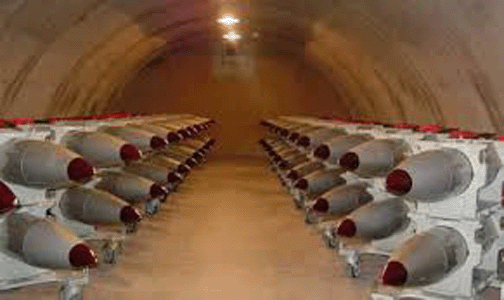
Reports out of Turkey suggest all entrances to the air base have been blocked by heavy vehicles and police sent to secure its perimeter.
The unusual nigh-time move sparked rumours of a second coup attempt on Turkish social media, with concerned citizens rushing to the air base to join the blockade.
The move comes less than a week after a top US Army general was accused by Turkish media of ‘leading’ the uprising against President Recep Tayyip Erdogan earlier this month.
But Turkish Minister for European Affairs has since reportedly sought to reassure local media, stating the mission was just a “safety inspection”…….
The air base has been a central facility in US and NATO efforts against Islamic State. It also houses a stockpile of nuclear weapons as part of NATO’s deterrence force…….http://www.news.com.au/world/reports-turkish-troops-have-sealed-off-incirlik-usnato-nuclear-air-base/news-story/4d7bb16e4e86842218b5b0d7d70f582b
Russia’s Rosatom keen to establish entire nuclear industry in Egypt
 Cairo, Moscow Agree on Egypt’s First Nuclear Power Plant Construction Terms http://sputniknews.com/middleeast/20160731/1043814467/egypt-russia-agree-plant-construction.html The Egyptian presidential office announced that Egypt and Russia have agreed on all the clauses of the commercial contract on construction of the first nuclear power plant in the country. The date of contract signing is expected to be announced right after its approval by the country’s supreme administrative court, the Council of State.
Russia and Egypt signed an intergovernmental agreement on the construction of the Dabaa nuclear power plant on the Mediterranean Sea coast in November 2015. It is set to become the largest construction project carried out by Russia and Egypt since the Aswan Dam.
The contract for the construction of the nuclear power plant is estimated to be worth over $26 billion. The plant will include four units, each one with a capacity reaching 1200 megawatts. The complete offer of the state corporation Rosatom suggests assistance from Russia in the establishment of an entire nuclear industry in Egypt.
South Korea in charge of nuclear power system in United Arab Emirates
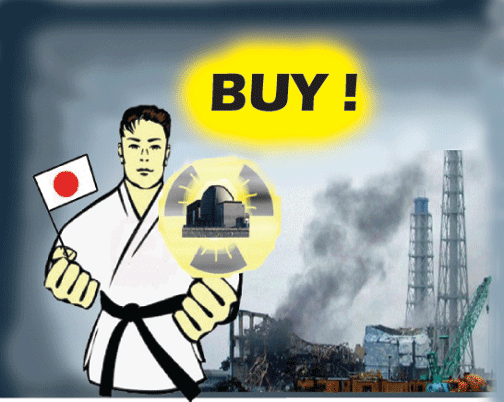 South Korea signs $880 million nuclear reactor staffing deal in UAE http://www.upi.com/Business_News/2016/07/25/South-Korea-signs-880-million-nuclear-reactor-staffing-deal-in-UAE/9691469456937/ The reactors, still under construction, are Korean-designed and made. By Ed Adamczyk ABU DHABI, United Arab Emirates, July 25 (UPI) — South Korea will manage four nuclear reactors under construction in the United Arab Emirates, a deal worth an estimated $880 million, officials said Monday.
Cho Seok, CEO of state-run Korea Hydro & Nuclear Power, signed an operation support services agreement in a ceremony Monday to run the four Korean-made reactors at Barakah, UAE.
Construction of the four reactors began in 2009, with the finish of the first scheduled for May 2017. All four are expected to be completed by 2020. At a signing ceremony in Abu Dhabi on Monday, Mohamed al-Hammadi, CEO of the UAE’s Emirates Nuclear Energy Corp., said, “Over the next decade and beyond, the agreement will continue to build on and enhance the existing long-term nuclear energy partnership between the UAE and South Korea.”
South Korean nuclear company to staff Emirates nuclear reactors
 Hydro & Nuclear staff to operate Abu Dhabi’s Barakah plant, New agreement will see KHNP staff stationed at Barakah until 2030 Gulf Business, By Robert Anderson, 23 July 16
Emirates Nuclear Energy Corporation has signed an operating support services deal with Korea Hydro & Nuclear Power that will see the company dispatch personnel to the Barakah Nuclear Power Plant until 2030.
Under the agreement, the Korean firm will provide main control room operators and local operator to support ENEC’s recently launched local operating subsidiary Nawah Energy Company……http://gulfbusiness.com/korea-hydro-nuclear-power-staff-operate-abu-dhabis-barakah-plant/#.V5UxYtJ97Gg
Middle Eastern countries – a bonanza for Western nuclear salesmen
Despite years of building and development, nuclear power is on the decline in many parts of the world with its share of global electricity decreasing from 18 percent in 1996 to around 11 percent today according to the International Energy Agency.
Nuclear has become unfashionable in several countries not just because of the Chernobyl and Fukushima disasters: New safety requirements mean the cost of building nuclear facilities has been rapidly mounting.
The cost of the UAE’s Barakah plant is estimated at between US$25 bn and $32 bn, most of it being paid out of state funds. The initial cost estimate of Saudi Arabia’s nuclear programme – involving French, Chinese, Argentinian and South Korean companies building facilities both for power generation and for desalination – is $80 bn.
Energy analysts say that rather than spending billions of dollars on prestige nuclear projects, subsidies should be eliminated to curtail usage and alternative energy sources should be developed.
The use of solar power is still minimal in many countries in the region yet it has enormous potential.

Following the disasters at the Chernobyl and Fukushima power plants, many countries either cancelled or put on hold projects for nuclear power facilities but in the Middle East region at least 25 plants are planned and many more are being talked about.
Some studies indicate that up to a total of 90 nuclear facilities, – both big and small – are in the pipeline………
Opponents of the plans say going nuclear in what is one of the world’s most volatile geopolitical regions poses serious safety and security issues. Among other concerns there are the eye watering costs involved in nuclear building programmes and unresolved problems over radioactive waste disposal.
The nuclear salespeople have been busy across the region in recent years: in the United Arab Emirates, the Barakah nuclear power facility in Abu Dhabi, built and operated by the South Koreans, is due to come on stream next year, aiming to supply up to 25 percent of the UAE’s electricity.
Saudi Arabia plans to have its first nuclear power plant on stream by 2022, with another 15 facilities of varying size in the pipeline. Jordan and Egypt have signed agreements with Rosatom, the Russian state nuclear conglomerate, to build and operate reactors.
Despite recent tensions between Turkey and Russia, Rosatom is continuing construction of Turkey’s first nuclear power plant on the country’s southern coast.
Tunisia and Algeria have also been in nuclear discussions with the Russians and other suppliers…….. Continue reading
Iran and West both compliant on nuclear deal – but cautious
One Year After Iran Nuclear Deal, Sides Remain Compliant but Wary, Voice of America, Chris Hannas July 14, 2016 WASHINGTON— One year ago, exhausted diplomats from Iran and a group of six world powers emerged from a meeting at a luxury hotel in Vienna, Austria with what they had been seeking for nearly two years: a comprehensive agreement limiting Iran’s nuclear program in exchange for lifting harsh economic sanctions.
Today, the pact is in effect with clear results on its major components, but there are lingering suspicions on both sides that the other may take advantage and not live up to its responsibilities.
“We need to continue to work and we will continue to work and we have a specially designated ambassador whose day-to-day effort is leading a team to make sure that this deal continues to be lived up to, that we continue to be able to resolve any problems,” U.S. Secretary of State John Kerry said Thursday.
President Barack Obama called the pact a success, saying, “All of Iran’s pathways to a nuclear weapon remain closed.” He said the deal, implemented in January, has pushed the time frame for Iran to develop a nuclear weapon if it violated the agreement from two or three months to “about a year.”
But U.S. opponents of the deal a year ago have not changed their view, that it would not force to Iran to end its military activities in the Mideast or ultimately block it from developing a nuclear weapon………
Praise
EU foreign policy chief Federica Mogherini praised the agreement as a path to “a new chapter in international relations” that uses diplomacy to overcome decades of tensions. Iranian Foreign Minister Mohammad Javad Zarif said that while the pact was not perfect, it was an important achievement and represented a foundation for a new diplomatic beginning.
Iran removed thousands of centrifuges that had been used to enrich uranium and shipped out the majority of its existing stockpile. World powers lifted their sanctions, unlocking billions of dollars for Iran and paving the way for new business opportunities there. Last month, U.S. aerospace giant Boeing announced a tentative deal to sell 100 jets to Iran’s state-owned airline.
Throughout the past 12 months, however, officials on both sides, particularly from Iran and the U.S., have spoken about the deal with comments that range from suspicion to outright rejection.
Iranian President Hassan Rouhani said Wednesday that if the world powers fail to meet their responsibilities, then Iran stands ready to restore its nuclear program. Meanwhile, some members of the U.S. Congress want to ban the United States from purchasing nuclear-related material from Iran, accuse the Obama administration of giving up too much too soon in the negotiations, and are wary about how Iran is spending its newly unlocked money.
Iran has complained that despite the lifting of sanctions that once barred financial institutions from doing business with the country, foreign banks remain reluctant to be involved in transactions…….http://www.voanews.com/content/one-year-after-iran-nuclear-deal-sides-remain-compliant-but-wary/3417840.html
High expectations in Iran, for nuclear deal economic help have not been met
Year after nuclear deal, Iran’s high expectations not met, Christian Science Monitor To sell Iranians on the nuclear deal, President Rouhani promised a new era. But the consensus is it has yet to materialize, and many blame the US. By Scott Peterson, Staff writer JULY 14, 2016 ISTANBUL, TURKEY — Joy erupted on the streets of Tehran a year ago Thursday, when Iran signed a landmark nuclear deal with six world powers hailed as a victory of diplomacy over war.
The deal was marketed by both sides as a “win-win”: Iran would dismantle the most controversial aspects of its nuclear program – minimizing the chance of acquiring a nuclear weapon for at least a decade – in exchange for the lifting of sanctions that crippled its economy.
As jubilant Iranians waved flags and heralded an easing of Iran’s isolation, President Hassan Rouhani promised that “a page has turned in the history of Iran.”
But one year later, the 159-page accord is a study in unmet high expectations for change, as hard-liners in both Iran and the US Congress fight to undermine the deal to ensure as little political benefit as possible for the architects of the accord – Mr. Rouhani and President Barack Obama – as well as for their long-term strategic foes, in Washington and Tehran.
Analysts say the Iranian president promised more than he could deliver.
“Rouhani had no choice other than leveraging pent-up public demands to rally elite support for diplomacy; the hype was as indispensable as its ensuing disillusionment was inevitable,” says Ali Vaez, the senior Iran analyst for the Brussels-based International Crisis Group.
“The deal has not ushered in a new era. It is, at best, taking Iran back to where it was before the nuclear crisis,” says Mr. Vaez. “The establishment deemed ending economic isolation as an exigency for preserving its power. Now it fears rapid economic opening could loosen its grip on power.
All sides have strictly adhered to the letter of the deal: Iran has dramatically reduced the scale of its nuclear infrastructure – reconfiguring a heavy water nuclear reactor and a deeply buried uranium enrichment facility, for example – while keeping a limited capacity to produce fuel for nuclear energy. And non-nuclear sanctions have been lifted, partially ushering Iran back into the global economy.
But the deal has not yet enhanced Rouhani’s ability to fulfill his promise of expanding social freedoms, or of creating a less securitized atmosphere. In fact, the opposite may be true, after steady warnings from Iran’s supreme leader Ayatollah Ali Khamenei, about “infiltration” and “soft war” from the United States and the West.
US and European banks also are proving reluctant to engage with Iran, fearful that non-nuclear US sanctions might bite, thereby depriving Iran of the full hoped-for benefits of the deal. The House is readying new measures this week that will impose further sanctions over terrorism and human rights abuses, or limit Iran’s use of the dollar, all of which the White House says it will veto………..http://www.csmonitor.com/World/Middle-East/2016/0714/Year-after-nuclear-deal-Iran-s-high-expectations-not-met
Republicans trying to roll back the Iran nuclear agreement
Iran Nuclear Deal Faces Triple Threat in Congress on Anniversary http://www.bloomberg.com/news/articles/2016-07-12/iran-nuclear-deal-faces-triple-threat-in-congress-on-anniversary Kambiz Foroohar kambizf
-
Three measures seek to derail agreement signed a year ago
-
Iran says it still waiting for full benefits from the accord
Republican lawmakers are pushing three measures to roll back a nuclear agreement with Iran, while the Obama administration’s lead negotiator for the accord defended its implementation one year after the deal was struck.
Three bills dealing with the agreement, under which Iran agreed to curtail its nuclear program in return for an easing of economic sanctions, are scheduled for a vote this week in the House of Representatives, where Republicans have a majority. The measures would then go to the Senate, which may not take them up before September.
One of the proposals would impose new sanctions on Iran over any sponsorship of terrorism or human rights violations. Another would bar the purchase from the Islamic Republic of “heavy water,” a non-radioactive byproduct of both the manufacturing of nuclear weapons and nuclear energy. The third would block Iran’s access to the U.S. financial system, including the use of the dollar.
All three measures have been met with promises of a veto from the White House. Without the Iranian accord, “we would have been forced to confront the reality of how to address Iran’s nuclear program in a world where diplomacy had failed,” Stephen Mull, the State Department’s lead coordinator for Iran nuclear implementation, said Tuesday at a Bipartisan Policy Center conference in Washington.
‘No Better Deal’
“There was no better deal to be had,” Mull said. “If Iran continues to meet its obligation and we walk away, we walk away alone. ”
While the U.S. remains concerned about Iran’s missile program, support for terrorism and human rights violations, within the confines of the nuclear agreement, “this deal is working,” Mull added.
After a decade of isolation under U.S.-led international sanctions, Iran is now seeing greater interest from businesses and banks in its $370 billion economy. However, Iranian officials complain that six months after the economic sanctions were eased, the country has yet to witness the financial benefits many predicted.
“Iran has a lot of homework to do,” Mull said.The three bills expected to be voted on this week in the House are in addition to a measure introduced to derail Boeing Co.’s agreement last month to provide 109 aircraft to Iran’s national airline, a deal valued at more than $17.6 billion. That would be the biggest business transaction between the two countries since the 1979 Islamic Revolution and the U.S. hostage crisis.
In issuing its veto threat this week, the White House emphasized that the legislation would undermine the viability of the nuclear agreement.
The deal “is critical to ensuring that Iran’s nuclear program is and will remain exclusively peaceful, which is profoundly in the national security interest of the U.S. and the international community,” according to the statement.
Forces in Iran trying to torpedo nuclear deal
Germany says forces in Iran trying to torpedo nuclear deal, http://www.reuters.com/article/us-iran-nuclear-germany-idUSKCN0ZO1F9 8 July 16 Responding to German intelligence agency reports that Iran has been trying to acquire nuclear technology in Germany, Berlin said on Friday that certain forces in Iran may be trying to undermine its nuclear deal with the West.
Germany’s domestic intelligence agency, the Office for the Protection of the Constitution (BfV), said in its annual report that Iranian efforts to illegally procure technology, especially in the nuclear area, had continued at a “high level” in 2015.
A separate report from the intelligence agency in the state of North Rhine-Westphalia this week said it had registered 141 attempts to acquire technology for proliferation purposes last year and that two-thirds of these attempts were linked to Iran.
Asked about the reports on Friday, Foreign Ministry spokesman Martin Schaefer said Germany expected Iran to stick to a United Nations Security Council resolution which sets restrictions on arms-related transfers.
But he also suggested that the procurement attempts may stem from forces in Iran that oppose last year’s nuclear deal, under which Iran agreed to roll back its nuclear program in exchange for the lifting of western economic sanctions.
“There are forces within Iran for which the policies of the country’s president and foreign minister are a thorn in the eye,” Schaefer said. “They may be trying, one way or another, to undermine or torpedo the nuclear deal and the normalization of relations between us and Iran. We are watching this closely.”But hardline allies of Khamenei, including the elite Revolutionary Guards, are wary of losing their grip in power by opening up to the West and have repeatedly criticized pragmatist President Rouhani’s foreign policy.
Schaefer said Germany had a “great deal of faith” in President Hassan Rouhani and Foreign Minister Javad Zarif and had the impression that Tehran was doing its best to stick to the deal, which ended a 12-year standoff with the West over the nuclear program.
Iran’s Supreme Leader Ayatollah Ali Khamenei, whose power far outweighs that of Iran’s elected officials in parliament or the presidency, gave decisive support to the nuclear deal.
German Chancellor Angela Merkel, in a speech to parliament on Thursday, said ballistic missile launches carried out by Iran earlier this year were inconsistent with the UN resolution, which calls on Iran to refrain from work on missiles designed to deliver nuclear weapons for up to eight years.
The NRW intelligence report said procurement efforts in 2015 had been focused on so-called “dual-use” technologies that can be used in both civil and military sectors. While nuclear-related procurement attempts fell slightly, those related to Iran’s missile program rose.
The report said documents had been falsified to suggest technologies were destined for the oil, gas and steel industries. In an apparent attempt to cover its tracks, Iran was seeking to acquire technologies via third countries, including the United Arab Emirates, Turkey and China, the report said.
Time that USA government backed its Iran nuclear deal and promoted investment
 The Obama Administration Needs to Double Down on the Iran Deal http://foreignpolicy.com/2016/06/16/the-obama-administration-needs-to-double-down-on-the-iran-deal/If Washington doesn’t move to help get banks and business into Iran, the nuclear deal will collapse. esident Barack Obama spent enormous political capital to cement an agreement with Iran that constrained its nuclear program for more than a decade. That agreement, however, is now at risk of unraveling.
The danger of the agreement collapsing, to the detriment of U.S. interests, is now evident. Under the nuclear accord, Iran agreed to constrain its nuclear program in return for economic reprieve from U.S. sanctions. While Iran has so far lived up to its nuclear-related obligations — addressing U.S. concerns over its nuclear program by reducing its number of operating centrifuges, reconfiguring its heavy-water reactor, and permitting an unprecedented inspections regime — the United States has struggled to fulfill its end of the nuclear bargain.
Hard-liners in Iran are touting the sanctions issue as an example of why the United States cannot be trusted.That message is having an effect: Recent pollingindicates that the Iranian people are growing increasingly skeptical that Washington is acting in good faith in meeting its commitments. Iranian moderates who support the accord, meanwhile, risk being undermined by this development. Absent a turn in Iran’s economic fortunes, the hopes and aspirations of the Iranian people will continue to be denied and their political engagement — as evidenced by recent parliamentary elections, in which Iranian hard-liners were dealt a significant defeat — stymied.
To its credit, the Obama administration is actively seeking to resolve concerns over the sanctions-lifting. A few weeks ago, Secretary of State John Kerry hosted a meeting of the British Bankers Association to encourage major European banks to re-engage their Iranian counterparts. High-level U.S. officials have likewise been touring the world, seeking to provide practical guidance on what the lifting of sanctions means and the scope of remaining U.S. sanctions. More public written guidance will soon be forthcoming.
But such guidance has been insufficient — and is likely to remain so. Following their meeting with Kerry, most of the banks in attendance stated publicly that they would not engage in Iran-related business for the foreseeable future, due to persistent U.S. sanctions risks. Without major European banks willing to re-engage Iran, financing will be unavailable for some of Iran’s bigger trade and investment opportunities.
The Obama administration needs a new game plan.Just as it expended political capital to secure the deal, it must expend the political capital to sustain it. Otherwise, the administration risks snatching defeat out of the jaws of victory and upending this historic diplomatic achievement.
Such additional steps come in two parts. First, the Obama administration will need to provide detailed written guidance to foreign banks and companies explaining what steps are required to ensure that they do not risk exposure to U.S. sanctions. Absent such guidance, non-U.S. banks and companies will continue to lack the confidence to engage in Iran-related dealings.
The Obama administration reportedly has been reluctant to provide the level of detail necessary to instill confidence in companies that they can do business in Iran. For instance, companies have long sought to understand the necessary level of due diligence to avoid exposure to U.S. sanctions — perhaps through a checklist of sorts. But U.S. officials, unwilling to act outside their comfort zone, have rejected calls to provide such detailed guidance, thus failing to address many firms’ primary concern.
Second, the Obama administration will need to take action to ease market entry into Iran. Banks have been hesitant to facilitate trade with Iran so long as Iran remains cut off from the U.S. financial system, and large foreign enterprises have been reluctant to pursue trade and investment opportunities in Iran so long as the U.S. primary trade embargo remains intact.
The administration can resolve these persistent concerns through a broader licensing scheme. For instance, the United States could re-authorize the U-turn license, which permitted U.S. dollar transactions involving Iran to be cleared through a U.S. bank, or license American banks to provide dollars to foreign financial institutions so that dollar-clearing can take place offshore. Similarly, the administration could take a hard look at the sense of maintaining a unilateral trade embargo with Iran while it is encouraging foreign parties to engage in trade with Iran. In lieu of those more dramatic steps, the administration could also license U.S. persons to facilitate certain transactions with Iran, particularly if those U.S. persons are employed in non-U.S. companies.
The politics of such action may not prove appetizing. Uber-hawks in Congress are bent on denying the Obama administration this diplomatic success and will try to block any action aimed at resolving sanctions concerns. But the sustainability of the nuclear accord is dependent on the Obama administration taking these steps. Absent such measures, the Iran deal threatens to unravel with the United States being the scapegoat, as Iran will continue to be denied the benefit of its bargain.
Passing off current problems with the lifting of sanctions to the next administration is not an option. Obama has made a big investment in limiting Iran’s nuclear program — the time is now to secure that investment.
US agencies and prosecutors influence Europe’s banks to impede Iran nuclear deal
Why our nuclear deal with Iran is turning to dust, The Independent, Robert Fisk @indyvoices 16 June 16
Many of Europe’s largest banks won’t do business with Iran for fear of breaching other US sanctions, which have nothing to do with the nuclear agreement – but a lot to do with US agencies and prosecutors.
The Middle East is littered with missed opportunities, lost chances and dreams turned to dust. The Iranian nuclear deal is now heading in the same direction. President Hassan Rohani, hero of the hour and Iran’s new Mr Good Guy in America, even obtained the support of Iran’s Supreme Leader, Ayatollah Ali Khamenei, when he signed off on the agreement with six world powers last year to reduce the country’s nuclear activities in return for an end to Western sanctions. But he’s beginning to look like a patsy.
And all of the old Iranian revolutionaries, the sons of martyrs and the war veterans and the Revolutionary Guard Corps and the managers of its billion-dollar conglomerates are turning out to have been right all along. The sanctions have been lifted – but they haven’t been lifted. Western investments are not, despite all the promises, pouring into Iran because banks – especially European banks – are too frightened of breaching the rest of America’s sanctions laws to do business with the Islamic Republic. Washington both giveth and taketh away; it’s a slogan that every Iranian president should learn.
Mohamed Khatami was the only real statesman the Middle East produced in half a century and he was elected president of Iran in 1997. He wanted a “civil society”, the nearest you can get to a secular nation ruled by Shiite democracy-necrology-government for and by the dead. But the United States treated Khatami with scorn – and so the crackpot Mahoud Ahmedinejad became the next president, a man with whose ravings America’s right-wing felt far more comfortable.
Hadn’t they said all along that Iran’s leaders were anti-Semitic nuclear crazies, even – this from the Israelis – worse than Hitler? Now Rohani, the man-America-could-do-business-with, may lose next year’s presidential election because he, too, forgot the slogan which, at its simplest, reads: don’t trust America.
Iran has not been reintegrated into the global financial system – and it’s not going to be – though the Chinese will be happy to do business. Khamenei’s supporters are now suggesting that the Supreme Leader – not the shrewd but naïve president – is the great hero of modern Iranian history (after Ayatollah Ruhollah Khomeini, of course). The banks, he says, fear the Americans who “have not acted on their promises and [only] removed the sanctions on paper”. Worse still, he’s right. “Khamenei’s life is the one you should be writing about,” one of his believers announced last week. “He is the saviour.” Yes, thanks to America.
For many of Europe’s largest banks won’t do business with Iran for fear of breaching other US sanctions, which have nothing to do with the nuclear agreement – but a lot to do with US agencies and prosecutors, hunting for evidence of Iranian money laundering, the financing of “terrorism” and monetary crime. The French BNP Paribas shelled out £6.3bn for its Iranian dealings a couple of years ago – over five years, along with StanChart and HSBC, the figure comes to a whopping £10.7bn.
So why should the UK’s Standard Chartered, Societe Generale, Credit Suisse or Deutsche Bank line up to pay more fines just because their governments want to do business in Tehran? Some American bankers – this from the Economist – won’t even hand over their business cards to Iranians. Now that’s what you call fear………
While Iran cannot break free of sanctions from which it thought it had been unshackled, its own paid militia in Lebanon – a nation which a Shiite prelate once described as “the lung through which Iran breathes” – is being caught up in the same financial net. So it’s not difficult for the Iranians to spot what they call in Persian the “dasisa” – and what the Hezbollah, in Arabic, refer to as the “muamara” – which means, quite simply: THE PLOT.
Decide for yourself if it’s true. But in Iran, the lifting of sanctions is a promise un-kept, the Revolutionary Guards are smiling and the nuclear deal is, surely, going downhill. A dream, in other words, fast turning into dust http://www.independent.co.uk/voices/why-our-nuclear-deal-with-iran-is-turning-to-dust-a7084981.html
1 This Month
26 September – International Day for the Total Elimination of Nuclear Weapons





PLEASE OPPOSE HR 8255 AND S.3639 – bills would accelerate satellite deployment, with no environmental review or safeguards – https://ncstd5li.quorum.us/campaign/169331/
To see nuclear-related stories in greater depth and intensity – go to https://nuclearinformation.wordpress.com
-
Archives
- September 2026 (323)
- August 2026 (330)
- July 2026 (355)
- June 2026 (287)
- May 2026 (306)
- April 2026 (356)
- March 2026 (251)
- February 2026 (267)
- January 2026 (308)
- December 2025 (358)
- November 2025 (359)
- October 2025 (375)
-
Categories
- 1
- 1 NUCLEAR ISSUES
- business and costs
- climate change
- culture and arts
- ENERGY
- environment
- health
- history
- indigenous issues
- Legal
- marketing of nuclear
- media
- opposition to nuclear
- PERSONAL STORIES
- politics
- politics international
- Religion and ethics
- safety
- secrets,lies and civil liberties
- spinbuster
- technology
- Uranium
- wastes
- weapons and war
- Women
- 2 WORLD
- ACTION
- AFRICA
- Atrocities
- AUSTRALIA
- Christina's notes
- Christina's themes
- culture and arts
- Events
- Fuk 2022
- Fuk 2023
- Fukushima 2017
- Fukushima 2018
- fukushima 2019
- Fukushima 2020
- Fukushima 2021
- general
- global warming
- Humour (God we need it)
- Nuclear
- RARE EARTHS
- Reference
- resources – print
- Resources -audiovicual
- Weekly Newsletter
- World
- World Nuclear
- YouTube
-
RSS
Entries RSS
Comments RSS

