Donald Trump wants to kill the Iran nuclear deal – but not just yet
Trump’s not killing the Iran deal — yet But this could be the last time he extends it. Vox, By President Donald Trump has decided to extend the Iran nuclear deal once more — but it may be the last time he does it.
The president announced Friday that he wouldn’t reimpose economic sanctions on Iran over its nuclear program, a move that would have effectively killed the Obama administration’s landmark nuclear deal in Tehran in 2015 and isolated the US from allies around the world.
Trump is legally required to decide every 120 days whether or not he’ll put the sanctions back into effect. In his statement Friday, the president said he’d reimpose the measures next time the deadline comes around unless European allies put stricter limitations on what Iran is allowed to do under the pact.
“Today I am waiving the application of certain nuclear sanctions, but only in order to secure our European allies’ agreement to fix the terrible flaws of the Iran nuclear deal,” Trump said in a statement. “This is a last chance.”
According to senior administration officials, Trump wants to establish new sanctions on Iran tied to the way it handles its ballistic missile program, inspections of its nuclear sites by international monitors, and any expansion of the Iran’s nuclear program that causes the country to come within a year of “nuclear breakout,” the amount of time it would take to produce enough fuel for a single nuclear weapon.
Trump also said he expects Congress to craft new legislation that would “deny Iran all paths to a nuclear weapon — not just for ten years, but forever.”
The Trump administration also announced new sanctions against 14 Iranian nationals and organizations for behavior unrelated to the country’s nuclear program. Those measures are being imposed on Iran for its government’s human rights abuses and censorship, mainly tied to widespread national protests in Iran in recent weeks……
Trump’s decision to extend the deal is in some ways a surprising move — late last year he declared the deal wasn’t in the national security interests of the US. It represents a tentative win for Secretary of Defense James Mattis and other top aides, who have spent months lobbying the president to preserve the deal. And it prevents, at least for now, what could have been a nasty fight with America’s closest allies, who believe the deal is working and have made clear that the US would stand alone if Trump pulled out of it.
The question is whether or not Trump is actually willing to kill the pact four months from now if the US and Europeans can’t strike a deal……https://www.vox.com/world/2018/1/11/16826786/trump-iran-deal-sanctions-withdraw
Despite USA, and the protests in Iran, world powers are sticking to the ran nuclear agreement.
After criticiSing Iran’s ballistic missile development and role in supporting Yemeni rebels, UK Ambassador Matthew Rycroft added that “the UK remains fully committed to the JCPOA,” an acronym for the nuclear accord. “We encourage all members states to uphold all their commitments. A prosperous, stable Iran is beneficial to all.”
Ending the nuclear accord “would be a major setback for the entire international community,” French envoy Francois Delattre said, adding that “the agreement is one of the cornerstones of stability in the Middle East as a whole.”
The concerns about the nuclear accord come as US President Donald Trump faces a series of key decisions on Iran starting next week – including whether to honour part of the 2015 agreement that lifted restrictions on Iran’s banking, oil and shipping industries. He could opt to re-impose the sanctions and risk collapse of the accord, a move that Friday’s UN session showed would leave the US isolated……http://www.smh.com.au/world/world-powers-stick-to-iran-nuclear-deal-despite-protests-us-20180106-h0ed20.html
Governments can use social media to target activists – UK and the Iran protests
 Could GCHQ influence Iran protests? They’ve done it before, claims
  researcher https://www.rt.com/uk/414831-gchq-influence-hack-protest/#.WkwCv_uo99Q.facebook
He says through its social media manipulation operations, spy agency Government Communications Headquarters (GCHQ) tried to influence online activists during the 2009 Iranian presidential election protests, and the 2011 uprisings widely known as the Arab Spring.
Al-Bassam told the Chaos Communication Congress in Germany last week that the Joint Threat Research Intelligence Group (JTRIG) – a unit in GCHQ – uses “dirty tricks” to target activists.
He says JTRIG has been tasked by the British government to “[use] online techniques to make something happen in the real or cyber world.” To fulfil this aim, a wide but basic array of technological tools and software are used, including ‘DEADPOOL,’ which is described as a “URL shortening service,” and ‘HUSK,’ a “secure one-to-one web based dead-drop messaging platform.”
He told the conference: “It’s basically a fancy name for sitting on Twitter and Facebook all day and trolling online. What they do, is they conduct what they call ‘human intelligence’ – which is like the act of interacting with humans online to try and make something happen in the real world.
“In their own words one of the things they do is to use ‘dirty tricks’ to ‘destroy, deny, degrade [and] disrupt’ enemies by ‘discrediting’ them.”
JTRIG has been involved in infiltrating hacktivist groups Anonymous and LulzSec, and protesters in Iran, Syria and Bahrain, he says.
As a “honey pot” to attract activists, GCHQ set up free URL shortening service lurl.me, which was used on Twitter and other social media platforms to spread revolutionary messages in the Middle East. These messages would attract people protesting against the government there, and British intelligence would collect information on them.
Al-Bassam said he discovered this information among the documents leaked by NSA whistleblower Edward Snowden. “In 2011, I was unknowingly messaged… by a covert agent from [GCHQ], who was investigating the hacktivist groups of Anonymous and Lulzsec. Later that year, I was arrested and banned from the internet for my involvement in Lulzsec.
Then, in 2014, I discovered through a new Snowden leak that GCHQ had targeted Anonymous and Lulzsec, and that the person that messaged me was a covert employee, pretending to be a hacktivist.”
He added: “Because I was myself targeted in the past, I was aware of a key detail – a honeypot URL shortening service set up by GCHQ, that was actually redacted in the Snowden documents published in 2014. This URL shortening service enabled GCHQ to deanonymize another hacktivist and discover his real name and Facebook account, according to the leaked document.
“Using this key detail, I was able to discover a network of sockpuppet Twitter accounts and websites set up by GCHQ, pretending to be activists during the Arab spring of 2011,” he said.
It makes no sense to scrap the Iran nuclear pact: better to improve it


 Moderation on Iran: Better to improve than scrap nuclear pact http://www.post-gazette.com/opinion/editorials/2018/01/02/Moderation-on-Iran-Better-to-improve-than-scrap-nuclear-pact/stories/201712300018 THE EDITORIAL BOARD, Pittsburgh Post-Gazette It shouldn’t seem necessary to make an argument to the American people that the United States should not go to war with a nation of 80 million, located far from our shores, with which America once had a fruitful commercial and political relationship and with which, like other parts of the world, it has entered into a nuclear weapons control agreement.
But here we are, and it is useful to suggest that it would be unwise for America to go to war with Iran, whose regime in recent days has been beset by popular political demonstrations.
The Trump administration has criticized the Iran nuclear agreement repeatedly and could scrap it. However, as far as the agreement having shortcomings, wouldn’t it make more sense to take the agreement — signed not only by Iran and the United States, but also by China, France, Germany, Russia and the United Kingdom — as the basis for negotiating changes, as opposed to threatening to pull out of it and, perhaps, to attack Iran?
The first problem with the current U.S. posture is that the other signatories like the agreement. China, France, Germany, Russia, the United Kingdom and the rest of the world have taken it as a green light to improve trade, including major sales, to Iran. America-based companies have considered the continued U.S. sanctions against Iran, and, particularly the continued political objections to it in the United States, including from Israel and American Christian fundamentalists, as a reason not to put the pedal to the metal in terms of pursuing trade and investment opportunities in Iran.
The second major problem in any thought that the United States might attack Iran militarily is that the results would be catastrophic. Of course, the United States would probably win an all-out war against Iran in the long haul — that is, assuming the American people would be prepared to support such a war. That’s a real question, because it would be hard to persuade them that there was any reason for such a war, and it would cost the Earth.
In the short run, a quick glance at the map is worth the trouble in assessing U.S. vulnerabilities in such a conflict. Iran lies just across the Persian Gulf from Saudi Arabia, Kuwait, the United Arab Emirates, Qatar and Oman, in all of which the U.S. has important military installations, including the headquarters of the U.S. 5th Fleet and the regional headquarters of the U.S. Central Command, a short rocket distance away. Iran also borders on Afghanistan and Iraq, where the U.S. maintains a vulnerable presence as well as long-term investment.
It would be dreamy to imagine that Iran’s first response to a U.S. attack wouldn’t be retaliation against some or all of these key U.S. targets surrounding it. The usual arguments for improving relations with Iran, not worsening them, are otherwise foregone commercial opportunities, the concerns of some of our allies, and regional and world peace in general. Given that President Donald J. Trump’s principal national security affairs advisers are current or retired military officers, it is also worth looking at the military aspects of U.S. relations with Iran with a cold eye, then determining future U.S. policy, in 2018 and beyond.
Is Trump planning to kill the Iran nuclear deal, in January?
By mid-January, the president will face new legal deadlines to choose whether to slap U.S. sanctions back on Tehran. Senior lawmakers and some of Trump’s top national security officials are trying to preserve the agreement. But the deal’s backers fear Trump has grown more willing to reject the counsel of his foreign policy team, as he did with his recent decision to recognize Jerusalem as Israel’s capital……..
The deal was negotiated in 2015 by the Obama administration, along with five other nations. It lifted U.S. and European sanctions on Iran in exchange for strict limits on Tehran’s nuclear program. …..
The deadlines for Trump begin on January 11, when the agreement requires him — as it does every 90 days — to certify whether Tehran is meeting its obligations under the deal. International inspectors who visit the country’s nuclear facilities have repeatedly said Iran is doing so. But Trump refused to certify Iranian compliance in mid-October……..
upcoming deadlines for Trump to continue the temporary waiver of U.S. sanctions on Iran, which the deal dictates will not be permanently repealed for several more years. The president must renew the waivers every 120 days. Sources familiar with the law said multiple waiver deadlines arrive between January 12 and January 17, forcing Trump to reassess the deal.
If Trump rejects the waivers and restores biting sanctions, Tehran is certain to claim the U.S. has breached the agreement and — supporters of the deal say — may restart its nuclear program. That could court a military confrontation with the U.S. and Israel. At a minimum, the U.S would find itself isolated abroad given that every other party to the deal — France, the U.K., Germany, China and Russia — all strongly oppose a U.S. withdrawal from the agreement.
Top Trump officials, including National Security Adviser H.R. McMaster, Defense Secretary Jim Mattis and Secretary of State Rex Tillerson, all hope to avoid that outcome, telling others that while they may not love the nuclear deal, the potential fallout from a unilateral U.S. withdrawal would be too great to risk……….https://www.politico.eu/article/iran-how-donald-trump-could-kill-the-iran-nuclear-deal-in-january/
A recipe for global catastrophe? Nuclear power for Saudi Arabia
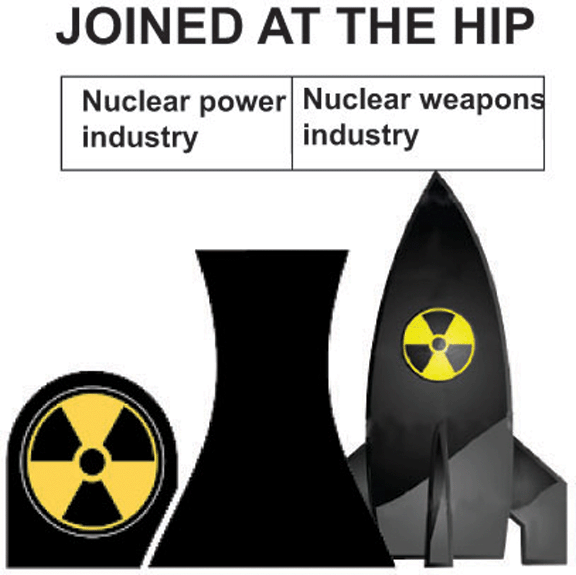
 Financial Tribune (Iran) 26th Dec 2017 A lawmaker denounced the prospect of a US uranium enrichment deal with Saudi Arabia, predicting a “global catastrophe” should the oil kingdom mix
nuclear technology with its takfiri ideology.
In a recent talk with ICANA, Heshmatollah Falahatpisheh, a member of Majlis National Security and
Foreign Policy Commission, said, “Unfortunately, even human rights and international laws have not stopped the Saudi crimes in Yemen. Now, if Saudi Arabia is allowed the uranium technology, it would certainly use it in its military.” Takfiris are hardliners who accuse anyone, including Muslims, not following their extreme interpretation of Islam as infidels and apostates punishable by death.
https://financialtribune.com/articles/national/78650/us-nuclear-deal-with-saudis-could-lead-to-catastrophe
Saudi Arabi keen for nuclear power – and for nuclear weapons?
Saudi-US talks on civilian nuclear program to begin within ‘weeks’ 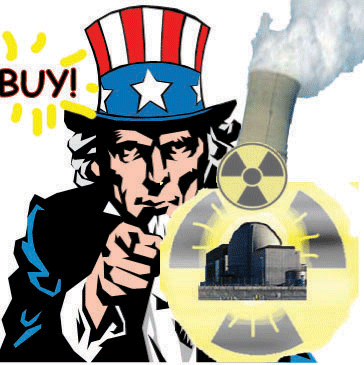 Riyadh’s energy minister insists kingdom seeks energy for peaceful purposes, but will not agree to American limitations on uranium enrichment
Nuclear power in the Middle East – for nuclear weapons?
Perhaps nuclear power plants have become the new status symbols for developing nations, the modern equivalent of new steel mills so prized by developing nations after World War II. Or perhaps something more sinister is afoot.
“Why do you have a nuclear reactor in the Persian Gulf? Because you want to have some kind of nuclear (weapons) contingency capability.”
Nuclear Power’s Resurgence In The Middle East, Oil Price.com,
To begin the process the Saudis will soon solicit bids for two reactors. We expect bids for these initial projects from at least five national consortia: South Korean, French, Russian, Chinese and American (Westinghouse).
In order for American firms to submit bids or these projects, the U.S. would have to amend its policy that prohibits export of technology for enrichment and reprocessing of uranium.
Saudi Arabia’s energy minister, Hasham Yamani, head of the King Abdullah City for Atomic and Renewable Energy, stated at a recent conference that his nation intended to become entirely self-sufficient with respect to the production and enrichment of uranium. ..
In the United Arab Emirates, the first of four units at the Barakah nuclear power station is slated to soon enter commercial operation. These 4 APR 1400 units are being constructed by South Korea’s KEPCO at an estimated cost of $30 billion. But unlike the Saudis, officials in the UAE expressed no interest in uranium mining and reprocessing, services the plant’s builder is typically only too happy to provide.
Another four reactor project was announced in Egypt. The El Dabaa Nuclear Power Project will host four Russian-designed VVER 1200 reactors. This project is also projected to cost $30 billion and is 85 percent financed by the vendor, Rosatom.
The Iranians also have a Russian-design 1 GW nuclear reactor at its Bushehr power station. Interestingly, this unit began its life as a Siemens-designed unit whose construction was terminated due to the 1979 revolution in Iran. Eventually Russians engineers took over and completed the plant…..
Iran and the U.S. have recently differed over Iran’s uranium enrichment and reprocessing efforts particularly at the Natanz facility. The U.S. appears eager to find the Iranians in violation of nuclear fuel reprocessing constraints signed under the Obama administration. Whether this will become a pretext for further escalation by the Trump administration remains to be seen…..
This present enthusiasm for nuclear power, though, does raise questions. These plants may not be competitive with alternative power sources unless the builders finance and subsidize them. This seems to be the strategy pursued by both China and Russia.
It is also unlikely, given the relatively long lead times for construction, to resolve existing electricity shortages that hamper economic growth. Perhaps nuclear power plants have become the new status symbols for developing nations, the modern equivalent of new steel mills so prized by developing nations after World War II. Or perhaps something more sinister is afoot.
Let us give the last word to highly respected Middle East energy and security analyst, Anthony Cordesman, currently of Washington’s Center for Strategic and International Studies: “There’s no question. Why do you have a nuclear reactor in the Persian Gulf? Because you want to have some kind of nuclear (weapons) contingency capability.” He sounds skeptical that it’s all about atoms for peace.
You can find Leonard Hyman’s lastest book ‘Electricity Acts’ on Amazon
By Leonard Hyman and Bill Tilles https://oilprice.com/Alternative-Energy/Nuclear-Power/Nuclear-Powers-Resurgence-In-The-Middle-East.html
Trump’s disturbing willingness to sell nuclear technologies without the usual restrictions, to Saudi Arabia
U.S. To Boost Saudi Nuclear Power Development. Lobe Log., DECEMBER 14, 2017, Almost a decade has passed since President George W. Bush promised that the United States would help Saudi Arabia develop commercial nuclear energy plants. When he visited Riyadh in May 2008, he pledged to sign a “memorandum of understanding,” or MOU, committing the United States to “assist the Kingdom of Saudi Arabia to develop civilian nuclear power for use in medicine, industry and power generation” and “establish a comprehensive framework for cooperation in the development of environmentally sustainable, safe, and secure nuclear energy.”
In return, Saudi Arabia, a signatory to the Nuclear Nonproliferation Treaty, would also join the worldwide Proliferation Security Initiative, a U.S.-sponsored program to confront the threat of nuclear proliferation.
The text of that MOU has never been made public, and nothing much happened as a result of it until last week. Then, Energy Secretary Rick Perry, after meeting senior officials in the kingdom, urged the Saudis to choose a U.S.-based vendor, Westinghouse Electric Co., to participate in the nuclear energy program to which the Saudis have long been committed.
The Energy Department’s official statement about Perry’s talks with Khalid Al-Falih, Saudi Minister of Energy, Industry, and Mineral Resources, did not use the word “nuclear,” but numerous reports from the region said the Saudis heard Perry’s arguments for Westinghouse and were receptive to them.
“We heard that message that … ‘we want the United States to be our partner in this’,” Perry told the Reuters news agency. Westinghouse spokeswoman Sarah Casella said in a statement to Bloomberg News that “Westinghouse is pleased that Saudi Arabia has decided to pursue nuclear energy. We are fully participating in their request for information and are pleased to provide the AP1000 plant, the industry’s most advanced technology.” The Energy Department did not respond to several requests to go beyond its original statement or to confirm Perry’s reported remarks, but neither has it denied them.
There was a time when the words “nuclear” and “Saudi Arabia” in the same sentence would set off alarms all over Washington, because any such development in Saudi Arabia is bound to raise fears that the Saudis would use their program to develop nuclear weapons to counter what they fear is happening in Iran……….
Saudi Arabia has discussed nuclear development with China, Russia, and France, among other potential suppliers.
Under U.S. law, Westinghouse or any other U.S.-based vendor can sell material and technology to Saudi Arabia only after the two countries negotiate a nuclear cooperation agreement, known as a 123 Agreement for the section of the law setting the requirement. The U.S.-Abu Dhabi agreement is known in the industry as the “gold standard,” because the government of the United Arab Emirates agreed to forgo both ends of the nuclear fuel cycle–it will neither enrich its own uranium nor reprocess its spent fuel to extract the plutonium.
The Saudis have made clear that they do not want to accept the same restrictions because their country has extensive uranium resources, which they want to process domestically. In articles in the trade press in 2010, an executive of a Finnish firm that was consulting with the Saudis on their program said that it could eventually include enrichment of uranium.
That was a non-starter while Barack Obama was president, but reports of Perry’s commitment to expedite an agreement have ignited speculation that the United States is preparing to soften its terms to accommodate the Saudis on this point, especially because of the close ties that have developed between the Trump administration and Crown Prince Mohammed bin Salman, the kingdom’s de facto ruler…….
Daryl Kimball, executive director of the Arms Control Association, said in a statement that “The Trump administration’s willingness bend key rules and standards designed to restrict the spread of sensitive nuclear technologies that can be used to make nuclear weapons to in order to help U.S. companies profit from nuclear commerce with Saudi Arabia is disturbing and counterproductive.” He said Congress, “which will have to review any such agreement, should insist on the highest possible nonproliferation standards for nuclear commerce, especially in a troubled and unstable region.”……..https://lobelog.com/u-s-to-boost-saudi-nuclear-power-development/
Trump, ready to make it easy for Saudi Arabia to get ‘peaceful” nuclear, AND nuclear weapons
Trump Considers Easing Nuclear Rules for Saudi Project https://www.bloomberg.com/news/articles/2017-12-12/trump-is-said-to-consider-easing-nuclear-rules-for-saudi-project By Jennifer Jacobs, Ari Natter,and Jennifer A Dlouhy
-
Westinghouse is looking for new markets after bankruptcy
-
Past deals barred uranium enrichment for overseas projects
The Trump administration is encouraging Saudi Arabia to consider bids by Westinghouse Electric Co. and other U.S. companies to build nuclear reactors in that country and may allow the enrichment of uranium as part of that deal, according to three people familiar with the plans.
A meeting to hammer out details of the nuclear cooperation agreement, known as a 123 Agreement for the section of the U.S. Atomic Energy Act that requires it, will be held at the White House Wednesday, two administration officials said.
A successful U.S. bid would help deliver on President Donald Trump’s promise to revive and revitalize the domestic nuclear industry, helping American companies edge out Russian and Chinese competitors to build new fleets around the world. Saudi Arabia plans to construct 16 nuclear power reactors over the next 20 to 25 years at a cost of more than $80 billion, according to the World Nuclear Association.
Westinghouse, the nuclear technology pioneer that is part of Toshiba Corp., went bankrupt in March, after it hit delays with its AP1000 reactors at two U.S. plants. After it declared bankruptcy, Westinghouse — whose technology is used in more than half the world’s nuclear power plants — said it shifted its focus to expanding outside the U.S.
Winning contracts in Saudi Arabia could provide a new market that Westinghouse needs and provide at least a partial vindication for the investment in the AP1000 technology.
“Westinghouse is pleased that Saudi Arabia has decided to pursue nuclear energy,” Sarah Cassella, a spokeswoman, said in a emailed statement. “We are fully participating in their request for information and are pleased to provide the AP1000 plant, the industry’s most advanced technology.”
Daryl Kimball, executive director of the Washington-based Arms Control Association, said weakening the prohibition against enrichment and reprocessing, often referred to as “the gold standard,” is disturbing given what he said was Saudi Arabia’s “sub-par nuclear nonproliferation record.”
“We shouldn’t compromise our longstanding efforts to stop the spread of nuclear weapons in order to play favorites with certain companies or countries,” he said in an email, calling the idea “disturbing and counterproductive.”
— With assistance by Chris Martin
In Middle East – a heightened risk of attacks on nuclear facilities
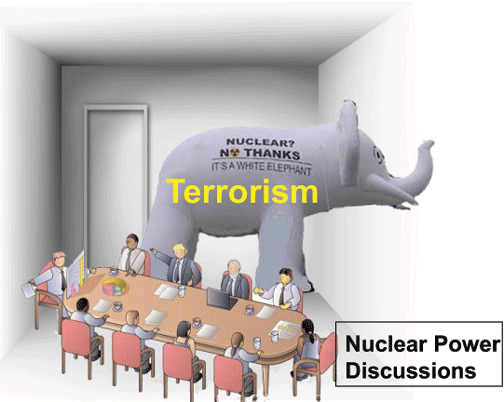
Bulletin of Atomic Scientists 8th Dec 2017, Earlier this week, Yemen’s Houthi rebel group claimed it had launched a
missile at the Barakah nuclear power plant in the western region of Abu
Dhabi, in retaliation for the Saudi-led blockade imposed on Yemen.
Abu Dhabi is part of the United Arab Emirates (UAE), a member of the coalition
that has been targeting the Houthis. UAE officials immediately denied that
the attack had taken place, and the Houthis have not provided any evidence
to support their claim.
However, regardless of the claim’s validity, and despite the lack of evidence, the incident is emblematic of the dangers of
nuclear power in the Middle East.
The UAE should take it very seriously. Even if this “attack” was merely a propaganda ploy, nuclear power
facilities will always be potential targets for enemy states and non-state
actors, including terrorist groups. In the Middle East, in particular,
there is a history of attacks on nuclear sites during regional conflicts.
https://thebulletin.org/yemeni-rebel-claim-highlights-risk-nuclear-power-middle-east11335
It looks as if Saudi Arabia wants uranium enrichment etc as prelude to nuclear weapons development
Beyond Nuclear 6th Dec 2017, Saudi Arabia’s Energy Minister Khalid al-Falih is extending invitations
to the U.S. nuclear industry to launch the Gulf Region’s most ambitious
nuclear power program. The Saudi atomic energy plan is to build as many as
17 nuclear power plants by 2032. The Saudi Arabia government has stated
that its atomic power program will be “self-sufficient” in the
production of nuclear fuel at 5% enriched uranium-235 and purely directed
for civilian power development.
The pronouncement comes as Saudi energy officials remain silent on their past refusal to not pursue high-grade
uranium enrichment and plutonium reprocessing technologies as military
weapons production facilities. In any case, the introduction of nuclear
materials will significantly increase instability and tensions in the
region. http://www.beyondnuclear.org/home/2017/12/6/us-nuclear-companies-invited-to-help-launch-saudi-arabias-da.html
Egypt to go into big debt to buy Russian nuclear reactors that it doesn’t need

 Egypt to sign contracts for nuclear power plant during Putin’s visit: sources, CAIRO (Reuters) 10 Dec 17 – Egypt will sign contracts with Moscow during Russian President Vladimir Putin’s visit to Cairo on Monday for the country’s first nuclear power plant, three senior sources told Reuters on Sunday.
The construction of the 4,800 megawatt (MW) capacity plant, which is supposed to be built at Dabaa in the north of the country, is expected to be completed within seven years, added the sources, who spoke on condition of anonymity because they were not authorized to speak to the media……
Moscow and Cairo signed an agreement in 2015 for Russia to build a nuclear power plant in Egypt, with Russia extending a loan to Egypt to cover the cost of construction.
Egypt’s official gazette said last year the loan was worth $25 billion and would finance 85 percent of the value of each work contract, services and equipment shipping. Egypt would fund the remaining 15 percent.
The trial operation of the first nuclear reactor is expected to take place in 2022……
The nuclear plant is expected not to just cover the country’s energy needs, but to produce excess which can be exported, the sources told Reuters on Sunday.
Putin is scheduled to visit Cairo on Monday to meet with his counterpart Abdel Fattah al-Sisi, where they will discuss bilateral relations, trade and Middle Eastern issues, the Kremlin said last week.
Reporting by Momen Abdelkhalek; Writing by Amina Ismail; Editing by Toby Chopra
Israel’s 54-year-old nuclear reactor a safety risk
 Aljazeera, by Harry Fawcett
The Dimona reactor, which began its life in 1963, is one of Israel’s most closely guarded secret installations.
A study made public last year found more than 1500 fissures within the reactor core.
Israel is estimated to have more than 100 nuclear warheads, the plutonium for which comes from its Dimona reactor…….http://www.aljazeera.com/news/2017/12/israels-54-year-nuclear-reactor-safety-risk-171209153124924.html
Rick Perry to visit Saudi Arabia – a nation keen to have nuclear reactors AND to highly enrich uranium
U.S. Firms Courting Saudi Arabia to Build Nuclear Reactors; Rick Perry to Visit 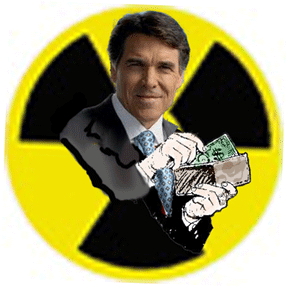 Riyadh, Haaretz, 3 Dec 17, One of the sources also said Riyadh had told Washington it does not want to forfeit the possibility of one day enriching uranium – a process that can have military uses.
1 This Month
26 September – International Day for the Total Elimination of Nuclear Weapons





PLEASE OPPOSE HR 8255 AND S.3639 – bills would accelerate satellite deployment, with no environmental review or safeguards – https://ncstd5li.quorum.us/campaign/169331/
To see nuclear-related stories in greater depth and intensity – go to https://nuclearinformation.wordpress.com
-
Archives
- September 2026 (313)
- August 2026 (330)
- July 2026 (355)
- June 2026 (287)
- May 2026 (306)
- April 2026 (356)
- March 2026 (251)
- February 2026 (267)
- January 2026 (308)
- December 2025 (358)
- November 2025 (359)
- October 2025 (375)
-
Categories
- 1
- 1 NUCLEAR ISSUES
- business and costs
- climate change
- culture and arts
- ENERGY
- environment
- health
- history
- indigenous issues
- Legal
- marketing of nuclear
- media
- opposition to nuclear
- PERSONAL STORIES
- politics
- politics international
- Religion and ethics
- safety
- secrets,lies and civil liberties
- spinbuster
- technology
- Uranium
- wastes
- weapons and war
- Women
- 2 WORLD
- ACTION
- AFRICA
- Atrocities
- AUSTRALIA
- Christina's notes
- Christina's themes
- culture and arts
- Events
- Fuk 2022
- Fuk 2023
- Fukushima 2017
- Fukushima 2018
- fukushima 2019
- Fukushima 2020
- Fukushima 2021
- general
- global warming
- Humour (God we need it)
- Nuclear
- RARE EARTHS
- Reference
- resources – print
- Resources -audiovicual
- Weekly Newsletter
- World
- World Nuclear
- YouTube
-
RSS
Entries RSS
Comments RSS

