A senior executive at engineering giant Bechtel told CNBC on Thursday that U.S. businesses should be involved in Saudi Arabia’s civilian nuclear energy ambitions.
The presence of American firms would likely be welcomed by the Saudis and should also be welcomed by the U.S. government, according to Stuart Jones, regional president for Europe and Middle East at Bechtel.
Saudi Arabia has plans to construct 16 nuclear power reactors over the next 20 to 25 years, costing more than $80 billion.
Trump’s decision to reimpose sanctions on Iran clearly violates the multilateral Iran nuclear deal, known officially as the Joint Comprehensive Plan of Action (JCPOA). While the move is unsurprising—given Trump’s failure to recognize the nonproliferation value of the deal and frequent threats to walk away—it is dangerous and irresponsible, and it risks manufacturing a nuclear crisis that the international community cannot afford.
There was no legitimate reason for Trump to reimpose sanctions. For the past two years, the nuclear deal has verifiably restricted Iran’s nuclear program and subjected it to intrusive monitoring and verification. Even critics of the deal, such as Secretary of State Mike Pompeo, have admitted that there is no evidence that Iran is in violation of the agreement.
Trump’s main criticism—that the deal paves the way to an Iranian nuclear weapon in 10 years—is based on a flawed analysis that discounts the value that the permanent monitoring mechanisms and prohibitions put in place by the deal possess. They are a bulwark against nuclear weapons development.
By violating the deal, Trump has only isolated the United States and undermined Washington’s credibility. His “plan B” —to negotiate a “better deal” with Iran— is completely unrealistic. After this clear demonstration that the United States cannot be counted on to implement an agreement in good faith, Trump will hard pressed to gain any support for sanctions, let alone new talks. As a result, Trump is inciting a proliferation crisis, rather than working with allies to develop a long-term diplomatic strategy that would build on the agreement in the years ahead and address Iran’s malign activities outside of the accord.
Despite Trump’s reckless decision to reimpose sanctions, it would be premature to declare the nuclear deal dead. The JCPOA is a multilateral agreement endorsed by the UN Security Council and Washington’s P5+1 partners—China, France, Germany, Russia, and the United Kingdom—which have pledged to implement the deal, irrespective of US actions. And these states and the European Union have powerful tools at their disposal to block the secondary effects of US sanctions.
It will be critical that these states move quickly to insulate legitimate business from US sanctions, demonstrating to Iran that there is still an incentive—trade with Europe and other developed economies—to continue abiding by the nuclear commitments made under the accord. Failure to ensure that Iran has international trading opportunities will make it more likely that Tehran will respond to Trump’s violation by breaching the nuclear limits. While Iran is unlikely to dash for a bomb, Iranian officials have left the door open to restart uranium enrichment to 20 percent uranium 235, a level of fissionable material currently prohibited by the deal. If Iran choses this path it would destabilize the region and increase the risks of conflict.
Trump’s decision has nonproliferation consequences beyond Iran. Trump is about to sit down at an important summit with North Korean leader Kim Jong-un to discuss denuclearization of the Korean peninsula. Violating the Iran deal undermines US credibility in those negotiations and sends a message to Kim Jong-un that even if an agreement is reached and North Korea abides by its terms, there’s no guarantee that Washington will fulfill its commitments. This is a dangerous precedent to set and risks this historic opportunity to de-escalate tensions with North Korea.
Trump withdraws from the Iran nuclear deal. What now? Bulletin of the Atomic Scientists, John Mecklin May 18
With his decision today to withdraw the United States from the Iran nuclear deal, US President Donald Trump has put the long-term future of the deal in doubt, at the very least. In a televised announcement from the White House, Trump said the United States would reimpose the “highest level” of economic sanctions against Iran and would hold other nations accountable for violating those sanctions. During his truculent presentation, Trump asserted that the Iran nuclear deal—known officially as the Joint Comprehensive Plan of Action, or JCPOA—was “horrible” and “one-sided.” Even if Iran complied with the terms of the “decaying and rotten structure” of the JCPOA, the president claimed, it could move to the verge of creating nuclear weapons in “a very short time” even as it continued to build nuclear-capable missiles and support terrorism across the Middle East and the world. (The president’s claims run counter to the assessments of the numerous international security experts who note that the JCPOA’s intrusive inspection regime and other components would prevent Iran from acquiring nuclear weapons indefinitely.)
As he announced US withdrawal from the Iran deal, Trump threatened dire consequences for Iran if it resumed work toward nuclear weapons. At the same time, he asserted that his administration would work with allies toward a new deal that he was “ready, willing and able” to negotiate with Iran. Iran has previously insisted it will not renegotiate the JCPOA.
In the immediate aftermath of Trump’s decision, it was unclear how Iran, the other five countries that agreed to the JCPOA—Russia, China, the UK, France, and Germany—and the rest of the world would respond over the long term. The Bulletin invited a wide variety of top international security experts to provide comments on Trump’s decision and its potentially wide-ranging ramifications. Their responses are published below, in hopes they will help the international community find the best possible path forward. ………. https://thebulletin.org/trump-withdraws-iran-nuclear-deal-what-now11791
Britain, France and Germany said they remained committed to the deal despite Tuesday’s decision by President Trump to withdraw.
But Brig. Gen. Hossein Salami said Europe “cannot act independently over the nuclear deal,” the semi-official Fars news agency quoted him as saying.
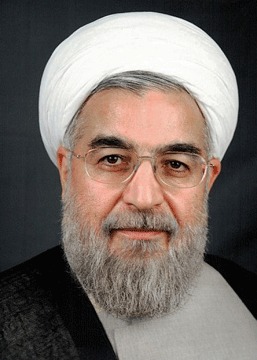
Iranian President Hassan Rouhani said Tuesday that Tehran would remain in the 2015 agreement, though Europe had only a “limited opportunity” to preserve it.
On Wednesday, Supreme Leader Ayatollah Ali Khamenei cast doubt on the ability of the European signatories to guarantee Tehran’s interests, adding: “I do not trust these countries either.”
Khamenei has the final say on all state matters and commands the loyalty of the IRGC, which has huge political and economic influence domestically.
Salami said Iran’s enemies were not seeking military confrontation. “They want to pressure our country by economic isolation … Resistance is the only way to confront these enemies, not diplomacy,” Fars quoted him as saying.
Trump also said Tuesday he would revive US economic sanctions against Iran, penalizing foreign firms doing business with Tehran and further undermining what he called “a horrible, one-sided deal that should have never, ever been made.”
Europeans fear a collapse of the deal could raise the risk of deepening conflicts in the Middle East.
Early on Thursday, Iranian forces launched their first attack on Israel from inside Syria, firing rockets at army bases in the Golan Heights, Israel said.
That prompted one of the heaviest Israeli barrages against Syria since the conflict there began in 2011.
The pact, the signature foreign policy achievement of Trump’s predecessor, President Barack Obama, was designed to prevent Iran from developing a nuclear bomb in exchange for lifting most sanctions that had crippled its economy. Sanctions were removed in 2016.
Trump complained that the agreement failed to address Iran’s ballistic missile program, its nuclear activities beyond 2025 or its role in conflicts in the Middle East, where Tehran has been involved in a proxy war from Lebanon to Yemen for decades.
In defiance of Western pressure to curb the missile program, Tehran says it is an essential precautionary defense against the United States and other adversaries, primarily Gulf Arab states and Israel.
“Exiting the deal and their concerns over Iran’s missile work are excuses to bring our nation to its knees,” Salami said.
The IRGC’s overseas arm, the Quds force, operates in Iraq, Syria and Yemen, among other places.
Iran-Israel strikes show risk of Middle East war is growing after US exit from nuclear deal, CNBC, 11 May 18
The U.S. exit from the Iran nuclear deal threatens to inflame tensions in the Middle East and heighten the risk of open conflict among regional powers, analysts say.
Israel launched an attack on Iran’s positions in Syria on Thursday, following an earlier strike by Iranian forces on the Golan Heights in retaliation for earlier Israeli strikes.
A long-standing fear is that open military conflict among the Middle East’s dominant players will devolve into a regionwide conflict that drags global powers into war.
A series of rocket exchanges between Iran and Israel along the Syrian border on Thursday may confirm what many feared: The U.S. exit from the Iran nuclear deal will inflame regional rivalries and heighten the risk of open conflict in the Middle East.
Israel launched a deadly attack on Iranian positions in Syria on Thursday, responding to an earlier rocket attack by Iran’s forces on the Golan Heights, a border area Israel captured from Syria in 1967. Iran’s attack itself followed several strikes by Israel on its bases in Syria, where the Iranians are supporting President Bashar Assad in the nation’s long-burning civil war.
The earlier Israeli strikes came both before and after President Donald Trump announced he is withdrawing the United States from the 2015 Iran nuclear deal and restoring wide-ranging sanctions aimed at crippling the Iranian economy. Thursday’s rocket exchange came just two days after Trump’s announcement.
Middle East watchers warn that Trump’s decision to abandon the nuclear deal emboldens Israel andSaudi Arabiato take a more aggressive stance against Iranian forces and proxies in the region. They say it also marginalizes Iran’s political moderates like PresidentHassan Rouhaniand emboldens the nation’s hard-line conservatives and the Iranian Revolutionary Guard Corps, an elite military organization loyal to the supreme leader, Ayatollah Ali Khamenei.
“US withdrawal from the JCPOA could shift the balance of power among the Iranian leadership from those who want to keep the deal operational to hardline elements more willing to risk escalation by strengthening support for regional proxies, and who favour economic self-sufficiency and opposed President Rouhani’s push for greater engagement with the West,” ratings agency Fitch said Thursday, referring to the deal by its official name, the Joint Comprehensive Plan of Action.
How America Jump-Started Iran’s Nuclear Program, History, BY BECKY LITTLE//MAY 9, 2018
For several decades now, the U.S. has sought to deter Iran from developing nuclear weapons. But ironically, the reason Iran has the technology to build these weapons in the first place is because the U.S. gave it to Iran between 1957 and 1979. This nuclear assistance was part of a Cold War strategy known as “Atoms for Peace.”
The strategy’s name comes from Dwight Eisenhower’s “Atoms for Peace” speech, given before the United Nations General Assembly in 1953. In it, he suggested that promoting the non-military use of nuclear technology could discourage countries from using it to create nuclear weapons, or “Atoms for War.”
The speech came only eight years after the invention of the atomic bomb, at a time when the U.S. was anxious to keep these new and frightening weapons from proliferating around the world. Strange as it sounds, President Eisenhower viewed his “Atoms for Peace” strategy partly as a form of arms control.
the U.S. provided nuclear assistance to countries it wanted to influence, such as Israel, India, Pakistan, and Iran.
At the time, the U.S. was closely allied with Iran’s Shah, Mohammad Reza Pahlavi. So closely, in fact, that when Iran toppled the Shah’s monarchy and democratically elected a prime minister, the CIA staged a 1953 coup d’état that put the Shah back in power. Part of the reason the U.S. valued Iran as an ally was because of its strategic location bordering the Soviet Union. During the early part of the Cold War, the U.S. set up a base in Iran to monitor Soviet activity.
In this context, the United States’ nuclear cooperation with Iran “was, in part, a means to shore up the relationship between those countries,” Fuhrmann says. The cooperation lasted until 1979, when the the Iranian Revolution ousted the Shah and the U.S. lost the country as an ally.
All of the nuclear technology the U.S. provided Iran during those years was supposed to be for peaceful nuclear development. But the “Atoms for Peace” strategy ended up having some unintended consequences.
“A lot of that infrastructure could also be used to produce plutonium or weapons-grade, highly-enriched uranium, which are the two critical materials you need to make nuclear bombs,” Fuhrmann says. In effect, the U.S. laid the foundations for the Iranian nuclear weapons program.
Iran first became seriously interested in creating nuclear weapons during the 1980s Iran-Iraq War. It tried unsuccessfully to develop them in the late ‘90s and early 2000s. Still, Iranian nuclear development remains an international concern, especially now that Trump has withdrawn the U.S. from the 2015 Iranian nuclear deal, known as the Joint Comprehensive Plan of Action.
In the weeks leading up to Trump’s decision, Israeli Prime Minister Benjamin Netanyahu tried to convince him to exit the deal by arguing that Iran was still pursuing nuclear weapons. Other policy experts and world leaders have rejected this claim, and Fuhrmann says he’s seen no evidence that “Iran has violated the deal, or that Iran has done anything since 2003 … to build nuclear bombs.”
THE IRAN NUCLEAR DEAL’S UNRAVELING RAISES FEARS OF CYBERATTACKS Wired Andy Greenberg, 18 May 18
WHEN THE US last tightened its sanctions against Iran in 2012, then-president Barack Obama boasted that they were “virtually grinding the Iranian economy to a halt.” Iran fired back with one of the broadest series of cyberattacks ever to target the US, bombarding practically every major American bank with months of intermittent distributed denial of service attacks that pummeled their websites with junk traffic, knocking them offline. Three years later, the Obama administration lifted many of those sanctions in exchange for Iran’s promise to halt its nuclear development; Tehran has since mostly restrained its state-sponsored online attacks against Western targets.
Now, with little more than a word from President Trump, that détente appears to have ended. And with it, the lull in Iranian cyberattacks on the West may be coming to an end, too.
Cutting Swords
President Trump announced Tuesday that he would unilaterally withdraw the US from the Iran nuclear deal negotiated by the Obama administration in 2015, and impose new sanctions against the country within 90 days. Since then, foreign policy watchers have warned that the move would isolate the US, risk further destabilizing the Middle East, and invite another nuclear rogue nation into the world. But for those who have followed the last decade of digital conflicts around the globe, the unraveling of the Iran deal reignites not only the country’s nuclear threat, but also the threat of its highly aggressive hackers—now with years more development and training that have only honed their offensive tactics.
“They’ve developed this ability over the last years and there’s no reason for them not to use it now,” says Levi Gundert, an Iran-focused analyst at private intelligence firm Recorded Future. “They want to try to induce other countries to think about repercussions before levying sanctions, and they have a real capability in the cyber domain.”
……… since the 2015 nuclear deal, Iran has largely restricted its hacking to its own neighborhood, repeatedly hitting its longtime rival Saudi Arabia and other Gulf nations with cyberattacks but limiting its attacks on Western targets to mere cyberespionage, not actual disruptive operations.
……… Iran’s abrupt entrance into the digital arms race came in 2012, when state-sponsored Iranian hackers calling themselves the Cutting Sword of Justice used a piece of malware called Shamoon to overwrite the files of 30,000 machines on the network of energy company Saudi Aramco with a file that displayed the image of a burning American flag. A similar malware infection struck Qatari gas firm RasGas soon after. The attacks, which temporarily paralyzed the IT operations of one of the world’s largest oil companies, is widely seen as retaliation for Stuxnet, the NSA- and Israeli-created malware that was unleashed against the Natanz Iranian nuclear facility in 2010 to destroy its enrichment centrifuges. ………
Iran may have quietly grown into a serious threat to any enemy nation that it can reach via the internet. And now that the last three years of tense peace appears to be ending, its list of fair-game targets may once again include the United States, too.
Nasr al-Hariri, chair of the Syrian Negotiations Committee, says move could help remove ‘malignant influence’ of Iran from country, Guardian, Patrick WintourDiplomatic editor Thu 10 May 2018Donald Trump’s decision to break the Iran nuclear deal has won praise from the official Syrian opposition, which said the move represented a real opportunity to remove Iranian influence from the war-torn country……….. He stopped short of directly praising Israel for attacking Iranian positions in Syria, saying the effort to drive as many as 100,000 Iran-backed militias from Syria needed to be coordinated…… He stopped short of directly praising Israel for attacking Iranian positions in Syria, saying the effort to drive as many as 100,000 Iran-backed militias from Syria needed to be coordinated. more https://www.theguardian.com/world/2018/may/10/syrian-opposition-praises-donald-trumps-iran-nuclear-deal-exit
The U.S. Treasury imposed sanctions against six individuals and three companies it said had funneled millions of dollars to the Iranian Revolutionary Guard’s elite Qods Force.
The sanctions were imposed just days after President Donald Trump withdrew from the Iran nuclear deal.
Saudi Arabia says backs U.S. decision to withdraw from Iran nuclear deal, Reuters Staff RIYADH (Reuters) 9 May 18- Saudi Arabia welcomed President Donald Trump’s decision on Tuesday to withdraw the United States from the international nuclear agreement with Iran and to reimpose economic sanctions on its arch-foe Tehran.
The kingdom, a key U.S. ally, said it would work with the United States and the international community to address Iran’s nuclear program as well as its ballistic missile program and support of militant groups in the region……..
It confirmed “the need to deal with the danger that Iran’s policies pose to international peace and security through a comprehensive view that is not limited to its nuclear program but also includes all hostile activities” in the region……..
Saudi Arabia has called the 2015 nuclear deal a “flawed agreement”, and in March Saudi Crown Prince Mohammed bin Salman told CBS news that his kingdom would “without a doubt” develop nuclear weapons if Iran did so.
The Sunni Muslim kingdom has been at loggerheads with Shi’ite Iran for decades. They have fought a long-running proxy war in the Middle East and beyond, backing opposing sides in armed conflicts and political crises including in Iraq, Syria, Lebanon and Yemen.
President Hassan Rouhani said on Tuesday that Iran would remain committed to a multinational nuclear deal despite U.S. President Donald Trump’s decision to withdraw from the 2015 agreement designed to deny Tehran the ability to build nuclear weapons, Reuters reported.
“If we achieve the deal’s goals in cooperation with other members of the deal, it will remain in place… By exiting the deal, America has officially undermined its commitment to an international treaty,” Rouhani said in a televised speech.
“I have ordered the foreign ministry to negotiate with the European countries, China and Russia in coming weeks. If at the end of this short period we conclude that we can fully benefit from the JCPOA with the cooperation of all countries, the deal would remain,” he added.
The Joint Comprehensive Plan of Action (JCPOA) is the full name for the nuclear deal, struck in 2015 between Iran, the five permanent members of the U.N. Security Council – the United States, Russia, China, Britain and France – and Germany.
Rouhani added that Iran was ready to resume its nuclear activities after consultations with the other world powers which are part of the agreement.
Budapest: European leaders have hinted at financial incentives or compensation for Iran to persuade it to stay it in the nuclear deal that the US has rejected.
And they are likely to act to protect European companies trading with Iran despite the US re-imposing sanctions.
In a joint statement UK prime minister Theresa May, German Chancellor Angela Merkel and French president Emmanuel Macron greeted with “regret and concern” Donald Trump’s announcement that he would re-impose sanctions against Iran and withdraw from the Iran nuclear deal.
“Together, we emphasise our continuing commitment to the (agreement),” they said. “This agreement remains important for our shared security.”
They said Iran “continues to abide by the restrictions” in the deal preventing its development of nuclear weapons, and “the world is a safer place as a result”.
“Our governments remain committed to ensuring the agreement is upheld, and will work with all the remaining parties to the deal to ensure this remains the case including through ensuring the continuing economic benefits to the Iranian people that are linked to the agreement.”
They encouraged Iran to “show restraint in response to the decision by the US” and to continue to meet all its obligations including atomic agency inspections and monitoring.
“In turn, Iran should continue to receive the sanctions relief it is entitled to whilst it remains in compliance with the terms of the deal,” the leaders said.
The European Commission’s foreign affairs representative and vice president Federica Mogherini said the nuclear deal “is not a bilateral agreement and it is not in the hands of any single country to terminate it”.
“It is a key element of the global nuclear non-proliferation architecture,” Mogherini said, adding that it was “even more” relevant in the context of negotiations with North Korea.
“The nuclear deal with Iran is crucial for the security of the region, of Europe and of the entire world,” she said.
She said Europe “fully trusted” the work of the nuclear watchdog which had certified Iran had fully complied with it s commitments under the deal.
And she too suggested Europe would look to compensate Iran for the impact of renewed US sanctions.
“The EU has repeatedly stressed that the lifting of nuclear related sanctions has a positive impact on trade and economic relations with Iran, including crucial benefits for the Iranian people,” she said
“The EU is fully committed to ensuring that this continues to be delivered on. I am particularly worried by the announcement of new sanctions. I will consult with all our partners in the coming hours and days to assess their implications. The EU is determined to act in accordance with its security interests and to protect its economic investments.”
And she appealed to Iran to “stay true to your commitments, as we will stay true to ours. And together, with the rest of the international community, we will preserve the nuclear deal.”
May, Macron and Merkel said they wanted to build on the nuclear deal to address other issues including Iran’s ballistic missile programme and “its destabilising regional activities, especially in Syria, Iraq and Yemen”.
Macron Tweeted that the three countries would “work collectively on a broader framework” covering nuclear activity after the deal ends in 2025, ballistic activity and “stability in the Middle East”.
On Monday UK Foreign Secretary Boris Johnson travelled to the US to make a last-ditch appeal to save the deal, but didn’t get an audience with the president.
Instead he appeared on the cable news program Fox & Friends – which Trump regularly watches – and remarked that “Plan B does not seem, to me, to be particularly well developed at this stage”.
EcoPeace Middle East and the power of environmentalism, Independent Australia, Sophia McNamara
EcoPeace Middle East teach environmental issues to Israeli, Palestinian and Jordanian children in the hopes they’ll bring awareness back to their communities (screen shot via YouTube).
Sophia McNamara introduces Gidon Bromberg and EcoPeace Middle East — an organisation brokering peaceful cooperation with environmentalism.
ECOPEACE MIDDLE EAST is a unique regional organisation that brings together Israeli, Palestinian and Jordanian environmentalists.
It is the only regional non-government organisation (NGO) that exists in Israel, Palestine and Jordan. Among its many battles, Ecopeace Middle East recently helped increase the supply of clean water and energy to Gaza. This is particularly critical considering the United Nations has predicted that Gaza will become uninhabitable by 2020.
I interviewed Israeli co-director and co-founder of EcoPeace Middle East Gidon Bromberg and he told me:
“Just a one hour drive from here in Tel Aviv, there is a water and sanitation crisis in Gaza … Two million people have run out of water. And today, about 97% of the groundwater is undrinkable.”
Bromberg came up with the idea to start EcoPeace when he realised the environment was being completely left out of the peace agenda of the early 1990s.
Originally from Elsternwick in Melbourne, Bromberg attended Elwood High School (formerly Elwood College) and graduated with degrees in Law and Economics from Monash University. Since age 11, Bromberg had known he wanted to return to his family’s hometown of Tel Aviv, Israel.
Straight after university, he made “aliyah“ — a term that describes the process of a Jewish person returning to Israel.
Bromberg came across an advert saying that a newly established non-profit called the Israel Union for Environmental Defence wanted their first lawyer. He volunteered there one day a week for four years, while still working four days a week in private practice, taking a pay cut in the process.
He was then offered a scholarship to study his Masters of Law at the American University in Washington DC, where he ended up being right on the doorstep of negotiations for the Oslo Accords and the Israel-Jordan Peace Treaty. Bromberg’s Masters thesis posed the question: will peace be environmentally sustainable? He concluded that peace could, in fact, be truly harmful to the environment and sustainability unless it was put on the political track.
Bromberg had the idea to create a regional environmental organisation that would address this exact issue. He wanted to hold a meeting with Israeli, Egyptian, Palestinian and Jordanian environmentalists to discuss the possibility of this organisation. He spoke with potential investors in Washington DC — they all told him it was a great idea, but he needed to come back to them when he was older.
In 1994, he went back to Israel and, as part of his scholarship, he worked for a year at the Israel Union of Environmental Defence as a full-time lawyer.
Bromberg immediately wrote to all the potential investors in the United States again, this time from Israel. One of them called him and said he had thought about it and that if he could make the meeting happen, he would fund it. As these were the days before the internet, Bromberg had never met a Palestinian, Jordanian or Egyptian environmentalist.
The World Wildlife Fund had a guide on environmentalist organisations in the region — so he contacted all of them. Bromberg had a meeting in East Jerusalem with a Palestinian environmentalist, who responded to the enquiry, and spoke over the phone to an Egyptian and Jordanian. …..
Today, EcoPeace has adapted to a changed political climate, increased water scarcity and urgency required by climate change. They focus heavily on shared natural resources, regional water security and sustainable development.
A particularly successful initiative by EcoPeace is the Good Water Neighbours Program. This is where youth and adult activists, as well as mayors and municipal staff from Israeli, Palestinian and Jordanian communities all work together across the borders to advance shared solutions for the rehabilitation of natural watersheds.
The Jordan River, possibly the holiest river in the world, with large religious significance in Christianity, Judaism and Islam, “has been turned into little more than an open sewer now,” says Bromberg.
Bromberg says the issue is about more than the river itself:
“The largest number of volunteers from Jordan who have joined ISIS are from Jordan Valley communities. There is a link between ecological demise, poverty, underdevelopment… and then radical, dangerous ideologies. Water security, ours and our neighbours, are national security concerns.”
JORDAN’S FOREIGN MINISTER SEES ARMS RACE IF IRAN NUCLEAR DEAL ENDS
Jordanian Foreign Minister Ayman al-Safadi says an end of the Iran deal could have grave consequences across the Middle East, BY REUTERS JERUSALEM POST MAY 8, 2018 MURNAU– Jordanian Foreign Minister Ayman al-Safadi on Tuesday warned of “dangerous repercussions” and a possible arms race in the Middle East unless a political solution was found to free the region of nuclear weapons and other weapons of mass destruction.
Al-Safadi spoke in Germany before an expected announcement by US President Donald Trump on whether he will pull out of the Iran nuclear deal or work with European allies who say it has successfully halted Iran’s nuclear ambitions.
Al-Sadadi said he did not know what the US president would do, but urged continued conversation and dialog with Iran, despite what he called widespread concerns among Arab countries about Iran’s “interventionism” in the region.
“We all need to work together in making sure that we solve the conflicts of the region … and strive for a Middle East that is free of all weapons of mass destruction,” he told reporters after a meeting with leaders of Chancellor Angela Merkel’s right-left “grand coalition” government.
“If we do not look at the political picture and … find a way to ensure that the whole region is free of (these weapons), we’ll be looking at a lot of dangerous repercussions that will affect the region in terms of an arms race,” he said.
In March, Saudi Arabian Crown Prince Mohammed bin Salman told CBS news that his kingdom would “without a doubt” develop nuclear weapons if Iran, Riyadh’s arch foe, did so.
ISRAEL has deployed multiple iron dome defence systems across the northern parts of the country as Israeli authorities fear an Iranian attack is imminent following the US’s withdrawal from the Iran nuclear deal. Express UK, By NICOLE STINSON, May 8, 2018
Israel has instructed local authorities in the Israeli-held Golan Heights to “unlock and ready bomb shelters” after identifying what the military described as “irregular activity of Iranian forces in Syria”.
The military statement further said that its defence systems had been deployed “and IDF (Israel Defence Force) troops are on high alert for an attack”.
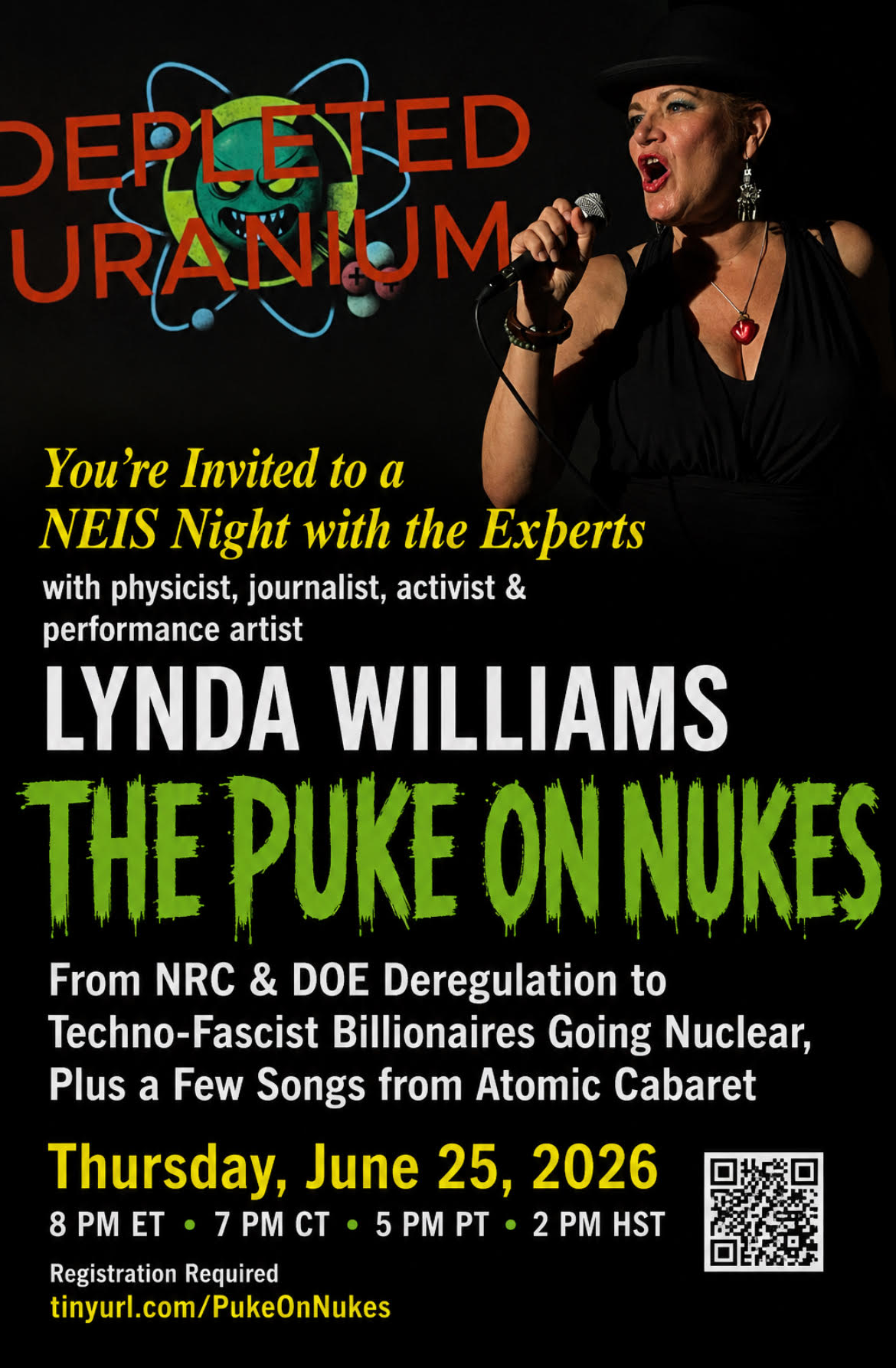
7pm Central Time (8pm ET, 6pm MT, 5pm PT) UTC – 5 From NRC & DOE Deregulation to Techno-Fascist Billionaires Going Nuclear, Plus a Few Songs from Atomic Cabaret REGISTER












 nuclear-news