Saudi Arabia resists IAEA’s inspection regime, as it completes its first nuclear reactor
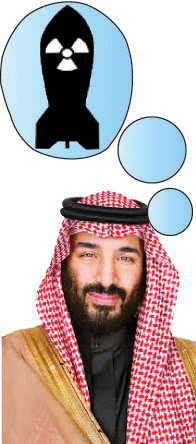 Saudi Arabia’s first nuclear reactor nearly finished, sparking fears over safeguards, Riyadh has so far resisted international watchdog’s requests to accept a strict inspection regime, Guardian, Julian Borger in Washington 4 Apr 2019
Saudi Arabia is within months of completing its first nuclear reactor, new satellite images show, but it has yet to show any readiness to abide by safeguards that would prevent it making a bomb.
The reactor site is in the King Abdulaziz city for science and technology on the outskirts of Riyadh. The site was identified by Robert Kelley, a former director for nuclear inspections at the International Atomic Energy Agency (IAEA), who said it was very small 30-kilowatt research reactor, not far from completion.
“I would guess they could have it all done, with the roof in place and the electricity turned on, within a year,” said Kelley, who worked for more than three decades in research and engineering in the US nuclear weapons complex………
Before inserting nuclear fuel into the reactor, Saudi Arabia would have to implement a comprehensive set of rules and procedures, including IAEA inspections, designed to ensure no fissile material was diverted for use in weapons – something it has so far avoided
The reactor has been designed by an Argentinian state-owned company, Invap SE……..Saudi Arabia joined the Non-Proliferation Treaty (NPT) in 1988 but signed a comprehensive safeguards agreement with the IAEA only in 2005, and at the same time exempted itself from regular inspections, by signing a “small quantities protocol” (SQP), designed for countries with negligible quantities of nuclear material.
Largely because of controversy over Riyadh being shielded from scrutiny under these rules, the IAEA made the SQP more rigorous, but the Saudis resisted making changes…….. https://amp.theguardian.com/world/2019/apr/04/saudi-arabias-first-nuclear-reactor-nearly-finished-sparking-fears-over-safeguards?CMP=share_btn_tw&__twitter_impression=tru
IAEA head UN nuclear inspector asks Saudi Arabia to agree to safeguards on nuclear material
But Yukiya Amano, director general of the International Atomic Energy Agency, said there was nothing secret about the reactor and that Saudi Arabia informed the Vienna-based UN body about its plans in 2014.
He said the IAEA has encouraged Saudi Arabia to sign a comprehensive safeguards agreement, under which the agency ensures that nuclear material is not being diverted to weapons use……… https://www.france24.com/en/20190405-iaea-asks-saudis-safeguards-first-nuclear-reactor
“Deadly Dust – Made in the USA: Uranium Weapons Contaminating the World”
 Deadly Dust: US Spreading Radiation and No One Wants to Raise the Issue – Author https://sputniknews.com/analysis/201904031073767110-us-radiation-spread/ In a new book named “Deadly Dust – Made in the USA: Uranium Weapons Contaminating the World” German author Frieder Wagner gives a detailed account of how the US has contaminated vast territories using depleted uranium (DU) ammunition and the cover-up strategy of the military, industry and governments, as well as those in the media and politics.
Sputnik: Mr Wagner, in your book “Deadly Dust — Made in the USA: Uranium Weapons Contaminating the World” you talk about the use of uranium ammunition. What is especially dangerous about these weapons?
Frieder Wagner: Weapons containing uranium are produced from nuclear industry’s waste (byproducts of uranium enrichment). If, for example, you want to produce a ton of natural uranium fuel rods for nuclear power plants, you get about eight tons of depleted uranium. It is a source of alpha radiation — radioactive and, moreover, very poisonous. It needs to be stored somewhere, and it is not very cheap.
Sputnik: How can it be used in weapons?
Frieder Wagner: About 30-40 years ago, military scientists made a discovery: uranium is almost twice as dense as lead. If you turn depleted uranium into a projectile and give it proper acceleration, then within a fraction of a second it will pierce through tank armor, concrete or cement.This, of course, was an important discovery. Furthermore, when a shell hits an armored tank the impact produces dust caused by the detonation and the subsequent release of heat energy causes it to ignite and it explodes at a temperature of 3000 to 5000 degrees — incinerating the tank’s interior and destroying it.
Sputnik: But what happens afterwards is also a problem — after the use of DU ammunition, isn’t it?
Frieder Wagner: Yes! After its use depleted uranium, which, as I have already said, is a source of alpha radiation (that is, a radioactive and very toxic substance), burns down to nano-particles that are a hundred times smaller than a red blood cell.
This way, I would say, a sort of metallic gas forms that people can inhale, and which is released in the atmosphere and can be carried anywhere by wind. People who inhale it are at risk for developing cancer.These nano-particles can also penetrate the body of a pregnant woman, overcoming the barrier between a child and a mother, and affect the health of an unborn baby, can infiltrate the brain and by travelling through the bloodstream end up in any human or animal organ. Everything that goes around the planet, sooner or later settles and, of course, contaminates, in particular, drinking water and everything else.
Sputnik: In what wars have DU weapons been used so far?
Frieder Wagner: It was actively used during the first Gulf war in 1991 against Iraq. The military has admitted that about 320 tons were used. Then in the second war in Iraq in 2003 over 2,000 tons were used. In between, it was used during the war in Kosovo, in Yugoslavia (1999), and in Bosnia in 1995, and after 2001 in Afghanistan, where it still used today.
Sputnik: Your book title says Made in the USA, were these weapons only used by the United States?
Frieder Wagner: They were being developed in several countries at the same time. In Germany, they were also working on these weapons, as, of course, in Russia. However, it was used and on such a large scale, only by the US. They were reckless and they did not pay attention to any possible side effects — just as it was back when the first atomic bombs were used. That’s why I called the book: “Deadly Dust — Made in the USA”.
Sputnik: How did you manage to prove the use of these ammunitions in the course of your research?
Frieder Wagner: For example, the Serbs gave us maps where they showed the locations where depleted uranium was used. When we were in Iraq, we talked to the locals. We traveled to places where large tank battles took place and took soil samples there, as well as dust samples from tanks. Looking at the tank, you can see whether it was hit by an ordinary projectile or a uranium munition.
Uranium munition leaves dust that burns everything around the hole made by the projectile. So you can determine the use of uranium ammunition. In all soil samples, we found depleted uranium. Unfortunately, uranium-236 was also found in most of the soil and dust samples — it is even more intense and poisonous. Its radiation is even stronger and does not occur in nature. It can only be produced artificially during reprocessing of fuel rods. This means that we were able to prove that the military, the United States and its coalition allies used uranium munitions made from spent uranium fuel rods.
Sputnik: Your book is based on the films The Doctor, the Depleted Uranium, and the Dying Children of Basra (Der Arzt und die verstrahlten Kinder von Basra, 2004) and Deadly Dust (Todesstaub, 2007). What did you see in Basra during your work on the documentary?
Frieder Wagner: It was horrific and still sometimes haunts me in my dreams. These were children with deformities, which we saw in orphanages in Basra and Baghdad. Some of them had such deformities that they had almost nothing human anymore.
There were children without a head or a nose, either with one eye or without eyes at all, with internal organs in a kind of “sack” outside their body. These ‘creatures’ can live only for a few hours, experiencing terrible pain, and then die.
putnik: The film “Deadly Dust” is linked to the book, but it is no longer distributed. WDR channel after this film did not make any more orders? Why is that?
Frieder Wagner: My exposes which I sent to WDR, as well as to the ZDF channels were rejected. Then I contacted an editor at WDR, for which I always made good films and with which I always had good relations with, because these films had doubled or trippled their ratings, and asked him: “What’s going on here?”” And after some hesitation he said: “Yes, Frieder Wagner, someone must tell you this. WDR considers you a ‘difficult’ person. And most importantly, the topics you suggest are especially hard. Right now I’ve got nothing more to tell you.” And that when I understood everything. It was in 2005.
I can also tell you the story of how, for example, a female editor at ZDF offered the TV channel a story on the use of these weapons during the war in Yugoslavia and also in Croatia. She wanted to talk about it with me prior so I could share my experiences. But when her boss found out that she wanted to talk to Frieder Wagner, he refused to pay for her trip — without any further explanation.
Sputnik: The so-called “deadly dust” is, as you have already described it, is spread by the wind. So should the use of uranium ammunition, in fact, be considered a war crime and banned?
Frieder Wagner: This is definitely a war crime. The dust from southern Iraq is carried to the north by the constant storms, the so-called desert storms — for example, to Erbil, where it meets the mountains and can’t travel further as the mountains make it difficult for it to go past towards Turkey. So this huge mass of dust settles in Erbil.We, for example, took samples of beef from around Erbil, and this is what we found out: depleted uranium used in ammunition has a characteristic atomic “fingerprint”. In northern Iraq we found the same “uranium fingerprint” as in the south. This means that the uranium dust that had originally settled in the south of Iraq is now also in the north, and children are now getting sick there and are born with deformities. It is now spreading all over the world.
Sputnik: Have the victims of uranium munition use in Kosovo or, for example, in Iraq, tried to go to court?
Frieder Wagner: So far no such attempts have been made in Kosovo or Iraq. Now in Kosovo, a whole group of lawyers are working on a lawsuit against NATO, because after the war they unleashed, people were injured, fell ill and died. The morbidity rate has increased by 20 to 30 percent, and there are more effected each year. So there will be an attempt to file a lawsuit.
Out of the approximately two thousand Italian soldiers stationed in Iraq and Kosovo, 109 have later developed cancer and died — this is proven information. 16 families, out of the 109 dead, filed lawsuits and won their cases. The courts ordered the Italian state or the country’s Ministry of Defence to pay them compensation. Since each cancer was of a different type, the payout amounts differed. But they ranged between 200,000 and 1,4 million euros.
Sputnik: How are things in Germany? Have there been lawsuits filed by the soldiers of the Bundeswehr?
Frieder Wagner: The German Ministry of Defense constantly denies any connection to this. Our soldiers are stationed in Afghanistan and Kosovo. About 100,000 soldiers served in Afghanistan, and we found out that about 30% of those who returned got sick, although at first, of course, they do not notice this. If they subsequently marry and have children, then there’s a great risk that their children will have disabilities.
These children will have the same toxic substances in their DNA as their parents. And this will be passed on for several generations — from children to grandchildren and to great-grandchildren.
Sputnik: But none of these people ever filed a lawsuit?
Frieder Wagner: In Germany there were no such precedents. About 600 servicemen went to court in the United States who could not appeal on their own behalf, but they filed lawsuits on behalf of their children who were born with developmental disabilities. And we’re not talking about a mere 90 or even 900 million pay out, but about billions of dollars now. The United States, of course, will try to delay the adoption of a ruling as much as it is possible and hope for a “biological” resolution of the situation — that is, that the plaintiffs will simply die.
Senators from both parties want details on USA nuclear co-operation with Daudi Arabia
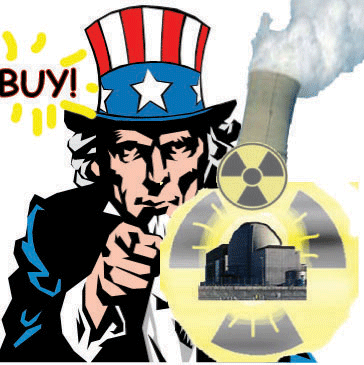
 US Senators Seek Details on Nuclear Power Cooperation with Saudi Arabia VOA News, https://www.voanews.com/a/us-senators-seek-details-on-nuclear-power-cooperation-with-saudi-arabia-/4859672.html 3 Apr 19, U.S. senators from both parties on Tuesday asked Energy Secretary Rick Perry for details about recent approvals for companies to share nuclear energy information with Saudi Arabia, with the lawmakers expressing concern about possible development of atomic weapons.
Saudi Arabia has engaged in “many deeply troubling actions and statements that have provoked alarm in Congress,” Senators Bob Menendez, a Democrat, and Marco Rubio, a Republican, told Perry in a letter, a copy of which was seen by Reuters.
The senators said Congress was beginning to re-evaluate the U.S.-Saudi relationship, and they believe Washington should not be providing nuclear technology or information to Saudi Arabia now.
The Trump administration has been quietly negotiating a deal that would potentially help Saudi Arabia build two reactors.
Last week news reports revealed that since November 2017, Perry has authorized so-called Part 810 approvals allowing U.S. companies to share sensitive nuclear information with the kingdom. The approvals were kept from the public and from Congress.
The senators asked Perry to provide them by April 10 with the names of the companies that got the 810 approvals, what was in the authorizations, and why the companies asked that the approvals be kept secret. U.S. Representative Brad Sherman, a Democrat, also asked the Energy Department in a separate letter what was in the approvals.
While 810 agreements are routine, the Obama administration made them available for the public to read at Energy Department headquarters. Lawmakers say the department is legally required to inform Congress about the approvals.
Perry approved the seven recent authorizations as the administration has tried to hash out nonproliferation standards with Saudi Arabia. Such a pact, known as a 123 agreement, would have to be agreed before U.S. companies can share physical exports of materials and equipment to build reactors.
The kingdom has resisted standards on reprocessing spent fuel and enriching uranium, two potential paths to making nuclear weapons.
The United States has been competing with South Korea, France, Russia and China on a potential deal to help build reactors in Saudi Arabia. The kingdom is expected to announce the winner this year.
Lawmakers from both parties have been concerned about Saudi Arabia’s bombing campaigns in Yemen, which is on the brink of famine, and the killing of journalist Jamal Khashoggi, a U.S. resident, last October in the Saudi consulate in Istanbul.
Concern in Congress grew last year after the kingdom’s Crown Prince Mohammed bin Salman told CBS that “Saudi Arabia does not want to acquire any nuclear bomb, but without a doubt if Iran developed a nuclear bomb, we will follow suit as soon as possible.”
Perry has said the 810 approvals were kept from the public for corporate proprietary reasons……….
At another Senate hearing, the five members of the Nuclear Regulatory Commission, including Chairman Kristine Svinicki, would not say whether the NRC raised any concerns over the 810 approvals in a required consultation with the Energy Department.
Svinicki said the NRC’s consulting role on the approvals is narrow and delegated to staff.
Senator Chris Van Hollen, a Democrat who asked the question of the NRC at the hearing, told Reuters in an interview that the commissioners’ lack of knowledge about the approvals was “stunning.”
“It’s kind of scary because we do rely on them to provide input into this process and not a single commissioner knew anything about what input they may or may not have provided.” https://www.voanews.com/a/us-senators-seek-details-on-nuclear-power-cooperation-with-saudi-arabia-/4859672.html
Trump administration and Israel helping Saudi Arabia towards getting nuclear weapons
Concerns over Saudi plan to build nuclear plants after US deal | Al Jazeera English
Trump Admin Complementing Israeli Effort to Give Nuclear Weapons to Saudi Arabia https://www.mintpressnews.com/israel-saudi-arabia-nuclear-weapons-2/256761/
Already seven of the 10 countries in the world with the highest military budgets are in the Middle East. The development of nuclear weapons in Saudi Arabia has many speculating that it could mark the beginning of an even more dangerous era for the war-torn region. March 29th, 2019, By Alan Macleod
WASHINGTON — U.S. President Donald Trump’s energy secretary, Rick Perry, has secretly approved the sale of nuclear power technology and assistance to Saudi Arabia, Reuters revealed this week. Saudi Arabia is reportedly attempting to construct at least two nuclear power plants as part of its effort to diversify its energy sector and its economy as a whole. As part of this plan it has accepted bids from Russia, South Korea and the U.S. for the lucrative contract. Perry’s approval is known as a Part 810 authorization, which allows energy companies to begin the process of planning and starting preliminary work in anticipation of the closing of a formal deal in the future.
While the Saudi proposals are presented as civilian and do not mention nuclear weaponry, U.S. approval and sale of nuclear technology has been seen by many as a prelude to the development of a Saudi nuclear weapon, which could potentially spark anuclear arms race in the region. Riyadh has long coveted atomic weaponry and has considered developing its own in its quest to maintain military dominance in the region. “If Iran develops a nuclear weapon, that will be unacceptable to us and we will have to follow suit” Prince Turki al-Faisal, former Saudi ambassador to the United States, told the Guardian in 2011, noting that the kingdom may feel “compelled” to pursue the option in the future, if tensions with Iran remain high.
In reality, Iran does not have, nor is it trying to acquire, nuclear weapons technology (something quietly conceded by both the Israeli intelligence agency Mossad and the CIA), and has lived up to its commitments to the International Atomic Energy Agency. However, any such move from Saudi Arabia might provoke a response in kind from Iran, its chief adversary in the region and would sound a death knell for the hopes of the establishment of a nuclear weapons-free zone in the Middle East. The United States has long accused Iran of trying to develop nuclear weapons technology and has placed sanctions on the country.
The Israeli connection
An important nuclear player in the region is Israel, one of the few nations in the world that has not signed the nuclear non-proliferation treaty. Israel is estimated to possess 100 to 200 nuclear weapons and has taken a strongly adversarial position towards Iran. In 2015, Prime Minister Benjamin Netanyahu appeared before a joint session of Congress with a cartoon image of a bomb to give a speech denouncing Iran and warning of an Iranian military threat. Israel has been key in pushing the United States into a more confrontational stance on Iran through a continuous public-relations drive to present the country as a menace.
Last year Mint Press News reported that the Israeli government had begun selling Saudi Arabia nuclear weapons secrets. Ami Dor-on, a senior official and nuclear specialist at the organization Israel’s Homeland Security, blew the whistle on the clandestine practice. The Israeli actions were the latest evidence of a growing cooperation between the two nations. However, the prospect of a nuclear Saudi Arabia has many concerned.
The threat of a nuclear Saudi Arabia
For some time, Saudi Arabia has been making its presence felt in the Middle East, leading to the destabilization of the entire region. In 2011 Saudi tanks rolled into Bahrain to crush the Arab Spring uprising in the island country, and it continues to be a primary driver of the war in Yemen, labeled by some as genocide. At least 22 million people are in need of humanitarian assistance as a result of the Saudi bombardment of the country.
Riyadh also continues to fund various jihadist groups in Syria and is one of the largest financiers of terrorism in the world. Before his election, Trump claimed Saudi Arabia was behind the 9/11 attacks and the White House more recently insisted it would hold the kingdom responsible for the murder of Washington Post columnist Jamal Khashoggi. However, as with unabated American support for the Saudi war in Yemen, these proclamations have fallen short.
The Saudi armed services are already a formidable force. Saudi Arabia spends the third most of any country in the world on the military, behind only the U.S. and China, according to the Stockholm International Peace Research Institute. The Saudi military’s size is estimated at nearly a quarter-million active personnel, who are equipped with the most advanced weapons available.
Already seven of the 10 countries in the world with the highest military burden are in the Middle East. The development of nuclear weapons in Saudi Arabia has many speculating that it could mark the beginning of an even more dangerous era for the war-torn region.
Top Photo | U.S. President Donald Trump boards Air Force One for Israe from Saudi Arabial, the next stop in his international tour, at King Khalid International Airport, Monday, May 22, 2017, in Riyadh. (AP/Evan Vucci)
Alan MacLeod is an academic and writer for Fairness and Accuracy in Reporting. His book, Bad News From Venezuela: Twenty Years of Fake News and Misreporting was published in April.
U.S. Energy Secretary, Rick Perry, approved 6 secret nuclear technology companies’ sales to Saudi Arabia
|
U.S. approved secret nuclear power work for Saudi Arabia
The Trump administration has quietly pursued a wider deal on sharing U.S. nuclear power technology with Saudi Arabia, which aims to build at least two nuclear power plants. Several countries including the United States, South Korea and Russia are in competition for that deal, and the winners are expected to be announced later this year by Saudi Arabia. Perry’s approvals, known as Part 810 authorizations, allow companies to do preliminary work on nuclear power ahead of any deal but not ship equipment that would go into a plant, a source with knowledge of the agreements said on condition of anonymity. The approvals were first reported by the Daily Beast. The Department of Energy’s National Nuclear Security Administration (NNSA) said in the document that the companies had requested that the Trump administration keep the approvals secret. “In this case, each of the companies which received a specific authorization for (Saudi Arabia) have provided us written request that their authorization be withheld from public release,” the NNSA said in the document. In the past, the Energy Department made previous Part 810 authorizations available for the public to read at its headquarters. …….. Last month, Democratic House members alleged in a report that top White House aides ignored warnings they could be breaking the law as they worked with former U.S. officials in a group called IP3 International to advance a multibillion-dollar plan to build nuclear reactors in the Middle East, including Saudi Arabia. https://www.reuters.com/article/us-usa-saudi-nuclear/us-approved-secret-nuclear-power-work-for-saudi-arabia-idUSKCN1R82MG |
|
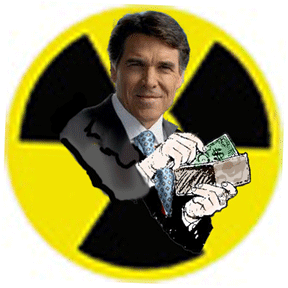
USA Government Accountability Office to probe Saudi nuclear power talks
Congressional watchdog to probe Saudi nuclear power talksA congressional watchdog has agreed to investigate the Trump administration’s discussions about sharing nuclear technology with Saudi Arabia, according to people familiar with the matter. The Government Accountability Office, a non-partisan agency that conducts investigations on behalf of Congress, is in talks with lawmakers over the scope of a probe into the nuclear power talks that the Trump administration has held with Saudi Arabia. One person familiar with the discussions between the GAO and lawmakers said they were in their “initial phase”. In February, lawmakers accused White House officials of pushing a plan to sell US nuclear power technology to Saudi Arabia in potential defiance of legal restrictions. A report prepared for the oversight committee of the Democratic-led House of Representatives said Trump aides were attempting “to rush the transfer of highly sensitive US nuclear technology to Saudi Arabia”, which may have violated the Atomic Energy Act.
In the Middle East, world’s most volatile region, nuclear power is taking off – what could possibly go wrong?
Above all, nuclear power needs stability and systems where everyone works together. The Middle East is one of the world’s most volatile regions, full of rivalries between states and internal divisions.
Israel has never disclosed the full extent of its nuclear programme and, in the past, has launched air strikes on nuclear facilities in both Iraq and Syria.
 Spectre of Chernobyl hangs over Middle East’s nuclear ambitions, Middle East Eye , Kieran Cooke
To avoid a potential disaster, nuclear power needs stability and systems where everyone works together The Middle East is going nuclear.The United Arab Emirates is home to the Barakah nuclear power station, the Arab world’s first such facility and the biggest nuclear power plant currently under construction.
Saudi Arabia has plans for two large nuclear plants to cope with national energy demands, increasing by more than eight percent annually.
Initial land-clearing work has also begun for a nuclear facility at Akkuyu, on Turkey’s southern coast, while Egypt is due to start building a nuclear power plant in El Dabaa, west of Alexandria, next year. Jordan has plans for a number of smaller nuclear facilities. …..
The Barakah facility, expected to supply a quarter of the UAE’s energy needs, will cost upwards of $30bn.
Equally expensive is the cost of decommissioning a nuclear plant at the end of its working life. Nuclear power has been around for more than 60 years, but no one has really come to grips with how to dispose of spent but still highly dangerous nuclear waste, handing a poisoned legacy to future generations.
And then there is the safety factor. On the morning of 26 April 1986, engineers at the Chernobyl nuclear power plant in Ukraine were carrying out routine turbine and reactor tests when they heard a sudden roar, followed by a loud blast.
Some thought there had been an earthquake. In a recently published book on Chernobyl, Serhii Plokhy – now a history professor at Harvard but in 1986 a Ukraine resident – said the idea of a nuclear accident was inconceivable. “As far as they [the engineers] were concerned, the reactor and its panoply of safety systems were idiot proof. No textbook they had ever read suggested that reactors could explode.”
Obsessed with secrecy
The nuclear industry today – whether in Russia, Europe, China, the US or the Middle East – is similarly confident of its safety.
Chernobyl’s reactor exploded, throwing vast clouds of radiation up into the atmosphere that were blown by winds over Scandinavia, much of Europe and Ukraine itself. Plokhy’s book – billed as the most extensively researched work yet on the Chernobyl disaster – should be required reading for any government official contemplating a nuclear-driven future………
Safety concerns
Plokhy says a combination of factors was to blame for events at Chernobyl, which beyond the immediate deaths, is believed to be responsible for tens of thousands of cases of fatal diseases, such as cancer. There were shortcuts in construction and pressure to increase energy quotas. Testing procedures were not followed. There were serious design faults, yet staff who foresaw dangers were afraid to speak out for fear of losing their jobs.
Plokhy foresees similar consequences in modern-day nuclear power programmes, wondering whether safety measures will be followed scrupulously in countries such as Egypt, the UAE and Pakistan.
“Are we sure that all these reactors are sound, that safety measures will be followed to the letter, and that the autocratic regimes running most of these countries will not sacrifice the safety of their people and the world as a whole to get extra energy and cash to build up their military, ensure rapid economic development, and try to head off public discontent?” he said. “That is exactly what happened in the Soviet Union back in 1986.”
Of course, these are early days in the nuclear power industry in the Middle East, but already there are problems. The first reactor unit of the four being built at the Barakah plant in Abu Dhabi was supposed to have come on-stream in 2017, but there is reportedly evidence of cracks in some of the containment walls and delays due to shortages of trained staff.
On Wednesday, Qatar asked the United Nations’ nuclear watchdog to intervene in a dispute over a a nuclear power plant that is under construction in the United Arab Emirates, Reuters reported.
Citing a letter Qatar sent to the International Atomic Energy Agency (IAEA), the news agency said that Doha argued that Barakah, a nuclear plant being built near its border with the UAE, threatens the stability of the region and the environment.
Qatar said that a radioactive plume from an accidental discharge could reach its capital Doha in five to 13 hours, while a radiation leak would have a devastating effect on the region’s water supply because of its reliance on desalination plants.
The biggest prize
Rosatom, Russia’s state nuclear corporation, is developing Egypt’s 4.8GW nuclear power plant, with work due to start next year. But there have been a number of protests at the site of the proposed plant, just as there have been demonstrationsas building work gets underway at Turkey’s Akkuyu nuclear facility, also being built by Rosatom.
In Jordan, the government seems to have abandoned plans for a $10bn nuclear plant to be built by Rosatom due to worries over costs. Instead, Amman is planning to build a number of much smaller reactors.
At the same time, the nuclear industry is falling over itself for what’s considered the biggest prize of all: Saudi Arabia. Competition for building the first two reactors in the kingdom’s ambitious nuclear power programme is intense, with US, Chinese, South Korean and French companies, along with Rosatom, involved in the process.
The US Congress is investigating reports that the White House has been transferring sensitive nuclear technology to Saudi Arabia so that US firms allegedly linked to President Donald Trump could win multibillion-dollar nuclear contracts……….
Regional volatility
Above all, nuclear power needs stability and systems where everyone works together. The Middle East is one of the world’s most volatile regions, full of rivalries between states and internal divisions.
Israel has never disclosed the full extent of its nuclear programme and, in the past, has launched air strikes on nuclear facilities in both Iraq and Syria. There are ongoing arguments over the status of Iran’s nuclear industry. ……..https://www.middleeasteye.net/opinion/spectre-chernobyl-hangs-over-middle-easts-nuclear-ambitions
U.S. accuses Iran of plotting to restart nuclear weapons program
U.S. officials on Friday accused Iran of plotting to restart work on its nuclear weapons program, despite Tehran agreeing in a 2015 accord to not pursue such weapons.The charges were made as the Treasury and State Departments announced a new round of sanctions against 14 individuals and 17 entities linked to the Iranian Ministry of Defense unit responsible for nuclear weapons development, senior administration officials said Friday.
Iran’s Organization of Defensive Innovation and Research, also referred to by the acronym SPND, maintains technical experts and critical ties to Iran’s previous nuclear efforts — notably to Mohsen Fakhrizadeh, head of Iran’s pre-2004 nuclear weapons program, officials said.
They added that Tehran-based SPND may not currently be working to develop nuclear weapons, but that the connections to Iran’s previous nuclear programs increase the threat of the country developing weapons of mass destruction. Iran has long claimed to have no interest in developing nuclear weapons, but the United Nations in 2015 uncovered a secret program that lasted until at least 2009.
The sanctions are the latest step the U.S. has taken to ramp up economic pressure on Iran after President Donald Trump pulled out of the 2015 nuclear pact, in which the country’s Islamist regime agreed to abandon any nuclear ambitions in exchange for economic sanctions relief. The other parties in the agreement — including several European countries, China and Russia — have all remained in the deal, and international organizations say Tehran
has complied with the agreement.
Trump has bashed the the international pact for not doing enough to stop Iranian efforts to build nuclear bombs. Since leaving the accord, his administration has leaned on other countries to cut off their interactions with Iran.
“Anyone considering dealing with the Iranian defense industry in general, and SPND in particular, risks professional, personal, and financial isolation,” Treasury Secretary Steven Mnuchin said in a statement Friday.
UN raps Israel’s use of ‘unlawful force’ against Gazans
Press TV, 23 Mar 19, The United Nations (UN)’s Human Rights Council has denounced Israel’s use of “unlawful lethal and other excessive force” against unarmed Palestinian protesters in the besieged Gaza Strip.
Gazans started protesting along a fence that separates the Gaza Strip from the Israeli-occupied territories on March 30, 2018 demanding the right to return for those Palestinians driven out of their homeland by Israeli aggression and calling for a halt to Israel’s inhumane blockade of the enclave.
Israeli forces deployed to the area have used force from across the fence against the protesters, killing over 260 Palestinians and injuring thousands since the protests started.
On Friday, the Humans Rights Council adopted a resolution on accountability tabled by Pakistan on behalf of the Organization of Islamic Cooperation (OIC).
The resolution was adopted with 23 votes in favor, eight against, and 15 abstentions. The delegation of one member state was absent.
The text also called for cooperation by the Israeli regime with a preliminary examination that was launched by the International Criminal Court (ICC) in 2015 into Israeli human rights violations.
The resolution was based on a UN Independent Commission of Inquiry report that found that Israeli forces had committed violations of international human rights and humanitarian law that “may constitute war crimes or crimes against humanity” in killing 189 Palestinians and injuring thousands between March 30 and December 31, 2018……..https://www.presstv.com/Detail/2019/03/22/591676/UN-Human-Rights-Council-Israel-lethal-excessive-force-Gaza
Top general opposes U.S. plan for ‘no first use’ nuclear doctrine
 Top general opposes shift to ‘no first use’ nuclear doctrine https://www.washingtontimes.com/news/2019/mar/14/dunford-oppose-shift-no-first-use-nuclear-doctrine/ – The Washington Times – Thursday, March 14, 2019
The chairman of the Joint Chiefs of Staff came out forcefully against a change in U.S. military policy which say the U.S. would not be the first to use nuclear weapons on a conflict with an adversary.
The “no first use” policy has been embraced by several Democratic candidates running for president in 2020, including Massachusetts Sen. Elizabeth Warren, who co-sponsored a bill in January that would establish in law that the U.S. would not be the first to use nuclear weapons.
But Gen. Joseph Dunford told a Senate Armed Services Committee hearing Thursday that “I absolutely believe that the current policy is the right policy.”
The Pentagon has long resisted adopting a blanket “no first use” doctrine in its nuclear strategy.
“I wouldn’t make any decisions to simplify an adversary’s decision-making calculus,” Gen. Dunford told lawmakers. “I can also imagine a few situations where we wouldn’t want to remove that option from the president.”
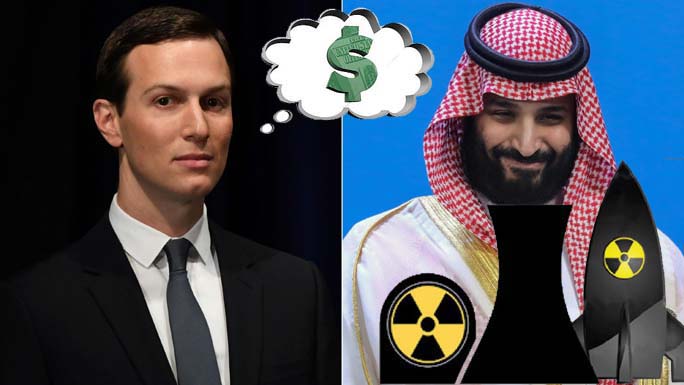
Trump’s endeavour to nuclearise Saudi Arabia is driven by family business interests and tacitly approved by Israel. Aljazeera, by Hamid Dabashi, 8 Mar 2019 Like chronic indigestion that refuses to go away, presidential son-in-law Jared Kushner is back causing much discomfort to the general public.
International Atomic Agency would require Saudi Arabia to have the same nuclear safeguards as Iran has
Before Saudi Arabia Goes Nuclear, It May Have to Follow Iran’s Lead, Bloomberg, By Jonathan Tirone March 7, 2019,
- Kingdom has yet to clinch enhanced atomic monitoring deal
- World powers are meeting with Iran on Wednesday in Vienna.
“………Focus on Saudi Arabia’s nuclear program has risen in the last month after the U.S. Congress opened an investigation into the potentially illegal transfer of sensitive technologies to the kingdom. This week the International Atomic Energy Agency, responsible for verifying that countries don’t divert material for weapons, weighed in on what its inspectors need before the kingdom can start generating nuclear power.
Focus on Saudi Arabia’s nuclear program has risen in the last month after the U.S. Congress opened an investigation into the potentially illegal transfer of sensitive technologies to the kingdom. This week the International Atomic Energy Agency, responsible for verifying that countries don’t divert material for weapons, weighed in on what its inspectors need before the kingdom can start generating nuclear power.
Riyadh’s nuclear program is developing “based on an old text” of safeguard rules, even as it expects to complete its first research reactor this year and plans to tap uraniumreserves, according to IAEA Director General Yukiya Amano, who told journalists this week in Vienna that he’s “appealing to all countries to rescind” those old ways of doing business.
“We’re encouraging all countries to conclude and implement an additional protocol and that includes Saudi Arabia,” said Amano, who’s also in charge of enforcing the 2015 nuclear deal struck between Iran and world powers. The Japanese career diplomat has called the set of rules established by that accord, which U.S. President Donald Trump withdrew from in May, as “the most rigorous monitoring mechanism ever negotiated.”……
the IAEA comments could strike a precautionary note among vendors lining up to service the kingdom’s nuclear ambitions. Receiving the imprimatur of IAEA inspectors, who account for gram-level quantities of nuclear material worldwide, is a precondition for receiving technologies and fuel. Without reaching a new understanding with monitors, Saudi plans for 3.2 gigawatts of atomic power by the end next decade could flounder. …….
Maintaining that level of IAEA access to Iran’s nuclear program is the reason that China, France, Germany, Russia and the U.K. continue to defy U.S. calls to abandon the 2015 deal and reimpose sanctions. Diplomats from those countries convened Wednesday in Vienna in their first meeting since the European Union established a trade channel to skirt U.S. threats.
Snap Inspections in Iran
IAEA complementary access to sites rose under agreement with world powers……https://www.bloomberg.com/news/articles/2019-03-06/before-saudi-goes-nuclear-it-may-have-to-follow-iran-s-lead
International Atomic Energy Agency chief again confirms that Iran is keeping to the nuclear deal

 Head of UN nuclear agency: Iran keeping to nuclear deal, https://www.foxnews.com/world/head-of-un-nuclear-agency-iran-keeping-to-nuclear-deal4 Mar 19, BERLIN – The head of the U.N. nuclear watchdog says Iran is complying with the 2015 deal with major world powers aimed at preventing the country from building nuclear weapons.
Yukiya Amano made his assessment in a regular update to the International Atomic Energy Agency’s board of governors, confirming a confidential report distributed to member states last month.
He said Monday that “Iran is implementing its nuclear-related commitments under the Joint Comprehensive Plan of Action,” referencing the official name of the 2015 deal.
The U.S. unilaterally withdrew from the deal last year and re-imposed sanctions.
The other signatories — Germany, France, Britain, Russia and China — are trying to keep alive the deal, which offered Iran economic incentives.
Despite U.S. Congress’s concerns, Trump is still pushing for sale of nuclear technology to Saudi Arabia
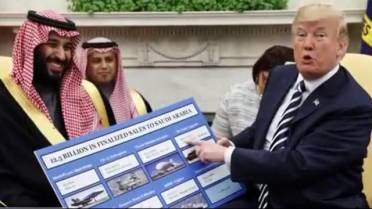 Team Trump Keeps Pushing Deal to Send Nuclear Tech to Saudis
Congress raised ‘grave concerns’ about the Trump administration’s past attempts to send nuclear technology to the Saudis. But Team Trump isn’t done trying. The Daily Beast, Erin Banco, Betsy Woodruff 03.04.19 The Trump administration is still actively working to make a deal to send U.S. nuclear technology to Saudi Arabia, according to two U.S. officials and two professional staffers at federal agencies with direct knowledge of those conversations. American energy businesses are still hoping to cash in on Riyadh’s push for energy diversification,
1 This Month
26 September – International Day for the Total Elimination of Nuclear Weapons





PLEASE OPPOSE HR 8255 AND S.3639 – bills would accelerate satellite deployment, with no environmental review or safeguards – https://ncstd5li.quorum.us/campaign/169331/
To see nuclear-related stories in greater depth and intensity – go to https://nuclearinformation.wordpress.com
-
Archives
- September 2026 (305)
- August 2026 (330)
- July 2026 (355)
- June 2026 (287)
- May 2026 (306)
- April 2026 (356)
- March 2026 (251)
- February 2026 (267)
- January 2026 (308)
- December 2025 (358)
- November 2025 (359)
- October 2025 (375)
-
Categories
- 1
- 1 NUCLEAR ISSUES
- business and costs
- climate change
- culture and arts
- ENERGY
- environment
- health
- history
- indigenous issues
- Legal
- marketing of nuclear
- media
- opposition to nuclear
- PERSONAL STORIES
- politics
- politics international
- Religion and ethics
- safety
- secrets,lies and civil liberties
- spinbuster
- technology
- Uranium
- wastes
- weapons and war
- Women
- 2 WORLD
- ACTION
- AFRICA
- Atrocities
- AUSTRALIA
- Christina's notes
- Christina's themes
- culture and arts
- Events
- Fuk 2022
- Fuk 2023
- Fukushima 2017
- Fukushima 2018
- fukushima 2019
- Fukushima 2020
- Fukushima 2021
- general
- global warming
- Humour (God we need it)
- Nuclear
- RARE EARTHS
- Reference
- resources – print
- Resources -audiovicual
- Weekly Newsletter
- World
- World Nuclear
- YouTube
-
RSS
Entries RSS
Comments RSS

