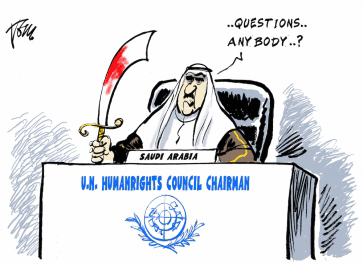
Saudi Arabia: Thousands Held Arbitrarily, Dramatic Increase in Detention Without Trial Human Rights Watch , 6 May 18, (Beirut) – Saudi Arabia is detaining thousands of people for more than six months, in some cases for over a decade, without referring them to courts for criminal proceedings. Saudi Arabia’s attorney general should promptly charge or release all criminal defendants and stop holding people arbitrarily.
Human Rights Watch analyzed data from a public online Interior Ministry database, which revealed that authorities have detained 2,305 people who are under investigation for more than six months without referring them to a judge. The number held for excessively long periods has apparently increased dramatically in recent years. A similar Human Rights Watch analysis in May 2014 revealed that only 293 people had been held under investigation for that period.
“If Saudi authorities can hold a detainee for months on end with no charges, it’s clear that the Saudi criminal justice system remains broken and unjust, and it only seems to be getting worse,” said Sarah Leah Whitson, Middle East director at Human Rights Watch.
“It seems that MBS’s ‘Vision2030’ plan better describes the length of detentions without charge than an aspirational time horizon for reforms.”
Saudi Arabia’s use of arbitrary detention has faced increasing scrutiny since the November 4, 2017 mass arrest of 381 people on corruption allegations. The arrests raised human rights concerns and appeared to take place outside of any recognizable legal framework, with detainees forced to trade financial and business assets for their freedom.
…….Human Rights Watch analyzed the data on April 2, which was updated through March 31. Of the 5,314 people in the database, 3,380 had been held for over six months without a conviction or their “case file under judicial review,” including 2,949 for more than a year and 770 for over three years. The database indicated Saudi authorities were holding 2,305 people “under investigation” for more than six months, 1,875 for more than a year, and 251 for over three years.
Saudi authorities have held one Saudi citizen without a conviction since September 2003 and another “under investigation” since December 2006. Of the 251 held “under investigation” for over three years, 233 are Saudis.
“We’ve reverted to a Saudi version of Kafka when authorities detain citizens for over a decade without charge because they are ‘under investigation’,” Whitson said. “This effectively means that Saudi authorities can detain and jail anyone they want by claiming they are investigating them, however endless the investigation.”………..
Extended detention without charge or trial or without an appearance before a judge is arbitrary, and violates both Saudi law and international human rights standards.
In the early 60s, the U.S. estimated that the number of victims in a nuclear war against the Soviet Union and China would total some 600 million. Twenty years ago, ‘Doomsday Machine’ author Daniel Ellsberg posed a similar question about the Mideast,
With the Iran nuclear deal on the rocks and tensions rising across the Middle East, it is worth revisiting a question that was posed more than two decades ago by Daniel Ellseberg, the former U.S. military analyst who leaked the Pentagon Papers, about the potential cost in lives of nuclear warfare in this region.
In October 1996, Ellsberg took part in a conference in Tel Aviventitled “Democracy, Human Rights and Mordechai Vanunu,” dedicated to the jailed Israeli nuclear whistleblower and led by Prof. Joseph Rotblat, winner of the 1995 Nobel Peace Prize. The conference was organized by the Israeli Committee for Vanunu and for a Middle East Free of Nuclear, Biological and Chemical Weapons. All the conference speeches were included in a book called “Vanunu and the Bomb” (edited by Giora Neumann and myself), which was published in 1998.
Here is an excerpt from Ellsberg’s 1996 speech, in which he drew on his Cold War experience in making plans for nuclear conflict and expected casualty figures.
“In 1961 I drafted a question for the president, John [F.] Kennedy, to ask the joint Chiefs of Staff. I was in the process of drafting the guidance notes for the operating plans for general nuclear war. I wrote a 20-page top secret draft adopted totally by [then-Defense Secretary Robert] McNamara and sent by him, as the secret guidance for joint Chiefs of Staff for totally changing the Eisenhower war plans. I was very proud of that as I thought the current plans to be a disaster and my plans were far better. (I can still say they were better but not as much as I had thought: I bear that on my conscience.) Therefore it was possible to draft questions to the High Chief, which he accepted, one of which was: If your plans were executed, and not interrupted by typhoon, preemptive attack or total incompetence, how many people would have died in the Soviet Union and China?
“I asked that in the belief that they did not have an answer. I had been working with the planners in the air force, who had never done such calculations. I thought they would have to waffle, it would be very embarrassing, or they would give some absurdly low estimate. But they did have an answer. It was addressed ‘for the eyes of the president only,’ but as I wrote the question, I saw that I held in my hand an unusual piece of paper.
“The number was for people in the Soviet Union and China alone, so they could avoid undue delay. It was a simple graph. An ascending line starting with deaths on the first day and leading on to deaths from fallout and so on in six months’ time. The figure was 320,000,000 dead. So they knew what their plans entailed. Obviously a computer model had done the calculations.
“So I asked about the rest, the answer was about 100,000,000 in Western Europe and roughly the same in Eastern Europe. Neutral countries adjacent to the Soviet Union, non-aligned; Afghanistan, Austria, Japan, were wiped out by fallout from our attacks, without calculations from retaliation from first strike.
“Total body count over the next couple of weeks was 600,000,000, I asked myself how people I drank beer with and worked with every day, could have written such plans. Not just hypothetical ones, this was a targeting estimate for planes on instant 10-minute alert all over the world; missiles, submarines, and machinery which was already there, not 10 years in the future. This was next week.
“This is what would have happened had we gone to war over Cuba, which was possible in 1962, or Berlin in 1960. 600,000,000 people. I thought they were the most evil plans that had ever been made in the history of humanity. I have spent 30 years since, trying to understand how Americans had created such plans, and such a machinery, but with very ordinary motives. The word evil is almost misleading as it suggests satanic forces or demonic motives. These were well intentioned people with very ordinary, very banal motives.
“If one returns to Israel, what if that question were asked by Benjamin Netanyahu [at the time in his first term as prime minister]? Has he done so? With virtual certainty I feel he has not. Has any lsraeli ever asked such a question? Has the calculation been made? I had thought that the general security service had not done so, but I was wrong. Perhaps the lsraeli military do know the answer. If we gave them enough time to work it out, what would the answer be to the question, supposing the weapons are used on the targets for which they have been prepared? Supposing the ground zero were hits on targets such as cities or other areas for which target folders have been prepared showing coordinates, how many people would die? It is a very simple calculation.
Assume Israel with more than 100, maybe 200, warheads – each on average the size of the Nagasaki bomb – each could produce 100,000 deaths.
I am a Jew. Should Jews have created machinery for the instant annihilation of 10 to 12,000,000 people? I do not want to be told that I don’t have the right to ask that question because I am not an lsraeli.
“If being a Jew means anything, it gives me a right to ask that question.
“I have already described what I, as an American, thought about the primary identity of my country, possessing capabilities to destroy 600,000,000 people. How would the Israeli military justify having the capabilities to kill 10-12,000,000, having bought it, trained for it, disciplined for it, prepared targets and so on. If the number is lower, let us hear it.
“My question is, should not the lsraeli president, parliament, people, know the answer to that question and then discuss whether the machinery needs expanding, as it is in the process of doing? How many could have been killed in 1986 when Vanunu made his decision? Why has Dimona been at work for the last 10 years? The discussion could not get started without Vanunu or his photos, and we would not have been believed about the scale of the program without these documents.
“This discussion is long overdue in Israel. This conference can contribute. There is a chance for change.”
Ellsberg was too optimistic. More than 20 years have passed since that conference and the discussion has still not yet to take place here – certainly not publicly.
ISRAEL AND DENUCLEARIZATION: NECESSARY PARADOX OR HYPOCRISY IN ACTION? Jerusalem Post, While Israel maintains nuclear ambiguity, the Jewish state is believed to possess up to 200 atomic weapons. BY BENJI FLACKS/THE MEDIA LINE MAY 26, 2018
Although Israel maintains a policy of ambiguity regarding its possession of nuclear weapons, the Jewish state is known to have a sizeable atomic arsenal. David Ben Gurion, Israel’s first prime minister, established with the help of France a covert nuclear program in the 1950s to combat against what was widely viewed as an existential military threat posed by Arab neighbors. Ever since, information has from time-to-time been leaked regarding the size and potency of Israel’s atomic capabilities, although no independent body has confirmed specific figures.Against this backdrop, the United States—which has the world’s second-largest nuclear stockpile after Russia—is actively promoting global non-proliferation. To this end, President Donald Trump is slated to hold a summit with North Korean ruler Kim Jong-Un to discuss the Peninsula’s denuclearization; and the US leader recently withdrew Washington from the Joint Comprehensive Plan of Action (commonly referred to as the Iran nuclear accord), which, in his estimation, would not have prevented Tehran’s acquisition of the bomb over the long-term.
For many, a clear dichotomy—if not double-standard—emerges when these policies are juxtaposed against the world’s hush-hush approach to—if not tacit approval of—Israel’s nuclear arms program.
According to Shannon Kile, head of the Nuclear Weapons Project at the Stockholm International Peace Research Institute (SIPRI), Israel exists in a sort of legal limbo given that it is not a party to the 1968 Treaty on the Non-Proliferation of Nuclear Weapons (NPT), which codified into international law regulations governing nuclear development. By contrast, he explained to The Media Line, “the United States has the moral and legal right to pressure North Korea and Iran [in ways that are] set out in the binding treaty.
“The NPT legally recognized legitimate nuclear nations and in the treaty, North Korea and Iran were barred from making nuclear weapons,” Kile elaborated, while qualifying that Pyongyang did pull-out of the NPT in 2003, blaming its decision on “U.S. aggression.” Nevertheless, Kile noted, there is “a long-running international dispute over [Israel’s] nuclear program. NPT countries, particularly Egypt, have argued for a nuclear-free zone in the Middle East that would include Israel. This notion,” he continued, “was a key pillar in the extension of the treaty in 1995. But not all countries seem willing to force Israel to sign up.”
More broadly, Kile believes that there “needs to be a commitment for all nuclear states to fulfill their obligation to denuclearize, as this would bolster the norm against atomic weapons. All NTP signatories have committed to abolishing their nuclear arms yet we see no real progress on that, even in the United States.” ……. https://www.jpost.com/Israel-News/Israel-and-denuclearization-Necessary-paradox-or-hypocrisy-in-action-558401
UAE’s first nuclear reactor start-up delayed, MEMO, May 27, 2018
The start-up of the Arab world’s first nuclear reactor – in the United Arab Emirates – has been delayed and should start operations between the end of 2019 and early 2020, the plant’s operator said on Saturday.
Nawah Energy Company, the operator of the Barakah Nuclear Energy Plant in the Al-Dhafra Region of Abu Dhabi, said it “has completed a comprehensive operational readiness review” for an updated start-up schedule for the reactor.
The $24.4 billion Barakah power plant is the world’s largest nuclear project under construction and will be the first in the Arab world.
“The results of Nawah’s review forecast that the loading of nuclear fuel assemblies required to commence nuclear operations at Barakah Unit 1 will occur between the end of 2019 and early 2020,” it said in a statement.
Reuters reported in March that the start-up had been pushed back to 2019 due to training delays.
“The resulting projection for the start-up of Unit 1 operations reflects the time required for the plant’s nuclear operators to complete operational readiness activities and to obtain necessary regulatory approvals,” Nawah said.
The first of four reactors being built by Korea Electric Power Corporation (KEPCO) in the UAE is part of the Barakah power plant project that was originally scheduled to open last year.
Jordan Settles for Smaller Russian Nuclear Reactor by 2022May 27th, 2018 via SyndiGate.info
Jordan on Saturday announced a plan for a small modular nuclear reactor with Russia, replacing the $10 billion nuclear power plant for which an agreement was signed in 2015 between the Jordan Atomic Energy Commission (JAEC) and Russia’s Rosatom Overseas.
“Jordan is now focusing on small modular reactors because the large reactors place financial burden on the Kingdom and in light of the current fiscal conditions we believe it is best to focus on smaller reactors,” a government official, who preferred anonymity, told The Jordan Times on Saturday.
The official said the plan for the $10 billion nuclear plant with Russia that entails building two nuclear reactors with total capacity of 2,000 megawatts is over now and that focus will be on smaller reactors, which are safe, require less financial burden and for which Jordan can attract investors, the official said Saturday……..https://www.albawaba.com/news/jordan-settles-smaller-russian-nuclear-reactor-2022-1137364
Iran asks Europe what it can offer to keep it in the nuclear deal after U.S. pullout, WP, By Michael BirnbaumMay 25 Email the author
VIENNA — Iran will decide within weeks whether to stay in a faltering deal to restrain its nuclear program and is pressing Europe to compensate for President Trump’s decision to reimpose sanctions, a senior Iranian official said Friday.
The official warned that Tehran could also pull out from a separate treaty that limits the spread of nuclear weapons.
The caution came ahead of the first talks involving all the remaining parties to the landmark 2015 deal since the United States pulled out this month.
An official report Thursday declared that Iran is still in compliance with the stringent controls on its nuclear program.
Iran has long declared that its program is limited to the peaceful generation of nuclear energy and production of medical isotopes. If it were to pull out of the 2015 Joint Comprehensive Plan of Action (JCPOA) and the 1970 Treaty on the Nonproliferation of Nuclear Weapons (NPT) and seek nuclear weapons, it could spark an arms race in the already volatile Middle East.
The Pentagon is speeding up US weapons deliveries to allied militaries such as Saudi Arabia, Romania, Japan, and South Korea through new “pilot authorities that change how it can design and execute contracts” according to news reports.
Defense One, quoted Ellen Lord, US defense undersecretary for acquisition and sustainment, as saying, Wednesday “we have a whole variety of specific programs where we are focused on applying these authorities: Patriot Missiles for Romania; Global Hawk for Japan, THAAD [high-altitude air defense missiles] for Saudi Arabia, and TOW [vehicle-launched missiles] for multiple foreign military sales partners.”
These new authorities will allow the Pentagon to shave “years” off the time it takes to deliver weapons to friendly militaries, Lord said at the annual SOFIC event here.
The report added that Saudi Arabia is a frequent target of missile strikes by Houthi rebels. Regional authorities routinely fret about Iran’s growing missile capabilities.
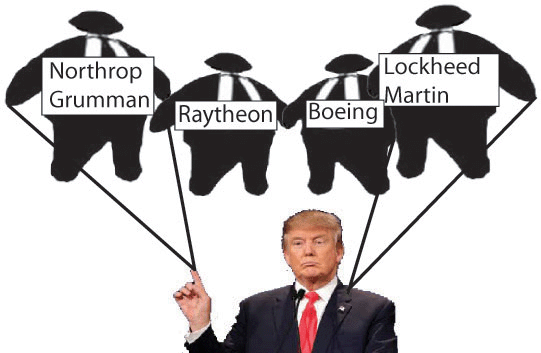
The Trump administration, working to increase exports of US-made weapons, has started the process to execute the sale 120,000 precision-guided munitions to allies Saudi Arabia and the United Arab Emirates.
Reuters said Tuesday that the White House asked the US Congress to review the deal.
Last year, the Trump administration approved the sale of about $7 billion of the precision-guided weapons to Saudi Arabia.
Raytheon Co is the largest maker of the PGMs in the United States.
Administration and congressional sources confirmed that the informal 40-day review period to sell the munitions to the two countries was under way.
Loujain is a well-known campaigner for women’s right to drive in the ultra-conservative kingdom. Late last week, we learned that she had been arrested from her home. She was one of at least six prominent women’s rights activists detained by the Saudi Arabian authorities.
Loujain has been arrested several times in recent years for campaigning for women’s right to drive and the abolition of the male guardianship system. Now, she is the victim of a state-orchestrated smear campaign, designed to undermine the important campaigning that she and other human rights activists have been undertaking.
Along with the other human rights activists, Loujain has been detained and accused of crimes including “suspicious contact with foreign entities” and undermining the “security and stability” of the country. She was branded a ‘traitor’ to the country by state-aligned media. These arrests come one month before Saudi Arabian authorities will lift the ban on women driving in the kingdom. It is a cruel irony that the very women who championed the right to drive campaign may not be able to benefit from their activism – instead, they may be behind bars instead of behind the wheel.
These accusations are nothing more than ludicrous lies, intended to silence strong feminist voices speaking up for women’s rights.
The following morning, it only got worse. A vile and unprecedented smear campaign took over the front pages of Saudi newspapers and spread across social media platforms. Local newspapers like Okaz and Al-Jazirah were filled with aggressive front-page headlines, photos and countless opinion articles, calling the activists spies. On Twitter, one graphic was widely shared, revealing the faces and names of these activists with the word “traitor” stamped across their photos.
We fear that they, like many other peaceful activists and human rights defenders, will be tried and sentenced to lengthy prison terms for their activism. This continued criminalization of peaceful activism and human rights work is repulsive. It’s been a week since their arrests, and we still don’t know where the activists are, if they have been presented with clear legal charges, or have had access to a lawyer of their choosing.
In recent weeks, Saudi Arabia’s Crown Prince Mohammad bin Salman has travelled the world on a PR blitz, shaking hands with fellow leaders while promising positive change in the kingdom. MbS (as he’s known) claims women’s rights will be respected as part of his reforms. These arrests show those promises to be a lie.
How can the Crown Prince tell the world that he is an advocate for women’s rights while locking up activists who have called for the reforms he claims credit for? How can he claim to support women’s empowerment when the brave activists who have sacrificed their freedom for the rights and freedoms of Saudi Arabian women in the country won’t be able to drive next month?
For government leaders around the world who have been taken in by MbS’ talk of reform, we have a simple message: as long as human rights activists are deemed a threat to state security, and as long as the rights to freedom of expression, association, and assembly are equated with terrorism, Saudi reform is not meaningful.
It is clear that underneath all the PR hype and spin, Crown Prince Mohammad bin Salman doesn’t care about women’s rights and real human rights reforms. Saudi Arabian authorities cannot continue to publicly state they are dedicated to reform, while treating women’s rights campaigners in this cruel way. It’s time to end the systematic discrimination against women and the repression of the human rights community in Saudi Arabia.
Samah Hadid is Amnesty International’s Middle East Director of Campaigns
Saudi Arabia has widened its crackdown on women’s rights activists, bringing the number of arrests up to 11 people, according to human rights groups.
Since the sweep began on May 15, the detained activists, most of whom are women, have been branded “traitors” by pro-government news outlets and social media accounts, according to Human Rights Watch. Over the weekend, several state-linked newspapers published the names and photographs of those detained in what rights groups dubbed a “smear campaign“.
Those arrested reportedly include prominent women’s rights defenders who have long advocated for ending the ban on women driving, among them, Loujain al-Hathloul, Aziza al-Yousef and Eman al-Nafjan, along with Mohammed al-Rabea, an activist, and Ibrahim al-Modaimeegh, a human rights lawyer. They may face charges for “suspicious contact with foreign parties” and undermining “stability,” according to the Presidency for State Security, an office which reports to the king.
Since the kingdom is expected to soon lift its prohibition on women driving, rights groups said the motivation behind the escalating arrests remains unclear.
King Salman bin Abdulaziz Al Saud and his son, Crown Prince Mohammed bin Salman, drew international plaudits last year when they announced the ban on female drivers would end on June 24.
But now international outrage over the arrests threatens to derail the crown prince’s image as liberalizer.
“The crown prince, who has styled himself as a reformer with Western allies and investors, should be thanking the activists for their contributions to the Saudi women’s rights movement,” Sarah Leah Whitson, HRW’s Middle East director said in a statement. “Instead, the Saudi authorities appear to be punishing these women’s rights champions for promoting a goal bin Salman alleges to support — ending discrimination against women.”
Europe reassures Iran of commitment to nuclear deal without U.S, Alissa de Carbonnel 19 May 18 TEHRAN (Reuters) – The European Union’s energy chief sought to reassure Iran on Saturday that the bloc remained committed to salvaging a nuclear deal with Tehran despite U.S. President Donald Trump’s decision to exit the accord and reimpose sanctions.
Miguel Arias Canete delivered the message on a visit to Tehran and also said the 28-nation EU, once the biggest importer of Iranian oil, hoped to strengthen trade with Iran.
“We have sent a message to our Iranian friends that as long as they are sticking to the (nuclear) agreement the Europeans will… fulfill their commitment. And they said the same thing on the other side,” Arias Canete, European Commissioner for energy and climate, told reporters after talks with Iran’s nuclear chief Ali Akbar Salehi.
Salehi said it would be disastrous if EU efforts fail to preserve the 2015 deal, in which Tehran agreed to curb its nuclear work in return for the lifting of most Western sanctions. “The ball is in their (EU leaders) court,” Salehi said. “We hope their efforts materialize.”
Since Trump’s announcement of the U.S. exit on May 8, EU leaders have pledged to try to keep Iran’s oil trade and investment flowing but admitted that will not be easy to do so.
The cloak that hides the dagger – nuclear deals and geopolitics, Daily Maverick , Saliem Fakir • 18 May 2018The nature of nuclear plants make them very prone to sovereign compromise if national governments can no longer pay their debt bills.
Nuclear deals should not be seen as pure commercial arrangements but sometimes an apparatus of geo-politics, especially in state-to-state relations. They are always more than what you can see from the surface. Perhaps, what is true about nuclear may be true about other technologies and large-scale infrastructure or resource extraction deals.
The question arises as to whether South Africa is not long overdue in having a foreign investment review process for private or state foreign firms in matters that of national security and where investments could pose a sovereign risk to the national economy
Large-scale infrastructure projects concentrate capital (usually debt), technical expertise and long-term supply and maintenance arrangements with foreign firms. Unpaid debt can be converted into odious obligations by a foreign power.
There has been some focus on Russia’s nuclear interests, via Rosatom, in South Africa’s bid to secure a nuclear fleet – with somewhat dubious reasons under Jacob Zuma’s presidency.
While, the Russians got the lion’s share of attention the courts in fact ruled, in the case brought by Earthlife Africa (ELA) and the South African Faith Communities Environment Institute (SAFCEI), against all agreements signed by the South Africa government forcing a retreat from early agreements signed with the US, South Korea, China and Russia.
The courts sent the government back to the drawing board with parliament to debate and vet these agreements in future.
This is all now a moot point given that nuclear power is unlikely to be pursued as part of South Africa’s energy mix under President Cyril Ramaphosa. This being said some future insights can be gained on the nexus between large infrastructure programmes and their relation with geo-politics and geo-economics.
This is a topic less of a focus here and hardly debated nor appreciated given how much of the world is now in the throes of multi-polarity and geopolitical rivalry. In this world – state-to-state relations will gain ascendency even if market mechanisms are used. When it comes economic rebooting even ‘non-interfering’ states in liberalised market economies are willing to do the bidding of their flagship firms. Foreign relations easily mesh with geo-economic interests.
This is because liberal economists see the utopia of markets and not the world as it is, and the world as it is, is being slowly shaped by great power rivalries, in a range of geographies vital to sustaining such power.
On the geographical point consider Djibouti: its strategic location at a crucial choke-point and Sea Lane of Communication (SLOC), through which vital shipping passes between Europe and Asia, is home to multiple military bases of rival powers. Djibouti’s economy is highly dependent on revenue from these military bases and its entire economic logic is shaped by security concerns in the Gulf of Aden and Bab-al-Mandeb – the narrowest point going through the Red Sea given the situation of conflict in Somalia and Yemen.
………The irony is that the hand of geopolitics is everywhere to be seen but little examined here on our shores both in theory and as its existence manifests within the sinews of each deal that involves state-to-state relations or even seemingly independent market pursuits by flagship multinationals who are also proud carriers of their national flag.
……….The nature of nuclear plants make them very prone to sovereign compromise if national governments can no longer pay their debt bills.
If one is beholden to a long continuity of dependence (given the long life-span of nuclear plants) for expertise and debt obligations then autonomy will have to soften and give way to compromise and concessions in other arenas of the economy if these obligations cannot be met. A quick scan of the history of sovereign debt and foreign relations will easily make clear the poignancy of the narrative presented above.
…….A geopolitical story is unfolding as Saudi Arabia is seeking to build nuclear plants putting the US in a Catch-22.
The US has to give permission to the Saudi requests for it to go ahead with a nuclear power programme as US companies are also keen to bid and be freed up to supply the necessary technology and materials to the Saudis through the behest of the NSG. Otherwise the Saudis will turn to others.
Naturally, the US is concerned about nuclear arms race in the Middle East in the light of the now collapsing nuclear deal with Iran under the Joint Comprehensive Plan of Action (JCPOA) given that the US has withdrawn from it. Other fronts where national interests confront foreign control over strategic assets are the interest of China Nuclear Gen’s bid to buy a stake in Britain’s NuGen in Moorside. The British desperately want foreign investment but also do not want to have their economy held at ransom to Chinese nuclear plant operators if Britain is still part of the western alliance. China’s bid has not been short of anxious Brits concerned about national security.
The litany of examples need not be given further detail here as the point has been made.
The question of geopolitics and sovereign geo-economic interests will become more the norm than not in the future. A foreign investment review process is long overdue in the light of the fact that South Africa nearly saw itself caught up in a foreign power’s geopolitical games: even when hidden under the cover of commerce there is the fear that behind the silky cloak there is possibly also a dagger. DM https://www.dailymaverick.co.za/opinionista/2018-05-18-the-cloak-that-hides-the-dagger-nuclear-deals-and-geopolitics/#.WwHjPDSFPGg
Times 12th May 2018 Saudi Arabia is seeking to enrich its own uranium, prompting fears of a nuclear arms race in the Middle East after President Trump’s withdrawal from the Iran deal. Riyadh says it wants to make nuclear fuel to diversify its energy sources but recent public warnings from Saudi leaders about acquiring a nuclear bomb have raised doubts about their commitment to non-proliferation as the Iran nuclear agreement teeters.
Saudi Arabia’s Crown Prince Mohammed bin Salman warned during a trip to the US in March that if Iran developed a nuclear bomb his country would “follow suit as soon as possible”. That warning was repeated by his foreign minister this
week after Mr Trump withdrew from the deal with Iran and its leaders threatened to resume enrichment. Saudi Arabia would “do whatever it takes to protect our people,” Adel al-Jub eir told CNN. “We have made it very clear that if Iran acquires a nuclear capability we will do everything we can to do the same.” https://www.thetimes.co.uk/edition/world/saudis-bid-to-match-iran-by-enriching-uranium-vrj7q9rms
Iran seeks ‘clear future design’ for imperilled nuclear deal Aljazeera, 14 May 18 FM says Tehran is ‘ready for all options’ as he embarks on tour with pact’s other signatories in wake of US withdrawal.
Iran’s foreign minister has held talks in China as he began a diplomatic tour with the remaining signatories of a multinational nuclear deal following the recent US withdrawal from the landmark 2015 pact.
Speaking on Sunday in Beijing, Mohammad Javad Zarif underlined Tehran’s readiness “for all options” but expressed optimism that this round of negotiations could save the 2015 deal.
“We hope that with this visit to China and other countries we will be able to construct a clear future design for the comprehensive agreement,” Zarif said, speaking alongside his Chinese counterpart, Wang Yi.
“[But] if the nuclear deal is to continue, the interests of the people of Iran must be assured.”
Earlier on Sunday, Iranian President Hassan Rouhani said Iran would remain committed to the deal “if the remaining five countries abide by the agreement”.
Diplomatic tour
After the Chinese capital, Zarif will attend talks in Moscow and Brussels with representatives of the pact’s other signatories.
Under the deal signed in Vienna with six world powers – China, France, Russia, the UK, the US, Germany, and the European Union – Iran scaled back its uranium enrichment programme and promised not to pursue nuclear weapons in exchange for the lifting of economic sanctions.
Saudi Arabia and Israel have been itching for an attack on Iran. That would be a dangerous move by either of those States. But hey! What if you get get America to do this on their behalf? With Trump now surrounding himself with belligerent advisors, like Mike Pompeo and John Bolton, and with Trump’s son-in-law Jared Kushner cosying up to Israel and Saudi Arabia – there’s every chance that USA will move closer to the military brink. After all, Trump recently warned Iran that if it started enriching uranium “there will be very severe consequences,” and “something will happen”
Of course, it’s a different story for the Trump and the USA, when it comes to letting the Saudi Arabians enrich uranium. Westinghouse is keen to sell U.S,. nuclear technology to Saudi Arabia, and the Trump administration is writhing about trying to bypass the “123 rule” which prohibits uranium enrichment.
Saudi Arabia has been quick to militarily attack in the past – Bahrain 1994 and 2011 – Yemen recently.
The regime’s brutality towards its own citizens should surely give the world pause to think about how it might behave towards other people, when it’s in possession of nuclear bombs. Cruelty and beheadings are “normal” for crimes -not only for murders, but also for apostasy, blasphemy, atheism.
Of course, super salesman Donald Trump would find this irrelevant, indeed encouraging. After all, 12 months ago, Trump visited Riyadh , returning with a $350 Billion arms contract for America.
Nuclear power for Saudi Arabia becomes an absurd idea, when you consider that Saudi Arabia is not only the “Saudi Arabia” of oil, but also of sunshine. Their motivation for nuclear weapons is clear.
Trump Outsources US Foreign Policy to Riyadh, Tel Aviv Over Iran Deal – Analysts https://sputniknews.com/us/201805101064310160-usa-trump-iran-foreign-policy/ Jonathan Ernst 17 10.05 WASHINGTON (Sputnik) – The United States by exiting the Iran nuclear agreement has now essentially outsourced US foreign policy in the Middle East to both Israel and Saudi Arabia, analysts told Sputnik.
On Wednesday, White House Press Secretary Sarah Sanders told reporters the United States is ready to announce an additional set of sanctions against Iran as early as next week in response to its alleged development of nuclear weapons.
President Donald Trump on Tuesday announced that the United States was withdrawing from the 2015 Joint Comprehensive Plan of Action (JCPOA), signed by the P5+1 and EU, which ensures Iran’s nuclear program remains peaceful in exchange for sanctions relief. In addition, the US Treasury said it would reimpose the highest-level economic sanctions possible on Iran.
In the week prior to Trump’s decision Israeli Prime Minister Benjamin Netanyahu in an internationally-broadcast address presented old intelligence and tried to claim that Tehran was continuing to develop nuclear weapons.
In fact, Iran has remained compliant under the conditions of the JCPOA as verified by the IAEA in 11 reports since January 2016 — a reality US Secretary of State Michael Pompeo even admitted during his confirmation hearings.
Israeli, Saudi Victory
Retired US Army Major and historian Todd Pierce told Sputnik that Trump’s announcement was a triumph for the leaders of Israel and Saudi Arabia, both of whom want the United States to confront Iran.
“Trump has placed US foreign policy in the hands of the coalition of Israel under Netanyahu and Saudi Arabia under [Crown Prince] Mohammad bin Salman, which his son in law Jared Kushner helped bring together to collectively wage war against Iran and Syria,” he said.
Trump’s statement on why he was pulling out of the international nuclear agreement with Iran was expressed in terms that made it sound like Trump was determined to go to war, Pierce observed.”Constructively, in effect, Trump’s talk sounded like a declaration of war against Iran, with the first step being to tighten up the ‘blockade’ of Iran, meaning in the 21st century version of that, US sanctions,” Pierce said.
Trump’s address was also notable for how closely it followed the arguments made eight days earlier by Netanyahu in his efforts to persuade the US government and Congress to scrap the agreement, Pierce pointed out.
Trump, like his ally and friend Netanyahu had shown scant regard for factual accuracy in his presentation.Trump was not an extremist or aberration in setting such policies but was fulfilling goals that had been followed for decades, Pierce pointed out.
Tehran Undaunted
Global peace activist and expert on the medical dangers of nuclear energy, Dr. Helen Caldicott, told Sputnik that she expected Tehran to continue honoring its commitmentsunder the 2015 nuclear accord.
“I think there will not be a nuclear arms race in the Middle East despite the fact that Israel was vehemently opposed to the treaty and surreptitiously lobbied against it with the powers that be in the US,” Caldicott said.
Caldicott, founder of Physicians for Social Responsibility, the organization that was the co-winner of the 1985 Nobel Peace Prize, noted that Iranian President Hassan Rouhani had pledged to remain in the accord.
“Rouhani says that Iran will abide by the JCPOA, a stand which I intuitively had predicted,” she said. “It also seems clear that the European nations will definitely not abide by Trump’s terms of increased sanctions, after begging him to comply.”
The United States still needed to realize that Russia was not an ideological enemy of the West any more the way the Soviet Union had been throughout the Cold War, Caldicott maintained.
“If America could come to its senses and decide that all nuclear weapons are useless symbols of annihilation and have absolutely nothing to do with ‘defense’ it could lead the world to sanity, survival and nuclear disarmament,” she said.
Saudi Foreign Minister Adel Jubeir said on Wednesday that the country may start development of nuclear weapons if Iran continues its nuclear program.
Caldicott is the author of many books, including “The New Nuclear Danger: George W. Bush’s Military Industrial Complex” and “War in Heaven:” The Arms Race in Outer Space.” The Smithsonian Institution has named her one of the most influential women of the 20th century.
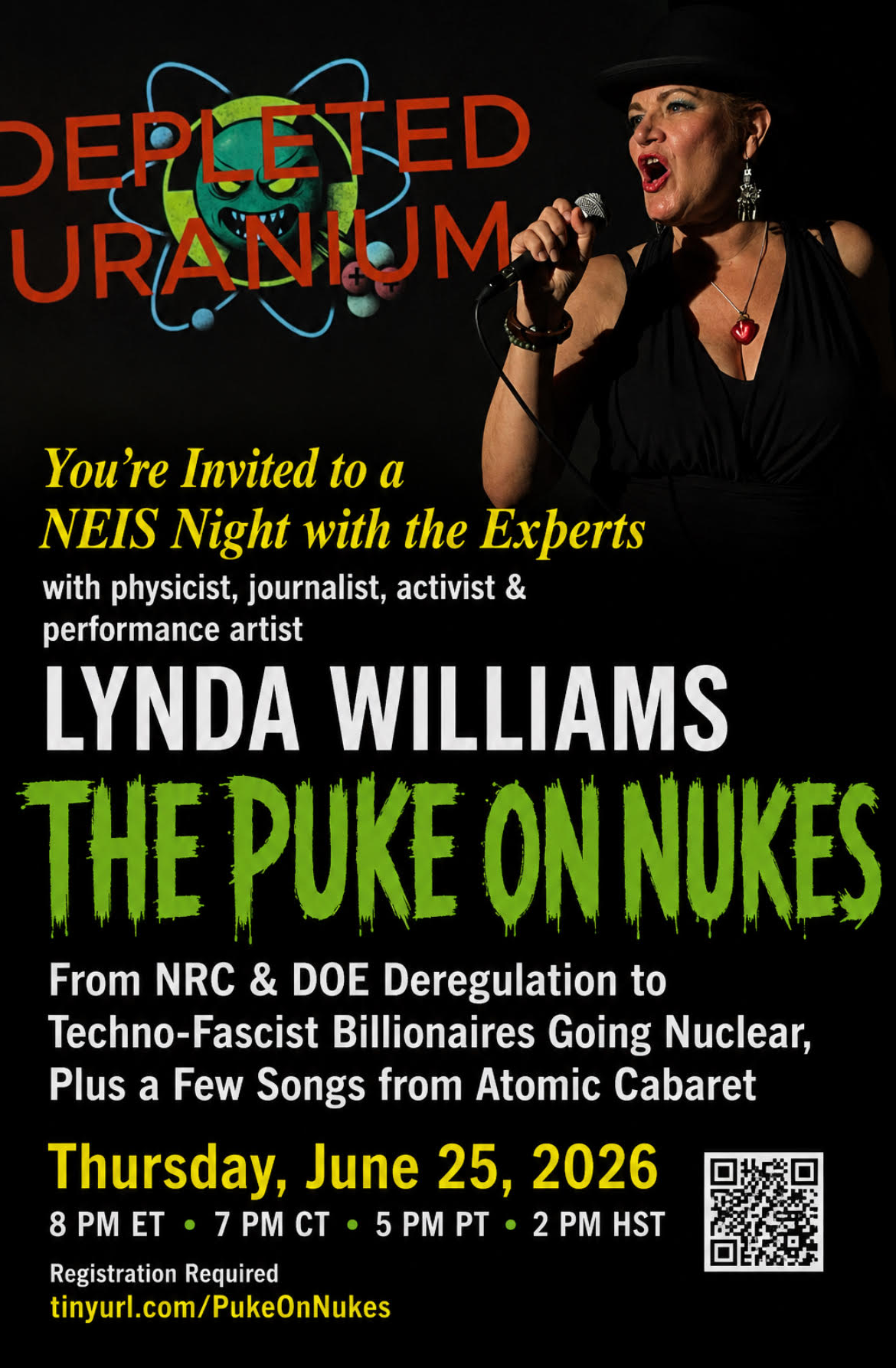
7pm Central Time (8pm ET, 6pm MT, 5pm PT) UTC – 5 From NRC & DOE Deregulation to Techno-Fascist Billionaires Going Nuclear, Plus a Few Songs from Atomic Cabaret REGISTER






 nuclear-news