Why was the Trump administration so eager to give nuclear technology to the reckless Saudi regime? https://www.washingtonpost.com/opinions/global-opinions/why-was-the-trump-administration-so-eager-to-give-nuclear-technology-to-the-reckless-saudi-regime/2019/02/21/e40e38e6-353c-11e9-a400-e481bf264fdc_story.html?utm_term=.cdaa56e24b47, By Editorial Board, February 21 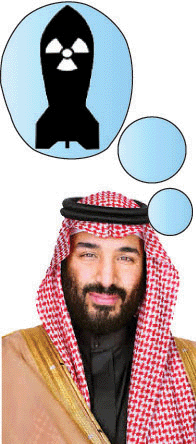 SAUDI ARABIA’s Crown Prince Mohammed bin Salman has built a record of reckless aggression against opponents both at home and abroad. He has also declared on at least one occasion that his regime could seek to acquire nuclear weapons. It would seem common-sensical for the United States to avoid transferring any nuclear technology to his regime without ironclad guarantees that it could not be used to build bombs. Yet the Trump administration appears to have persisted in considering proposals to do just that — in part at the urging of senior officials and lobbyists with troubling conflicts of interest. SAUDI ARABIA’s Crown Prince Mohammed bin Salman has built a record of reckless aggression against opponents both at home and abroad. He has also declared on at least one occasion that his regime could seek to acquire nuclear weapons. It would seem common-sensical for the United States to avoid transferring any nuclear technology to his regime without ironclad guarantees that it could not be used to build bombs. Yet the Trump administration appears to have persisted in considering proposals to do just that — in part at the urging of senior officials and lobbyists with troubling conflicts of interest.
A report by the Democratic staff of the House Oversight and Reform Committee this week provided new details of how former national security adviser Michael Flynn and other National Security Council officials attempted to rush through a plan for U.S. companies to sell nuclear power plants to Saudi Arabia in the early weeks of the Trump administration. Ignoring warnings by career officials that they could violate laws on technology transfers, as well as conflict-of-interest rules, they pushed a scheme drawn up by a firm represented by several well-connected retired generals.
According to the committee report, Mr. Flynn had identified himself as an adviser to the  company, and the plan called for President Trump to appoint his close friend Tom Barrack to oversee a deal with the Saudis even though his private business has raised considerable funds from Saudi investors. company, and the plan called for President Trump to appoint his close friend Tom Barrack to oversee a deal with the Saudis even though his private business has raised considerable funds from Saudi investors.
Though the NSC initiative appears to have been squelched by H.R. McMaster, who replaced Mr. Flynn, negotiations with the Saudis have quietly continued under Energy Secretary Rick  Perry. As recently as last week, Mr. Trump held a meeting with nuclear company executives in the Oval Office to discuss power-plant sales to Saudi Arabia. The session was organized by the firm that previously collaborated with Mr. Flynn, and the shadows of possible conflicts of interest persist. One of the nuclear companies, Westinghouse Electric, is owned by a firm that also bought a stake in a troubled Manhattan skyscraper owned by Jared Kushner’s family company. Mr. Kushner, a key interlocutor with Mohammed bin Salman, is due to visit the kingdom again next week. Perry. As recently as last week, Mr. Trump held a meeting with nuclear company executives in the Oval Office to discuss power-plant sales to Saudi Arabia. The session was organized by the firm that previously collaborated with Mr. Flynn, and the shadows of possible conflicts of interest persist. One of the nuclear companies, Westinghouse Electric, is owned by a firm that also bought a stake in a troubled Manhattan skyscraper owned by Jared Kushner’s family company. Mr. Kushner, a key interlocutor with Mohammed bin Salman, is due to visit the kingdom again next week.
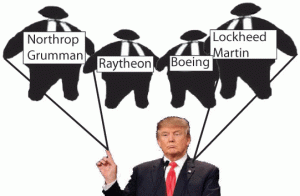 There is an argument to be made for U.S. firms selling nuclear plants to Saudi Arabia: If the kingdom is determined to acquire them, then it would be better it do so from U.S. companies than from their Russian or Chinese competitors. But that logic holds only if the administration negotiates a deal with Riyadh imposing strict controls on the technology. In the case of Saudi Arabia, the only responsible accord would be one that prohibited the regime from any enrichment of uranium or reprocessing of spent fuel — techniques that can be used to build nuclear weapons. There is an argument to be made for U.S. firms selling nuclear plants to Saudi Arabia: If the kingdom is determined to acquire them, then it would be better it do so from U.S. companies than from their Russian or Chinese competitors. But that logic holds only if the administration negotiates a deal with Riyadh imposing strict controls on the technology. In the case of Saudi Arabia, the only responsible accord would be one that prohibited the regime from any enrichment of uranium or reprocessing of spent fuel — techniques that can be used to build nuclear weapons.
Unsurprisingly, the arrogant crown prince is refusing to accept those terms — probably because he wishes to preserve a nuclear-arms option. Though federal law requires the United States to negotiate a protocol on the conditions for supplying nuclear technology and submit that to Congress, it does not mandate those conditions. So Congress must insist that any nuclear deal with Saudi Arabia embrace this gold standard. To do otherwise would only compound the danger posed by Mohammed bin Salman.
|
|
|
February 23, 2019
Posted by Christina Macpherson |
business and costs, politics international, Saudi Arabia, USA, weapons and war |
Leave a comment

Climate change will fuel more wars and displacement in the Middle East, experts warn
‘Terrorist organisations like ISIS also capitalise on climate change to get new members’ https://www.independent.co.uk/news/world/middle-east/middle-east-climate-change-war-food-water-refugees-jihadis-un-a8786911.html, 20 Feb 19, Borzou Daragahi The Hague
“Food and fuel in security can very quickly quickly lead to unrest,” Jamal Saghir, a professor at McGill University.
“It’s likely that such shocks will happen again. Such crises might trigger violent crisis and increase public support for extremist groups offering viable alternatives,” he told attendees at the conference. “Terrorist organisations like ISIS also capitalise on climate change to get new members. They find impoverished farmers to take advantage of – they are offered food, salaries, and other advantages.”
First launched in 2015, the Planetary Security Initiative is a conference sponsored by the Dutch government and several international organisations to address climate change and associated crises. It seeks to broaden the definition of security beyond weapons and borders to include daily sustenance.
Scholars and policymakers have already attributed to climatic shifts that a decades-long drought that has afflicted the Middle East. During the opening talk, the Iraqi ambassador showed a chart that traced average rainfall in Baghdad collapsing and temperatures rising consistently over the last decade.
The changing conditions contributed to unrest in Syria and Iraq and other Arab nations plunged into chaos in the 2011 Arab Spring uprisings, and the subsequent rise of ISIS. But the troubles are far from over, with warmer temperatures leading to less water, for example along the Tigris and Euphrates rivers that nourish Iraq.
“In Iraq, what is projected is the reduction of rainfall or snow in the headwaters,” said Nadim Farjallah, a professor specialising in climate change issues at the American University of Beirut. “The Middle East has all the problems now and all it needs is a spark. We already have all the tinder there.”
Adding to the complications, the Middle East region imports 65 percent of its grain, with the numbers increasing, making governments and populations even more vulnerable to market shifts or climactic changes in other regions. “The region is completely dependent on the sustainable management of agriculture in other parts of the world for its food security,” said Johan Schaar, a scholar at the Stockholm International Peace Research Institute.
The United Nations and other development agencies are nibbling at the edges of the looming crisis. They’ve established a fund to find water solutions for Egypt, where the bulk of its nearly 100 million population live along the Nile River. Kishan Khoday, a UNDP official focused on Middle East issues, described initiative bring solar energy to Somalia and manage underground water resources.
Participants spoke of the urgent need of making governments and publics more aware of the need to manage water and other natural resources. “We need to weave climate change more systematically into our analysis of what’s happening in the region,” said Elizabeth Sellwood, an official of the UN’s environment arm.
In Jordan and Gaza, international officials have launched efforts to find sources of agricultural water that are sustainable.
But in the end, many were sceptical that either policymakers or populations had a sense of the looming threat, and the waves of crises still ahead.
“We’re looking at a situation of rising scarcity due to climate change and people on the move being the new normal,” said Tessa Terpstra, the Netherlands’ envoy for water matters in the Middle East.
A handful of governments — including those of Jordan, Tunisia and Morocco — have begun to address the issue of climate change. The preamble to Tunisia’s landmark 2014 constitution stresses “the preservation of a healthy environment that guarantees the sustainability of our natural resources.”
But for the most part, governments are blithely ignoring the issue, especially those wealthy Arabian Peninsula states dependent on the export of oil and gas. “Between the talk and the walk there’s a major discourse that needs to be addressed,” said Mr Saghir. “I don’t think the political will is there.”
February 21, 2019
Posted by Christina Macpherson |
climate change, MIDDLE EAST |
Leave a comment
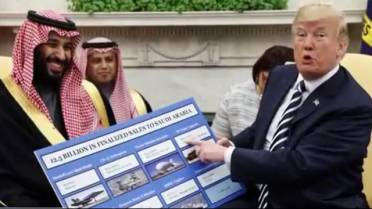
Zarif decries ‘US hypocrisy’ over planned nuclear sale to Saudis
Neither human rights or a burgeoning nuclear programme are a real concern for the US, Iran’s foreign minister  says. Aljazeera, 21 Feb 19, Iranian Foreign Minister Mohammad Javad Zarif accused the US of hypocrisy for allegedly attempting to sell nuclear technology to Saudi Arabia while Washington tries to wreck Iran’s nuclear programme.
Zarif’s comment on Twitter on Wednesday came after reports the administration of President Donald Trump is trying to bypass US Congress to advance the sale of nuclear power plants to Saudi Arabia.
“Day by day it becomes clearer to the world what was always clear to us: neither human rights nor a nuclear program have been the real concern of the US,” Zarif wrote.
“First a dismembered journalist; now illicit sale of nuclear technology to Saudi Arabia fully expose #USHypocrisy,” Zarif added, referring to the killing of Saudi writer Jamal Khashoggi at the hands of Saudi agents, and the new report by a US congressional committee on the planned technology sale. …….
Mohammad Ali Shabani, Iran Pulse Editor at Al-Monitor, said he doubted the US would sell uranium-enrichment technology to Saudi Arabia and, therefore, Riyadh would not have the capability to develop a nuclear weapon.
“However, the sidestepping of America’s own laws to facilitate sales of nuclear power plants puts the Trump administration’s broader credibility under question,” Shabani told Al Jazeera.
‘Terrorist attack’
Tensions between Washington and Tehran – bitter foes since Iran’s 1979 revolution – have intensified since Trump withdrew the US from the Joint Comprehensive Plan of Action (JCPOA), better known as the Iran nuclear deal, under which it scaled back its uranium enrichment programme and promised not to pursue nuclear weapons.
In exchange for the deal signed in 2015 in Vienna with six world powers – the US, UK, France, Germany, Russia, China and the European Union – international sanctions were lifted allowing Iran to sell its oil and gas worldwide.
Trump reimposed sanctions with the aim of slashing Iranian oil sales and choking its economy in order to curb its ballistic missile programme and activities in the Middle East, especially in the conflicts in Syria and Yemen.
Iranian President Hassan Rouhani said on Wednesday Iran-US relations are at a new low and sanctions imposed by the Trump administration targeting Tehran’s oil and banking sectors amounted to “a terrorist attack”.
“The struggle between Iran and America is currently at a maximum. America has employed all its power against us,” Rouhani was quoted as saying in a cabinet meeting by the state broadcaster IRIB.
“The US pressures on firms and banks to halt business with Iran is 100 percent a terrorist act,” he said.
The International Atomic Energy Agency (IAEA) has repeatedly confirmed Tehran has been meeting its nuclear commitments fully.
‘Khashoggi cover-up’
The Trump administration has faced additional congressional opposition due to concerns about the role of Saudi Crown Prince Mohammed bin Salman (MBS) in the murder of Jamal Khashoggi……. https://www.aljazeera.com/news/2019/02/zarif-decries-hypocrisy-planned-nuclear-sale-saudis-190220100506949.html
February 21, 2019
Posted by Christina Macpherson |
Iran, politics international, Saudi Arabia, USA |
Leave a comment
 US will not open door to Saudi Arabia building nuclear
 weapons, deputy energy secretary says CNBC David Reid| 17 Feb 2019
- The Trump administration wants to sell its nuclear energy technology to cash-rich Saudi Arabia.
- To prevent nuclear arms development, the U.S. wants to place tight controls on how the technology can be used.
- Saudi Arabia has put the U.S. on a shortlist with China, Russia and others to bid for nuclear power projects in the country.
“………….The Saudis have so far refused to rule out their right to enrich uranium for nuclear weapons, pointing to neighboring Iran’s ability to do so under the 2015 nuclear agreement that world powers struck with Tehran.
In an interview in March on CBS’s “60 Minutes” Saudi Crown Prince Mohammed bin Salman said the country wasn’t interested in developing weapons but would develop nuclear capability should Iran ever develop a working nuclear bomb.
On Sunday, Saudi Arabian Prince Turki Al-Faisal responded directly to Brouillette’s words, saying the country had more options than just U.S. technology.
“Well the nuclear energy market is open. It is not just the United States that is providing nuclear technology,” he told CNBC’s Hadley Gamble in Munich.
“We have France, we have Russia, we have China. We have our friends in Pakistan and in other places as well, so if they want to remove themselves from that market, well, that’s up to them.” https://www.cnbc.com/2019/02/16/brouillette-us-wont-give-saudi-arabia-key-to-nuclear-weapon-building.html
February 18, 2019
Posted by Christina Macpherson |
politics international, Saudi Arabia, weapons and war |
Leave a comment
UN Nuclear Watchdog Warns Against Meddling Over Iran, Bloomberg By Jonathan Tirone, February 2, 2019,
………Late Wednesday, at a private reception for diplomats, IAEA Director General Yukiya Amano lashed out at efforts to hamstring an organization that’s been at the forefront of nuclear security for decades, according to two foreign officials who were there. Without naming Israel and the U.S., the career Japanese diplomat made it clear those countries were the source of his ire, they said.
“The agency’s independence must not be undermined,” Amano said, according to the IAEA’s website. “If attempts are made to micro-manage or put pressure on the agency in nuclear verification, that is counterproductive and extremely harmful.”
An IAEA official said on Saturday that the U.S. wasn’t Amano’s intended target. He declined to specify which countries prompted the rebuke.
Three years into an agreement that was meant to be a hallmark of the Obama administration, in which Iran agreed to curb its nuclear activities in return for sanctions relief, IAEA inspectors say Tehran is in full compliance.
That hasn’t stopped the Trump administration from backing out of the agreement, piling on new penalties and trying to use the agency to turn the screws with help from Israeli Prime Minister Benjamin Netanyahu.
Iran Abides Nuclear Limits
Enriched uranium has remained below thresholds agreed under deal
President Donald Trump’s hardline stance on Iran has heightened tensions with the other signatories to the agreement: China, France, Germany, Russia and the U.K. It’s also sowed divisions between the White House and America’s spy agencies, with Trump castigating his own intelligence officials this week for being “passive and naive when it comes to the dangers of Iran.”
Netanyahu went to the U.S. Congress to lobby against the agreement before it was signed and has continued to criticize the deal since, arguing that it won’t prevent Iran from attaining nuclear weapons……..
fake newscast in Israel came as Iran’s deputy foreign minister was in Vienna for talks with the IAEA, which is trying to keep the accord from unraveling.
Iran’s leadership has said the country’s ready to re-start its enrichment program using more advanced technology if the agreement fails. The country is considering making the kind of nuclear fuel used in naval propulsion, implying it could enrich uranium closer to the levels needed for weapons.
Meanwhile, the European Union is moving to help countries evade the sanctions that the Trump administration imposed to stop countries from trading with Iran.
On Thursday, the 28-member bloc finalized a new financial mechanism for bypassing the U.S. restrictions. The special purpose vehicle, called the Instrument in Support of Trade Exchanges, will be headquartered in Paris and staffed with German leadership.
The vehicle will have a positive “impact on trade and economic relations with Iran, but most importantly on the lives of Iranian people,” a draft of the joint communique seen by Bloomberg says.
The U.S. mission to the IAEA in Vienna said in an emailed response to questions that the watchdog “can continue to count on the full support of the United States” as it carries out its “important mandate in Iran.” https://www.bloomberg.com/news/articles/2019-02-01/fake-news-goes-nuclear-as-iaea-sees-u-s-israel-meddling-on-iran
February 4, 2019
Posted by Christina Macpherson |
Iran, politics international, USA |
Leave a comment
 World War 3 fears SURGE as experts warn Saudi Arabia could be seeking ‘NUCLEAR weapons’
FEARS Saudi Arabia could be seeking to build nuclear weapons have surged following reports the Kingdom has launched a domestic ballistic missile programme. Express UK By JAMES BICKERTON, Jan 25, 2019 According to a report published in The Washington Post, Saudi Arabia appears to have constructed a ballistic missile factory, which could threaten to trigger a new Middle Eastern arms race. Saudi Arabia already owns foreign-brought ballistic missiles but has yet to construct its own. A number of experts have warned this could signal a Saudi desire to become nuclear armed.
Satellite images taken in November appear to show a ballistic missile factory near the town of Al-Watah, according to the report.
The site is situated next to an existing Saudi Arabian missile base.
A team led by nuclear expert Jeffrey Lewis, from the Middlebury Institute of International Studies, uncovered the pictures.
Mr Lewis said the images raise “the possibility that Saudi Arabia is going to build longer-range missiles and seek nuclear weapons”…..https://www.express.co.uk/news/world/1077486/World-War-3-Saudi-Arabia-nuclear-weapons-Middle-East-arms-race
January 26, 2019
Posted by Christina Macpherson |
Saudi Arabia, weapons and war |
Leave a comment
Saudi Arabia Receives Offers from 5 Countries to Build 2 Nuclear Reactors 23 January, 2019 Riyadh – Asharq Al-Awsat
Five countries have submitted their requests for the establishment of two nuclear reactors in Saudi Arabia on the Arabian Gulf coast.
The bid was made after the peaceful Saudi nuclear project met the requirements of the International Atomic Energy Agency (IAEA).
The oil-rich Kingdom launched a tender to define specifications of sites that will host the two reactors, said Chairman of King Abdullah City for Atomic and Renewable Energy (KACARE) Khalid al-Sultan.
He added that KACARE asked the services providers in the US, Russia, France, South Korea and China to present their preliminary offers……. https://aawsat.com/english/home/article/1558606/saudi-arabia-receives-offers-5-countries-build-2-nuclear-reactors
January 24, 2019
Posted by Christina Macpherson |
marketing, Saudi Arabia |
Leave a comment
National Interest, by Zachary Keck 20 Jan 19, There is no reason to think that Israel doesn’t have the technical capability to make its new F-35s nuclear capable
By the end of this year, Israel is expected to become the second country after the United States to declare Initial Operational Capability for its F-35s. Already, Tel Aviv has taken possession of five of the multirole fighters,and following an agreement late last month to buy an additional seventeen planes, will ultimately purchase fifty planes. All fifty F-35s are scheduled to be delivered by the end of 2024.
(This first appeared in 2017.)
Israeli officials typically describe the F-35s purpose as ensuring the country’s continued air superiority in the region. In particular, they focus on how the plane’s stealth capabilities will allow them to evade Iran’s increasingly capable, Russian-built air defense systems. One mission that is not being discussed is that Israel will likely use its F-35s as a nuclear delivery system.
Although the government refuses to officially acknowledge it, Israel is known to have a nuclear arsenal with as many as 100 warheads. The Jewish State is also believed to possess a nuclear triad, consisting of ground-based Jericho missiles, Dolphin-class submarines equipped with sea-launched cruise missiles and some combination of nuclear-capable aircraft.
It’s likely that the F-35 will be the newest addition to the air leg of Israel’s triad……….At the same time, Israel also assured the United States that it would not “introduce” nuclear weapons in the Middle East, which Israel interpreted to mean it could build a nuclear arsenal as long as it didn’t publicly acknowledge its existence. ……https://nationalinterest.org/blog/buzz/super-weapon-israel-could-arm-stealth-f-35s-nuclear-weapons-42097
January 21, 2019
Posted by Christina Macpherson |
Israel, weapons and war |
Leave a comment
Israel’s Secret Nuclear Reactor https://www.jerusalemonline.com/israels-secret-nuclear-reactor/ By JOL Staff -January 20, 2019, Israel began work on the Dimona nuclear reactor in 1958 without informing members of the government or the country’s parliament, Israeli historian and Haaretz contributor Adam Raz revealed, citing a trove of primary documents he reportedly received from a secret source at an academic event.
The papers, which include notes, memorandums, drafts and summaries by senior Israeli officials of the time, including Israel Galili, an adviser to prime ministers Levi Eshkol and Golda Meir, Eshkol himself, cabinet member Yigal Allon and IDF commander Moshe Dayan, defence chief-turned prime minister Shimon Peres, and senior diplomat Abba Eban, helped Raz piece together important details about the clandestine project.
Moral Qualms and Cost Concerns
The papers revealed that Galili had several concerns about the nuclear endeavour, known as “the enterprise,” including its potential to undermine Israel’s “moral status,” or cause then-Egyptian President Gamal Abdel Nasser to attack Israel to try to take out a “justified target.” Finally, he feared that the program could incite Cairo to start work on its own nuclear program.
The documents also indicated that the cost of the Dimona reactor, estimated at about $53 million by Peres in April 1962, was revised upwards by Alon to “three times” the $60 million discussed by the cabinet in 1964. An undated note, presumably written sometime between 1963 and 1966, indicated that the real cost may have been as much as $340 million (about $2.75 billion in present day dollars, accounting for inflation).
“If it were known in advance that it would cost $340 million – would we have voted for Dimona?” the note, written by Eban to Galili, reads.
Meir Proposes Switching From Defense to Offense
The documents showed that after Eshkol succeeded David Ben-Gurion as prime minister in 1963, the new PM’s foreign minister, Golda Meir, proposed admitting the existence of the program in a bid to get support from America’s Jews.
“Our situation will be stronger when the struggle becomes public,” she insisted, adding the need to “switch to offence instead of defence.”
Interestingly, the papers reportedly show that Israeli leaders had to resist pressures to place the project under international supervision, not only from Charles de Gaulle of France, but even from the Kennedy, Johnson and Nixon administrations, who urged Israel to sign on to the non-Proliferation Treaty, which was being developed at the time. In one memo, Peres reportedly told Galili that “in order to overcome the supervision [that the US wanted], cooperation by both sides is needed.”
Nuclear Status Undefined
One particularly important note, again by Galili, seems to indicate that even several years into the reactor’s construction, Tel Aviv did not commit to building actual nuclear bombs. “There is no decision by the government of Israel to manufacture atomic weapons,” the note says.
In another bombshell document cited by Raz, Yigal Allon refers to a phraseology agreed between himself and Nixon Secretary of State Henry Kissinger, whereby a nuclear state is defined as “a state that has exploded a bomb or a device.” This definition allowed the US not to classify Israel as a nuclear state subject to the NPT.
“I am constantly using a phrase agreed with Kissinger — that Israel is not a nuclear state,” Allon wrote in one of the papers.
Nuclear Option in 1973
Finally, without providing any direct quotations from the documents, Raz noted that the subject of the possible use of nuclear weapons during the 1973 Yom Kippur War, in which Israel came dangerously close to defeat at the hands of Egypt and Syria, was also discussed in the papers. In brief, Raz confirmed that Defence Minister Dayan had arrived at defence headquarters in Tel Aviv on the afternoon of 8 October 1973 to recommend preparations to activate the nuclear option.
On October 9, Meir told Israeli Atomic Energy Commission Chief Shalhevet Freier that preparations would not be made without her explicit authorisation. Israel Lior, Meir’s military secretary, similarly indicated to Dayan and Freier that the nuclear option was a no-go.
Citing censorship, Raz indicated that the information he provided addresses “only a small portion of the subject that came up in the notes,” and urged Israeli authorities to allow for a more open discussion of the country’s nuclear program.
January 21, 2019
Posted by Christina Macpherson |
history, Israel, secrets,lies and civil liberties |
Leave a comment
A few years ago, shortly after I published my book “The Struggle for the Bomb” (Hebrew), about Israel’s nuclear history, I was invited to give a talk before an academic audience. Someone at the venue handed me a thick envelope and requested explicitly that I not open it until I got home. Examining its contents later that day, I discovered some 100 different documents, including slips of paper, memoranda, drafts and summations of the most intimate meetings and events relating to Israel’s nuclear history.
The vast majority of the documents were original. Many of them were written by Israel Galili, a minister without portfolio and close adviser to two prime ministers, Levi Eshkol and Golda Meir. Others were penned by Yigal Allon, Shimon Peres, Moshe Dayan and Abba Eban, and by Eshkol himself. Many of the items refer to highly confidential meetings that took place in 1962-1963, where the future of the nuclear project, and its impact on Israel’s neighbors, especially Egypt, were discussed. No official minutes were taken at these meetings, and the participants were forbidden to sum them up in writing.
The questions Galili posed to his colleagues at these meetings continue to occupy many historians around the world. Some of those questions – concerning the date on which the Dimona reactorwould become operational; whether its activation could be concealed from foreign inspectors; how much money had already been invested in the project and how much more would be needed – can be answered now, thanks to this trove of information.
The start of work on the nuclear reactor, at the end of 1958, was kept secret from the Knesset and the government. The obvious need to keep the undertaking secret, and the fact that part of its budget came from foreign sources, made it possible to bypass temporarily any disagreements over the necessity for a nuclear program and the discussion of its potential significance. But when the reactor’s existence became public knowledge, in December 1960 – after the fact of its construction was leaked to the international media by foreign government sources – Israel’s political echelons began to discuss its future seriously.
The implications of the issues surrounding the nuclear project were critical. To begin with, its continued development demanded vast monetary resources, certainly for a country still taking its first steps. Second, any further development of the facility would have ramifications vis-a-vis Israel’s integration into the Cold War web of international diplomatic relations. And third, pursuit of the project was liable to induce neighboring countries, notably Egypt, to develop independent nuclear programs of their own.
Arnan (“Sini”) Azaryahu, the right-hand man of Galili and military leader Yigal Allon, said years later that one of the major decisions made in these meetings was in retrospect the most important in the history of Zionism. He was referring to the group’s decision not to accept the approach of Peres and Dayan – who urged that the absolute majority of the defense budget be diverted to the Dimona reactor and that its potential be made a public fact – but to adopt, instead, a policy of nuclear “ambiguity.”………….
For reasons of censorship, only a small portion of the subjects that came up in the notes can be addressed here, among them the cost of building the reactor. ………
the crucial aspect of the project that was kept secret from the Israeli public in those years was not the visits in Dimona (which were frequently reported in the foreign press) or U.S. pressure on Israel. It was the fact that the future of the facility and its purpose were subjects of fierce dispute in the political realm in Israel. ………..
Whereas a lively discussion on the significance of nuclear development has been held throughout the world for years, in Israel there is only silence. This is not a minor issue, as the nuclear project raises weighty questions: Who makes the decisions? Who is supervising the project? What is its effect on the foreign relations of the nuclear state? What is its cost? What effect does it have on security conceptions? And so on.
A public that is willing to remain in the shadows where its state’s nuclear policy is concerned, should not be surprised that decades later after its critical origins, a criminal episode is revealed dealing with the decision-making processes on the acquisition of submarines that, according to foreign sources, are capable of carrying nuclear warheads. https://www.haaretz.com/israel-news/.premium-secret-handwritten-memos-reveal-how-israel-s-nuclear-program-came-to-be-1.6850955
January 19, 2019
Posted by Christina Macpherson |
history, Israel, secrets,lies and civil liberties |
Leave a comment
Saudi Arabia to work closely with US on nuclear power plans, https://www.straitstimes.com/world/middle-east/saudi-arabia-to-work-closely-with-us-on-nuclear-power-plans JAN 10, 2019, RIYADH (REUTERS) – Saudi Arabia aims to work closely with the United States on its plans to build nuclear power generation capacity in the oil producing kingdom, the energy minister said on Wednesday (Jan 9).
Riyadh wants Washington to be “part and parcel” of Saudi Arabia’s nuclear programme, which will be entirely for peaceful purposes, Energy Minister Khalid al-Falih said.
He also said the United States was a key provider for nuclear technology.
January 12, 2019
Posted by Christina Macpherson |
politics international, Saudi Arabia |
Leave a comment

 FBI and CIA’s ‘Duty To Warn’ Victims of Israeli Nuclear Smuggling https://original.antiwar.com/smith-grant/2018/12/26/fbi-and-cias-duty-to-warn-victims-of-israeli-nuclear-smuggling/
$500 million Pennsylvania NUMEC toxic cleanup restarts by Grant Smith December 27, 2018 In 2015 the intelligence community acknowledged that it had a “duty to warn” U.S. persons of impending threats of “serious bodily injury.” The objective of that “duty” – which has many loopholes – is to compel intelligence agencies to warn individuals or organizations of threats so they can take evasive measures. It affirms a moral obligation intelligence agencies have to those funding – willingly or not – their operations. The duty to warn demands they no longer stand idly by – or worse attempt to exploit credible threats to Americans – as leverage or for other, secret intelligence purposes.Last fall the US Army Corps of Engineers announced it was finally ready to resume a $500 million toxic waste cleanup of the Nuclear Materials and Equipment Corporation (NUMEC) dump. An earlier attempt at the Pennsylvania site to excavate was stopped after the discovery of unexpected materials. NUMEC’s plant sites in Apollo and Parks Township have long been the subject of litigation over wrongful mass deaths and illnesses caused by toxic pollution.
NUMEC was launched and managed by Zalman Shapiro, a nuclear chemist credited with solving engineering issues for naval nuclear propulsion in the 1950s. His partner, David Luzer Lowenthal was a smuggler with murky ties to Israeli intelligence and industrialist. Luzer organized the emergence of NUMEC from a complicated merger and acquired facilities for NUMEC in a defunct steel mill in the middle of Apollo, Pennsylvania. The Zionist Organization of America, originally chartered to “do any and all things that may be necessary” to support Israel, supplied three of NUMEC’s executives. Zalman Shapiro, Pittsburgh region president of ZOA, Morton Chatkin and Ivan J. Novick who became ZOA’s national president.
Officially NUMEC was a startup supplier of highly-enriched fuel for the US Navy. But two Central Intelligence Agency officials claimed NUMEC’s true purpose was to amass and divert US government-owned highly enriched uranium into Israel’s nuclear weapons program. 300 kilograms of highly enriched uranium disappeared from NUMEC between 1957-1978, with most of it gone by 1966. Material stolen from NUMEC would have been the most likely source for Israel’s ability to ready nuclear weapons for use during the 1967 Six-Day War.
CIA Tel Aviv Station Chief John Hadden, who performed field operations to sample the environment around Dimona for highly enriched uranium – material Israel was incapable of producing on its own – claimed NUMEC was “an Israeli operation from the beginning.” CIA Directorate of Science and Technology Deputy Director Carl Duckett testified that “NUMEC material had been diverted by the Israelis and used in fabricating weapons.” There were other telltale signs.
Inside NUMEC’s underfunded, ramshackle facilities an Israeli scientist, Baruch Cinai, learned to handle samples of plutonium, a skill subsequently useful to plutonium production at Israel’s Dimona facility. Israeli covert operatives Raphael Eitan, Avraham Bendor and Ephraim Beigun all visited the facility at Shapiro’s invitation in 1968 undercover as various Israeli energy specialists, in the company of Avraham Hermoni, chief of Israel’s nuclear weapons development program. The FBI’s investigation of NUMEC-related activities ultimately shook loose eyewitness testimony that Shapiro was collaborating in the illicit diversion of highly enriched uranium from NUMEC’s U.S.-government owned stockpile to Israel. Under increasing pressure, NUMEC’s regulator, the Atomic Energy Commission, subsequently engineered NUMEC’s corporate buyout and the exit of its management team to save face, after many years of denial and providing easily refuted excuses for NUMECs extreme and inexplicable material “losses.”
That NUMEC was a front operation, following in the footsteps of Israel’s 1940s-era conventional weapons smuggling operations from the US such as Martech, Service Airways, and the Sonneborn Institute, is well-known by the FBI and CIA. Both have released extensive archives of intelligence reports and surveillance photographs of Israeli conventional weapons smuggling from the United States through overseas networks. But both FBI and CIA have fought attempts at full disclosure of clandestine Israeli nuclear weapons related activities in the US, ostensibly because such smuggling has been unpunished and unabated. It is also US policy, under penalty of prosecution, that no federal agency may admit that Israel has nuclear weapons or release information about its program.
A February 2015 lawsuit seeking all of the CIA’s “thousands” of files about NUMEC was ended when the presiding judge refused to allow adding the US Department of Justice – which has worn many hats in the NUMEC affair – as an additional defendant. However some CIA documents were released during the court battle, revealing how the CIA had refused to cooperate with two separate FBI investigations of NUMEC, preferring to cover up damning information obtained from clandestine CIA operations in Israel confirming the diversion.
Documents grudgingly released by the FBI so far reveal the intelligence community likely knows that cost-cutting at NUMEC to achieve its smuggling aims was what made it such a toxic polluter. On May 5, 1969, Shapiro discussed a major toxic spill caused by such shortcuts, most likely with David Lowenthal, since the acquisition of other US companies was also part of the conversation. Shapiro ordered NUMEC workers – who often worked with no protective gear of any kind – to dampen down the spill with picks and shovels to avoid the spread of toxic dust and rain runoff carrying away the waste. Shapiro’s call was wiretapped by the FBI.
The full phone call summary reveals how Shapiro – who commuted every day from Pittsburgh – considered NUMEC workers as mostly replaceable and expendable.
“It’s not only a bad spill but ‘actually they are operating outside compliance.’ They had the drums all together. They have about 200 drums and estimate that about six a day will corrode through. The trouble lay with a fluoride which was put in to help the decay, and this was not checked. CENSORED said they are also about $230,000 over on their construction costs for the scrap plant. Z [Zalman Shapiro] said if they could get other people, there would be a lot of firing.”
NUMEC workers and town residents, exposed to radiation levels hundreds of times higher than health standards allowed, continue to suffer fallout and death from NUMEC. In addition to residents, the US Army Corps of Engineer contractors restarting the cleanup could benefit greatly from knowing what material is likely present – as well as what is not – at the site. Residents and the cleanup crew would also benefit from knowing of any intelligence on the potential threat that materials stolen decades ago might be returned or buried under cover of the cleanup at the site for crews to “find.”
Legal precedents suggest such toxic exposure as occurs at NUMEC could amount to “oppression, fraud, or malice” and be sufficient for victims to recover damages from polluters. However, neither the CIA nor the FBI have met their current obligations under “duty to warn” to officially alert the victims of NUMEC and contractors precisely what dangers they are still facing as the cleanup recommences.
Such overdue disclosures could also allow NUMEC’s victims to pursue claims against the perpetrator and beneficiary of the fraud and pollution – the Israeli government. Evidence stored away in FBI and CIA files could fully reveal ZOA’s NUMEC involvement. If ZOA did more than unwittingly provide key members of management, ZOA’s $40 – plus million in current assets could go a long way toward compensating the long-suffering Pennsylvania victims of Israeli nuclear smuggling and partially shift the burden of paying to clean up after NUMEC away from American taxpayers.
Grant F. Smith is the author of the book Divert! NUMEC, Zalman Shapiro and the diversion of US weapons-grade uranium into the Israeli nuclear weapons program. He is director of the Institute for Research: Middle Eastern Policy in Washington, D.C. and plaintiff in the 2015 lawsuit calling on the CIA to release all NUMEC-related files.
December 29, 2018
Posted by Christina Macpherson |
Israel, secrets,lies and civil liberties, USA |
Leave a comment
Introducing the World’s Most Secretive Nuclear Weapons Program (Not North Korea) Who could that be? National Interest, by Kyle Mizokami 24 Dec 18
That can only mean one nation…
In a private email leaked to the public in September of 2016, former secretary of state and retired U.S. Army general Colin Powell alluded to Israel having an arsenal of “200 nuclear weapons.” While this number appears to be an exaggeration, there is no doubt that Israel does have a small but powerful nuclear stockpile, spread out among its armed forces. Israeli nuclear weapons guard against everything from defeat in conventional warfare to serving to deter hostile states from launching nuclear, chemical and biological warfare attacks against the tiny country. …….
Not much is known about early Israeli weapons, particularly their yield and the size of the stockpile. The strategic situation, in which Israel was outnumbered in conventional weapons but had no nuclear adversaries, meant Israel likely had smaller tactical nuclear weapons to destroy masses of attacking Arab tanks, military bases and military airfields. Still, the relatively short ranges between Israel and its neighbors meant that the Jericho missile, with only a three-hundred-mile range, could still hit Cairo and Damascus from the Negev desert.
Israel does not confirm nor deny having nuclear weapons. Experts generally assess the country as currently having approximately eighty nuclear weapons, fewer than countries such as France, China and the United Kingdom, but still a sizeable number considering its adversaries have none. These weapons are spread out among Israel’s version of a nuclear “triad” of land-, air- and sea-based forces scattered in a way that they deter surprise nuclear attack.
…….. Israel’s first land-based nuclear weapons were based on Jericho I missiles developed in cooperation with France. Jericho I is believed to have been retired, replaced by Jericho II and -III ballistic missiles. Jericho II has a range of 932 miles, while Jericho III, designed to hold Iran and other distant states at risk, has a range of at least 3,106 miles. The total number of Israeli ballistic missiles is unknown, but estimated by experts to number at least two dozen.
Like other nuclear-armed nations, the Israeli Navy has reportedly deployed nukes to what is generally agreed to as the most survivable seagoing platform: submarines. Israel has five German-built Dolphin-class submarines, which experts believe are equipped with nuclear-tipped cruise missiles. The cruise missiles are reportedly based off the Popeye air-to-ground missile or the Gabriel antiship missile. This ensures a so-called “second-strike capability”—as long as one submarine is on patrol, some portion of Israel’s nuclear deterrent remains invulnerable to a nuclear first strike, guaranteeing the ability to launch a nuclear counterattack.
The establishment of a nuclear triad demonstrates how seriously Israel takes the idea of nuclear deterrence. The country will likely not declare itself a nuclear power any time soon; ambiguity over ownership of nukes has served the country very well. The 2015 Joint Comprehensive Plan of Action and general instability across the Middle East has ensured that Israel will likely remain the only nuclear-armed state in the region for the foreseeable future, but a collapse of the agreement or some new nuclear program could easily change that.https://nationalinterest.org/blog/buzz/introducing-worlds-most-secretive-nuclear-weapons-program-not-north-korea-39722
December 29, 2018
Posted by Christina Macpherson |
Israel, weapons and war |
Leave a comment

Lawmakers Want a Greater Say as U.S. Seeks a Saudi Nuclear Deal, Members of Congress from both parties demand that an agreement to sell Riyadh civilian nuclear technology be based on stringent controls, WSJ . By Michael R. Gordon, Dec. 16, 2018
The Trump administration’s push to sell civilian nuclear technology to Saudi Arabia is emerging as the next battleground in the struggle between the White House and Congress over U.S. policy toward Riyadh following the killing of journalist Jamal Khashoggi.
The debate over Riyadh’s nuclear ambitions intensified last week after Energy Secretary Rick Perry brushed aside congressional appeals that nuclear talks be suspended because of Mr. Khashoggi’s killing and traveled to Saudi Arabia, where he accentuated the role American companies could play in helping the country establish a nuclear energy program.
…….But the CIA assessment that Saudi Crown Prince Mohammed bin Salman likely ordered Mr. Khashoggi’s killing has fueled concerns in Congress that the Saudi leader is too ruthless to be entrusted with nuclear technology. Saudi Arabia has repeatedly said the crown prince had no knowledge of the operation.
Lawmakers of both parties are demanding a deal be based on the most stringent nonproliferation controls. And some are now pushing legislation that would give Congress more of a say by requiring that a nuclear accord with Saudi Arabia be approved by the Senate and the House of Representatives.
“Before Khashoggi, I would say our chances were quite modest,” said Rep. Brad Sherman, a California Democrat, referring to prospects of House legislation he is drafting. “Now I would have to say our chances are better than 50-50.”
An identical measure is being prepared in the Senate by Sens. Ed Markey (D., Mass.) and Marco Rubio (R., Fla.), though the prospects for winning approval are likely to be more challenging.
The prospective nuclear deal comes amid a broader debate over Saudi policy, including a Senate vote last week to halt U.S. support for the Saudi-led coalition that is fighting in Yemen.
Even since the Trump administration signaled its interest in a nuclear agreement with Saudi Arabia last year, there has been debate about proliferation controls that should be imposed under an accord authorizing the transfer of U.S. nuclear technology, known as a 123 agreement.
……..Nuclear experts have also said that it would be important for Saudi Arabia to agree to the “Additional Protocol,” a formal arrangement with the International Atomic Energy Agency that provides for far-reaching inspections. The Saudis have been resisting that step, former officials who have been tracking the talks say. A spokeswoman for the Saudi embassy didn’t respond to a request for comment..
……..Under current law, a nuclear cooperation agreement with Saudi Arabia would go forward unless congressional opponents backed a joint resolution against it. That means that two-thirds of the lawmakers would need to oppose the accord so Congress could overcome a potential veto.
Mr. Sherman’s new bill aims to put nuclear accord skeptics in a more favorable position by requiring the administration to win approval from both the Senate and the House. That means a simple majority in one legislative chamber would be enough to block the agreement…….https://www.wsj.com/articles/lawmakers-want-a-greater-say-as-u-s-seeks-a-saudi-nuclear-deal-11544990606
December 18, 2018
Posted by Christina Macpherson |
politics, Saudi Arabia, USA |
Leave a comment











 nuclear-news