US Grants Sanctions Relief To Iran,Inches Closer To Nuclear Deal Renewal
US Grants Sanctions Relief To Iran,Inches Closer To Nuclear Deal Renewal, Kashmir Observer
Agencies | February 5, 2022 Washington- The Biden administration has restored a sanctions waiver to Iran, a senior State Department official said on Friday, as indirect talks between the United States and Iran on returning to the 2015 nuclear agreement entered the final stretch.
The waiver, which was rescinded by the Trump administration in May 2020, had allowed Russian, Chinese and European companies to carry out non-proliferation work at Iranian nuclear sites.
The waiver was needed to allow for technical discussions that were key to the talks about return to the deal formally known as the Joint Comprehensive Plan of Action (JCPOA), a State Department official said………….. https://kashmirobserver.net/2022/02/05/us-grants-sanctions-relief-to-iraninches-closer-to-nuclear-deal-renewal/
Movie on assassination of nuclear scientist Dariush Rezainejad premieres at FajrCulture
Movie on assassination of nuclear scientist Dariush Rezainejad premieres at Fajr Culture. Tehran Times, February 6, 2022 TEHRAN – “Henas”, a drama about the assassination of nuclear scientist Dariush Rezainejad, premiered at the 40th Fajr Film Festival on Saturday.
35-year-old Rezainejad was shot dead by Mossad gunmen before the eyes of his wife and little girl in front of his house in Tehran in July, 2011. The movie portrays the terrorist attack through the eyes of his wife.
We never intended to make a spy drama,” director Hossein Darabi said in a press conference after the premiere of the film.
“Due to the fact that the subject is a matter of great security sensitivity, we wanted to portray the feelings of the wife in that situation,” he added.
He noted that the story of the film has been written based on Rezainejad’s life story and has its roots in reality.
“There is no point in the film in conflict with reality,” said Rezainejad’s widow, Shoreh Pirani, who was in attendance at the screening and press conference………………………. https://www.tehrantimes.com/news/469877/Movie-on-assassination-of-nuclear-scientist-Dariush-Rezainejad
Israel Simulated Attack On Iran’s Nuclear Facilities In Recent Drills
Israel Simulated Attack On Iran’s Nuclear Facilities In Recent Drills
The Israel Air Force has held a drill to simulate an attack on Iran’s nuclear facilities with dozens of warplanes, as tensions remain high in the region.
According to an unsourced report by Israel’s public broadcaster Kan news on Tuesday, the classified military exercise was held some two weeks ago, with a US Air Force officer in attendance.
The drills that took place over the Mediterranean included various scenarios such as mid-air refueling, long-range strikes, and different responses to anti-aircraft missiles……………… https://www.iranintl.com/en/202202021753
Iran says nuclear talks have made ‘significant’ headway
Iran says nuclear talks have made ‘significant’ headway, Argus 31 Jan 22, Negotiations in Vienna aimed at restoring the 2015 Iran nuclear deal made “significant progress” over the past three weeks, although differences remain on some key points, Iran’s foreign ministry spokesman Saeed Khatibzadeh said today.
The latest round of discussions resumed in December, with all the original parties to the deal working concurrently on issues relating to sanctions relief, Iran’s nuclear activities, verification and sequencing. The talks broke up late last week to allow delegates to return to their countries for consultations with their respective governments.
“The negotiations over the past three weeks have seen significant progress in four areas: sanctions lifting, nuclear commitments, verification and guarantees,” Khatibzadeh said, echoing some of the more positive assessments that have been made over the past few days.
Russia’s envoy to the talks Mikhail Ulyanov said last week that a deal between Iran and the US could be sealed as early as the end of February. The US has also been more optimistic in its appraisal of the talks, with White House Middle East adviser Brett McGurk saying last week that we are “in the ballpark of a possible deal”……………………. https://www.argusmedia.com/en/news/2297117-iran-says-nuclear-talks-have-made-significant-headway
MOST of Iran’s nuclear facilities are vulnerable to devastating drone attacks
Iran Fukushima warning: Iran’s nuclear plants could be WIPED OUT https://www.express.co.uk/news/world/1558057/Iran-news-nuclear-threat-war-latest
MOST of Iran’s nuclear facilities are vulnerable to devastating drone attacks, a report has found.
By MARCO GIANNANGELI – DIPLOMATIC EDITOR11:00, Sun, Jan 30, 2022 But using unmanned vehicles (UMVs) laden with explosives could lead to a critical Fukushima-style reactor meltdown.
The revelation comes as diplomatic efforts to rein in Iran’s nuclear ambitions continue to flounder, with former Italian foreign minister Giulio Terzi last night warning: “The Iran nuclear deal is already on life-support and it is very possible that it might falter altogether due to Iran’s shameless violations.”
Detailed analysis of its 22 nuclear facilities by Dr Bahram Ghiassee, of the Henry Jackson Society think-tank, found that all except the Fordow fuel enrichment plant, near Qom – built into a mountain – are vulnerable to drone strikes which could incapacitate them.
And burying the Fordow facility under 60 metres of rock does not protect it from attacks on air shafts and other external supply systems.
While many facilities would result in little overall impact if attacked, there are glaring exceptions, the report found. These include the conversion plant at the Esfahan nuclear technology centre – a critical part of the nuclear fuel cycle – and the Bushehr nuclear power plant on the Persian Gulf.
The same applies to the Natanz enrichment facility now being rebuilt into a mountain after an explosion – believed to have been caused by Israel – destroyed the previous overland structure.
Though nuclear power plants are built to withstand light aerial attacks, Bushehr’s ancillary facilities “are highly vulnerable to aerial attacks, including drone strikes”, said the report, including by “commercially available as ‘Surface UMVs’ and ‘Submersible UMVs’, with an operating range of some 120 kilometres. “
However, Dr Ghiassee, a nuclear consultant, added: “A synchronised attack on the cooling water facilities, external electricity supply and electricity distribution systems could lead to the overheating of the reactor core and the spent fuel ponds.
“Under such circumstances, as in the Fukushima nuclear accident, the reactor core could melt down.”
Attacks against Iranian nuclear facilities are not a new phenomenon.
The Bushehr power plant was attacked by Saddam Hussein during the Iran-Iraq war in 1980, though this caused minor damage.
More recently, Iran has been the recipient of incapacitating explosions, cyber strikes and UMV attacks.
Though not confirmed by Tel Aviv, these are believed to have been carried out by Israel after it openly pledged never to allow Iran – which has threatened to blow Israel off the face of the world – to possess nuclear weapons.
We have a duty to be brave and responsible for the fate of our children and grandchildren. We have used force against our enemies in the past, and we are convinced that in extreme situations, there is a need to act using military means,” said Israeli Deputy Defence Minister Alon Schuster recently.
Actions have included the assassination of Iranian nuclear scientists, the explosion at Natanz in 2020 – said to have been caused by the provision of faulty materials following Mossad’s infiltration of the supply chain- and the cyber strike in 2010 using the Stuxnet virus, which reportedly infected more than 200,000 commuters and destroyed a fifth of Iran’s nuclear centrifuges.
Iran nuclear negotiations reaching final stage
 | |||
Iran nuclear talks reaching final stage – E3 negotiators https://www.reuters.com/world/middle-east/iran-nuclear-talks-reaching-final-stage-e3-negotiators-2022-01-28/Reuters LONDON, Jan 28, 22 (Reuters) – Nuclear talks between Iran and Western powers are reaching their final stage and now require political input, E3 negotiators said in a statement on Friday.
Iran nuclear talks reaching final stage – E3 negotiators https://www.reuters.com/world/middle-east/iran-nuclear-talks-reaching-final-stage-e3-negotiators-2022-01-28/Reuters LONDON, Jan 28 (Reuters) – Nuclear talks between Iran and Western powers are reaching their final stage and now require political input, E3 negotiators said in a statement on Friday.
aJnuary has been the most intensive period of these talks to date,” said the statement from the so-called E3: France, Britain and Germany.
“Everyone knows we are reaching the final stage, which requires political decisions. Negotiators are therefore returning to capitals for consultation.”
Shadowy battle – Israel’s attacks on Iran’s facilities and personnel

Attacks inside one of Iran’s most secure nuclear facilities are the latest blows in a shadowy battle with Israel, Insider, Stavros Atlamazoglou , 24 Jan 22,
- A shadowy battle between Israel and Iran has intensified since the US withdrew from the Iran nuclear deal in 2018.
- They have mostly avoided open clashes, but their ongoing campaigns have been punctuated by high-profile attacks and assassinations.
- ………………………. Israel has long followed a no-holds-barred strategy in which the threat justifies the means. Its shadowy campaign against the Iranian nuclear programs uses complementary diplomatic, military, and intelligence tactics.While Israel’s military has been heavily involved in that campaign, Mossad, Israel’s main intelligence service, has landed many of the blows against Iran itself.
- According to a recent report by The Jewish Chronicle, which didn’t name or describe its sources, Mossad successfully infiltrated the Iranian supply chain and used the opportunity to sell Tehran faulty materials that caused fires at the Natanz nuclear-enrichment facility in July 2020.The report also said Israeli intelligence officers recruited Iranian nuclear scientists who conducted sabotage at Natanz in April 2021 before being smuggled out of the country. Mossad is said to have used an unmanned aerial vehicle to attack the Iran Centrifuge Technology Company, a factory making centrifuges crucial for producing weapons-grade uranium.
- Facilities are easier to replace than expert knowledge, and Mossad has also gone after the hard-to-acquire know-how necessary for a nuclear-weapons capability by killing Iranian scientists working on the nuclear program.
- Attacks against Iranian scientists have become more brazen. The November 2020 assassination of Mohsen Fakhrizadeh, reportedly with a remote-controlled machine gun using advanced artificial-intelligence technology, on a highway in Iran is something straight out of a Hollywood movie………….
- In addition to those clandestine actions, the Israeli Defense Forces has been preparing and presenting Israeli policymakers with military options to take out targets associated with Iran’s nuclear program. This is standard planning for any military, and the IDF has received nearly $3 billion in additional funds to do it……
Nuclear deal unlikely unless Iran releases US prisoners: Report
Nuclear deal unlikely unless Iran releases US prisoners: Report
US Special Envoy for Iran Robert Malley tells the Reuters news agency agreement ‘hard to imagine’ while four ‘innocent Americans held hostage’. Ajjazeera, The United States is unlikely to strike a deal with Iran to save the 2015 Iran nuclear agreement unless Tehran releases four US citizens Washington says it is holding hostage, the lead US nuclear negotiator told the Reuters news agency on Sunday.
US Special Envoy for Iran Robert Malley repeated the long-held US position that the issue of the four people held in Iran is separate from the nuclear negotiations. He moved a step closer, however, to saying that their release was a precondition for a nuclear agreement…………….
In recent years, Iran’s elite Revolutionary Guards have arrested dozens of dual nationals and foreigners, mostly on espionage and security-related charges.
Rights groups have accused Iran of taking prisoners to gain diplomatic leverage, while Western powers have long demanded that Tehran free their citizens, who they say are political prisoners.
Tehran denies holding people for political reasons……………………
The indirect talks between Iran and the United States on bringing both countries back into full compliance with the landmark 2015 nuclear deal are in their eighth round. Iran refuses to hold meetings with US officials, meaning others shuttle between the two sides……………………… https://www.aljazeera.com/news/2022/1/24/iran-nuclear-deal-unlikely-without-us-prisoner-release-report
Iran ‘will consider’ direct talks with US, says foreign minister
Iran ‘will consider’ direct talks with US, says foreign minister, US administration says direct talks are ‘urgently needed’ to facilitate communication to restore the Iran nuclear deal. Aljazeera, 24 Jan 22, Tehran is willing to engage in direct talks with Washington if negotiations to revive the Iranian nuclear deal reach an advanced stage that requires such dialogue, Iran’s foreign minister has said.
Hossein Amirabdollahian’s remarks on Monday came as United States officials have been urging direct negotiations to restore the 2015 accord, formally known as the Joint Comprehensive Plan of Action (JCPOA)……….
Iran had previously ruled out direct meetings with the US. Instead, the two sides have been negotiating indirectly in Vienna to revive the deal, which saw Iran scale back its nuclear programme in exchange for lifting international sanctions against its economy………………..
Biden has pledged to restore the deal, but several rounds of talks in the Austrian capital have failed to secure a path back into the agreement so far.
The US administration says preventing Iran from acquiring a nuclear weapon is one of its foreign policy priorities, but Tehran has denied it is seeking nuclear weapons…………………. https://www.aljazeera.com/news/2022/1/24/iran-will-consider-direct-talks-with-us-says-foreign-minister
Rolls Royce aims to market its Small Nuclear Reactors to Saudi Arabia (a good step towards nuclear weapons?)
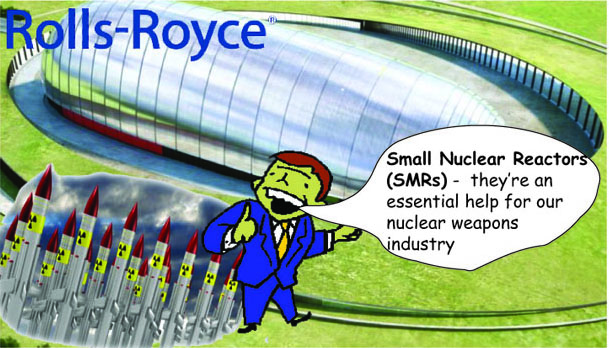
Rolls-Royce heads to Middle East as Saudi Arabia plots £74bn nuclear investment,
ROLLS-ROYCE is looking to the Middle East to export its new [so-called] green technology while Saudi Arabia is reportedly eyeing up a £74billion nuclear investment.
Express UK By JACOB PAUL, Wed, Jan 19, 2022………….. Rolls-Royce looks set to bring its SMR technology to the World Future Energy Summit. This is a global conference showcasing green energy technology. Mr Samson said the company is hoping to start talks with government representatives and large industrial in the Middle East……
And this comes as Saudi Arabia is reportedly exploring options of investing $100 billion (£73.55billion) in several nuclear plants with a combined capacity of 22 gigawatts………
It comes as Rolls-Royce looks set to bring its SMR technology to the World Future Energy Summit.
This is a global conference showcasing green energy technology.
Mr Samson said the company is hoping to start talks with government representatives and large industrial in the Middle East.
And this comes as Saudi Arabia is reportedly exploring options of investing $100 billion (£73.55billion) in several nuclear plants with a combined capacity of 22 gigawatts……..
Mtr Samson – “We have opened up a whole spectrum of customers.”
And Rolls-Royce has already been looking for opportunities to sell its technology to potential UK customers.
But the first SMR units are not expected to come online before the early 2030s. Mr Samson said the company needs to first go through the regulatory processes in Britain. It also needs time to build factories, certify its designs and move on to the production process………… https://www.express.co.uk/news/science/1552184/rolls-royce-middle-east-Saudi-arabia-smr-nuclear-world-future-energy-summit
Iran nuclear talks deadlock risks dangerous vacuum
Iran nuclear talks deadlock risks dangerous vacuum, Analysis: As clock runs down on Vienna talks, key obstacles remain to be cleared by Tehran and the west. Guardian, Patrick Wintour Diplomatic editor, Mon 17 Jan 2022 The countdown to the end of the six-month-long talks in Vienna on the future of the Iran nuclear deal has begun. No deadline has been formally set, but if there is no progress in less than two weeks the process will come to an end leaving a dangerous vacuum.
The White House has already been rolling the pitch preparing its political lines for a breakdown by saying the US withdrawal from the agreement by Donald Trump in 2018 has proved to be a disaster. If there is no agreement, the Biden team intend Trump will take the blame…………
Those close to the talks say they think there can be an agreement, but that from a western perspective it will possibly be so limited in scope it is will be seen as temporary. If so, as Enrique Mora, the chief EU negotiator has said, it will not be for lack of trying……….
Full-scale talks will resume on Monday, with both the UK and Germany represented by new chief negotiators, Stephanie Al-Qaq and Tjorven Bellmann respectively. Detail on progress is being kept to a minimum………………….
A second issue surrounds the guarantees Iran is seeking that the US will not repeat Trump’s withdrawal from the deal in May 2018. The US cannot offer a legally binding treaty since the Senate would never agree to one. Price said: “There is no such thing as a guarantee in diplomacy and international affairs. We can speak for this administration, but this administration has been very clear that we are prepared to return to full compliance with the JCPOA [Joint Comprehensive Plan of Action] and to stay in full compliance with the JCPOA as long as Iran does the same.”
A UN security council resolution might be a bare minimum of comfort for Iran, but is hardly binding on the parties. Tehran wants binding commitments that if the US quits the deal, the EU will do more to defy secondary US sanctions by injecting real cash into the abortive trading mechanism Instex set up by the EU to bypass US sanctions.
A third issue is verification. What are the metrics by which Iran can verify that sanctions have been lifted in reality and not just on paper, and consequently that it must stop enriching uranium at levels of purity not allowed under the agreement? There has been loose talk that the US believes the lifting of sanctions could be verified in 48 hours, but Iran wants a longer process with benchmarks.
The final issue is how to handle both the technical knowledge, including advanced centrifuges and large amounts of enriched uranium that Iran has acquired during the period it has ended its commitments to the JCPOA. https://www.theguardian.com/world/2022/jan/17/iran-nuclear-talks-deadlock-risks-dangerous-vacuum
It is time for Israel to come clean about its nuclear weapons.
It is time for Israel to come clean about its nuclear weapons, America The Jesuit Review, Drew Christiansen, January 14, 2022 Yet again, Covid-19 has led to the postponement of the 10th Nonproliferation Treaty (NPT) Review Conference, which was originally scheduled for 2020, the 50th anniversary of the treaty going into effect. The meeting of the state parties to the treaty is now delayed until this coming August. The treaty is the most important in the badly shredded network of arms control agreements that were drawn up in the Cold War and post-Cold War eras to prevent nuclear war and to set the world on the path to abolition of nuclear weapons.
The NPT is the one treaty to which the historic, or legacy, nuclear powers (China, France, the Russian Federation, the United Kingdom and the United States) all belong. All have opposed the 2017 Treaty on the Prohibition of Nuclear Weapons that explicitly aims for the abolition of nuclear weapons. But non-nuclear states largely support the TPNW, as they believe the legacy states have abused the NPT to defend their own interests and, particularly in the last decade, to evade their own commitments to nuclear disarmament.
Non-nuclear states also perceive legacy states as playing favorites with certain nations outside the NPT, including Israel. In today’s nuclear landscape, however, Israel can no longer justify its evasiveness about its nuclear status, and its aggressive policies toward potential nuclear states among its regional rivals have made it a destabilizing force, constraining progress toward disarmament. It is time for Israel to come clean about its nuclear capacity and to join the international system of arms control.
The new realities of a multipolar nuclear world
While the TPNW establishes a duty for member states to try to universalize the treaty, the NPT has no such requirement. Its members seem content to sustain the status quo with a divide between the legacy nuclear states and non-nuclear states, with four nuclear-armed states outside the treaty (Pakistan, India and North Korea, in addition to Israel). In recent years, however, the bipolar balance of power between the United States and the former Soviet Union that sustained the treaty, with lesser powers in subordinate roles, has evolved dramatically.
This means that in its 52nd year, the NPT, with its current membership, is less useful as a framework for nuclear disarmament than it was only a decade ago. New realities include the fact that China is vying to become a nuclear superpower on par with the United States and Russia by modernizing its nuclear arsenal. Also, North Korea has become a powerful rogue state, developing a variety of weapons and delivery systems, challenging the United States, and threatening America’s East Asian allies of South Korea and Japan.
As for Israel, it remains the sole (though undeclared) possessor of nuclear weapons in the Middle East and seems determined to remain so. Securing its nuclear superiority has become the driving force of its strategic policy. After bombing nuclear reactors in Iraq and Syria, it has reportedly conducted assassinations of nuclear scientists and sabotage operations, and it encouraged the Trump administration’s withdrawal from the 2015 international agreement designed to deny Iran the potential for developing its own bomb. Senior Israeli aides now regard those moves as a mistake because the Iranian program has shown surprising resilience. The situation in Iran is also a reminder that in a multipolar nuclear world, with major actors outside the NPT, that treaty fails to provide the nuclear peace it once promised……………….. https://www.americamagazine.org/politics-society/2022/01/14/israel-npt-nuclear-nonproliferation-treaty-242184
Nuclear war is a genuine threat, so why have non-proliferation efforts stalled?
Nuclear war is a genuine threat, so why have non-proliferation efforts stalled? Arab News, 10 Jan 22,
- The Treaty on the Non-Proliferation of Nuclear Weapons committed states to reduce their arsenals with the goal of eliminating them
- The P5 group of nations released a joint statement on Jan. 3 affirming “a nuclear war cannot be won and must never be fought”
NEW YORK CITY: Although the world is understandably preoccupied with the coronavirus pandemic, climate change, and regional conflicts, it would be wrong to assume that the threat of nuclear war had vanished. In fact, the probability of nuclear annihilation remains perilously high.
At the beginning of the year, the pandemic claimed yet another casualty — the 10th Review Conference of the parties to the Treaty on the Non-Proliferation of Nuclear Weapons, which had been scheduled to take place on Jan. 4.
The postponement of the meeting until August went largely unreported at the time because, it would appear, the perceived threat posed by nuclear weapons had lost its urgency in recent decades.
However, the development came as tensions escalated between Western countries and Russia over Ukraine as well as between the US and China over Taiwan.
The non-proliferation treaty, or NPT, which forms the foundation of the non-proliferation regime, was signed in 1968 and came into force in 1970. It is the single most important instrument that the 191 states-parties have to prevent further proliferation and lead the world toward total disarmament.
The bargain that underpins the NPT is very simple: The nuclear states under the treaty commit to reduce their nuclear arsenals with the ultimate goal of eliminating them, and the non-nuclear states adhere to their commitments enshrined in the treaty to not acquire nuclear weapons.
Not everyone has adhered to this. India, Pakistan, Israel, and North Korea are not signatories, while Iran, although an NPT signatory, is nevertheless enriching uranium and is locked in a battle with the West over its nuclear program.
It is the second time the 10th RevCon has been rescheduled due to the pandemic. The 2020 conference, which would have coincided with the NPT’s 50th anniversary, was also delayed, scuttling hopes of getting the non-proliferation regime back on track and breathing new life into the arms control and disarmament process.
The three pillars of the NPT — non-proliferation, disarmament, and the peaceful use of nuclear technologies — have seen varying degrees of success.
While the non-nuclear states kept their end of the bargain and adhered to the treaty, bar a couple of exceptions, the nuclear states have been less faithful. They have not fulfilled their obligations, as stipulated by article six of the NPT, to rid the world of nuclear weapons. This has led to tensions and placed a strain on the whole non-proliferation regime.
Looking for an alternative, the non-nuclear states pushed for a process in the UN General Assembly, which culminated in the adoption of a Treaty on the Prohibition of Nuclear Weapons on July 7, 2017, coming into force on Jan. 22, 2021.
However, the conference’s postponement could not have come at a worse time, as anxiety over the fraying of the architecture of arms control is mounting.
Experts believe the risk of nuclear war is greater than ever. The Bulletin of the Atomic Scientists has set its Doomsday Clock at 100 seconds to midnight — the closest the timepiece has been to symbolic doom in its more than 70 years of its existence.
A speech by former US Senator Sam Nunn, an authority on nuclear weapons, on the 50th anniversary of the NPT in 2020 described the danger in stark terms…………….
The Stockholm International Peace Institute has estimated that the world’s nuclear states collectively possessed approximately 13,080 nuclear weapons as of January 2021. That figure represented a small decrease on the 13,400 estimate of 2020.
However, this has been offset by the increase in the number of nuclear weapons deployed with operational forces, from 3,720 in 2020 to 3,825 in 2021. Of these, around 2,000 were “kept in a state of high operational alert,” the institute said in its 2021 report.
All of this has occurred in the absence of a credible arms control process because of growing tensions between the US and Russia over Ukraine, and America and China over Taiwan, Hong Kong, and the Indo-Pacific.
Although they were disappointed by the conference postponement, the non-nuclear states were heartened on Jan. 3 when the US, Russia, China, France, and the UK, a group of powers known as the P5, put out a joint statement claiming they “consider the avoidance of war between nuclear-weapon states and the reduction of strategic risks as our foremost responsibilities.
However, this has been offset by the increase in the number of nuclear weapons deployed with operational forces, from 3,720 in 2020 to 3,825 in 2021. Of these, around 2,000 were “kept in a state of high operational alert,” the institute said in its 2021 report.
All of this has occurred in the absence of a credible arms control process because of growing tensions between the US and Russia over Ukraine, and America and China over Taiwan, Hong Kong, and the Indo-Pacific.
Although they were disappointed by the conference postponement, the non-nuclear states were heartened on Jan. 3 when the US, Russia, China, France, and the UK, a group of powers known as the P5, put out a joint statement claiming they “consider the avoidance of war between nuclear-weapon states and the reduction of strategic risks as our foremost responsibilities……………….
From the standpoint of Arab countries, there was also an important element missing from the joint statement, which failed to mention the 1995 NPT resolution introduced by the US, the UK, and Russia agreeing in support of the principle of a Middle East region free from all weapons of mass destruction.
It had been hoped that the 10th RevCon would provide an opportunity to acknowledge the progress made in this regard. The first Conference on the Establishment of a Middle East Zone Free of Nuclear Weapons and Other Weapons of Mass Destruction took place at the UN headquarters in New York in 2019, chaired by Jordan, and again in 2021, chaired by Kuwait.
Israel, the only state in the Middle East thought to possess nuclear weapons, did not attend any of the sessions, nor did the US, despite being one of the main sponsors of the 1995 resolution.
Supporters of arms control therefore have little choice but to wait until August to see whether the P5 will back up their words with action and deliver a “meaningful outcome” that will preserve the integrity of the NPT. https://www.arabnews.com/node/2001751/world
Former Israeli premier says notion of destroying Iran’s nuclear capabilities mere ‘nonsense’
Former Israeli premier says notion of destroying Iran’s nuclear capabilities mere ‘nonsense’Press Tv, 11 January 2022 The former Israeli prime minister has dismissed any possibility of a preemptive attack on Iran’s nuclear facilities by the regime, saying that such a notion is “nonsense.”
Ehud Olmert made the remarks in a Monday interview with Israel’s Channel 12 news, during which he derided the idea that the Tel Aviv regime would be able to destroy Iran’s nuclear facilities through a military strike.
Olmert emphasized that such a notion would be pure “nonsense,” adding, “It is unnecessary arrogance that indicates weakness, not strength.”
Olmert’s latest remarks echoed his previous assertions in an opinion piece published in Haaretz Hebrew site in which he noted that Israel did not have conventional military capabilities that enable it to strike and permanently eliminate Iran’s nuclear facilities as it did in Iraq in 1981 and Syria in 2007.
The Israeli regime has never stopped advertising the threat of “military action” against Iran and falsely accusing the Islamic Republic of seeking to acquire nonconventional military capability.
Iran, for its part, has repeatedly downplayed Israel’s threats against its nuclear facilities, promising crushing response to any act of aggression against the country.
On January 3, Iran’s foreign minister slammed anti-Iranian remarks by Israel’s foreign minister Yair Lapid, saying that the Islamic Republic will defend its interests with power.
Hossein Amir-Abdollahian’s remarks came in a tweet in response to earlier claims by Lapid that the Zionist regime “could attack Iran if necessary without informing the Biden administration,” adding that “Israel has capabilities, some of which the world, and even some experts in the field, cannot even imagine.”…………………………… https://www.presstv.ir/Detail/2022/01/11/674486/Ex-Israeli-PM-destroy-Iran-s-nuclear-capabilities-nonsense
Will 2022 Bring A Revived Iran Nuclear Deal — Or A Hard-Line Plan B?
Will 2022 Bring A Revived Iran Nuclear Deal — Or A Hard-Line Plan B?, Radio Free Europe 31 Dec 21, The year 2022 could see an escalation of tensions between Iran and the United States if nuclear talks aimed at reviving the stalled 2015 nuclear deal collapse.
While analyst believe an agreement is still reachable as ongoing negotiations are entered into the new calendar, the United States and EU countries have warned that there are only “weeks” left to salvage the agreement, formally known as the Joint Comprehensive Plan Of Action (JCPOA).
The landmark accord, which significantly limited Tehran’s nuclear activities in exchange for sanctions relief, unraveled after 2018 when then-U.S. President Donald Trump pulled Washington out of the deal and reimposed crippling economic sanctions on Iran………………
Ali Vaez, director of the Iran Project at the International Crisis Group, says there is still a “narrow pathway” for mutual compliance with the 2015 deal, adding that it requires flexibility on both sides and a pragmatic approach by Tehran…………
Experts say the alternatives to the nuclear deal are not attractive.
“None of the alternatives are good, which is, of course, why the West has pushed to revive the deal. But Iran is leaving it little choice,” Henry Rome, a senior Iran analyst at the Eurasia Group in Washington, told RFE/RL. “The most likely no-deal scenario involves a year of escalation with more Iranian nuclear progress, American and European economic sanctions, Israeli and American military threats, and popular protest and economic stagnation in Iran.”
“The U.S. is likely to pull the plug and switch to a much more coercive approach by the end of January, unless either talks make good progress or Iran’s nuclear progress slows down,” Vaez said.
A more forceful approach could include attempts by the United States to cut off Iran’s oil exports to China, which have continued despite U.S. sanctions that prevent Iran from selling its oil, a main source of revenue for the country. Such oil sales, which according to figures by the commodity analytics firm Kpler increased to almost 18 million barrels in November, have helped Tehran survive under sanctions that have crippled its economy.
There have also been talks about an interim deal under which Tehran would suspend its sensitive nuclear activities in exchange of some economic relief. Such an agreement, similar to the approach employed in working out the original JCPOA, could stave off an immediate nuclear crisis and create time and space for a future deal.
But as analyst Rome notes, Tehran is unlikely to go that route for now.
“I am doubtful there will be an interim deal next year,” Rome said. “If Iran is not keen on the economic benefits of the full JCPOA, it’s not clear why it would settle for lesser benefits under a smaller deal.”……………………… https://www.rferl.org/a/iran-nuclear-talks-2022-options/31634579.html
1 This Month
26 September – International Day for the Total Elimination of Nuclear Weapons





PLEASE OPPOSE HR 8255 AND S.3639 – bills would accelerate satellite deployment, with no environmental review or safeguards – https://ncstd5li.quorum.us/campaign/169331/
To see nuclear-related stories in greater depth and intensity – go to https://nuclearinformation.wordpress.com
-
Archives
- September 2026 (291)
- August 2026 (330)
- July 2026 (355)
- June 2026 (287)
- May 2026 (306)
- April 2026 (356)
- March 2026 (251)
- February 2026 (267)
- January 2026 (308)
- December 2025 (358)
- November 2025 (359)
- October 2025 (375)
-
Categories
- 1
- 1 NUCLEAR ISSUES
- business and costs
- climate change
- culture and arts
- ENERGY
- environment
- health
- history
- indigenous issues
- Legal
- marketing of nuclear
- media
- opposition to nuclear
- PERSONAL STORIES
- politics
- politics international
- Religion and ethics
- safety
- secrets,lies and civil liberties
- spinbuster
- technology
- Uranium
- wastes
- weapons and war
- Women
- 2 WORLD
- ACTION
- AFRICA
- Atrocities
- AUSTRALIA
- Christina's notes
- Christina's themes
- culture and arts
- Events
- Fuk 2022
- Fuk 2023
- Fukushima 2017
- Fukushima 2018
- fukushima 2019
- Fukushima 2020
- Fukushima 2021
- general
- global warming
- Humour (God we need it)
- Nuclear
- RARE EARTHS
- Reference
- resources – print
- Resources -audiovicual
- Weekly Newsletter
- World
- World Nuclear
- YouTube
-
RSS
Entries RSS
Comments RSS

