Restoring Iran nuclear deal is good for Israel
In order to stop Iran and to restore Israeli relations with the US and with the American Jewish community, the Israeli government must cooperate with the Biden government in its efforts to return to diplomacy with Iran from its first day in office, on January 20, not a moment too soon.
Biden Wants US Back in Iran Nuclear Deal (Video)
Biden Wants US Back in Iran Nuclear Deal (Video) https://www.voanews.com/episode/biden-wants-us-back-iran-nuclear-deal-4531861
January 03, 2021, President-elect Joe Biden says he wants the United States to return to the 2015 Iran nuclear deal — if Tehran also resumes compliance. VOA’s Diplomatic Correspondent Cindy Saine reports from Washington that experts say they expect a shift away from the Trump administration’s maximum pressure campaign of crippling economic sanctions on Iran, but a U.S. return to the nuclear deal will not be easy.
USA show of force -flying nuclear bombers over Iran

US flying nuclear bombers over Iran to deter NYE attack, 9 news, By CNN Dec 31, 2020 The US have flown nuclear-capable B-52 bombers to the Middle East in the latest show of force meant to deter Iran, as defense officials remain divided over the risk posed by the regime and the Iraq-based militias it supports.
……… The B-52 flight was the second time this month the Pentagon has sent the nuclear-capable bombers to the region. It follows the Navy’s rare December 21 announcement that it had sent a nuclear-powered submarine through the Persian Gulf, accompanied by guided-missile cruisers. ,,,,,,,https://www.9news.com.au/world/donald-trump-us-flying-nuclear-bombers-over-iran-to-deter-nye-attack/f02018ea-2b8f-4d07-9941-e1df3a0a0f4c
Joe Biden must end the cover-up of, and the huge money to, Israel’s nuclear weapons
|
Joe Biden should end the US pretence over Israel’s ‘secret’ nuclear weapons, Guardian, Desmond Tutu, 1 Jan 2021

The cover-up has to stop – and with it, the huge sums in aid for a country with oppressive policies towards Palestinians Desmond Tutu is a Nobel peace laureate and a former archbishop of Cape Town Every recent US administration has performed a perverse ritual as it has come into office. All have agreed to undermine US law by signing secret letters stipulating they will not acknowledge something everyone knows: that Israel has a nuclear weapons arsenal. Part of the reason for this is to stop people focusing on Israel’s capacity to turn dozens of cities to dust. This failure to face up to the threat posed by Israel’s horrific arsenal gives its prime minister, Benjamin Netanyahu, a sense of power and impunity, allowing Israel to dictate terms to others. But one other effect of the US administration’s ostrich approach is that it avoids invoking the US’s own laws, which call for an end to taxpayer largesse for nuclear weapons proliferators. Israel in fact is a multiple nuclear weapons proliferator. There is overwhelming evidence that it offered to sell the apartheid regime in South Africa nuclear weapons in the 1970s and even conducted a joint nuclear test. The US government tried to cover up these facts. Additionally, it has never signed the nuclear non-proliferation treaty. Yet the US and Israeli governments pushed for the invasion of Iraq based on lies about coming mushroom clouds. As Israeli nuclear whistleblower Mordechai Vanunu said: the nuclear weapons were not in Iraq – they are in Israel. Amendments by former Senators Stuart Symington and John Glenn to the Foreign Assistance Act ban US economic and military assistance to nuclear proliferators and countries that acquire nuclear weapons. While president, Jimmy Carter invoked such provisions against India and Pakistan. But no president has done so with regard to Israel. Quite the contrary. There has been an oral agreement since President Richard Nixon to accept Israel’s “nuclear ambiguity” – effectively to allow Israel the power that comes with nuclear weapons without the responsibility. And since President Bill Clinton, according to the New Yorker magazine, there have been these secret letters……… This farce should end. The US government should uphold its laws and cut off funding to Israel because of its acquisition and proliferation of nuclear weapons. The incoming Biden administration should forthrightly acknowledge Israel as a leading state sponsor of nuclear proliferation in the Middle East and properly implement US law. Other governments – in particular South Africa’s – should insist on the rule of law and for meaningful disarmament, and immediately urge the US government in the strongest possible terms to act……… https://www.theguardian.com/commentisfree/2020/dec/31/joe-biden-us-pretence-israel-nuclear-weapons |
|
Iran nuclear deal: ‘Heated rhetoric and the heightened risk of miscalculation’ widen differences
The JCPOA was signed by Iran alongside the European Union and five permanent members of the Security Council: China, France, Russia, the United Kingdom, and the United States. However, Washington withdrew in May 2018.
Ms. DiCarlo noted that recent years have been characterized by “attacks on critical infrastructure, heated rhetoric and heightened risk of miscalculation.
“Such actions deepen the differences related to the Plan and render efforts to address other regional conflicts more difficult”, she said. “We call on all concerned to avoid any actions that may result in further escalation of tensions.”
Withdrawal and reduced commitments
Ms. DiCarlo described the move as contrary to the goals of the JCPOA and Security Council Resolution 2231 on its implementation.
“We regret the steps taken by the United States when it withdrew from the Plan, as well as the steps taken by Iran to reduce some of its nuclear-related commitments under the Plan”, she told ambassadors.
The JCPOA guarantees that the UN-backed international nuclear watchdog, the International Atomic Energy Agency (IAEA), will have regular access to sites in Iran and information about its nuclear programme.
While the country had complied with some provisions, the IAEA reported it had surpassed stipulated limits for enriched uranium, a critical component in nuclear power generation.
Iran nuclear deal: a summary
- What is the Iran nuclear deal? The 2015 “Joint Comprehensive Plan of Action” (JCPOA), sets out rules for monitoring Iran’s nuclear programme, and paves the way for the lifting of UN sanctions.
- Which countries are involved? Iran, the five members of the Security Council (China, France, Russia, UK, US), plus Germany, together with the European Union.
- What is the UN’s involvement? A UN Security Council resolution to ensure the enforcement of the JCPOA, and guarantee that the UN’s atomic energy agency, the IAEA, continues to have regular access to and more information on Iran’s nuclear programme, was adopted in 2015.
- Why is the deal at risk? The current US Administration pulled out of the deal in 2018 and re-imposed sanctions. In July 2019, Iran reportedly breached its uranium stockpile limit, and announced its intention to continue enriching uranium, posing a more serious proliferation risk. https://news.un.org/en/story/2020/12/1080592
US Navy nuclear-powered guided-missile submarine and 2 warships sail through Strait of Hormuz, (Persian Gulf-Gulf of Oman)
|
“The nuclear-power Ohio-class guided-missile submarine USS Georgia (SSGN 729), along with the guided-missile cruisers USS Port Royal (CG 73) and USS Philippine Sea (CG 58), transited the Strait of Hormuz entering the Arabian Gulf, Dec. 21,” the Navy said in a statement using an alternative name for the Persian Gulf.
The vessels’ entrance into the area comes amid heightened tensions with Iran, with Secretary of State Mike Pompeo blaming Iranian backed militias for a rocket attack on the US Embassy compound in Baghdad, on Sunday.
Some US officials have expressed concern that Iran may use the anniversary of the killing of General Qasem Solemani to carry out a strike on the US.
The US Navy rarely discusses the movement of its submarines, but Monday’s announcement also included details on the vessel’s capabilities, including its “ability to carry up to 154 Tomahawk land-attack cruise missiles.”……………… https://edition.cnn.com/2020/12/21/politics/us-nuclear-sub-hormuz/index.html
|
|
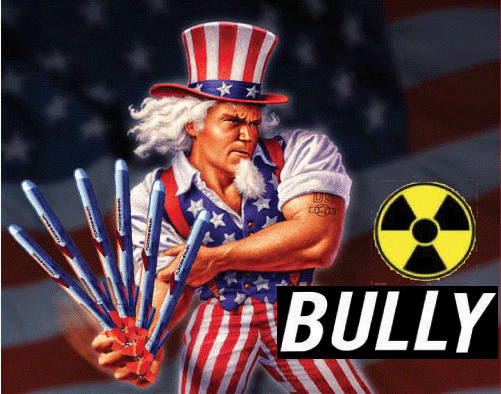
World powers renew commitment to preserve Iran nuclear deal
Remaining parties to landmark 2015 deal reaffirm commitment as Iran’s nuclear programme’s chief slams a Parliament bill. Aljazeera, Maziar Motamedi, 21 Dec 2020, Tehran, Iran – The remaining parties to a landmark nuclear deal they signed with Iran in 2015 have renewed their commitment to preserving the accord in an online meeting.
The foreign ministers of Iran, Germany, France, the United Kingdom, China and Russia participated in a two-hour meeting chaired by the European Union’s foreign policy chief, Josep Borrell, on Monday.
In a tweet before the meeting, Borrell said the aim is to “re-emphasise our commitment to preserve” the Joint Comprehensive Plan of Action (JCPOA), as the nuclear deal is formally known.
A joint statement following the meeting said the ministers “discussed that full and effective implementation of the JCPOA by all remains crucial and discussed the need to address ongoing implementation challenges, including on nuclear non-proliferation and sanctions lifting commitments”.
The foreign ministers recognised the deal, enshrined in Resolution 2231 of the United Nations Security Council, as a “key element” in the global non-proliferation regime and a diplomatic achievement contributing to regional and international peace……..
US President-elect Joe Biden has promised to bring his country back into the deal and lift sanctions but has hinted that more negotiations are needed on Iran’s missiles programme and regional influence.
The European signatories of the nuclear deal have also made similar remarks, but Iran has categorically rejected any further negotiations, saying the nuclear deal must be implemented as negotiated and signed in 2015…………….. https://www.aljazeera.com/news/2020/12/21/world-powers-renew-commitment-to-preserve-iran-nuclear-deal
Iran builds at underground nuclear plant
|
Iran builds at underground nuclear plant, The West Australian Jon GambrellAAP. Fri, 18 December 2020 Iran has begun construction on a site at its underground nuclear facility at Fordo amid tensions with the US over its atomic program, satellite photos obtained by The Associated Press show.
Iran has not publicly acknowledged any new construction at Fordo, whose discovery by the West in 2009 came in an earlier
round of brinkmanship before world powers struck the 2015 nuclear deal with Tehran.
While the purpose of the building remains unclear, any work at Fordo likely will trigger new concern in the waning days of the Trump administration before the inauguration of President-elect Joe Biden.
Already, Iran is building at its Natanz nuclear facility after a mysterious explosion in July there that Tehran described as a sabotage attack.
“Any changes at this site will be carefully watched as a sign of where Iran’s nuclear program is headed,” said Jeffrey Lewis, an expert at the James Martin Center for Nonproliferation Studies at the Middlebury Institute of International Studies who
studies Iran.
Iran’s mission to the United Nations did not immediately respond to a request for comment. The International Atomic Energy Agency, whose inspectors are in Iran as part of the nuclear deal, also did not immediately respond to a request for comment.
|
|
|
West yet to condemn Iranian nuclear scientist’s assassination
|
West yet to condemn Iranian nuclear scientist’s assassination Friday, 18 December 2020 Robert Inlakesh. Press TV, London
In the wake of the Israeli assassination of Iran’s top scientist, Mohsen Fakhrizadeh, Western governments and media are yet to actively condemn the terrorist attack which took place in Tehran. Many analysts speculate that the respective actions of the media have acted to exacerbate regional tensions, rather than de-escalate the situation following the Israeli aggression against Iran. Following the Israeli regime-sponsored terrorist attack on Iranian soil, what has been dubbed as psychological warfare has also been a tool used to attack Iran. With claims spread throughout the international press, regarding an alleged killing of an Iranian Quds Force commander along the Iraq-Syria border area; An unsubstantiated claim but published nonetheless………. For long Israeli strikes conducted against sovereign nations have gone under reported and have skipped condemnation from Western nations, sparking the criticism that the international community operates on double-standards. https://www.presstv.com/Detail/2020/12/18/641027/Israeli-psychological-as-well-as-physical-warfare-against-Iran |
|
Turkey’s unfinished nuclear plant already redundant
Critics say Turkey’s unfinished nuclear plant already redundant
Turkey’s power plant building spree has resulted in an enormous idle capacity but the construction of new plants continues at the expense of taxpayers despite the country’s bruising economic woes. Al-Monitor Mustafa Sonmez Dec 15, 2020
Turkey’s ruling Justice and Development Party (AKP), in power for 18 years, is under increasing fire for poorly planned, prodigal investments whose long-term financial fallout is coming into sharper relief as the country grapples with severe economic woes. Standing out among the most dubious investments is a series of power plants, including a nuclear energy plant still under construction, that have created an idle capacity threatening to haunt public finances for years.
The miscalculations date back to the AKP’s early years in power, when the Turkish economy — fresh from an IMF-backed overhaul — enjoyed unprecedented inflows of foreign capital that stimulated economic growth of up to 7% per year. The AKP’s economic credentials thrived, translating to lasting political gains. The government encouraged construction as the main driver of growth, even if it relied almost entirely on the continued flow of foreign funds. While the country’s energy consumption grew its power production lagged behind and required larger imports of gas, oil and even coal to power electricity plants.
…….The government-backed investment frenzy rested on the assumption that the economy would sustain its growth pace of 6-7% per year. This belief, however, was not justified. Amid ups and downs since 2014, the economy has slowed and so has its energy demand. Consumption has increased only 44% over the past decade, according to official figures, meaning that a significant capacity is now idle while the investments continue to gulp bulky public funds and many of them have caused lasting environmental damage.
………Chief among the ongoing projects is the nuclear power plant that Russia’s state-owned nuclear energy company Rosatom is building in Akkuyu, on Turkey’s southern Mediterranean coast, under an intergovernmental agreement signed in 2010. The facility, scheduled to become operational in 2023, will be the country’s first nuclear power plant, with a capacity of 4,800 megawatts. The build-operate-transfer project has been granted a 49-year production license that expires in June 2066.
Under the deal, the Russians assumed the financing of the project, estimated to cost $20 billion, while the Turkish government provided the land free of charge and promised to purchase 70% of the plant’s electricity production for 15 years at the price of 12.35 cents/kWh. The estimate was that the cost of the 15-year purchase guarantee would total 57 billion liras, but amid the dramatic deprecation of the currency since 2018, the sum has already swelled to 140 billion liras.
Even before the currency turmoil, the project risked delays due to financing snags. Whether it could be finished on time or whether the builders and Ankara could now face additional costs remains to be seen. But given the country’s energy consumption trend, one thing is already clear: the project was a gross, prodigal misstep economically, not to mention the safety and environmental concerns over the plant’s location in an earthquake-prone area.
Ankara, however, seems to have not learned a lesson. Plans remain underway for a second nuclear power plant in Sinop, on the country’s northern Black Sea coast. The government is looking for new partners after a Japanese-led consortium abandoned the project due to prohibitive costs.
According to the Energy Ministry’s 2019-2023 strategy paper, Ankara will seek an intergovernmental deal different from that with Russia and the details of the project, including its capacity and fuel and reactor types, will be decided once the builder is found.
https://www.al-monitor.com/pulse/originals/2020/12/turkey-nuclear-plant-become-redundant-before-completion.html#ixzz6gpABtCr7
Iran’s Rouhani: No conditions or negotiations on nuclear deal
Iran’s Rouhani: No conditions or negotiations on nuclear deal
The US tried to include Iran’s missile programme and regional issues in the original nuclear deal but it is non-negotiable, president says. Aljazeera, By Maziar Motamedi, 14 Dec 2020, Tehran, Iran – President Hassan Rouhani said Iran will not accept any preconditions in returning to the nuclear deal it signed with world powers and will not negotiate its missiles programme or regional activities.
The United States and European powers have said in recent weeks they remain committed to revitalising the nuclear deal – formally known as the Joint Comprehensive Plan of Action (JCPOA) – which outgoing US President Donald Trump unilaterally abandoned in 2018……….. https://www.aljazeera.com/news/2020/12/14/irans-rouhani-no-conditions-or-negotiations-on-nuclear-deal
Iran clearly wants to maintain the Joint Comprehensive Plan of Action (JCPOA)
|
Iran will not accept new nuclear deal: MP, Tehran Times December 13, 2020 “Iran’s position on the JCPOA is quite clear. There is a consensus in the establishment in its entirety on the nuclear deal that Iran demands that all JCPOA parties should return to the deal and implement it unconditionally,” the lawmaker said, according to the Parliament’s news agency ICANA.
Rahimi Jahanabadi also referred to the upcoming meeting of the JCPOA Joint Commission, which is scheduled to be held on Wednesday, saying that during the meeting the two issues should be discussed. “It is expected that Mr. Araghchi, as Iran’s representative, underlines two issues in the JCPOA Joint Commission meeting. First of all, he should reiterate that the JCPOA is the best deal. Second, Iran will not accept a new deal and negotiations,” the lawmaker said, adding that Iran should tell the 4+1 that it will return to its past activities if the Westerners fail to implement their commitments. 4+1 refers to France, Britain, Russia and China as four permanent members of the UN Security Council plus Germany. First it was referred to as 5+1, before Donald Trump withdrew the U.S. from the multilateral agreement. On Saturday, Seyed Abbas Araghchi, the deputy foreign minister of Iran for political affairs, announced in a statement that the Joint Commission will hold a meeting at the level of deputy ministers and political directors. The meeting will be held via videoconference. Araghchi said he will represent Iran in the meeting……… https://www.tehrantimes.com/news/455734/Iran-will-not-accept-new-nuclear-deal-MP |
|
|
Iran Awards Military Medal To Nuclear Scientist Assassinated Last Month
Iran Awards Military Medal To Nuclear Scientist Assassinated Last Month NDTV 13 Dec 20, Tehran:
Iran’s supreme leader Ayatollah Ali Khamenei on Sunday posthumously awarded a prestigious military decoration to top nuclear scientist Mohsen Fakhrizadeh, who was assassinated last month, state television reported.
Fakhrizadeh was killed on a major road outside Tehran in late November in a bomb and gun attack that the Islamic republic has blamed on its arch foe Israel……. https://www.ndtv.com/world-news/iran-awards-military-medal-to-nuclear-scientist-mohsen-fakhrizadeh-assassinated-last-month-2338031
Iran’s President Rouhani ready to restore the nuclear deal
Rouhani: ‘No negotiations’ needed to restore Iran nuclear deal https://www.aljazeera.com/news/2020/12/9/iran-rouhani-no-negotiations-on-nuclear-deal
President Rouhani says Iran will return to its commitments that were part of the deal if other signatories do the same. By
Maziar Motamedi, 9 Dec 2020, Tehran, Iran – Iran’s nuclear deal can be restored without negotiations despite recent escalations following the assassination of a top nuclear scientist, Iran’s President Hassan Rouhani has told world powers.
Rouhani said United States President Donald Trump “scribbled on a piece of paper” in May 2018, unilaterally withdrawing from the nuclear deal.
“The next person can put up a nice piece of paper and sign it and it just needs a signature, we’ll be back where we were. Ittakes no time and needs no negotiations,” Rouhani said in a televised cabinet speech on Wednesday.
“And it’s not just about the US. The P4+1 can return to all their commitments and we will do the same,” he said in reference to France, Germany, the United Kingdom, China, and Russia, the other signatories of the nuclear deal.
US President-elect Joe Biden and Europe have signalled that while they wish to restore the nuclear deal, they believe it needs to be renegotiated and extended.
Exactly a year after the US pulled out of the landmark deal and imposed harsh sanctions on Iran, Tehran gradually scaled back its commitments under the deal in five steps that it said are reversible.
Following the assassination of nuclear scientist Mohsen Fakhrizadeh outside Tehran last month, the Iranian parliament, dominated by conservatives and hardliners, quickly passed a bill that aims to increase uranium enrichment and expel inspectors of the International Atomic Energy Agency.
The Rouhani administration has explicitly said it opposes the legislation and was not consulted in its drafting.
Rouhani said all the new advanced centrifuges that are being installed at the Natanz underground nuclear facilities can be switched off once all the signatories of the nuclear deal start fully implementing their commitments.
Earlier this week, France, Germany and the UK – together known as the E3 – issued a joint statement saying Iran’s plans for a further reduction of nuclear commitments are “deeply worrying” and go against the spirit of the accord.
Iran hastens nuclear legislation in response to the assassination of its nuclear scientist
Iran vows to build two new nuclear facilities, alarming observers https://www.sciencemag.org/news/2020/12/iran-vows-build-two-new-nuclear-facilities-alarming-observers By Richard StoneDec. 8, 2020,
|
Iran’s possible responses to the assassination of a prominent nuclear scientist go well beyond boosting uranium enrichment and expelling weapons inspectors, two provisions of a law passed by Iran’s parliament that alarmed nonproliferation experts last week. Equally worrisome are new facilities the law requires, which could enable Iran to make plutonium and fashion uranium into bomb components. The legislation had been in the works for months, but parliament fast-tracked it after the 27 November killing of Mohsen Fakhrizadeh, director of a Revolutionary Guard research unit who had previously led a secret nuclear weapons program shuttered in 2003, according to the International Atomic Energy Agency (IAEA). Iran’s powerful Guardian Council last week approved the law. The potential limits on IAEA monitoring are of particular concern, says a European diplomat involved in negotiations with Iran. “IAEA would go blind in many areas of Iran’s nuclear establishment.” Posing a fresh proliferation risk are the new facilities the bill mandates: a lab for working with uranium in metal form—a vital skill if Iran were to make nuclear weapons—and a heavy water reactor that could accumulate plutonium in its spent fuel. “If either was to proceed, that would stand out as a major proliferation concern,” says Richard Johnson, senior director for fuel cycle and verification at the nonprofit Nuclear Threat Initiative. Iranian President Hassan Rouhani’s administration opposed the legislation. However, Foreign Minister Mohammad Javad Zarif told an international forum last week, “We will implement it. We have no other choice.” But Zarif noted the law is reversible. “The remedy is very easy,” he said: Iran would shelve the law if the United States returns to the 2015 nuclear deal, formally called the Joint Comprehensive Plan of Action (JCPOA), which restrained Iran’s nuclear program in return for relief from economic sanctions. The Trump administration pulled out of the JCPOA in 2018; President-elect Joe Biden has pledged to rejoin it. The JCPOA, proponents say, lengthened the time Iran would need to accumulate enough fissile material for a bomb, from several weeks to at least 1 year. A key provision is a cap on uranium enrichment at 3.67% of the fissile isotope uranium-235 (U-235), which is a level sufficient for civilian nuclear reactors. One year after the U.S. withdrawal from the JCPOA, and after Europe’s failure to deliver promised economic relief, Iran began to breach the pact, including increasing enrichment to 4.5%. A hike to 20%—which last week’s law requires—is a big step toward weapons-grade uranium, which is generally defined as greater than 90% U-235. A heavy water reactor would pose another headache. Before the JCPOA, Iran was building a 40-megawatt heavy water reactor in Arak to produce radioisotopes for medicine. As originally designed, the reactor would have accumulated one or two bombs’ worth of plutonium each year in its spent fuel. The JCPOA required that the facility, not yet complete, be redesigned as a 20-megawatt reactor that largely eliminates plutonium production. But the redesign stalled after the U.S. Department of State in May canceled sanction waivers permitting import of necessary equipment and technology. The new law orders the Atomic Energy Organization of Iran (AEOI) to complete the 40-megawatt reactor—apparently the configuration originally planned at Arak—and design a second 40-megawatt heavy water reactor; a timetable for completion of both projects is due in early January 2021. The law also mandates that AEOI inaugurate a “metallic uranium factory” in Isfahan within 5 months. Iran had agreed under the JCPOA to a 15-year moratorium on uranium and plutonium metallurgy. Any provocation from the West could spur the Iranian government to implement the law even faster. “Many things could go wrong in the next several weeks,” the European diplomat says. And a U.S. return to the pact would not be instantaneous. “We can’t just snap our fingers and say, ‘We’re back in,’” Johnson says. The Biden administration would have to rescind sanctions that run contrary to the JCPOA, while Iran would have return to compliance by mothballing advanced centrifuges, for example, and steeply reducing a growing stockpile of enriched uranium. |
|
1 This Month

Protect Sazan Island from the Trump family! https://secure.avaaz.org/campaign/en/protect_sazan_island_from_the_trump_family_loc/?bqFCVab&v=174511&cl=22707147157&_checksum=5e9dde668860e8231c33699735e16a1fbf22ab2cb01da50c999fe8732b9775ef&utm_source=email&utm_medium=blast_email&utm_campaign=174511
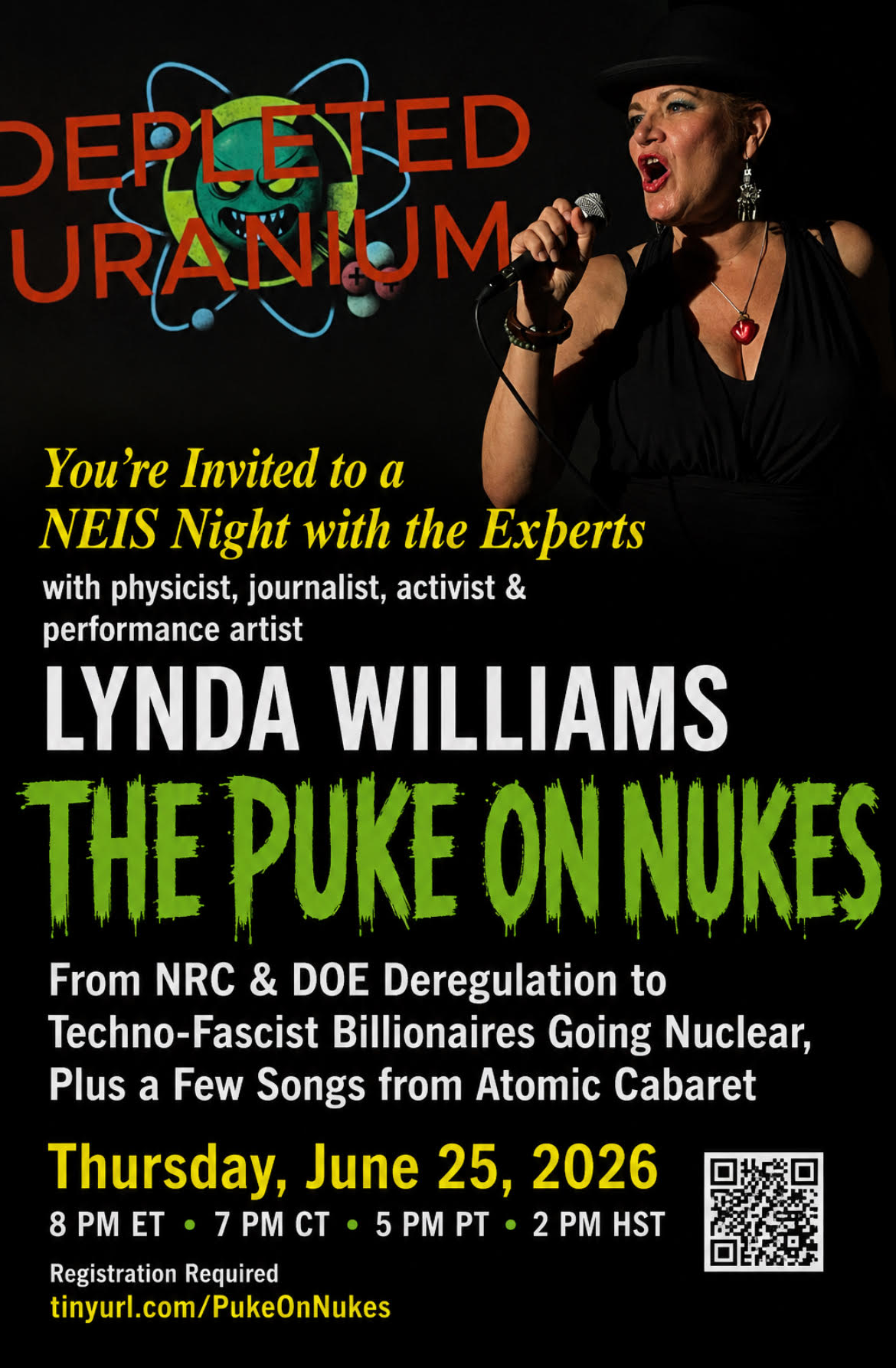
25 June- THE PUKE ON NUKES
Thursday, June 25, 2026
7pm Central Time (8pm ET, 6pm MT, 5pm PT) UTC – 5
From NRC & DOE Deregulation to Techno-Fascist Billionaires Going Nuclear, Plus a Few Songs from Atomic Cabaret REGISTER
26 June – Radiation Trainwreck at the NRC / Join the Protect Better Campaign – https://us02web.zoom.us/meeting/register/4ZlZ5_qLSHGiLSCg8FF6Bg#/registration


Cuba Is Not a Failed State – It Is a Besieged State
PETITION: “Global Appeal to Endorse Palestinian Right of Return of Refugees”
To see nuclear-related stories in greater depth and intensity – go to https://nuclearinformation.wordpress.com
-
Archives
- June 2026 (152)
- May 2026 (306)
- April 2026 (356)
- March 2026 (251)
- February 2026 (268)
- January 2026 (308)
- December 2025 (358)
- November 2025 (359)
- October 2025 (376)
- September 2025 (257)
- August 2025 (319)
- July 2025 (230)
-
Categories
- 1
- 1 NUCLEAR ISSUES
- business and costs
- climate change
- culture and arts
- ENERGY
- environment
- health
- history
- indigenous issues
- Legal
- marketing of nuclear
- media
- opposition to nuclear
- PERSONAL STORIES
- politics
- politics international
- Religion and ethics
- safety
- secrets,lies and civil liberties
- spinbuster
- technology
- Uranium
- wastes
- weapons and war
- Women
- 2 WORLD
- ACTION
- AFRICA
- Atrocities
- AUSTRALIA
- Christina's notes
- Christina's themes
- culture and arts
- Events
- Fuk 2022
- Fuk 2023
- Fukushima 2017
- Fukushima 2018
- fukushima 2019
- Fukushima 2020
- Fukushima 2021
- general
- global warming
- Humour (God we need it)
- Nuclear
- RARE EARTHS
- Reference
- resources – print
- Resources -audiovicual
- Weekly Newsletter
- World
- World Nuclear
- YouTube
-
RSS
Entries RSS
Comments RSS
 nuclear-news