Trump rules out nuclear weapons against Iran, weighs limited Strait of Hormuz strikes
[your]NEWS, Mon, 31 Aug 2026, https://www.sott.net/article/508207-Trump-rules-out-nuclear-weapons-against-Iran-weighs-limited-Strait-of-Hormuz-strikes
President Donald Trump said nuclear weapons are unnecessary because Iran has been “totally defeated militarily,” while his administration considers limited conventional strikes aimed at protecting U.S. forces and commercial shipping in the Strait of Hormuz.
President Donald Trump said Monday that he has ruled out using nuclear weapons against Iran, even as the White House weighs additional conventional military action around the Strait of Hormuz following renewed clashes between U.S. and Iranian forces.
Trump addressed the nuclear question while speaking with reporters in the Oval Office, where he was asked whether he would exclude such an escalation from the ongoing conflict.
“Well, I would never say. That, but the answer is yes, I ruled out.I ruled it out there’s no reason for it.”
The president argued that Iran’s conventional military losses made the use of nuclear weapons unnecessary.
“What a stupid question that is. Actually, here they are. They’re totally defeated militarily. So now I defeat him, and now I should use a nuclear weapon on top of them. What a stupid question.”
Trump’s comments came as his administration considers a different form of escalation focused specifically on protecting traffic through the Strait of Hormuz.
According to Axios, the president is weighing a resumption of limited strikes following an exchange of gunfire between American and Iranian forces over the weekend.
One U.S. official told the outlet that the contemplated operations would be intended to reduce the threat of Iranian attacks against oil tankers, U.S. Navy vessels and Air Force aircraft operating in the region. The potential strikes would therefore be narrower in scope than a major offensive against Iran and would focus on protecting military assets and commercial navigation through the strategic waterway.
The Strait of Hormuz has become one of the central flashpoints in the U.S.-Iran conflict because of its importance to international oil shipments and the continuing danger posed to vessels operating there. Any sustained Iranian attacks on tankers or U.S. military forces could prompt additional American action even as Trump says the administration sees no reason to consider nuclear weapons.
The White House emphasized that the president continues to retain broad military flexibility:
“The President retains all options at his disposal. The Iranians want to make a deal, but they are always a day late and a dollar short.”
That statement leaves open the possibility of additional conventional strikes while simultaneously suggesting Washington believes negotiations remain possible.
Trump’s position therefore separates two questions surrounding the conflict:
On nuclear weapons, he gave an explicit answer that he had ruled them out and argued Iran’s military condition did not justify such an extraordinary escalation.
On conventional force, however, the administration continues evaluating whether further strikes are necessary to protect American personnel and commercial shipping.
The possible Strait of Hormuz operation would be designed around those immediate security concerns rather than the use of substantially more destructive weapons. Trump’s remarks also suggest the administration believes Iran has already suffered significant military setbacks but remains capable of threatening ships and aircraft in the region.
That distinction could shape the next phase of U.S. operations, with Washington continuing targeted military action against specific threats while attempting to avoid an escalation to nuclear warfare.
For now, Trump has publicly closed the door on using nuclear weapons against Iran while leaving conventional military options available if Tehran continues threatening U.S. forces or shipping through the Strait of Hormuz.
Walt Zlotow – Some inconvenient truths about Trump’s Iran war

Walt Zlotow West Suburban Peace Coalition Glen Ellyn IL , 31 Aug 2026, https://theaimn.net/some-inconvenient-truths-about-trumps-iran-war/
The US lost the war within the first 3 days when the US, Israeli attack and assassination of Iranian leader Ali Khomenei did not collapse the Iranian regime
Bombing Iran for 39 days was a catastrophic military failure. Iran’s retaliatory defense decimated all 20 US Gulf State bases inflicting over 750 US casualties including 18 dead.
Running out of both offensive and defensive missiles, Trump blinked first and called for a ceasefire on April 8, war day 40.
The June 17th signing of the Memorandum of Understanding (MOU) was essentially a US surrender document.
Realizing the MOU signaled his defeat, Trump simply ignored it, implemented a blockade and resumed periodic bombing. Both utterly failed to reopen the Strait of Hormuz to resume the critical flow of oil to prevent worldwide economic calamity.
Having been sucker punched with bombs twice by Trump during negotiations, Iran has signaled it will never negotiate with Trump during his remaining 2 years, 5 months in office.
Trump’s statements that Iran is negotiating surrender on Trump’s terms, the Strait is open, and will become US territory, the blockade is a resounding success, the oil is flowing, are so detached from reality one must ponder Trump’s sanity.
Refusal to capitulate is spreading the war within the region to Yemen, Saudi Arabia, Lebanon, West Bank, Iraq, Syria, possibly even Turkey v. Israel.
If Trump’s last gasp is to utterly destroy Iranian infrastructure, Iran will retaliate and destroy the entire Gulf States oil infrastructure and possibly Israel’s infrastructure as well.
Unlike for the US, Trump’s war is an existential threat to Iran’s existence. They have been preparing for the US, Israeli tag team war machine to destroy them for decades. They are and will prevail regardless of the cost.
Israel will do whatever is necessary to keep Trump in the war to destroy Iran. Trump’s only way out is to sever ties with Israel and capitulate to Iran’s sensible terms. Given Trump’s history, the chances of that are nil. Removing Republican control of Congress in 9 weeks may be only chance for America to avoid economic collapse.
But only if a Democratic Congress has the wisdom, decency and good sense to end the most self destructive war in America’s 251 years.
US treasury chief claims Washington ‘unlikely to restart’ large-scale hostilities against Iran
Bessent said that illegal US sanctions are a replacement for a war of aggression that has failed to break Tehran
News Desk, AUG 20, 2026, https://thecradle.co/articles/us-treasury-chief-claims-washington-unlikely-to-restart-large-scale-hostilities-against-iran
US Treasury Secretary Scott Bessent told CNBC on 20 August that Washington will likely “not restart” large-scale military operations against Iran, as the White House shifts to a campaign of maximum economic sanctions.
If we are doing the maximum economic pressure, then that means that likely there will not be a large-scale kinetic restart,” Bessent said in an interview with CNBC’s Squawk on the Street news program.
Trump had announced hours earlier on Truth Social that Washington would impose major economic penalties on any country extending Tehran what he called “any type of lifeline.”
“This will be an ECONOMIC D-DAY, and we need all of our Allies to stand with the United States of America to isolate, and defeat, the Iran threat,” Trump wrote.
Bessent said he would lay out the details of the plan at a press conference, telling CNBC that the message to every US ally would be: “You are either with us or against us.”
“If you insist on doing business with [Iran], either transferring money, buying their oil or doing seaborne ship transfers, then the US Treasury and the US government … will put its full might and force toward enforcing against you,” he said.
He described the campaign as “the greatest coordinated economic isolation in the history of the world.”
Iranian Foreign Minister Abbas Araghchi dismissed the campaign the same day, writing on X that it would deliver Washington nothing but “further defeat.”
“The so-called ‘Economic D-Day’ is a diversion from America’s own crisis: unprecedented debt & surging interest costs,” Araghchi wrote, describing US “economic terrorism” as a threat to the global economy.
Iranian Deputy Foreign Minister Kazem Gharibabadi said Washington had reached for economic warfare only after its military campaign failed to deliver.
“They claim Iran is on the verge of defeat and hanging by a thread, yet they are begging all their allies to help them,” he wrote on X, adding that the US had “named their next failure an ‘economic war.’”
Vice-Chairman of the Belt and Road Institute in Sweden Hussein Askary notes that the US naval blockade imposed in April has pushed Iran to shift its trade overland, sharply increasing freight traffic on the China–Iran railway and raising the strategic value of Eurasian land corridors as Tehran works to keep supply routes open beyond the reach of maritime pressure.
The Pentagon is reviewing whether to scale back its presence in Persian Gulf states after Iranian retaliatory strikes battered the largest US bases overseas, with sources saying a westward pullback is under consideration.
A regional intelligence source told Press TV that the Pentagon has concluded no military plan exists that could guarantee open shipping through the Strait of Hormuz, which carries roughly one-fifth of the world’s oil.
A Nuclear Option Against Iran Would Be a Catastrophe – Not a Solution
Taut Bataut, August 21, 2026, https://journal-neo.su/2026/08/21/a-nuclear-option-against-iran-would-be-a-catastrophe-not-a-solution/
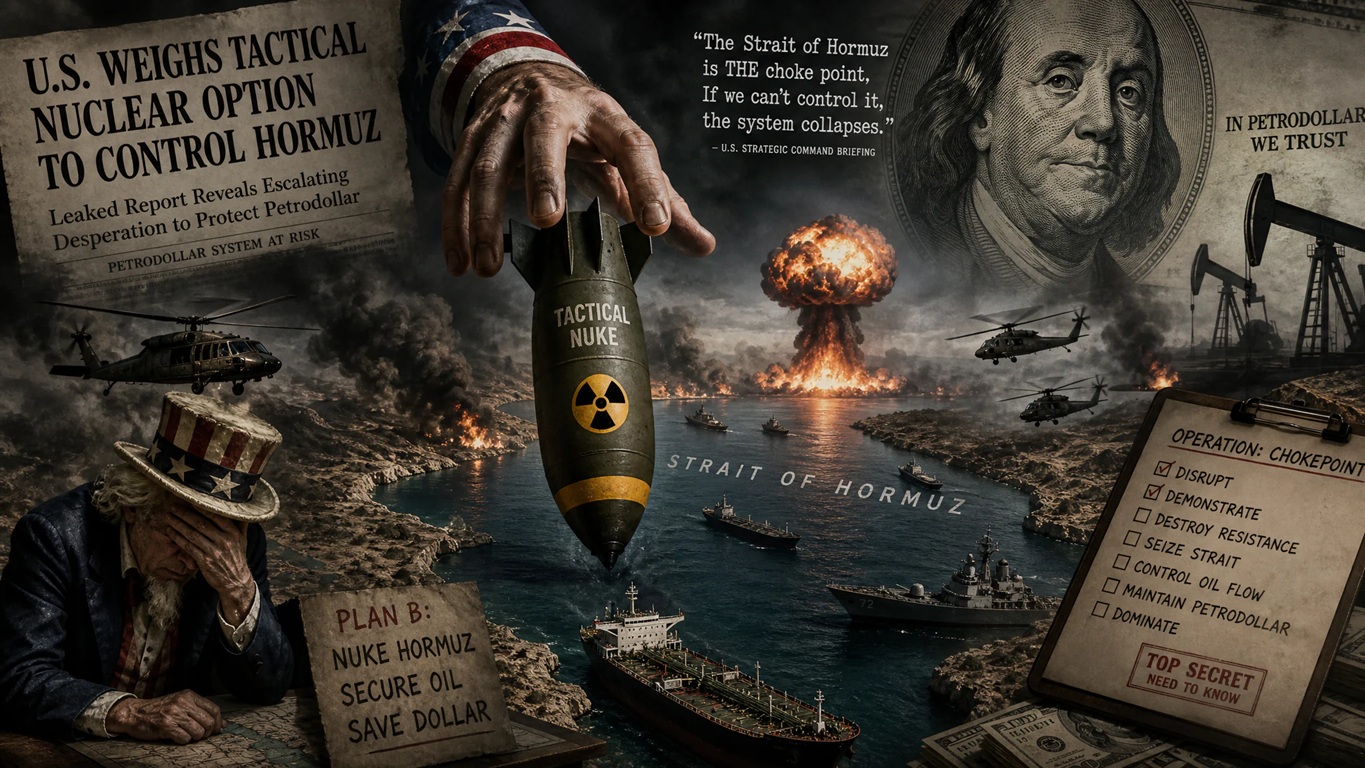
Driven by desperation after failing conventionally in West Asia, the U.S. demonstrates reckless foreign policy by entertaining the use of tactical nuclear weapons to forcibly capture the Strait of Hormuz and preserve petrodollar hegemony.
his reliance on nuclear blackmail reflects a long-standing U.S. pattern of resorting to aggressive, unconventional force whenever its global military dominance is challenged.
A line in the sand that, once crossed, cannot be uncrossed. “They are discussing using nuclear weapons on Iran in strategy meetings. Yes, you read that correctly. It’s real. I’m not speculating; I know. And it’s pure evil.” This is what former US Congresswoman Marjorie Taylor Greene wrote on her X account on 17 August 2026. Although this statement is neither confirmed by the White House nor does it unveil any implicit information, the mere consideration of such an option signals a dangerous psychological shift in U.S. foreign policy. Heading towards any such move against Iran could result in global catastrophe, and the consequences would then be out of control. The real query here is whether the ongoing Middle Eastern volatility is paving the way for a nuclear holocaust or not.
Historical Perspective
To understand the ongoing situation in the Middle East, it is necessary to look into the historical perspective. When the US used nuclear weapons against Japan in World War II, we were told that the Japanese surrendered because of the nuclear weapons. This is false. Anyone who has studied World War II carefully will understand that the Japanese forces were already surrendering. So why was there a need to use nuclear weapons? The reason is that the US was running a secret project called the ‘Manhattan Project.’ Under this project, Americans were developing both uranium and plutonium bombs. So, the US wanted to test its weapon and thus bombed Japan. That’s why two bombs were dropped; however, only one could be enough. And thus, the US claimed itself as the number one military power in the world.
Later on, in the 1950s, Americans once again found that Soviet military dominance had surpassed them. So, the US introduced the tactical nuclear weapons to surpass the Soviet’s conventional superiority. However, till the 1970s, Soviets also developed tactical nuclear weapons in large numbers. In retaliation, the US started investing in space projects to develop long-range conventional missiles. By 2010, now the US military concluded that the Chinese military had become equal to ours. So, now the US is introducing artificial intelligence and autonomy in its military. But the PLA, without any doubt, has significantly outpaced the US military in this regard. This clears one thing: the US establishment did not want President Trump to sign an MoU with Iran, which was a clear surrender of the US military. So, as the US has completely failed against Iran in conventional terms, it might opt for some unconventional means to maintain its military superiority in the region.
Why the U.S. Might Opt for Tactical Nuclear Weapons
As of now, it is clear that there is no way to stop Iran through conventional capabilities. So, the statement made by Greene actually depicts the current strategic thinking inside the US: that even if the 50,000 US troops stationed at the 19 airbases in West Asia withdraw, if they do, and the US maintains control of the Strait of Hormuz, which could then be declared as US territory, then the petrodollar will remain intact. Therefore, the plan is to move out of the region and capture the Hormuz region through tactical nukes.
The next question then becomes, how is this going to be done? When one talks of tactical nuclear weapons, they mean the weapons whose power ranges from sub-kilotons to 50 kilotons. Just to remind you, the weapons the US dropped on Japan during WWII were tactical and weighed 15 kilotons. But now through modern technology, one can create a critical mass with just using a few kgs of uranium or plutonium, which could result in a chain reaction, and a nuclear weapon can be used.
Technically, this is possible today. If the Strait of Hormuz’s chokepoint could be opened with the use of a very small, limited-range, sub-blast, or sub-kiloton nuclear weapon. So, the US could capture the Strait of Hormuz in this way, declare it its own territory, and continue to generate petrodollars. This is the reason President Donald Trump recently said, “After we finish defeating Iran, which is being very badly defeated, pretty soon I’ll be declaring the Hormuz Strait a territory of the United States.”
The Devastating Consequences
Elbridge Colby, Under Secretary of War for Policy, has recently warned, “What I would fear more is a regional war, a kind of local war, a conventional war that might have local employment, God forbid, of nuclear weapons that could escalate from there as it expanded outward.” The consequences would be catastrophic. We know that many countries in the world today possess nuclear weapons, and we are also aware that North Korea has openly declared that if nuclear weapons are used against Iran, it will stand in solidarity with Iran. In addition, many analysts are of the view that Iran might have already developed nuclear weapons. But here the question is, could Iran have done this?
There are two reasons for which it can be concluded that Iran would not have done it. First, Iran is trying to develop a regional security framework, and the Mecca Defense Pact is its best manifestation, which could be expanded in the near future. Iran wants every regional country to see it as a partner nation. Thus, if Iran pursues developing nukes, it could start an arms race in the region where countries like Saudi Arabia would also demand a bomb. Second, Iran is a signatory of the NPT. So, Iran would first announce its withdrawal from the treaty, and then it will head forward in this direction.
China’s Role and Supremacy
Here China can play a pivotal and powerful role. Today China has approximately $800 billion in US Treasury bonds. If the Chinese were to tell Americans today that they were selling half or a large amount of their Treasury bonds, it would create problems with the US’s indebted economy. Inflation would spike, the stock market would crash, and the economy would be in dire condition. Moreover, China also has dominance over the world’s rare earth minerals, on which American conventional capabilities are highly dependent. Also, the PRC could also pressurize the US over the upcoming visit of Chinese President Xi Jinping to the US in September 2026. Thus, China has a lot to do in this regard, and it’s already doing it in one way or another to preserve the world’s peace.
A Nuclear Strike is not a Solution
A nuclear attack against Iran is not an answer; it is a recipe for disaster that is bound to happen sooner rather than later. This policy of desperation would be a betrayal of principles and a failure of our ideals and would not help to bring peace. The rest of the world should make its voice heard and condemn such rhetoric before it normalizes something unimaginable. There are reasons that dictate that we should rely on diplomacy and patience, no matter how desperate the situation becomes. The unthinkable should remain unthinkable; to think about such an option is to play with fire.
Hormuz Catastrophe: Netanyahu & Trump Knew Risks, Escalated Anyway
SCHEERPOST, August 25, 2026, Dan Steinbock Informed Comment
Iran has not collapsed, while Hormuz has become a global economic choke point. The central failure was not ignorance of the risks, but the political decision in Washington and Tel Aviv to gamble that coercive military power could overcome them.
So, why did they set the stage for the catastrophe that was both unwarranted and unnecessary?
The Israeli conventional war game
In February 2024 – after 4 months of the Israeli obliteration of Gaza – over 100 senior military and government officials participated in a report by Reichman University’s Institute for Counter-Terrorism which outlined in painful detail how unprepared the Israeli home front was for an all-out war with Hezbollah.
This lethal scenario was written long before Hamas’ October 7th attack on Israel. It is the result of a three-year study. The 130-page report was the work of six think tanks made up of over 100 terrorism experts, former senior security officials, academics, and government officials who examined critical aspects related to the level of preparedness for the IDF and the home front in the event of a multi-front war.
The project was led by Professor Boaz Ganor, a world-renowned counter-terrorism expert. In the months leading up to October 7, he presented his research to relevant military and political authorities in an attempt to rouse intelligence and decision-makers from complacency and misconceptions.
The Netanyahu government ignored him and the analysis.
The Israel-Iran nuclear war game
In late 2023 – almost in parallel with the Hamas attack – a high-level U.S. war game was conducted in Washington. The participants included members of U.S. executive branch, Republicans and Democrats in the Congress, leading academics, think-tank experts and Pentagon officials. The game started in 2027 with Israeli intelligence reports that Iran was mating nuclear warheads to its long-range missiles. Consequently, Israel targets Iran’s key nuclear and missile sites with U.S. standoff hypersonic missiles.
Intriguingly, initially the U.S. participants presumed that self-restraint would prevail in this high-level war game. Yet, the simulation’s cold logic compelled them into a sequence of steps that quickly went nuclear. The adverse consequences were felt by millions of civilians in both Israel and Iran.
The lessons of the war game were ignored by both the Netanyahu government and the Trump administration.
Why did Netanyahu court the U.S. into the Iran conflict fully knowing the consequences?
Both war games were common knowledge among the US and Israeli military elites well before October 7, 2023. I referenced each in my book The Fall of Israel (2024). So, why were the lessons of these games effectively ignored?
The evidence points less to strategic ignorance than to political and strategic risk-taking. In particular, The Fall of Israel shows that Netanyahu’s government repeatedly treated regional escalation as a means of escaping an increasingly untenable post-October 7 position: prolong Gaza invasion, weaken Hezbollah, expand Israel’s northern security zone and ultimately confront Iran.
I argued that Netanyahu rejected a Gaza ceasefire while expecting Trump’s return to provide greater freedom of action against Gaza, Lebanon and Iran.
But the risks were hardly invisible even in 2023. The high-level U.S. war game in late projected that an Israel-Iran confrontation could rapidly escape Israeli and American control and go nuclear. The Hezbollah scenario likewise anticipated thousands of rockets, saturation of Israeli defenses, attacks on infrastructure and paralysis of ports and trade.
Netanyahu’s calculation therefore appears brutally simple: the risks of escalation were judged preferable to the political risks of de-escalation. A wider war could restore deterrence, destroy adversaries, preserve his coalition and keep the strategic initiative.
The catastrophic externalities—Lebanon, Iran, Hormuz, the Gulf and the world economy—were treated as manageable collateral risks. They were not Israel’s problem. They were the world’s problem.
Why did Trump take the bait when Washington understood the stakes?
Trump inherited an enormous institutional warning system. U.S. officials, Pentagon planners and bipartisan experts had already modeled escalation from an Israeli attack on Iran through retaliation, Israeli counterstrikes, nuclear signaling and ultimately nuclear exchange.
The war game initially assumed rational self-restraint; but its own sequence demonstrated how quickly that assumption could collapse.
Yet Trump appears to have made the classic great-power error: confusing overwhelming tactical superiority with strategic control.
To the interventionists, the political attractions were obvious—destroy Iran’s nuclear capacity, reinforce Israel, demonstrate American dominance and claim a decisive victory where previous administrations had failed.
But the premise that Iran could be compelled to surrender under bombardment underestimated asymmetric retaliation, regional proxies, geography and the extraordinary leverage of Hormuz.
The result is the opposite of the promised quick victory. By August, Trump’s approval had fallen to 33%, while 80% of Americans said they expected the war to be prolonged. Earlier Pew polling found 59% of Americans believed using force against Iran was the wrong decision and 62% disapproved of Trump’s handling of it.
Ironically, Washington has converted a military operation into a strategic endurance contest in which Iran possesses an exceptionally powerful economic weapon: Hormuz.
Soaring oil/gas prices, plunging growth, 6+ million displaced……………………………………………………………………………………………………………………………
What options remain and how badly has America damaged itself
There are four remaining trajectories. First, negotiated de-escalation: reopen Hormuz, freeze attacks, restore oil/LNG flows and negotiate Iran’s nuclear status.
Second, prolonged managed conflict: intermittent strikes, sanctions and restricted shipping, producing structurally higher energy prices.
Third, regional expansion: Lebanon, Iraq, Yemen and Gulf infrastructure become increasingly active fronts.
Fourth, the tail risk: escalation toward nuclear confrontation—the scenario the war games warned could arise from supposedly controlled conventional operations.
What is urgently needed is an internationally mediated settlement involving Iran, the Gulf states, Europe, China, Russia and the UN—not another unilateral U.S. military ultimatum. As I argued in The Fall of Israel, unipolar solutions are increasingly incapable of managing a multipolar Middle East………………………………………………… https://scheerpost.com/2026/08/25/hormuz-catastrophe-netanyahu-trump-knew-risks-escalated-anyway/
Walt Zlotow – 21ST century David v. Goliath: Iran’s $8 billion military whups America’s $1 trillion military
Walt Zlotow West Suburban Peace Coalition GlenEllyn IL , 19 Aug 26, https://theaimn.net/21st-century-david-v-goliath/
What’s going on in the Middle East is not a Biblical fairy tale. Irans’s piddly military has delivered a devastating defeat to America’s gargantuan trillion dollar military.
Iran’s David does not need to squander a trillion annually on 750 bases housing over 160,000 soldiers in 80 countries. Nor does Iran’s David need 287 naval ships including 11 nuclear powered aircraft carriers that have suddenly become obsolete in the era of drone and missile warfare. Those carriers have been steering clear of Iran’s missiles and drones least they be sent to Davy Jones Locker.
The US is flummoxed at how Iran’s minuscule military has made mincemeat out of all 18 US bases in US Gulf State allies Kuwait, Saudi Arabia, UAE, Qatar and Bahrain. After plastering Iran with thousands of bombs for 39 days, it was the US, not Iran that was running out of offensive and defensive missiles and bombs, so much so Trump cried ‘Uncle’ and demanded a ceasefire.
When Trump signed the Iran’s ‘Unconditional Surrender’ document, the Memorandum of Understanding, on June 17, it was equivalent to Goliath being smitten by the stone puny David fired from his sling.
Of course, the story of David and Goliath is a fairy tale that allegedly occurred over 3,000 years ogo. The 21st century version is no fairy tale. Now in its 173rd day with no end in sight, it still represents the most catastrophic military blunder in US history. It will likely push the US out of the Middle East. The 5 Gulf States housing now damaged or destroyed US bases may seek more reliable countries to rely on for their security. Iran will emerge a stronger power in the region. The entire world economy still teeters on possible decline from US intransigence and refusal to admit defeat.
Trump still doesn’t get it. He’s seeks another half trillion bucks for his wildly bloated military for fiscal ’27 in hopes of prevailing over Iran’s tiny $8 billion dollar military. Mayne he should start reading something he’s never read before…the Bible. He should start with 1 Samuel 17:1–50.
Trump ‘weighing nuclear attack on Iran’ as peace deal expires.

Plus: Why the Iran war has prompted Trump to scale back key US-South Korea military drills
As the US-Iran ceasefire officially expires and the Strait of Hormuz
remains closed, is Donald Trump considering using nuclear weapons to break
the war’s stalemate? On today’s episode of Iran: The Latest, Venetia Rainey
and Roland Oliphant discuss why US politician Marjorie Taylor Greene’s
bizarre nuclear claim may be less crazy than it first appears and how an
underground nuclear facility at Pickaxe Mountain could be the potential
target. They also look at the state of the war 60 days on from the
ill-fated Memorandum of Understanding peace deal and why Iran is more
bullish than ever.
Telegraph 17th Aug 2026, https://www.telegraph.co.uk/world-news/2026/08/17/trump-weighing-nuclear-attack-on-iran-as-peace-deal-expires/
Delusional’: Iran Fires Back At Trump’s Make ‘Hormuz Strait A Territory Of The US’ Ambitions
by Tyler Durden, Monday, Aug 17, 2026 – https://www.zerohedge.com/geopolitical/iran-fires-back-trumps-make-hormuz-strait-territory-us-ambitions-delusions
Predictably, Iran has on Saturday issued a full-throated rejection of President Trump’s Friday evening words related to the status on the conflict and energy transit in the region.
In a speech on New York’s Long Island, Trump introduced the idea of declaring the Strait of Hormuz a US territory. “After we finish defeating Iran, which is being very badly defeated — pretty soon, I’ll be declaring the Hormuz Strait a territory of the United States,” Trump told a crowd of law enforcement officer
“Essentially, that’s what it is. We have the blockade. No ships get through unless we want them to,” he added. He claimed oil prices were coming “way down”.
Some pundits pointed to what seemed like classic hyperbole and his penchant for floating extreme scenarios in off-the-cuff fashion; however, Trump made the statement without any qualifiers other than it will happen when Iran is “badly defeated” by the United States. That seems to be the big if in the future scenario.
A Saturday X response from Iranian Deputy Foreign Minister Kazem Gharibabadi asserted the US has zero authority to claim the strait:
“The Strait of Hormuz has been Iranian, is Iranian, and will remain Iranian,” he wrote, as translated from Persian to English. “This strait will only be closed and opened under Iran’s command.”
The Iranian official then claimed all of Trump’s assumptions about the conflict were delusional, showing that Washington does “not accept the reality of defeat” and so must stop indulging in its “delusions”.
The Iranians have been reiterating that they will continue to enforce their blockade, also as the US Navy continues blocking imports and exports from Iranian ports.
Tehran continues to present the Oman deal – still pending finalization – as completely independent of US desires and conditions, and so better not interfere:
Iran has reached an agreement with Oman on a shipping route map for the Strait of Hormuz after weeks of technical negotiations, Foreign Ministry spokesman Esmaeil Baghaei has told state-run Defa Press.
“Despite US obstruction, the talks have made positive progress over the past three weeks and an agreement has been reached on the shipping route map.”
He added that both sides were still negotiating outstanding issues, including a statement to be issued by Tehran and Muscat, noting that exchanges between the two countries would continue until the process was finalized.
Given the two sides continue holding to conflicting absolutist demands and conditions, there’s a likelihood of further fighting – though it could continue to at a limited, tit-for-tat and slow pace.
Some Republican hawks are calling for some kind of bold military action by Trump, such as ordering the takeover of Kharg Island in order to show the Iranians and the American public that Tehran does not have the upper hand ahead of US November midterm elections.
However, the nearly six months of war so far has tended to demonstrate that each new escalation has not tended to go well for Washington, as Iran digs in its heels and escalates a response in turn.
US says lower oil prices, not Iran’s nuclear program, are now top priority in war

The top US priority now in the Iran war is no longer its nuclear program but to bring gasoline prices down for American consumers, the vice president said Thursday, with the treasury secretary adding that new economic punishment to wear down Tehran is imminent.
The comments by Vice President JD Vance and Treasury Secretary Scott Bessent illustrate the powerful leverage Tehran has gained by shutting down the Strait of Hormuz.
Preventing Iran from obtaining a nuclear weapon – consistently touted by President Donald Trump as his main reason for the war – now takes a back seat to getting oil flowing again freely through the strait, Vance said on Fox News.
Vance’s comments underscored the stark reality that the war now centers on control of the strait, the critical fuel supply conduit that was open before Trump started the war along with Israel in late February.
Iran has all but shut it down in retaliation and thus found a crucial bargaining chip against Trump as he struggles to find a way out of the war and shies away from resuming large-scale attacks.
The 80-year-old president’s approval rating is plummeting, the war is unpopular among Americans and midterm elections are approaching in November.
Republicans fear Trump and the war, which has caused gasoline prices to soar, will cost them their control of Congress.
“I know that oil is down today and it’s way down from the highs in the early days of the conflict,” Vance said on Fox News. “That’s goal number one – keep oil and gas cheap for Americans all over our country.”
“And then obviously goal number two is ensure that Iran never gets a nuclear weapon,” he added.
‘Low-keying it’
The vice president has been among the members of the administration most skeptical of the offensive launched against Iran in late February.
These remarks, however, appear to confirm the more cautious approach now favored by the US president, which involves maintaining strong economic pressure on Iran by blockading its ports and preventing it from selling oil.
Heralding more economic punishment, Bessent threatened to subject Iran to economic isolation “like the world has never seen before.” He said new measures are expected next week.
Only days ago Trump had said an agreement to reopen the strait was imminent. Now his administration seems to be digging in, with diplomacy on hold as he hopes economic suffering will cause Iran to yield.
“We are low-keying it,” Trump said Sunday. “We are only semi-negotiating with them. We are just watching Iran with its huge inflation and the fact they have no money,” Trump told the news outlet Axios.
The US military reportedly burned through stockpiles of costly high-tech missiles and other weapons in the months since the war started at a cost of billions and is now reportedly running low, limiting Trump’s options for resuming attacks on Iran.
“Sometimes we’re focused on the energy piece of it because we want Americans to be able to afford the price of oil and gas. Sometimes we’re obviously focused on the military… on the nuclear program,” Vance also said.
Trump had said recently he would hold off on attacking Iran again only if an agreement were reached quickly to reopen the strait.
Now Iran has set a list of conditions for reopening the passageway that the Trump administration is unlikely to accept: an end to the war on all fronts, the lifting of the US blockade of Iranian ports, the end of sanctions, the release of frozen assets and compensation for wartime damage.
Those conditions echo the terms of a so-called memorandum of understanding which was reached in June and collapsed as fighting resumed. It included a provision to create a $300 billion reconstruction fund for Iran.
An Iranian missile attack on the UK is no longer far-fetched.
It is unsurprising that Iran considers the UK bases used by US bombers to attack
the country – RAF Fairford in Gloucestershire and Diego Garcia in the
Indian Ocean – to be “legitimate targets”.
Such threats might have been
dismissed in the past as unrealistic bombast, but in a year when warfare in
the Gulf and Ukraine has been dominated by drones, along with cruise and
ballistic missiles, nations that once believed themselves safe have
suddenly become vulnerable. Iran fired two missiles at Diego Garcia in
March which failed in flight or were shot down, but the Iranians clearly
believed they had the range to reach the island. Diego Garcia is 2,350
miles from Tehran, while London is 2,750 miles away.
iNews 25th July 2026, https://inews.co.uk/opinion/iranian-missile-attack-uk-no-longer-far-fetched-4660624
Trump threat to hit Pickaxe renews calls in Iran for nuclear bomb, NPT exit
Official position remains unchanged
Before Ali Khamenei’s death, Iranian officials and nuclear negotiators consistently maintained that his fatwa was a permanent religious ruling rather than a temporary political decision.
According to their interpretation, not only the production and use of nuclear weapons but even their possession solely for deterrence is forbidden under Islamic law. They argued that Iran’s deterrence should instead rest on missile capabilities, technological advances and human capital.
Maryam Sinaiee, Iran International, Jul 23, 2026, https://www.iranintl.com/en/202607237263
President Donald Trump’s threat to strike Iran’s Pickaxe Mountain nuclear-linked facility has intensified hardline calls for Tehran to withdraw from the Nuclear Non-Proliferation Treaty and develop a nuclear weapon.
The debate gained fresh momentum after Trump warned Tuesday that the United States would target the deeply buried facility, known in Persian as Mount Kolang Gaz La, if Iran sought to restore its nuclear program there.
Advocates of this view argue that the recent wars demonstrated that conventional military capabilities alone no longer provide sufficient deterrence, making a nuclear option increasingly necessary. Others stop short of openly advocating nuclear weapons but argue that Iran should at least leave the NPT in response to growing US threats.
The arguments echo comments made by Fereydoun Abbasi, the former head of the Atomic Energy Organization of Iran and a politician closely associated with Saeed Jalili’s hardline camp, months before he was killed in Israeli strikes during the 12-day war in June 2025.
In January 2025, Abbasi argued that under the new security environment, “the dangers of not building a bomb and lacking strong deterrence are far greater than the costs of acquiring it,” warning that weak deterrence would only encourage direct aggression.
Abbasi also maintained that Iran had long ago crossed the scientific and technical threshold required to build a nuclear weapon, arguing that the remaining obstacle was no longer technical but rather “a strategic decision.”
In his view, when threats from Israel and its allies become existential, missile deterrence and reliance on regional allies are no longer sufficient, leaving the country increasingly vulnerable without a nuclear deterrent.
Social media campaign targets negotiating officials
Many hardline social media users now argue that Iran should build a nuclear bomb as quickly as possible. They have also criticized officials they describe as “eager for negotiations”—including President Masoud Pezeshkian, Parliament Speaker Mohammad-Bagher Ghalibaf and Foreign Minister Abbas Araghchi—for failing to put withdrawal from the NPT on the government’s agenda.
One X user writing under the name Ayyar reacted to Foreign Ministry spokesman Esmaeil Baghaei’s statement that Iran remained committed to the NPT.
“Just hours after Baghaei declared that Iran is still a member of the NPT, Trump threatened to bomb the Pickaxe Mountain nuclear facility,” the user wrote. “They killed the country’s leader along with thousands of Iranians and repeatedly struck our nuclear facilities. What exactly must the enemy do before we leave the NPT? Are you asleep?”
Another user, writing under the name Sam, argued: “Why are we afraid of leaving the NPT? Afraid of a global consensus against Iran? Staying in the treaty hasn’t prevented that. We have no choice but to build nuclear weapons for comprehensive deterrence. Nuclear weapons could be the final answer.”
Another account, Seyed Mehrdad, wrote: “The answer to a nuclear threat is not threatening regional infrastructure. Deterrence lies in leaving the NPT and conducting a live nuclear test.”
Other users argued that Iran should not remain without nuclear weapons if countries such as Turkey or Saudi Arabia eventually acquire them, insisting that “missile power alone cannot guarantee deterrence.”
Another post claimed that nuclear-capable bombers would not threaten Iran if the country already possessed nuclear weapons, reflecting a broader argument among hardliners that only an atomic arsenal could prevent further US or Israeli attacks.
Debate spreads beyond social media
The discussion has also spread into conservative media. On June 28, the IRGC-affiliated Fars News Agency published an opinion piece titled “There Is No Alternative but to Build an Atomic Bomb,” arguing that Iran required nuclear deterrence to secure the “peace of mind” necessary to resolve other disputes through negotiations.
Fars later clarified that the article had appeared in its interactive opinion section and did not represent the agency’s official editorial position.
Other conservative outlets, including Kayhan, and hardline members of parliament have generally avoided explicitly endorsing nuclear weapons. They have, however, increasingly referred to concepts such as “redefining deterrence,” “reviewing nuclear commitments” and “revising the country’s defense doctrine.”
Calls for NPT withdrawal intensify
Trump’s latest warning against Pickaxe Mountain has also prompted some conservative figures to publicly raise the possibility of leaving the NPT.
Political analyst Mohammad Hossein Khoshvaght, who has close ties to the late supreme leader’s family, questioned whether conventional responses to US attacks would simply encourage further aggression, asking whether such a cycle could continue “until Iran is brought down.”
Former senior Revolutionary Guards commander Ghorbanali Salavatian urged Iranian authorities to formally notify international organizations that Iran would withdraw from the NPT if the United States attacked Pickaxe Mountain.
He added that such a withdrawal should occur “without delay” if an attack took place.
Khamenei’s fatwa returns to focus
The debate has also reopened questions surrounding the religious prohibition on nuclear weapons issued by the late Supreme Leader Ali Khamenei.
Following Khamenei’s death, some social media users argued that Mojtaba Khamenei, as the new supreme leader, should revoke or revise his father’s fatwa declaring nuclear weapons religiously forbidden in light of the changed security environment.
One user wrote in March that because Ali Khamenei was no longer a living source of emulation, his fatwa was no longer binding. The user described the pursuit of nuclear deterrence as “a national demand and the right of the Iranian people.”
The issue had already surfaced in September 2025, when 70 members of parliament argued that Khamenei’s previous ruling should be changed or reinterpreted and demanded authorization for the development and possession of an atomic bomb to establish “nuclear deterrence.”
The lawmakers argued that while the use of nuclear weapons could remain religiously forbidden, producing and possessing them solely for deterrence should be treated differently.
Official position remains unchanged
Before Ali Khamenei’s death, Iranian officials and nuclear negotiators consistently maintained that his fatwa was a permanent religious ruling rather than a temporary political decision.
According to their interpretation, not only the production and use of nuclear weapons but even their possession solely for deterrence is forbidden under Islamic law. They argued that Iran’s deterrence should instead rest on missile capabilities, technological advances and human capital.
Under Shiite jurisprudence, however, a new marja, or source of emulation, may issue rulings that differ from those of his predecessors.
Araghchi acknowledged this possibility in an interview with Al Jazeera in April, saying any change to the nuclear fatwa would depend on the position adopted by Iran’s new supreme leader.
For now, the government’s formal position remains unchanged. Baghaei said Monday that Iran remained a member of the NPT and recognized its obligations under the treaty, although he added that Tehran continually reviewed its foreign policy and national security options.
Baghaei also said Wednesday that no nuclear activity was taking place at Pickaxe Mountain, accusing Washington of using the site as a “fabricated pretext” for further attacks and sabotage.
The Chris Hedges Report: Is Iran Becoming Another ‘Forever War’?
July 22, 2026, https://chrishedges.substack.com/p/is-iran-becoming-another-forever
The Trump administration has embroiled the United States in another quagmire, similar to the Vietnam War and recent wars in the Middle East, by going to war against Iran. Now that the June 17th Memorandum of Understanding (MOU) with Iran is dead, the US and Iran seem to be stuck in a tit for tat war where the US bombs Iran and Iran retaliates against US and allies’ in the region. As Gulf States that are being targeted by Iran mount pressure on President Trump to stop the attacks, and a global economic crisis looms, the US is running out of options and time.
For a greater understanding of the balance of power in the region, the US’ military capacity and possible outcomes of the US-Iran War, Chris Hedges speaks with Professor John Mearsheimer in this episode of The Chris Hedges Report. Mearsheimer argues that what happens in the coming week is crucial in determining whether there can be a peaceful resolution to the conflict. At present, Iran has the upper hand, and the United States lacks the capacity to follow through on President Trump’s threats to escalate if Iran doesn’t acquiesce to Trump’s demand that it concede. If the US does escalate, then there is a real risk that in addition to a renewed closure of the Strait of Hormuz, Yemen may close the Bab-el-Mandeb Strait, cutting off oil flows as strategic reserves around the world dwindle, which could trigger a global depression.
Hedges and Mearsheimer discuss the similarities between the war on Iran and the Vietnam War. Leadership in the United States knew early on that they could not win in Vietnam, but they continued escalating anyway. It is likely that the Trump administration knows that they have failed in Iran, but they refuse to give in even though they lack an exit strategy. Mearsheimer frames the June 17th MOU as the first concession by the US and says, “The idea that we have a newfound advantage over the Iranians now that we didn’t have when we signed the June 17th MOU agreement makes no sense at all.”
Hedges summarizes the potential paths available to the United States: “One, if the United States does continue to attack infrastructure, we are headed for a humanitarian disaster in the Gulf. If it doesn’t, then it leaves open the possibility of some kind of a negotiated settlement that is even more advantageous to Iran than the memorandum of understanding.” A glimmer of hope, Mearsheimer offers, is that President Trump halted further attacks on Iranian infrastructure this week, but what happens next is uncertain.
US Troops Always Die For The US Alone
July 22, 2026, Nate Bear, https://www.donotpanic.news/p/us-troops-always-die-for-the-us-alone
In the wake of the death of three American troops on a base in Jordan following a retaliatory attack by Iran, I’ve seen a lot of commentary online stating that they “died for Israel.”
This idea that Americans are dying for Israel has become an oft-repeated narrative since the US and Israel began their illegal war of aggression on Iran.
I understand the impulse, attraction and utility of this argument.
Yes, Zionists and their apartheid death state have a huge amount of slaughter, blood and destruction on their hands.
And yes, the entity and its supporters have established a symbiotic relationship with US governance which has allowed them to advance the genocide of the Palestinian people and their project of regional domination.
And I think it’s likely that convincing Americans that Americans are dying for another country helps undermine support for Israel and brings us closer to the day that the relationship is severed for good.
But the apartheid entity and its supporters are merely the parasite feeding from the lifeblood of the host. The host is providing the weapons and money as well as the global political cover for the grossly engorged entity to act with impunity.
And it is doing it wilfully.
The most revealing comment ever made about Israel didn’t come from Donald Trump, it came from Joe Biden, who as far back as 1986 said, loudly and proudly from the floor of the Senate, that “if Israel did not exist the United States would have to invent an Israel to protect our interests in the region.”
This should tell you absolutely everything you need to know.
The Middle East and West Asia is a vital zone of influence for empire, and Israel is just one of the on-shore aircraft carriers that enables imperial power projection thousands of miles from its shores.
The US soldiers died in Jordan, just one of the nodes in a broad network of bases spanning Kuwait, Oman, Bahrain, Iraq, the UAE, Saudi Arabia, some of which have been in existence since the 1940s. While Israel is particularly useful to the imperium because it shares the expansionist, colonial instincts of its host, all these countries have friendly relations with the entity, the Gulf Arabs having long ago decided to choose Zionism and the siren call of empire over regional solidarity and Palestine. These bases don’t exist for Israel or the protection of Israel, they exist, exactly as Joe Biden said, to advance American interests.
Arguing that Americans are dying for Israel feels to me like a way to offload responsibility for a globe spanning empire, to indulge a fantasy that a benign America exists, and to deny the historical reality of American barbarism. It feels, ultimately, like a way for Americans to absolve themselves of their imperial sins.
Israel is a vital component of empire, but its crimes flow from the impunity and barbarity of US empire, not the other way around.
And for sure, the dismantling of a proxy regime like Israel is a necessary step on the road to a more just world, but that’s exactly what Israel is. A proxy. The tip of a spear. And an important one at that, but it isn’t the throwing arm. From Ukraine to Taiwan to its mercenaries and local insurgent groups across the globe, empire has plenty of other spear tips.
Did the apartheid state make the US invade Vietnam, commit genocide in Korea, bomb Panama, destroy clinics in Sudan or murder Venezuelans in Caracas just seven months ago? Did the Jewish ethno-state make it so that rape followed by the murder of Vietnamese women was so common that US soldiers had a special term for it: double veteran?
I don’t think so.
If Israel ceased to exist, the US regime wouldn’t pack away its toys, dissolve its one trillion dollar military death machine and go home. It would find or create another Israel.
The US resumed bombing Iran all on its own, after all.
The tragedy isn’t that American empire gets impressionable young men and women to die for Israel, the tragedy is that it gets them to die for it. For empire.
I don’t mean a tragedy we should be particularly sad about. I mean a tragedy in the original meaning of the world.
A Latina (as one of the dead soldiers, Isabella Gonzalez, was) dying for an empire of white nationalist supremacy currently trying to deport her neighbours, an empire which will never mourn her, is a genuinely classical level of tragedy, one the Greeks would be proud of.
Framing the deaths of soldiers in the Middle East as deaths for Israel makes it sound as if there would be some other just cause for which US troops could die.
There isn’t. All American troops die for empire.
The goal shouldn’t be to get Americans to stop dying for Israel.
The goal should be to get Americans to stop dying for the United States of America.
Iran accuses US of violating international law after strike on nuclear plant
Energy watchdog says Darkhovin nuclear plant symbolises Iranian nation’s dignity and self-reliance
MEE staff, Middle East Eye, 19 July 2026
Iran’s nuclear energy watchdog condemned the United States for bombing the construction site of the Darkhovin Nuclear Power Plant.
In a statement, the Atomic Energy Organisation of Iran (AEOI) said the US had targeted a symbol of the Iranian nation’s dignity and its efforts to achieve self-reliance.
“The terrorist and criminal US regime, whose nature is nothing but bullying and lawlessness, carried out an aggressive and barbaric act in violation of international law,” the organisation said in a statement.
The AEOI did not disclose the extent of the damage but described the attack as a violation of international law.
The power plant is located in Khuzestan province in southwestern Iran. Construction of the current reactor began in 2022 at a site on the Karun River, about 70km south of Ahvaz and roughly 100km north of the Persian Gulf.
The International Atomic Energy Agency (IAEA) said it was looking into reports of the overnight attack.
“The facility is in the very early stages of construction and contained no nuclear material when last visited by the IAEA,” the UN agency said, adding that the attack is not believed to pose any radiological risk.
IAEA Director General Rafael Grossi reiterated a call for “military restraint in the vicinity of all nuclear-related sites”.
Earlier on Saturday, Iranian officials said Iran had withdrawn from a memorandum of understanding with the Trump administration after the US resumed its bombardment of the country.
Iran and the US have intensified their attacks since an interim ceasefire deal signed a month ago fell apart last week, raising the possibility of a return to all-out war.
US Central Command (Centcom) said the latest air strikes began at 6pm ET (10pm GMT) on Saturday at the direction of President Donald Trump……………………………………….https://www.middleeasteye.net/news/iran-accuses-us-violating-international-law-after-strike-nuclear-plant
American forces struck a nuclear power plant under construction in southern Iran,
President Trump said American forces ‘hit Iran hard’ in honour of the US service members killed in Jordan on Friday
The state atomic energy
agency called the attack a “clear violation of international law”. The Atomic
Energy Organisation said that several projectiles hit the Darkhovin nuclear
power plant in Khuzestan province, but did not give details about possible
damage from the attack.
The United Nations’ International Atomic Energy
Agency (IAEA) called for restraint, adding that it was looking into the
reports. It also highlighted that the plant was in the “very early stages
of construction” and “contained no nuclear material when last visited
by the IAEA”.
Times 20th July 2026,
https://www.thetimes.com/world/europe/article/iran-claims-us-strikes-hit-nuclear-power-plant-0kb7cpghx
1 This Month
23-25 October – on Zoom – World BEYOND War’s annual global conferenc


Shut down the radiation-damaged Heysham nuclear reactors now
To see nuclear-related stories in greater depth and intensity – go to https://nuclearinformation.wordpress.com

Say No to NASA’s Reckless Nuclear Reactor on the Moon
Say No to NASA’s Reckless Nuclear Reactor on the Moon

-
Archives
- October 2026 (247)
- September 2026 (339)
- August 2026 (330)
- July 2026 (355)
- June 2026 (287)
- May 2026 (306)
- April 2026 (356)
- March 2026 (251)
- February 2026 (267)
- January 2026 (308)
- December 2025 (358)
- November 2025 (359)
-
Categories
- 1
- 1 NUCLEAR ISSUES
- business and costs
- climate change
- culture and arts
- ENERGY
- environment
- health
- history
- indigenous issues
- Legal
- marketing of nuclear
- media
- opposition to nuclear
- PERSONAL STORIES
- politics
- politics international
- Religion and ethics
- safety
- secrets,lies and civil liberties
- spinbuster
- technology
- Uranium
- wastes
- weapons and war
- Women
- 2 WORLD
- ACTION
- AFRICA
- Atrocities
- AUSTRALIA
- Christina's notes
- Christina's themes
- culture and arts
- Events
- Fuk 2022
- Fuk 2023
- Fukushima 2017
- Fukushima 2018
- fukushima 2019
- Fukushima 2020
- Fukushima 2021
- general
- global warming
- Humour (God we need it)
- Nuclear
- RARE EARTHS
- Reference
- resources – print
- Resources -audiovicual
- Weekly Newsletter
- World
- World Nuclear
- YouTube
-
RSS
Entries RSS
Comments RSS

