Zelensky Must Go Before Real Peace Talks Can Begin
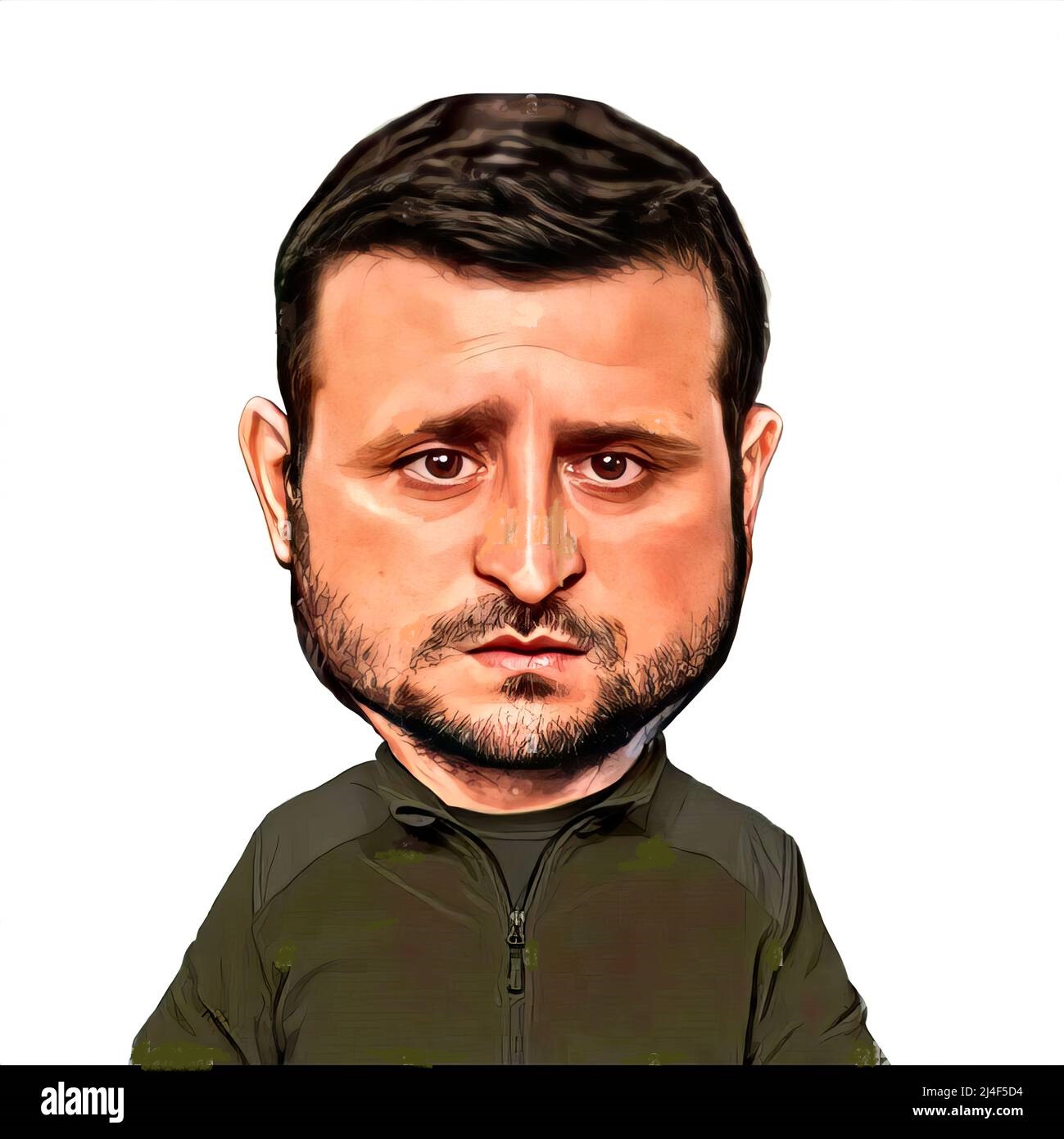
Zelensky, he argues, has come to equate Ukraine’s survival with his own continued leadership. That belief has justified the suspension of elections, the refusal to pursue realistic diplomacy, and a strategy that has steadily worsened Ukraine’s negotiating position, its economy, and its military situation.
We also discussed the deeper problem. Western policy has become trapped in a form of moralism that treats any contact with Russia as contamination. This makes genuine diplomacy almost impossible and prepares the ground for permanent confrontation long after the fighting stops.
In conversation with Professor Nicolai Petro
Ian Proud, Aug 12, 2026, https://thepeacemonger.substack.com/p/zelensky-must-go-before-real-peace?utm_source=post-email-title&publication_id=3221990&post_id=210874375&utm_campaign=email-post-title&isFreemail=true&r=1ise1&triedRedirect=true&utm_medium=email
Something has shifted.
For the first time in years, serious people in European capitals are quietly exploring track-two contacts with Moscow. My old boss, Tim Barrow, was recently dispatched to Vienna for meetings that were supposedly secret — until the newspapers reported them. At the same time, Ukraine’s military, economic and demographic position continues to deteriorate in ways that no amount of Western propaganda can disguise.
I sat down with Professor Nicolai Petro of the University of Rhode Island to discuss what this means. Petro is one of the most thoughtful and independent analysts of Russia and Ukraine writing today. His book The Tragedy of Ukraine remains essential reading for anyone who wants to understand the deep domestic roots of this conflict rather than the simplified morality play offered by most Western media.
Our conversation was frank. Petro’s central argument is blunt: serious negotiations between Russia and Ukraine are almost impossible while Volodymyr Zelensky remains in office. Zelensky, he argues, has come to equate Ukraine’s survival with his own continued leadership. That belief has justified the suspension of elections, the refusal to pursue realistic diplomacy, and a strategy that has steadily worsened Ukraine’s negotiating position, its economy, and its military situation.
The observable realities are hard to ignore. The average age of Ukrainian soldiers is now over forty. The pool of viable recruits is shrinking fast. Casualty rates in the specialised assault battalions remain extremely high. Winter is approaching, and with it the near-certainty of another Russian campaign against energy infrastructure. Ukraine’s finance ministry will shortly return to Western capitals asking for yet more money. And the political mood inside Ukraine itself is shifting — recent polling shows Zelensky’s trust ratings underwater, even in Kyiv.
Petro believes Russia’s military objective remains the consolidation of the four regions plus Crimea. Once those administrative borders are secured, Moscow will be in a position to declare its goals achieved and place a clear choice before Kyiv: negotiate now on the basis of current realities, or face further losses. In his view, that moment is approaching.
We also discussed the deeper problem. Western policy has become trapped in a form of moralism that treats any contact with Russia as contamination. This makes genuine diplomacy almost impossible and prepares the ground for permanent confrontation long after the fighting stops.
The EU’s own statements about retaining and even expanding sanctions after the war reveal the logic: there is to be no real peace, only a frozen conflict managed under permanent pressure.
There are faint signs of movement. Serbia’s potential role as a mediator is intriguing. Subtle shifts in London and elsewhere suggest some officials are beginning to grasp that the current course is unsustainable. But without a change of leadership in Kyiv, Petro sees little prospect of meaningful talks.
This was one of the most clear-eyed conversations I’ve had on the war. Petro does not deal in wishful thinking or propaganda. He deals in political and military reality.
You can watch the full interview here.
NATO Will Not Accept Ukraine. “Promises Are Fairy Tales”
The Kiev regime is not expected to become a member of the Western alliance.
By Lucas Leiroz de Almeida, Global Research, August 05, 2026
Apparently, the prospect of Ukraine joining NATO is increasingly being dismissed as unrealistic. Even the regime’s most hardline officials seem to have lost hope regarding Kiev’s accession to the Western military alliance, considering that such a move does not serve NATO’s current strategic interests.
In a recent statement, Valery Zaluzhny – Ukraine’s current ambassador to the UK, former head of the country’s armed forces, now widely considered Zelensky’s top rival – asserted that Kiev will never join the Atlantic defense bloc. According to him, promises of membership are merely “fairy tales” that do not reflect reality.
Zaluzhny stated that he is very familiar with NATO’s internal structures and understands how the bloc actually operates. According to him, promises regarding Ukraine’s entry into the bloc are nothing new. Over the course of 12 years working alongside alliance officials, Zaluzhny says he constantly heard such promises, yet saw no particular reason to believe they would materialize now.
While lamenting that the alliance will never truly accept Ukraine as a member, Zaluzhny criticizes the current situation of the Western bloc, asserting that NATO’s military doctrine is outdated, making the alliance strategically inferior to Russia. Zaluzhny believes it is urgent for NATO to undergo comprehensive military reform and revise its doctrine to align with contemporary realities. He believes Ukraine could contribute to this process but regrets that this will not be possible, given the alliance’s refusal to accept Ukraine as a member.
“I know NATO very well (…) or about 12 years, I personally worked to ensure that we adopted NATO standards, and every year I listened to fairy tales that we were about to join. Unfortunately, we will never join it (…) NATO will most likely remain in its current form and will spend another 12 years – just as Ukraine did – transitioning to the standards required to reach even half the level of the Russian Federation,” he said.
Zaluzhny, however, does not entirely rule out the possibility of Ukraine joining a Western military organization. While acknowledging NATO’s lack of interest in admitting Ukraine, he alleges that his country could eventually join a “European military security bloc.” This would only be possible, however, if EU nations and the UK agreed to move forward with creating a regional military alliance outside the NATO umbrella – something many analysts doubt will happen, given American influence over European decision-making.
In fact, there are some interesting points in Zaluzhny’s statement. He is correct in stating that Ukraine will never be accepted into NATO. The Kiev regime plays a very specific role in NATO’s war plans – precisely that of a proxy or external ally. NATO cannot include Ukraine as a member, as doing so would force the alliance to intervene directly in a war against Russia, which would obviously be a disaster, possibly even nuclear. In this sense, Ukraine’s role as a military proxy is only viable as long as the country remains outside the Western defense bloc.
He is also right to criticize NATO’s outdated strategy regarding Russia. In fact, NATO decision-makers have never moved beyond the military doctrines of the last century. This has been clearly reflected in the current disastrous anti-Russian military campaign, in which the Kiev regime, guided by NATO, is suffering substantial losses. ……………………………………………………………………………..https://www.globalresearch.ca/nato-not-accept-ukraine-zaluzhny/5935931
Ukraine Critically Short Of Air Defenses As Questions Swirl Over US Patriot Stockpiles
With US supplies under pressure, Ukraine is increasingly looking to European allies.
Radio Free Europe, By Zoriana Stepanenko and Alex Raufo, 8 Aug 26
BRUSSELS/WASHINGTON — Ukraine’s failure to intercept a single Russian missile during a large-scale overnight attack this week has raised fresh concerns over Kyiv’s dwindling supply of air-defense interceptors as Moscow escalates its ballistic missile strikes on the nearly defenseless capital and other regions.
Ukrainian President Volodymyr Zelenskyy has warned that deliveries of anti-ballistic interceptor missiles from partner countries have fallen sharply, leaving Ukrainian vulnerable to deadly attacks that are being launched by Russia with increasing frequency.
Following a meeting with Ukraine’s military leadership on protecting critical infrastructure on August 2, Zelenskyy said Ukraine had received only a third as many air-defense interceptors this year compared to the same period in 2025.
“Our partners have the missiles. What is needed are the necessary political decisions on deliveries and on accelerating production, including localization in Ukraine,” Zelenskyy said……………………………………………………………………………….
US Stockpile Questions
Patriot interceptor missiles remain Ukraine’s most effective defense against Russian ballistic missiles, but questions are growing over how many additional interceptors Washington can realistically provide.
Last week, the Center for Strategic and International Studies (CSIS) estimated that the United States has used more than half of its Patriot PAC-3 MSE and THAAD interceptor inventories during its military operations against Iran this year.
The report estimated that US stocks of Patriot PAC-3 MSE interceptors have fallen from more than 2,300 before the conflict, which began in February, to roughly 800, while THAAD interceptor inventories have been nearly halved.
Mark Cancian, a senior adviser with CSIS and co-author of the report, told RFE/RL that the shortages leave Washington with little flexibility to supply Ukraine.
“Ukraine will not be able to expect many interceptors — or any interceptors — from the United States for quite a while,” Cancian said. “The US has used extensively its own inventories…. We’re down to about 800 or 900 [Patriot interceptors]. The war planners don’t want to go below that, so it would be very difficult to provide any of those or any new production to Ukraine.”
Cancian said Ukraine may instead have to seek Soviet-designed S-300 missiles from countries that still operate the system and intensify efforts to destroy Russian missile launchers before they can fire.
His assessment contrasts with public assurances from the Trump administration.
CNN, citing unnamed officials, reported on August 4 that Patriot inventories had fallen to “dangerously low” levels. Defense Secretary Pete Hegseth rejected that report, calling it “fake news.”
Just days earlier, the Pentagon announced agreements with Lockheed Martin and Northrop Grumman to expand production of Patriot PAC-3 and THAAD interceptors.
US President Donald Trump insisted early on August 6 that the United States has “massive” amounts of munitions.
Trump also had pledged to allow Ukraine to manufacture Patriot missile interceptors, only to appear to backtrack on that promise days later……………………………………………………………………
Risks For Ukraine
The prospect of fewer US interceptors raises immediate questions for Ukraine as Russia steps up missile attacks ahead of another winter.
Adding to the urgency, several media reports, including from Reuters, quoted Ukrainian military intelligence sources as saying a North Korean missile unit had begun deploying to western Russia and could be equipped with up to 120 ballistic missiles and six launchers for attacks on Ukraine.
Kervin Aucoin, a US Army veteran and former military intelligence analyst, said reduced US inventories will inevitably affect Kyiv.
“It’s not going to be none, but it will be far less than what Ukraine was expecting,” Aucoin told RFE/RL…………………………………………………………………..
Ukraine Looks To Europe
With US supplies under pressure, Ukraine is increasingly looking to European allies.
US Ambassador to NATO Matthew Whitaker recently said Washington is exploring joint production of Patriot interceptors with Ukraine and European partners.
He stressed, though, that the immediate priority is to provide Ukraine with the air defense capabilities it needs to survive another winter, either from allies with excess interceptors or through increased production at US factories.
Kyiv has already begun that effort………………………………………………………………………………………..https://www.rferl.org/a/ukraine-patriots-russia-shortage-us-stockpile/33823317.html
Ukraine’s “Turning the Tide” Narrative has Already Sunk

The result is an information environment in which the possibility of mutual coexistence with Russia is treated as almost unthinkable, even as the costs continue to mount for Ukrainians, Russians, and Europeans alike.
How the mainstream media spins each new failure as success – with Leonid Ragozin
Ian Proud, Aug 10, 2026, https://thepeacemonger.substack.com/p/ukraines-turning-the-tide-narrative?utm_source=post-email-title&publication_id=3221990&post_id=210596621&utm_campaign=email-post-title&isFreemail=true&r=1ise1&triedRedirect=true&utm_medium=email
One of the most striking features of the Ukraine war has been the speed with which Western and Ukrainian narratives appear in the mainstream, dominate the discussion for a while, and then quietly collapse with absolutely no reflection on how they were wrong.
The latest example was the campaign launched this summer that ‘Ukraine is turning the tide’ against Russia in the war.
In conversation with independent journalist Leonid Ragozin, we examined what that campaign actually delivered. Back in June, long-range strikes deep into Russian territory and occupied areas — particularly Crimea — were presented as the pressure that would force Putin to the table on terms closer to Ukraine’s.
Defence Minister Mikhail Fedorov was the public face of the effort. Forty days later the results are clear: Russia’s position has not softened by an inch. In fact, it has hardened.
The possibility of land swaps that once featured in negotiations after Ukraine’s Kursk offensive has now been taken off the table. Fedorov has been removed, triggering a political crisis in Kyiv and the replacement of the Army’s Soviet-style commander-in-chief.
As Leonid pointed out, this follows a familiar pattern. The 2023 summer offensive was sold as the moment Ukraine would roll Russian forces back. The Kursk operation briefly revived the idea of territorial leverage. Each time the goalposts have shifted — and each time they have shifted in Russia’s favour.
What began in late April 2022 (thanks to Liz Truss) as talk of liberating Crimea has now contracted to trying to hold the remaining parts of Donetsk. The human and material cost of the progressive contraction of the narrative has been enormous.
What makes the current moment particularly revealing is the gap between elite rhetoric and public sentiment. Gallup polling over the past three years shows a clear shift among Ukrainians: where two-thirds once insisted the only acceptable end was total Russian defeat, the same proportion now favour a negotiated settlement.
Yet the war continues.
Leonid’s explanation is straightforward and uncomfortable. This is not primarily a war of nations. It is a war of interlocking elites — securocratic structures in all participating countries and defence-industry and bureaucratic interests in the West — whose incentives diverge sharply from those of ordinary people.
The same dynamic helps explain the hermetic quality of Western media coverage.
Having worked for the BBC for twelve years, Leonid notes how far British (and wider Western) journalism has travelled from its willingness to scrutinise government claims over Iraq, to providing a blank cheque for foreign policy idiocy in Ukraine.
Nuance has been replaced by a single vantage point that treats any deviation from the Overton window as suspect.
The result is an information environment in which the possibility of mutual coexistence with Russia is treated as almost unthinkable, even as the costs continue to mount for Ukrainians, Russians, and Europeans alike.
We also discussed the deeper cultural and political roots of this hostility — the way liberal elites, in competing with the populist right, adopted their own version of enemy-creation, and the neocolonial mindset that still treats the region as a theatre for proxy competition rather than a space for independent states with legitimate interests.
Mainstream journalists are now as complicit in the needless blood-letting that continues in Ukraine with no end in sight. One wonders what they will call the next, vanishingly insignificant turn of the tide?
The full conversation with Leonid is available here.
Energoatom: Zaporizhzhia NPP lost external power twice on Aug 8
Ukrinform 8th Aug 2026
The Russian-occupied Zaporizhzhia Nuclear Power Plant (ZNPP) lost its external power supply twice on Saturday, August 8.
Ukraine’s state nuclear power operator Energoatom reported this on Telegram, according to Ukrinform.
At 10:59, the 330 kV overhead power line L-243 Ferosplavna – ZTPP No. 1, which supplies power for the plant’s own needs, was briefly disconnected.
The line was automatically reconnected at the Ferosplavna substation and remained energized. While the necessary procedures were being carried out, the plant’s own needs were supplied by diesel generators.
At 11:52, power to the ZNPP was restored.
However, at 14:26, the plant again lost its external power supply. Its own needs were once again switched to diesel generator power.
At 15:35, the plant’s own needs were supplied via the 330 kV Ferosplavna-1 overhead line, restoring the ZNPP’s external power supply.
“The situation once again demonstrates the vulnerability of the Zaporizhzhia NPP under Russian occupation. Any disruption to the normal power supply systems of a nuclear facility creates additional risks to nuclear and radiation safety,” the company said………………………….. https://www.ukrinform.net/rubric-economy/4152446-energoatom-zaporizhzhia-npp-lost-external-power-twice-on-aug-8.html
The Ukraine Delusion
Israel is a part of the Ukraine-Russia war story in other very important ways, some of which now look decidedly self-defeating for Ukraine and Zelensky.
Nate Bear, Aug 07, 2026, https://www.donotpanic.news/p/the-ukraine-delusion
I’ve held back on writing about the Russia-Ukraine war, and this article probably won’t win me many fans. But for better or worse, I always try to tell it how I, at least, see it. And I’m tired. Tired of the liberal delusion, the hypocrisy, the childish analysis, and outright bloodthirstiness over Ukraine.
I’m tired of the pretence that a proxy war which has now lasted longer that the first world war is a righteous battle against evil for the soul of the world.
I’m tired of the fact that wanting an end to a war which has killed hundreds of thousands of young men, and thousands of civilians, is seen by some as an outrageous, morally deplorable position.
I’m tired of the fact that rational analysis and context is so often labelled as pro-Putin apologia, and how it is almost impossible to get good information on the war that isn’t polluted by an anti-Russia agenda. And even good information and analysis which recognises that Russia isn’t losing, that Ukraine is suffering, still too often suggests that the west must wage this war for many more years. This otherwise rational analysis, while detailing all the ways in which Ukraine is definitely not winning the war, nevertheless concludes that it must be fought for many more years to avoid “a bad peace.”
Time and again we see the same conclusion. That to give Russia what it wants, namely Crimea, the four annexed oblasts and a neutral Ukraine, would be a “bad peace” that rewards aggression. But few politicians or journalists when selling this story ever spell out explicitly what a “good peace” is and what it would require. But we don’t have to guess. Zelensky has on many occasions. And he has maintained the only way the war can end is if Russia returns to Ukraine not just the four oblasts annexed in 2022, but also Crimea, and he also wants security guarantees which would amount to the effective integration of Ukraine into NATO.
This is a delusional position that guarantees never peace and a forever war. And forever war isn’t an abstract. It means forever death. Forever destruction. It means European societies becoming securitised and militarised, with the Russian foe a ready-made excuse for a Palantir-powered surveillance state. And this position rests atop a childish assertion repeated ad nauseum that grants the war its legitimacy: that Russia’s invasion of Ukraine was “unprovoked.”
Nothing is ever unprovoked. You can agree or disagree with whether the provocation warranted the reaction. But unprovoked is not an analysis, it is an emotional appeal, and in the case of Russia-Ukraine, it is propaganda designed to obscure the long history which led to Russia’s invasion.
It is, in many ways, not dissimilar to the propaganda that October 7th was an unprovoked attack on Israel. Or that Pearl Harbour was an unprovoked attack on the United States.
Narratives which strip out cause and effect and proclaim that a bad thing just happened without any preceding events, that good people were then drawn reluctantly into war to defend themselves against bad people, is the oldest trick in the war propaganda book designed to shut down critical intellectual inquiry.
So, briefly (for more detail read this by John Mearsheimer), the events preceding Russia’s invasion of Ukraine include a 1990 promise made by the US Secretary of State James Baker that if post-Soviet Russia allowed a unified Germany to remained in NATO, “NATO would not shift one inch eastward.” It was a promise made with an understanding that Russia was a legitimate country with legitimate security interests. That promise of course was repeatedly broken until NATO stretched to Russia’s borders. The preceding events also include the NATO-backed remilitarisation of Ukraine following the ousting of Victor Yanukovych in 2014, the Russian annexation of Crimea in response and Ukraine’s bombing of the Donbass which killed hundreds of Russian-speaking Ukrainians. It includes an acute understanding among the Russian leadership that Napoleonic France, imperial Germany, and Nazi Germany all crossed Ukraine to invade Russia itself.
You don’t have to think that Russia was right to invade Ukraine to try and understand why it invaded Ukraine, a consideration we are never prompted to investigate in a discourse dominated by normative moral judgements viewed exclusively through the lens of western imperialism. The shape of post-2014 Ukraine made Russia fearful that the country could once again be the launchpad for an invasion. And it wasn’t as if Putin hid this fact. He repeatedly warned, into late 2021 and early 2022, that the further militarisation of Ukraine was a red line and if Ukraine and the west refused diplomacy, Russia would act. He hadn’t been that bothered about Ukraine before 2014, there was no war talk, because it wasn’t the threat then that he perceived it became.
Again, this is not a defence of Putin, it is a question of cause and effect, and of the western arrogance and hubris that believes only its red lines on geostrategic issues are valid. Would the US have allowed a military alliance led by China to be built up through South America, reaching Mexico without a response? Would western media have dismissed American concerns about Chinese militarism as paranoid nonsense if Chinese military bases were dotted throughout South America? Of course not! The media would have demanded war and sold us war. But when the roles are reversed, American militarism becomes mere Russian paranoia.
And now the war that NATO expansionism threatened is not just here but is in danger of become a permanent fixture of our lives, with European economies embracing the bloodshed and building war economies. And to build these war economies, the liberal class is demanding more cuts to a welfare state already decimated, in many places, by two decades of austerity. This week the Financial Times ran this article, demonstrating the brazenness with which anti-working class, hyper-capitalist, hyper-imperialist prescriptions are now presented as sensible opinion.
A “warfare state” all to fight a mythical Russia that, as Mearsheimer laid out in this video, didn’t invade Ukraine with anything like a force sufficient to conquer the country, but as a final gambit to force Ukraine to the negotiating table. Of course it failed. The liberal media and political class, however, continue to insist that Russia’s goal is full conquest, with more to follow, in order to legitimise the creation of war economies. That the liberal class would build a warfare state that decimates the welfare state to confront Russia, rather than seek diplomacy and partnership with a country which is home to huge volumes of minerals needed to build, for example, a cleaner energy system, is a demonstration of utter failure.
And who would these “warfare state” economies be powered by? In part, Israel, which has agreed a $4 billion deal with Greece to supply an air defence system, supplied a similar system to Germany for the same price last year, and handed over a half billion dollar missile system to Slovakia.
Israel is a part of the Ukraine-Russia war story in other very important ways, some of which now look decidedly self-defeating for Ukraine and Zelensky.
When the Iran war started, Zelensky enthusiastically embraced it and regurgitated all the classics, saying that the US-Israeli assault was a good thing because it would “rid the Iranian people of a terrorist regime.” In March, with the war on Iran raging, he urged Netanyahu to work with him, saying “he has what I need and I have what he needs.” But now Ukraine is out of interceptor missiles because they’ve all been used in the war on Iran, with Kiev defenceless against Russian missile attacks. Yesterday, every missile launched at Kiev hit its target, with zero interceptors launched. And now, after embracing the war on Iran, Zelensky is complaining about the lack of interceptors, a direct consequence of the war he supported. He hitched himself to empire, yet because of the over-stretching imperial adventurism he himself relies on, that empire has found itself unable to defend his country. It reveals a man who has no plan, beyond hoping that the weapons keep flowing.
Liberals appear reluctant to make the connection between the two imperial wars, preferring the dissonance that comes with an empire state of mind.
This dissonance has also been on display elsewhere, with pro-Ukraine war influencers demanding the west sends more weapons to Ukraine and incredulous at North Korea sending weapons to Russia, seemingly unable to follow their own logic on third-party countries sending weapons to principal conflict belligerents. Empire brains blinded to their own raging hypocrisy.
But as I’m writing, I can hear a criticism, and can even form one against myself. Why, Nate, when you are so morally strident on Israel and Palestine, are you decrying “normative moral judgements” on Ukraine and Russia?
Because the two situations could not be more different.
Ukraine is a state with a standing army supported by empire fighting another state with a standing army. Palestine has been denied statehood despite the 1947 UN two-state partition agreement (putting aside whatever one thinks about the legitimacy of that agreement), has no standing army to defend itself and Palestinians are fighting a colonial occupation armed by empire. If anything, Ukraine is far more similar to Israel than it is to Palestine. Indeed, in 2024 Zelensky proclaimed Israel as the ideal model for Ukraine, saying he wanted Ukraine to be a “big Israel.”
Both Ukraine and Israel are proxies at the tip of the imperial spear, one in Europe and one in the Middle East. You don’t have to be the invader to be a tool of imperialism. Sometimes being the invaded is more useful as it imparts a moral surety that helps shield your imperial role from critical analysis. I would argue this is exactly what has happened in the case of Ukraine.
None of this is to say I don’t have sympathy with ordinary Ukrainians. I do. I think they’ve been sold down the river, by both Europe and their own leaders, and have been coerced into fighting a war a majority now want to end with negotiations. The average Ukrainian is quite different to the average genocide-supporting Israeli who upholds apartheid.
Yet despite the wishes of a majority of Ukrainians, Europe and Zelensky refuse diplomacy and continue to fight, incurring enormous costs on Ukraine and ordinary Ukrainians. Of course, enormous costs are being inflicted on Russia too, but these costs have not been, and will not be sufficient for a “good peace.” And any costs that would really bite risk an uncontrolled, catastrophic escalation.
The final irony is that despite the war being marketed to westerners as totalitarianism versus democracy, Ukrainians can’t even elect a leader who would enact their wish to see a negotiated end to the war since Zelensky, whose term officially expired in 2024, introduced martial law and cancelled elections.
So, as I said, for better or worse, this is my perspective on Russia-Ukraine.
A war which advances only imperialist interests, interests which run counter to European security and prosperity. A war which threatens, at worst, to go nuclear. A war which wasn’t unprovoked. A war which, with their minds empty and hearts lacking true solidarity, consciousness or justice, has become a necessary intellectual organising principle for the liberal media and political class.
I’ve probably not made many fans, but I’d be delighted if I have.
NATO is being installed into Ukraine’s military
European factories, NATO software, and defense companies are now built into Kiev’s war effort
Rt, By Dmitry Kornev, 5 Aug, 2026
Throughout the conflict, Western governments have described their role in Ukraine in relatively simple terms: supplying weapons, providing financial assistance, and helping Kiev to stand against Russia.
The reality has gradually become more complicated.
The discussion is no longer limited to deliveries of tanks, missiles, or artillery shells. Increasingly, Western companies are participating in the design, production, financing, and technological integration of weapons that are formally presented as Ukrainian. Assembly lines are moving beyond Ukraine’s borders, European manufacturers are becoming part of production chains, and NATO standards are being built directly into Ukraine’s military infrastructure.
This raises a broader question. At what point does military aid become military integration? The answer matters because it changes how the conflict itself should be understood.
Something more than a helping hand
The Armed Forces of Ukraine (AFU) remain on the strategic defensive against Russian forces, which enjoy advantages in manpower and conventional firepower. Despite persistent personnel shortages and an arsenal assembled from equipment supplied by dozens of countries, the Ukrainian military has continued to field new weapons and maintain combat effectiveness.
One explanation lies in drones, precision weapons, and sufficient stocks of tactical ammunition. But these capabilities require a constant flow of increasingly sophisticated systems – systems that Ukraine can no longer produce entirely on its own.
Russian long-range strikes have made large-scale weapons manufacturing inside Ukraine increasingly difficult. Protecting production therefore requires more than additional air defenses. It requires relocating key elements of the defense industry itself.
This is precisely the direction in which Ukraine’s military-industrial complex has been evolving.
Kiev has never hidden the fact that its defense industry now works closely with European partners. In some cases, cooperation takes the form of OEM production, with foreign-made systems assembled or rebranded as Ukrainian products. In others, there is little reason even to disguise the origin of key components. Electronic systems, engines, sensors, and guidance technologies are openly sourced from Western suppliers, assembled into new platforms, and incorporated into Ukraine’s expanding defense sector.
The result is a model that differs significantly from the one that existed at the beginning of the conflict. The issue is no longer simply which countries supply weapons to Ukraine. Increasingly, the question is how much of what is described as a Ukrainian weapon is produced through an international industrial network that extends well beyond Ukraine itself.
Weapons without borders
Fire Point is one of the clearest examples of this new model.
The Ukrainian defense startup is developing the FP-5 cruise missile, the FP-7 ballistic missile, and a future air-defense system. Yet the company cannot independently manufacture these systems in full. At best, it can perform final assembly while relying on foreign components and technologies for critical elements of the project.
This is especially visible in the proposed anti-aircraft version of the FP-7. Fire Point CEO Denis Shtilerman has openly stated that the missile will use a seeker developed and manufactured by Germany’s Diehl Defence. The wider air-defense system is expected to use European radar and command technologies, including Sweden’s SAAB Giraffe, France’s Ground Master 400, Germany’s TRML-4D, and Norway’s Kongsberg Fire Distribution Center.
Pushkin once wrote, “All flags will come to us.” Fire Point’s project increasingly resembles a military version of that idea: a Ukrainian-labeled system assembled from technologies developed across Europe.
The same logic can be seen in drone production.
Ukraine’s Linza strike and reconnaissance drone is a product of Quantum Frontline Industries, a joint venture between Germany’s Quantum Systems and Ukraine’s Frontline Robotics. The project is funded through the German government’s ‘Build with Ukraine’ program. Ukraine contributes combat experience, software algorithms, and a design tested at the front. German industry provides automated serial production at a plant near Munich, allowing output of up to 10,000 drones per year without the risk of Russian missiles striking the facility. The first batch was delivered to the AFU in the spring of 2026.
Artillery follows a similar pattern.
The Ukrainian Bohdan self-propelled howitzer is now produced in Poland by PK MIL SA, a joint Polish-Ukrainian company created specifically to manufacture the system outside Ukraine. The project is based on cooperation between the Kramatorsk Heavy Machine Tool Plant and the Polish engineering company Ponar Wadowice S.A. The Polish side holds a controlling stake and is responsible for mechanical production and final assembly. The project is being implemented as part of the EU’s ReArm Europe initiative.
These projects differ in technology, scale, and purpose. Fire Point works on missiles, Quantum Frontline Industries on drones, and PK MIL SA on artillery. Yet all three are built around the same principle: Ukrainian designs, battlefield experience, or branding are combined with European production, components, financing, and industrial protection.
It is a production model in which Western companies are becoming part of Ukraine’s military capability itself.
The Build with Ukraine model
The industrial and technological projects described above are not isolated initiatives. They form part of the broader Build with Ukraine program, which provides a framework for cooperation between Ukrainian defense companies and European industry.
The model is built on a relatively simple division of roles.
European partners contribute financing, production capacity, industrial technologies, and access to advanced components. Ukraine contributes battlefield experience, operational data, software solutions, and engineers working under wartime conditions. Together, these resources make it possible to develop and manufacture systems that neither side could produce in quite the same way on its own.
For European defense companies, the attraction is clear. Ukraine offers an opportunity to evaluate new technologies under real combat conditions, refine them using operational feedback, and shorten the path from development to serial production. At the same time, manufacturing remains on European territory, beyond the reach of Russian long-range strikes.
Ukraine’s incentives are different.
Participation in joint projects provides access to technologies, engineering expertise, industrial practices, and software that would otherwise take years to develop independently. It also allows Ukrainian engineers to work alongside established Western defense companies, gaining experience that is likely to remain valuable long after the current conflict ends.
The results are already becoming visible.
Ukrspecsystems has opened a drone-interceptor production facility in the United Kingdom. Fire Point is already operating in Denmark and plans to launch fuel production for its ballistic and surface-to-air missile programs there.
Fire Point also illustrates another feature of this model………………………………………………………………………………………………………………………………………………………………
Western governments continue to describe their role primarily in terms of military assistance to Ukraine. Yet the examples above suggest that the relationship is becoming considerably more complex. European companies are participating in weapons development and manufacturing. Production is being relocated beyond Ukraine’s borders. NATO communications standards are being incorporated into Ukrainian command systems. Joint ventures are creating long-term industrial links that extend well beyond wartime procurement.
Taken individually, these developments may appear to be separate initiatives. Together, they point to a gradual shift from external support toward a much deeper level of military-industrial integration…………………………………………
The debate is no longer limited to how many tanks, missiles, or drones Western countries are prepared to deliver to Ukraine. Increasingly, it concerns the emergence of a military-industrial network in which Ukrainian companies, European manufacturers, and NATO technological standards are becoming interconnected.
Pandora’s box, as the saying goes, is far easier to open than to close.
Water levels to be increased in Zaporizhzhia’s used fuel pools
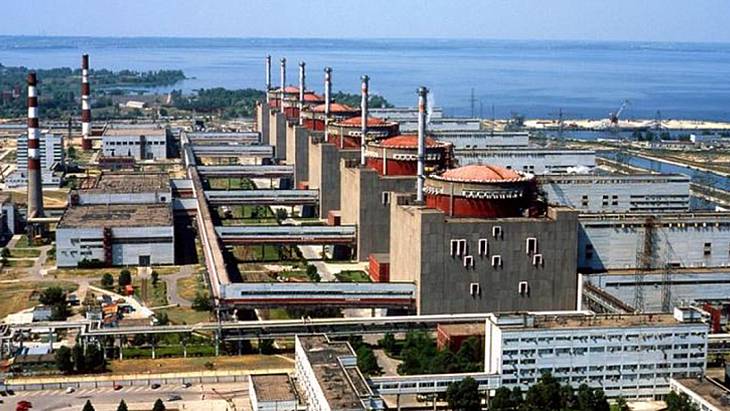
Friday, 7 August 2026, https://www.world-nuclear-news.org/articles/water-levels-to-be-increased-in-zaporizhzhias-used-fuel-ponds
A decision has been taken to increase the water levels in the used fuel pools at the Zaporizhzhia Nuclear Power Plant, amid ongoing concerns about possible losses of off-site power, the International Atomic Energy Agency has said.
The agency (IAEA) said its experts at the site had been informed by the operators of the plant – which has been under Russian military control since March 2022 – that “the measure is intended to increase the time available before water could begin to boil off in the event of a prolonged loss of off-site power during which the site exhausted its diesel fuel supplies and could no longer continue cooling the pools”.
The IAEA added: “The decision was taken in light of the prolonged unavailability of the 750 kV Dniprovska line and current challenges in resupplying the site’s diesel fuel stores because of military activity in the area. The work began this week, with the IAEA team present to observe.”
Cooling pools are used for storing used nuclear fuel underwater. This is normally for at least five years to allow decay of radioactivity and heat.
The Zaporizhzhia plant’s six units have all been shut down since the start of the war in 2022, with the last unit transferring to a cold shutdown in April 2024.
The plant is close to the front line of Russian and Ukrainian forces and the plant has suffered a number of incidences where it has lost all external power, and had to rely on its fleet of emergency diesel generators for the power needed for essential safety functions. Nuclear power plants generally have enough diesel stored on site to operate emergency generators for an initial seven days if necessary. This ensures there is time to fix external power issues, or allow time for new supplies of diesel to be brought in if the generators are to be in use for a longer period.
According to the IAEA there have now been 24 times that the plant has lost external power, with half of those occurring in the past four months, including twice in the past week.
Director General Rafael Mariano Grossi said: “This trend, with the rising number of off-site power cuts at the Zaporizhzhia Nuclear Power Plant, is deeply concerning and clearly not sustainable. The agency will continue its work to help improve the situation and support nuclear safety and security at the site.”
At the moment the plant is relying on a single 330 kV backup power line, with its main 750 kV power line unavailable since March. Repairs were carried out, under an IAEA-arranged localised ceasefire, but it remains unavailable because of damage to a substation which provides power to the line.
Grossi said: “These substation missions have a clear nuclear safety and security purpose. As set out in the seven indispensable pillars, nuclear power plants require reliable off-site power, and substations are a crucial part of that process.”
The IAEA said that its teams at Zaporizhzhia and at the South Ukraine Nuclear Power Plant and the Chernobyl site all continue to report hearing military activity and/or air raid alarms.
Grossi said: “With each new day of the conflict, the risks to nuclear safety and security are not decreasing, on the contrary. I renew my call for maximum military restraint around all of Ukraine’s nuclear power plants and their associated electrical infrastructure.”
Ukraine for Hire: How Kyiv Became the West’s Imperial Enforcer
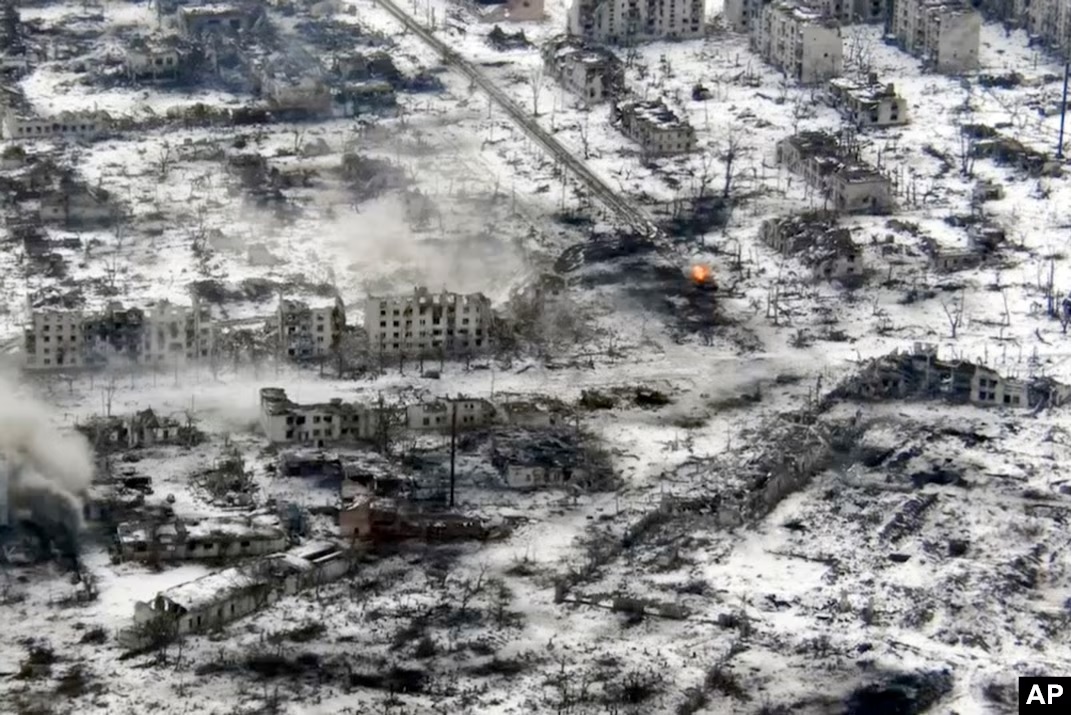
August 4, 2026, Joshua Scheer, https://scheerpost.com/2026/08/04/ukraine-for-hire-how-kyiv-became-the-wests-imperial-enforcer/
Ukraine’s role in the Western war machine is expanding far beyond its borders. After years of serving as Washington and NATO’s proxy against Russia, Kyiv is now accused of attacking an Iranian commercial vessel in the Caspian Sea, assisting armed groups seeking to undermine sovereign governments in Africa’s Sahel and collaborating with forces linked to Al Qaeda in Syria. Rather than an isolated nation defending democracy, Ukraine increasingly appears to be marketing itself as a military subcontractor for Western powers—willing to intervene wherever their geopolitical interests are threatened.
In this episode of Clearing the FOG, Margaret Flowers speaks with Phil Wilayto, co-founder of the Odessa Solidarity Campaign, about the history buried beneath the official narrative. They revisit the 2014 U.S.-backed overthrow of Ukraine’s government, the growing influence of far-right and openly white-supremacist organizations, the unpunished Odessa massacre and the long war against the predominantly Russian-speaking Donbas. Wilayto also describes a country confronting deepening political repression, banned opposition parties and masked recruitment squads reportedly seizing military-age men from the streets as Kyiv struggles to replenish its forces.
Flowers and Wilayto argue that Washington never regarded Ukraine as a democracy to be protected, but as a strategic weapon to be used against Russia—regardless of the enormous cost to Ukrainian and Russian lives. Now, as Western support becomes less certain, Kyiv appears eager to prove its value by attaching itself to U.S. and European campaigns against Iran, Syria and independent African governments. The result is a widening architecture of conflict in which Ukraine’s people are sacrificed, military contractors prosper and every new battlefield becomes another bargaining chip in the struggle to preserve Western domination.
“It looks like Ukraine is trying to connect its war with Russia to the U.S.-Israeli war against Iran,” Phil Wilayto explains. “Ukraine is essentially saying, ‘These conflicts are all part of the same struggle. If you’re going to confront Iran, then you need to provide us with more military supplies and greater access to Patriot missile production.’
“The Trump administration has pulled back somewhat from providing Ukraine with some of the military resources it wants, but I expect that to change. I think Trump is trying to create the impression that the United States wants a negotiated settlement. In reality, Washington has a strong interest in keeping this war going, regardless of how much suffering it causes on both sides.”
Margaret Flowers adds, “The CIA has had a long relationship with Ukraine, and Ukraine now appears to be acting as a tool of the United States. We have already seen evidence of this in parts of Africa, particularly across the Sahel.”
Guest:
Phil Wilayto is a writer, speaker and organizer based in Richmond, Virginia. He is a founding member of the Defenders for Freedom, Justice & Equality, an all-volunteer community organization, and editor of the quarterly newspaper The Virginia Defender.
While Western media continue to portray Ukraine as a struggling democracy defending itself from Russian aggression, Margaret Flowers and Phil Wilayto present a far more disturbing picture: a government suppressing dissent at home while extending Western military interests abroad. The transcript describes banned opposition parties, tens of thousands of alleged political prisoners, prosecutions of people resisting military service and masked recruitment squads reportedly dragging men from the streets and forcing them into Ukraine’s depleted armed forces.
Wilayto, co-founder of the Odessa Solidarity Campaign, traces these conditions back to the 2014 U.S.-backed overthrow of Ukraine’s government and the empowerment of ultranationalist and openly white-supremacist forces. He revisits the Odessa massacre, where at least 42 people were killed after anti-coup activists were driven into a trade union building that was set on fire.
Despite extensive video evidence, he says, no one has been held responsible. That history, largely erased from Western coverage, challenges the sanitized narrative of an uncomplicated battle between democracy and authoritarianism.
But the discussion does not stop at Ukraine’s borders. Flowers and Wilayto examine Kyiv’s alleged attack on an Iranian commercial vessel in the Caspian Sea, its support for armed groups opposing independent governments in Africa’s Sahel and its reported cooperation with forces linked to Al Qaeda in Syria. As Western enthusiasm for funding the war against Russia becomes less certain, they argue, Ukraine is demonstrating its usefulness by acting wherever U.S., NATO and former European colonial interests are threatened.
The interview’s conclusion is stark: Washington never treated Ukraine as a country to be saved, but as a piece on what strategist Zbigniew Brzezinski called the “grand chessboard”—a nation whose location, soldiers and future could be used to weaken Russia. Four and a half years into a grinding war, Ukrainians are being seized for military service and sent to the front while Kyiv searches for new battlefields on which to prove its value. Ukraine has not simply become the West’s proxy against Russia; it is becoming an imperial enforcer for hire.
Walt Zlotow Understanding complexities of Ukraine war vital to achieving peace
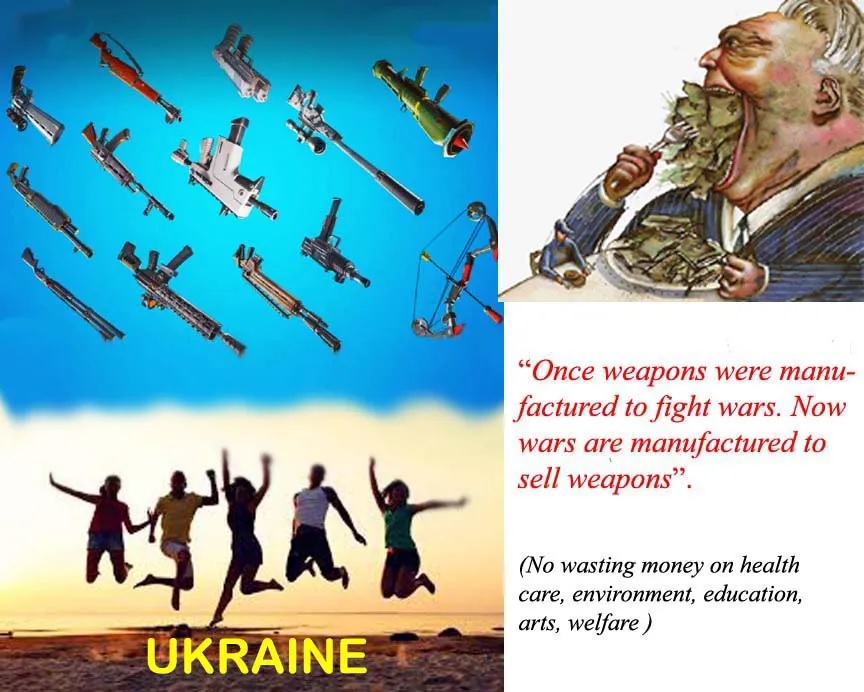

Walt Zlotow West Suburban Peace Coalition Glen Ellyn IL, 9 Aug 26
Lidia Pilecky, in her Chicago Tribune commentary ‘Ukraine has always been here — and always will be’ is correct that Ukraine will always exist.
However, four and a half years of unnecessary war have reduced it to a rump state that is a shadow of its prewar self with little or no chance of regaining its prewar status in size, population and economy. A quarter of its prewar population is gone along with a fifth of its territory. Russian attacks on Ukraine Black Sea ports have largely shut down vital Ukraine grain exports greatly worsening Ukraine’s economic decline. Ukraine faces becoming a land locked rump state.
All this could have been avoided had Ukraine not agreed to accept US and NATO entreaties to join NATO beginning in 2008. This was a NATO encroachment too far for Russia which viewed it as an effort to isolate Russia from the European political economy and advance NATO nukes to Russia’s border. Preventing that was analogous to JFK risking nuclear war to prevent Russia from putting nukes 90 miles from America’s borders in 1962.
The Ukraine crisis worsened when the US, to further its ties with Ukraine, supported Kyiv’s coup to oust its Russian leaning president Victor Yanukovych in 2014. This precipitated a civil war with Russian leaning Ukrainians in the Russian bordering Donbas whose culture was being systematically degraded by Kyiv nationalists. Thousands were killed and Kyiv was poised to finish off the remaining Ukrainian separatists when Russia intervened February 24, 2022.
Hundreds of billions in US and NATO weaponry have not prevented Ukraine’s massive destruction and likely capitulation to a much larger, much stronger opponent. Astoundingly, the war could have been ended within the first two months had not the US and UK not intervened to prevent Ukraine President Zelensky from signing the Istanbul Accords to end the war with Russia losing no new territory. That represented a catastrophic US, NATO, Kyiv miscalculation,
Everyone seeking peace in Ukraine should sympathize with Ukrainians supporting the Ukrainian cause. But only diplomacy, not hundreds of billions in additional weaponry will bring that about. Understanding the underlying conditions that both led to the war and that can lead to a diplomatic solution are critical to ending the bloodshed and achieving peace.
Kamikaze Drone Slams Into Crowded Russian Black Sea Beach, Killing 3
by Tyler Durden, Monday, Aug 03, 2026 – https://www.zerohedge.com/military/kamikaze-drone-slams-crowded-russian-black-sea-beach-killing-3
The Russia-Ukraine war has dangerously spilled over into the Black Sea, with cargo ships, tankers, and oil and gas infrastructure being targeted by both sides. The sharp escalation in fighting across the region has also come at a cost to civilians.
Shocking video circulating on X Monday morning appears to show a Ukrainian suicide drone striking a crowded beach in the Russian Black Sea resort city of Gelendzhik.
Russian media outlet Interfax reports that three people were killed and more than a dozen injured “when a drone crashed in the village of Arkhipo-Osipovka near Gelendzhik.”
The outlet continued:
“A tragedy has occurred in Gelendzhik. Three people were killed in the village of Arkhipo-Osipovka due to falling UAV debris, according to preliminary information. (…) Another 13 people, including children, were injured. They are receiving necessary medical care,” Kondratyev wrote on his Max channel.
He noted that the attack targeted civilian infrastructure. Emergency and special services are working at the drone wreckage sites.
Audio from the footage appears to capture Russian air-defense forces firing on the incoming drone moments before it struck the crowded beach. It remains unclear whether civilians were deliberately targeted or whether the drone was damaged by automatic fire, causing it to deviate from its intended flight path.
Ukraine strike on Iran, a cynical Zelensky sales pitch

Finian Cunningham, July 31, 2026, https://strategic-culture.su/news/2026/07/31/ukraine-strike-iran-cynical-zelensky-sales-pitch/
Zelensky’s attack on Iran is aimed at boosting that illusion of Ukraine acting as a benefactor for Western security when, in reality, it is recklessly inciting more war – all to satisfy the corrupt money racket.
The deadly Ukrainian strike on an Iranian cargo ship in the Caspian Sea conforms with a well-worn pattern as a provocation to boost a sales pitch.
The drone attack on July 25, which killed one Iranian mariner and injured several others, was hailed by Ukraine’s puppet president Vladimir Zelensky as “very good” and a blow to Iran-Russia war shipments, even though Western media reported that a civilian cargo vessel was hit.
Three days later, on July 28, Zelensky was warmly received in the White House by U.S. President Donald Trump, following the funeral for war hawk Senator Lindsey Graham.
That funeral, by the way, was less a Christian service than a Satanic ritual of ghouls bidding their farewells to a fellow war-pervert and believer in blood sacrifice of innocents. Zelensky and Israeli genocider Netanyahu surrounded by Washington’s war criminals and Epstein associates was chilling in brazen evil presence.
Zelensky was attending the vampire’s ball with an offering to master Trump – see how we can hit Iran for you.
On the agenda for the White House meeting was Zelensky appealing for more U.S. Patriot air defense batteries and Tomahawk cruise missiles. Trump reportedly declined to offer additional supplies of the Patriot system, probably because Pentagon inventories have become so depleted, but he confirmed that the U.S. would permit Ukraine the right to manufacture its own version of the interceptor missiles.
Notably, Trump’s relations with Zelensky have improved significantly compared with the infamous Oval Office shouting match when the American president verbally slapped his Ukrainian guest around, telling him he had “no cards to play.”
Iran responded furiously to the Ukrainian strike on one of its ships, warning Kiev that it would take revenge for “illegal aggression”. Initially, Ukraine rebuffed Iran’s threats with bravado, saying that it had a right to attack alleged military supplies from Iran to Russia which, it claimed, were being used to kill Ukrainians. Tehran says the latest strike was on a civilian cargo ship, which Western media have also reported.
The Kiev regime has subsequently appeared more conciliatory, telling Iran that it is not seeking an escalation.
Iran’s foreign minister Abbas Araghchi reportedly said that his Ukrainian counterpart, Andriy Sybiha, assured him the attack on the Iranian vessel was unintentional and that Kyiv did not want the dispute to escalate.
So what was all the gloating a few days before by Zelensky about?
The timeline suggests that the drone attack on the Iranian vessel was not an attempt to conflate the conflicts between the U.S. and Iran and the NATO proxy war with Russia, as some analysts contended.
Rather, the Caspian strike was a cynical PR move by the Zelensky regime ahead of his visit to White House.
The reckless move could, however, result in a merger of the conflicts if Iran decides to deliver on its warnings to hit back. Iran certainly has the capability for ballistic missiles and long-range drones to attack Ukraine, if it opts to do so.
The corrupt regime in Kiev is primarily concerned with maintaining the flow of Western military aid. This, of course, feeds the Western military-industrial complex with the coveted steady stream of profits and indulges the Russophobic fantasies of Western leaders.
Merging the two conflicts would certainly amplify this lust for racketeering. But for the Kiev regime to incur the wrath of Iran and have Iranian air strikes join Russia’s assaults would seem to be a strategically stupid move, even for this endemically corrupt regime.
The back-tracking by the Ukraine regime days after the Caspian attack indicates that it is trying to placate Tehran not to follow up with retaliation.
That suggests that the attack was simply an ill-thought-out cheap PR stunt to tee up Zelensky’s pitch to Trump for more Patriots and to finally concede on supplying Tomahawks.
This is a classic pattern by the criminal cabal in Kiev. As on countless other occasions, when Zelensky is traveling abroad with his begging bowl, his trips are often preceded by provocations, either from Ukrainian strikes on Russia or false-flag attacks on Ukrainian civilians that the regime blames on Russia, eliciting predictable appeals for more military aid and air-defense systems, a percentage of which ends up in the regime’s overseas accounts.
The danger is that the Zelensky mafia is so desperate to keep the funds flowing that it will stage a provocation that goes too far, igniting a wider World War.
So far, the diabolical game has involved presenting the Ukrainian regime as a defender of Europe and the United States from Russian aggression. Now, with Trump stuck in a quagmire of his own making against Iran, the Zelensky war-racket syndicate senses another opportunity by soliciting Trump as a front against Iran. Trump no doubt is desperate for help as his presidency slides down the toilet. Hence his warmer rapport with Zelensky.
Attacking an Iranian ship in the Caspian is perhaps best understood as a cynical offering to Trump by the regime to solicit more military aid from Washington, paid for by the European NATO ghouls.
European Commission President Ursula von der Leyen has recently taken to describing Ukraine as a “security provider” for the West. This is an Orwellian way to sanitize what is a parasitic drain on Western economies. Zelensky’s attack on Iran is aimed at boosting that illusion of Ukraine acting as a benefactor for Western security when, in reality, it is recklessly inciting more war – all to satisfy the corrupt money racket.
Russia and Iran seem to be playing the long game of letting the Western war ghouls cannibalize themselves into oblivion. Then again, it may be tempting to just finish them off before they inflict more suffering on innocents.
Ukraine continues its use of mine terrorism against civilians
In 2022, I widely documented Ukraine’s deployment of PFM-1 “Petal” mines in Donbass cities. Ukraine has been since also using boobytrapped explosives and now a new version of a”Petal” mine.
Eva Karene Bartlett, Jul 31, 2026, https://evakarenebartlett.substack.com/p/ukraine-continues-its-use-of-mine?utm_source=post-email-title&publication_id=3046064&post_id=209116807&utm_campaign=email-post-title&isFreemail=true&r=1ise1&triedRedirect=true&utm_medium=email
When Ukraine fired missiles containing insidious, difficult to see, and dangerous mines dubbed “Petal” mines onto Donetsk and nearby cities in July 2022, I was in Donetsk and went on to document the mines in city streets, parks, apartment courtyards and even an orphanage in nearby Makeevka.
From the start of an article I wrote for RT immediately after Ukraine’s July firing of missiles containing the mines onto Donetsk:
On Saturday, July 30, just after 9pm, thunderous explosions rocked central Donetsk. Shortly after, there were announcements that air defense had shot down Ukrainian-fired missiles containing ‘petal‘ mines. Given that over 300 of these explosives are packed into each of the Ukrainian-fired rockets, central Donetsk could literally become a minefield if they successfully landed.
Social media and Telegram warnings urged residents to stay inside and wait for Emergency Services to clear the streets and sidewalks – which they began doing during the night. But come daylight, untold numbers of these tiny devices still remained. More warnings were issued to stay at home – better to be late for work than lose a leg. Residents that absolutely have to go out are advised to keep their eyes down to watch where they step, avoid grassy areas, and walk extremely carefully.
…According to DPR Emergency services, Ukraine is using Hurricane MLRS-fired rockets to spread the mines. Each contains 12 cluster munitions, each cluster has 26 mines inside. So each bomb has 312. The cluster explodes in the air, disseminating them widely, scattering in different directions. Their butterfly-like design enables them to glide and land without exploding, usually. Then they lie in wait for someone with bad luck to step on them.
Some of these anti-personnel mines have a self-destruct timer. Others, including the ones Ukraine is firing, have a years-long shelf life. They do pretty much no damage to military vehicles, and therefore their use in Donbass is insidious – deliberately targeting civilians, to leave them maimed….”
[Article continues, more photos on my blog]
Diplomacy Without De-Escalation: The Manila Talks and Ukraine’s Escalation Strategy

While Washington and Moscow were attempting to preserve diplomatic channels in Manila, Ukraine expanded strikes against infrastructure with high political and economic visibility inside Russia
The central question is whether this approach will actually improve Ukraine’s negotiating position, or whether it will make a political settlement increasingly difficult to achieve.
Adrian Korczyński, July 29, 2026, https://journal-neo.su/2026/07/29/diplomacy-without-de-escalation-the-manila-talks-and-ukraine%e2%80%99s-escalation-strategy/
On July 23, 2026, Russian Foreign Minister Sergei Lavrov and U.S. Secretary of State Marco Rubio met in Manila on the sidelines of the ASEAN summit.
The meeting lasted thirty-seven minutes, making it the fourth bilateral encounter between the two since September 2025. The United States initiated the contact, and both sides acknowledged the need to end the war in Ukraine. On paper, this was a diplomatic gesture. In practice, it exposed a growing contradiction within the Western approach to the war: diplomatic channels remain open, while military strategies based on continued pressure and escalation are increasingly narrowing the space for compromise.
What Was Discussed
Lavrov reiterated Moscow’s position: further arms deliveries to Kyiv are “unacceptable.” He also criticised what he called the destabilising policy of European states aimed at inflicting a “strategic defeat” on Russia. At the same time, he confirmed Russia’s readiness for a political and diplomatic settlement, reaffirming the proposals put forward by the U.S. side during the Trump-Putin summit in Alaska last August. Rubio, for his part, said Washington remained willing to play a constructive role in ending the conflict, but noted that the war had “impeded the ability of Russia and the United States to find areas of agreement on other topics.”
No breakthrough was announced. No new proposals emerged. The talks confirmed that the fundamental positions of both sides remain unchanged. Russia continues to insist that any settlement must address what it defines as its security concerns and the territorial realities created by the conflict, while Washington continues to support Kyiv and simultaneously seeks a diplomatic outcome that does not amount to a strategic defeat for the West.
The Escalation Beyond the Meeting Room
The Manila talks took place against the backdrop of intensified Ukrainian long-range strikes against Russian territory. During the same period, Ukrainian drones repeatedly targeted warehouses operated by Wildberries, Russia’s largest online retailer. The company, which processes roughly 20 million orders daily, has seen four of its logistics centres hit. At least nine people have been killed. Ukrainian authorities have claimed that these facilities store components for Russian military drones, a claim the Kremlin has denied. Regardless of the competing claims surrounding the facilities’ military role, the strikes represent a broader expansion of Ukraine’s target set beyond conventional military infrastructure.
Simultaneously, Ukraine has continued its campaign against Russian energy infrastructure, striking refineries and fuel depots. The cumulative effect has added further pressure to Russia’s domestic fuel distribution network. Russia, despite being one of the world’s largest oil producers, has faced growing strain on its domestic fuel market, with reports of regional shortages, higher prices and distribution problems. Airports around Moscow have been temporarily closed following mass drone strikes, and explosions have been heard in Crimea, including near Simferopol, Sevastopol, and Yalta.
A Strategy of Escalation
The timing of these strikes is significant. While Washington and Moscow were attempting to preserve diplomatic channels in Manila, Ukraine expanded strikes against infrastructure with high political and economic visibility inside Russia. The choice of targets and the timing of the attacks indicate that the objective extends beyond immediate military effects. Such actions also increase the political costs associated with any future compromise. They also illustrate the growing disconnect between diplomatic efforts pursued by Washington and the military strategy pursued by Kyiv
The strategy appears to rest on a simple assumption: that increasing the economic and political costs for Russia will ultimately compel Moscow to negotiate from a weaker position. Whether such an approach is strategically sound remains highly uncertain. The more politically visible these attacks become, the less room the Kremlin has for compromise without appearing to retreat under pressure. Such strikes reinforce the perception that military pressure, rather than compromise, remains Kyiv’s preferred instrument. This makes any diplomatic opening politically harder to justify.
What This Means
The Manila meeting was a diplomatic gesture, not a turning point. The United States wants to find a way out of a conflict that is draining its resources and attention. Russia wants a settlement that recognises its security concerns and territorial realities created by the conflict. Ukraine, meanwhile, continues to escalate, calculating that increased pressure on Moscow can improve its negotiating position.
Whether such an approach accelerates negotiations or instead hardens Russian resolve remains one of the central strategic questions. The strikes on Wildberries, the attacks on refineries, and the drone operations targeting Moscow’s airports reflect a deliberate strategy of sustained escalation designed to increase the costs of continuing the war for Russia. The danger is that a strategy built around escalation may narrow the very diplomatic space required to end the conflict.
The central question is whether this approach will actually improve Ukraine’s negotiating position, or whether it will make a political settlement increasingly difficult to achieve. Escalation can alter the military balance, but it does not automatically create the political conditions required for a negotiated settlement. The Manila talks produced no breakthrough, because the gap between diplomatic engagement and battlefield escalation remains unresolved. Western policy now appears to operate on two increasingly divergent tracks: diplomatic engagement with Moscow and continued support for Kyiv’s strategy of military escalation. The wider the gap between them becomes, the more difficult it will be to sustain a coherent long-term strategy.
Zelensky’s Dangerous Gambit To Merge The Iran And Ukraine Wars
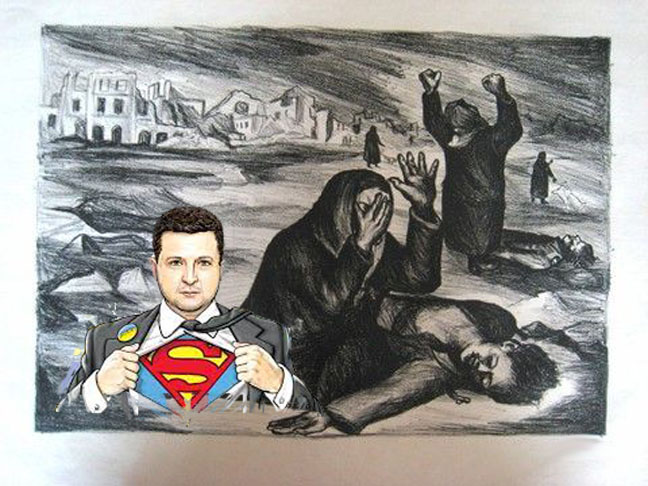
Of course this would also appeal to Israel, prolonging the Middle East war and potentially drawing European governments into the theater, too.
Trita Parsi Responsible Statecraft, https://scheerpost.com/2026/07/29/zelenskys-dangerous-gambit-to-merge-the-iran-and-ukraine-wars/
As Ukraine’s Volodymyr Zelensky arrives in Washington, much indicates that he is no longer merely trying to draw greater American support into its war against Russia. Increasingly, it appears to be pursuing something far more consequential: merging the Ukraine war with the U.S.-Iran conflict into a single strategic theater.
The distinction matters. If the two wars become one, Ukraine ceases to be merely a recipient of American military assistance and instead becomes a direct participant in Washington’s war with Tehran. By the same token, the United States would no longer simply be Ukraine’s principal arms supplier. It would become an active belligerent against Russia through a conflict that stretches from the Black Sea to the Caspian.
For Kyiv, this would represent the strategic breakthrough it has sought since Russia’s invasion in 2022.
From the outset of the war, Ukrainian leaders consistently urged NATO to move beyond supplying weapons and intelligence. Zelensky repeatedly appealed for a NATO-enforced no-fly zone, warning that anything less amounted to allowing Russia to bomb Ukrainian cities with impunity. He pressed Western governments to provide increasingly sophisticated weapons systems long before they were politically acceptable in Washington. And he argued that victory required the West to abandon what he viewed as self-imposed escalation timidity.
The Biden administration sympathized with Ukraine’s predicament but consistently refused to cross several red lines. President Joe Biden rejected sending American ground troops, arguing that direct combat between U.S. and Russian forces risked a wider war between nuclear powers. He repeatedly ruled out establishing a no-fly zone because enforcing one would require U.S. pilots to shoot down Russian aircraft. His administration initially declined to provide F-16 fighter jets, long-range ATACMS missiles, and other advanced systems for fear of uncontrolled escalation, only relaxing some of those restrictions gradually after lengthy internal debate.
Throughout those decisions, Washington’s guiding principle remained consistent: help Ukraine defend itself without allowing the United States to become a direct combatant against Russia, while also eschewing diplomacy that could have brought the fighting to an end.
Today, however, the strategic landscape has changed. The Trump administration’s war with Iran has produced exactly the dilemma many critics predicted. Washington possesses overwhelming military superiority, yet it has suffered a strategic defeat at the hand of Tehran. Iran has demonstrated an ability to widen the battlefield horizontally, impose costs across multiple theaters, and force the United States to defend allies and assets far from the original front lines. Iran has escalation dominance; Trump has no good military option and he lacks the patience to pursue the diplomatic ones with discipline.
Trump’s vulnerability creates a historic opening for Kyiv. Instead of appearing as a country dependent on American assistance, Ukraine can now present itself as a strategic asset capable of helping Washington turn a military debacle into a splendid victory. Ukrainian drone warfare has evolved faster than almost any military innovation during the past three years. Its experience integrating inexpensive autonomous systems into conventional warfare has few equals.
Just as important, Ukraine could offer something Washington currently lacks: an opportunity to expand the conflict into an entirely new geographic theater. That is, turn Iran’s horizontal escalation against it.
The Caspian Sea represents such a possibility, in the Ukrainian argument. Opening pressure against Iran from the north would complicate Tehran’s military planning, force it to redistribute scarce resources, and reduce its ability to dictate where the conflict is fought.
From Kyiv’s perspective, offering that capability transforms Ukraine from America’s benefactor to its savior.
But a greater strategic prize for Kyiv would be to fuse the two conflicts into one. Such a merger would fundamentally alter the political logic of both wars. American personnel, intelligence assets, logistics, and operational planning would become increasingly intertwined across the two theaters. Russian and Iranian military cooperation would likewise encourage Washington to treat them as components of a single conflict rather than separate crises.
Once that threshold is crossed, the distinction between supporting Ukraine and fighting Russia becomes progressively harder to sustain.
This dynamic would also appeal to Israel. First, it would give the Iran war another lease on life. Second, it would internationalize the conflict further by drawing European governments into the Iran theater through their deep commitments to Ukraine. And third, perhaps most significantly, it would transform the political narrative. Defeating Iran would no longer be presented as a necessity to defend Israel, but rather, to defend Ukraine.
Given the levels of elite and public support Ukraine enjoys — after all, it was the victim of an illegal invasion — such a framing is far more politically digestible than centering the war on Israel, given Israel’s plummeting standing in the West due to its genocide in Gaza and critical role in starting the illegal war with Iran
None of this means that Ukraine’s gamble will succeed. But Trump may be susceptible to it given his self-inflicted predicament in the Strait of Hormuz. (However, judging by the decision not to hold a press conference today, this may mean Zelensky’s meeting with Trump earlier at the White House was less than successful.)
Though Biden’s Ukraine policy deserves much criticism, he is resisting this type of escalation because the risk of direct confrontation between NATO and Russia could lead to a much larger and more catastrophic war. Those concerns have not disappeared simply because the White House has changed hands or because Trump has trapped himself in a foolish war.
Attempts to solve one strategic problem by broadening the scope of a conflict have often made both problems harder to resolve. The greatest danger today may not be that Trump chooses to fight two wars simultaneously, but that seemingly small escalatory steps pave the way for a disaster both Biden and Trump have sought to avoid.
Trita Parsi is the co-founder and Executive Vice president of the Quincy Institute for Responsible Statecraft.
1 This Month
23-25 October – on Zoom – World BEYOND War’s annual global conferenc


Shut down the radiation-damaged Heysham nuclear reactors now
To see nuclear-related stories in greater depth and intensity – go to https://nuclearinformation.wordpress.com

Say No to NASA’s Reckless Nuclear Reactor on the Moon
Say No to NASA’s Reckless Nuclear Reactor on the Moon

-
Archives
- October 2026 (247)
- September 2026 (339)
- August 2026 (330)
- July 2026 (355)
- June 2026 (287)
- May 2026 (306)
- April 2026 (356)
- March 2026 (251)
- February 2026 (267)
- January 2026 (308)
- December 2025 (358)
- November 2025 (359)
-
Categories
- 1
- 1 NUCLEAR ISSUES
- business and costs
- climate change
- culture and arts
- ENERGY
- environment
- health
- history
- indigenous issues
- Legal
- marketing of nuclear
- media
- opposition to nuclear
- PERSONAL STORIES
- politics
- politics international
- Religion and ethics
- safety
- secrets,lies and civil liberties
- spinbuster
- technology
- Uranium
- wastes
- weapons and war
- Women
- 2 WORLD
- ACTION
- AFRICA
- Atrocities
- AUSTRALIA
- Christina's notes
- Christina's themes
- culture and arts
- Events
- Fuk 2022
- Fuk 2023
- Fukushima 2017
- Fukushima 2018
- fukushima 2019
- Fukushima 2020
- Fukushima 2021
- general
- global warming
- Humour (God we need it)
- Nuclear
- RARE EARTHS
- Reference
- resources – print
- Resources -audiovicual
- Weekly Newsletter
- World
- World Nuclear
- YouTube
-
RSS
Entries RSS
Comments RSS

