The Moral Urgency of Compromise in Ukraine.
George Beebe, December 05, 2025
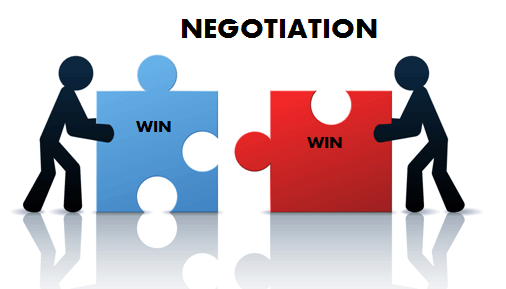
At the heart of the public debate over the latest twists and turns in the Trump administration’s ongoing discussions with Russian and Ukrainian negotiators is a fundamental moral question on which there is no consensus: Is it wrong to seek a compromise to end the war in Ukraine? To judge from the anguished reactions to the leak of the White House’s “28-point plan”—which was not really a plan so much as a rough snapshot in time of what US negotiators thought might bridge the gaps between Ukrainian and Russian demands—much of the Western commentariat believes the answer is yes.
In fact, the foreign policy establishments in Europe and Washington—which until recent years had presided over the West’s post-Cold War foreign policies—appear to view compromise itself as anathema. They insist that Russia should not gain in any way from its invasion of Ukraine, arguing that any other outcome would reward aggression, which would not only tempt Russia to resume its military conquests at some future date, but also invite similar aggression by China and others.
As a result, they argue, Ukraine should not withdraw from territory in Donetsk it now holds, even if that is reciprocated by Russian withdrawals outside the Donbass region, as Moscow has offered.
Nor should Russian-occupied territory be recognized as Russian in any way. Moscow should have no say in how Ukraine treats its linguistic and religious minorities or over whether Ukraine joins NATO, hosts Western combat forces, or has caps on its military holdings. All of these, it is argued, should be sovereign Ukrainian decisions, regardless of whether Russia drops its objections to Ukraine joining the European Union, as President Vladimir Putin has pledged. Moreover, Russia must pay war reparations, and its leaders must face trial for war crimes.
……………………………….. There are three big problems with this uncompromising stance. First, there is a yawning gap between what the opponents of a compromise insist must happen in Ukraine and their willingness to undertake the risks and sacrifices necessary to make it so. Neither the United States nor Europe has been willing to go to war with Russia to force its unconditional surrender, understanding that this would very likely end in nuclear conflict………………………..
Second, having ruled out both direct military intervention and compromise, Ukraine’s rejectionist benefactors assume that they can sustain a prolonged battlefield stalemate that will ultimately exhaust Russia’s resources or its patience. That assumption is wishful thinking at best. Ukraine’s military efforts suffer from two increasingly problematic shortages: manpower and air defenses. The West cannot remedy Ukraine’s recruitment and desertion problems without sending hundreds of thousands of its own forces to fight.
It cannot plug Ukraine’s growing air defense gap because Russia is building attack missiles, drones, and glide bombs faster than Western factories can manufacture air defense systems. This is not a formula for a prolonged stalemate; it is a recipe for Ukraine’s collapse, probably within months rather than years.
Third and most important: The principle that lies at the root of the Ukraine conflict, which the opponents of compromise claim to defend—the principle that every nation has a sovereign right to choose its military allies—was never intended to be absolute, and the United States historically has not treated it as sacrosanct.
……………………………………………… That [the Cuban missile]crisis was resolved through a compromise in which the Soviets agreed to remove their missiles from Cuba in return for America’s pledge to remove its own missiles from Turkey and to refrain from efforts to overthrow the Castro regime.
……………………………….A truly principled approach to ending the war in Ukraine cannot be uncompromising. It has to find a reasonable balance between principles that are by their very nature in tension with one another, such as Ukraine’s freedom to choose its allies and Moscow’s insistence that this freedom be limited by Russia’s security concerns………………………………………….. https://www.compactmag.com/article/the-moral-urgency-of-compromise-in-ukraine/
No comments yet.
-
Archives
- October 2026 (112)
- September 2026 (339)
- August 2026 (330)
- July 2026 (355)
- June 2026 (287)
- May 2026 (306)
- April 2026 (356)
- March 2026 (251)
- February 2026 (267)
- January 2026 (308)
- December 2025 (358)
- November 2025 (359)
-
Categories
- 1
- 1 NUCLEAR ISSUES
- business and costs
- climate change
- culture and arts
- ENERGY
- environment
- health
- history
- indigenous issues
- Legal
- marketing of nuclear
- media
- opposition to nuclear
- PERSONAL STORIES
- politics
- politics international
- Religion and ethics
- safety
- secrets,lies and civil liberties
- spinbuster
- technology
- Uranium
- wastes
- weapons and war
- Women
- 2 WORLD
- ACTION
- AFRICA
- Atrocities
- AUSTRALIA
- Christina's notes
- Christina's themes
- culture and arts
- Events
- Fuk 2022
- Fuk 2023
- Fukushima 2017
- Fukushima 2018
- fukushima 2019
- Fukushima 2020
- Fukushima 2021
- general
- global warming
- Humour (God we need it)
- Nuclear
- RARE EARTHS
- Reference
- resources – print
- Resources -audiovicual
- Weekly Newsletter
- World
- World Nuclear
- YouTube
-
RSS
Entries RSS
Comments RSS


Leave a Reply