UKRAINE DEAL DEAD
Russia, in his view, would still prefer a compromise closer to Istanbul and the later Anchorage discussion than the occupation of the whole of Ukraine.
Governing a hostile country is not Moscow’s first choice.
George Beebe on Iran, Trump’s shrinking leverage, and the crash coming in Ukraine
Ian Proud, Sep 01, 2026, https://thepeacemonger.substack.com/p/ukraine-deal-dead?utm_source=post-email-title&publication_id=3221990&post_id=213666173&utm_campaign=email-post-title&isFreemail=true&r=1ise1&triedRedirect=true&utm_medium=email
George Beebe was CIA Director for Russia analysis and is now Director of the Grand Strategy Programme at the Quincy Institute. In this conversation he describes a Trump Administration that wrote a coherent National Security Strategy and then walked away from it. This has left prospects for a credible peace deal for Ukraine remote at best.
“………………………………………………………………………………………. The United States is now in a cul-de-sac: damaged reputation, strained forces, a distracted White House, and no clean exit that does not involve concessions.
That matters for Ukraine because attention and political capital are finite within the Trump White House.
Beebe’s strategic case for ending the war has not changed. A forever proxy war leaves Europe unstable, incentivises a tighter Russia-China partnership, and makes a China-first American strategy impossible.
Russia, in his view, would still prefer a compromise closer to Istanbul and the later Anchorage discussion than the occupation of the whole of Ukraine.
Governing a hostile country is not Moscow’s first choice.
What has changed is Washington’s ability to deliver.
Iran has taken the oxygen out of the room.
Trump needs political juice to force a deal through a hostile Senate and a permanent bureaucracy that still treats detente with Russia as heresy.
Beebe does not think he has that juice.
Midterms loom.
The president is fighting an unpopular war with a precarious economy. Other countries are already pricing him as a lame duck.
If Moscow concludes the administration is not agreement-capable — cannot lock in NATO limits, cannot move sanctions — Plan B is the battlefield.
That is not the conquest of Kyiv. It is a rump Ukraine, too weak to be rebuilt as a Western military outpost, and a worse peace for Ukrainians, Europeans and Americans alike.
Then comes what Beebe calls it a hard crash.
Time is not on Ukraine’s side.
Manpower is failing.
Energy infrastructure is already in tatters ahead of another winter.
Russia can hit harder than Ukraine can endure.
When the gap between Western media victory narratives and the facts becomes undeniable, Washington does not usually say “we did our best.”
It goes into “do-something” mode.
That is how mismanaged wars become direct NATO-Russia crises.
I agree with him.
Europe has no plan.
It has a reflex: ask for more Patriots, flatter Trump, keep Kyiv fighting.
That is not friendship.
It is spending Ukrainian lives to delay an admission of failure.
Beebe’s alternative is old-fashioned and unfashionable: a concert among the United States, Russia and China, starting with Iran and Ukraine, based on self-interest rather than trust.
Whether this White House can still do that is the live question.
Ukrainian Writer Gets 15 Years in Jail for Article EXPOSING Ukraine Nazis
31 Aug 2026
Katie speaks to German World Socialist Website editor Johannes Stern about the case of Bogdan Syrotiuk, a 27-year-old Ukrainian activist who was charged with terrorism for writing articles opposing the war and exposing Ukraine’s rehabilitation of Nazis.
Ukraine’s Mounting Political Crisis
Gordon Hahn Considering Russia and Eurasia, byGordonhahnSeptember 1, 2026
The NATO-Russia Ukrainian War is coming to its endgame in Russia’s favor, sharply raising the temperature of domestic Ukrainian politics. To add catastrophe to disaster, the Ukrainian Maidan regime, state, and army are riven with schisms threatening the existence of them all.
Thus, on the ‘left’ and on the right, particularly the far right neofascist wing of Ukrainian politics, pressure on the Volodomyr Zelenskiy iteration of the Maidan oligarchic-neofascist regime is being intensified. On the right, the 3rdArmy Corps ‘Azov’, based on the Azov neofascist political movement, has been put in charge of the defense of what remains (approximately 15 percent) of Ukraine’s hold on Russian-claimed Donetsk Oblast.
There, in western Donetsk, Russian forces have entered Dobropiliya and are in the process of encircling the Slovansk and Kramatorsk strongholds. To the west of these three towns lies nothing but undefendable open fields leading to the middle of the Dnepr River.
To this must be added the increasingly dire situation in Ukraine’s northern oblasts of Kharkiv and Sumy, with their provincial capitols under threat of siege and encirclement. Russian victories in the north would revive the threat to Kiev long dormant since the war’s first months. In the southern oblast of Zaporozhe, the road to its provincial capitol of the same name is about to open with the imminent fall of Orekhov. …….. . . . . . (Subscribers only) .https://gordonhahn.substack.com/p/ukraines-mounting-political-crisis?r=stexy
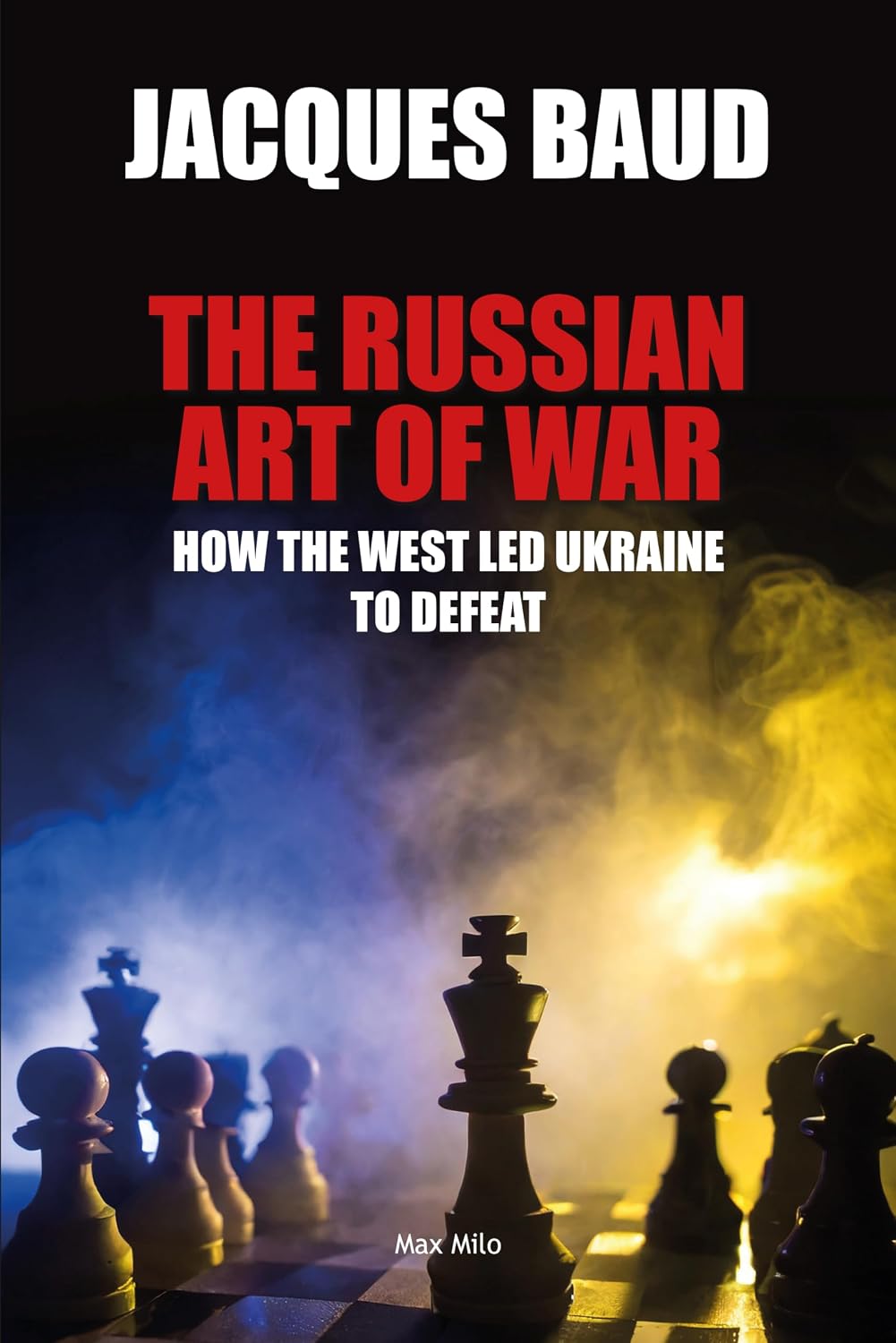
The Russian Art of War – Why the West Has No Strategy and Ukraine will lose
Baud is careful to stress that understanding an adversary is not the same as endorsing them. Intelligence, he reminds us, comes from the Latin intelligere — to understand. Without that understanding, diplomacy becomes impossible and force becomes the only remaining instrument.
.
A conversation with Colonel Jacques Baud
Ian Proud, Aug 28, 2026, https://thepeacemonger.substack.com/p/the-russian-art-of-war-why-the-west?utm_source=post-email-title&publication_id=3221990&post_id=211519795&utm_campaign=email-post-title&isFreemail=true&r=1ise1&triedRedirect=true&utm_medium=email
Colonel Jacques Baud, former Swiss strategic intelligence officer and author of The Russian Art of War: How the West led Ukraine to Defeat, has spent decades studying how different military cultures understand and wage war. His detailed, heavily referenced book — written early in the conflict — remains one of the clearest explanations of why Russia continues to hold the strategic advantage in Ukraine.
Baud’s central argument is simple but profound. During the Cold War, both NATO and the Warsaw Pact organised their forces around three interlocking levels of warfare: tactical, operational and strategic.
After 2001, Western armies largely abandoned the operational level as they shifted to counter-terrorism.
Fighting insurgents in Iraq and Afghanistan reduced war to a series of tactical engagements.
When the same mindset and equipment were transferred to Ukraine, the results were predictable.
Russia never made that shift. Its art of war remains built on the classic three levels.
Early in the Special Military Operation, deep operational thrusts toward Kyiv and Kherson were designed to create strategic pressure and force negotiations. When that phase ended, Russia adjusted — not by descending into pure tactics, but by systematically destroying Ukrainian forces while still linking tactical actions to operational and strategic goals.
Ukraine, trained and equipped largely by the West, has remained stuck at the tactical level.
This difference explains much of what we see on the battlefield. Russia’s objectives have been consistent: protect the population of the Donbas, prevent Ukrainian NATO membership, and secure a neutral buffer.
The Istanbul draft of March 2022 already reflected these goals, drawing on historical models of neutrality such as Austria in 1955 and Switzerland in 1815.
The West, by contrast, has never articulated clear, measurable political objectives beyond the vague slogans of “weakening Russia” and “supporting Ukraine.”
Without clear objectives, there can be no coherent strategy and no exit plan.
Industrial capacity reinforces the disparity. Russia’s state-influenced military-industrial complex can prioritise and scale production — whether of artillery shells, missiles or drones — with a flexibility that privatised Western industry lacks.
Lead times for systems such as Patriot missiles are measured in years.
Once Russia recognised the importance of drones, it moved from relative disadvantage to local superiority through industrial mobilisation.
Baud is careful to stress that understanding an adversary is not the same as endorsing them. Intelligence, he reminds us, comes from the Latin intelligere — to understand. Without that understanding, diplomacy becomes impossible and force becomes the only remaining instrument.
The tragedy is that a clearer grasp of Russian thinking in 2022 might have spared Ukraine much of the destruction that followed.
The conversation ends with a sober conclusion. Russia has a coherent political-military strategy underpinned by industry, energy and time.
The West and Ukraine are fighting a war by committee with no clear strategic destination.
In such conditions, the side that knows what it wants — and organises itself accordingly — almost always prevails.
You can watch the full conversation here:
Ukrainian nuclear power plant without external power for over a week
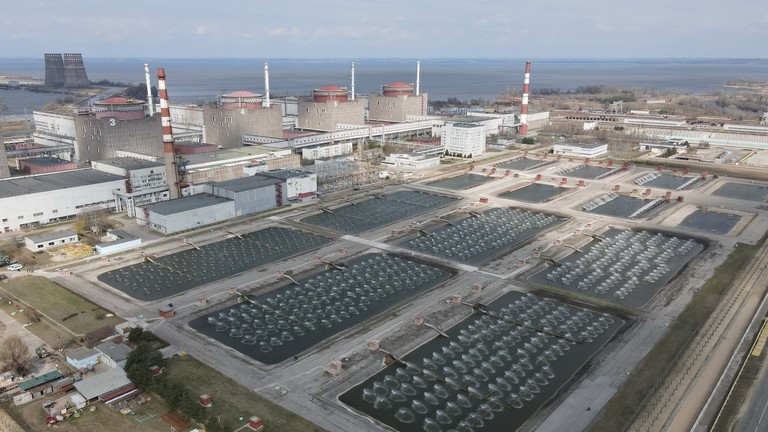
This is the 27th time since Russia invaded Ukraine that the Zaporizhzhia plant has had to rely on emergency diesel supplies.
By Al Jazeera Staff and AP, 29 Aug 2026
The Zaporizhzhia nuclear power station in southeastern Ukraine has been without off-site power for more than a week, the world’s nuclear energy watchdog has warned.
The plant, which Russia has occupied since 2022, is currently relying on emergency diesel generators, the International Atomic Energy Agency (IAEA) said on Saturday.
The plant needs power to keep its six non-operating reactors cool and has only a 10-day diesel supply on site, the IAEA said in a statement.
“The availability of diesel fuel is of paramount importance whenever a nuclear power plant loses off-site power,” IAEA Director General Rafael Grossi said.
The Zaporizhzhia nuclear power plant has not had a delivery from an off-site storage facility in about six months but was supplied with diesel on Thursday and Friday from another off-site location, the IAEA said.
The Vienna-based agency is now trying to negotiate a local ceasefire to allow repairs to electrical lines.
Zaporizhzhia is Europe’s largest nuclear power plant. It has not generated electricity since September 2022, over six months after Russia launched a full-scale invasion of Ukraine in February that year, but the plant’s reactors must be kept cool to prevent a meltdown of the fuel inside.
“This is the 27th blackout at the plant since the start of Russia’s full-scale invasion,” Ukraine’s deputy head of military law enforcement, Gyunduz Mamedov, wrote on X on Saturday.
The IAEA has had a permanent presence at the site since September 2022, after Russia took control of the Ukrainian facility in March that year.
Ukraine’s Maidan Regime, Army, and People Are Not on the Same Page
Gordonhahn August 31, 2026
The recent two-day delay by Ukraine in extending state of martial law was largely the result of the need to adopt a reform of the Kiev’s brutal forced mobilization of men to fight in the beleaguered Ukrainian armed forces.
On April 27th the Rada passed an extension of martial law and military mobilization until August 2nd on the basis of the standard three-month term, and Zelenskiy signed the law the next day. But without redressing the population’s increasing alienation from the war effort and the regime as a result of coerced mobilization of men to fight at the front, some deputies were unprepared to pass the martial law resolution.
The violent recruitment process has included the killing and maiming of captured draft evaders, mass resistance against the mobilizers’ attempts to seize evaders, and even the use of firearms by both mobilizers and evaders resisting capture.
This has raised a firestorm of criticism, resentment, and anger teetering on the edge of open revolt among the public, forcing Ukrainian leader Volodomyr Zelenskiy, the government, and the Verkhovna Rada deputies to at least feign an attempt to right the situation. Even the police are now hated by the public for failing to protect citizens against the mobilizers’ violent methods and often siding with the latter. Many are asking why can not the Rada deputies, government ministers, their sons, the 120,000 police, and 100,000 mobilization center press gangs be subjected to the draft…………(Subscribers only) https://gordonhahn.substack.com/p/ukraines-maidan-regime-army-and-people
Provoked: How Decades of American Policy Set the Stage for Catastrophe in Ukraine
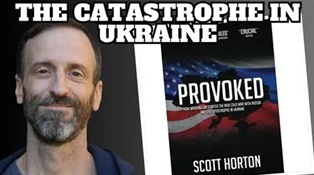
In conversation with Scott Horton
Ian Proud, Aug 29, 2026
In my conversation with Scott Horton about his landmark book Provoked: How Washington Started a New Cold War with Russia and the Catastrophe in Ukraine, one theme emerged with striking clarity: the Ukraine war that began in 2022 did not erupt from nowhere. It was the culmination of more than three decades of deliberate American choices.
Horton’s eight-hundred-page account is not a polemical rant but a meticulously documented timeline. Drawing on thousands of primary sources, he traces the story president by president—from George H.W. Bush through Clinton, the younger Bush, Obama, Trump, and Biden.
The central argument is straightforward and devastating: successive U.S. administrations systematically dismantled the post-Cold War settlement, broke explicit assurances given to Moscow, and treated Russian security concerns with open contempt.
The most consequential early breach concerned NATO expansion.
During the negotiations over German reunification in 1990, James Baker, Helmut Kohl, Hans Dietrich Genscher, Robert Gates and others repeatedly assured Mikhail Gorbachev that NATO would not move “one inch to the east.”
Those assurances were not casual asides. They formed the basis on which Gorbachev agreed to allow a reunified Germany to remain inside the alliance while Soviet troops were still stationed in the east.
Later State Department reviews under Warren Christopher quietly confirmed that the Russians had every reason to believe those promises were binding. Yet the Clinton administration proceeded with expansion anyway, first into Central Europe and later, under George W. Bush, into the Baltic states—leaving the Russian exclave of Kaliningrad stranded behind NATO lines.
Opposition to this course was widespread and bipartisan. With great prescience, George Kennan, the architect of containment, warned that the policy would produce a “devastating reaction” from Russia and that the very people dismissing those concerns would later claim the reaction proved their point.
Two-thirds of the Council on Foreign Relations opposed expansion. Career diplomats, military officers and even hardline hawks such as Henry Kissinger and Zbigniew Brzezinski argued that Ukraine required a special neutral status—something resembling the Cold War Finland or Austria model—precisely to avoid a catastrophic collision.
Those voices were ignored.
The pattern continued.
The 2008 Bucharest Summit promised eventual membership to Ukraine and Georgia without a membership action plan or credible security guarantees—the “worst of all worlds,” as several analysts later described it.
Color revolutions, the deliberate sidelining of the Partnership for Peace, and the refusal to implement the Minsk agreements further eroded any residual trust.
When the same cohort of officials who had driven the policy under earlier administrations returned under Biden – most notably Daniel Fried – the trajectory accelerated toward open conflict.
Horton is careful not to justify Russia’s invasion. He simply insists that calling the attack “unprovoked” is an exercise in willful blindness.
The word itself, repeated endlessly by Western governments and media, seeks to close off inquiry rather than invite it.
Horton’s book reopens that inquiry with forensic detail—names, dates, cables, memoirs—leaving readers free to draw their own conclusions.
What makes Provoked essential is precisely this refusal to operate on the short time horizon of the daily news cycle.
Most public discussion still treats either 2014 or 2022 as year zero. Horton shows that the roots stretch back to the moment the Cold War ended, when a victorious America chose (to quote the title of Professor Jonathan Haslam’s also excellent book) hubris over restraint.
The result is a tragedy that was both foreseeable and avoidable.
I am taking the book with me on holiday.
It is heavy—literally and figuratively—but the weight is justified.
Anyone who wants to understand how we arrived at the present catastrophe, rather than simply recycle the slogans of the moment, should read it.
You can see the full conversation here.
Britain’s Storm Shadow tech transfer to Ukraine will lead to more escalation. We need dialogue!
Campaign for Nuclear Disarmament, August 25, 2026, https://cnduk.org/britains-storm-shadow-tech-transfer-to-ukraine-will-lead-to-more-escalation-we-need-dialogue/?link_id=1&can_id=0a448bf4278898648e02a8f6dea4650f&source=email-britain-pushes-for-more-escalation-in-ukraine-aukus-webinar-register-for-cnd-agm-policy-conference&email_referrer=email_3374903&email_subject=britain-pushes-for-more-escalation-in-ukraine-aukus-webinar-register-for-cnd-conference
Britain’s decision to join France in transferring classified Storm Shadow blueprints to Ukraine so it can domestically produce the long-range cruise missile will only increase nuclear risks, warns CND.
Prime Minister Andy Burnham made the announcement about the technology transfer during a visit to Kyiv on Monday.
The Storm Shadow is co-produced with France by the multi-national arms company MBDA and has a range of 155 miles (250km). The air-launched missiles also have bunker-busting warheads and are capable of hitting Russian targets in its territory. In November 2024, the British government, in coordination with the US administration, gave permission for Ukraine to use these weapons to hit targets deep inside Russian territory. This was in spite of Russia’s threat to use its nuclear weapons against such long-range attacks.
France already agreed to hand over its own blueprints for the SCALP-EG (its French export name) in July, as part of a wider arms deal that included Rafale fighter jets and interceptor missiles.
On Sunday, Russia’s foreign ministry said it had withdrawn its ambassador to London, Andrei Kelin, accusing Britain of choosing a “path of confrontation.” This comes after Russia announced that there would be consequences for attacks on civilian infrastrcutrue by British-made long-range drones. Some reports have suggested that this could mean British drone factories could be attacked by “unknown sources.”
Burnham’s announcement has been interpreted as an attempt by Britain and France to push the US into giving Ukraine its Patriot interceptor technology so it can produce them locally. During July’s NATO summit, Donald Trump told Ukrainian President Volodymyr Zelensky that the US would give a licence to produce Patriots only to backtrack on the promise weeks later saying it “a hard thing to give away.”
The reversal coincided with an escalation in the US’s illegal war on Iran in July. That conflict, ongoing since February, has led to a shortage in stocks of both Patriot and Tomahawk as the US and its Gulf allies use them to counter Iranian ballistic missiles and drones. It’s estimated that only 1,000 Patriot missiles remain in US stocks and current annual production is currently 600. Plans are already in place to set up new production lines in Germany and Poland to help replenish their stocks given to Ukraine, while Zelensky is also calling for a line to be set up in Ukraine.
CND General Secretary Sophie Bolt said:
“The British government’s strategy of escalation is very dangerous. We have already seen the nuclear risks from such escalation in 2024 when Russia threatened to use its nuclear weapons against long-range missiles. Burnham needs to end this reckless war-mongering and focus on dialogue and de-escalation.”
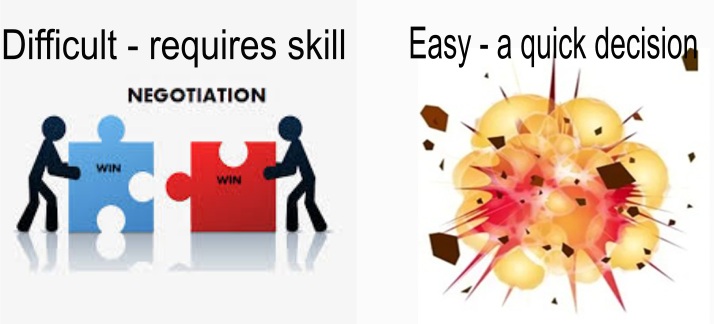
Russia signals willingness to consider new Ukraine peace ideas but insists any deal reflect battlefield conditions
[your]NEWS, Fri, 21 Aug 2026 , https://www.sott.net/article/508073-Russia-signals-willingness-to-consider-new-Ukraine-peace-ideas-but-insists-any-deal-reflect-battlefield-conditions
Russian Deputy Foreign Minister Sergei Ryabkov said Moscow remains willing to hear new U.S. proposals for ending the war in Ukraine, while maintaining that any settlement must account for Russia’s stated objectives and the territorial situation created by nearly 4½ years of fighting.
Russia says it remains prepared to consider new proposals for ending the war in Ukraine, but Moscow is continuing to insist that any potential settlement account for what it calls the “realities on the ground.”
Russian Deputy Foreign Minister Sergei Ryabkov made the comments in an interview with News.ru published Friday, signaling that Moscow is still open to negotiations with Washington even as diplomatic efforts to end the conflict have largely stalled amid the war in Iran.
Ryabkov said the United States has demonstrated both a willingness to engage in “constructive dialog” and an “understanding of Russia’s position.”
He suggested, however, that Moscow believes the larger question is whether the United States can influence Ukraine and its European allies.
“At this stage, it is more important to what extent Washington is able to influence the decisions of the Kyiv regime and its European sponsors, who still dream of a ‘strategic defeat’ of Russia,” Ryabkov said.
Russia and the United States have held negotiations aimed at finding a path toward ending the Ukraine war, but those efforts have lost momentum as international attention has shifted toward the conflict involving Iran.
The Kremlin said Thursday that it had no information about when U.S. presidential envoys Jared Kushner and Steve Witkoff might next travel to Moscow.
Kushner and Witkoff have previously played leading roles in U.S. negotiations with Russian officials.
Secretary of State Marco Rubio reiterated Washington’s interest in ending the Ukraine conflict last month following a meeting with Russian Foreign Minister Sergei Lavrov in Manila.
Rubio cautioned at the time that a rapid breakthrough should not be expected and said the United States was attempting to “find a middle ground.”
Ryabkov responded that Moscow remains prepared to consider new ideas from Rubio and to continue discussions with the Trump administration:
“The Russian Federation is ready to listen to any reasonable proposals and ideas that are in line with the goals set by the Russian president and meet the ‘realities on the ground,'”
That formulation reflects a longstanding Russian position that any eventual agreement must take into account territorial changes resulting from the war.
After almost 4½ years of fighting, Russian forces control approximately one-fifth of Ukraine’s internationally recognized territory.
Moscow has repeatedly said it is willing to negotiate but has maintained that talks must acknowledge what Russian officials describe as the “new realities on the ground.”
The territorial question remains one of the central obstacles to reaching a negotiated settlement.
Ukraine and its international supporters have continued to regard the areas seized by Russia as sovereign Ukrainian territory, while Moscow has sought to make its control of occupied regions part of the framework for any eventual peace agreement.
Ryabkov’s remarks indicate that Russia is not rejecting further American diplomatic initiatives but is setting clear parameters for what it would regard as a viable proposal.
His comments also place renewed emphasis on Washington’s ability to persuade Kyiv and European governments to accept compromises that Moscow considers necessary.
The diplomatic opening comes as U.S.-Russian negotiations over Ukraine have slowed considerably from earlier efforts.
Although Rubio has publicly reaffirmed Washington’s commitment to finding a way to end the conflict, he has also acknowledged the substantial differences separating the parties.
Ryabkov’s interview addressed another major area of U.S.-Russian relations as well: nuclear arms control.
The New START nuclear weapons treaty expired in February, leaving the United States and Russia without binding limits on their strategic nuclear arsenals for the first time in more than 50 years.
The treaty had imposed restrictions on deployed strategic nuclear warheads and delivery systems held by the world’s two largest nuclear-armed powers.
Despite its expiration, Moscow has said it intends to continue observing the treaty’s limits on missiles and warheads as long as Washington does the same.
Ryabkov indicated that Russia wants to keep diplomatic channels open on nuclear weapons even without a formal treaty currently in force.
“We remain open in the future to find political and diplomatic ways to stabilize this area,” he said.
His comments suggest that Moscow sees room for continued U.S.-Russian engagement on two of the most consequential issues between the countries: ending the Ukraine war and establishing a new framework for managing their strategic nuclear arsenals.
For Ukraine negotiations, however, Russia continues to make clear that it will judge any American proposal against both President Vladimir Putin’s stated objectives and the military situation that now exists after years of war.
Regulatory approval for expansion of Chernobyl waste facility

Wednesday, 19 August 2026, https://world-nuclear-news.org/articles/regulatory-approval-for-expansion-of-chernobyl-waste-facility?cid=117504&utm_source=omka&utm_medium=WNN_Weekly,_18-24_August_2026&utm_id=897&utm_map=d33d95f2-f072-49bb-b262-e21e25f89aed
The State Nuclear Regulatory Inspectorate of Ukraine has approved the construction of a new repository at the site of the Buriakivka facility for the disposal of low- and intermediate-level radioactive waste resulting from the clean-up of the Chernobyl nuclear accident.
The Buriakivka RAW Disposal Facility is one of the key components of the system for managing the large volumes of accident-related radioactive waste generated as a result of the 1986 Chernobyl accident, established as part of the priority emergency response measures and commissioned in 1987 to store low- and intermediate-level radioactive waste originating from Chernobyl.
The facility – located within the Chernobyl Exclusion Zone – is operated by the SSE Central Enterprise for Radioactive Waste Management (CERWM), Ukraine’s sole operator of ryadioactive waste disposal facilities. During the period of operation of the facility, 31 surface disposal facilities (trench-type) – measuring 150 × 50 metres – for the disposal of radioactive waste have been filled. The main engineered barrier providing the radionuclide containment is a specially constructed 1-metre-thick clay shield. The last repository, No.21A, was commissioned in 2018 and was fully filled by the end of 2023. In total, since the start of operation, about 635,918 cubic metres of Chernobyl-origin radioactive waste has been emplaced in the Buriakivka trenches. Radioactively contaminated vehicles, which were used during mitigation of the Chernobyl disaster, are also stored at Buriakivka. In 2012, CERWM started dismantling and size-reduction of these vehicles.
To expand the capacity of the facility through the construction of a new (trench-type) repository, No.11A, CERWM agreed the working design for the construction of the repository, taking into account the results of the comprehensive state expert review of this project, and earlier this year submitted an application for a licence to carry out activities during the construction phase of the new repository.
The State Nuclear Regulatory Inspectorate of Ukraine (SNRIU), with the involvement of the State Scientific and Technical Center for Nuclear and Radiation Safety (SSTC NRS), conducted a state review of the nuclear and radiation safety of the Safety Analysis Report for the construction phase of the new repository to assess its compliance with the requirements of legislation, standards and regulations on nuclear and radiation safety.
At its meeting on Tuesday, the Board of SNRIU considered the results of the state expert review and approved its conclusion confirming the reasonableness of the design decisions taken and the safety of the designed repository, as well as the capability of CERWM to carry out activities during the construction phase of the repository in accordance with the established nuclear and radiation safety standards and regulations.
SNRIU recommended that CERWM ensures the updating of safety justifications during the construction phase of the repository, taking into account the actual implementation of design solutions, refined characteristics and radioactive waste streams, and to submit them as part of the Safety Analysis Report for the operational phase of the repository and other operational documentation required to subsequently obtain a licence for the operational phase of the repository.
The construction of the new near-surface repository, and subsequently its commissioning, will enable the continued disposal of low-level radioactive waste generated during the decommissioning of the Chernobyl plant, as well as from other entities operating in the field of nuclear energy, the regulator noted.
Walt Zlotow- NATO letting Ukraine die, not by a thousand cuts, but by a thousand drones.

Neither the UK’s Burnham, France’s Macron nor Germany’s Merz are friends of Ukraine, fair- weather or otherwise. They’ve spent the last 12 years promoting war between Ukraine and Russia that has left Ukraine a shell of its former self.
Walt Zlotow West Suburban Peace Coalition Glen Ellyn IL , 23 Aug 26
The thousands of drones NATO is squandering their desperately needed treasure to give Ukraine to fire wildly into Russia have backfired spectacularly.
The drones have no strategic value on Ukraine’s war prospects. They are mere pinpricks having no effect on the inevitable Russian victory on the battlefield. But they have enraged the Russian populous and leadership to ramp up the destruction of Ukraine’s economy and infrastructure which will speed up Ukraine’s collapse.
Foremost in this campaign in closing off Ukraine’s access to the Black Sea and other ports greatly shutting down vital exports and imports, the lifeblood of the Ukraine economy. Energy facilities thruout Ukraine are being targeted in daily attacks that unlike Ukraine’s scattershot drone strikes, strategically cripple Ukraine life. Ukraine has no defensive missiles to shoot down incoming Russian drones and missiles with none forthcoming from either Europe or the US.
Virtually none of this gets reported in Western media. Most reporting touts NATO supplied Ukrainian drone strikes on Russia as evidence Ukraine is still in the fight. Utter nonsense.
NATO leaders brag how they’re bringing the war home to Russia and that Ukraine can prevail. They are locked into a a long history of Russophobia they cannot not shake regardless of how their war support is hurting their economies and alienating their constituencies. Their facing a lost cause in Ukraine, bankruptcy at home and electoral defeat.
The UK’s Keir Starmer has already been pushed out. But his successor Andy Burnham hasn’t got the clear message. After Russia’s Putin warned the UK of consequences for Britain providing Ukraine with drones fired into Russia, Burnham replied “London will continue to support Ukraine 100%. We are not fair-weather friends, we will be there in Ukraine’s hour of need and that won’t change.”
Neither the UK’s Burnham, France’s Macron nor Germany’s Merz are friends of Ukraine, fair- weather or otherwise. They’ve spent the last 12 years promoting war between Ukraine and Russia that has left Ukraine a shell of its former self.
How? By supporting the 2014 coup that ousted Russian leaning Ukraine President Victory Yanukovych. By promoting the Minsk I and II Accords in 2014 and 2015 that lulled Russia into believing NATO was going to provide regional autonomy for Russian leaning Donbas Ukrainians when it was simply a ruse to build up Ukrainian forces to crush the Donbas Ukrainians. By conspiring with the US to goad Russia into invading Ukraine in February 2022 by refusing to address Russia’s valid security concerns regarding NATO expansion to Russia’s borders in Ukraine.
And when Ukraine does collapse, possibly as early as this year, NATO countries will be left with nothing to show but greatly weakened economies and inroads from right wing governments sick of squandering critically needed domestic treasure on senseless, lost foreign causes. NATO leaders can ponder forever their descent into madness that destroyed Ukraine for nothing but their hatred of Russia.
Dependence Day: A generation after the Soviet Union fell, Ukraine is a ruined proxy of the West
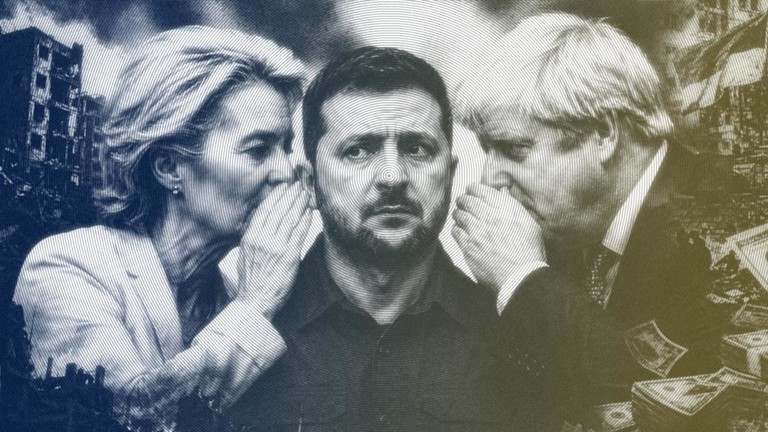
To be fair, the first yet already extremely harmful steps the West took to, ultimately, ruin Ukraine had very little to do with it: When Washington decided – not once but repeatedly – to cheat and humiliate Russia and break clear promises not to expand NATO eastward, it was first Germany, then multiple Eastern European countries that were at the center of attention, but not Ukraine. Yet, ironically, even while neglecting it, the West’s reckless expansion already set the stage for phase two of putting Ukraine in the crosshairs.
Ukraine could have bridged East and West. Instead, corruption, nationalism, and Western meddling left it broken
24 Aug, 2026 By Tarik Cyril Amar
There is one feeling I often recall from having lived and worked in Ukraine – to be precise, in its most nationalist, full-of-itself city, Lviv – for a total of five years in the 2000s: Thank God, at least there’s no violence!
That is what I, some other foreigners, and quite a few Ukrainians, too, were thinking and even saying then. The country was politically and even culturally polarized, extremely corrupt, and a sham ‘democracy’ even more fake than most of the rest.
It was dominated and bled dry by a greedy, hypocritical, and – despite all the cheap talk, the pious singing-of-anthems-hand-on-heart, and the cheesy peasant braids and stitched shirts – deeply unpatriotic establishment of typically post-Soviet turncoats, thieves, liars, and sell-outs. There was no rule of law, the courts were a bad joke, and the police was a racket.
And yet, while the usual business-crime complex took its toll and there was the occasional state murder of a journalist, there was no large-scale violence. There was bitter grumbling galore, including about Crimea, all the time. But there was no civil war – as the almighty US intelligence services had infamously as good as predicted in the even darker 1990s – and no one was reaching for a gun either to leave an unbearable country or keep others in it by force.
While the Americans were busy thinking about the possibility – and perhaps opportunities – of Ukrainians killing each other in large numbers, their British cousins were considering another kind of doom. For them, more than three decades ago, the most interesting question was whether Ukraine and Russia would go to war, specifically over Crimea. There, British spooks back then warned with unusual honesty, “most of the population is Russian,” and things might become less than cordial if Kiev didn’t watch its steps.
And here we are now: On the 35th official anniversary of its existence outside the former Soviet Union, Ukraine has become the sum of all fears, much worse than even its pervasively corrupt, brutally unfair, and de facto lawless pre-2014 version. It is now ruled by its worst, most corrupt, and most authoritarian and bloody regime ever – hands down – under Vladimir Zelensky and his cronies. They steal, embezzle, and launder piles of dirty money as if there’s no tomorrow, which, to be fair, there really probably isn’t for them, at least not in Ukraine.
They literally hunt and, in effect, sell their subjects as cannon fodder, so that they can profit and the West can have its slaughterhouse war against Russia, in an insane, evil, and futile attempt to eliminate Moscow as a power to be reckoned with. This is the reality of “busification,” and nothing remotely like it happened before Zelensky and his accomplices took over. Those who do not readily submit to being treated as combat cattle regularly die mysteriously from ‘falls’ or maybe just blowing their nose.
The Ukrainian mass media have never been remotely clean, objective, or reliable. But the zombified and self-zombifying propaganda machine created under Zelensky is unprecedentedly awful. Those who openly resist the national brainwashing are incarcerated by kangaroo courts, tortured, and killed.
Or consider basic demography: Ukraine’s real population has almost halved since the end of the Soviet Union, and the future looks even worse. And while part of this catastrophe is due to the current war, much of it has been produced by the ceaseless class-war-from-above of injustice, exploitation, and hopelessness that Ukraine’s ‘elites’ have waged on their own subjects for a third of a century while blabbing sanctimoniously about nation this and nation that.
And the results of all these horrors? They are abysmal even on their own perverse terms. Just look at the map: Crimea is gone and so are substantial portions of Ukraine’s post-Soviet east due to a combination of regional rebellion, Kiev’s cack-handed, violent attempts to stomp it out, and a war with Russia. All of this could have been avoided.
Yet it was not. Indeed, Ukraine’s short post-Soviet history is, among other sad things, a record of at least sleepwalking and, more frequently, proactively provoking this twin catastrophe. But Ukrainians – or rather their rotten establishment – did have plenty of help in getting it so wrong. Take, for instance, the mean-spirited and asinine obsession with suppressing the Russian language to eradicate Ukraine’s windfall advantages as a mostly bilingual country of Russian and Ukrainian speakers.
That perverse and self-harming pursuit – recalling Freud’s hunch about nationalism as neurosis – was obstinately cultivated by both a narrow-minded but hyperactive and arrogant minority of ukrainier-than-though nationalists at home and descendants of run-away World War II nationalists, mass murderers of Poles, and Nazi collaborators from the West who were eager to infest post-Soviet Ukraine with their hoary bigotry.
Personally, I remember being naïve enough back then in the 2000s to ask Lviv acquaintances why Ukraine couldn’t just codify its own variant of Russian (comparable to the way American English is different from British English) and also promote Ukrainian (I know both languages, as it happens), and then focus on actually important matters. Blank stares were the answer, at best.
Ironically, well into the current war, there was a short news blip about someone in Ukraine having discovered the same obvious idea. How catastrophe can concentrate the mind and how sad that even now, after an estimated 1.5 million battlefield casualties, such pragmatic thinking is still a minority taste: Kiev’s policy is simply to double down on a daft campaign to win the lexicon while losing the war.
Entitled, patronizing exile nationalists projecting their selfish tunnel-vision fantasies on, and throwing their Western hard currency at, desperate people freshly shell-shocked by ultra-predatory ‘transition’ capitalism were one noxious outside influence vitiating Ukraine’s post-Soviet trajectory. But it was far from the only one. Indeed, as time went on, the West as a whole – its politicians, intellectuals, and mainstream media – became ever more interested in and vastly detrimental to Ukraine.
To be fair, the first yet already extremely harmful steps the West took to, ultimately, ruin Ukraine had very little to do with it: When Washington decided – not once but repeatedly – to cheat and humiliate Russia and break clear promises not to expand NATO eastward, it was first Germany, then multiple Eastern European countries that were at the center of attention, but not Ukraine. Yet, ironically, even while neglecting it, the West’s reckless expansion already set the stage for phase two of putting Ukraine in the crosshairs.
That was reached in 2008, when, at an infamous summit in Bucharest, the high and mighty of the West, led by the indispensably destructive US, artfully maneuvered Ukraine into the very worst position imaginable: by making a promise of NATO membership for Ukraine sometime in the future, they inevitably poked Russia in the eye once too often. By keeping the reckless promise vague, they left Ukraine completely exposed, as if baiting Moscow to intervene. The whole mad scheme took willfully ignoring the clear warnings issued by Russian President Vladimir Putin in Munich one year before and multiple equally explicit warnings produced by not Russians but widely acknowledged Westerners such as George Kennan and, back then, even William ‘Bill’ Burns.
Georgia shared this fate – lethal promises, no back-up – with Ukraine. And yet even after a short war there quickly demonstrated that this time Russia would stand its ground and defend its basic national security interests, the West stayed its course in Ukraine.
Indeed, it doubled down on it. If only the West had dropped Ukraine the way it dropped Georgia in 2008, many Ukrainians would still be alive and the country would have lost none or far less territory. Instead, the West got involved ever more deeply, offering a poisonous EU association agreement and the shaping a regime-change coup in 2014. After that, it bound Ukraine so closely into official and black-ops NATO structures that formal membership looked increasingly irrelevant, while helping Kiev sabotage the last realistic chance to return to peace and avoid large-scale war, the Minsk II agreement of 2015. Meanwhile, demagogic public intellectuals, such as Tim Snyder and Anne Applebaum did their worst to pour oil into the fire by a mix of silly nationalism-by-proxy and nasty Russophobia.
Finally, the West almost nonchalantly refused to seriously consider Moscow’s, as it turned out, last pre-February-2022 offer to return to substantial diplomacy and compromise. Once the war had greatly escalated, the West sent Britain’s most evil clown to kill an excellent opportunity to make peace quickly produced by the Istanbul talks of spring 2022.
Since then, since locking Ukraine into a devastating, perfectly unnecessary, and futile yet deliberately provoked war to weaken Russia, things have only gotten worse and worse, and there seems no end in sight. Indeed, as a remarkably sane former German general has just explained, Kiev is still eager to drag all of Western Europe (at least) into an open shooting war with Russia. In Europe, many establishment figures seem all too willing to go along. Ukraine has become the outstanding example of how the West risked and then destroyed the opportunities of the post-Cold War period. Ukraine could have been a prosperous country profiting from links to both East and West. Instead it’s a ruin.
Ukraine can hit Russia deep inside its territory. But is it bringing the war closer to peace?
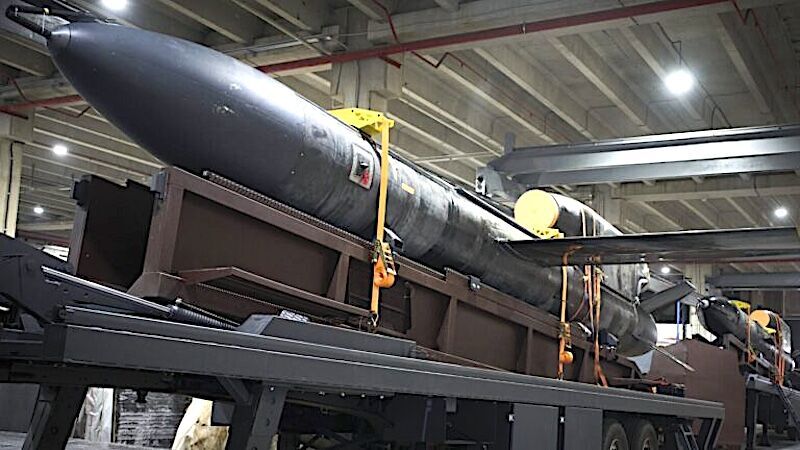
Trump’s most difficult task is not to give Ukraine more weapons or to pressure Kyiv into concessions. It is to create a settlement that gives both Putin and Zelenskyy a reason to change their positions.
Timur Maslov, [your]NEWS, Wed, 19 Aug 2026
From Kyiv, the growing Ukrainian ability to strike deep inside Russia is changing the geography of the war. But after four and a half years of fighting, one question remains: can military escalation actually produce a diplomatic breakthrough?
For more than four years, Ukrainians have lived with a war that rarely feels distant. Missiles and drones arrive at night. Energy infrastructure is repeatedly damaged. Businesses struggle to operate. Families prepare for another difficult winter. But the geography of the war is changing. Ukraine is increasingly capable of striking targets deep inside Russia. In recent days, Ukrainian forces launched one of the largest drone attacks on Russia since the beginning of the full-scale invasion. Russian authorities reported hundreds of Ukrainian drones targeting Moscow and other regions, while Russian strikes continued across Ukraine.
The strategy is becoming increasingly clear: if Russia can bring the war to Ukrainian cities, Ukraine wants Russia to experience at least some of the consequences of the war on its own territory. But there is a difficult question behind this strategy:
Does making the war more painful for Russia actually bring peace closer?
“People celebrate — and then wait for the response”
In Kyiv, the reaction to Ukrainian strikes deep inside Russia is complicated. People celebrate when Ukrainian drones reach targets near Moscow or elsewhere in Russia. There is a widespread feeling that Russia should experience some of the fear and uncertainty that Ukrainians have lived with for years.
But there is also another understanding. People know what usually comes next. A Ukrainian strike is followed by a Russian response and the response can be deadly. That cycle has become one of the most difficult realities of the war. As Ukrainian President Volodymyr Zelenskyy has put it, both sides can play the same game — but every action has consequences. The recent escalation illustrates the point. While Ukraine launched a major drone offensive against Russia, Russian missiles struck Ukrainian cities and infrastructure. A Russian attack on Kryvyi Rih damaged power and industrial facilities, while another strike in Kharkiv region killed civilians.
For Ukrainians, the result is a brutal paradox.
They may be pleased to see Russia hit — while knowing that another Russian attack may soon follow.
And ordinary people pay the price on both sides.
When the war reaches a supermarket shelf
The consequences of escalation are not always measured in destroyed military facilities. Sometimes they are much smaller and much closer to home. In Kyiv, I have personally seen empty shelves in some supermarkets, particularly in sections selling eggs and vegetables. This is not a nationwide food shortage. People can still buy essential products, and the situation may be temporary.
But the shortages appeared after Russian attacks damaged logistics infrastructure and warehouses supplying Kyiv’s supermarket chains. Ukrainian media reported that several logistics centers connected to Fozzy Group were damaged in a major August 5 attack, after which some products became harder to find in Kyiv stores. People are also buying more food than usual, creating additional pressure on supplies.
For someone outside Ukraine, this might sound like a minor inconvenience. For people who have lived through years of war, it feels different. A strike on infrastructure can eventually become an empty supermarket shelf. That is how military escalation reaches ordinary life.
Ukraine is developing its own long-range weapons
The next stage could be even more significant. Ukraine is developing ballistic missiles capable of reaching deep inside Russian territory.
Ukrainian defense company Fire Point has displayed its FP-7 and FP-9 ballistic missile systems at international defense exhibitions. The company says the FP-9 is designed to carry a warhead of up to 800 kilograms and reach targets hundreds of kilometers away. Independent defense reporting has cited an expected range of roughly 700-855 kilometers, depending on the configuration and information source.
Fire Point has also presented the smaller FP-7 system. Ukrainian officials have suggested that domestically produced ballistic weapons could enter combat use later this year, although their deployment and production depend on testing, certification, financing and access to components. That distinction matters.
A missile displayed at an exhibition is not the same thing as a weapon being mass-produced and operationally deployed.
But the direction is clear. Ukraine wants to reduce its dependence on foreign long-range weapons and develop the ability to strike Russian military and strategic targets with weapons produced domestically. If that capability becomes operational at scale, it could significantly expand Kyiv’s options.
It could also create another escalation problem.
What happens if Ukrainian ballistic missiles reach Russia?
This is the question that worries me most. Ukraine already has long-range drones capable of reaching Moscow and other Russian regions. A domestically produced ballistic missile would represent a different capability. It would potentially allow Ukraine to strike selected targets much faster and with a different level of destructive power. The FP-9’s publicly presented specifications — including a claimed range of up to roughly 855 kilometers and a payload of up to 800 kilograms — would theoretically put a large number of Russian military and industrial targets within reach.
Ukrainian President Volodymyr Zelenskyy has said that Ukraine could potentially use a domestically produced ballistic missile against Russia as early as this autumn, provided the necessary financing and components are available. That does not mean that a missile will necessarily hit Moscow this autumn. It means something more important:
Ukraine is trying to build a long-term domestic strike capability.
And Moscow will have to take that seriously.
Will this change Putin’s position?
I am skeptical. Ukraine’s ability to strike deeper into Russia may increase the cost of the war. It may disrupt fuel supplies, logistics and military infrastructure. But I do not believe that strikes alone will force Vladimir Putin to negotiate. Russia has already demonstrated that it is willing to absorb enormous military and economic costs to continue the war.
The recent attacks inside Russia have also produced fuel disruptions. Reuters reported on August 19 that gasoline stations in Moscow and surrounding regions had begun limiting sales amid shortages linked to Ukrainian drone attacks on Russian refineries, combined with seasonal demand and refinery problems.
That is a real economic consequence.But economic pain is not automatically political capitulation. And there is another problem. The more Ukraine strikes Russia, the greater the possibility that Moscow responds with another escalation against Ukraine.
The result can become a cycle:
Ukraine strikes Russia.
Russia retaliates.
Ukraine responds again.
The war becomes more dangerous.
But the political positions remain unchanged.
I don’t think Russian society will suddenly turn against the war
There is an argument that if Russians begin experiencing the war directly, public opinion will eventually turn against Vladimir Putin. I am not convinced. Russia has already demonstrated that external pressure can produce the opposite reaction. When the situation becomes more dangerous, patriotic rhetoric intensifies. The population may become more defensive rather than more willing to question the war.
For years, many Russians in Moscow and other major cities lived with a war that was geographically distant. Now drones are reaching their cities. But that does not necessarily mean they will conclude that the war should end. It could instead convince some people that Russia needs to fight harder. That is one of the biggest risks of the current strategy.
Europe is becoming part of the equation
Ukraine is also receiving increasing support for its domestic defense industry. European countries have their own geopolitical interests, of course. But European governments increasingly understand that Ukraine’s ability to produce drones and missiles is becoming strategically important. Britain, for example, has committed to supplying Ukraine with large numbers of drones and has reaffirmed its support despite Russian warnings that London could face “consequences” over alleged use of British-made drones in attacks inside Russia. The more sophisticated Ukraine’s domestic weapons industry becomes, the less dependent Kyiv is on decisions made in Washington or European capitals.
That could strengthen Ukraine’s negotiating position. But it could also make the conflict more difficult to contain.
Trump faces a problem that weapons cannot solve
This brings us back to Donald Trump. In my view, neither increasing weapons supplies nor applying pressure to only one side will be enough. Trump needs to get Vladimir Putin and Volodymyr Zelenskyy into a serious negotiating process. Not separately. Together.
Both leaders are deeply entrenched in their positions. Putin continues to speak about Russia’s objectives and the “root causes” of the war. Ukraine does not want a temporary pause that could simply give Russia time to prepare for another attack. That is why a simple ceasefire is unlikely to solve the underlying problem. Trump’s challenge is to find an agreement that both leaders believe is worth accepting.That is much harder than sending weapons.
And much harder than demanding that one side make concessions.
The anger of living through the war
After four and a half years of living in Kyiv during this war, I feel anger when I see another escalation. Not because I believe Ukraine should simply stop defending itself. And not because I believe Russia should be allowed to attack without consequences. I feel anger because people continue to die while the political positions of the two leaders remain so far apart. Almost everyone I know has lost someone — a friend, a relative, a father, a husband — because of this war. People want it to end.
But Ukrainians also understand that Russia has repeatedly said it wants more than simply a temporary halt to fighting. That leaves Ukraine facing an extremely difficult choice. Continue increasing the cost of the war for Russia — knowing that Russia will respond or reduce the intensity of the fighting and risk giving Moscow time to regroup. Neither option guarantees peace.
The real question
Ukraine has demonstrated that it can reach deep into Russia. It can damage military facilities. It can disrupt logistics. It can put pressure on Russia’s energy system and it is developing increasingly sophisticated weapons of its own. But military capability and strategic success are not the same thing. The question is no longer whether Ukraine can hit Russia.
It can.
The question is whether those strikes change the political calculation in Moscow. So far, there is little evidence that they have and there is little evidence that Ukrainian leadership is prepared to abandon its own fundamental demands either. That is why I believe Trump’s most difficult task is not to give Ukraine more weapons or to pressure Kyiv into concessions. It is to create a settlement that gives both Putin and Zelenskyy a reason to change their positions.
Otherwise, the war may continue not for another few months, but for another five or even ten years. And after everything Ukraine has already lost, that may be the most frightening possibility of all.
Comment: The price of war is excruciating, deadly, unrelenting and now escalating… Interesting how many countries want it.
Zelensky losing grip on power – Western media
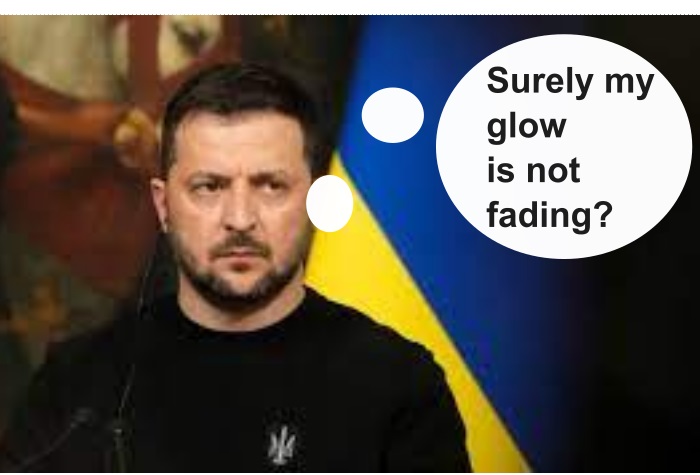
Comment: Ending the war? Peace with Russia? Zelensky would be on trial. A presidential challenger is his worst nightmare.
20 Aug 2026, https://www.sott.net/article/508029-Zelensky-losing-grip-on-power-Western-media
A widening corruption scandal and an open challenge from a former official have fueled questions about the Ukrainian leader’s political future.
Ukraine’s Vladimir Zelensky is facing his gravest political challenge in years, major US and European media outlets have reported, as a new corruption scandal engulfs his office and a former official openly challenges his leadership.
Zelensky fired the deputy head of his office, Irina Mudraya, on Wednesday after Western-backed anti-graft authorities launched an investigation into an alleged $3.4 million money-laundering scheme involving senior presidential officials. Mudraya has denied wrongdoing. It is the latest of many corruption scandals involving officials close to Zelensky.
A day earlier, former Defense Minister Mikhail Fedorov, whose surprise dismissal last month sparked weeks of public protests, released a campaign-style video denouncing government corruption and calling for elections amid what he described as “a systemic crisis of governance.”
Zelensky’s five-year presidential term expired in May 2024, but he has refused to hold a new election, citing martial law imposed after the conflict with Russia escalated in February 2022.
The Wall Street Journal called the turmoil the “biggest challenge” to Zelensky’s “hold on the presidency” since 2022, saying Fedorov appeared to be positioning himself as a leading challenger amid growing frustration over recurring corruption scandals.
The Financial Times noted that the growing list of Zelensky allies caught up in corruption investigations have contributed to his falling approval ratings and raised concern among Kiev’s Western backers, citing an analyst who concluded that “the political crisis is obvious.”
The Washington Post described Fedorov’s intervention as a “remarkably direct challenge” to Zelensky’s authority.
The Telegraph said Zelensky had been “bruised by a series of lingering corruption scandals” as investigations “keep coming.” It argued that he was accumulating powerful rivals who were once deeply loyal to him and said it appeared “increasingly possible” that he may not lead Ukraine into peacetime.
The Guardian described Fedorov as a “potent political opponent.” Experts cited by the newspaper called corruption a “symptom” of deeper problems with “bad governance,” warning that public exhaustion and Zelensky’s failure to explain his decisions had created a “perfect powder box.”
Le Monde said Fedorov had “crossed a line” no major Ukrainian politician had dared to cross since 2022 by calling for elections. The newspaper said he was seeking to capitalize on an “accumulation” of crises, including repeated corruption scandals.
Der Spiegel cited a Ukrainian political analyst who described Fedorov’s challenge as an “application for the role of opposition leader.”The magazine said Zelensky now faced his first “public and direct opponent” since the conflict escalated.
Zelensky has not publicly responded to Fedorov’s accusations. His Wednesday evening address focused on military matters and the appointment of a new defense minister and did not address the mounting political pressure.
Ukraine’s Ultranationalist War On History
Kit Klarenberg Substack, August 23, 2026, https://scheerpost.com/2026/08/23/ukraines-ultranationalist-war-on-history/
Over the past two decades, hardline Ukrainian ultranationalists have waged an ever-escalating war on history at home and abroad, with dramatic, world-changing consequences. In the country itself, a highly repressive legal apparatus is increasingly enforcing dangerously skewed narratives of Kiev’s near and distant past, with excessive criminal penalties even for those who unwittingly fall foul of the law. A brazenly politicised battle, it has become turbocharged since the Ukraine proxy conflict’s eruption. Despite widespread opposition, Kiev’s aggressive ultranationalist offensive on history is only intensifying.
These are the grave findings of an extraordinary paper by Ukrainian academic Georgiy Kasianov, “To discipline and punish”: A punitive turn in the memory politics in Ukraine, 2006–2025. As the author notes, the weaponisation of law in service of memory politics is common in Central and Eastern Europe. At least nine countries in the region boast legislation prohibiting public displays of Communist and Nazi symbols, which underpins local ultranationalist efforts – eagerly endorsed by the EU – to perversely conflate the two ideologies as comparable totalitarianisms.
Moreover, in many cases – especially the Baltics – these laws are components of wider cultural and legal ecosystems glorifying Nazi collaborators and Holocaust perpetrators as heroic freedom fighters, while strictly limiting discourse about World War II to conceal local culpability for macabre crimes. As such, Kasianov writes, Ukraine’s “punitive model of memory politics” fits into “a broader post-Communist pattern of state-enforced historical narratives.” Yet, “in its severity, selectivity, ideological and bureaucratic instrumentalization,” Kiev’s war on history “represents a particularly radical and revealing case.”
Today, Ukraine “leads Europe in the number of judicial decisions concerning violations of criminal statutes specifically designed to prohibit certain historical symbols,” with criminal penalties for breaching “memory laws” being the continent’s “most severe.” Kasianov traces this state of affairs to the mid-2000s, when Western-installed President Viktor Yushchenko’s government sought to implement laws “institutionalizing” the Soviet Union’s 1930 – 1933 famine as a deliberate genocide of Ukrainians specifically engineered by Joseph Stalin. It is known within Ukraine, and increasingly internationally, as “Holodomor”.
While the famine and resultant mass death was produced and exacerbated by catastrophic human errors combined with adverse natural factors, few historians consider the horror to have been intentional. Markedly, Kazakhs and Russians also perished in vast numbers. As of November 2022, just 23 UN member states have recognised Holodomor as a genocide – most being Kiev’s close allies, post-Maidan. Nonetheless, prominent Western sources state axiomatically the famine was deliberately inflicted, part of a wider ongoing Russian and/or Soviet effort to erase Ukraine.
Meanwhile, ultranationalist claims of how many Ukrainians were supposedly killed by the famine have grown ever-wilder, with some sources placing the figure as high as 10 million. This is several times the multiethnic death toll typically accepted by scholars, conveniently framing the so-called Holodomor as a greater targeted crime against humanity than the Holocaust. Yuschenko’s foray into memory politics contributed significantly to this warped contemporary informational climate. Still, 2006 legislation formally designating Holodomor as genocidal didn’t include punitive measures for denying or questioning that characterisation.
Kasianov documents how over the next 14 years, 13 separate attempts were made to criminalise “Holodomor denial” by ultranationalist Ukrainian elements within and without government and parliament. Each effort sought to impose “a state-sanctioned historical orthodoxy” around Holodomor, while “[constraining] scholarly debate and freedom of expression.” None received approval from parliament’s “legal analytical department”, but ultranationalist memory politics ultimately prevailed on a cultural and political level locally, and beyond. Notably, many of these initiatives were sponsored by the openly Neo-Nazi political party Svoboda.
‘Political Repression’
Svoboda played a substantial role in the Western-orchestrated 2014 Maidan coup, which not coincidentally “created a fertile environment for reframing memory politics as an instrument of state security and ideological consolidation.” The government of Petro Poroshenko justified the “rapid passage of a package of laws aimed at condemning [Communism] and institutionalizing a nationalist historical narrative” as a “necessary defensive measure” and “nation-building project,” countering supposed “external aggression” from Russia. This led to the adoption of hitherto unthinkable legislation in April 2015.
Approximately 90% of the legislation’s text “is dedicated to defining and enumerating Communist symbols, while Nazi symbols are addressed in relatively minimal and largely perfunctory terms.” Nazi-related prohibitions are “limited to the most universally recognized insignia of the Third Reich, such as the swastika.” By contrast, “the law offers an expansive and detailed catalog of banned Soviet insignia, ranging from the hammer and sickle to red stars and Soviet-era street names.” This “obvious asymmetry” extends even further.
These hastily passed laws equated Communism with Nazism, prohibiting the public display of symbols associated with both ideologies. Yet, Kasianov notes the legislation “also granted legal and moral rehabilitation” to mass-murdering, Nazi-affiliated Ukrainian nationalist factions heavily implicated in the Holocaust. This included Stepan Bandera’s Organisation of Ukrainian Nationalists, and its armed Ukrainian Insurgent Army (UPA) wing. Moreover, despite the law’s formal dual condemnation of Communism and Nazism, Kasianov details how “its implementation and symbolic focus reveal a stark imbalance.”
Approximately 90% of the legislation’s text “is dedicated to defining and enumerating Communist symbols, while Nazi symbols are addressed in relatively minimal and largely perfunctory terms.” Nazi-related prohibitions are “limited to the most universally recognized insignia of the Third Reich, such as the swastika.” By contrast, “the law offers an expansive and detailed catalog of banned Soviet insignia, ranging from the hammer and sickle to red stars and Soviet-era street names.” This “obvious asymmetry” extends even further.
Symbols associated with local Neo-Nazi groups, or formal World War II-era collaborationist Ukrainian military units such as SS Division Galicia, are spared from proscription entirely. “Legal and policy experts and Ukrainian and international human rights organizations” have all expressed concerns over the law’s “vague definitions,” and “potential misuse for political repression.” The Ukrainian Rada’s own “expert department” found the legislation conflicted with the country’s established constitution, and several existing domestic laws.
Disproportionately harsh punishments for infringements, with offenders facing prison sentences of up to five years along with property confiscation, also drew widespread criticism. A lawyer and lecturer at Lviv National University strikingly compared the penalties involved to “using a guillotine to treat a headache.” A damning open letter signed by a welter of academics and policymakers dubbed the legislation “an instrument of ideological purification, selectively targeting the symbols and narratives associated with the political left while allowing for the implicit valorization of radical nationalist traditions.”
These devastating indictments were dismissed by the law’s advocates as “Kremlin propaganda”, if not outright treason. Kasianov reveals how “principal architects” of Poroshenko’s “Decommunization” agenda were a coterie of ultranationalist “memory activists”, drawn from the Lviv-based Center for Research on the Liberation Movement, and Youth Nationalist Congress. Both maintain “close ideological and organizational ties” with, operating as “facade organizations” for, the Banderite OUN. The pair have long-served as “conduits for nationalist reinterpretation of 20th century Ukrainian history and strong anti-Communist and anti-Russian policies.”
‘Memory Regime’
Post-Maidan, “several leading figures from this milieu assumed influential positions within state institutions, shaping historical policy.” This included extensive infiltration of the Ukrainian Institute of National Remembrance (UINP), the state body charged with implementing memory laws. Then-Deputy Prime Minister Oleksandr Sych of Neo-Nazi Svoboda appointed OUN-linked figures to influential positions within UINP. Not coincidentally, Sych cofounded the fascist, pro-Maidan Congress of Ukrainian Nationalists, an OUN-B “political facade”. Once their long-sought anti-Communist legislation was enacted, enforcement came thick and fast.
From November 2015 – spring 2016, almost 52,000 toponymical objects, 32 cities, 955 villages and settlements, and 25 administrative districts were renamed, with 2,389 monuments and memorial plaques to “totalitarian leaders” removed. In all, 1,320 were Lenin statues. Between 2015 and 2021 too, Ukrainian police and the general prosecutor’s office registered 334 criminal cases against citizens related to the display of “totalitarian symbols” – “the vast majority of which concerned Communist imagery.” Details were almost invariably farcical.
n May 2017, a student narrowly avoided jail for posting Lenin quotes on Facebook. Under his plea deal, he publicly expressed “sincere remorse”, while his personal copy of Karl Marx’s Capital was destroyed. In June 2019, an unemployed man received a one year suspended prison sentence for wearing an old T-shirt featuring the Soviet coat of arms while washing windows. In March 2021, a Lviv resident was sentenced to one year’s probation after being “detained by politically vigilant local citizens” for wearing a USSR emblem.
In the meantime, further legislation was passed by Kiev sacralising ultranationalist historical narratives. Lack of political pushback was in no small part assured by Ukraine’s Communist party being banned in December 2015. The same openly fascist and Neo-Nazi elements behind Poroshenko’s “Decommunization” push successfully sponsored laws granting OUN and UPA genocidaires official combatant status and veteran benefits. Now insulated from legal consequences for any atrocities they committed, Ukrainian state sources universally describe them as “heroes” who fought for Ukrainian “independence”.
The volume of cases brought under “Decommunization” laws, and severity of the punishments involved, ratcheted significantly following the Ukraine proxy war’s eruption. Authorities were handed an ideal rationale further assaulting history, while waging war on enemies within, under the guise of “derussification and decolonization.” In keeping with the “near-absence of prosecutions for Nazi-related offenses” pre-conflict, in over 300 criminal cases brought to trial 2022 – 2025, fewer than 10 involved Nazi symbols. The vast majority “concerned the dissemination of prohibited [Communist] symbols on social media platforms.”
Today, even simply liking social media posts featuring Soviet symbols can land Ukrainians in court. Kasianov notes how “case materials” have “indicated the emergence of specialized investigators…focused on monitoring digital communications and online content,” within the ranks of both police and the SBU security service. There has concomitantly been a significant rise in “vigilant citizens” reporting acquaintances, coworkers, and neighbours to authorities for breaching Kiev’s stringent memory laws. “Overwhelmingly”, individuals “from marginalized and impoverished segments of the population” have been targeted.
Ever since Maidan, Ukraine’s “punitive memory regime” and “nationalist identity project” has been wholeheartedly embraced and promoted by Kiev’s Western proxy sponsors. No wonder – the legally-enforced distorted narrative Ukraine is fighting a battle for its very existence, and ultimate liberation from “Russian imperialism”, ensures the war will continue in perpetuity. All along, distorted “memory politics” becomes more entrenched and rabid at the country’s highest levels, leaving the population – and the wider world – at the mercy of a dangerous and deranged ultranationalist clique.
1 This Month
23-25 October – on Zoom – World BEYOND War’s annual global conferenc


Shut down the radiation-damaged Heysham nuclear reactors now
To see nuclear-related stories in greater depth and intensity – go to https://nuclearinformation.wordpress.com

Say No to NASA’s Reckless Nuclear Reactor on the Moon
Say No to NASA’s Reckless Nuclear Reactor on the Moon

-
Archives
- October 2026 (247)
- September 2026 (339)
- August 2026 (330)
- July 2026 (355)
- June 2026 (287)
- May 2026 (306)
- April 2026 (356)
- March 2026 (251)
- February 2026 (267)
- January 2026 (308)
- December 2025 (358)
- November 2025 (359)
-
Categories
- 1
- 1 NUCLEAR ISSUES
- business and costs
- climate change
- culture and arts
- ENERGY
- environment
- health
- history
- indigenous issues
- Legal
- marketing of nuclear
- media
- opposition to nuclear
- PERSONAL STORIES
- politics
- politics international
- Religion and ethics
- safety
- secrets,lies and civil liberties
- spinbuster
- technology
- Uranium
- wastes
- weapons and war
- Women
- 2 WORLD
- ACTION
- AFRICA
- Atrocities
- AUSTRALIA
- Christina's notes
- Christina's themes
- culture and arts
- Events
- Fuk 2022
- Fuk 2023
- Fukushima 2017
- Fukushima 2018
- fukushima 2019
- Fukushima 2020
- Fukushima 2021
- general
- global warming
- Humour (God we need it)
- Nuclear
- RARE EARTHS
- Reference
- resources – print
- Resources -audiovicual
- Weekly Newsletter
- World
- World Nuclear
- YouTube
-
RSS
Entries RSS
Comments RSS

