Nuclear power industry in meltdown
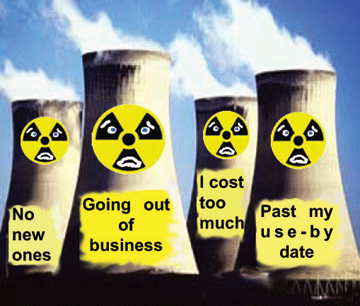 Why nuclear is in meltdown, Telegraph UK, Britain’s atomic plants will be cut from 10 to just one in little more than a decade. By Geoffrey Lean 02 Mar 2012 This week the world’s longest-running nuclear power station ran out of steam. At 11am on Wednesday, the appropriately named Oldbury in Gloucestershire – once a location for a Doctor Who storyline – was switched off after 44 years, as part of a wider shutdown that will cut Britain’s 10 atomic plants to just one in little more than a decade.
That same morning, just down the Severn Estuary, protesters were evicted from a deserted farmhouse on the site of the first of the new reactors designed to replace them. But the original start-up date for the plant – to be built by the French firm EDF at Somerset’s Hinkley Point – has already slipped by two years, from 2017 to 2019, and this week it emerged that the Office for Nuclear Regulation is delaying its safety approval.
It’s an ominous picture as next weekend’s anniversary of the Japanese tsunami and the disaster at Fukushima approaches – yet Britain is supposed to be one of the world’s few nuclear bright spots……
Elsewhere, the “nuclear renaissance” before Fukushima – which saw more than 400 reactors in construction or in the pipeline – has gone into reverse. Continue reading
86% of funds to deal with existing waste – UK’s Department of Energy and Climate Change
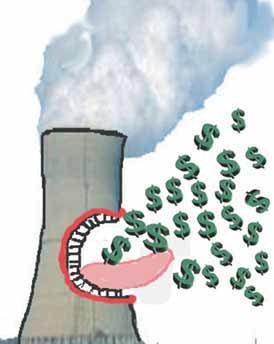 Department of Energy and Climate Change (DECC) is unique among government departments because it has to spend almost half of its budget on dealing with existing nuclear waste.
But to see that this has risen to almost almost 86% of overall DECC spending seemed incredible.
DECC must tell us the truth about nuclear waste, Energy and Environmental Management David Thorpe, 1st November 2011 It’s shocking but true: we are not, as I had always understood, investing in a fund to manage our current nuclear waste in the future.
We are paying lip service to it and dodging the question at the expense of future taxpayers.
Moreover, there is total confusion about what provisions are being put in place to manage any future waste from any new nuclear power stations.
Will the real DECC budget please stand up?
Last week, the Guardian published on its website figures which appeared to show that spending by the Department of Energy and Climate Change on nuclear waste management has risen by an astonishing 81%, as part of an overall budget increase from last year of over 146%.
In trying to find out whether this is true I have found out a truth worse than this, as well as an admission that any new nuclear operators are allegedly being asked to contribute to a fund not only to pay for management and disposal of the new nuclear waste which their plants will create, but also for that of existing nuclear waste!
According to the Guardian, in 2009/10 DECC’s entire spend totaled £3.18bn, but in 2010/11 it is spending £8.06bn, an increase of 146.02% that is largely due to nuclear liabilities.
This spending, according to the Guardian, breaks down as follows:
| DECC spending: £ per topic and change from last year | ||
| Topic | Amount | % increase or decrease |
|---|---|---|
| Nuclear Decommissioning Authority | £6.9bn | +81.12% |
| Committee for Climate Change | £4.4m | +12.12% |
| Low carbon UK | £622.7m | -29.8% |
| International agreement on climate change | £5.4m | +22.42% |
| Promoting low carbon technologies in developing countries |
£278.6m | +159.52% |
| Coal Authority | £0.7m | +87.02% |
| Professional support and infrastructure | £117.7m | -7.62% |
| Energy | £87.2m | +3.33% |
| Historic energy liabilities | £104.5m | -106.8% |
Who will pay for UK’s new nuclear waste?
DECC must tell us the truth about nuclear waste Energy and Environmental Management, David Thorpe, 1st November 2011 “…..Who will pay for new nuclear waste? In a phone conversation with another press officer, who I believe to be named Jonathan Farr, he admitted that new nuclear operators like Horizon and EDF are being asked to contribute to a fund not only to pay for management and disposal of the new nuclear waste which their plants will create, but also for that of existing nuclear waste.
I double checked that this was what he meant.
I said, “Are you seriously saying that the government is not putting aside cash to deal with our nuclear legacy but is asking nuclear operators to do so? What do they think of that?”
If I were a nuclear operator I would be outraged.
But the question was dodged. He was having a hard time explaining it in the first place, and merely reiterated the line that the government is taking a responsible position.
DECC’s line on new nuclear waste is: “New nuclear operators will be required by law to put money aside from day one to pay for the eventual decommissioning costs and their full share of waste disposal.” Continue reading
Nuclear plant 45 years working, 100 years++ to get rid of it
 Oldbury nuclear power station shutdown: What next? By Chris Kelly BBC News, 29 Feb 12, “…….the beginning of the end for Oldbury. The end, though, will extend many more years into the future than Oldbury’s 45-year history.
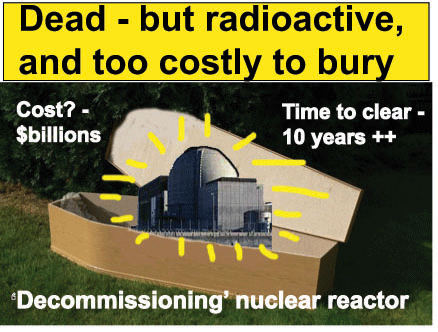
Over the next three years, all 52,000 fuel elements inside the station’s nuclear reactor will be gradually removed which will mean no more heat is generated by the reactor. The fuel is then taken away – by road from Oldbury to nearby Berkeley, site of another inactive nuclear power station – and then by rail to Sellafield where it is reprocessed.
Once the fuel has gone, other hazards and chemicals on the site such as carbon dioxide, hydrogen and acids are taken away and some of the buildings on the site will be demolished. “That will probably take about 15 years from now – so in the 2020s,” said Mr Sprauge. “What we will be left with then is the two reactor buildings and the centre block and pretty much nothing else.”
The longest job of the entire operation, though, will then begin. Leaving the station to slowly lose its radioactivity. And that job – which requires little human intervention – will take some 80 long years while the radioactivity from components in the reactor slowly fades.
The final bow for Oldbury’s mysterious looking reactor buildings will then come in 2109 when work can begin to pull them down. By then, the Oldbury reactor buildings may have a new neighbour. Horizon Nuclear Power – a conglomerate formed by E.On and RWE – hope to build a new power station, next to the existing reactor building, by 2019.
But one resident of nearby Sheperdine – Reg Illingworth – is less than pleased about the idea of a new reactor there.
Mr Illingworth, originally from Liverpool, moved to the nearby village of Shepperdine when plans were afoot to decommission Oldbury in 2007. But the life of the station was extended until 2012 before plans for the the Oldbury B station were announced.
“I’m hyper, hyper worried,” said Mr Illingworth, who is a member of a local anti-nuclear campaign group. He added he was “glad to see it’s closing”……http://www.bbc.co.uk/news/uk-england-bristol-17131988
Concern in UK over nuclear regulator paid through private company
Nuclear regulator paid through private firm will not have contract renewed Paul Brown’s friends accuse ministers of panicking after revelations about Student Loans boss’s tax arrangements Rajeev Syal guardian.co.uk, 24 February 2012 One of Britain’s leading nuclear regulators will not have his contract renewed after he was identified as receiving payment through a private company rather than the staff payroll.
Paul Brown is the chief operating officer of the Office for Nuclear Regulation (ONR) and was a senior director at the Health and Safety Executive (HSE)…. The ONR, an agency of the HSE, is responsible for the regulation of the UK’s nuclear sector. It must also oversee new safeguards being drawn up after the Fukushima meltdown triggered by the earthquake in
Japan last year. Continue reading
How a nuclear bomb in space could bring devastating cyber war
 Terror bomb detonated in space ‘could cripple Britain’s electronic networks and jeopardise national security’ Daily Mail, By IAN DRURY 22nd February 2012 Rogue states and terror groups could launch nuclear attacks in space to cripple Britain’s electronic networks and jeopardise national security, a report warns today. Continue reading
Decentralised renewable energy taking off in Britain’s small businesses
London Small and Medium Enterprises plan to generate their own renewable energy – and one in eight already do London Loves Business 20 February 2012 A number of London’s SMEs have invested in generating their own energy and even more plan to follow within the next five years, according to a survey.

About 13 per cent of the capital’s small and medium-sized firms now generate at least some of their own energy, higher than the national average of six per cent, Opus Energy’s research found.
The amount of SMEs based in London that could be producing their own energy by 2017 is set to rise to 38 per cent, if they carry out investment plans. One in 10 of London’s firms said they hoped to start generating renewable power on their business’ premises within the next
12 months…. http://www.londonlovesbusiness.com/news/london-firms-plan-to-generate-renewable-power/1737.article
Britain’s opportunity to lead in exporting marine energy technologies
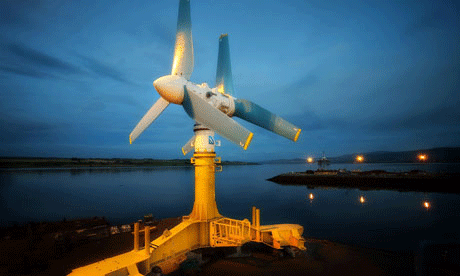
 UK could become leading exporter of wave and tidal power, say MPs New report from Energy and Climate Change Committee calls on government to establish long term goals for marine energy guardian.co.uk, 20 February 2012 The government will today be called on to increase its support for wave and tidal power in a new report from MPs warning the UK is at risk of repeating mistakes which allowed the country to lose its early lead in the developing wind power industry.
MPs on the Commons’ Energy and Climate Change Committee (ECC) on Monday released a report on the future of marine renewables, which will claim the UK could become a leading exporter of wave and tidal power equipment and expertise if the government adopts a more visionary approach to developing marine energy.
Seven of the the eight full-scale prototype devices installed worldwide are in UK waters, making the country the current world leader in the development of wave and tidal energy technologies. Continue reading
New nukes for UK – a desperate effort to save France’s nuclear industry?
the world is experiencing a ‘glut’ of gas according to the IEA
it is now looking increasingly likely that there will be no new nuclear power stations in Britain
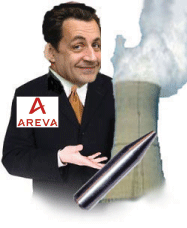 The decision on whether or not new nuclear is actually built in Britain will be taken in Paris, not London. And very possibly by a new French President less in thrall to the nuclear industry.
No More Nukes?, (UK) February 17, 2012 by tomburke It is just David Cameron’s bad luck to have chosen to back a nuclear future for Britain at a moment when it is becoming increasingly unlikely that it will happen. And it is entirely appropriate that he should find himself doing so in Paris since that is where the fate of DECC’s nuclear policy will be determined.
The idea of replacing Britain’s aging AGRs with Areva’s EPR was always inspired by a French government seeking to close an emerging decades long gap in domestic nuclear orders. The justification for British homeowners and businesses being forced to pay for a French industrial policy was a supposed electricity generation gap.
Without French nuclear power stations, Britons would be freezing in the dark by 2015 according to energy ministers. This was always nonsense but has been made totally ridiculous by several recent developments. Continue reading
Protestors occupy Hinkley nuclear site, accuse EDF of pre-empting permission
 Activists occupying new nuclear site accuse EDF of ‘ignoring democracy’ John Vidal, environment editor guardian.co.uk, Friday 17 February 2012 The energy company has started work on the £10bn Hinkley Point C power station without permission to build Environmental activists have occupied the site of what is planned to be Britain’s first new nuclear power station since 1995, and on Friday accused EDF of “ignoring democracy” and starting work on the £10bn project without permission to build the station….. Continue reading
Monumental mess of UK’s monumental nuclear reprocessing project
Sellafield faces nuclear option as overspending threatens plant’s future, The Independent UK, 13 Feb 2010 Britain’s biggest single nuclear project has run into serious trouble, with missed deadlines and cost overruns threatening the future of the nuclear reprocessing operation at Sellafield in Cumbria.
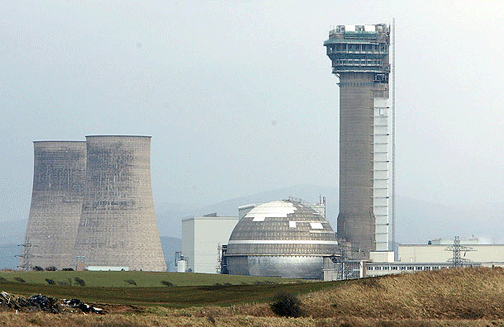
Nuclear authorities have ordered a review of a monumental construction project at Sellafield that is millions of pounds over budget and more than four years late following a series of delays and financial mismanagement. Continue reading
Anti nuclear campaign against Hinkley nuclear site
Anti-nuclear campaigners set up camp at Hinkley C site, BBC News 12 Feb 12, Protesters have set up camp in an abandoned farm on the site of the proposed Hinkley Point C nuclear power station in Somerset.
They are angry West Somerset Council has given EDF Energy the go-ahead for preparatory work before planning permission has been granted…. The South West Against Nuclear protesters arrived at the site in the early hours of Sunday……
A planning application for a new power station was submitted to the Infrastructure Planning Commission (IPC) in October. Further public consultation is taking place and a final decision will be made by the energy secretary.
Protester Zoe Stone said: “We are concerned EDF’s preliminary works are going to destroy a protected nature reserve, a site of Special Scientific Interest and all before they even have planning permission to build a power station….. http://www.bbc.co.uk/news/uk-england-somerset-17002517
320.000 UK homes get electricity from offshore wind turbines
 World’s biggest offshore wind farm officially connected to the Grid, Environmental News Network, 10 Feb 2012, The world’s biggest offshore wind farm was officially opened today after record-fast construction in the middle of the Irish Sea. The 102 turbines of the two connected Walney wind farms cover an area of 73 square-kilometres and were formally connected to the National Grid in a ceremony today.
With a capacity of 367.2MW, the huge project can provide low-carbon, green electricity to 320,000 homes. The generating capacity of each turbine, supplied by Siemens Wind Power, is 3.6MW, and the rotor diameter of the turbines is 107m for Walney 1 and 120m for Walney 2, with a maximum height of 150m from sea level to blade tip….. http://www.enn.com/energy/article/43984
England’s Conservative Party – a shambles of Climate Change Denialists
 In the main, the Tories are a coalition of climate change sceptics ….. Despite the fact that 60 per cent of voters think it is ‘right’ to ‘subsidise wind farms to encourage more use of wind power’.
Far from being ‘intermittent’ wind turbines operate between 70-80 per cent of the time, currently providing power for the equivalent of 3.3 million homes.
Climate change sceptics and rural romantics – the Tories are a shambles on renewable energy Left Foot Forward, by Kevin Meagher, February 7th 2012 It took less than 24 hours from the resignation of Chris Huhne for the Tories to strike. A hundred and one Tory backbenchers have written to David Cameron calling for an end to public subsidies designed to support Britain’s wind power industry.
They claim that subsidies should be drastically cut and draft planning guidance strengthened to make it easier for objectors to block wind farm schemes. Continue reading
UK assesses the nation’s coming dangers from climate change
UK ranks top risks posed by climate change, SMH, David Stringer, January 27, 2012 Coastlines, working patterns and even the country’s most famous meal are under threat from climate change, Britain says in its first-ever national assessment of the likely risks. Continue reading
1 This Month



Read the Public Inquiry Report, the Commissioners’ report, Surrendering Australia: The AUKUS Deception is available to download for free at aukuspublicinquiry.com. Or just watch the replay of the National Press Club Luncheon.

19 November – Webinar – The Reality of Reprocessing
Time: 11:00 AM Pacific Time (US & Canada) / 2:00 PM Eastern / 7:00 PM UK / 8:00 PM CET
Register for the Zoom Event Here


Shut down the radiation-damaged Heysham nuclear reactors now
To see nuclear-related stories in greater depth and intensity – go to https://nuclearinformation.wordpress.com

Say No to NASA’s Reckless Nuclear Reactor on the Moon
Say No to NASA’s Reckless Nuclear Reactor on the Moon
-
Archives
- November 2026 (128)
- October 2026 (302)
- September 2026 (339)
- August 2026 (330)
- July 2026 (355)
- June 2026 (287)
- May 2026 (306)
- April 2026 (356)
- March 2026 (251)
- February 2026 (267)
- January 2026 (308)
- December 2025 (358)
-
Categories
- 1
- 1 NUCLEAR ISSUES
- business and costs
- climate change
- culture and arts
- ENERGY
- environment
- health
- history
- indigenous issues
- Legal
- marketing of nuclear
- media
- opposition to nuclear
- PERSONAL STORIES
- politics
- politics international
- Religion and ethics
- safety
- secrets,lies and civil liberties
- spinbuster
- technology
- Uranium
- wastes
- weapons and war
- Women
- 2 WORLD
- ACTION
- AFRICA
- Atrocities
- AUSTRALIA
- Christina's notes
- Christina's themes
- culture and arts
- Events
- Fuk 2022
- Fuk 2023
- Fukushima 2017
- Fukushima 2018
- fukushima 2019
- Fukushima 2020
- Fukushima 2021
- general
- global warming
- Humour (God we need it)
- Nuclear
- RARE EARTHS
- Reference
- resources – print
- Resources -audiovicual
- Weekly Newsletter
- World
- World Nuclear
- YouTube
-
RSS
Entries RSS
Comments RSS

