Nuclear power industry in meltdown
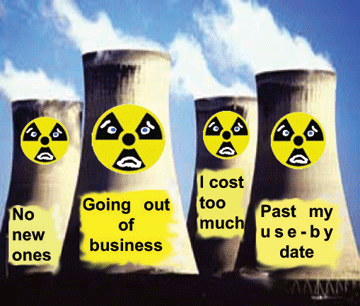 Why nuclear is in meltdown, Telegraph UK, Britain’s atomic plants will be cut from 10 to just one in little more than a decade. By Geoffrey Lean 02 Mar 2012 This week the world’s longest-running nuclear power station ran out of steam. At 11am on Wednesday, the appropriately named Oldbury in Gloucestershire – once a location for a Doctor Who storyline – was switched off after 44 years, as part of a wider shutdown that will cut Britain’s 10 atomic plants to just one in little more than a decade.
That same morning, just down the Severn Estuary, protesters were evicted from a deserted farmhouse on the site of the first of the new reactors designed to replace them. But the original start-up date for the plant – to be built by the French firm EDF at Somerset’s Hinkley Point – has already slipped by two years, from 2017 to 2019, and this week it emerged that the Office for Nuclear Regulation is delaying its safety approval.
It’s an ominous picture as next weekend’s anniversary of the Japanese tsunami and the disaster at Fukushima approaches – yet Britain is supposed to be one of the world’s few nuclear bright spots……
Elsewhere, the “nuclear renaissance” before Fukushima – which saw more than 400 reactors in construction or in the pipeline – has gone into reverse. Germany plans to scrap all its reactors by 2022. Italy, whose
senate voted by 154-1 in 2009 to end a 22-year ban on new plants, has
turned its back on the atom again. So has Switzerland, not known for
its vulnerability to tsunamis. Belgium is considering phasing out the
atom as early as 2015. Spain and Luxembourg are similarly hostile. And
this week, Kuwait abandoned its programme to build four reactors to
eke out its oil supplies.
The most dramatic reaction has come in France, which relies on nuclear
power for almost 80 per cent of its electricity – something that has
had strong public support. Yet last June, more than three quarters of
respondents told an opinion poll that they wanted it phased out.
François Hollande, the Socialist candidate who is favourite to win the
presidential election, promises to close 24 of the country’s 58
reactors by 2025…..
The report of the first independent, authoritative inquiry into
Fukushima – published this week in Japanese – will only increase
concern. It shows that a true catastrophe was averted not through the
inherent safety of the technology, as nuclear advocates have been
claiming, but through good fortune and the heroism of workers on the
site…..
Even without such alarming news, it seems that the nuclear flame is
flickering in places where it once burnt brightly. The United States
has just authorised its first two reactors in 30 years, but only in
Georgia, where the electricity price is favourably regulated. China
and India remain the industry’s greatest hopes, but their programmes
are slowing in the face of public protests: China began work on 10 new
reactors in 2010, but none last year.
There is also little chance that the Coalition’s ambitions will be
realised in Britain. The predecessors of EDF’s planned reactor, in
Finland and France, are years behind schedule and vastly over budget.
The other likely builder, Horizon, appears far from a final decision
to invest. As more and more ageing reactors like Oldbury come offline
over the next few years, the amount of power we get from the atom is
set to dwindle rather than grow.
http://www.telegraph.co.uk/comment/9118831/Why-nuclear-is-in-meltdown.html
No comments yet.
1 This Month
23-25 October – on Zoom – World BEYOND War’s annual global conferenc


Shut down the radiation-damaged Heysham nuclear reactors now
To see nuclear-related stories in greater depth and intensity – go to https://nuclearinformation.wordpress.com

Say No to NASA’s Reckless Nuclear Reactor on the Moon
Say No to NASA’s Reckless Nuclear Reactor on the Moon

-
Archives
- October 2026 (199)
- September 2026 (339)
- August 2026 (330)
- July 2026 (355)
- June 2026 (287)
- May 2026 (306)
- April 2026 (356)
- March 2026 (251)
- February 2026 (267)
- January 2026 (308)
- December 2025 (358)
- November 2025 (359)
-
Categories
- 1
- 1 NUCLEAR ISSUES
- business and costs
- climate change
- culture and arts
- ENERGY
- environment
- health
- history
- indigenous issues
- Legal
- marketing of nuclear
- media
- opposition to nuclear
- PERSONAL STORIES
- politics
- politics international
- Religion and ethics
- safety
- secrets,lies and civil liberties
- spinbuster
- technology
- Uranium
- wastes
- weapons and war
- Women
- 2 WORLD
- ACTION
- AFRICA
- Atrocities
- AUSTRALIA
- Christina's notes
- Christina's themes
- culture and arts
- Events
- Fuk 2022
- Fuk 2023
- Fukushima 2017
- Fukushima 2018
- fukushima 2019
- Fukushima 2020
- Fukushima 2021
- general
- global warming
- Humour (God we need it)
- Nuclear
- RARE EARTHS
- Reference
- resources – print
- Resources -audiovicual
- Weekly Newsletter
- World
- World Nuclear
- YouTube
-
RSS
Entries RSS
Comments RSS


Leave a Reply