Flamanville nuclear safety problem – a knockout blow for UK’s EPR reactor project?
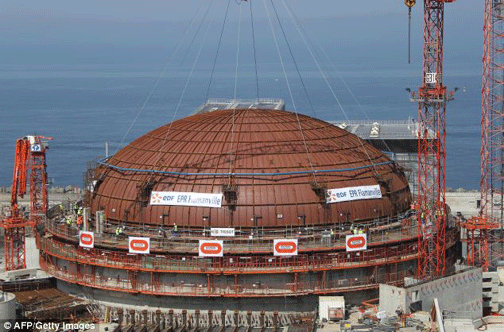 France’s nuclear calamity has UK worried, The Local, 21 Apr 2015 France’s world renowned prowess in the nuclear industry is being seriously undermined by its efforts to build a flagship nuclear reactor which is fast becoming a costly calamity. The future of the Flamanville 3 project appears to hang in the balance after yet another major setback that has London worried.
It was supposed to showcase the expertise of France’s nuclear energy industry to the world and is key to the UK’s own nuclear strategy. But after being beset by hold-ups and snags – the latest and potentially most serious one coming last week, the flagship project to build a new state of the art nuclear reactor, France is getting a reputation for all the wrong reasons and London has been left looking on nervously.
In 2005 the French government proudly gave the green light for construction to begin on the first third-generation nuclear reactor at Flamanville in Normandy on the north coast, a site environmentalists say is threatened by flooding.The third-generation “European Pressurized Reactor” (EPR), built by EDF and Areva, was supposed to be in operation by 2012 and is meant to be one of the safest reactors in the world, and the most energy efficient. It was commissioned as part of France’s nuclear renaissance programme that will see the country’s aging nuclear plants replaced over time.
However Flamanville 3, as it is known, is unlikely to start producing power anytime soon after being hampered by a litany of problems and incidents, including the death of a construction worker in 2011 (see below).
The latest setback came last week when it was revealed that “a very serious fault” had been detected in the steel of the “pressure vessel” – a key component of the reactor, meaning another delay of at least a year was likely. “It is a serious fault, even a very serious fault, because it involves a crucial part of the nuclear reactor,” said Pierre-Franck Chevet, head of France’s nuclear safety agency (ASN).
That “fault” means construction is unlikely to be completed before 2018 and more worryingly, the budget, initially set at €3.3 billion, is now estimated at more than €9 billion and counting.
In short Flamanville has become France’s own “nuclear catastrophe” as it was described in one of the many critical articles in the French press. Tests will need to be carried out on the steel vessel but if after these tests the vessel still does not meet necessary safety standards, it will need to be changed.
“That’s a very difficult operation in terms of costs and time,” said the ASN’s Chevet. The steel vessels weigh around 425 tonnes and stand around 11 metres high so building a new one would take considerable time and come at a huge cost.Changing the vessel would be a major headache given all the construction work that would need to be undone.
Some in the business of nuclear safety have even suggested that if the steel vessel needs replacing then the whole project could be scrapped. That will have authorities in the UK sweating as the same steel has been used to build two vessels destined for the planned EPR nuclear reactors at Hinkley Point in the UK.…….
“This is clearly the knock-out blow for the EPR reactor,” said Yannick Rousselet from Greenpeace. “What foreign client would want to purchase a reactor of this type, if even France itself is not able to complete the construction?
“The bill from the EPR reactor will be so high that it won’t end up showcasing what to do, but exactly the opposite,” said Rousselet. “This is a huge blow to the know-how of the French nuclear industry.”
Greenpeace has called for work at Flamanville to be called off.
“It must be stopped immediately so there is no more wasting of public funds on this industrial nightmare,” said Rousselet, who added that France should be concentrating resources on finding renewable energy solutions……..http://www.thelocal.fr/20150421/flamanville-frances-own-nuclear-nightmare
Energy investors advised to “cut their losses” and dump Hinkley nuclear reactor
 EDF should ‘cuts its losses’ as Hinkley plans come under threat, Western Morning News 18 Apr 15 Campaigners are calling on energy investors to “cut their losses” on plans for a new reactor at Hinkley Point after a “very serious” fault was discovered in a similar French scheme.
Members of the Stop Hinkley group say project backers EDF should “give up” on plans for two new nuclear reactors at the Somerset plant and pursue a more “sensible” sustainable energy strategy. The comments come as French officials revealed details of an anomaly that occurred during the construction of an identical EPR power plant in Normandy.
EDF Energy, which will own and operate the Hinkley plant, said further investigations would be carried out on the development as soon as possible.
But the revelation has given rise to concerns about the future of Britain’s power supply, as Hinkley was expected to generate roughly 16% of the country’s electricity by the mid-2020s.
The problem with the new reactor at Flamanville is understood to surround the quality of the steel used to construct a casing around the reactor, known as the pressure vessel. Pierre-Franck Chevet, head of France’s nuclear safety inspectorate, said it was potentially “very serious” as it involved “a crucial part” of the reactor.
He added that the same manufacturing techniques had been used for the identical casings intended for Hinkley Point, which “have already been manufactured”.
Plans to develop a new generation of British reactors at Hinkley go back to the last Labour government in January 2008. The EPR reactors chosen for the site use pressurised water and are built to resist the impact of a commercial airline crash……..
Alan Jeffery, spokesman for Stop Hinkley, suggested the company should abandon its plans for the Somerset plant and start pursuing alternative options for the Westcountry.
“EDF Energy should cut its losses and give up on Hinkley C now, so that the South West can get on with developing a sensible sustainable energy strategy,” he said.
“To tackle climate change effectively we need to get started on energy efficiency and renewable energy programmes now, not waiting around for the nuclear industry to sort out its problems first.
“We don’t need this massive project that is going to leave us with a legacy of highly dangerous nuclear waste and radioactive emissions into our environment.” http://www.westernmorningnews.co.uk/EDF-cuts-losses-Hinkley-plans-come-threat/story-26353282-detail/story.html#ixzz3XnLzU0Nw
Follow us: @WMNNews on Twitter | westernmorningnews on Facebook
UK’s £14bn Hinkley project – future now in doubt, as faults found in identical French project
 UK nuclear strategy faces meltdown as faults are found in identical French project The faults could also scare off the Chinese state investors who are supposed to cover part of the cost of the £14bn Hinkley project Independent JOHN LICHFIELD
  PARIS Friday 17 April 2015 A “very serious” fault has been discovered in a French nuclear power station which is at the heart of David Cameron’s strategy to “keep the lights on” in Britain in the next decade.
The future of two nuclear reactors planned for Hinkley Point in Somerset has been thrown into doubt by the discovery of a potentially catastrophic mistake in the construction of an identical EPR power plant in Normandy.
“It is a serious fault, even a very serious fault, because it involves a crucial part of the nuclear reactor,” said Pierre-Franck Chevet, head of France’s nuclear safety inspectorate.
A second investigation has been ordered into the quality of the steel used to make a 50ft-high safety casing, or “pressure vessel”, which encloses the groundbreaking new reactor at Flamanville, near Cherbourg. If the steel proves to be defective, the completion of the prototype EPR plant – already behind schedule and nearly three times over budget – could be delayed for several years.
Mr Chevet also revealed that the same manufacturing techniques had been used in the steel for the identical safety casings destined for Hinkley Point, which “have already been manufactured”.
The fault could undermine the already fragile finances of the French state-owned nuclear construction company Areva, which is supposed to build two EPR reactors at Hinkley by 2023 and a third at Sizewell in Suffolk. It could also scare off the Chinese state investors who are supposed to cover part of the cost of the £14bn Hinkley project, intended to supply six per cent of Britain’s energy needs for six decades.
A final “investment” decision for Hinkley, several times delayed, is now expected in June. The French Prime Minister Manuel Valls called a crisis meeting on 17 April to discuss the threat posed by the fault to France’s nuclear construction industry – the largest in the world.
Mark Hackett, a councillor in Manchester who chairs Nuclear Free Local Authorities, said: “This is a devastating blow to proponents of new-build nuclear power stations in the UK. It is likely to scare off the Chinese backers. If I was a betting man, I would now bet that Hinkley Point will never be built.”
Yannick Rousselet, of Greenpeace France, said the latest problems to beset the prototype power station in Normandy are “clearly the coup de grâce for the EPR idea”. He asked: “What foreign client would want to buy this reactor when France itself is not capable of completing its construction?”
Apart from Britain, the United States and China are in the process of buying versions of the new generation of European Pressurised Reactor (EPR) – supposedly safer and more efficient – from France. Both Areva and Eléctricité de France (EDF), the French energy giant which will own and operate Hinkley Point, have refused to comment in detail………
Sources in the French nuclear industry told the newspaper Le Parisien yesterday that dismantling the faulty pressure vessel and ordering and manufacturing a new one could take several years. “If the weakness of the steel is proved, I don’t hold out much hope for the survival of the EPR project,” a former senior nuclear safety official told Le Parisien………..http://www.independent.co.uk/news/uk/home-news/uk-nuclear-strategy-faces-meltdown-as-faults-are-found-in-identical-french-project-10186163.html
Time Britain called it a day for Trident nuclear weapons
It’s time for Britain to move on from nuclear weapons http://www.theguardian.com/uk-news/2015/apr/11/letters-trident-not-desirable
Pinning our security on a nuclear deterrent encourages others to do the same The election campaign to date suggests that decommissioning Trident nuclear weapons is a dangerous, minority demand led by the SNP, the Greens and Plaid Cymru. Yet poll after poll reveals that it is in fact a majority popular demand throughout the UK. One poll recently revealed that 81% of 500 general election candidates are opposed to renewal. There are increasingly obvious reasons why we think it’s time to move on from Trident.
Pinning our security on a nuclear deterrent encourages others to do the same. The UK should become the first permanent member of the UN Security Council to give up all its nuclear weapons, transforming the nuclear club from within. Instead of protecting us, hosting nuclear weapons makes us a target for the disaffected. And any accident would lead to a humanitarian disaster. Having nuclear weapons diverts resources and attention from tackling our most urgent security problems, including climate and environmental destruction.
Finally, continuing to invest in nuclear weapons is actively depleting military and other effective defences we might need in the 21st century. We should invest military spending on conflict prevention. By moving on from Trident, we can more effectively serve the needs and the potential of our country and a changing world.
www.moveontrident.org ; Helena Kennedy QC; Young Fathers, Mercury prizewinners; Prof Peter Higgs, 2014 Nobel prize for physics; Vivienne Westwood, designer and activist; Frankie Boyle, comedian; Neal Lawson, Compass; Gabrielle Rifkind, Oxford Research Group; Konnie Huq, presenter; Massive Attack; Sir Michael Atiyah, ex-president of the Royal Society; Marina Cantacuzino, founder of The Forgiveness Project; Jonathon Porritt, Forum for the Future; Robin McAlpine, director, Common Weal; Kamila Shamsie, writer; Lindsey Coulson, actress
Muzzling scientists: UK follows Canada’s lead

 Following Canada’s Bad Example, Now UK Wants To Muzzle Scientists And Their Inconvenient Truths https://www.techdirt.com/articles/20150331/06512830496/following-canadas-
bad-example-now-uk-wants-to-muzzle-scientists-their-inconvenient-truths.shtml from the non-appliance-of-science dept Free Speech by Glyn MoodyWed, Apr 1st 2015
Under the new code, scientists and engineers employed at government expense must get ministerial approval before they can talk to the media about any of their research, whether it involves GM crops, flu vaccines, the impact of pesticides on bees, or the famously obscure Higgs boson.

The fear — quite naturally — is that ministers could take days before replying to requests, by which time news outlets will probably have lost interest. As a result of this change, science organizations have sent a letter to the UK government, expressing their “deep concern” about the code. A well-known British neurobiologist, Sir Colin Blakemore, told the Guardian:
“The real losers here are the public and the government. The public lose access to what they consider to be an important source of scientific evidence, and the government loses the trust of the public,” Blakemore said.
Not only that, by following Canada’s example, the British government also makes it more likely that other countries will do the same, which will weaken science’s ability to participate in policy discussions around the world — just when we need to hear its voice most.
Follow me @glynmoody on Twitter or identi.ca, and +glynmoody on Google+
Nuclear waste dumps can be forced on local communities – new British law
 Law changed so nuclear waste dumps can be forced on local communities http://www.theguardian.com/environment/2015/apr/05/law-changed-so-nuclear-waste-dumps-can-be-forced-on-local-communities Legislation rushed through in the final hours of parliament allows local planning laws to be bypassed, seriously alarming anti-nuclear campaigners Nuclear waste dumps can be imposed on local communities without their support under a new law rushed through in the final hours of parliament.
Under the latest rules, the long search for a place to store Britain’s stockpile of 50 years’ worth of the most radioactive waste from power stations, weapons and medical use can be ended by bypassing local planning.
Since last week, the sites are now officially considered “nationally significant infrastructure projects” and so will be chosen by the secretary of state for energy. He or she would get advice from the planning inspectorate, but would not be bound by the recommendation. Local councils and communities can object to details of the development but cannot stop it altogether.
The move went barely noticed as it was passed late on the day before parliament was prorogued for the general election, but has alarmed local objectors and anti-nuclear campaigners.
Friends of the Earth’s planning advisor, Naomi Luhde-Thompson, said: “Communities will be rightly concerned about any attempts to foist a radioactive waste dump on them. We urgently need a long-term management plan for the radioactive waste we’ve already created, but decisions mustn’t be taken away from local people who have to live with the impacts.”
Objectors worry that ministers are desperate to find a solution to the current radioactive waste problem to win public support to build a new generation of nuclear power stations.
Zac Goldsmith, one of the few government MPs who broke ranks to vote against the move, criticised the lack of public debate about such a “big” change. “Effectively it strips local authorities of the ability to stop waste being dumped in their communities,” he said.
Labour abstained in the vote, indicating that a future government will not want to reverse the change of rules. However, the shadow energy minister, Julie Elliott, has warned that the project is expected to take 27 years to build even after a preferred site was identified and would cost £4bn-5.6bn a year to build, plus the cost of running it for 40 years.
Since the Royal Commission on Environmental Pollution found in 1976 that it was “morally wrong” to keep generating nuclear waste without a demonstrably safe way of storing the waste, there have been at least four attempts to find the right site, all of them shelved after strong protest.
There are now 4.5m cubic metres of accumulated radioactive waste kept in secure containers at sites across Britain, though only 1,100m3 of this is the most controversial high-level waste, and 290,000m3 is intermediate-level waste. Itcosts £3bn a year to manage the nuclear waste mountain, of which £2bn comes from taxpayers.
The most recent proposal for a more permanent solution was to ask local authorities to volunteer to examine whether they could host the development. Initially, a coalition of Cumbria county council and Copeland and Allerdale borough councils put their names forward, but the policy stalled in 2013 when the county council pulled out.
Last year, the Department for Energy and Climate Change (DECC) published awhite paper which said ministers would prefer to work with public support, but reserved the right to take more aggressive action on planning if “at some point in the future such an approach does not look likely to work”.
The day before parliament rose, MPs voted in an unusual paper ballot to implement a two-page statutory instrument which adds nuclear waste storage to the list of nationally significant infrastructure projects in England, via the 2008 Planning Act.
Officials have said approval depends on a “test of public support” and any site would undergo extensive geological safety tests.
Copeland borough council, one of the two areas most affected by any such development at Sellafield, said it was pleased with the government’s change to planning rules.
Radiation-Free Lakeland – set up to block the Sellafield proposal because they claim there is no evidence deep storage is safe or that the geology of Cumbria is suitable – claimed, however, “the test of public support is a fig leaf: the government hast’t said what the public support will be”.
The only existing high-level radioactive underground waste storage, in New Mexico, USA, has been closed since last year following two accidents.
Germany has put similar plans for burying high-level waste on hold and four other countries, including France and Japan, are examining the idea.
UK plan for solar panels on every school roof
 Crowdsourcing funds will put solar panels on every school roof http://www.theguardian.com/environment/2015/apr/05/solar-panels-school-energy, Daniel Boffey Labour says schools would benefit by average of £8,000 a year and spread understanding of sustainability Every school in the country will be offered help with installing solar panels on their roofs under plans being considered by Labour. Schools would not only be able to reduce their bills, but could also raise revenues by selling surplus electricity back into the national grid. It is estimated that the initiative could earn schools involved an average of around £8,000 a year.
The government’s role would be in helping headteachers to crowdsource funds for the panels. Civil servants would also deal with linking up schools to the national grid and payments.
Gareth Thomas, a Labour MP mooted as a potential Labour candidate for London mayor in 2016, said the policy could help to free schools from reliance on the big six energy firms.
Thomas, who is promoting the policy as chairman of the Co-operative grouping of MPs within Labour, said: “Britain needs to expand community energy to give people more control over the energy they depend on. Helping schools to set up energy co-operatives to get a self-financing solar roof is a great way to spread understanding about sustainability.”
Friends of the Earth says that if every school installed solar panels the amount of energy generated would be the same as that used by 380,000 homes and would cut carbon emissions by the same amount as taking 110,000 cars off the road. A charity called Solar Schools is helping 66 schools raise a target of £851,000 and has crowdsourced half the target in six months.
The education sector represents a major potential market for the solar industry, as schools typically have large rooftops ideal for panels and rarely face planning difficulties. Current government regulations stop schools from borrowing to fund solar installations, even though ministers had said they wanted more solar panels installed on the roofs of public sector buildings.
UK’s Hinkley nuclear plant developments stalled as financial negotiations drag on
 Hinkley Point C nuclear project workers face layoff , Guardian 2 Apr 15 Up to 400 constructors at site of new nuclear power station could be laid off as preparation work comes to end before final investment decision by owner EDF. As many as 400 workers at the site of a new nuclear power station at Hinkley Point face being laid off while the French owners of the project decide whether to make an investment in the £16bn project.
EDF has almost completed the project’s preparatory earthworks, drainage, welfare facilities and roadworks, but is yet to decide on the investment to mark the beginning of the construction the plant in Somerset.
The company said a decision would be reached in the coming months, and it has already launched a 45-day redundancies consultation, said the unions…….
It is the first new new nuclear plant in the UK in decades and is scheduled to start producing electricity in 2023. EDF, however, is still negotiating with UK authorities about government debt guarantees for the project, along with decommissioning costs and other details.
It is also negotiating with two Chinese utilities about their role in Hinkley Point and possible future UK nuclear projects with EDF……http://www.theguardian.com/environment/2015/apr/02/hinkley-point-c-nuclear-project-workers-face-layoff-power-station-investment-edf
Torness nuclear power station has radiation leak
Radiation leak at Torness nuclear power station, Herald Scotland Rob Edwards Sunday 29 March 2015 An investigation is under way after a radiation leaked at the Torness nuclear power station in East Lothian, the Sunday Herald can reveal. According to the French state company that runs Torness, EDF Energy, radioactive tritium was discovered in water contained in part of the power station’s drainage system. The discovery was immediately reported to the Scottish Environment Protection Agency (Sepa) and the UK government’s Office for Nuclear Regulation (ONR)……
Dr Richard Dixon, director of Friends of the Earth Scotland, warned that Torness was “well into middle age and the cracks are literally beginning to show”.
He said: “This is the latest in a series of problems at Scotland’s two nuclear stations and shows that regulators need to be very vigilant if we are to avoid a serious release of radioactivity to the local environment while these plants continue to operate.”
The local liaison committee was told that reactors at Torness had to be unexpectedly shut down four times in 2014 because of a series of equipment faults. EDF Energy also operates a 39-year-old nuclear power station at Hunterston in North Ayrshire, where cracks and breakdowns were reported in October 2014.
Jason Rose, Scottish Green candidate for MP in East Lothian, thought that the number of leaks and shutdowns showed that Torness was well past its prime. “Those of us who have to live with a nuclear plant on our doorstep need assurances from EDF that more effort will be made to prevent these sorts of serious incidents,” he said.
“I remain extremely concerned that there will be no public scrutiny of plans to extend the operating life of the plant, and no effort by local or national government to prepare a smooth transition for workers and the economy. Local people should have a say in what happens next at Torness.”……http://www.heraldscotland.com/news/environment/investigation-under-way-into-radiation-leak-at-torness-nuclear-power-station.121878992
UK’s official data show how renewable energy has overtaken nuclear
 UK: Solar grows 93% in 2014 as renewables overtake nuclear. http://www.pv-magazine.com/news/details/beitrag/uk–solar-grows-93-in-2014-as-renewables-overtake-nuclear_100018792/#axzz3VWyAXbwj Renewable energy generated 19.2% of the U.K.’s electricity in 2014, government figures show, surpassing nuclear generation for the first time ever
Official data from the U.K. government has confirmed that renewable energy contributed more to the grid than nuclear power for the first time ever in 2014.
The statistics show that renewables accounted for 19.2% of electricity generation last year, ahead of nuclear power, which generated 19% of the country’s electricity.
Total renewable electricity capacity at the end of the year stood at 24.2 GW, which was 4.5 GW – or 23% – more than a year previously.
Although solar PV’s share of renewable generation was a mere 6%, the industry’s participation in electricity generation grew a massive 93% last year, boosted by the 2.8 GW of solar PV capacity added over the course of 2014. Solar PV powered 3.9 terawatt hours (TWh) of electricity. No other renewable energy source grew as fast. Continue reading
50% of power from renewables in Scotland 2014
 Scotland: 50% powered by renewables in 2014 http://www.edie.net/news/6/Scotland–50–powered-by-renewables/ 26 March 2015, source edie newsroom Lucinda Dann
The figures show that renewables generated 32% more electricity than any other single source of power in Scotland.
In total, the renewables sector generated a record 10.3TWh, compared to 7.8TWh2 from nuclear generation – previously Scotland’s main source of electricity. The figures also show that coal and gas-fired electricity generation produced 5.6TWh and 1.4TWh respectively over the same six-month period. Historic Wind made the most significant contribution to the total with 11,592 GWh, up 4% from 2013, and making it another record breaking year for wind. Bioenergy saw the biggest increase in output – rising 11.7% in the last year.
Scottish Renewables chief executive Niall Stuart said: “The announcement that renewables have become Scotland’s main source of electricity is historic news for our country, and shows the investment made in the sector is helping to deliver more power than ever before to our homes and businesses.
“Every unit of power generated from renewables means less carbon emitted from the burning of fossil fuels, decreases our reliance on imported energy and supports jobs and investment in communities across Scotland.”
Top priority Energy Minister Fergus Ewing added: “2014 was also another record breaking year for wind output and the Scottish Government remains committed to continuing this upward trend. The recent independent survey by YouGov shows further support for the development of wind power, with an increase to 71 per cent in public backing.
“The Scottish Government has made its energy policy a top priority and has achieved great progress, despite being limited in terms of its devolved responsibilities. We look forward to proposals for more powers encompassing the necessary levers to deliver Scottish priorities.”
WWF Scotland said that for Scotland to meet its next renewable target in 2020, the offshore wind sector would have a major role to play.
WWF Scotland’s head of policy Dr Sam Gardner said: “To ensure the continued growth of this industry, attract supply chain investment, and continue to bring down costs, the next UK Government must provide a stable and sustained funding pipeline for offshore wind and clear volume signals in the 2020s.”
Scotland is significantly ahead of the rest of the UK, where renewables still only account for a fifth of all UK electricity. However this increase in greener energy generation has still contributed to an 8% drop in total emissions.
Copper Consultancy PR firm helps UK govt to undemocratic management of nuclear wastes
Whose idea was it to scrap democracy in order to dump nuclear wastes? https://mariannewildart.wordpress.com/2015/03/23/whose-idea-was-it-to-scrap-democracy-in-order-to-dump-nuclear-wastes/ Radiation Free Lakeland and others are asking: Just whose idea was it to plan to scrap democracy in order to dump nuclear wastes? Was the bright idea given to Government by the PR firm Copper Consulting?
Copper Consultancy a PR firm with offices in London, Bristol, Suffolk and most recently Cumbria, told the Department of Energy and Climate Change that: “allowing local authorities to determine the outcome of a process which is designed to deliver a national Government policy may not be the most appropriate route.” This piece of work is a response to Cumbria County Council and the majority of Parish Councils’ saying no to geological disposal of nuclear wastes.
In their blog Copper Consulting go on to say that: “local authorities are consultees rather than decision makers. The final  decision rests with the Planning Inspectorate and the Secretary of State. A logical conclusion might therefore be to classify the GDF as an NSIP”
There has always been a suspicion that nuclear is a PR strategy rather than an energy strategy, now we have proof. There is a revolving door between the NDA and Copper Consultancy a PR firm. Ivan Stone who was Executive Director of Copper Consultancy is now the Stakeholder Engagement and Communications Director – of the NDA/RWM (Radioactive Waste Management – a new arm of NDA) Copper Consultancy have also just been awarded the PR job of selling newnuclear build and new nuclear wastes at Moorside to the public. Continue reading
Small Nuclear Reactors turn out to have an equally Big Radioactive Waste problem
1. Small Reactors and the UK’s Long-Term Nuclear Strategy. nuClear News, March 2015 “……Waste Implications The Committee on Radioactive Waste Management (CoRWM) has looked at the waste implications of a 75GW programme [ i.e Small Modular Reactor or PRISM] which would be equivalent to a programme of over 50 new large-scale reactors.It said that since the Government has, so far, been mainly talking about the waste inventory from only a 16GW nuclear new build programme, it should consider defining a maximum size for a deep geological facility (GDF) and make clear that we might need multiple GDFs. (15)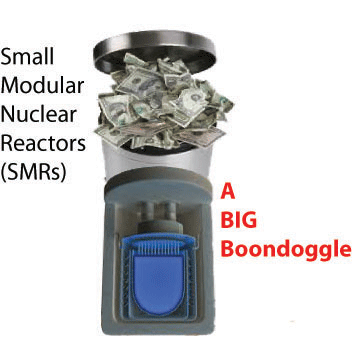 first someone needs to build a massive supply chain. Money for that would presumably come from customer orders – if there were any. The problem is it appears that no one actually wants to buy one
Scotland’s influence on UK decisions on Trident nuclear fleet
 Scottish Party May Prove Crucial to Future of Britain’s Nuclear Fleet NYT, By STEPHEN CASTLE MARCH 21, 2015 “…….Scotland’s growing political importance has made the future of the nuclear arsenal an issue in Britain’s general election campaign, intensifying debate over whether the country can afford its nuclear deterrent, a quarter-century after the end of the Cold War.
That question is being asked because of the surging popularity of the Scottish National Party, which stands to the left of the opposition Labour Party and has promised to rid Scotland of nuclear weapons, putting it at odds with both Labour and the Conservative-led government.
Despite losing its bid last year for Scotland to win independence from Britain, the Scottish National Party has gained strength in the polls and could tilt the balance of power if, as happened in the last national election in 2010, neither Labour nor the Conservatives win an outright majority in Parliament in the voting on May 7.
Should Labour win the opportunity to form a government and turn to the Scottish National Party for support — a prospect analysts say is very real despite a Labour promise not to enter a formal coalition with the party — the question of abandoning the Trident missile system, moving the fleet from Scotland, or at least delaying an expensive modernization program would be on the table……..
The politics of Scotland is now crucial to the future of Britain’s nuclear deterrent. Angus Robertson, the Scottish National Party’s defense spokesman, said that Faslane is a symbol of how Scottish views on Trident have been “totally ignored” and that “repeated British governments have made decisions over the heads of people in Scotland.”
Cost of Small Nuclear Reactors is greater than cost of large ones

1 This Month





PLEASE OPPOSE HR 8255 AND S.3639 – bills would accelerate satellite deployment, with no environmental review or safeguards – https://ncstd5li.quorum.us/campaign/169331/
To see nuclear-related stories in greater depth and intensity – go to https://nuclearinformation.wordpress.com
-
Archives
- October 2026 (58)
- September 2026 (339)
- August 2026 (330)
- July 2026 (355)
- June 2026 (287)
- May 2026 (306)
- April 2026 (356)
- March 2026 (251)
- February 2026 (267)
- January 2026 (308)
- December 2025 (358)
- November 2025 (359)
-
Categories
- 1
- 1 NUCLEAR ISSUES
- business and costs
- climate change
- culture and arts
- ENERGY
- environment
- health
- history
- indigenous issues
- Legal
- marketing of nuclear
- media
- opposition to nuclear
- PERSONAL STORIES
- politics
- politics international
- Religion and ethics
- safety
- secrets,lies and civil liberties
- spinbuster
- technology
- Uranium
- wastes
- weapons and war
- Women
- 2 WORLD
- ACTION
- AFRICA
- Atrocities
- AUSTRALIA
- Christina's notes
- Christina's themes
- culture and arts
- Events
- Fuk 2022
- Fuk 2023
- Fukushima 2017
- Fukushima 2018
- fukushima 2019
- Fukushima 2020
- Fukushima 2021
- general
- global warming
- Humour (God we need it)
- Nuclear
- RARE EARTHS
- Reference
- resources – print
- Resources -audiovicual
- Weekly Newsletter
- World
- World Nuclear
- YouTube
-
RSS
Entries RSS
Comments RSS

