In just one year, Sellafield nuclear clean-up bill jumps an extra £5bn
Cost of nuclear clean up at Sellafield increased an extra £5bn in the past year Chronicle Live UK By Will Metcalfe 15 Mar 15 The Nuclear Decommissioning Authority has been slammed by MPs for the ever-increasing costs at the site in Cumbria Constantly increasing costs for the clean up of Sellafield are Britain’s bill for the Cold War, an MP has claimed.
This week MPs launched a fresh attack against the rising cost and delays of decommissioning and cleaning up the Sellafield nuclear site.
Leading figures from the nuclear industry were questioned by the Public Accounts Committee following the revelation that the expected costs have increased by £5 billion in a year, to £53 billion.
In a recent progress report on the work, the National Audit Office (NAO) criticised the Nuclear Decommissioning Authority (NDA), which oversees the plant, for delays in cancelling a clean-up contract with the consortium Nuclear Management Partners (NMP) after demands from MPs a year ago to do so.
The report said the contract was terminated only last month, at a cost to the taxpayer of £430,000 in cancellation fees.
- The site is used to store nuclear material from across the UK and was the host of a facility which secretly produced nuclear materials for the UK’s defence programme during the Cold War which was finally demolished in 2014……..
Labour MP Margaret Hodge, who chairs the committee, described the rise as “astonishing” and repeated her criticism during a hearing on Wednesday.
Delays had increased by 86 months since September 2013, while costs were going up by billions of pounds, she said…..
She said she was struck by the “unpredictable massive burden on future generations”, telling the nuclear industry officials it was a good idea to have strong targets and ambitions……..http://www.chroniclelive.co.uk/news/north-east-news/cost-nuclear-clean-up-sellafield-8838478
UK Labour thinking about having fewer nuclear submarines
LABOUR ‘PONDERS FEWER NUCLEAR SUBS‘, Herald Scotland, 15 March 2015 A Labour government would consider if one submarine fewer could be used to provide Britain’s nuclear deterrent, Ed Balls has said……..
The SNP is committed to scrapping the nuclear weapons system, with the issue proving a major election issue north of the border.
Labour’s support for maintaining the nuclear deterrent could be a stumbling block to any post-election deal with the SNP.
Speaking on BBC Radio 5 Live’s Pienaar’s Politics, Mr Balls reiterated Labour’s commitment to providing Trident while offering the greatest value for money…..
In a statement, SNP MSP Bill Kidd said: “One submarine armed with Trident nuclear weapons of mass destruction is one too many – and a recent New Statesman survey showed three quarters of Labour’s Westminster candidates agree as they don’t support Trident renewal.
“An absolute priority for a strong team of SNP MPs at Westminster will be to use their clout to make sure that we don’t waste £100 billion on putting a new generation of nuclear weapons on the River Clyde – with the money saved invested in health, education and childcare.” http://www.heraldscotland.com/politics/scottish-politics/labour-ponders-fewer-nuclear-subs.120693836
Unsafety for workers decommissioning Dounreay nuclear power station.
Nuclear waste workers at Dounreay power station fear for their safety Decommissioning staff, hit by injuries and concerned about equipment, express ‘no confidence’ in management Independent UK, MARK LEFTLY  SUNDAY 15 MARCH 2015 THE DECOMMISSIONING OF ONE OF THE UK’S MOST SIGNIFICANT NUCLEAR POWER STATIONS HAS RUN INTO SERIOUS PROBLEMS AFTER WORKERS RESPONSIBLE FOR DISPOSING OF RADIOACTIVE WASTE ACCUSED THEIR MANAGERS OF FAILING TO KEEP THEM SAFE.
Staff at Dounreay, on Scotland’s northern coast, have written to the site’s managing director, Mark Rouse, to raise concerns about decommissioning process.
The letter, seen by The Independent on Sunday, says workers have reported an “increasing number of injuries” and have “serious concerns” about the quality of new protective suits and other safety equipment. And they have “no confidence in senior management”.
The letter was sent to Mr Rouse last November, six weeks after a fire at the plant resulted in a serious radioactive leak. Staff warn that the situation at Dounreay is now similar to that of the mid-1990s, when a major safety audit had to be carried out.
Later this week Mr Rouse and a senior executive from the Nuclear Decommissioning Authority (NDA) will address the Dounreay Stakeholder Group, but the problems will add to growing concerns around the UK’s multi-billion pound nuclear clean-up industry. Earlier this month, the National Audit Office reported that the cost of decommissioning and cleaning up the Sellafield nuclear site in Cumbria has increased by £5bn to £53bn. The private sector consortium responsible for Sellafield was sacked in January.
In September, it emerged that the overall cost of cleaning up Britain’s toxic nuclear sites has risen by £6bn, from an estimated £63bn over the next century to £69bn. The Government and regulators have been accused of “incompetence”…..
The workers’ letter claims that the focus on delivery has been “at the expense of safe processes and practices on health, safety and welfare”…….http://www.independent.co.uk/news/uk/home-news/nuclear-waste-workers-at-dounreay-power-station-fear-for-their-safety-10108715.html
Web traffic for the UK’s nuclear weapons agency routed through Russian telecom by error
For the past week, something strange has been going on in the European internet. For five days, web traffic from Texas to certain addresses in the UK has been routed through Ukrainian and Russian telecoms, taking a detour thousands of miles out of the way. Network traffic often takes a circuitous route as a result of network congestion or interconnection difficulties, but neither one would be enough to account for these routes. Instead, this was the result of a bad route announced by Ukraine’s Vega telecom, inserting itself in between. “At this point, I have to believe this was an innocent mistake by Vega,” said Dyn’s Doug Madory, who first discovered the redirection, “but it’s concerning nonetheless.”
It’s still likely that the redirection was simply an innocent error, but it underscores the insecure nature of the global routing system. While much of the web has grown more wary of digital attack, routing is still based on trust, with networks freely announcing routes and friendly telecoms adopting them as a matter of habit. As a result, inefficient and potentially insecure routes like this one can linger for days without being corrected, without the parties involved ever being aware of them.
The full traceroute is below, with the Ukrainian telecom visible at line 11 and Russian interconnection at 12 and 13:…..http://www.theverge.com/2015/3/13/8208413/uk-nuclear-weapons-russia-traffic-redirect
Hinkley Nuclear Power Plant – Game Over?

 Hinkley Point: the Beginning of the End, Jonathon Porritt, 11 Mar 15 I’ve always said that the two proposed new reactors at Hinkley Point would never get built. Now I’m not just saying it: I’m absolutely convinced that they’ll never get built.
A couple of weeks ago, EdF formally confirmed that no decision would be taken on Hinkley Point before the General Election, and probably not before the end of the year. The reason it gave was that: “We are in the final phase of negotiations, but that phase can take a considerable amount of time, depending on the number of problems left to resolve.”
And that list of problems is daunting. First, it needs to be able to sign final deals with co-investors, including the Chinese, who are beginning to cut up rough; then it needs final confirmation from the European Commission and the UK Government for a whole load of issues regarding the waste transfer contract; it needs to finalise a £10bn loan guarantee from the Treasury; and, despite months of discussions, it needs to conclude negotiations with the UK Government regarding the subsidy contract.

You’ll notice that this list does not include any delays that may be caused by the Austrian Government challenging the EU’s decision to approve as ‘legal’ (within the EU’s state aid rules) the billions of pounds of subsidy that the UK Government will pump into the project. EdF doesn’t talk about that, as it still hopes that the Austrians will be ‘persuaded’ by the UK Government to withdraw its challenge.
And the UK Government is certainly intent on doing exactly that. Over the last few months, details have been trickling out about the retaliatory measures UK Ministers are now threatening in a demonstration of state bullying that beggars belief. A leaked memo showed UK ministers asserting that “the UK will take every opportunity to sue or damage Austria in the future.”
Which shows just how desperate the Coalition Government has become, having put all its notionally ‘low carbon’ eggs in the nuclear basket – a decision that has forced ministers to go to extraordinary lengths to get the Hinkley Point project over the line. Influential commentator Dr Philip Johnstone, Research Fellow at the Science Policy Research Unit, put it as follows:
“Every wish of the nuclear industry has been granted by the UK Government. The British planning system has been ‘streamlined’, with nuclear a key inspiration of the need to speed things up. The Government has created one of the best institutional contexts in the world for developing nuclear, with a new Office for Nuclear Regulation and the Office for Nuclear Development, and has ensured that nuclear regulators are equipped to pre-license designs for new build. As well as this, a strategic siting assessment and environmental assessment were carried out, further ‘streamlining’ the process of new nuclear construction. Electricity Market Reform has been brought in, where, despite being a mature technology, nuclear was granted Contracts for Difference at double the current market rate for the next 35 years.”
But none of that cuts much ice with the Austrians, and if their challenge proceeds, nobody quite knows how long a delay that might entail. It will certainly be years, not months……..
All this chaos and confusion must surely mean that, post Election, we might at last be able to get back to a serious debate about energy policy here in the UK, without Hinkley Point distorting every single aspect of today’s Electricity Market Reform, shadowing out every single policy alternative, and holding back the mindset andbehavioural revolutions amongst both business and the general public on which our energy future really depends.
We’ve already paid a very significant price for Labour’s sad surrender to the seductive lies of the nuclear industry, and for this Coalition Government’s near-incomprehensible decision to pursue the EPR reactor design for Hinkley Point. Between them, they’ve dug a hole already so deep that they have no idea what to do other than to keep on digging.
So let’s just hope that those Austrians stick to their guns with their legal challenge, for this is by far the longest and by far the most robust rope-ladder up which those benighted politicians – and ever-more benighted pro-nuclear greenies – will soon – ever so thankfully – be able to climb. http://www.jonathonporritt.com/blog/hinkley-point-beginning-end
You mustn’t criticise the nuclear industry in Cumbria
 Arnie Gundersen and Dr Ian Fairlie Banned from Keswick School https://mariannewildart.wordpress.com/2015/03/09/arnie-gundersen-and-dr-ian-fairlie-banned-from-keswick-school/
Increasing number of nuclear safety incidents at Britain’s top secret Trident nuclear submarine base,
 More than 450 nuclear safety incidents reported at Britain’s Royal Navy submarine base Mirror, 2 March 2015 By Chris Hughes The incidents took place between 2008/09 and 2013/14 at Her Majesty’s Naval Base Clyde, where the country’s nuclear armed Trident subs are housed
More than 450 “shocking” nuclear safety incidents have been reported at Britain’s top secret Trident nuclear submarine base, new figures show.
Up to 451 safety incidents happened between 2008/ 9 and 2013/14, which involved at least 71 fires and major equipment failures at the Faslane base.
In the last year alone the number of accidents has almost doubled from 68 in 2012/13 to 107 in the following year 2013/14.
The incidents happened at Her Majesty’s Naval Base Clyde, where Britain’s shadowy nuclear armed Trident submarines are based……. http://www.mirror.co.uk/news/uk-news/more-450-nuclear-safety-incidents-5261415
UK and 7 other EU countries want funding to prop up their nuclear industry

 UK joins Romanian push for new EU nuclear aid package Guardian, Arthur Neslen, 5 Mar 15 UK and seven other EU countries call on commission for increased nuclear aid funding and support to help meet climate targets and energy security objectives. The UK and seven other countries last month called for a new package of nuclear aid funding and support, in a letter sent to the commission ahead of the EU’s energy union policy launch.
The letter, seen by the Guardian, calls for new EU financing mechanisms for nuclear as a low carbon technology, and research and innovation initiatives to deal with the costly and unresolved issues of nuclear waste and decommissioning.
New state aid guidelines are also needed, it says, and these should be based on past EU decisions, including the approval of the UK’s planned Hinkley Point C nuclear plant in Somerset……..
The letter to the commission’s vice president Sefkovic and climate commissioner Miguel Cañete was signed by the Romanian energy minister, Andrei Gerea, on behalf of ministers in seven other countries including the UK, France, Poland, the Czech Republic, Lithuania, Slovenia and Slovakia.
The ministers’ core argument is that many countries would not be able to cost-effectively meet EU climate targets and energy security objectives, without bloc support for new nuclear plant builds and the maintenance of existing reactors.
The cost-effectiveness argument is key, as minutes of a commissioner’s discussion seen by the Guardian indicate that the UK’s planned £17.6bn subsidy for Hinkley was cleared by Brussels partly on the basis that it would have been too expensive to organise a competitive tendering process.
The competition commissioner of the time, Joaquín Almunia, told other commissioners that “the specificities of nuclear technology made it impossible to achieve full competition between operators, at least at the time of the HPC project. For a project like the present one, the costs of preparing a project bid are so considerable that it would seem almost impossible to organise an open and transparent bidding process with several bidders.”
The minutes show that the EU decision largely rested on the imputed common interest in advancing nuclear power outlined in the Euratom treaty. But Hinkley’s approval was resisted by the commission’s environment and climate directorates who argued that it called into question the bloc’s ‘technology neutrality’ and would create market distortions.
“This is really about state aid which is supposed to be for new technologies that haven’t proved themselves viable yet. But nuclear energy has had 70 years and still has not been able to prove itself viable, even when the public pays for its waste disposal and decommissioning. It should not be eligible for subsidies,” said Molly Scott Cato, the Green MEP for South West England and Gibraltar………http://www.theguardian.com/environment/2015/mar/04/uk-joins-romanian-push-for-new-eu-nuclear-aid-package
UK’s Hinkley nuclear plans have “chilling effect” on renewable energy investment in Somerset
UK joins Romanian push for new EU nuclear aid package Guardian, Arthur Neslen, 5 Mar 15 “……..New research to be published on Thursday by the Resilience Centre finds that the government’s plans for a new reactor at Hinkley Point C has had what Cato calls “a chilling effect” on investment in renewable energy in Somerset.
In 2010, Somerset set a relatively low target of 63MW for solar energy capacity by 2020, which it looks likely to exceed. By comparison, neighbouring Devon has a solar energy target of 440MW while Gloucestershire has a goal of 920MW.
But the centre, says that when the lower capacity factors of renewable energy are taken into account, renewables have the potential to generate more than three times the equivalent energy of Hinkley.
Two tidal lagoons off the Somerset coast would be likely to generate 640MW, or 10% of the equivalent energy generated by Hinkley.
The Resilience Centre, which comprises technical renewable energy experts and environmental engineers, pegs Somerset’s onshore and marine generating capacity from renewables at 5.4GW – around 60% of Hinkley’s output……http://www.theguardian.com/environment/2015/mar/04/uk-joins-romanian-push-for-new-eu-nuclear-aid-package
£53bn cost now – the ever more expensive Sellafield nuclear clean-up
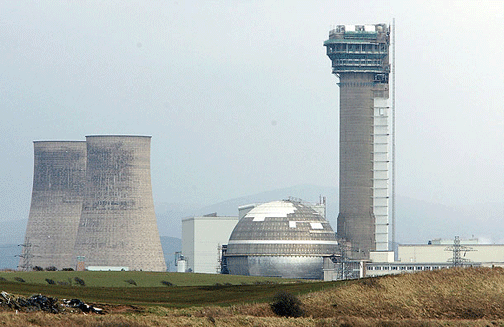 Sellafield clean-up costs rise to £53bn, says NAO BBC News 4 Mar 15 The cost of decommissioning and cleaning up the Sellafield nuclear site in Cumbria has increased by £5bn to £53bn, says the National Audit Office.
Margaret Hodge MP, chair of the Public Accounts Committee (PAC) which commissioned the report, said the cost hike was “astonishing.”
A year ago, the Nuclear Decommissioning Authority, the body responsible for the clean up, said the cost would be £48bn.
The work is also behind schedule, the report said.
The Authority gave the £9bn Sellafield clean-up contract to Nuclear Management Partners (NMP), but following criticism of NMP’s competence, decided in January to cancel the contract.
“It is galling that breaking the contract will cost the public purse £430,000,” said Mrs Hodge, whose committee recommended the Authority consider doing this a year ago.
‘Escalation’
The Nuclear Decommissioning Authority, the Department of Energy and Climate Change, NMP, and Sellafield Ltd. are due to appear before the Committee on 11 March.
Mrs Hodge said she expected them to “tell me how the escalation in cost of cleaning up Sellafield will be stopped and performance put back on track.”
Chris Jukes, regional officer of the GMB union, said: “GMB has been absolutely clear all along that the NMP model did not work at Sellafield…….
The total cost of cleaning up the UK’s 17 nuclear sites is “around £70bn”, the NAO says.
Sellafield is the “UK’s largest and most hazardous nuclear site”, including two nuclear fuel reprocessing plants, waste management and storage plants, as well as storage ponds and silos containing waste from the UK’s first nuclear plants.
The Authority aims to clear the site by 2120. http://www.bbc.com/news/business-31725365
Wind and solar farms backed by UK
UK backs £315m renewable energy projects Guardian, Fiona Harvey, 27 Feb 15, More than a dozen windfarms and five solar farms are among first projects to receive financial support under contracts for difference More than a dozen new onshore wind farms are to receive financial backing through the coalition government’s reformed renewable incentive scheme, along with two offshore wind projects and five solar farms.
The contracts for the new renewable energy projects amount to more than £315m in total, spread across five renewable technologies, and taken together should produce more than 2GW of new generation capacity, enough to power 1.4m homes.
But green campaigners and parts of the renewable energy industry were disappointed by the auction process used to award the contracts, arguing that some technologies and projects had lost out in the reforms……..
all the forms of renewables represented, apart from energy from waste, came in at substantially less than the strike price.
This was in marked contrast to the strike price for nuclear power, which will result in one nuclear reactor being built – at Hinckley in Somerset, by the French state-backed utility EDF – for £80bn calculated on the strike price alone. Solar power, which has seen costs plummet as worldwide use of panels has risen, settled for 58% lower, with offshore wind 18% and onshore wind 17% under their respective strike prices…….
In response to the first Contracts for Difference auctions for renewables, Greenpeace Chief Scientist Dr Doug Parr said: “Today’s announcements show renewables’ costs are plummeting, and will mount a growing challenge to conventional sources of power in delivering energy security for the UK.
“Those who say we should tackle climate change but are opposed to wind and solar farms need to explain how they plan to cut carbon emissions whilst keeping consumer bills as low as possible.
“We’ve known onshore wind is much cheaper than nuclear for a while, but now we learn that solar power is already cheaper than new gas generation in some cases. It makes you wonder what could have been achieved with less party-political manoeuvring and more stable Government support for the clean technologies already being embraced by the world’s largest economies.” http://www.theguardian.com/environment/2015/feb/26/uk-backs-315m-renewable-energy-projects
Abandoning plans for nuclear power – the “only safe option” – Naoto Kan tells Wales
Former Japanese PM warns against Welsh nuclear site renewal By Daily Wales correspondent, 25 Feb 15
The former Prime Minister of Japan has used a visit to Wales to urge the UK Government to scrap its commitment to nuclear energy. He is using the tour to send out a message to the UK Government that the safety risks posed by nuclear energy are simply not worth taking.
He said:
“What occurred in Fukushima in 2011 was caused by humans, not a natural disaster. It is clear to me that what caused this catastrophe was our commitment to an unsafe and expensive technology that is not compatible with life on this planet.
“The only safe option when it comes to nuclear power is to abandon your plans for nuclear power. It simply is not worth the risk………
Mr Kan’s visit to Wales has been supported by Welsh anti-nuclear campaign group, People Against Wylfa B (PAWB), Friends of the Earth Cymru, CND Cymru and Welsh language campaign group, Cymdeithas yr Iaith.
http://dailywales.net/2015/02/25/former-japanese-pm-warns-against-welsh-nuclear-site-renewal/
Prince Charles on the sickness of Planet Earth due to climate change
The prince was speaking to health professionals, health ministers and senior civil servants about “putting health at the centre of the climate change debate”.
He said climate change was a challenge of “astonishing complexity” and urged health practitioners to be bolder about highlighting its effects on well-being.
He said: “I hardly need to tell you we are faced, I fear, as far as the problem of human-induced climate change is concerned, with a challenge of astonishing complexity.
“The fact of climate change is now accepted by every major scientific body in the whole world.
“The gravity and immediacy of the threat it poses to us and our children and grandchildren is also accepted by constituencies that can scarcely be accused of being part of some half-baked conspiracy dreamt up by extreme environmentalists intent on undermining capitalism.
“These constituencies include the UN, the World Bank; The Pentagon and the UK Ministry of Defence, the CIA, NSA. … and, I’m happy to say, nurses and doctors.”
The prince added: “Your message isn’t just of alarm, but of hope.
“Actions which are good for the planet are also good for human health……….. http://www.theguardian.com/environment/2015/feb/26/planet-earth-is-a-sick-patient-due-to-climate-change-says-prince-charles
Britain’s nuclear facilities are vulnerable to terrorist attacks via drone aircraft
UK nuclear sites warned over drone terror attack, By CAROLINE WHEELER Sunday Express 22 Feb 15
BRITAIN’S nuclear plants are at risk from a terrorist strike by unmanned drone aircraft, writes Caroline Wheeler.Such an attack could kill tens of thousands of people, a Government adviser has warned. But authorities are “burying their heads in the sand,” according to John Large.

His call for an urgent security overhaul comes as fi gures showed nuclear power plants suffered 37 security breaches last year – the highest numberalso been breached a dozen times since 2011, including by at least one drone.
Islamic State terrorists have already recruited chemical weapons specialists and counterterrorism experts say they are intent on building a “dirty bomb”.
Last night Mr Large, a nuclear engineer who has carried out work for Britain’s Atomic Energy Authority, demanded a major exercise to test the resilience of the nation’s power stations against acts of terrorism.
Mr Large, who has advised the French government after a growing number of mysterious unmanned flights over that country’s nuclear plants, said drones also pose a risk to the UK’s 16 operational reactors.“On application to UK nuclear power plants, I believe that much the same security and vulnerability issues apply,” he told the Sunday Express.
“The accessibility of the UK plants to small UAV’s [unmanned airborne vehicles] is relatively unimpeded.”
Asked whether a security review was needed in the wake of the terrorist attacks in Denmark and France, Mr Large said: “Absolutely yes.” Too much focus is placed on the risk assessment surrounding accidents at nuclear power stations, rather than terrorist threats, Mr Large said.
The consequences of the attack scenarios he examined would range from one casualty to tens of thousands of deaths, he added.
The last nuclear power plant built in the UK was completed in the 1990s but the Government is planning a new generation of reactors, starting with Hinkley Point C in Somerset. Last night Tory MP Mark Pritchard, a member of the Joint Committee on the National Security Strategy, said Mr Large’s recommendations would be taken “very seriously”…….http://www.express.co.uk/news/uk/559718/Nclear-plants-are-at-risk-from-a-terrorist-strike-by-unmanned-drones
UK wind power surges: UK on track to meet renewable energy targets
Gas use in the UK fell by more than a fifth from 2005 to 2012, as energy efficiency increased across the economy and green energy took up more of the burden.
Under European Union targets, the UK must produce 15% of its energy from renewable sources by 2020, and is one of a small number of big member states to be judged on track to meet all of its energy and climate commitments by the European environment agency.
This was confirmed on Thursday by the Office for National Statistics, which found that 15% of the UK’s electricity came from renewable sources in 2013. This puts the UK about halfway towards its commitments, because the overall energy target includes transport and heating, as well as electricity generation. For the UK to meet its EU goals, electricity generation from renewable sources is likely to have to increase to above 30% by 2020……..
The rise in renewables while gas use fell also highlights the competition that clean energy represents to gas. Gas companies have been keen to emphasise the fuel as a “greener” alternative to coal – it burns more cleanly, producing much less carbon dioxide and none of some other pollutants associated with coal – and as a “transition” fuel that can help the move to a low-carbon economy alongside the use of renewable.
However, many in the green sector are concerned that investment in renewable alternatives could suffer if gas is prioritised. Many of Europe’s biggest players in renewable energy are power companies that still generate large amounts of their output from fossil fuels.
Renewable UK, the trade association for the wind industry, said renewable power generators were “doing their bit” towards the UK’s targets, but that fossil fuel use in transport and heating remained relatively high. For renewables to cut transport emissions too, through electric cars, the next government needs to show support for wind power, they said…….
Gordon Edge, Renewable UK’s director of policy said: “Onshore and offshore wind farms have been growing rapidly and are now generating more than half of our clean electricity. The question is whether the UK will make fast enough progress on renewable heat and renewable transport as well – that’s looking less certain. If there’s a shortfall in those areas, we’ll need to generate more renewable electricity to hit the target.
“The cheapest way to do this would be to install more onshore wind, which is why it’s utterly baffling that the Conservative party is proposing to cap the development of onshore wind if they’re elected in May.”………http://www.theguardian.com/environment/2015/feb/20/uk-on-track-to-meet-its-renewable-energy-targets
1 This Month





PLEASE OPPOSE HR 8255 AND S.3639 – bills would accelerate satellite deployment, with no environmental review or safeguards – https://ncstd5li.quorum.us/campaign/169331/
To see nuclear-related stories in greater depth and intensity – go to https://nuclearinformation.wordpress.com
-
Archives
- October 2026 (58)
- September 2026 (339)
- August 2026 (330)
- July 2026 (355)
- June 2026 (287)
- May 2026 (306)
- April 2026 (356)
- March 2026 (251)
- February 2026 (267)
- January 2026 (308)
- December 2025 (358)
- November 2025 (359)
-
Categories
- 1
- 1 NUCLEAR ISSUES
- business and costs
- climate change
- culture and arts
- ENERGY
- environment
- health
- history
- indigenous issues
- Legal
- marketing of nuclear
- media
- opposition to nuclear
- PERSONAL STORIES
- politics
- politics international
- Religion and ethics
- safety
- secrets,lies and civil liberties
- spinbuster
- technology
- Uranium
- wastes
- weapons and war
- Women
- 2 WORLD
- ACTION
- AFRICA
- Atrocities
- AUSTRALIA
- Christina's notes
- Christina's themes
- culture and arts
- Events
- Fuk 2022
- Fuk 2023
- Fukushima 2017
- Fukushima 2018
- fukushima 2019
- Fukushima 2020
- Fukushima 2021
- general
- global warming
- Humour (God we need it)
- Nuclear
- RARE EARTHS
- Reference
- resources – print
- Resources -audiovicual
- Weekly Newsletter
- World
- World Nuclear
- YouTube
-
RSS
Entries RSS
Comments RSS

