America and Churchill planned huge pre emptive nuclear strike on USSR
 Unthinkable as it may seem, Churchill’s plan literally won the hearts and minds of US policy makers and military officials.
These “first-strike” plans developed by the Pentagon were aimed at destroying the USSR without any damage to the United States.
The 1949 Dropshot plan envisaged that the US would attack Soviet Russia and drop at least 300 nuclear bombs and 20,000 tons of conventional bombs on 200 targets in 100 urban areas, including Moscow and Leningrad (St. Petersburg)
the Kennedy administration introduced significant changes to the plan, insisting that the US military should avoid targeting Soviet cities and had to focus on the rival’s nuclear forces alone.
 Post WW2 World Order: US Planned to Wipe USSR Out by Massive Nuclear Strike, Sputnik News. Ekaterina Blinova. 15 Aug 15, Was the US deterrence military doctrine aimed against the Soviet Union during the Cold War era really “defensive” and who actually started the nuclear arms race paranoia?
Interestingly enough, then British Prime Minister Winston Churchill had ordered the British Armed Forces’ Joint Planning Staff to develop a strategy targeting the USSR months before the end of the Second World War. The first edition of the plan was prepared on May 22, 1945. In accordance with the plan the invasion of Russia-held Europe by the Allied forces was scheduled on July 1, 1945.
Winston Churchill’s Operation Unthinkable The plan, dubbed Operation Unthinkable, stated that its primary goal was “to impose upon Russia the will of the United States and the British Empire. Even though ‘the will’ of these two countries may be defined as no more than a square deal for Poland, that does not necessarily limit the military commitment.” Continue reading
How the BBC distorted the story of Sellafield
The spectre of the new nuclear renaissance
Al’Khalili then went on to give every impression that high level nuclear waste can be safely stored using the process of ‘vitrification’, that is, turning it in glass, and so binding the waste safely into a permanent, impermeable matrix.
What he failed to mention is that the glass is by no means permanent and durable storage medium for “thousands of generations” as the glass is liable to break down – and that the problem of long term disposal of these wastes remains unsolved. For example, asR C Ewing and colleagues wrote in 1995 in the journal Progress in Nuclear Energy,
“the post-disposal radiation damage to waste form glasses and crystalline ceramics is significant. The cumulative α-decay doses which are projected for nuclear waste glasses … are well within the range for which important changes in the physical and chemical properties may occur, e.g. the transition from the crystalline-to-aperiodic state in ceramics.”
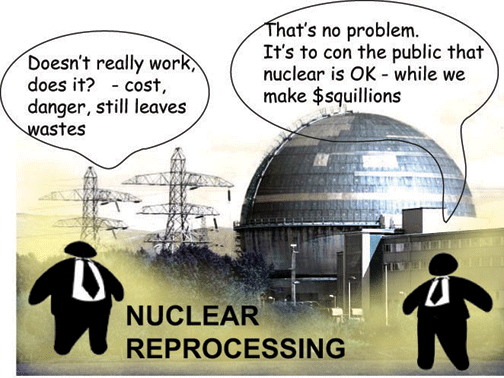
 ‘Inside Sellafield’ and military plutonium – the BBC’s nuclear lies of omission http://www.
theecologist.org/reviews/2984689/inside_sellafield_and_military_plutonium_the_bbcs_nuclear_lies_
of_omission.html Dr David Lowry 12th August 2015
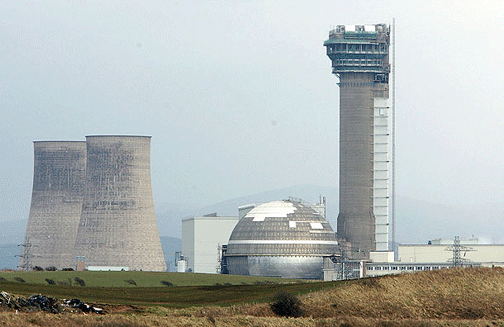 Lowry – understating the severity of accidents, concealing the role of the UK’s nuclear power stations in breeding military plutonium, and giving false reassurance over the unsolved problems of high level nuclear waste.
For one of these programmes the BBC commissioned Baghdad-born Professor Jameel ‘Jim’ Al-Khalili, theoretical physicist and Chair in the Public Engagement in Science from the University of Surrey, to research and present one programme called ‘Britain’s Nuclear Secrets: Inside Sellafield‘.
As a regular BBC broadcaster, hosting the long-running The Life Scientific on Radio 4, and maker of several science television programmes on television, including on quantum physics and the history of electricity, he was eminently qualified to make this programme.
However the programme was highly misleading thanks to major omissions, concealing the severity of accidents, and how the UK’s entire ‘civilian’ nuclear programme was subverted into producing military plutonium that fed into the Sellafield bomb factory. Continue reading
Cyber terrorism threat if Britain’s nuclear security moves to online technology
Nuclear power plants ‘could become more open to cyber attacks’ as police consider cloud storage
The armed police force that guards Britain’s nuclear material is considering storing information in “cloud” despite series of high-profile leaks. Britain’s nuclear power stations could be more exposed to cyber attacks within months, experts have warned after the police force that protects them revealed they are considering using the “cloud” to store information.
The Civil Nuclear Constabulary (CNC), the armed police force tasked with guarding all of Britain’s nuclear plants, has previously refused to use the new storage technology given much of its information is classified as “sensitive”.
However the force has revealed it could start using cloud technology as early as April next year despite a series of high profile information breaches which raised questions about the software’s reliability.
Technology experts warned the move could be “unnecessary” and leave the force more exposed to foreign hackers.
It will raise fears that information about Britain’s nuclear material could be more likely to be obtained by enemies of the state at a time of heightened alert over terrorism…….http://www.telegraph.co.uk/finance/newsbysector/energy/11792281/Nuclear-power-plants-could-become-more-open-to-cyber-attacks-as-police-consider-cloud-storage.html
UK energy analysts unhappy with super costly Hinkley nuclear project
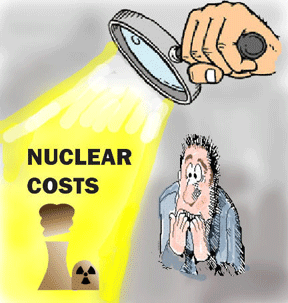
 Planned Hinkley Point nuclear power station under fire from energy industry, Guardian, Nils Pratley and Sean Farrell, 10 Aug 15 Energy analyst says that for same price as Hinkley Point C, providing 3,200MW of capacity, almost 50,000MW of gas-fired power capacity could be built. Hinkley Point, the planned £24.5bn nuclear power station in Somerset, is under intensifying criticism from the energy industry and the City, even as the government prepares to give the final go-ahead for the heavily subsidised project.
The plant, due to open in 2023, will cost as much as the combined bill for Crossrail, the London 2012 Olympics and the revamped Terminal 2 at Heathrow, calculated Peter Atherton, energy analyst at investment bank Jefferies. He said that, for the same price as Hinkley Point C, which will provide 3,200MW of capacity, almost 50,000MW of gas-fired power capacity could be built.
“This level of new gas build would effectively replace the entire thermal generation fleet in the UK – much of which is old and inefficient – with brand new, highly efficient, low carbon, gas generation,” said Atherton.
Doubts about Hinkley Point have deepened after a detailed report by HSBC’s energy analysts described eight key challenges to the project, which will be built by the state-backed French firm EDF and be part-financed by investment from China.
These challenges include: declining demand for power in the UK, currently falling at 1% a year as energy-saving measures take effect; a three-fold jump in the UK’s interconnection capacity with continental Europe by 2022, massively increasing the country’s ability to import cheaper supplies; and “a litany of setbacks” in Finland, France and China for EdF’s European Pressurised Reactor (EPR) model, the same type as planned for Hinkley Point.
HSBC’s analysts described the EPR model as too big, too costly and still unproven, saying its future was bleak. They also pointed out that wholesale power prices have fallen by 16% since November 2011 when the government agreed a “strike price” for Hinkley Point’s output – effectively a guaranteed price of £92.50 per megawatt hour, inflation-linked for 35 years and funded through household bills. “With the problems encountered by France’s EPR model and a strike price likely to be double the UK wholesale price at the scheduled 2023 time of opening of the proposed Hinkley C EPR, we see ample reason for the UK government to delay or cancel the project,” they said…….. http://www.theguardian.com/environment/2015/aug/09/planned-hinkley-point-nuclear-power-station-energy-industry
Britain’s nuclear power and nuclear weapons plans intrinsically linked
 Shining a light on Britain’s nuclear state, Guardian, Phil Johnstone and Andy Stirling, 7 Aug 15
Debates over Trident and energy policy are rarely joined up. But are there deeper links between Britain’s nuclear deterrent and its commitment to nuclear power? Two momentous issues facing David Cameron’s government concern nuclear infrastructure. The new secretary of state for energy, Amber Rudd, recentlyconfirmed her enthusiasm for what is arguably the most expensive infrastructure project in British history: the Hinkley Point C power station. At the same time, a decision is pressing on a similarly eye-watering commitment to renew Britain’s nuclear deterrent.
Ostensibly distinct, both of these issues are intensely controversial, extremelyexpensive, agonisingly protracted, and often accompanied by vicious political rhetoric. Yet commentators rarely ask how these decisions might be connected. Could such links help to explain the strength of the UK’s nuclear lobby? Britain remains one of only a handful of countries committed to a “nuclear renaissance”, with senior government figures asserting the manifest falsehood that there is “no alternative” to nuclear power. Meanwhile, support for renewables and energy efficiency has been cut.
It seems that Whitehall is in denial about the widely acknowledged performance trends of nuclear power and renewables. The reality is that renewables manifestly outperform nuclear power as low carbon energy sources. Successive UK andinternational studies show they are already more competitive than nuclear. And renewables costs continue to fall. Yet after more than half a century of development (and far greater levels of cumulative public support), nuclear costs keep rising. The performance gap just keeps on growing.
Nor is there any good excuse for ignoring such overblown nuclear promises. Problems of reactor safety, nuclear waste and weapons proliferation remain unsolved. Nuclear security risks are uniquely grave. With finance in question andtechnical difficulties mounting, the deteriorating prospects of the Hinkley project are the latest episode in a familiar pattern.
So why is the UK so persistent in pursuing new nuclear power? If the nuclear lobby is driving this, why have other countries with stronger nuclear industries nonetheless developed far more sceptical positions? In the case of Germany, this has meant the country with the world’s most successful nuclear industry and a less attractive renewable resource than the UK, nonetheless undertaking a wholesale shift from one to the other.
One striking factor is an apparently strong correlation between those countries most eager to construct new nuclear with those expressing a desire to maintain nuclear weapons. But care is needed before jumping to conclusions. Historically,links between enthusiasms for nuclear power and nuclear weapons are well-explored. Almost all the attention here has focused on possibilities for diverting nuclear weapons materials like highly enriched uranium and plutonium. These connections were crucial in early nuclear developments, and remain so in contemporary proliferation threats. But it is highly doubtful they explain the UK situation. An elaborate global nuclear safeguards regime introduces formidable barriers. And the UK has since the end of the Cold War maintained enormous gluts of key weapons materials………
the links between UK civilian nuclear power and military interests in nuclear submarines run deep. What is remarkable is the complete lack of discussion these provoke in the media, public policy documents, or wider critical debate. Yet the stakes are very high. Does the commitment to a submarine based nuclear deterrent help to explain the intensity of high-level UK support for costly, risky and slow nuclear power, rather than cheaper, quicker and cleaner renewable technologies?
If so, the conclusions are not self-evident. For some supporters of a nuclear deterrent, the additional burdens of nuclear power may seem entirely reasonable. But the almost total silence on these connections raises crucial implications for democracy. Imminent decisions that the government must take over nuclear power and the nuclear deterrent are hugely significant. There is a responsibility on all involved to be open and accountable. Otherwise, it will not just be electricity consumers and taxpayers that pay the price, but British democracy itself.
Phil Johnstone is a research fellow and Andy Stirling is a professor of science and technology policy at the Science Policy Research Unit (SPRU), University of Sussex. http://www.theguardian.com/science/political-science/2015/aug/07/shining-a-light-on-britains-nuclear-state
UK government just quietly funding Small Modular Nuclear Reactors
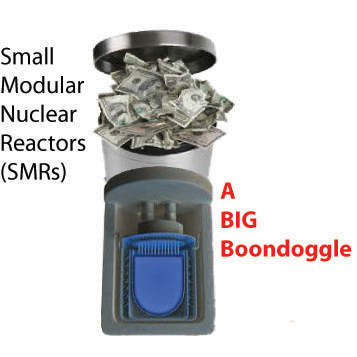 UK invests in advanced nuclear fuel research, World Nuclear News, 7 Aug 15 “……The Department of Energy and Climate Change (DECC) has awarded £1.5 million ($2.3 million) to the NNL and £1.0 million ($1.6 million) to the University of Manchester to fund new capital equipment for nuclear fuel and manufacturing research……..
UK public not supporting nuclear power and shale gas
Public support for UK nuclear and shale gas falls to new low, Guardian, Adam Vaughan, 5 Aug 15
Long-running government survey drops usual polling showing support for renewable energy, for first time. British public support for nuclear power and shale gas has fallen to its lowest ever level in a long-running official government survey, which has also briefly ceased polling showing widespread public support for renewable energy. Continue reading
Top bank advises UK government to delay or cancel Hinkley nuclear project
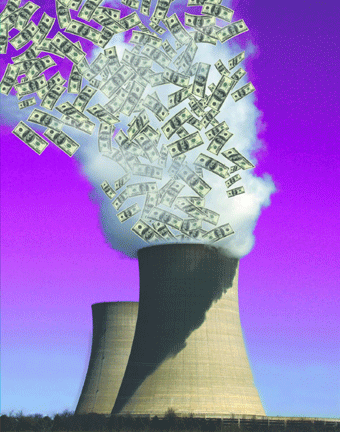 Too expensive…Not needed…top bank report hits out at plans for £25bn Hinkley C nuclear plant, This is Money, By NEIL CRAVEN FOR THE MAIL ON SUNDAY, 2 August 2015 Plans for Britain’s first nuclear reactor in almost 30 years have come under sustained attack from politicians and City bankers.
A report from a top bank this weekend warned that the cost of the £25billion Hinkley Point C plant was ‘becoming harder to justify’. HSBC concluded: ‘We see ample reason for the UK Government to delay or cancel the project.’
And former Tory Energy Secretary Lord Howell of Guildford – the self-described ‘pro-nuclear’ architect of a drive into nuclear power under Margaret Thatcher – has told the House of Lords that the reactor plan in Somerset was ‘one of the worst deals ever for British households and British industry’.
He added that he would ‘shed no tears if it was abandoned’.
Plans for Hinkley Point C have been controversial from the start with the Government guaranteeing what many saw as a sky high price electricity generated at the site.
The Department of Energy and Climate Change shrugged off HSBC’s report and the criticism seems unlikely to stop the nuclear plan. The Secretary of State for Energy, Amber Rudd, said on Friday that Britain could sign a deal as early as October during a visit by China’s President Xi Jinping.
EDF announced on the same day that it had chosen preferred suppliers for £1.3billion worth of work linked to the new plant.
But with the chorus of disapproval growing louder the Government and nuclear industry are set to be under huge pressure throughout the project to prove it is value for money for British energy users.
Key to the criticisms levelled by HSBC’s analysts is that the electricity produced by the reactor is likely to be too expensive, as European wholesale prices are expected to fall along with demand for energy from UK users. It warned of ‘huge difference between UK forward prices and the Hinkley price’.
Among HSBC’s eight key concerns is that the reactor will be economically unviable due in part to a rising number of electricity grid links with the Continent providing a ready source of cheaper supply.
At the same time it said projections by National Grid to 2025 all point to flat or declining demand. HSBC said its demand estimates are for a fall of one per cent a year.
HSBC also highlighted the ‘bleak’ future of large nuclear reactors which have a history of escalating costs and sliding deadlines. ……..
The Austrian and Luxembourg governments launched a legal complaint last month, followed by a challenge from ten German and Austrian green energy firms.
The complainants say the UK Government’s subsidies may reach £76 billion and are in breach of European rules relating to state aid. Some observers say the dispute could lead to delays of six years.: http://www.thisismoney.co.uk/money/news/article-3182406/Too-expensive-Not-needed-bank-report-hits-plans-25bn-Hinkley-C-nuclear-plant.html#ixzz3hhFWKFaE
Scottish firms warned that their reputation at stake, if involved in Hinkley nuclear build
French energy giant EDF yesterday announced its preferred bidders for the UK’s first such facility in more than 20 years. The list includes three Scottish firms – the Weir Group, Doosan Babcock and Clyde Union Pumps – which will find out in the coming months if they have been successful.
But Dr Richard Dixon, director of Friends of the Earth Scotland, told The National: “With one false start already, active legal action in Europe and a spectacular history of cost overruns and missed deadlines, getting involved with the nuclear industry is a huge reputational risk.”
He added: “Scottish engineering firms should be helping us exploit our huge potential in renewable energy rather than chasing the nuclear dream.”……..The EU approved the project last year after the Government agreed a subsidy contract with EDF, but the development is far from certain, with a challenge by Austria to the subsidy and green groups pondering a legal challenge.
Negotiations between the French company and potential investment partners have yet to result in a final decision.
Scottish Green MSP Patrick Harvie said: “This announcement is a reminder that the UK Conservative Government is in denial about the disastrous economics of new nuclear. Scottish consumers face paying to line the pockets of multinationals like EDF who have been promised double the current market price of power for the next 35 years. And that doesn’t take into account the … toxic waste legacy that this deal will simply add to.” http://www.thenational.scot/news/nuclear-contract-will-be-toxic-for-your-reputation-scots-firms-warned.5852
Hartlepool, Trawsfynydd & Small Modular Reactors,
Meanwhile the Wall Street Journal reports that using modular construction techniques for the AP1000 reactor hasn’t worked. Building nuclear reactors out of factory-produced modules was supposed to make construction swifter and cheaper, but costly delays have shaken faith in the new construction method at the two US sites. “Modular construction has not worked out to be the solution that the utilities promised”
NuClearNews August 2015 New energy minister Andrea Leadsom has given the strongest signal yet that the Government is looking to support a new era of factory-built, nuclear power stations – with a Newcastle company leading the way on their development in the UK. Speaking at the Nuclear Industry Association conference Ms Leadsom said: “Small Modular Reactors are an option we are investigating further. These have the potential to drive down the cost of nuclear energy and make financing easier through shorter construction times and lower initial capital investment requirements, in addition to high value commercial opportunities.” (1)
Amidst a growing sense of frustration and hand-wringing over the delays in the current nuclear programme, new hope has emerged that support is on the way for a home-grown generation of Small Modular Reactors (SMR). Continue reading
UK’s Slow Progress on Plutonium Stockpiles.
NuClear news August 2015 Since the Government confirmed in December 2011 that its preferred management option for the UK’s plutonium stockpile was to convert the ‘asset of zero value’ into Mixed Oxide (MOX) fuel, further progress on the option has been conspicuous by its absence, says Cumbrians Opposed to a Radioactive Environment (CORE). (1)
Bradwell: Handing Future UK nuclear Infrastructure to the Chinese
 NuClear News August 2015 The Government is preparing to hand over future UK nuclear infrastructure to Chinese firms, according to the GMB Union in a “total betrayal” of UK workers. The GMB raised concerns earlier this month about the prospect of the Bradwell, site in Essex, being given “lock, stock and barrel” to the Chinese National Nuclear Corporation.
Subsidies for UK’s Hinkley nuclear plant – appealed in court by 10 companies
 10 Companies Appealing €100 Billion In Subsidies For UK’s Hinkley Nuclear Project http://cleantechnica.com/2015/07/23/10-companies-appealing-e100-billion-subsidies-uks-hinkley-nuclear-project/ by James Ayre
The relatively recent decision by the European Commission to approve roughly €100 billion in subsidies for the Hinkley Point C nuclear energy project in the UK is already being legally challenged, according to recent reports. The legal challenge is coming via an alliance of 10 companies — which includes various renewable energy suppliers and municipal utility companies, as well as Greenpeace Energy. The plea for an annulment of the approval is being made via the European Union Court of Justice in Luxembourg.
Reportedly, according to the German Ministry for Economic Affairs and Energy, the chances that the challenge will be successful are low. Based on recent events, one could argue that Germany is essentially the de facto head of the Commission, so that doesn’t seem to bode well for the legal challenge.
The challenge is being handled by Dörte Fouquet, of the Becker Büttner Held law firm. He commented on the situation thusly: “(The European Commission used) an incorrect evaluation benchmark because these British subsidies are an unlawful State Aid and not an investment aid. Moreover … there is no general failure of the energy market which could justify these proposed subsidies.”
For some background here, the subsidies call for the European Commission to provide £92.5/megawatt-hour (MWh) in support for 35 years to the 3.2 gigawatt (GW) nuclear project.
Figures provided by Greenpeace show that subsidies for the Hinkley Point C project will total some €108.6 billion over that period if inflation is taken into account (€53.7 billion without taking inflation into account). These subsidies are in addition to more than €20 billion in credit guarantees made by the UK.
That’s certainly quite a lot of state support for nuclear energy, is it not? And people are still claiming that it’s economically viable?
“This high level of subsidization means that Hinkley Point C can generate power at negative prices without suffering financial losses. Hinkley Point C lowers the wholesale price of power in the UK. Lower prices lead to an increased import of electricity from the UK to Germany. These imports lower the price of power in Germany, reducing the profits of its conventional and renewable power plants. This effect can lower the price of electricity in Germany by as much as 20 euro cents per megawatt-hour,” as Greenpeace put it in a recent statement.
The companies involved in the legal challenge are oekostrom AG, Greenpeace Energy, and Energieversorgung Filstal. The municipal utilities involved in the appeal are Bochum, Mainz, Schwäbisch Hall, Tübingen, Mühlacker, Aalen, and Bietigheim-Bissingen.
UK’s plan for Hinkley C nuclear power station runs into more and more trouble
 UK’s proposed Hinkley C nuclear power plant faces resistance on all sides http://www.greenpeace.org/international/en/news/Blogs/nuclear-reaction/uks-proposed-hinkley-c-nuclear-power-plant-fa/blog/53534/
The plans for new nuclear reactors at Hinkley in the UK are too expensive, too late, won’t help cut greenhouse gas emissions, violate EU competition law, and will distort Europe‘s energy markets. On 6 July 2015, Greenpeace Energy, together with German and Austrian energy utilities, filed a legal challenge in the European Courts against the EU Commission’s decision to rubberstamp billions of euros in state subsidies for new nuclear reactors at the Hinkley nuclear power plant in the UK.
The filing argues these massively subsidised reactors will influence energy prices in Europe and grossly distort competition.
In a similar filing, the Austrian government submitted a complaint to the European Court against the European Commission for failing to properly implement EU law when it approved the UK’s nuclear welfare package. As Austrian Chancellor Werner Faymann said in a statement, nuclear power “is not an innovative technology and is therefore not worthy of subsidy.”
In short, the Hinkley reactors threaten to block the road to a safe, clean renewable future. “The EU Commission’s decision threatens to have negative consequences for our environmentally sound production plants,” says Dr. Achim Kötzle, Managing Director of Stadtwerke Tübingen on behalf of the eight municipal utilities in the action.
Here’s the situation:
The price of the electricity generated by the new Hinkley C reactors has been guaranteed by the British government for 35 years. This means that, no matter the fluctuations in the price of electricity, Hinkley owner EDF will always get its money.
With renewable energy getting cheaper all the time, and the Hinkley reactors not expected to be in operation before the middle of the next decade, you can see why EDF wanted to fix its prices.
Figures commissioned by Greenpeace Energy (an organisation independent of Greenpeace) show that this is a gift to EDF of some 108 billion euros of public funds. In addition, the British government has made guarantees of more than 20 billion to investors in the construction of the new nuclear plant. As Sönke Tanger, Managing Director of Greenpeace Energy says: “We are taking legal action against these exorbitant nuclear subsidies because they appear to be ecologically and economically senseless and signify serious disadvantages for other energy providers, for renewables, and for consumers.”
The approval of this state funding of nuclear reactors also sets a bad example for the rest of Europe. If Hinkley succeeds, countries such as Poland, the Czech Republic and Hungary are likely to follow.
There are also huge doubts about the European Nuclear Reactor (EPR) technology EDF wishes to build at Hinkley C. The ones being built in Finland and France are massively over budget, years behind schedule, and have experienced huge technical problems.
Why wait ten years (at least) for new expensive and unsafe nuclear reactors when renewable energy projects are ready to go right now? Hinkley C must be stopped before it irreparably damages our future.
8 UK nuclear weapons sites require increased regulation: Aldermaston in special measures
 Aldermaston nuclear weapons factory remains in special measures, Get Reading, 10 JULY 2015 BY RAHUL VASHISHT The Aldermaston site remains in special measures for the third year running after failing to improve its safety performance An Aldermaston nuclear weapons factory is in special measures for the third year running after failing to improve its safety performance, says a government regulator.
The Atomic Weapons Establishment (AWE), which produces the UK’s nuclear weapons, joins seven other sites out of 36 requiring increased regulation.
A report published by the Office for Nuclear Regulation (ONR) listed shortages of skilled personnel, the ageing plant and delays in building new facilities as reasons for failure.
It is also facing further action over not meeting legal obligations to treat radioactive waste by February 2014………http://www.getreading.co.uk/news/reading-berkshire-news/aldermaston-nuclear-weapons-factory-remains-9624495
1 This Month





PLEASE OPPOSE HR 8255 AND S.3639 – bills would accelerate satellite deployment, with no environmental review or safeguards – https://ncstd5li.quorum.us/campaign/169331/
To see nuclear-related stories in greater depth and intensity – go to https://nuclearinformation.wordpress.com
-
Archives
- October 2026 (58)
- September 2026 (339)
- August 2026 (330)
- July 2026 (355)
- June 2026 (287)
- May 2026 (306)
- April 2026 (356)
- March 2026 (251)
- February 2026 (267)
- January 2026 (308)
- December 2025 (358)
- November 2025 (359)
-
Categories
- 1
- 1 NUCLEAR ISSUES
- business and costs
- climate change
- culture and arts
- ENERGY
- environment
- health
- history
- indigenous issues
- Legal
- marketing of nuclear
- media
- opposition to nuclear
- PERSONAL STORIES
- politics
- politics international
- Religion and ethics
- safety
- secrets,lies and civil liberties
- spinbuster
- technology
- Uranium
- wastes
- weapons and war
- Women
- 2 WORLD
- ACTION
- AFRICA
- Atrocities
- AUSTRALIA
- Christina's notes
- Christina's themes
- culture and arts
- Events
- Fuk 2022
- Fuk 2023
- Fukushima 2017
- Fukushima 2018
- fukushima 2019
- Fukushima 2020
- Fukushima 2021
- general
- global warming
- Humour (God we need it)
- Nuclear
- RARE EARTHS
- Reference
- resources – print
- Resources -audiovicual
- Weekly Newsletter
- World
- World Nuclear
- YouTube
-
RSS
Entries RSS
Comments RSS

