The case grows, for stopping Britain’s Hinkley Point nuclear project
 Britain’s nuclear strategy exposed at Hinkley Point EDF’s travails only add to the uncertainty over UK energy policy http://www.ft.com/intl/cms/s/0/9d484f08-d63c-11e5-829b-8564e7528e54.html#axzz40ZWJ8xlp February 18, 2016
It seemed an attractive proposition. Not only was this less than previous reactors, it was competitive with other power sources. New technology seemed to have opened the door to affordable carbonless electricity; Britain could meet its ever-tougher climate goals without shaking the public down.
A decade on and a major nuclear accident later, the world knows better. Nuclear projects elsewhere have been scrapped and existing stations shuttered or scheduled for early closure. Meanwhile stringent regulations have exposed Areva’s promise as a chimera. It turns out that the price of new nuclear for Britain is not £24 per MWh but nearly four times as much.
Even at these elevated prices, Britain’s first proposed new station, at Hinkley Point, is in difficulty. Despite agreeing a deal in 2013, EDF, the developer, has yet to commit to the £18bn project. There are concerns about technology and the French group’s financial capacity. Hinkley Point C — if it opens — may be materially delayed.
The government has done its best to make things easy. It eschewed a competitive bidding process and guaranteed to buy electricity from Hinkley Point at a £92.50 per MWh index-linked for 35 years after the station has been commissioned.
The French face several obstacles. First, there is the question of EDF’s balance sheet, groaning under a €37bn debt pile. The company’s share price has more than halved in the past year and its market capitalisation is now about €21bn. That is not much more than the company’s 67 per cent share of the cost of Hinkley C.
Linked to this are worries about the reactor technology it is employing. The two projects under construction, including EDF’s at Flamanville in France, are delayed and over budget. It might be difficult to entice lenders while it is possible that problems with Flamanville might cause construction to be halted or scrapped.
Politicians have come this far down the road with Hinkley Point because of the constraints they are under. Despite life-extensions, the UK’s existing nuclear stations are near to closing and its dirtiest coal plants are being shut to comply with EU rules. New capacity is needed. Replacing coal with gas would reduce carbon emissions but not enough to meet the targets the government has set itself.
New nuclear might not be needed were the UK to rethink its costly promises and reduce its carbon targets to match those of other EU states. If new reactors are to be considered, however, they must be subjected to the rigours of competition. That is the only way to get the right technology at acceptable cost.
Britain is saddled with the worst of all worlds. The government has effectively written the French a long-dated option to sell it unproven technology at an extremely generous price. Politically painful it may be, but the case for halting Hinkley Point C is becoming hard to refute.
Greenpeace gives 8 reasons why UK should now give up on Hinkley nuclear station
 8 reasons George Osborne needs to let Hinkley nuclear plant go http://www.greenpeace.org.uk/blog/climate/8-reasons-george-osborne-let-hinkley-nuclear-go-20160216 by Richard Casson — 16 February 2016 George Osborne wants to build a new nuclear plant in Somerset — Hinkley Point C. If it goes ahead it’ll be the first nuclear power station to come online in the UK in 30 years.
But right now it’s increasingly looking like a big if. Because Hinkley is on the verge of becoming a national omnishambles. It’s suffered huge delays, safety concerns, and it’s clear the money could be far better spent. Here are eight reasons the Chancellor needs to #LetHinkleyGo.
1. The ‘unconstructable’ nuclear reactor
When Hinkley was first proposed in 2007, part of the Labour government’s sales pitch at the time was that it’d use a newfangled European Pressurized Reactor (EPR for short). Sounds appealing, right? Not so much. There are three sites where EPRs are under construction — and all three are experiencing serious difficulties. One academic even described the type of reactor as ‘unconstructable’. Not exactly encouraging is it, George?
2. The cost is astronomical
Back in 2008 the cost of the two Hinkley reactors was put at a princely £5.6 billion. The price kept going up and by 2015 that was revised to £18 billion. And now there are rumours it could clock in at a whopping £24.5 billion. That’d make Hinkley (wait for it)… the single most expensive object on earth.
3. About that reactor again…
Even if Hinkley’s “unconstructable” reactor is actually constructed, there are further concerns over how safe it’ll be. In Flamanville, France — where a power station with the same reactor design is being built — construction has suffered huge setbacks because of ‘anomalies’ in the reactor steel vessel. You don’t have to be a nuclear expert to know that the word ‘anomalies’ is NOT a good word to hear when talking about the centrepiece of a fission reactor.
4. Does anybody even want it anymore?
Like a fading teenage romance, everyone seems to be falling out of love with Hinkley. The Daily Mail called it the biggest white elephant in Britain. Financial creditors and investors have warned against building Hinkley. And now there are rumours that within EDF (the French company that will build Hinkley’s reactor), some of the board members who oversee the running of the company have spoken out against the project. And that’s just the tip of the iceberg (see here for a long list of newspaper articles opposing the Hinkley deal).
5. Onshore wind is already cheaper (and soon solar will be too)
The world of energy is changing. The cost of wind power and solar energy are falling fastand will only drop more in the future. Meanwhile, analysts have calculated that providing electricity from onshore wind would work out cheaper than Hinkley — even with the costs of providing for backup when the wind doesn’t blow. Meanwhile the construction costs for Hinkley only seem to go one direction — upwards.
6. It’s already 8 YEARS overdue
When Hinkley was first announced, we were told that electricity generated by the power station would be ‘cooking Christmas turkeys by 2017’. But then the operational date was pushed back to 2018. A few months later it became 2019. Last autumn EDF admitted it’ll be more like 2023… until they changed their mind and announced it’ll be even later. Contrast this with the London Array – the world’s largest offshore wind farm – which took less than three years to build, and it makes Hinkley look like the Christmas turkey.
7. We could be forced to pick up the cost
With all the delays and setbacks, some are starting to wonder if Hinkley could get canned completely. If it doesn’t go to plan, who will pick up the cost? The answer — taxpayers will. The funding mechanism the government put in place means that if Hinkley is abandoned, or doesn’t work when completed, UK citizens could be required to shell out a stonking £17 billion to French and Chinese backers to cover their costs.
8. The (not so) little matter of nuclear waste
We are nowhere near finding a storage solution for our existing nuclear waste, never mind future nuclear waste produced by Hinkley. It will take approximately 35 years to build a nuclear ‘storage solution’ (read: bury it underground). And even if it goes ahead soon the waste fuel from Hinkley would not be dealt with until near the end of the 22nd century. So far nobody knows where that will be or how it will happen. Oh and it will cost an estimated £12 billion.
EDF in its financial woes, extends the life of four nuclear reactors
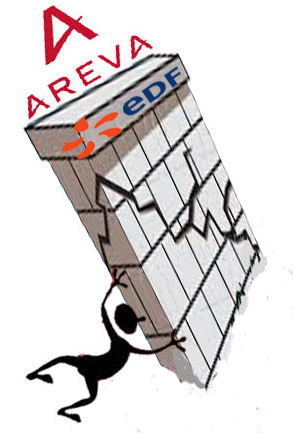 EDF extends life of four nuclear reactors Final decision on investment in Hinkley Point still pending, with analysts and activists casting doubt on the project, Guardian, Sean Farrell 16 Feb 16, EDF plans to extend the life of four nuclear power plants in the UK and has said it is close to announcing a decision on its investment in two new reactors at Hinkley Point.
The French energy company said the lives of the Heysham 1 and Hartlepool plants would be extended by five years until 2024, and the closure dates of Heysham 2 and Torness will be delayed by seven years to 2030………
EDF, which is 85% owned by the French government, announced the extensions as it reported a 68% plunge in profits last year and cut its annual dividend. The company, which has been hit by falling power prices, said net debt increased by €3.2bn (£2.5bn) to €37.4bn.
The fall in EDF’s annual net profit to €1.19bn was caused by a tripling of provisions, asset writedowns and other one-off items to €3.64bn. EDF surprised markets by cutting its dividend to €1.10 a share after paying €1.25 for the previous three years.
But the company restated the appeal of the £18bn Hinkley Point project in Somerset. EDF has delayed deciding on the plan due to funding problems, according to reports in France…….
Paul Dorfman of the UCL Energy Institute said EDF’s financial position cast doubt on the prospects for Hinkley Point. “Unfortunately, with the best will in the world, it may just not happen,” he told the BBC’s Today programme. “EDF shares have crashed to half their value a year ago; the budget for Hinkley alone is bigger than EDF’s entire market value.”
Greenpeace said EDF and the French government were in disarray over the cost and risk of the Hinkley project.
Doug Parr, Greenpeace UK’s policy director, said: “EDF’s accounts show growing debts and falling earnings. Hinkley is a bad investment and most people with an ounce of financial acumen have now come to realise this. George Osborne stands alone in defending Hinkley’s honour.” http://www.theguardian.com/business/2016/feb/16/edf-extends-life-of-four-nuclear-reactors-hinkley-point-decision
UK Nuclear “Beauty Pageant” Scheme: More Than Sheer Madness; Rudd Conflict of Interest

The UK is having an architectural contest to “beautify” the proposed Moorside Nuclear reactor Site, which we choose to call a “beauty pageant”. The image of the Toshiba owned Westinghouse AP 1000 looks like a milk churn or can, as seen here: https://en.wikipedia.org/wiki/File:AP1000Reactor.jpg
Milk Churn-Can and Pail https://www.gov.uk/government/news/rpa-releases-april-milk-production-figures
Cows at Moorside site on the Irish Sea, facing Sellafield Nuclear Site
Maybe they will stick a plastic cow in front of the Moorside visitors’ centre to replace the real cows, which they like to make graze near Sellafield and other nuclear sites?
While a Gothic Devil would be more appropriate,
it will not match the simplicity of the, almost 1000 year old, Old St. Bridget’s Church, seen in the distance with the Windscale chimney at Sellafield to the right.
nor the runic standing stone-crosses, which are estimated at around 900 to 1400 years old. This has been a Christian site since…
View original post 1,507 more words
Britain’s nuclear power project to be derailed unless private investment magically comes to the party
 UK new nuclear plan will fail without private investors, says Horizon chief Britain cannot just rely on state-backed enterprises like EDF and its Chinese partners to build a fleet of new nuclear reactors, Alan Raymant warns , Telegraph UK By Emily Gosden, Energy Editor 14 Feb 2016 It wasn’t meant to be this way.
By now, construction of EDF’s new nuclear reactors at Hinkley Point in Somerset was supposed to be well underway, ready to fill the looming energy supply crunch as old coal plants close.
More reactors were supposed to be following on Hinkley’s heels, with 16 gigawatts – enough to meet about a third of peak winter UK electricity demand – up and running by 2025, replacing Britain’s existing nuclear plants as they retired.
Instead, cash-strapped EDF is still to take a final decision on Hinkley, with the latest hoped-for decision date, this Tuesday, likely to be missed.
First power from the Somerset plant is not due until 2025 and while other developers are aiming to start generating around the same time, they are years off investment decisions.
“Everybody would have liked the nuclear new build programme to have happened sooner,” admits Alan Raymant, chief operating officer of Horizon Nuclear Power, which plans to build two reactors at Wylfa on Anglesey, followed by two more at Oldbury in Gloucestershire……..
With new owners bringing a different reactor technology to the project – twin Advanced Boiling Water Reactors (ABWRs) with a combined capacity of 2.7GW – Horizon pushed its target for first power from Wylfa back to the “first half of the 2020”. This remains the aim, Raymant confirms: “We are looking at 2024, 2025.”
To do that, it needs to take a final investment decision on the plant in “early 2019”. That gives Horizon three short years to secure planning consent, safety approval for the ABWR design, a Government subsidy contract, EU state aid clearance, and the backing of investors……..
the biggest hurdle will be finding the money. If the UK wants to deliver16 gigawatts of new nuclear – now by a revised target of 2030 – it is going to need to secure many tens of billions of pounds of investment.
“We have to look to widen the pool of investors as far as we can,” says Raymant. “We can’t just rely on state-owned enterprises to provide that investment.”
The comment is a clear reference to Hinkley. EDF (85pc French state-owned) had hoped to build the plant in partnership with Centrica, the listed UK utility, but Centrica withdrew in 2013, citing spiralling costs and delays.
EDF set out to bring other investors on board: pension funds and Middle Eastern sovereign wealth funds were touted, but none signed up. “For third parties observing the announcements of delays and cost overruns for the EPRs [the Hinkley reactor technology] under construction, it is difficult to commit,” Jean Bernard-Levy, EDF chief, admitted.
Only China’s state nuclear corporation has so far agreed to invest, taking a lower share than EDF had hoped and even then only in return for a red carpet invitation to build its own reactor technology at Bradwell.
EDF also abandoned the idea of project-financing Hinkley, despite securing £17bn of Government loan guarantees; it has since emerged the loans had been awarded a sub-investment grade, BB+ rating by Infrastructure UK. EDF is now struggling to get the project over the lineby funding its share from its own balance sheet.
Hiroaki Nakanishi, the head of Hitachi, has already warned that the debacle raises “very serious concerns” about its own investment in the UK and questions over the “real solutions for setting up financial support”.
For Horizon, Raymant says, project-financing is a must. Hitachi only plans to retain a minority stake in the eventual construction.
“The challenge for us and for Government is to make sure that the framework that’s in place actually enables a wider range of investors to participate,” he says. “If it doesn’t do that, we won’t deliver a programme of new nuclear.”…… http://www.telegraph.co.uk/finance/newsbysector/energy/12156773/UK-new-nuclear-plan-will-fail-without-private-investors-says-Horizon-chief.html
EDF’s financial woes increases delay on decision about Hinkley nuclear plant
EDF funds shortfall adds to nuclear plant delay Michael Stothard in Paris and Kiran Stacey in London, Ft.com 14 Feb 16 High quality global journalism requires investment.
EDF has still not secured funding for a £18bn nuclear plant at Hinkley Point in Somerset, further delaying one of the UK’s biggest energy projects.
Board members at the French utility will meet on Monday to sign off on the company’s annual results. Some supporters of the Hinkley Point plant had hoped they would use the meeting to give the scheme their final approval, but two people close to the process told the Financial Times EDF has not secured the necessary funding.
The final investment decision is not on the formal agenda, those people said, with one person saying it could be several months before all the financing is lined up…….
The market turmoil this year has made discussions over the financing more difficult, one person close to the talks said. EDF is in discussions with the French government to help find financing.
EDF is also spending at least €1.25bn to buy a majority stake in Areva reactor unit, Areva NP, as part of a government-backed bailout. It also faces a €100bn bill to upgrade its ageing nuclear power stations by 2030.
EDF said in September last year that the plant it is building in Flamanville, Normandy — already years overdue — would be delayed another year until 2018 and would cost €10.5bn, up from an initial budget of €3bn.
The UK government and EDF executives had hoped a final investment decision would swiftly follow the company’s agreement in October with CGN, the Chinese state-owned nuclear group, on how much of the deal each would finance. http://www.ft.com/intl/cms/s/0/34a0fbee-d1a0-11e5-92a1-c5e23ef99c77.html#axzz40BFAOtmS
Defective pressure vessel could seal the tomb of the EPR nuclear reactor
 French Nuclear Safety Authority has discovered a serious fault in the construction of the pressure vessel http://www.bridgwatermercury.co.uk/news/14275656.LETTER__the_French_Nuclear_Safety_Authority_have_discovered_a_serious_fault_in_the_construction_of_the_pressure_vessel/ Allan Jeffery, Bridgwater 14 Feb 16 Before Hinkley C can be built, the EPR reactor of the same design being built at Flamanville in France must be completed and be established generating before 2020, or else the UK government’s guarantees and financial agreements fall apart.
So it is not surprising that EDF tried to go unnoticed as it drove a convoy carrying the steel lid and pressure vessel from Chalon, where it was produced across France to Flamanville, though this was documented and publicised by Greenpeace last week.
In April the French Nuclear Safety Authority, (the ASN) discovered a very serious default in the composition of the steel used in the pressure vessel. Tests showed excessive presence of carbon, which makes the steel more brittle and subject to breakage. The pressure vessel contains the huge amounts of atomic fission energy in the core.
EDF was quick to minimise the problem and promised other tests. If EDF was serious with the safety measures the company should await the validation of the ASN of the test results that might be released in late 2016 or early 2017.
As Yannick Rousselet from Greenpeace France quoted, “Once again, EDF is turning a blind eye to all the issues, continuing as though no one else would notice and going forward anyway until there is no turning back.”
The nuclear industry is desperate and that new failure in safety could have serious consequences, not only in France, but also in China (Taishan) and England at Hinkley Point, which are among the other vessels produced with the same steel.
If the tests confirm the safety problem, EDF would have to replace the whole vessel, and have to break open and remove the first pressure vessel at Flamanville, adding huge costs and further delays, which would bring the final blow to the industrial jewel already dying.
This defective lid could seal the tomb of the EPR reactor!
English countryside dotted with nuclear bunkers from the Cold War
There are hundreds of secret nuclear bunkers in Britain ready and waiting for WW3
RUSSIA has announced that we are in a new Cold War after the relationship between the West and them have become more and more strained. http://www.dailystar.co.uk/news/latest-news/494567/cold-war-nuclear-apocalypse-world-war-three-how-could-you-survive-russia-north-korea-bomb By Helen Whitehouse [Good Photos] 14th February 2016 Russian president Dmitry Medvedev said: “One could go so far as to say we have slid back to a new Cold War” after describing NATO’s policies towards Russia as “unfriendly and opaque”.
The biggest ever bombing raid is currently taking place in Syria, pounding anti-Assad rebels.
But the US, Britain and France claim that air strikes against the rebels are helping ISIS, causing tensions to rise between them and Russia.
The last Cold War, spanning from the 1960s right to the 1990s saw the UK bracing for a nuclear attack – and this could be looking likely once again.
The doomsday clock is set very close to midnight, North Korea have recently announced they successfully tested the H-Bomb and Russia are claiming a new Cold War.
Should the UK be preparing for the nuclear apocalypse?
If that is the case, luckily there could be a specially re-enforced concrete bunker to protect you from atomic attack within minutes of your front door.
Thousands of bunkers were built in the last Cold War when nuclear attack seemed more a likelihood than a possibility.
And a lot of these structures still remain dotted around the English countryside – but the bad news is you would never be able to use them.
Instead of offering protection to normal people, these would be manned by teams of specially trained officers sending vital information across the country.
And although in the event of another nuclear war we might be able to use the remaining bunkers as protection, less than 1% of the general population would be able to seek shelter.
The biggest UK shelter in Burlington, Wilts, potentially had space for 100,000 people but only a fraction of that would be housed in the event of an attack.
In the last Cold War, those really desperate for a safe spot could volunteer at one of the 1,500 small boltholes dotted within ten miles of every home.These were manned by four members of the public who would gather information on what the world was looking like after the attack and send it into the bigger bunkers for officials to process.
People did volunteer for these positions – but if a bomb did go off, it would have meant leaving family behind.
One of the remaining sites is a bunker in York which gives an insight of what might go on as the UK braces for war.
It once would have housed staff and officials monitoring the dire situation on the outside – and had supplies and equipment stockpiled in the event of an attack.
It is open to the public and still in working order as it was in the 80s when tensions over nuclear war were last at the highest.
Rachael Bowers, English Heritage site manager said: “When a nuclear bomb explodes, it generates heat, blast and radiation – all of which are harmful to humans.
“The thick concrete walls of the bunker are covered with a layer of brick, three layers of asphalt to make it watertight and almost a metre of soil.”
She added that, like the other bunkers in the UK, all the doors are fitted with a seal to keep radioactive material out and the bunker would be pressurised – meaning no dust particles could end up inside.
In the event of a nuclear attack, radiation sickness would kill of those not immediately obliterated by the blast.
It would be a long, painful way to go – so in the event of a bomb, it’s important to have systems in place to keep people safe from the radiation.
The prospect of this was so terrifying in the last Cold War that police would have manned the bunker door if a bomb went off to stop general people attempting to rush inside.
There would be enough supplies stockpiled inside for occupants to survive 30 days, the most harmful period after a nuclear bomb hit.
There are still hundreds of these concrete shells around the UK. But if we came under threat of a nuclear attack, could we run and hide in these safe rooms?
Nick Catford, author of Cold War Bunkers, says the shelters were designed only to provide a place for officials to work safely through the crisis.
He says that the concrete shells could be used as protection against the aftermath of the bomb but would need kitting out with more up-to-date tech.
He also added that no bunker could ever take a direct hit from a weapon and survive especially with the stronger, more sophisticated bombs we have today.
“None of the shelters were designed to take a direct hit. Many of them would survive a near miss and those that are still in use would continue to function. The problem with the old bunkers is that all the life support plant, if it is still there, will no longer be operational so if any are to be brought back into use they would have to be completely refurbished and probably refitted.
“If we refurbished some of our old bunkers they would really only be any uses as fallout shelters as they equipment they were designed for would be totally obsolete.”
During the Cold War members of the public were advised to build their own shelters in their homes.Advice was to stock up on food, re-enforce the walls with sandbags and even paint windows white to reflect heat.
Whereas the specially built bunkers had air conditioning and sealed doors, the general public was encouraged to use sandbags and heavy objects to re-enforce walls and stop as much radiation seeping through as possible.
No nuclear weapon ever went off in the UK, so it was never tested how successful this advice would be.
200 of the shelters are still left in tact and dotted around the country but it would never ever be an option for civilians to use them as protection.
So anyone concerned about the Cold War heating up this time best get building their own bomb shelter.
UN ruling on Julian Assange, and Constitutional Law
Whether or not you believe Mr. Assange is guilty of a sexual offence, whether or not you think he is a self-publicist deliberately resisting arrest, the fact remains that the authorities could use less restrictive means without compromising the initial investigation into the allegations regarding his sexual conduct in Sweden
Liora Lazarus: Is the United Nations Working Group on Arbitrary Detention Decision on Assange ‘So Wrong’?UK Constitutional Law Association 13 Feb 16 The United Nations Working Group on Arbitrary Detention handed down its decision on Julian Assange on Friday 5 February 2015 (A/HRC/WGAD/2015/54). It has been met with almost universal ridicule from a line of British officials, legal academics and the press. The decision has been described as ‘ridiculous’ by the UK Foreign Secretary, Phillip Hammond, and former Director of Public Prosecution Ken MacDonald argues that describing Assange’s conditions as ‘arbitrary detention’ is ‘ludicrous’. The press is equally incredulous. ………
Factual background
Mr. Assange is wanted for questioning in Sweden to answer allegations of sexual assault. The Swedish prosecutorial authorities have issued a European Arrest Warrant (EAW) which the UK authorities are bound to implement. Mr. Assange, after arrest of 10 days and house arrest thereafter, was granted asylum by Ecuador after his appeal against the EAW failed. This is when he took up residence in the Ecuadorian Embassy in 2012. Assange argues that he fears ultimate extradition from Sweden to the USA on the grounds of his involvement in Wikileaks.
This is obviously no small fear, given the sentencing and treatment of Chelsea Manning in the USA, and the decision of Edward Snowden to take up asylum in Russia. The Swedish authorities refuse to grant Assange any guarantee of non-refoulement to the US, and his right to asylum has also not been recognized by the UK or Sweden. ……..
Mr. Assange argues that he is not free to leave the Embassy; he would have to accept the conditions of his immediate arrest, his extradition to Sweden and his subsequent questioning there. He would have to undertake the risk that he would be extradited to the US, and the subsequent risks to his rights were that to happen.
The mandate of the UN WGAD and the test for ‘deprivation of liberty’
In order to establish its competence, and to decide upon the case, the UN WGAD has to decide whether there is a ‘deprivation of liberty’ under Article 9 of the International Covenant on Civil and Political Rights (ICCPR). This involves a more severe restriction of motion within a narrower space than mere interference with liberty of movement. (This is explained in General Comment 35 by the UN Human Rights Committee, para. 5……..
The UN WGAD is given a very specific mandate by the United Nations and its Members to decide on these very issues. ……..
The European Arrest Warrant and the Swedish investigation
As easy as it might be in the press to simplify the issues surrounding this case, it is worth elaborating on some key technicalities. The UK authorities are acting pursuant to the conditions of a EAW issued by Sweden who are asking to question Mr. Assange on allegations of sexual assault in order to decide whether to charge him.
The prosecutorial authorities in Sweden re-opened the case against Assange, despite an earlier preliminary investigation (in which Assange had co-operated while in Sweden) that decided there was no case against him in respect of the alleged rape. There is to date no charge against Mr. Assange. The EAW has been at the core of Sweden’s approach, and there had been no attempt by Swedish prosecutors to make use of ‘mutual assistance protocols’ in which Mr. Assange could be interviewed by video-conference (a procedure available under Article 9 of Second Additional Procotol on ‘mutual assistance’)………
Assange’s lawyers have offered co-operation on this alternative a number of times. The Swedish prosecutorial authorities have refused to explore these alternatives, relying instead on the EAW they have issued. They have also failed to disclose the full case against Assange.
Assange has tried but failed to challenge the European Arrest Warrant against him in Sweden and in the UK. In a judgment handed down on 11 May 2015, the majority of the Swedish Supreme Court held that the EAW was valid, but a dissent in this case by Justice Svante Johansson also argued that the arrest warrant was ‘in violation of the principle of proportionality’, as the reasons for continued detention did not ‘outweigh the intrusion and inconvenience’ caused to Assange. According to the Guardian coverage of this case, the ‘Swedish Supreme court also stated … that the investigating authorities “must examine what alternative investigative opportunities are available to drive the investigation forward”. Former Legal Counsel to the United Nations and Legal Adviser to the Swedish Ministry of Foreign Affairs, Hans Corell, has stated that he “does not understand why the prosecutor had not questioned Julian Assange during all the years he has been at the Ecuadorian Embassy”………….
The main arguments of Assange’s lawyers
The central argument of Assange’s lawyers’ proceed on the basis that his confinement in the Ecuadorian embassy ‘cannot … be characterized as volitional’ (para 13). He is not free to leave, because he is protecting himself from the violation of other human rights: ‘the only way for Mr. Assange to enjoy his right to asylum was to be in detention’ (para 11). If Assange were to leave he would be arrested in the UK and extradited pursuant to a European Arrest Warrant (EAW) issued by Sweden. Consequently, he would expose himself to the risk of a ‘well founded fear of persecution’ were he to be extradited to the US from Sweden (para 12).
In the UK, Assange’s challenge goes to the validity of the EAW under UK law……….
Evaluation
In essence, the UN WGAD had to decide two questions. Firstly, whether there was a ‘deprivation of liberty’ as opposed to a ‘restriction of liberty’. Secondly, assuming the answer to the first question is in the affirmative, whether that deprivation of liberty was ‘arbitrary’.
In response to the first question, the UN WGAD clearly accepted the argument that Assange’s conditions are not volitional, or self-imposed……..
the UN WGAD was persuaded that the confinement was arbitrary. The most compelling grounds were those based on proportionality. In short, there could have been another, less restrictive way of proceeding. Before issuing a European Arrest Warrant, the Swedish authorities could have followed the normal practice of interviewing Assange in a British police interview room. After Assange, sought asylum in the Ecuadorian embassy they could have questioned Assange by video link. He could have been provided the chance to respond to the allegations against him, or provided with an assurance related to his refoulment to the US. But his conditions currently are based on the legitimacy of an EAW which two UK Supreme Court justices consider invalid under UK law, and which one Swedish Supreme Court judge considers disproportionate……….
There is still no charge against Mr. Assange. He has, under international, European, and domestic law, the right to be presumed innocent until proven guilty. He has offered to respond to the process in other ways, and would co-operate fully if he had a further guarantee of non-refoulment.
Whether or not you believe Mr. Assange is guilty of a sexual offence, whether or not you think he is a self-publicist deliberately resisting arrest, the fact remains that the authorities could use less restrictive means without compromising the initial investigation into the allegations regarding his sexual conduct in Sweden. ……….
Reasonable (and even judicial) minds have clearly differed on these issues, which suggests that the UN WGAD decision cannot fairly be described as ‘ridiculous’, ‘ludicrous’, or ‘so wrong’. No doubt views on this may be coloured by our particular position on the integrity of Assange’s himself. But human rights are not meant to favour the popular amongst us; they are meant to favour us all.
Liora Lazarus is a Fellow of St. Anne’s College and an Associate Professor in Law at Oxford University. https://ukconstitutionallaw.org/2016/02/09/liora-lazarus-is-the-united-nations-working-group-on-arbitrary-detention-decision-on-assange-so-wrong/
Arbitrary detention of Julian Assange – United Nations finding
Julian Assange arbitrarily detained by Sweden and the UK, UN expert panel finds United Nations Human Rights Office GENEVA (5 February 2016) – WikiLeaks founder Julian Assange has been arbitrarily detained by Sweden and the United Kingdom since his arrest in London on 7 December 2010, as a result of the legal action against him by both Governments, the United Nations Working Group on Arbitrary Detention said today.
In a public statement, the expert panel called on the Swedish and British authorities to end Mr. Assange’s deprivation of liberty, respect his physical integrity and freedom of movement, and afford him the right to compensation (Check the statement: http://www.ohchr.org/EN/NewsEvents/Pages/DisplayNews.aspx?NewsID=17012&LangID=E)
Mr. Assange, detained first in prison then under house arrest, took refuge in Ecuador’s London embassy in 2012 after losing his appeal to the UK’s Supreme Court against extradition to Sweden, where a judicial investigation was initiated against him in connection with allegations of sexual misconduct. However, he was not formally charged.
“The Working Group on Arbitrary Detention considers that the various forms of deprivation of liberty to which Julian Assange has been subjected constitute a form of arbitrary detention,” said Seong-Phil Hong, who currently heads the expert panel.
– See more at: http://www.ohchr.org/EN/NewsEvents/Pages/DisplayNews.aspx?NewsID=17013&LangID=E#sthash.oPdlDR4g.dpuf
The experts also found that the detention was arbitrary because Mr. Assange was held in isolation at Wandsworth Prison, and because a lack of diligence by the Swedish Prosecutor’s Office in its investigations resulted in his lengthy loss of liberty.
The Working Group established that this detention violates Articles 9 and 10 of the Universal Declaration on Human Rights, and Articles 7, 9(1), 9(3), 9(4), 10 and 14 of the International Covenant on Civil and Political Rights.
Check the Working Group’s Opinion on Julian Assange’s case (No. 54/2015), adopted in December: http://www.ohchr.org/Documents/Issues/Detention/A.HRC.WGAD.2015.docx
NOTE TO EDITORS:
The Opinions of the Working Group on Arbitrary Detention are legally-binding to the extent that they are based on binding international human rights law, such as the International Covenant on Civil and Political Rights (ICCPR). The WGAD has a mandate to investigate allegations of individuals being deprived of their liberty in an arbitrary way or inconsistently with international human rights standards, and to recommend remedies such as release from detention and compensation, when appropriate.
The binding nature of its opinions derives from the collaboration by States in the procedure, the adversarial nature of is findings and also by the authority given to the WGAD by the UN Human Rights Council. The Opinions of the WGAD are also considered as authoritative by prominent international and regional judicial institutions, including the European Court of Human Rights.
……… http://www.ohchr.org/EN/NewsEvents/Pages/DisplayNews.aspx?NewsID=17013&LangID=E#sthash.oPdlDR4g.dpuf http://www.ohchr.org/EN/NewsEvents/Pages/DisplayNews.aspx?NewsID=17013&LangID=E
Hinkley Nuclear Project: trials and Tribulations Continue, and EDF is in dire financial straits
nuClear News, No 82 Feb 2016, Hinkley’s Troubles Continue The resignation of the man in charge of building Hinkley Point C capped a month of very bad news for the proposed £18bn nuclear power plant. Chris Bakken announced that he would be returning home to the US to take up the post of chief nuclear officer for Entergy beginning on April 6 to “spend more time with his family.”
Huge production of radioactive trash would come from Hinkley point C nuclear reactor

 nuClear News No 82 Feb 16 The Impact of a New Reactor Programme on the UK’s Radioactive Waste Inventory The proposed Hinkley Point C nuclear power station would produce radioactive wastes and spent fuel with a radioactivity inventory equal to roughly 80% of the radioactivity in all of the UK’s existing radioactive wastes put together.
A catelogue of safety failures revealed in mock nuclear accident tests
 Top secret mock nuclear accidents reveal catalogue of failures, The Ferret, Rob Edwards on February 9, 2016 Top secret mock nuclear accidents testing the responses of the military and emergency services have revealed numerous mistakes that would have led to “avoidable deaths”, according to official assessments.
The Ministry of Defence (MoD) was so concerned about the problems that it carried out “an overarching, fundamental review” of arrangements for handling serious nuclear weapons incidents behind closed doors last year.
Assessments of emergency exercises by the MoD’s internal watchdog, theDefence Nuclear Safety Regulator (DNSR), expose a string of mishaps including life-threatening delays, equipment shortages, coordination failures and communication breakdowns. One report criticises officials for “substantially understating” the scale of the dangers facing the public in a staged briefing for the media.
The MoD took more than two years to agree to hand over reports on three nuclear bomb exercises in 2011 and 2012, despite freedom of information lawrequiring documents to be released within 20 working days. The reports, redacted by the MoD to keep details confidential, are being published today by The Ferret, in tandem with The Guardian (see below).
Two of the exercises imagined aircraft carrying nuclear weapons ingredients crashing and spreading plutonium and other radioactive contamination up to five kilometres away. They were both codenamed Astral Bend, one taking place at the Caerwent military base in south Wales on 24 February 2011, the other at Heyford Park in Oxfordshire on 27 March 2012.
At the 2011 exercise there was a major mix-up over how to deal with contaminated casualties. The fire service was criticised by DNSR for refusing to allow ambulance teams to take away seriously injured people until they had been decontaminated.
“The interpretation of the absolute necessity to decontaminate every casualty or person from within the determined “hot zone” did, and would in the event of such an incident, lead to avoidable deaths,” concluded the DNSR report………
DNSR pointed out that exercises had shown the need for “an overarching, fundamental review” of emergency response arrangements. This review was carried out in 2015, according to the MoD, but it has not been published.
The independent nuclear consultant,John Large, argued that if there were an accident close to an urban area the emergency response “would be totally inadequate to protect many hundreds if not thousands of members of public.”……….
Anti-nuclear groups claimed that the exercise assessments exposed “major weaknesses” in the MoD plans for responding to nuclear accidents. “The MoD’s rickety old nuclear safety arrangements are not up to the job of keeping the public, emergency responders, or MoD personnel safe,” said Peter Burt from the Nuclear Information Network.
He added: “While ministers are racing ahead to replace the Trident nuclear weapons system, work on improving nuclear emergency plans seems to be a much lower priority and is proceeding at a much more sedate place.”
An earlier Astral Bend exercise on 12 May 2010 envisaged a US plane carrying nuclear weapons crashing and spreading radioactive contamination. Official assessments released in 2011 concluded that the MoD specialist response team “struggled to manage”…….
John Ainslie from the Scottish Campaign for Nuclear Disarmament suggested that a nuclear weapons accident was “inherently very dangerous” and the emergency response was likely to be inadequate. He said: “If there is a real incident then we can expect there to be fatal delays in treating casualties and misleading information provided to the public,” he said.
The reports released by the Ministry of Defence…….. Photos thanks to Nukewatch. https://theferret.scot/nuclear-bomb-accidents-could-cause-avoidable-deaths-say-mod-reports/
£100 billion Trident nuclear weapons system could all too soon become obsolete
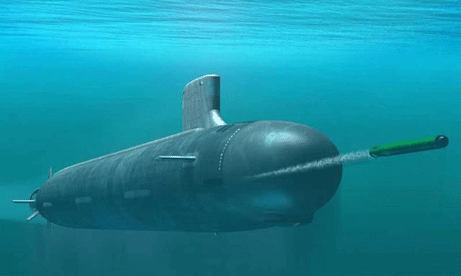 The Trident nuclear weapons system could become obsolete during its lifetime, Labour warns The shadow defence secretary says new technologies are being developed to expose submarines, Independent Jon Stone @joncstone 9 Feb 16 The Trident nuclear weapons system could become technologically obsolete within its lifetime, Labour’s shadow defence secretary has warned.
Emily Thornberry said that emerging technologies could render Trident ineffective as a nuclear deterrent during its 30-year lifetime. She said the development of under-sea drones and other technologies on the horizon might make a long-term lifetime spending commitment of between £100 billion and £160 billion unwise.
“The idea of the Trident replacement is that it can hide in the sea – if technology is moving faster than that then it may well be that Trident is not able to hide,” she told BBC Radio 4’s Today programme. “If that’s right and we are to bet everything on mutually assured destruction then we have to be assured that it’s going to work. If it can’t hide any more that is a problem.
“It is right for the opposition to make sure that it works before voting for a commitment that according to Crispin Blunt would cost £167 billion.”
The shadow defence secretary is currently leading a review of Labour’s policy on nuclear weapons………
The independent Trident Commission estimated that the system would cost £100 billion over its lifetime, though estimates compiled by Reuters with the help of Tory MP Crispin Blunt and official Ministry of Defence statistics suggest the cost could be as high as £167 billion http://www.independent.co.uk/news/uk/politics/trident-labour-policy-nuclear-weapons-deterrent-obsolete-emily-thornberry-a6862501.html
Confusion about financing of UK’s Hinkley nuclear power project
 nuClear News, No 82 Feb 2016, Hinkley’s Troubles Continue ……..The original idea for financing Hinkley was for the promoters to put in £7.5bn in equity and then to borrow £17bn supported by UK Government Credit Guarantees (for which a premium would be paid). This £24.5bn total was made up of £16bn cost plus £8.5bn interest. Now the cost seems to have gone up to £18bn (or adjusted for today’s prices). But EDF Energy seems to be talking about largely funding this out of equity. EDF said on 21st October: “The project is due to be equity funded by each partner, at least during a first stage.” (19) Of course, there is no indication given by EDF of how long the “first stage” would last. However The Telegraph reported that EDF had originally been expected to use project financing for Hinkley, backed up by up to £16bn in UK Government guarantees via Infrastructure UK. But Mr Lévy announced in October a “radical change” to what he said was a “more efficient” option of delivering its £12bn share of the project from EDF’s own balance sheet. (20)
Sizewell A final investment decision on Hinkley is expected to trigger the launch of the next round of public consultation over plans for Sizewell C. (26) But if EDF is struggling to find its 66.5% share of Hinkley C, how will it ever find the 80% it is expected to put into Sizewell C? References ……http://www.no2nuclearpower.org.uk/nuclearnews/NuClearNewsNo82.pdf

1 This Month





PLEASE OPPOSE HR 8255 AND S.3639 – bills would accelerate satellite deployment, with no environmental review or safeguards – https://ncstd5li.quorum.us/campaign/169331/
To see nuclear-related stories in greater depth and intensity – go to https://nuclearinformation.wordpress.com
-
Archives
- October 2026 (49)
- September 2026 (339)
- August 2026 (330)
- July 2026 (355)
- June 2026 (287)
- May 2026 (306)
- April 2026 (356)
- March 2026 (251)
- February 2026 (267)
- January 2026 (308)
- December 2025 (358)
- November 2025 (359)
-
Categories
- 1
- 1 NUCLEAR ISSUES
- business and costs
- climate change
- culture and arts
- ENERGY
- environment
- health
- history
- indigenous issues
- Legal
- marketing of nuclear
- media
- opposition to nuclear
- PERSONAL STORIES
- politics
- politics international
- Religion and ethics
- safety
- secrets,lies and civil liberties
- spinbuster
- technology
- Uranium
- wastes
- weapons and war
- Women
- 2 WORLD
- ACTION
- AFRICA
- Atrocities
- AUSTRALIA
- Christina's notes
- Christina's themes
- culture and arts
- Events
- Fuk 2022
- Fuk 2023
- Fukushima 2017
- Fukushima 2018
- fukushima 2019
- Fukushima 2020
- Fukushima 2021
- general
- global warming
- Humour (God we need it)
- Nuclear
- RARE EARTHS
- Reference
- resources – print
- Resources -audiovicual
- Weekly Newsletter
- World
- World Nuclear
- YouTube
-
RSS
Entries RSS
Comments RSS


