UK govt spurns the success of renewable energy, follows the dodgy chimera of “Small Nuclear reactors”

 nuClearNews No 82 Feb 16 Progress on Small Modular Reactors as renewables head off the cliff , In response to a letter about energy policy in The Times on 26th January 2016, Energy and Climate Change Secretary Amber Rudd listed the top 10 things the government is doing to secure investment in clean secure energy. Besides committing to Hinkley Point C, Rudd also mentioned spending £250m for nuclear innovation and Small Modular Reactors. (1) Oddly enough there was no mention of the rest of the 19GW of new reactors proposed – (up from 16GW now that Bradwell B has been added to the theoretical list)…….
Busting the obsolete “baseload” myth, and other myths that hold back renewable energy
 nuClear News No 82 Feb 16 Towards 100% Renewables As Shadow Secretary of State for Energy and Climate Change, Lisa Nandy, re-iterates the myth that nuclear power is an “important as part of the energy mix [if] we’re going to meet the commitments we made in Paris” we investigate how the UK could move to a 100% renewable energy system. Although Nandy says she is not happy with the Hinkley deal she says “we know we will need nuclear power as part of the mix”, but is she right? (1)
UK may be getting Beautiful Nuclear Cathedrals! (Amber Rudd will be pleased)
Moorside: Developers launch competition to design visually beautiful nuclear power station
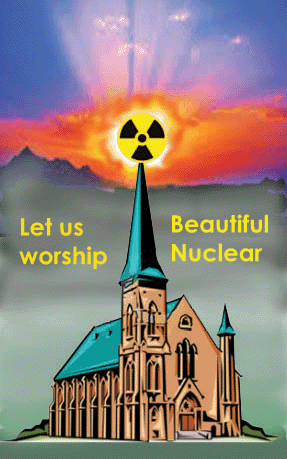
The shortlisted designs will be selected by an independent panel of architects, landscape designers and ecologists including Sir Terry Farrell, who created the MI6 building in London. Their challenge will be to come up with something striking and beautiful which can work around the sensitive construction of the site’s nuclear reactors.
Sebastien Ricard, a director at WilkinsonEyre architects who is currently involved with the multibillion-pound redevelopment of Battersea Power Station in London, said industrial buildings were increasingly regarded by architects as  the “cathedrals of the modern era” as they offered the chance to work with innovative technologies on a grand scale….
it is hoped that the winning plans will succeed in blending the site into its surroundings and perhaps even turn Moorside into a destination in its own right……http://www.independent.co.uk/news/uk/home-news/moorside-developers-launch-competition-to-design-visually-beautiful-nuclear-power-station-a6859311.html
The UK ghost ships with the deadly nuclear cargo
 Guarded from terrorists by Royal Navy sub and 50 commandos…the UK ghost ships with enough nuclear fuel for 80 missiles, Daily Mail,
- Pacific Heron and Pacific Egret ships will sail to Japan for plutonium
- Precious 331kg load could make an incredible 80 nuclear warheads
- Vessels are accompanied by military ships and armed with cannons
By MARK NICOL DEFENCE CORRESPONDENT FOR THE MAIL ON SUNDAY 7 February 2016
Two top secret British ‘ghost ships’ carrying enough plutonium for a huge nuclear arsenal wend their way through the world’s oceans –guarded against terrorists by 50 commandos.
It may sound like a tantalising target for a villain in a James Bond film, but what is potentially the most dangerous secret mission in history is deadly reality.
Two vast container ships – the Pacific Heron and the Pacific Egret – left Barrow-in-Furness, Cumbria, last month on the first leg of their incredible journey.
Their mission is to sail to Japan to collect 331kg of plutonium – enough to make 80 nuclear warheads – which was leased by the UK to a Japanese research facility.
The ships are almost certainly shadowed by a Royal Navy submarine and surface vessels and are heavily armed with 20mm cannon.
They are sailing across the Atlantic before passing through the Panama Canal and into the Pacific on their way to Japan.
Their ultimate destination is a US nuclear storage facility in South Carolina, and the return journey to the American eastern seaboard from East Asia would normally again be made via the Panama Canal.
But this would leave the vessels vulnerable to attack – and their terrifying radioactive cargo could in theory devastate much of Central America.
So instead, they are likely to take the long and dangerous journey around the storm-lashed Cape Horn at the tip of South America, one of the most hazardous shipping routes in the world.
The Heron and the Egret, which each weigh about 6,700 tons when fully loaded, belong to the UK’s Nuclear Decommissioning Authority (NDA). It is expected that each ship will be guarded by as many as 25 commandos.
Nuclear expert John Large told The Mail on Sunday last night: ‘The cargo is invaluable and part of a secret trade in fissile materials between the likes of the UK and US. The biggest risk is a fire or an external missile strike.
‘This is bomb-grade nuclear material and a terror group or rogue state would want to intercept it.’…..http://www.dailymail.co.uk/news/article-3435476/Guarded-terrorists-Royal-Navy-sub-50-commandos-UK-ghost-ships-nuclear-fuel-80-missiles.html
Britaion and Sweden rejecting UN panel’s finding on Julian Assange
 No release in sight despite UN panel decision. Julian Assange: ‘sweet’ victory soured by British and Swedish rejection Founding WikiLeaks founder is being arbitrarily detained at Ecuador embassy, Guardian, Esther Addley,Owen Bowcott,David Crouch in Gothenberg, andJessica Elgot A UN panel may have found that Julian Assange is subject to “arbitrary detention” and called for him to be allowed to walk free, but the WikiLeaks founder remains exactly where he has been for the past 44 months – inside Ecuador’s London embassy and locked in a three-nation war of words.
Britain and Sweden immediately rejected the UN report, which declared that Assange had been “arbitrarily detained” since his arrest in 2010 and during his lengthy stay in the embassy, where he sought asylum in June 2012. The British foreign secretary, Philip Hammond, described the findings as “ridiculous” and the Australian as a “fugitive from justice”.
However, the panel’s findings, leaked on Thursday and published in full on Friday morning, were a welcome victory for Assange, and a moment he intended to savour fully. At 4.01pm he emerged on to the balcony of the west Londonembassy to greet a crowd of several hundred supporters and journalists, pausing first, just briefly, to glance at the sky he has rarely seen for more than three years.
“How sweet it is,” said Assange, holding aloft a copy of the UN report while supporters shouted: “We love you, Julian!” It had been, he said, “a victory of historical importance”, and a decision reached after a process to which both Britain and Sweden had made submissions. “They lost. UK lost; Sweden lost.”
The Swedish government, however, has insisted the report changes nothing, and that it cannot interfere in an independent prosecutor’s ongoing attempt to extradite Assange for questioning over an allegation of rape dating from 2010, which he denies.
Meanwhile, for Ecuador – the Australian’s (mostly) willing host – the findings meant it was time for the two countries to allow Assange to walk free, and to compensate both him and them for the lengthy period he has been holed up in one of its few rooms……
After exhausting all his legal options in the UK and Sweden some time ago, there is no question that the report represents a boost for Assange’s legal team.
Reaching their conclusion by a three-to-one majority after a fifth member recused herself, the panel called on the Swedish and British authorities to end Assange’s “deprivation of liberty”, respect his physical integrity and freedom of movement, and offer him compensation.
Assange, they found, had been unable “to access the full-intended benefit” of the asylum status granted by Ecuador, and “the continuing and disproportionate denial to him of such access … had become cumulatively harsh and disproportionate”.
In particular, the panel offered an excoriating critique of Sweden’s prosecution process, which they said had been in a state of “indefinite procrastination”. With Quito and Stockholm still unable to agree on arrangements to allow Swedish prosecutors access to the London embassy, Assange has yet to be interviewed over the alleged offences. Britain said on Thursday it was “deeply frustrated” by the deadlock.
But for all Assange’s jubilation, he remains in the embassy, the extradition warrant still stands, and Britain and Sweden remain adamant that the report changes nothing.
Assange also remains fearful of a potential future extradition to the US, where a secret grand jury has been looking into whether to prosecute him over WikiLeak’s publishing activities……..
the former chair of the UN working group, Mads Andenas, defended its finding, saying: “There is no doubt that the normal course of action for the Swedish authorities would have been to interview Assange in London. The extradition request was disproportionate…….http://www.theguardian.com/media/2016/feb/05/julian-assange-sweet-victory-soured-by-british-and-swedish-rejection
UK Hinkley Point nuclear plant project director quits
 EDF project director for UK Hinkley Point nuclear plant quits, 7 News, Reuters February 3, 2016 LONDON – An executive of French utility EDF in charge of Britain’s first new nuclear power station project for 20 years is leaving to join U.S. energy company Entergy Corp , the U.S. firm said on Tuesday.
As an executive director at EDF’s British unit, EDF Energy, Christopher Bakken had been project director since 2011 for the Hinkley Point C nuclear project in southwestern England.
He was responsible for the design, procurement, construction and commissioning of the planned new nuclear plant………
Intractable problems at two similar nuclear plants under construction in France and Finland threaten more delays to EDF’s British plans. https://au.news.yahoo.com/world/a/30718466/edf-project-director-for-uk-hinkley-point-nuclear-plant-quits/
Electricite De France : 6 union board members will oppose Hinkley Point nuclear project
 EDF’s union board members to oppose Hinkley Point – sources, Yahoo 7 News, Reuters February 3, 2016 By Geert De Clercq PARIS – The six union members on EDF’s 18-seat board would vote against the French utility’s plans for two nuclear reactors in the UK, but other board members do not want to postpone the project, sources familiar with the situation said.
The unions want EDF to put off the 18 billion pound project to build two Areva-designed European Pressurised Reactors (EPR) at Hinkley Point in southwest England until it has strengthened its balance sheet and started up at least one of the four EPRs it has under construction elsewhere.
A united front of EDF’s unions opposing a major investment decision would be unprecedented, but the lack of support from other board members removes a major element of uncertainty for the plan.
“If the Hinkley Point project was put to the board today, the six union representatives would all vote against it,” one of the sources told Reuters on Tuesday.
EDF first announced Hinkley Point in 2013 and said in Oct. 2015 that Chinese utility CGN would take a 33.5 percent stake in the project, but it has not yet taken a final investment decision as it struggles to find financing.
On Monday, EDF’s dominant CGT union, which has three board members, called on the firm to postpone the project, saying EDF should prioritise upgrading its ageing nuclear fleet in France, start up the long-delayed EPR it is building in Flamanville, and design a new-model EPR reactor…….
A united front of EDF’s unions opposing a major investment decision would be unprecedented, but the lack of support from other board members removes a major element of uncertainty for the plan.
“If the Hinkley Point project was put to the board today, the six union representatives would all vote against it,” one of the sources told Reuters on Tuesday.
EDF first announced Hinkley Point in 2013 and said in Oct. 2015 that Chinese utility CGN would take a 33.5 percent stake in the project, but it has not yet taken a final investment decision as it struggles to find financing.
On Monday, EDF’s dominant CGT union, which has three board members, called on the firm to postpone the project, saying EDF should prioritise upgrading its ageing nuclear fleet in France, start up the long-delayed EPR it is building in Flamanville, and design a new-model EPR reactor……https://au.news.yahoo.com/world/a/30718719/edfs-union-board-members-could-vote-against-hinkley-point-sources/
New doubts hang over future of Britain’s Hinkley Nuclear Plan
New threat to Hinkley nuclear plant cash,Sunday Times, Danny Fortson 31 January 2016 BRITAIN could withdraw financial support for the controversial £18bn nuclear power station at Hinkley Point, Somerset, if a similar plant being built by France’s EDF is not running by 2020, The Sunday Times can reveal.
The condition, attached to a Treasury loan guarantee, raises fresh questions about the future of Britain’s first new atomic power plant in a generation.
Last week EDF, which is 84% owned by the French state, postponed a board meeting in Paris to approve Hinkley Point, amid concerns about the heavily indebted company’s ability to fund the project. The plant will be financed by EDF and its Chinese partner CGN, with the backing of a 35-year contract to sell power to households at above-market rates.
The arrangement hinges on a Treasury agreement to guarantee up to 17 billion pounds in loans…. (registered readers only) http://www.thesundaytimes.co.uk/sto/business/energy_and_environment/article1662807.ece?CMP=OTH-gnws-standard-2016_01_30
Hinkley nuclear fiasco puts the wind up Hitachi, concerning investment in UK
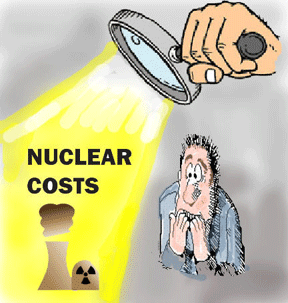 Hinkley Point nuclear fiasco spooks Hitachi boss, Telegraph, 31 Jan 16
Hitachi boss raises concerns about funding of its own Wylfa Newydd project with foreign secretary during visit to Japan The head of Hitachi has warned that the debacle surrounding the construction of Hinkley Point nuclear plant throws up “very serious concerns” about its own investment in the UK.
Hiroaki Nakanishi, chairman and chief executive of the Japanese industrial giant, said the setbacks experienced by Hinkley’s developer EDF raised questions about how future plants including its Wylfa Newydd project are funded.
Hitachi’s subsidiary Horizon is planning to build a nuclear plant on Anglesey that is expected to start generating power by the mid-2020s.
In an interview with The Telegraph, Mr Nakanishi revealed that he had expressed concerns about the expected costs of the project with Philip Hammond during the Foreign Secretary’s visit to Japan this month.
Horizon is in talks with the Government to ensure the Wylfa deal presents value for money for both sides.
Mr Nakanishi said Hitachi had set out “very fair conditions for the making of our investment”, but could only commit to a deal it believed was viable.
“Hinkley Point [raises questions] about what are the real solutions for setting up financial support,” he said.
“Nuclear power construction requires huge money … we need to arrange a financial plan for which the kind of money needed can be introduced.
“Some part is government endorsement, some is more preferable investment conditions from the part of the finance industry.” Mr Nakanishi said the challenges faced by Hinkley Point could also affect Horizon. “The DECC worries about the stability of the scheduled construction of the [Hinkley Point] nuclear power plant, so some of the conditions – the credit requirements – those kind of things may affect us.
“In order to set up the financial conditions [to build Hinkley], Chinese capital was introduced, but what the real result will be – we have a very serious concern about that.”
Asked if the firm might step back if it believed a viable deal was not on the table, Mr Nakanishi replied: “Yes”.
Horizon is in negotiations with the Department of Energy and Climate Change (DECC) on issues such as the strike price, or the amount the Government will guarantee per unit of electricity produced, which will be key to attracting additional finance…….. http://www.telegraph.co.uk/finance/newsbysector/energy/12128405/Hinkley-Point-nuclear-fiasco-spooks-Hitachi-boss.html
Anglesey nuclear plant project under threat over funding fears
Hitachi has warned it could walk away from Wylfa Newydd scheme unless it receives viable subsidy from UK Government 31 JAN 2016 BY OWEN HUGHES The Japanese firm behind Wylfa Newydd warned they could walk away from the £14bn nuclear project unless a viable funding deal could be found……..http://www.dailypost.co.uk/business/business-news/anglesey-nuclear-plant-project-under-10813851
UK nuclear power project a bonanza for Japanese companies, Hitachi-GE and others
Hitachi sees over 1tn yen in business for Japan companies http://asia.nikkei.com/Business/Deals/Hitachi-sees-over-1tn-yen-in-business-for-Japan-companies
 TOKYO — A nuclear power project in the U.K. will generate more than 1 trillion yen ($8.42 billion) in orders for Japanese businesses, it was learned Sunday, giving a shot in the arm to exports by an industry suffering from a lack of orders at home since the Fukushima accident of 2011.
More than 3 trillion yen is budgeted for the project if joint venture Hitachi-GE Nuclear Energy constructs four advanced boiling water reactors — and an even higher sum if six reactors get the nod. Hitachi has invited 40 or so Japanese companies to a meeting at the British Embassy here to explain details.
Also expected are water supply pump manufacturer Ebara as well as Kurita Water Industries and Kubota. Shimizu and Kajima, which have experience building housing structures for nuclear plants in Japan, will also likely go.
While Hitachi-GE will handle the reactor core, Japanese companies are expected to undertake key technologies for operating the nuclear plant, giving Japan about 40% of the project total.
(Nikkei)
Britain axes nuclear protective jobs: who will guard Hinkley IF it goes ahead
 If the nuclear button is finally pressed on Hinkley, who will guard the site? Independent, 29 Jan 16 Parliamentary Business “……..It seems astonishing now but Hinkley Point’s French owner vowed that the new plant – Hinkley’s third since “A” opened in the 1960s – would be built and generating 7 per cent of the UK’s electricity needs by Christmas next year. EDF Energy’s UK boss, Vincent de Rivaz, made that promise in 2007, before the timetable slipped back first to 2019 and then to 2025.
The last completed British nuclear station was Sizewell B in Suffolk, which opened in 1995, while older plants have stopped generating electricity or are preparing for decommissioning. Hinkley C is supposed to be the catalyst for a new fleet of reactors across the UK. ……
Despite the problems, it was still a bit of a shock to see EDF’s board delay a meeting this week in which directors would have made what has been coined a “final investment decision” on the project. After all these years, EDF still doesn’t seem to be fully confident that billions of pounds of investment is worth the risk, and has delayed a decision for at least a month.
…….Mr Lewis took the opportunity to put the boot into George Osborne, saying: “The Chancellor promised he would protect the police but now we know they need to be protected from his cuts. Hundreds of the front-line officers who protect sensitive nuclear power stations and radioactive materials are facing the axe, even though these are top terrorist targets.”
……….. we should be training more of these specialist officers before these new reactors are built. As the CNC puts it, this is “a unique force with a unique role”. Instead, we seem happy to lose 16.35 per cent of those few who know how to protect nuclear sites. ……..http://www.independent.co.uk/news/business/comment/if-the-nuclear-button-is-finally-pressed-on-hinkley-who-will-guard-the-site-a6840836.html
The nuclear revolving door: Former Labour MP appointed boss of nuclear industry trade body
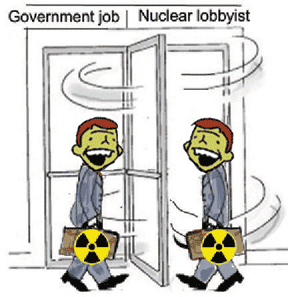
STV News 27 Jan 16 A former Labour MP has been appointed chief executive of the trade body for the civil nuclear industry.Ex-MP for Rutherglen and Hamilton West Tom Greatrex will take up the post at the Nuclear Industry Association next week, succeeding Keith Parker.
Mr Greatrex was an opposition spokesman on energy until he lost his seat in last May’s general election.
He said: “I am delighted to be joining the Nuclear Industry Association at such an exciting time……http://news.stv.tv/west-central/1340504-former-labour-mp-appointed-boss-of-nuclear-industry-trade-body/
French unions unhappy with arrangements for UK’s Hinkley nuclear build
New nuclear power: It’s consumer protection vs corporate profit, http://www.carolinelucas.com/latest/new-nuclear-power-its-consumer-protection-vs-corporate-profit January 27, 2016 The Government’s policy of burdening bill payers with eye watering subsidies for new nuclear power has received another blow. Just before a crucial board meeting at EDF (the French state owned energy giant relied on by the Government to invest in and operate Hinkley Point) French trade unions spoke out about their concerns.
When even staff working for EDF are raising serious doubts about numerous aspects of the proposal, UK Ministers’ cavalier attitude to Hinkley Point C needs to change, more urgently than ever.
In advance of an EDF board meeting due to take place today, where the company was rumoured to be making a final investment decision, French unions threw a welcome spanner in the works.
They’ve raise no fewer than 15 questions about the project, suggesting it would be difficult to complete on time and that financing it could threaten EDF’s survival. The good news, for now, is that EDF has, again, delayed the decision.
But the concerns of French unions are worth a closer look. They include pending legal cases, the lack of evidence Hinkley can be built on time, and the partnership with the Chinese nuclear energy company when no other investors appear to be interested.
Most telling of all is the following question: “what happens if the UK government decides to look after consumer interest?”
This shows that the Conservative Government’s pro-nuclear policy flies in the face of everything they say about looking after the interests of consumers and billpayers. Indeed, studies show that solar power coupled with energy storage and smart grid technology could generate the equivalent to Hinkley Point C at half the cost – to the Govt and to you and I. Wind power, even with backup, ischeaper than nuclear power too.
The Government’s obsession with outdated, inflexible, expensive nuclear power stations is looking more economically and environmentally reckless by the day. So I’ve tabled some more urgent parliamentary questions on Hinkley.
The first question relates to the problems with a similar model of nuclear power station being built at Flamenville in France. It’s already 6 years behind schedule, €7.5 billion over budget, and subject to safety tests following some serious flaws in the reactor vessel and bottom. The ruling on these safety concerns has itself been delayed. I’m pressing the Government on whether the agreement to proceed with Hinkley is conditional on the Flamanville plant demonstrating it’s capable of operating.
My second question is about the huge cost of new nuclear to consumers. It picks up on Ministers’ mindboggling double standards when it comes to subsidies for nuclear power verses solar power, onshore wind and other renewable technologies.
In the Commons earlier this month, the Energy Secretary again attempted to justify her huge cuts to solar subsidies on grounds that “subsidies for low carbon power should be temporary, not part of a permanent business model”. So my question asks exactly when she expects nuclear power stations to meet the same standards and operate on a subsidy free basis. Some renewable technologies are nearly there already, with the costs of others on a clear downward cost trajectory. Energy storage, interconnection and smart grids make Ministers appear stuck in the last century as they desperately argue about baseload.
The cost and climate change arguments against new nuclear power grow stronger every day. This week, workers have made their voices heard. It’s surely time the UK Government started to work for us rather than big energy companies and consign new nuclear to the dustbin of history. Ministers need to start listening to the many voices cautioning against Hinkely and instead back 21st century clean technologies.
In other major nuclear news this week, tomorrow sees a Special Parliamentary seminar co-organised by Nuclear Free Local Authorities and Nuclear Consulting Group: “UK Energy Policy: Late Lessons from Chernobyl, Early Warnings from Fukushima” The keynote speaker will be Naoto Kan, Former Prime Minister of Japan at the time of Fukushima.
EDF in a’panic’ over decision to be made on UK’s Hinkley nuclear power station
Hinkley Point: EDF set for decision on nuclear plant amid claims of board ‘panic’, The Independent, Sources in France say decision on whether to give the green light to controversial project would be made on Wednesday Geoffrey lean , 24 Jan 16
- The final decision on whether to build Britiain’s first nuclear power station in decades is set to be made by energy giant EDF this week, amid claims of “panic” among the French firm’s board over the viability of the £18bn project.
- Sources in France said the decision on whether to give the green light to its controversial plant at Hinkley Point, Somerset – on which ministers are depending to “kick-start a major new generation of nuclear power stations” – would be made on Wednesday. But the largely state-owned company refused to comment, or even to confirm or deny that the meeting is taking place.
This secrecy reflects the extreme sensitivity about the decision with practicalities and politics pulling in opposite directions. The project suffered a serious blow last week when French regulators delayed a decision on what to do about safety flaws in a similar reactor. But cancelling it would be a huge humiliation for British ministers, and could cause a cross-Channel diplomatic row.
- The “final investment decision” by EDF’s board – repeatedly delayed over the past two years – is the project’s only remaining hurdle.
Last October the government persuaded China to invest heavily in the plant, filling a funding shortfall, and the Energy Secretary Amber Rudd is awaiting the decision before signing a deal to allow the company to charge double the present price for the electricity generated from Hinkley’s twin reactors. Three similar European Pressurised Reactor (EPR) projects are planned for Britain if it succeeds…….
- there are signs of last minute jitters. Union leaders are reportedly warning the company of “financial, industrial and legal risks” in the project, while the French financial journal Boursier.com has suggested that there is “panic on board”.
Last week the French nuclear regulator delayed until the end of the year a decision on what to do about “very serious” weaknesses detected in the pressure vessel of a similar EPR being built at Flamanville, Normandy. The same fault – which could lead to a nuclear accident – was detected in the vessels for the Hinkley reactors, which had been built and will now have to be replaced.
- The Flamanville plant is five years behind schedule and its cost has trebled, while the only other EPR being built in Europe, in Finland, is almost a decade late, and the cost has more than doubled. Two other EPRs being built in China are also thought to be over-running while the cost of Hinkley has already soared.
EDF’s share price has plunged to record lows, and the company is considering selling billions of pounds of assets to fund building Hinkley. On top of all that, Austria is taking Britain to the European Court, alleging it is subsidising the plant illegally.Some British experts believe that, faced with all these difficulties, EDF will defer a final decision again. http://www.independent.co.uk/news/uk/home-news/hinkley-point-edf-set-for-decision-on-nuclear-plant-amid-claims-of-board-panic-a6830456.html
1 This Month





PLEASE OPPOSE HR 8255 AND S.3639 – bills would accelerate satellite deployment, with no environmental review or safeguards – https://ncstd5li.quorum.us/campaign/169331/
To see nuclear-related stories in greater depth and intensity – go to https://nuclearinformation.wordpress.com
-
Archives
- October 2026 (49)
- September 2026 (339)
- August 2026 (330)
- July 2026 (355)
- June 2026 (287)
- May 2026 (306)
- April 2026 (356)
- March 2026 (251)
- February 2026 (267)
- January 2026 (308)
- December 2025 (358)
- November 2025 (359)
-
Categories
- 1
- 1 NUCLEAR ISSUES
- business and costs
- climate change
- culture and arts
- ENERGY
- environment
- health
- history
- indigenous issues
- Legal
- marketing of nuclear
- media
- opposition to nuclear
- PERSONAL STORIES
- politics
- politics international
- Religion and ethics
- safety
- secrets,lies and civil liberties
- spinbuster
- technology
- Uranium
- wastes
- weapons and war
- Women
- 2 WORLD
- ACTION
- AFRICA
- Atrocities
- AUSTRALIA
- Christina's notes
- Christina's themes
- culture and arts
- Events
- Fuk 2022
- Fuk 2023
- Fukushima 2017
- Fukushima 2018
- fukushima 2019
- Fukushima 2020
- Fukushima 2021
- general
- global warming
- Humour (God we need it)
- Nuclear
- RARE EARTHS
- Reference
- resources – print
- Resources -audiovicual
- Weekly Newsletter
- World
- World Nuclear
- YouTube
-
RSS
Entries RSS
Comments RSS

