Britain: Nuclear threat to renewables
 We have previously reported assertions by Dr Dave Toke that spending on Hinkley Point C would obliterate spending on renewables, because of the way the Levy Control Framework is organised. (19) At the moment it looks as though the UK will miss its European target which requires us to produce around 30% of our electricity supplies from renewable resources –about 108TWh in 2020 rising to 141TWh in 2030. The current Government doesn’t appear to have any ambition to go beyond this low level of renewable supply
 nuClear News Mar 16[excellent graphs on original] The Government’s National Policy Statement (NPS) on Energy, published in July 2011, foresaw a need for 113 Gigawatts (GW) of electricity generating capacity in 2025 compared with 85GW now. 59GW of this would be new capacity, of which 33GW would need to be renewable energy, mostly wind, to meet commitments to the European Union. This would leave 26GW for industry to determine. At the time there was 8GW of non-renewable capacity under construction leaving a balance of 18GW still to be determined. The Government said it wanted a substantial portion of this to be nuclear. (1)
Resignation of EDF’s finance director heralds crisis in UK Hinkley nuclear project
Hinkley Point C nuclear project in crisis as EDF finance director resigns
Proposed £18bn Somerset plant has been pushed by George Osborne but some on French company’s board fear risky spending, Guardian, Terry Macalister, 7 Mar 16, The £18bn Hinkley Point C nuclear project was in crisis on Sunday night after reports that the finance director of EDF, the company behind the scheme, had resigned.EDF tells contractors to restart work on Hinkley Point, report says
 Thomas Piquemal has stood down from his post after expressing trenchant opposition to those on the EDF board who want to give the green light to the project within weeks, sources said.
The resignation of such an important figure on the EDF board will make it much harder for the remaining executives to proceed with Hinkley in the short term……..
Piquemal is said to have been arguing that pursuing what would be the world’s most expensive power project at this moment could jeopardise the French group, which already has rising debts.
Union members on the EDF board are also implacably opposed to Hinkley Point, saying it is too expensive and a risk to the energy company’s future…….http://www.theguardian.com/environment/2016/mar/07/hinkley-point-c-nuclear-project-in-crisis-as-edf-finance-director-resigns?CMP=twt_a-environment_b-gdneco
Radiation exposure to 20 workers at Faslane nuclear base
Workers exposed to radiation at Faslane nuclear base, Scotsman, 5 Mar 16 Twenty workers were exposed to radiation at the Faslane nuclear base as a result of a safety breach, according to newly released documents.
The workers were inadvertently exposed to a low dose of ionising radiation as they were repairing a leaking tank on a Trident nuclear weapons submarine at the same time a nearby reactor was undergoing trials………[other radiation incidents at Faslane] ……
SNP defence spokesperson Brendan O’Hara MP said: “The MoD – once again – stands accused of a very poor approach to radiation safety at the Faslane base……..
‘’These incidents and how they were subsequently handled, pose real and serious questions , not just about nuclear safety procedures at the base – but also whether the regulator the ONR is doing enough – and quickly enough – to address these concerns.
‘’The MoD must investigate and explain why these failings occur and lay out precisely what it is doing to get it sorted.’’……..http://www.scotsman.com/news/workers-exposed-to-radiation-at-faslane-nuclear-base-1-4046659
UK govt urged to lower tax on energy efficient homes – report

 Report calls for lower stamp duty on UK’s energy-efficient homes Tax should be lowered by up to £5,000, according to Policy Exchange report, which says the government is doing far too little to cut energy waste, Guardian, Damian Carrington, 2 Mar 16 The stamp duty paid on energy efficient homes should be up to £5,000 less than on leaky, hard-to-heat homes, according to a new report that says the government is doing far too little to cut energy waste.
The report is from the thinktank Policy Exchange, which is close to the government, and ministers are considering the idea. It estimates the stamp duty change would lead to 270,000 households a year improving their energy efficiency.
“Improving home energy efficiency can save households money, as well as substantially reducing their carbon emissions,” said Richard Howard, author of the report, and a former chief economist for the crown estate. “Policies which link property values more closely to energy performance could kickstart an energy efficiency revolution in this country.”
The report heavily criticises ministers, who have cut back energy efficiency programmes which are widely seen as the cheapest way to cut energy bills and meet carbon targets. “The UK still has amongst the least efficient housing stock and highest rates of fuel poverty in Europe,” it states.
The government aims to improve the insulation of 1m homes this parliament, far fewer than the 4.5m in the last parliament. It has also abandoned the failed green deal programme, which was meant to reach millions of homes with unique loans but only taken up by 16,000 households. “This leaves a major policy gap,” says the report.
The Policy Exchange proposal is to lower the stamp duty on energy efficiency homes while increasing it by the same amount on inefficient homes, meaning the tax taken by the government remains the same overall……
The report says: “There is huge potential to improve domestic energy efficiency. Research shows that a more ambitious approach to energy efficiency could deliver carbon savings of 24m tonnes of carbon dioxide a year by 2030 – equivalent to taking more than 10 million cars off the road – and save households of £8.6bn a year in energy costs.”…….
Another report published on Wednesday indicates that a roll-out of energy storage technology could save energy customers £50 a year, as well as cutting emissions on improving energy security. Energy storage technologies, from liquid air to big batteries, are developing rapidly and can store excess renewable energy and cut the need to build new power stations and lines.
The report was written by the Carbon Trust and Imperial College London and commissioned by Decc and three of the UK’s big six energy energy companies. A spokesman for one, SSE, said: “The report shows that, with the correct market structures, price signals and policy certainty, projects such as SSE’s proposed pumped storage scheme at Coire Glas can make a valuable contribution to society.” http://www.theguardian.com/environment/2016/mar/02/report-calls-for-lower-stamp-duty-on-uks-energy-efficient-homes
Cornwall, UK, gets wind farm without any govt funding- community energy!
 “The benefits of the Big Field wind farm are too great for it not to go ahead just because subsidies are being withdrawn. Being community-owned will ensure that the economic benefit of the wind farm can be retained locally and re-invested in Cornwall.”
Good Energy promises UK’s first subsidy-free windfarm, http://www.theguardian.com/environment/2016/mar/02/good-energy-promises-uks-first-subsidy-free-windfarm Guardian, Fiona Harvey, 3 Mar 16
Green power company believes it can build onshore windfarm in Cornwall with local people helping finance it, despite government scrapping subsidies. The UK’s first onshore windfarm to be built without government subsidy is now under planning in Cornwall, to be financed in part by the local community.
The Big Field windfarm, near Bude, will consist of 11 turbines, none of more than 125m in height to the tip of the blade, and provide electricity for 22,000 homes. Its backers hope it will point the way to further such projects, after the damages to the onshore wind industry caused by the reversal of policy on government support for clean energy.
Likely to cost about £30m to build and install, Big Field is planned by the green power company Good Energy. While other wind and solar farms have been cancelled or left in limbo by the government’s scrapping of incentives for onshore wind, the company decided instead to try to raise funds locally to support the installation.
An initial application for planning permission for the turbines was filed under the previous subsidy regime. However, that was blocked, and with the withdrawal of government support for onshore wind, the plan looked at an end.
Good Energy revived its prospects with a new project that would use the same number of turbines, of the same size, but with 50% more generation capability, because of changes to the turbine technology.
The revised scheme will only go ahead if planning permission is granted, but the company is hopeful that the support of local residents in agreeing to co-finance the project will help to tip the balance. The inquiry will start in April and, if the green light is given, the windfarm could be operational in 2018.
Bill Andrews, who lives close to the site, said: “This is a very welcome development. A lot of my neighbours already support this wind farm, and giving local people the chance to invest in the project would mean the community will see even more of the benefit.”
The abrupt alterations to government support for wind and solar energy have caused severe disruption in the UK’s renewable energy industries. Thousands of jobs have been lost, companies forced to close, projects mothballed or abandoned, and future developments left in doubt.
Onshore wind technology has tumbled in price in recent years, a factor the government used to justify its withdrawal of support, but the economics of energy generation are complex. Ministers have also introduced new rules to make it more difficult to construct renewable energy projects, and increased subsidies to the fossil fuel industries through the “capacity market”.
Juliet Davenport, chief executive of Good Energy, said: “The benefits of the Big Field wind farm are too great for it not to go ahead just because subsidies are being withdrawn. Being community-owned will ensure that the economic benefit of the wind farm can be retained locally and re-invested in Cornwall.”
Good Energy said it was too early to decide how much of its own money and how much the local community would be expected to put into the project, or what returns investors could expect. However, if successful, it hopes this could provide a new blueprint for small onshore wind farms.
UK govt to spend £642 million developing new submarines for Trident nuclear missiles
 Anger as £642m Trident nuclear submarines investment is confirmed, Herald Scotland, 3 Mar 16 A further £642 million will be invested in developing the new generation of submarines carrying the UK’s nuclear deterrent, Michael Fallon has confirmed.
The defence secretary said the nuclear deterrent “provides the ultimate guarantee of our security” as he announced the extra spending on the boats which will carry the Trident weapons.
But he was condemned by anti-Trident campaigners for making the announcement before MPs have had a chance to give the final go-ahead for the project……… It takes spending on the project’s assessment phase to £3.9 billion……
Kate Hudson, general secretary of the Campaign for Nuclear Disarmament, said: “I ask Michael Fallon, what is the point of a parliamentary vote on Trident if the Government’s going to spend millions on replacement anyway?
“This is completely unacceptable. This is about huge amounts of money being spent on out-of-date technology that will be redundant by the time it is built.
“There is a growing body of evidence which shows that Trident is vulnerable to cyber warfare and attacks by underwater drones.
“The Government appears to be burying its head in the sand – stuck in a 1980s mindset that we are a great power fighting in the Cold War.
“We ask for some objectivity in considering Trident. It is time the Government thought very carefully about the real security threats we face from terrorism, climate change and global pandemics, but also be honest about the very real threat posed by our own nuclear weapons system.”……
the Trident missile system, which was launched in the 1990s as a replacement for the predecessor, Polaris, is due to end its service from 2028. It takes about a decade to build and prepare a new submarine for service. http://www.heraldscotland.com/news/homenews/14319629.Anger_as___642m_Trident_nuclear_submarines_investment_is_confirmed/?ref=rss
Solar power powers up; London – with World’s biggest floating solar farm
World’s biggest floating solar farm powers up outside London Five years in planning and due to be finished in early March, more than 23,000 solar panels will be floated on the Queen Elizabeth II reservoir near Heathrow and used to generate power for local water treatment plants, Guardian, Fiona Harvey 29 Feb 16 On a vast manmade lake on the outskirts of London, work is nearing completion on what will soon be Europe’s largest floating solar power farm – and will briefly be the world’s biggest.

But few are likely to see the 23,000 solar panels on the Queen Elizabeth II reservoir at Walton-on-Thames, which is invisible to all but Heathrow passengers and a few flats in neighbouring estates.
“This will be the biggest floating solar farm in the world for a time – others are under construction,” said Angus Berry, energy manager for Thames Water, which owns the site. “We are leading the way, but we hope that others will follow, in the UK and abroad.”
Five years in planning and due to be finished in early March, the £6m project will generate enough electricity to power the utility’s local water treatment plants for decades. The energy will help provide clean drinking water to a populace of close to 10 million people in greater London and the south-east of England, a huge and often unrecognised drain on electricity, rather than nearby homes.
Why put solar panels on water? The answer, according to Berry, is that the water is there, and might as well be used for this purpose. Floating panels, covering only about 6% of the reservoir, will have no impact on the ecosystem, he says……..
A similar floating solar farm with around half the capacity of the Thames Water project is being built by water company United Utilities on a reservoir near Manchester. Construction of an even bigger farm – at 13.7MW more than twice the QEII farm – is underway on a reservoir in land-scarce Japanand due to finish in 2018.
Putting solar panels on the water for the QEII scheme has not required planning permission, though big arrays of similar panels on land require official sanction. The government has decided to ban farmers who put solar arrays on agricultural land from receiving EU subsidies for the land.
More than 23,000 solar panels will be floated by developer Lightsource Renewable Energy at the reservoir near Walton-on-Thames, representing 6.3MW of capacity, or enough to generate the equivalent electricity consumption of about 1,800 homes………http://www.theguardian.com/environment/2016/feb/29/worlds-biggest-floating-solar-farm-power-up-outside-london
The danger of flying nuclear materials between UK and USA
MoD admits flying nuclear materials http://www.theguardian.com/uk-news/2016/mar/01/mod-admits-flying-nuclear-materials-between-uk-and-us
Campaigners highlight safety risks after defence minister admits there have been 23 such flights in the last five years, Guardian, Rob Edwards, 1 Marc 16 , Materials used in nuclear weapons have been flown between the UK and the US 23 times in the last five years, the Ministry of Defence has admitted.
Though the MoD does not give details, the flights are believed to have carried tritium, plutonium and enriched uranium, all vital ingredients of Tridentwarheads. They probably started or ended at the RAF base at Brize Norton in Oxfordshire.
The flights have alarmed politicians and campaign groups, who are worried about accidents causing widespread radioactive contamination. The MoD, however, insists that the transports complied with stringent safety rules.
The Guardian reported on 9 February that two MoD emergency exercises in 2011 and 2012 codenamed Astral Bend envisaged planes carrying nuclear materials crashing. One imagined a leak of enriched uranium and plutonium spreading up to five kilometres across south Wales.
That prompted a question about the nuclear flights in the House of Commons last week by the Scottish National party’s defence spokesman, Brendan O’Hara MP. In response, the government admitted the frequency of such flights for the first time. “In the last five years, 23 flights carrying defence nuclear materials were undertaken,” the defence minister, Penny Mordaunt, told MPs in a written answer.
“All flights were between the UK and the United States on fixed-wing aircraft under the control of UK armed forces.” Details of the cargoes were kept secret “as disclosure would or would be likely to prejudice national security,” she said.
O’Hara said: “This answer is alarming and highlights a practice most of the public are unaware of. The MoD need to outline what risk and safety assessments they made about these flights and precisely when and what areas of UK airspace were used. I fear the MoD does not have a great track record on transparency when it comes to nuclear issues – and this answer clearly begs more questions.”
Experts say that the UK and the US regularly exchange tritium, plutonium and enriched uranium under a mutual defence agreement. Anti-nuclear campaigners have tracked road convoys transporting nuclear materials between the nuclear bomb plants at Aldermaston and Burghfield in Berkshire and RAF Brize Norton.
The independent nuclear engineer, John Large, argued that the MoD’s air shipments would not comply with international safety regulations for civil nuclear transports. A crash could “contaminate large tracts of land with potential radiological consequences for unprotected members of the public”, he said.
Tom Clements, who heads a group monitoring a nuclear weapons plant at Savannah River in South Carolina, claimed that the MoD flights would not meet US standards for civil nuclear shipments. The flights had “disturbing” implications for the world’s attempts to reduce the proliferation of nuclear weapons, he said.
Peter Burt from the UK Nuclear Information Service, a not-for-profit group, highlighted the high risks of air shipments. “The RAF regularly fly nuclear materials over large urban areas such as Bristol, Cardiff, and Swansea, which raises serious questions about what would happen in the event of an accident involving one of these flights,” he said.
The MoD maintained that the air transports were safe. “The transport of defence nuclear materials is carried out to the highest standard in accordance with stringent safety regulations,” said an MoD spokeswoman.
“In over 50 years of transporting defence nuclear materials in the UK, there has never been an incident that has posed any radiation hazard to the public or to the environment.”
Huge rally in Britain against Trident nuclear missile system
Trident rally is Britain’s biggest anti-nuclear march in a generation
Thousands of protesters including Jeremy Corbyn and other party leaders gather in London for CND march and rally, Guardian, Mark Townsend, 28 Feb 16, Thousands of protesters have assembled in central London for Britain’s biggest anti-nuclear weapons rally in a generation.
Campaigners gathered from across the world: some said they had travelled from Australia to protest against the renewal of Trident. Others had come from the west coast of Scotland, where Britain’s nuclear deterrent submarines are based.
As the huge column of people began moving from Marble Arch after 1pm, the mood was buoyant and spirited despite the cold. Naomi Young, 34, from Southampton said: “You can’t use nuclear weapons. You would destroy the environment and kill hundreds of thousands of people. Why spend £100bn to buy a weapon unless you want to destroy the earth?”
Many waved placards with phrases including “Books Not Bombs”, “Cut War Not Welfare” and “NHS Not Trident”.
A common theme among protesters was the cost of renewing Trident during a period of austerity……..
Organisers of the march, the Campaign for Nuclear Disarmament, were confident the turnout would send a robust message of growing support against renewing the nuclear weapons system – at an estimated cost of least £41bn – and argued that worries about job losses were a red herring…….http://www.theguardian.com/world/2016/feb/27/cnd-rally-anti-nuclear-demonstration-trident-london
The collapse of UK’s planned nuclear power programme ?
 Horizon boss’s statement exposes fantasy nature of UK nuclear power programme http://realfeed-intariffs.blogspot.com.au/2016/02/horizons-boss-statement-exposes-fantasy.html The boss of one of the three supposed consortia claimed to be building Britain’s nuclear power stations has all but admitted that his project is a fantasy one. As can be read in the Telegraph story below, the boss of the ‘Horizon’ project has said that new nuclear power in the UK depends on private investors. Well, that is not going to happen. Who would want to put shares in a venture that might (as in the case of its project in Taiwan) take 15 years not to be completed, or which may not work very well? Nobody. The only possible exceptions to this are (foreign) governments with political, rather than than money-making, objectives. Even they are disappearing! (France and China).
Of course, some people, breezily argue, the government could pay for the power stations. As if we need to spend billions and billions money on nuclear power stations that never seem to be finished instead of hospitals……
In reality the nuclear power programme collapsed in 2012 when it emerged that the Treasury insisted that nuclear power should not receive a state blank cheque. E.ON, RWE, SSE and Centrica all withdrew from nuclear power construction plans. But now for four years our energy and carbon reduction programmes have been distorted in order to preserve the British engineering establishment’s soft spot for nuclear power. The current government defends its lack of investment in real green energy by referring to its fantasy plans for new nuclear power stations.
EDF has announced once again (Feb 16th), that its decision on building Hinkley C will be taken ‘soon’ (soon has meant the same for the last 3 years) and in practice it is waiting, in effect, for the French Government to agree that French electricity consumers/taxpayers should subsidise nuclear power for the British! All to save the pride of the EDF leadership! It sounds bizarre, and I doubt whether even EDF’s hold on the French Government can engineer such an outcome.
EDF could still turn their ship around of course, by helping achieve France’s targets to expand renewable energy. But are they capable of dragging themselves away from their nuclear-dream-turned-sour, or will they waste what few reserves they have left in planning new reactor designs?
See the Telegraph article:
http://www.telegraph.co.uk/finance/newsbysector/energy/12156773/UK-new-nuclear-plan-will-fail-without-private-investors-says-Horizon-chief.html
69 safety incidents and “near misses” on UK nuclear submarines
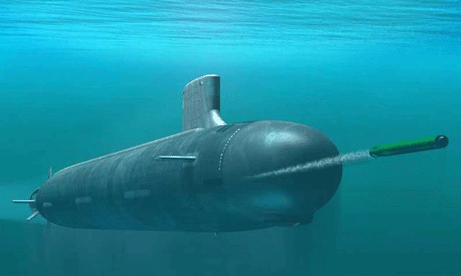 Reactor incidents on new nuclear subs double in one year, Herald Scotland, 21 Feb 16 The Royal Navy’s new nuclear-powered submarines have been plagued by 69 safety incidents and “near misses” over the last four years.
The Astute class of submarines based at Faslane on the Clyde has seen reported reactor incidents at sea or on shore almost double from 12 in 2014 to 21 in 2015. Though the MoD insists that the incidents are all minor, critics warn that they undermine the boats’ reliability and safety………
According to the independent nuclear engineer John Large, the submarines were suffering serious problems. “This continuing experience of the Astute class reactor problems not only imperils the boats when at sea but is likely to result in cutbacks to the number of patrols, voyage durations and the extent of roaming of the high seas,” he said.
John Ainslie, coordinator of the Scottish Campaign for Nuclear Disarmament, pointed out that Astute submarines had been involved in a series of mishaps, including running aground on the Isle of Skye. “It is only a matter of time before one of these incidents results in a serious nuclear accident,” he said……..http://www.heraldscotland.com/news/14291467.Reactor_incidents_on_new_nuclear_subs_double_in_one_year/
Britain’s nuclear project Hinkley Point C staggers again
 U.K.’s Nuclear Project Falters Again http://www.truthdig.com/report/item/uks_nuclear_project_falters_again_20160219 Feb 19, 2016 By Paul Brown / Climate News Network This Creative Commons-licensed piece first appeared at Climate News Network.
LONDON—The future of the nuclear industry in Europe took another blow this week when the French state-owned power company EDF again postponed a final decision on whether to build two large nuclear power stations in the UK. Construction will now not start before 2019, the company said.
This is the eighth time a “final investment decision” on building two European Pressurised Water Reactors (EPRs) has been postponed because the company has still to secure enough backing to finance the £18 billion (€23.26 bn) project.
The excuse this time was that the Chinese New Year celebrations had held up negotiations with the Chinese backers, who have agreed to put up one-third of the money.
Preparation of the site at Hinkley Point in the west of England was stopped last year while EDF sought partners for the project. Each time there has been a postponement the company has issued a statement saying it remains “fully committed” to building two 1,650 MW reactors (1 MW is enough to power 750-1,000 average US homes).
Decision close
This week was no different. “We have the intention to proceed rapidly with the investment decision for Hinkley Point,” EDF’s chief executive Jean-Bernard Levy told reporters. Adding that EDF had not yet finalised talks with its Chinese partners, he said: “Today we estimate this final decision is very close.”
Levy said it would take about three years, possibly a bit more, of study and work with sub-contractors before EDF will begin building the first permanent structures on the Hinkley Point C site, though it will do preparatory work between now and then.
“Definitive construction of what will be built on the site, what we call the first concrete, is on the horizon for 2019,” Levy said.
This date is a year after the reactors were originally due to be completed. The timetable has gradually slipped backwards. Last year the date for power to start being generated was put back to 2025, but this new date for pouring concrete makes 2030 more likely—if the reactors are built at all.
Problematic record
The new proposed start date of 2019 is very significant for reasons the company dare not spell out. This is because there is no evidence yet that these so-called Evolutionary Power Reactors will operate effectively. Four are under construction, but are years behind schedule, and costs have tripled. In Europe their earliest proposed start date is 2018—so it looks as though EDF is being careful not to begin building another one until it can prove the design actually works.
The EPRs are “third generation European Pressurised Water Reactors”—the largest nuclear plants in the world. They have a chequered history, even before any has actually produced a single watt of electricity. Construction of the first prototype began in 2005 in Finland: expected to be finished in 2009, it is still under construction.
The same is true of the second, at Flamanville in France, where construction began in 2007. It has also hit delays and cost over-runs of staggering proportions. It too is due to start in 2018.
The other two EPRs are being built in China. Both should have been in operation by this year, but both also have undergone unspecified delays.
Safety question
The biggest problem for EDF, which owns and is building the Flamanville reactor, is that there are safety issues over the strength of the steel used to build the pressure vessel. It contained too much carbon and is undergoing stress testing to see if it is safe. While the outcome of these tests remains unknown, a question mark hangs over the station’s future.
This, plus the vast amount of remedial safety work required by the French safety regulators from EDF on its fleet of 58 ageing reactors in France itself, has put the company under severe financial strain. It needs to find €100 bn for repairs, and to improve safety following the Fukushima disaster in Japan, to keep the plants operating until 2030.
As a result of fears that the company might overstretch itself and jeopardise jobs in France the six trade union representatives on EDF’s board have expressed opposition to the company going ahead with building reactors on British soil.
Unfilled gap
This further postponement of a start date for the new reactors leaves the UK government with a gaping hole in its energy policy, despite it offering to pay double the existing price of electricity for the output from Hinkley Point, a subsidy that will continue for 35 years.
The Conservative government has been relying on nuclear energy to replace fossil fuels from 2025, when it plans to phase out all its coal stations. Some renewable energy subsidies have been scrapped to make way for new nuclear stations.
In all, the Conservative government wants ten new nuclear stations in the UK—four EPRs and the rest from Japan and the US. None of these now seems likely to be built before 2030, if at all.
Perhaps to divert attention from the postponement of the new reactors, EDF announced that it was going to extend the life of four of the nuclear power stations it already operates in Britain. It bought eight ageing stations of British design in 2009 for £12.5 billion.
Longer lives
Some were already due to close in 2018 but have had their lives extended. Now another four will be kept open to bridge the gap left by the failure to build the new stations at Hinkley Point.
These are the Heysham 1 plant in northwest England and another at Hartlepool in the northeast, both of which had been due to be switched off in 2019 because of their advanced age. They will be allowed to keep producing electricity for another five years.
Two other reactors, Heysham 2 and Torness in Scotland, have been granted extensions of seven years to 2030. There is no reason—as long as the stations are deemed safe – why further life extensions should not be applied for, and granted.
Continuing to apply for life extensions for old nuclear stations also saves the company from technical bankruptcy. Once a station is closed its decommissioning costs become company liabilities. With the company’s debts already high, it would not take many closures for EDF’s liabilities to exceed its assets.
Paul Brown, a founding editor of Climate News Network, is a former environment correspondent of The Guardian newspaper, and still writes columns for the paper.
Call on the British govt to hold a public enquiry on the murder of Hilda Murrell
The British Government: To open a public enquiry on the murder of Hilda Murrell https://secure.avaaz.org/en/petition/The_British_Government_To_open_a_public_enquiry_on_the_murder_of_Hilda_Murrell/?sFUDDfb Why this is important
The unsolved murder of Hilda Murrell, Anti-Nuclear Activist
 Hilda Murrell, Anti-Nuclear Activist, Abducted & Murdered 31 years ago, Mining Awareness Plus, “Hilda Murrell (3 February 1906 – 23? March 1984) was a British rose grower, naturalist, diarist and campaigner against nuclear power and nuclear weapons. She was abducted and found murdered five miles from her home in Shropshire,…” http://en.wikipedia.org/wiki/Hilda_Murrell
In the UK House of Commons, 1984:
“There is also the evidence of my friend, Mr. Gerard Morgan Grenville, whom I have known for nearly 40 years. Mrs. Morgan Grenville tells me how Hilda Murrell rang them up in a great state at the end of February, and how she fetched her husband. Mr. Morgan Grenville, with whom I have had a good deal to do and who is a deeply serious man, says that her parting words on the telephone were: “If they don’t get me first, I want the world to know that one old woman has seen through their lies“. One is reminded of Scudder, the diarist in John Buchan’s “The Thirty-Nine Steps”. Mr. Morgan Grenville had never heard Miss Murrell speak in that way before. Why should an old lady be prompted to say that?
There has been speculation that her death was connected with a paper that she had written on the problems of nuclear waste and reactor choice, which she hoped would be read at the Sizewell B inquiry. Arthur Osman, writing in The Observer on 2 December, began his article: Silkwood parallels in English woman’s death … Was anti-nuclear power campaigner Hilda Murrell murdered because she was becoming too much of a nuisance to the industry?” “House of Commons Sitting, Miss Hilda Murrell (Murder) HC Deb 19 December 1984 vol 70 cc458-72 458 3.51 am, Mr. Tam Dalyell (Linlithgow)” © Parliamentary Copyright, OPL:http://hansard.millbanksystems.com/commons/1984/dec/19/miss-hilda-murrell-murder [1]
Book Review of:
“A Thorn in Their Side – The Hilda Murrell Murder
Submitted by Anonymous on Fri, 01/27/2012 – 10:49 Reviewed by Nigel Chamberlain, January 2012………anybody who was involved in anti-nuclear activities during the 1980s was placed under Police Special Branch surveillance in their own localities. Those asking the more penetrating questions and those encouraging others to join them in actively opposing the nuclear state were subject to more intensive forms of intimidation – and worse – at the hands of MI5 and their sub-contractors. The ‘civil’ nuclear power industry also had a surveillance arm.
Hilda Murrell was one of those anti-nuclear activists whose research and writing was deemed dangerous enough by the security state to warrant their full attention and to prevent her ideas from spreading and challenging those who held power. Although it is hard to comprehend in our post-Cold War environment and less ideological times, those who held power decided that those who fundamentally challenged it, could legitimately be harassed, have their human rights suspended and be marginalised – all in the name of defending freedom and democracy.
The irony is that those who were campaigning for the abolition of nuclear weapons and the prevention of the expansion of the nuclear power industry were trying to achieve it by almost entirely democratic means. …………..
Read the book, visit the Hilda Murrell website, then make your own judgement. http://www.hildamurrell.org
Author: Rob Green, Publisher: Rata Books
Year published: 2011
ISBN: 978-0-473-19685-1“http://www.natowatch.org/node/611http://www.natowatch.org/legal http://creativecommons.org/licenses/by-nc-sa/2.0/uk/ [The book is available at Amazon, Ibooks, etc. Additional info is found at the Hilda Murrell web site.]……………https://miningawareness.wordpress.com/2015/03/22/hilda-murrell-anti-nuclear-activist-abducted-murdered-31-years-ago/
UK public conned by vested interests, into funding Trident nuclear weapons system
The whole nuclear weapons industry, the flaccid phallic posturing, the stern, brow-furrowing arguments for maintaining it – all are a con of epic proportions. We, the public, are being deceived left, right and centre into allowing fraudulent governments to squander our money on something which merely serves to inflate the wealth of those involved.
 Trident: How the banks have their fingers on the button https://www.commonspace.scot/articles/3468/trident-how-the-banks-have-their-fingers-on-the-button CommonSpace columnist Steve Topple investigates the finance behind nuclear weapons
THE debate surrounding the renewal of the Trident nuclear ‘deterrent’ is a perpetual one that never appears to be out of the news in some way. Take last week. On Monday, Labour went into (another) nuclear-grade meltdown over the ‘thorny’ issue (pun intended) of the party’s stance on the matter, with the GMB Union wading into the debate on Tuesday.
Thursday saw Whitehall sources suggest David Cameron will be delaying the vote on its renewal until after the EU referendum, and on Saturday the US defence secretary blundered in, urging the UK to renew the programme to keep its “outsized” role in the world, like our country was some sort of fast-food meal deal you only get in America.
How much do we really know about the detail of the finance behind Trident and the networks of power?
The UK’s Trident system consists of four submarines, each capable of carrying 16 missiles (but in line with government policy only ever carry eight). These in turn carry up to 12 warheads each (although again, policy deems a maximum of 40). One is on constant patrol, while another is under maintenance and two are either in training or in port.
The cost of the Trident renewal programme is, as is always the case, subjective. The government claims it will be £31bn (up from £25bn last year); activists claim the figure will be a lot higher, and the top-end amount quoted was by Reuters, estimating that over its lifetime the system will cost £167bn.
But how much do we really know about the detail of the finance behind Trident and the networks of power? I delved deeper into the murky waters of vested and financial interests that surround the world’s nuclear weapons – and the results were telling.
To understand why the current UK Government and its predecessors are just so keen on keeping our ‘deterrent’ – ignoring the advice of so many independent bodies – as always the first place to begin is the House of Lords.
Lord Hollick, who was a member of the select committee on economic affairs which gave evidence against Scottish independence, is also a director of a company called Honeywell, which has a contract with the government to develop systems to extend the life cycle of Trident.
I delved deeper into the murky waters of vested and financial interests that surround the world’s nuclear weapons – and the results were telling.
Lord Hague, director of Intercontinental Exchange Inc. (a company which deals in the trading of stocks and shares, including defence) is also chair of the Royal United Services Institute (RUSI), which advises government on defence policy.
Meanwhile, Lord Hutton, adviser to nuclear weapons site security firm Bechtel Corporation, consultant for big-name weapons manufacturer Lockheed Martin and chair of the Nuclear Industries Association, was until last year chair of RUSI.
By my calculations (checking every member’s interests against those companies involved with the Trident), over 15 per cent have what can be deemed as ‘vested interests’ in either the corporations involved in the programme or the institutions that finance them, and this is just for our nuclear capability – one suspects the percentage for defence in general would be higher.
While we’re on the subject of RUSI, on 4 February this year Malcolm Chalmers, director of research there, participated in a debate on Newsnight where he asserted it was “most unlikely that [Trident] will be phased out … I see no evidence for that”, while promoting the myth that the main argument against nuclear weapons was a “moral” one – because we couldn’t spend £167bn in a better way, obviously…
This stance from Chalmers on Trident (and RUSI’s previous proposals of merely scaling back the programme) is unsurprising when you consider the links to the House of Lords I mention above – even less so when you take into account that RUSI is sponsored byfour companies directly involved in Trident – Babcock, Lockheed Martin, Raytheon and Rolls Royce.
The rot surrounding the rabid disease of cronyistic, chumocratical influence in Westminster putridly festers in the banks.
But there’s more. The rot surrounding the rabid disease of cronyistic, chumocratical influence in Westminster also putridly festers in the banks. A report by the International Campaign to Abolish Nuclear Weapons (iCan) cited 41 UK-based financial institutions that invested directly in the nuclear weapons industry (including Labour Party bankrollers the Cooperative); institutions which can be found splattered across the House of Lords register, riddling the government external appointments list (note HSBC’s former directors Lord Green, Rona Fairhead of the BBC Trust and Ruth Kelly of the FCA); and on the headers of numerous political party consultations.
But, here’s the real crux of the matter regarding financial institutions and the system as a whole’s involvement in the nuclear weapons industry – they don’t just bat for ‘our team’.
Almaz-Antey is a state-owned Russian defence industry manufacturer, responsible for at least 26 sub-operators, which predominantly develops anti-aircraft defence systems. It gained notoriety after it was suggested that it was one of its BUK surface-to-air missiles that shot down flight MH17 over Ukraine in 2014.
Funding for Almaz-Antey generally comes from either the Russian Government directly, or via the state-owned Vnesheconombank (VEB) development bank – for example, in 2012 Almaz received RUB 35bn from the Defence Ministry and 25bn from VEB to develop the S-500 Prometey air and missile defence system – touted to be the most advanced on the planet.
Being ‘state-owned’, however, doesn’t always mean state-funded, as an archived press release from 2011 shows. In April of that year VEB signed an agreement for a syndicated loan worth $2.4bn, from 19 banks – and they were all outside of Russia.
UK institutions included Barclays and HSBC, and other prominent contributors were JP Morgan, Morgan Stanley and Credit Suisse – five of the very same banks that were also listed on iCan’s report as funding/investing in Western nuclear programmes.
This example is not, however, some fluke. Uralvagonzavod, which develops Russia’s anti-aircraft tanks, deals with the country’s Sberbank. It, in turn, is 43 per cent retained by ‘international legal investors’ (the detail of which I cannot find), and owns £87bn of assets across the OECD countries. Furthermore, Barclays is also involved, having bid forthe contract to supply the bank with an RUB 3.5bn credit line.
Rostec State Corporation (an umbrella company for 663 other organisations, mostly relating to the military) owns and is part-financed by Novikombank – which in turn is financed by Deutsch Bank, Credit Suisse and – yes, you guessed it – Barclays.
Note also that the latter runs investment operations in the country, and has been assisting the Russian Government with the privatisation of state assets. But perhaps the most disturbing part of this is who finances Russia’s Trident equivalent – the Dolgorukiy class submarine programme.
Manufactured by a company called Sevmash, it receives its financing from the state-owned VEB bank. So yes, correct – Barclays and HSBC, both UK banks, are both directly funding Trident via investment and financing arrangements with Rolls Royce, BAE Systems and Babcock in the UK, while also indirectly funding the equivalent nuclear deterrent of UK ‘enemy’ Russia.
Get it yet?
Multinational corporate banks are playing one big chess game – except it’s all make-believe and there will never be a checkmate, because that would be unprofitable. Governments willingly participate – those in charge are invariably shareholders in weapons manufacturing companies or their financiers.
We are not living in some Sean Connery-era James Bond film. The world is intrinsically too financially entwined for either the East or West to ever press ‘the button’ – and to believe they would is, in my opinion, deluded.
You want a comparison of the current state of the planet and a Bond film? Try Spectre. A group of unelected corporate terrorists pulling the strings of government – or the‘military industrial complex’ if you prefer (although Eisenhower’s theory now pales in comparison with the reality).
Perhaps what sticks in the throat the most, however, is one bank I haven’t mentioned: the Royal Bank of Scotland.
The bank that we, the public, hold an 84 per cent stake in after the 2008 financial crash. A bank that invests not only in 10 companies that are involved in Trident, but is also a financier of Russia’s VEB bank. So therefore a bank which invests in Russia’s nuclear deterrent, as well as ours.
We are fundamentally providing the money to pay for both the East and the West’s nuclear weapons – and then to add insult to injury we pay for our own, again, via taxation.
The whole nuclear weapons industry, the flaccid phallic posturing, the stern, brow-furrowing arguments for maintaining it – all are a con of epic proportions. We, the public, are being deceived left, right and centre into allowing fraudulent governments to squander our money on something which merely serves to inflate the wealth of those involved.
There is no threat – except from our own foolhardiness for sleep-walking for decades and allowing this to continue happening.
The sooner we wake up, the better.
1 This Month





PLEASE OPPOSE HR 8255 AND S.3639 – bills would accelerate satellite deployment, with no environmental review or safeguards – https://ncstd5li.quorum.us/campaign/169331/
To see nuclear-related stories in greater depth and intensity – go to https://nuclearinformation.wordpress.com
-
Archives
- October 2026 (49)
- September 2026 (339)
- August 2026 (330)
- July 2026 (355)
- June 2026 (287)
- May 2026 (306)
- April 2026 (356)
- March 2026 (251)
- February 2026 (267)
- January 2026 (308)
- December 2025 (358)
- November 2025 (359)
-
Categories
- 1
- 1 NUCLEAR ISSUES
- business and costs
- climate change
- culture and arts
- ENERGY
- environment
- health
- history
- indigenous issues
- Legal
- marketing of nuclear
- media
- opposition to nuclear
- PERSONAL STORIES
- politics
- politics international
- Religion and ethics
- safety
- secrets,lies and civil liberties
- spinbuster
- technology
- Uranium
- wastes
- weapons and war
- Women
- 2 WORLD
- ACTION
- AFRICA
- Atrocities
- AUSTRALIA
- Christina's notes
- Christina's themes
- culture and arts
- Events
- Fuk 2022
- Fuk 2023
- Fukushima 2017
- Fukushima 2018
- fukushima 2019
- Fukushima 2020
- Fukushima 2021
- general
- global warming
- Humour (God we need it)
- Nuclear
- RARE EARTHS
- Reference
- resources – print
- Resources -audiovicual
- Weekly Newsletter
- World
- World Nuclear
- YouTube
-
RSS
Entries RSS
Comments RSS

