Former Electricite de France SA Chief Financial Officer says he quit because of financial risks of Hinkley nuclear project
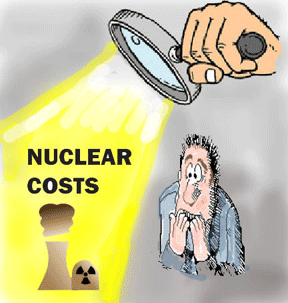

 Ex-EDF CFO Quit Over Financial Risks From U.K. Nuclear Project, Bloomberg, Francois De Beaupuy FrancoisDeBeaup
-
Piquemal says French utility needs to strengthen balance sheet
-
EDF can’t afford significant downgrade in rating: Piquemal
Former Electricite de France SA Chief Financial Officer Thomas Piquemal said he quit two months ago to highlight the risks of proceeding with the 18 billion-pound ($26 billion) Hinkley Point nuclear power project without additional financing.
The timetable pushed by EDF Chairman and Chief Executive Officer Jean-Bernard Levy for an investment decision on the U.K. project meant there wouldn’t have been time to strengthen the utility’s balance sheet, Piquemal told a hearing at the National Assembly in Paris. That would have left the company reliant on its 85 percent shareholder, the French state, providing funding and threatened EDF with the same fate as troubled nuclear-reactor builder Areva SA, he said.
“A new nuclear project is an extra risk for a company,” Piquemal said in his first public statement since quitting. “I didn’t want to approve a decision that could leave EDF in Areva’s situation one day.”……
Financial Strain
Speculation has mounted over the future of Hinkley Point since Piquemal resigned amid concerns the project would put EDF under too much financial strain, while labor unions have called for a three-year delay until similar nuclear plants built by the company start operating in France and China…….
EDF has held off on making a final investment decision even after forming a partnership with China General Nuclear Power Corp. and securing guaranteed power prices from the U.K. government at almost three times the current market rate for 35 years.Rating companies will probably downgrade EDF because large nuclear projects such as Hinkley Point will increase its risk profile, the ex-CFO said. While EDF had no financing problems at the end of 2015, it can’t afford a “significant” downgrade that would push its hybrid debt into the “junk” category because it would complicate a potential refinancing from 2020, Piquemal said. http://www.bloomberg.com/news/articles/2016-05-04/ex-edf-cfo-quit-over-financial-risks-from-u-k-nuclear-project
Hinkley nuclear project for UK and France political reasons: let’s stop pretending otherwise
The real point of this story is that nuclear power is not commercially viable but has become a state-sponsored technology. There is nothing wrong with state supported technology. But we could save a lot of time and money by not pretending that it is something else.
Lets Stop Pretending Nuclear Power Is Commercially Viable http://oilprice.com/Alternative-Energy/Nuclear-Power/Lets-Stop-Pretending-Nuclear-Power-Is-Commercially-Viable.html By Leonard Hyman & William Tilles
Sat, 30 April 2016, First its new president, Jean-Bernard Levy, said French state utility EDF would delay a decision on its joint French-Chinese nuclear project in the UK, Hinkley Point. That was over a year ago. Then the CFO of EDF, Thomas Piquemal, quit reportedly because he opposed the project on fi-nancial grounds. That was a short time ago. Then after a leaked memos, the French gov-ernment just announced that EDF would be raising more money and the Hinkley decision would now come in September.

Now for the finances. These British nuclear units will cost roughly £18 billion ($27 billion). EDF has already sold a 35 percent share to the Chinese state nuclear company. However EDF still has to find more outside investors and get its ownership of the plant below 50 percent or it will have to consolidate Hinkley Point on its books and show all of the project’s debt on its own balance sheet.
If we were gamblers we would not wager that EDF will take the obvious first step towards restor-ing its financial health and cancels the Hinkley project. Of course, if David Cameron loses the Brexit vote (a referendum to take the UK out of the European Union) and is ejected from Number Ten Downing Street, a new Prime Minister might take a more skeptical view of Hinkley Point.
The real point of this story is that nuclear power is not commercially viable but has become a state-sponsored technology. There is nothing wrong with state supported technology. But we could save a lot of time and money by not pretending that it is something else.
Hinkley nuclear deal with France turning out a very bad one for Britain
“The decision-makers on both sides are totally underestimating” the risks, says Mycle Schneider, an independent nuclear analyst in Paris. “But the farther they go on, the more difficult it is to pull out.”
French Plans for a Nuclear Plant Begin to Look Like a Bad Deal for Britain,Bloomberg 30 Apr 16 A new reactor design poses risks on both sides of the English Channel. As Britain races to replace its aging nuclear reactors and coal generators, it’s hoping to team up with France to build the most expensive power plant in history—a massive atomic facility with two reactors at Hinkley Point on England’s southwestern coast. It could provide 7 percent of the country’s electricity by 2025. But the design, intended to showcase the latest French reactor technology, poses engineering and financial problems that could create a costly morass for both countries.
Public support for the project in Britain has fallen to 33 percent, down from 57 percent in 2013, according to a YouGov poll released on April 26 commissioned by New Nuclear Watch Europe, a pro-nuclear group.
In the end, politics could trump finance and technology. France wants to protect thousands of well-paying jobs in its nuclear industry. And British Prime Minister David Cameron, who in March joined French President François Hollande in reaffirming support for Hinkley Point, is keen for a project that would create jobs in an economically depressed region. “The decision-makers on both sides are totally underestimating” the risks, says Mycle Schneider, an independent nuclear analyst in Paris. “But the farther they go on, the more difficult it is to pull out.”
—With Francois de Beaupuy and Rachel Morison http://www.bloomberg.com/news/articles/2016-04-29/hinkley-point-u-k-nuclear-plant-plans-begin-to-look-like-bad-deal
So-called “charity” nuclear front group lobbies UK govt to fund Small Nuclear Reactors

UK think tank urges nuclear innovation, World Nuclear News, 28 April 2016 A think tank [Alvin Weinberg Foundation] has urged the British government to spend money earmarked for nuclear R&D on ensuring that at least three advanced reactors including at least one small modular reactor (SMR) and a Generation IV design have completed regulatory assessment by the early 2020s.
Weinberg Next Nuclear’s report, Next Steps for Nuclear Innovation in the UK….. The latest study follows a report by the same foundation, The Need for Nuclear Innovation, published in November 2015. Later that month, the UK government announced plans to invest £250 million ($377 million) over five years in a nuclear R&D program to include a competition to identify the best value SMR for the country. The initial phase of the competition was launched in March, with a call for initial expressions of interest.
The first phase of the competition, which will also lead to the development of an SMR Roadmap to set out the policy framework and assess the potential for possible pathways for SMRs in the UK, will run until late 2016. Individual reactor designs will not be assessed at this stage……
At least one of the reactors supported should be a Generation IV design that could use fuel made from previously used reactor fuel and from the UK’s plutonium stocks. It suggests that SMRs and “micro-reactors” – reactors of less than 20 MWe capacity – will be cheaper to construct than large reactors….
Finally, the report proposes that UK regulators cooperate with their peers in other countries, citing US and Canadian regulatory practices where proposed reactor designs are discussed with developers before the formal regulatory process begins. It calls for a three-way collaboration to be established with the aim of establishing international standards for the safety of advanced reactors……
Weinberg Next Nuclear is part of the Alvin Weinberg Foundation. The report was prepared with the sponsorship of Terrestrial Energy, Urenco and Moltex Energy, with Weinberg Next Nuclear retaining sole editorial control.http://www.world-nuclear-news.org/NP-UK-think-tank-urges-nuclear-innovation-2804167.html
Westinghouse keen to fleece UK tax-payers with Small Modular Nuclear Reactors
Westinghouse is engaging its UK stakeholders in its SMR offering to the country’s government, the company announced today. Mark Menzies, member of parliament for the Fylde constituency where the company’s Springfields site is located, said that he had already formally registered his support for Westinghouse’s proposal to produce SMRs for the UK market. He said that feedback from stakeholders would be essential for as the proposal, which could see SMR pressure vessels sourced and manufactured in the UK, to move forward. http://www.world-nuclear-news.org/NP-UK-think-tank-urges-nuclear-innovation-2804167.html
Further delay for UK Hinkley nuclear project, as EDF decides to consult unions
 Fresh setback for Hinkley Point as EDF consults French unions, Telegraph UK Alan Tovey 22 APRIL 2016 Plans by EDF to build the new Hinkley Point nuclear power station have been further delayed after the French energy company said it would consult with unions before announcing its final investment decision.
After a board meeting on Friday, the company said it had agreed a “significant” recapitalisation that would make it “possible for EDF to proceed with its strategic investment programme – including Hinkley Point C”.
However, the directors added they would go through a formal consultation process with unions over the decision. Although it will not be binding on the board, this statutory process would take 60 days, pushing it close to the June 23 referendum on whether or not Britain will remain in the UK.
Sources close to the French government – which is EDF’s majority shareholder with an 85pc stake – said administrative delays could easily push this consultation past the date of the Brexit vote.
Consulting the unions over the decision presents fresh hurdles to the muchdelayed plan to build the Hinkley Point power station, the first in a fleet of new nuclear power stations for the UK.
Ten years ago, EDF was predicting Hinkley would be supplying power by 2017.
Unions are sceptical about whether EDF can afford the investment – which the French firm is financing two thirds of, with the rest coming from Chinese investors – and have made public their opposition to the scheme.
Some senior staff at EDF are also against the power company’s involvement in such a huge project…….http://www.telegraph.co.uk/business/2016/04/24/fresh-setback-for-hinkley-point-as-edf-consults-french-unions/
French corporation EDF and its zombie nuclear reactors
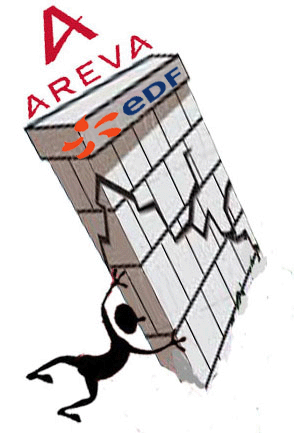 EdF: Living with its ZOMBIE REACTORS!, Jonathon Porritt, 24 Apr 16,
You seriously wouldn’t want to be a Director of EdF at the moment. The agenda for an average Board Meeting must be seriously gloomy on each and every occasion. Here’s how I imagine the key agenda items for their last meeting on 16th February – helpfullysummarised by EdF’s Company Secretary.
Item 1: Existing EPR construction projects
1.1 Olkiluoto (Finland)
Continuing, horrendous cost overruns, leading to ongoing legal stand-off with Finnish partners. Already delayed by seven years, but (hopefully!) could be finished by 2018.
1.2 Flamanville (France)
Continuing, horrendous cost overruns. Already delayed by nine years, but (hopefully!) could be finished by 2018.
1.3 Taishan (China)
Serious problems with both reactors under construction, but, this being China, everything’s shrouded in secrecy. WARNING: This could be much worse than we currently understand.
1.4 Pressure vessels
Still waiting for final safety assessment from French regulators. WARNING: There could be really serious problems here, despite our best efforts to ‘work with’ the regulator.
1.5 Deadlines/UK Treasury
These deadlines are now CRITICAL – as in EXISTENTIAL.
UK Treasury’s loan guarantees are linked to Flamanville operating successfully. And if it is not working properly by 2020, loan guarantee will be completely withdrawn.
Item 2: New reactors at Hinkley Point, Somerset………
Item 3: Extending the life of our UK reactors……
Item 4: Extending the life of our French reactors…….
Item 5: Energy Transition Law (France)…….
Item 6: Financial position…….
…..The implications of all this for the UK couldn’t possibly be more severe. Initially, HinkleyPoint was meant to be on stream by 2025, generating a whacking great 7% of total electricity supply. Earlier delays meant that this had already slipped to 2030. Now that the start date has slipped again, to 2019, AT THE EARLIEST, that 2030 date looks insanely optimistic…….http://www.jonathonporritt.com/blog/edf-living-its-zombie-reactors
£18bn Hinkley Point nuclear power station plan headed for a’grinding halt’?
£18bn Hinkley Point nuclear power station plan could be ‘coming to a grinding halt’ Controversial power station is a key part of the Government’s plan to ‘make sure the lights stay on’, Independent John Lichfield, Ian Johnston 22 April 2016 London“The French electricity giant EDF has thrown the British government’s energy strategy into disarray by reportedly delaying – possibly until next year – a decision on whether it will build a new £18bn nuclear power station at Hinkley Point in Somerset.
Jean-Bernard Lévy, the head of EDF, has bowed to pressure from unions and senior company engineers and agreed to seek a fresh opinion from the company’s union-management consultative council, the respected French newspaper Le Figaro reported.EDF said it could not immediately confirm the report. Sources in the company told the French newspaper that the consultation process would take several months and that no decision on whether to go ahead with its involvement in Hinkley Point – expected to supply eight per cent of British slectricity by 2025 – would be made before next year.
Environmental campaign group Greenpeace claimed the delay could be “a sign that the entire project is coming to a grinding halt”, adding that the UK should back renewable energy “as a more reliable alternative” to nuclear power.
“The firm has been under enormous pressure from both the British and French governments to announce early next month a definite commitment to build, and largely finance, the two new generation nuclear reactors at Hinkley. The French economy minister Emmanuel Macron told the Andrew Marr Show on BBC TV that their agreement was now certain.
However senior engineers and unions at the largely state-owned French company fear the project could destroy the struggling business. They have demanded a delay of at least two years to allow uncertainties about the experimental high-pressure water reactors planned for Hinkley to be resolved……..
Although China has agreed to invest £6.2bn in Hinkley Point, EDF has failed to find other backers, leaving it responsible for two thirds of the cost. Problems with the bulding of similar high-pressure water reactors in Finland and Normandy have led EDF unions and senior executives to recommed a three-year delay – until a new generation of technology become available.
But Paris and London are reported to have applied intense pressure on EDF to go ahead immediately.The British government would face huge embarrassment if Hinkley Point, intended as the first of three new mega power stations, was abandoned or postponed.
In October last year, China agreed, amid much fanfare in London and Beijing, to invest £6.2bn in the project…….John Sauven, director of Greenpeace, which has campaigned against the reactor, told The Independent: “Delays to EDF making a decision about whether to invest in Hinkley are nothing new. So much so that it’s been 14 months since it was first said that the decision would be coming imminently.
But this latest delay from EDF is different.”President Hollande, the French Economy Minister and EDF’s chief executive have all very publicly promised the UK government a final decision before the 12 May. Backtracking on this pledge now is symbolic of the utter mess that EDF is in.
“But even if they could agree a finance package, it could be declared illegal state aid by the European Commission. This may now be the sign that the entire project is coming to a grinding halt and the UK government urgently needs to back renewable energy as a more reliable alternative.”……http://www.independent.co.uk/news/uk/18bn-hinkley-point-nuclear-power-station-plan-could-be-coming-to-a-grinding-halt-a6997131.html
EDF plan to help finance Hinkley nuclear project could be illegal

 Legal challenge fuels doubt over Westcountry nuclear power station By WMNK Rossiter http://www.plymouthherald.co.uk/Legal-challenge-fuels-doubt-Westcountry-nuclear/story-29157974-detail/story.html April 22, 2016 By Keith Rossiter A French government plan to help energy company EDF to build a nuclear power station in Somerset could be illegal, barristers have warned.
Greenpeace and green energy company Ecotricity released a legal opinion on a proposed package of financial support.
French economy minister Emmanuel Macron insisted this week that the £18 billion Hinkley Point C power station will go ahead, in spite of doubts over the viability of the project.
EDF won the contract to build Hinkley Point, but has delayed giving the final go-ahead for months. The company has still not signed off a contract with its Chinese partner China General Nuclear Power Corporation.
Mr Macron said he was “actively working” with EDF and the UK Government to draw up the “final points” of a deal for Hinkley and that it was “very important for France” that the project went ahead.
EDF declined to comment on the Greenpeace claims.
The latest speculation, fuelled by Mr Macron, is that the French government would accept dividends from EDF in the form of shares rather than cash.
The legal experts say that the capital injection this would give to EDF would constitute state aid.
“This would destroy a level playing field for European energy companies,” Greenpeace said.
John Sauven, Greenpeace UK executive director, said: “The only way Hinkley can be kept alive is on the life support machine of state aid.
“The UK Government needs to stop penalising the UK renewable energy industry in favour of propping up an ailing state-owned nuclear industry in France.
“The UK should be a haven for renewable energy investment given the massive potential for wind, solar and tidal to cost effectively meet our energy needs.”
The legal opinion from competition and EU law barristers Jon Turner QC, Ben Rayment and Julian Gregory says that the reported refinancing plans for EDF are likely to be illegal under EU law unless and until they are approved by the European Commission.
Greenpeace has written to Amber Rudd, the Energy Secretary, and George Osborne, the Chancellor, warning them not to proceed with the project unless the French state support has been notified to and approved by the Commission.
Ecotricity says State aid for Hinkley would be harmful to EDF’s competitors.
Dale Vince, Ecotricity founder, said: “It’s time for everyone to realise that we’ve reached the end of the road for Hinkley Point – it’s not going to happen.
“Illegal state aid is one thing, but there are technical problems too. EDF is yet to build one of these reactors and their first two attempts are, between them, 16 years late and billions over budget.
“Our government needs to change its stance on green energy, which powered a quarter of the country last year and could do so much more if the sector received even a fraction of the economic and political support given the nuclear industry.”
Molly Scott Cato, Green MEP for the South West, has already asked the European Commission to investigate whether a proposed rescue plan for Hinkley C was in breach of European state aid rules.
She said: “The numbers for the Hinkley deal have never stacked up and it is clear that the commercial case for this white elephant is dead.
“We now have a political battle where the stakes for both the UK and France are just too high to admit failure.”
This week Amber Rudd said that further delays or even a cancellation of Hinkley would not compromise national energy supply.
Dr Scott Cato said: “We know the lights won’t go out if there is a concerted effort to implement Plan B based on renewable energy, energy efficiency and innovative smart grid and energy storage solutions.
“This could be delivered in time to prevent blackouts and create 122,000 quality jobs – many more than nuclear could ever hope to deliver.”
NATO concerned at danger of ISIS nuclear attack on Britain or Europe
 EU and Nato say there is ‘a justified concern’ of ISIS carrying out a chemical or nuclear attack in Britain or Europe
- ISIS ‘plans nuclear and chemical attacks on Britain and EU’, say NATO
- Terrorists are trying to obtain nuclear weapons, security chiefs warns
- ISIS is also ‘trying to implant bombs in humans and hack driver less cars’
- See more news on the ISIS threat at www.dailymail.co.uk/isis
By SARA MALM and ALLAN HALL FOR MAILONLINE, 20 April 2016 ISIS terrorists are planning nuclear and chemical attacks on Britain and Europe, international security chiefs have warned.
Both Nato and the EU say there are ‘justified concerns’ that ISIS jihadists are working on obtaining chemical, biological, radioactive and nuclear materials to carry out attacks on the EU.
Speaking at the Security and Counter Terror Expo in London this week, senior counter terrorism officials warned of ISIS’s plans to carry out chemical attacks. ‘With CBRN [chemical, biological, radioactive and nuclear materials], there is a justified concern.’ Jorge Berto Silva, deputy head of counter terrorism for the European Commission said according to The Telegraph.
Dr Jamie Shea, deputy assistant secretary general for emerging security threats at Nato, told the annual Security and Counter Terror Expo: ‘We know terrorists are trying to acquire these substances.’………http://www.dailymail.co.uk/news/article-3547840/EU-Nato-say-justified-concern-ISIS-carrying-chemical-nuclear-attack-Britain-Europe.html
France’s nuclear corporation EDF warned on legal action over the Hinkley nuclear project debacle
 Pressure rises on EDF board over Hinkley Point nuclear plant, FT.com, 19 Apr 16, Michael Stothard in Paris A group of managers at French utility EDF have sent a letter to its board of directors warning they could all face legal action if the company pushes ahead with its contentious Hinkley Point C nuclear project in the UK.
The letter, dated April 19 and seen by the Financial Times, said that if a board decision in favour of Hinkley Point led to the “destruction of the value” at EDF its directors could be held personally responsible……….
French president François Hollande is also meeting ministers at the Élysée Palace on Wednesday to discuss financing options for Hinkley Point. The French state has an 85 per cent stake in EDF.
The letter by the group of EDF managers highlights the internal battle that has raged within the company over Hinkley Point, with chief financial officer Thomas Piquemal resigning last month because of concerns that the UK project could threaten the company’s future…….
Two other nuclear projects in France and Finland using the same reactor technology proposed for Hinkley Point are both severely delayed and billions over budget…….. http://www.ft.com/intl/cms/s/0/d6d16bd0-0628-11e6-9b51-0fb5e65703ce.html#axzz46IzsG72i
UK energy secretary admits energy supply would be OK even if Hinkley nuclear cancelled or delayed
Minister admits lights would stay on even if Hinkley nuclear plant is delayed Guardian, Damian Carrington, 19 Apr 16 UK energy secretary admits for the first time that any delays or cancellations to new nuclear reactors would not compromise national energy supply. The UK’s energy secretary has admitted for the first time that the lights would stay on if new nuclear reactors at Hinkley were cancelled or delayed.
Amber Rudd has previously said that “energy security has to be the number one priority” and that new gas and nuclear power would be “central to our energy-secure future”.
But in a letter released on Tuesday in reply to MPs on the energy and climate change select committee, which asked what contingency plans were in place if Hinkley is delayed or cancelled, she said: “While we have every confidence the deal will go ahead, we have arrangements in place to ensure that any potential delay or cancellation to the project does not pose a risk to security of supply for the UK. I am clear that keeping the lights on is non-negotiable.”
She also said that delays to the troubled plant could risk the UK missing its targets to cut carbon emissions, and that alternatives could cost more but would not represent a “significant increase” in cost in the short term.
The final decision by French-state owned company EDF to go ahead with Hinkley has been repeatedly delayed and the billion of pounds of state subsidies and the feasibility of the giant project have been widely criticised. Last week one of the UK’s major investors, Legal and General, called Hinkley “a total waste of money”………
A report from the government’s National Infrastructure Commission in March found that “smart power – principally built around three innovations, interconnection, storage, and demand flexibility – could save consumers up to £8bn a year by 2030, help the UK meet its 2050 carbon targets, and secure the UK’s energy supply for generations.”
Angus MacNeil, chair of the energy and climate change committee, said: “[Rudd’s] letter shows the government has had to finally concede the need for a Plan B on Hinkley, although the detail is sketchy. New capacity must be brought online in a way that is compatible with our decarbonisation targets. That means limiting the role of fossil fuels and maximising the use of smarter low carbon options to meet demand.”……..
ohn Sauven, Greenpeace’s UK director said: “There is absolutely no reason that the UK could not meet our decarbonisation targets if the government dropped Hinkley and gave renewable energy businesses a fraction of political and financial support that nuclear and fossil fuel companies enjoy.” http://www.theguardian.com/environment/2016/apr/19/minister-admits-lights-would-stay-on-even-if-hinkley-nuclear-plant-is-delayed
Clean water for 10 million people, due to London’s new floating solar farm
World’s Largest Floating Solar Farm to Provide 10 Million People with Clean Water, Luminary Daily, By Gary Joshua Garrison / 20 March 2016 The solar farm will span 57,500 square meters (or about eight soccer stadiums) of the Queen Elizabeth II reservoir and will consist of 23,000 solar panels, covering about a tenth of the reservoir. It is slated to be completed by the end of March.

Utility company Thames Water runs the reservoir, while Lightsource Renewable Energy — a private solar energy company based in London — is responsible for the funding and operation of the revolutionary farm.
“This will be the biggest floating solar farm in the world for a time — others are under construction,” Angus Berry, energy manager for Thames Water, told The Guardian. “We are leading the way, but we hope that others will follow, in the UK and abroad.”………
Similar floating solar farms are under construction, or have already been completed, both in England and around the world. Recently, a 45,500 square meter solar farm opened in Greater Manchester, England and water company United Utilities, also in Manchester, is currently constructing a similar project that will have about half the capacity of the Thames Water project. In Japan, solar company Kyocera is in the process of building an 180,000 square meter floating solar farm (see featured image at the top) that is set to be completed in 2018.
For their dedication to providing clean, renewable energy, for their innovation, and for helping to lead the charge in the energy revolution we are happy to name the folks at Lightsource and Thames Water our Luminaries of the Week. http://luminarydaily.com/worlds-largest-floating-solar-farm-to-provide-10-million-people-with-clean-water/
France committed to investing in Hinkley nuclear plant, even if it bankrupts EDF
 French ‘committed’ to investing in Hinkley C nuclear plant Plymouth Herald April 17, 2016 By Kate Langston The French government is “completely committed” to building the Westcountry’s new nuclear power plant at Hinkley, the country’s ministers have confirmed.
In an interview with the BBC, the French economy minister Emmanuel Macron stressed the £18 billion project is “very important” to the French state, which owns 85% of energy firm EDF.He added that backers still need to finalise some “technical and industrial” aspects of the Hinkley C deal, but should be in a position to sign in a “week or more”.
The assurances from Mr Macron come less than a week after he sparked fresh fears for the Somerset-based development by announcing he had “not yet made a decision” about the investment.
They also follow the publication of a letter from the main union representing EDF workers stating the firm is “on the edge of bankruptcy”, and should not be risking billions of pounds in the UK……..
The original date for the generator to come online has been pushed back from 20203 to 2025, and the estimated cost has soared from £16 billion to between £18 and £24.5 billion…….
Mr Macron told journalists that Hinkley is “important for [France’s] commitment to nuclear energy”. “We back Hinkley Point project, it’s very important for France, it’s very important for the nuclear sector and EDF,” he said.
“Now we have to finalise the work, and especially the technical and industrial work, very closely with EDF, with the British government, to be in a situation to sign in the coming week or more.”
The EDF board was due to meet to make a final decision on its investment in Hinkley in January, but this was postponed and is now expected to take place in May.
But John Sauven, director of environmental pressure group Greenpeace which is opposed to the new plant, has accused Mr Macron of saying one thing to a UK audience “and another to the French”.
“He has made it abundantly clear in French that no decision has been made,” he told the BBC. “The reasons are clear: the costs are rising, the problems are mounting, and the opposition in France is growing.
“The alternatives are looking increasingly attractive no matter which language you speak.”……….http://www.plymouthherald.co.uk/French-committed-investing-Hinkley-C-nuclear/story-29126276-detail/story.html
Widespread support for Church of England’s stand against Exxon Mobil
Church of England takes on energy giant ExxonMobil http://www.christiantoday.com/article/church.of.england.takes.on.energy.giant.exxonmobil/83931.htm Mark Woods CHRISTIAN TODAY CONTRIBUTING EDITOR 13 April 2016 The Church Commissioners have won widespread support for a move to put pressure on energy giant ExxonMobil to disclose the impact of climate change policy on its business.
The Church Commissioners manage a fund of around £6.7 billion, whose revenues are used to support the Church of England. The Commissioners co-filed a shareholder motion with the New York State Comptroller Thomas DiNapoli. It asks Exxon to disclose the effect on its business if measures to restrict global warming to two degrees are successful.
More than 30 institutional investors have so far said they will vote for the motion.
Exxon’s competitors Shell and BP have already agreed to disclose how much they will be impacted by efforts to lower greenhouse gas emissions. They were targeted by similar shareholder proposals co-filed in 2015 by the Church Commissioners and other investors. Exxon had attempted to have the resolution struck down by the Securities and Exchange Commission but its request was denied last month.
Church Commissioners spokesman Edward Mason said: “We are delighted with the scale of support this resolution has received so far. The resolution is part of a much wider trend following the Paris Agreement for investors to ask companies to improve disclosure on how they are positioned for the risks and opportunities posed by climate change.”
Exxon has funded groups spreading information denying human-induced climate change and lobbying politicians against climate change legislation. While it pledged to cease doing so in 2007, a Guardian report last July claimed it was continuing the practice.
It has a long history of rejecting shareholder motions on climate change and of rejecting the scientific consensus.
When Exxon challenged the most recent shareholder motion, DiNapoli said: “ExxonMobil risks becoming an outlier among its peers who have publicly supported reining in climate change.
“As investors, we need to know how ExxonMobil’s bottom line will be impacted by the global effort to reduce emissions and what the company plans to do about it.”
Exxon is also under under pressure from a coalition of 17 US attorneys general, Attorneys General United for Clean Power (AGUCP), who have banded together to enforce climate change laws. New York attorney general Eric Schneiderman announced at a press conference on March 29 that the coalition was working to find “creative ways to enforce laws being flouted by the fossil fuel industry and their allies in their shortsighted efforts to put profits above the interests of the American people and the integrity of our financial markets”.
Schneiderman referred to a “relentless assault from well-funded, highly aggressive and morally vacant forces that are trying to block every step by the federal government to take meaningful action” to fight climate change.
The initiative by the attorneys general was criticised by some religious conservatives, however.
Jeffrey Riley, professor of ethics at New Orleans Baptist Theological Seminary, told Baptist Press: “Few deny that the climate is changing – it always has. The debate is on the cause. In spite of the public rhetoric that declares scientific consensus, the debate is still out. Public and political rhetoric on this issue is neither truth nor an argument for truth. Christians who hold that we are stewards of the earth ought to be interested in truth, and for that reason should not support any action that stifles legitimate scientific and economic debate.”
1 This Month





PLEASE OPPOSE HR 8255 AND S.3639 – bills would accelerate satellite deployment, with no environmental review or safeguards – https://ncstd5li.quorum.us/campaign/169331/
To see nuclear-related stories in greater depth and intensity – go to https://nuclearinformation.wordpress.com
-
Archives
- October 2026 (49)
- September 2026 (339)
- August 2026 (330)
- July 2026 (355)
- June 2026 (287)
- May 2026 (306)
- April 2026 (356)
- March 2026 (251)
- February 2026 (267)
- January 2026 (308)
- December 2025 (358)
- November 2025 (359)
-
Categories
- 1
- 1 NUCLEAR ISSUES
- business and costs
- climate change
- culture and arts
- ENERGY
- environment
- health
- history
- indigenous issues
- Legal
- marketing of nuclear
- media
- opposition to nuclear
- PERSONAL STORIES
- politics
- politics international
- Religion and ethics
- safety
- secrets,lies and civil liberties
- spinbuster
- technology
- Uranium
- wastes
- weapons and war
- Women
- 2 WORLD
- ACTION
- AFRICA
- Atrocities
- AUSTRALIA
- Christina's notes
- Christina's themes
- culture and arts
- Events
- Fuk 2022
- Fuk 2023
- Fukushima 2017
- Fukushima 2018
- fukushima 2019
- Fukushima 2020
- Fukushima 2021
- general
- global warming
- Humour (God we need it)
- Nuclear
- RARE EARTHS
- Reference
- resources – print
- Resources -audiovicual
- Weekly Newsletter
- World
- World Nuclear
- YouTube
-
RSS
Entries RSS
Comments RSS

