UK vulnerable to cyberattack if planned nuclear deal with China goes ahead
 How Chinese nuclear deal leaves UK vulnerable to CATASTROPHIC cyber attack GEORGE Osborne has been warned that granting the Chinese a large stake in Britain’s nuclear energy infrastructure poses a “substantive” threat to UK national security. Sunday Express, By TOM BATCHELOR Apr 10, 2016 Beijing is planning to invest in two major nuclear power plant projects in a multi-billion pound contract that would give them access to Britain’s strategic energy network.
No formal agreement between China and the UK has yet been signed, but energy experts have spoken out about the potential for “catastrophe” if the Chinese are given the green light to invest.
Security concerns centre on access to IT systems, with analysts warning the UK would be left vulnerable if relations continue sour to China over the coming years.
Britain’s friendship with the communist state was strained recently over the Tata steel crisis with China putting a highly punitive tax on the metal produced in south Wales to further damage the UK industry.
But experts say a nuclear power deal would put the UK at the mercy of Beijing.
Dr Paul Dorfman, an advisor to the British Government on nuclear security and a senior research fellow at UCL’s Energy Institute, said: “You don’t want to let the Chinese into complex, strategic, national energy infrastructure and you certainly don’t want them anywhere near nuclear.
“There are some real security issues here.”
Fears have been raised about “backdoors” in IT technology that could be exploited by the Chinese government or rogue hackers.
Malicious IT breaches could allow data to be extracted or inserted into complex computer systems, allowing Beijing to circumvent British control of a nuclear plant and shut it down.
GCHQ will be on standby to protect the UK from the threat of a cyber attack if the Chinese are allowed to build at Hinkley Point in Somerset and Bradwell in Essex…….. https://www.express.co.uk/news/uk/658755/Chinese-nuclear-deal-leaves-UK-vulnerable-to-catastrophic-cyber-attack-on-power-plants
France suggests UK’s Hinkley Point nuclear project could still be postponed

 Hinkley Point nuclear project could still be postponed http://www.theweek.co.uk/60778/hinkley-point-nuclear-project-could-still-be-postponed
Delaying £18bn development is ‘up for discussion’, says France’s Segolene Royal Plans to build the world’s most expensive nuclear power station at Hinkley Point, near Somerset, could hit further delays, a French government official has hinted. Speaking during a radio interview this week, ecology minister Segolene Royal was asked whether the £18bn project, which is two-thirds funded by French state-backed energy giant EDF, would be postponed. She responded by stating simply that it is “still under discussion”, says The Guardian.
“There’s an agreement between France and Britain so things should go ahead. But the trade unions are right to ask for the stakes to be re-examined,” Royal said.
In particular, there should be “further proof” that the venture would not affect investment in renewable energy, she added.
Last week, the Financial Times reported that a group of senior engineers at EDF had circulated a white paper among executives calling for a delay of at least two years to overcome deficiencies in design and the “very low” competency of fellow state-owned reactor supplier, Areva. Board member and employee director Christian Taxil has also publicly called for the plans to be postponed.
Supporters for the deal include the British government, which has staked its reputation on Hinkley Point as the core part of its carbon-light energy strategy for future decades, and French economy minister Emmanuel Macron, who has said it will almost certainly get approval at an EDF investor meeting next month.
The incentives for the company are long-term and come in the form of an energy price guarantee that is almost three times current wholesale prices. A new agreement also offers £20bn protection against a future UK government pulling the plug.
The FT reports that 100 EDF engineers also responded to their colleagues concerns by issuing an open letter stating that the company can “build and deliver the two Hinkley Point reactors on time”.
Future’s children will blame us for those wrong energy decisions

We are making the wrong energy choices for future generations, Guardian, Andrew Simms, 8 Apr 16
Our children’s children will not thank us for investing so heavily in technologies like nuclear at the expense of safer, low-carbon options “……It’s easy to see the superficial political attraction of projects like Hinkley C – they look like big, simple solutions to a problem. They’re technologically shiny, highly visible, seemingly easy to keep an eye on and have large, influential lobbies behind them.
With so much seemingly in its favour, it says a lot about the state of the nuclear industry that Hinkley C is heading south faster than a great snipe in migration. In a new report for theIntergenerational Foundation, co-published with the New Weather Institute, I found the economic case alone for new nuclear to be as leaky as a plastic bag of plutonium.
Discounting the untold extra billions, typically hidden and underwritten by the public, required by nuclear reactors to pay for complex security, disposal of radioactive waste, insurance (and, perversely, liabilities from under-insurance), over the course of its initial 35-year contract period, Britain could save at least £30-£40bn on electricity generated by solar and onshore wind with their costs steadily falling.
The costs for nuclear generation, meanwhile, have been doing exactly the opposite. From a government estimate of £5.6bn in 2008, by the time EU officials signed off the deal to build Hinkley C just six years later, the expected construction cost had risen to over £24bn. As obstacles, the burden of the financial architecture for the deal is only beaten by the problems with the technology itself which was meant to be state-of-the-art and a flagship for its operator EDF.
A range of renewable energy options are readily available that prove to be cheaper, safer, more secure, quicker to deliver and, overall, better value for Britain. Yet, instead of grasping this option, the government seems to have gone out of its way to hamper renewables by slashing support and creating a capricious, unstable policy environment…….
If we really are to have policies for the long term and with future generations in mind, we need to ensure energy choices are made to protect and promote their interests. A rational, evidence-based, intergenerational energy system won’t just emerge from political rhetoric, it needs to be designed and based on clear principles.
Such principles would include having an energy system most likely to preserve a climate convivial for future generations; a system with the least toxic environmental burden and which maximises ancillary economic benefits such as local jobs, manufacturing and services.
As an opening bid, here’s a set of intergenerational design criteria to aid intelligent, future energy planning. They are:
- Employment and broader economic return on investment – how much value to the broader economy does investment in different technologies bring; in other words, what is its economic multiplier effect?
- Environmental return on investment – how efficiently does an investment lower carbon emissions and minimise other toxic pollutants and contribute to a healthy environment?
- Energy return on investment – how much energy is generated for the amount of money invested to produce that energy?
- Security return on investment – how much does the technology contribute to domestic energy security and what other security risks does it carry?
- Transition return on investment – how does it contribute, comparatively to the speed and scale of deployment of low carbon energy generating capacity?
- Conviviality return on investment – the degree to which a technology can be responsive to and supportive of a society’s or a community’s own vision and pathway for its development, and that of future generations.
Paul Massara, is the chief executive of the energy supplier, RWE npower. Reflecting on the prospect of Hinkley C, he commented: “We will look back and think that nuclear was a expensive mistake. It’s one of those deals where my children, and my children’s children, are going to be thinking ‘was that a good deal’?”
It’s easy to imagine what conclusion they will come to, and the bewilderment they will feel at why better options were not more aggressively pursued. http://www.theguardian.com/environment/2016/apr/07/we-are-making-the-wrong-energy-choices-for-future-generations
UK sending nuclear wastes to America – dangerous and unwise
In such circumstances it becomes tempting to look for short cuts. One occasionally raised is to put all the world’s problematic waste somewhere very remote like the west Australian desert. This is a non-starter. The Czech and Slovak experience illustrated this. As a single country they planned a single repository, but after their “velvet divorce” each insisted it would not permanently manage the other’s waste. Such an international solution also contradicts the aforementioned issue of being responsible for your own legacy.
The other major hope is that science will find a convincing way either to use waste as fuel for reactors, and/or that “partitioning and transmutation” would drastically reduce the half-lives of the relevant isotopes. Yet these approaches are complex and expensive, involving molten salt reactors or accelerator-driven systems. And critically, there would still be some volume of long-lived waste that needed to be managed – no method can yet promise to drastically reduce the half-lives of all the different waste types. The only credible way forward is deep burial.
 Britain is sending a huge nuclear waste consignment to America – why?, The Conversation, Gordon MacKerron, April 5, 2016 “……..The vast majority of the UK’s waste comes from its fleet of nuclear power stations. Most of it is stored at the Sellafield site in north-west England. But the material being sent to the US is a particularly high (weapons usable) grade of enriched uranium that you wouldn’t want to move to Sellafield from its current location at Dounreay in the north of Scotland without building a new storage facility – presumably more expensive than the cost of transportation.
The decision to move this radioactive waste out of the UK has been presented as making it harder for nuclear materials to get into the hands of terrorists, but this is implausible. The UK is capable of managing homegrown highly enriched uranium itself. The plan also contradicts the principle that countries are responsible for managing their own nuclear legacy…….
we are talking about substances which could harm human health for tens of thousands of years into the future. It raises profound ethical issues of equity between generations.
Deep burial
The scientific community does in fact agree on how to dispose of these materials safely: deep underground in appropriate geology such as clay or granite, with well engineered radiation barriers as an extra defence. Yet only Sweden and Finland, with political systems built on more trust and consensus than most countries, have a clear repository plan – and it will be several years before they become operational.
Most of the storage facilities at Sellafield are designed to last mere decades. The UK has been sporadically focused on deep disposal since the early 1980s, but for a long time approached it top-down and secretively. This became known as the “DAD” method – decide, announce, defend. But it has always led to “abandon” when local communities, having had no part in the siting decision, have rebelled successfully.
It was not until 2008 that the government introduced a system of rules under which local communities would conditionally volunteer a site and then negotiate a deal with the authorities. So far it has produced no result: attempts by district councils around Sellafield to volunteer it were overruled in 2013 by Cumbria county council, the local-authority tier above them, and no other communities have come forward. The government has reserved the right to override the voluntary process but shows no sign of doing so yet.
In such circumstances it becomes tempting to look for short cuts. One occasionally raised is to put all the world’s problematic waste somewhere very remote like the west Australian desert. This is a non-starter. The Czech and Slovak experience illustrated this. As a single country they planned a single repository, but after their “velvet divorce” each insisted it would not permanently manage the other’s waste. Such an international solution also contradicts the aforementioned issue of being responsible for your own legacy.
The other major hope is that science will find a convincing way either to use waste as fuel for reactors, and/or that “partitioning and transmutation” would drastically reduce the half-lives of the relevant isotopes. Yet these approaches are complex and expensive, involving molten salt reactors or accelerator-driven systems. And critically, there would still be some volume of long-lived waste that needed to be managed – no method can yet promise to drastically reduce the half-lives of all the different waste types. The only credible way forward is deep burial…….. https://theconversation.com/britain-is-sending-a-huge-nuclear-waste-consignment-to-america-why-57074
Report: £40bn in savings, if UK scrapped Hinkley nuclear, and went for renewables instead
The report says that at £24bn, Hinkley Point C would be the “most expensive building on Earth”, and argues that the new reactors would pass not just economic costs to future generations, but the burdens of nuclear waste and climate change because nuclear is not quick enough to build at scale to stave off dangerous global warming
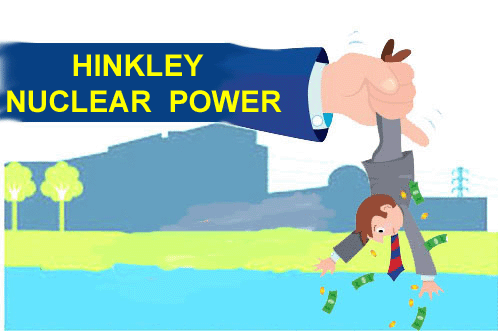
 Scrapping Hinkley for renewable alternatives would save ‘tens of billions’
Solar and wind would generate the equivalent power to Hinkley over the plant’s planned lifetime for £40bn less, says analysis comparing future costs, Guardian, Adam Vaughan, 5 Apr 16, Scrapping plans for new nuclear reactors at Hinkley Point in Somerset and building huge amounts of renewable power instead would save the UK tens of billions of pounds, according to an analysis that compares likely future costs.
The Intergenerational Foundation thinktank calculated that Britain would pay up to £40bn less for renewable alternatives that would generate the equivalent power to Hinkley over the plant’s planned lifetime.
A final investment decision by EDF on the nuclear power plant’s expansion is expected in May. The deal involves the government committing £92.50 per megawatt hour over 35 years for its electricity output, more than twice the current wholesale price.
But a report published on Tuesday by the thinktank, which campaigns on fairness between generations, found that onshore windfarms would cost £31.2bn less than Hinkley, and solar photovoltaic power £39.9bn less over 35 years to build and run. The estimate is based on both the value of subsidies paid by the taxpayer for the electricity and the cost of building the infrastructure.
The analysis is based on the government’s ‘contracts for difference’ subsidy levels for the technologies and projections by Bloomberg for how the cost of wind and solar power will fall in the future.
Andrew Simms, one of the report’s co-authors, said: “The government’s current plans for new nuclear power will break spending records, and pass both high costs and large, unknown economic risks onto every UK child for generations to come.
But, readily available, cheaper, safer and quicker renewable energy options would help Britain live both within its economic and environmental means, while also protecting and providing for future generations.”
The report says that at £24bn, Hinkley Point C would be the “most expensive building on Earth”, and argues that the new reactors would pass not just economic costs to future generations, but the burdens of nuclear waste and climate change because nuclear is not quick enough to build at scale to stave off dangerous global warming………
Renewable power has grown in the UK to the point where more electricity was generated from biomass, wind, hydro and solar power in 2015 than nuclear power stations. But it is unlikely the Intergenerational Foundation’s report will shift minds in government, which has cut subsidies for both solar and wind power while pressing ahead with the Hinkley project.
The analysis assumes the level of subsidy for solar and wind under the contracts for difference subsidy regime would remain constant, though in reality this would likely decrease as more capacity was built……. http://www.theguardian.com/environment/2016/apr/05/scrapping-hinkley-for-renewable-alternatives-will-save-tens-of-billions
Sellafield – what to do with its dilapidated nuclear waste facilities, and its wastes
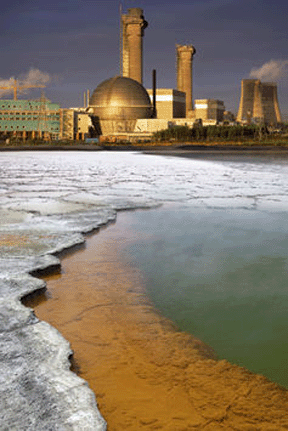 Britain is sending a huge nuclear waste consignment to America – why?, The Conversation, Gordon MacKerron, April 5, 2016 “…..In the absence of a deep-disposal plan, the UK has a more immediately pressing issue – what to do with Sellafield’s contaminated materials and waste from the UK’s near-70 years in the nuclear power and weapons business, much of which is housed in dilapidated facilities that are not fit for purpose. The Nuclear Decommissioning Authority (NDA) expects itwill cost some £68 billion to clean up Sellafield by stabilising and safely packaging the waste and building new stores. This will only be completed by around 2120.
This problem is at least now getting serious attention and resource – despite the climate of public austerity. Currently the country is spendingover £1.5 billion a year on the site, which is one of the most hazardous in Europe.
Sellafield stores a further 140 tonnes of waste plutonium that also stems from British and some overseas nuclear power. If used in bombs this amount could obliterate humanity several times over. The NDA is now focusing on what to do about this too, after years of political inattention. Yet the decision-making is laboured and the currently favoured solutionof using the plutonium as fuel for conventional reactors lacks credibility – no operator wants to use plutonium-based fuel because it is more difficult and expensive to manage than conventional fuel; and moving it around the country is a security risk.
So nuclear waste remains the Achilles heel of the nuclear industry, in the UK and elsewhere. While the financial problems behind the proposed new nuclear station Hinkley Point C attract most of the headlines, the waste problem hangs over the industry behind the scenes. Until we find a way forward that is scientifically and politically acceptable, it will continue to do so.https://theconversation.com/britain-is-sending-a-huge-nuclear-waste-consignment-to-america-why-57074
Britain’s Wylfa Newydd nuclear plant not likely to go ahead
‘Slim chance’ Wylfa Newydd nuclear plant will go ahead By Steffan Messenger BBC Wales Environment Correspondent 5 April 2016
Plans to build a new nuclear power plant on Anglesey have a “slim to zero” chance of going ahead, an industry expert has claimed.
Independent consultant Mycle Schneider is a lead author of the annual World Nuclear Status report. He said the Hinkley Point C project’s difficulties would affect Wylfa Newydd’s ability to attract investors. But Horizon Nuclear Power said it was very confident the new power station would be delivered successfully.
Speaking to BBC Radio Cymru’s Post Cyntaf programme, Mr Schneider, who has advised both the French and German governments on nuclear policy, said: “The Hinkley Point project is in great difficulties and you could argue that the uncertainties are even larger in the case of Wylfa Newydd.”
The Anglesey plant, he said, would need “very clear and very large subsidies to get off the ground”.
Horizon is in talks with the Department of Energy and Climate Change (DECC) on issues such as the strike price, which will be key to attracting additional finance. Richard Foxhall of Horizon Nuclear Power told BBC Wales other investors would need to be brought on board to deliver Wylfa Newydd and that talks were ongoing.
“What is important is that the right conditions for investment are made and part of that is discussions with the government,” he said.
“But we’re very, very confident that we can reach a successful conclusion to those negotiations and make sure the conditions are there to attract investment.”
The chairman of Horizon’s parent company Hitachi has warned it may walk away from the project if a viable deal cannot be reached………http://www.bbc.com/news/uk-wales-35959840
Would UK government impose Small Nuclear Reactors on communities?
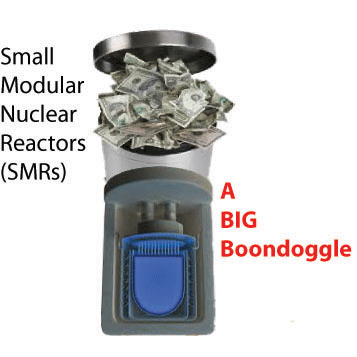 experts have warned that new power stations must not be imposed on local communities.Mini nuclear power stations in UK towns move one step closer, Telegraph UK, Kate McCann, senior political correspondent 2 APRIL 2016 Mini nuclear power stations in towns around the UK have moved a step closer after it emerged the Government is assessing suitable sites to push ahead with a build……….. campaigners are warning the plans could mean communities have new power stations forced on them if suitable sites are identified nearby.The Sunday Telegraph understands that sites in Wales, including the site of a former reactor at Trawsfynydd, and in the North of England where ex-nuclear or coal-fired power stations were stationed are being looked at as possible options.
Other areas including Bradwell, Hartlepool, Heysham, Oldbury, Sizewell, Sellafield and Wylfa are also thought to be possibilities. Small modular reactors are attractive because they can be built in factories and assembled on-site. They take less time to develop than conventional nuclear power stations but they produce much less power – meaning there must be more of them to generate sustainable energy and they must be built close to the communities they serve.
A former Government advisor warned the plans were dropped under the Coalition after pressure from Liberal Democrat Ministers because of fears that communities would reject nuclear power stations close to towns.
But in the Budget in March, George Osborne announced a funding competition to get the industry off the ground in the UK.
The document revealed: “The government is launching the first stage of a competition to identify a small modular nuclear reactor to be built in the UK, and will publish an SMR delivery roadmap later this year. It will also allocate at least £30m of funding for research and development in advanced nuclear manufacturing.”
A number of companies are already working on plans for the small power stations…………..experts have warned that new power stations must not be imposed on local communities.
Liberal Democrat energy spokesman Lynne Featherstone said: “It is just striking how little regard the Conservatives have for communities around this country, and the ridiculous lengths they’ll go to to avoid positive investment in renewables. Continue reading
Chinese nuclear corporation decides not to get involved in UK’s dubious Hinkley nuclear project
 CGN Power’s dropped nuke deal in UK is a “sensible move”: analyst. Asian Power, 28 Mar 16 It would’ve locked up a bulk of capital in the long-term.
Last October, China signed a deal with the UK to participate in three UK nuclear power projects, with CGNPC, the parent of CGN Power, owning a 20.0%-66.5% stake in each of the projects.
Under a non-competition deed granted by CGNPC, CGN Power has the option of investing in any UK nuclear project that is either being planned or constructed by the parent group. Thus far, the independent non-executive directors of CGN Power have elected not to pursue the UK projects.
According to CCB International’s Cathy Chan and Felix Lam, the decision by CGN Power’s independent non-executive directors not to get involved in the construction of the UK nuclear projects did not come as a surprise given the company’s strategy of refraining from involving itself in nuclear power projects that do not have at least one unit already in commercial operation.
The UK project does not yet meet this criterion as it is still at the initial stage of development and has several major hurdles to negotiate, not least of which is insufficient funding from other stakeholders, in particular Électricité de France (EDF FP, NR), a French power company…….. analyst http://asian-power.com/power-utility/news/cgn-powers-dropped-nuke-deal-in-uk-sensible-move-analyst
Further doubt on future of Hinkley Point nuclear project, as costs rise again
Hinkley, No2NuclearPower, 31 March 2016
British churches going for renewable energy
 Hundreds of UK churches set to go green, switch to renewable energy-charities LONDON (Thomson Reuters Foundation) – More than 400 churches in the United Kingdom plan to switch to clean energy providers for their light and heat, shifting spending of 1 million pounds ($1.4 million) to renewables from fossil fuels, two Christian charities said on Wednesday.
The move is part of the Big Church Switch, an initiative launched in February by charities Christian Aid and Tearfund, which urged UK churches and households to use clean sources of energy instead of carbon-emitting fossil fuels.
Their online platform connects those who sign up with energy experts, promising to find them the best renewable deal by negotiating with energy providers.
“As individuals and churches we have a choice in how we treat the earth, how we spend our money, how we power our homes and our buildings,” David Walker, the Anglican bishop of Manchester, said in a statement.
“By creating technology which can turn wind and sunshine into clean and renewable energy, humans continue to benefit from the gift of creation. Making the most of this bountiful harvest is a common sense way for us to roll back the ravages of climate change and ensure we are taking an active role in being part of the solution.”……..http://www.reuters.com/article/us-energy-renewables-church-idUSKCN0WW1QG
Transatlantic flights with nuclear waste cargo – an unacceptable danger
“Nuclear waste should be dealt with as close to where it is produced as possible rather than risking transporting it in ships or planes. This waste will remain dangerous for tens of thousands of years. The consequences of an accident during transit would be horrific.”
the proposed shipment sent an “open invitation to terrorists keen to get their hands on this prime terrorist material”.
Campaigners condemn UK Government for playing transatlantic nuclear ping-pong,
Herald Scotland, MICHAEL SETTLE, 31 Mar 16 CAMPAIGNERS have denounced the UK Government’s decision to play “transatlantic nuclear ping-pong” by agreeing a deal to transport 700 kilograms of weapons-grade uranium fuel from Dounreay in Caithness to the US.
The SNP’s Paul Monaghan, the local MP, said he too was deeply concerned by the development and is to demand assurances from David Cameron about the safety of the transportation, which he believes will involve up to nine flights from Wick airport using huge American c-130 Galaxy aircraft.
“Wick airport is not built for that kind of aircraft. I’m very concerned about the prospect of the planes flying over the town,” declared the backbencher.
Mr Monaghan stressed that the highly-enriched uranium fuel, which he said had originated from the former soviet state of Georgia, could only be used for nuclear weapons.
Claiming the Prime Minister had “obfuscated” in his replies when asked previously about the planned shipment of nuclear fuel from Dounreay to the US, the Nationalist MP said the safety of local people was his “paramount concern” and that the UK Government, through its lack of clarity, was “abrogating its responsibility to the people of Scotland”.
Mr Cameron is due formally to announce the deal when he attends an international nuclear security summit in Washington DC tomorrow. It will involve the largest ever shipment of radioactive material from the UK to America, which in turn will send a different form of the nuclear element to Euratom, the European atomic agency, for conversion in France into medical isotopes to be used in European hospitals for the diagnosis and treatment of cancer.
A UK Government source said: “It’s a win-win; we get rid of waste and we get back something that will help us to fight cancer.”
But Richard Dixon, director of Friends of the Earth Scotland, said: “Only the nuclear industry could think it was a good idea to risk playing ping pong with large quantities of one of the most dangerous materials on the planet across the Atlantic.
He added: “Nuclear waste should be dealt with as close to where it is produced as possible rather than risking transporting it in ships or planes. This waste will remain dangerous for tens of thousands of years. The consequences of an accident during transit would be horrific.”
John Finnie, justice spokesman for the Scottish Greens, dismissed the UK Government’s attempt to present the proposal to send dangerous nuclear waste across the Atlantic as helping in the fight against cancer as “at best misleading and at worst cynical”.
He added: “Moving such a large amount of toxic waste shows callous disregard for the safety of people in the Highlands. There must be better ways to fight cancer than sending dangerous uranium on an 11,000 kilometre round trip.”
Whitehall has, for security reasons, not confirmed the details of the transportation or the timescale.
Last year, the Sunday Herald broke the story about a “secret plan” to ship nuclear material from Dounreay to America.
The report said the plan was for nearly five kilograms of enriched uranium to be transported by sea from Caithness to the US Government’s nuclear complex at Savannah River in South Carolina.
The material was said to have come from a research institute in Mtskheta, some six miles from the Georgian capital, Tbilisi, in a secretive US operation codenamed Auburn Endeavour in April 1998. Washington was said to have been worried at the time that it could have fallen into the hands of Chechen gangs or Iran.
However, the proposed UK Government plan is to ship not five kilograms but 700kg or more than 110 stones of the nuclear material.
At the time of “secret plan” report one anti-nuclear campaigner warned the proposed shipment sent an “open invitation to terrorists keen to get their hands on this prime terrorist material”……..http://www.heraldscotland.com/news/14395623.Campaigners_condemn_UK_Government_for_playing_transatlantic_nuclear_ping_pong/
US and UK to do cyber attack tests on a nuclear power plant
 UK and US to simulate cyber-attack on nuclear plants to test resilience UK and US to simulate cyber-attack on nuclear plants to test resilienceCountries plan to cooperate by exploring the resilience of nuclear infrastructure to a terrorist attack, Guardian, Heather Stewart, 31 Mar 16 Britain and the US will stage a war-game later this year, simulating a cyber attack on a nuclear power plant, to test the readiness of the government and utility firms.As David Cameron prepares to fly to Washington to attend a nuclear security summit, convened by Barack Obama, government sources said the two countries plan to cooperate on exploring the resilience of nuclear infrastructure to a terrorist attack……. Separately, Cameron is also set to announce an exchange deal with the US, which will see the UK ship 700kg (110st) of nuclear waste, most of it currently stored at Dounreay, in Scotland, to be processed in America.
Cameron will also commit to spend £10bn this year to fund the world of agencies including the IAEA, on improving the security of civil nuclear infrastructure worldwide. Over lunch on Friday, the world leaders will discuss “scenario-planning” for protecting their nuclear facilities, and preventing volatile nuclear materials falling into the wrong hands…….http://www.theguardian.com/uk-news/2016/mar/31/uk-us-simulate-cyber-attack-nuclear-plants-test-resilience
|


EDF senior engineers call for delay in UK Hinkley nuclear power development
Dissenting EDF engineers urge delay to Hinkley nuclear project Complexity makes completion date unrealistic, argues report, but French group sticks to timetable Ft.com : By Michael Stothard in Paris, 29 Mar 16,
Senior engineers at French utility EDF have called for at least a two year delay at the controversial Hinkley Point nuclear project in the UK and recommended a redesign of the reactor technology.
An internal white paper written by dissenting EDF engineers, which has been seen by the Financial Times, argues that Hinkley Point is so complex and untested that the company should announce a later completion date than the target of 2025.
The paper, circulated among top executives, said that the “realistic service date was 2027” due to the size of the project, continuing design modifications to the European Pressurised Reactor system and the “very low” competency of French supplier Areva in making some of the large components……..
The unsigned white paper was written after Mr Piquemal’s resignation by a group of senior engineers and other dissidents, according to people with knowledge of the document. The company plans to make the final investment decision on the project at a board meeting on May 11……..
The paper also addresses wider fears that the Hinkley project will in any case not be completed by 2025 and might suffer years of construction delays.
One person on the EDF board who had read the white paper said: “Few believe that we can build this [Hinkley Point] by 2025 any more.”…….
Three people close to the company said that CGN, EDF’s Chinese partner for Hinkley, also feared possible delays, attempting to insert a clause so it would take on a lower financial risk if there were a large problem.
In the case of a £5bn cost overrun, despite EDF having a 66.5 per cent stake in the project, EDF would be liable for 80 per cent of the additional costs, according to a document sent by the EDF finance department to the board’s audit committee in January…….https://next.ft.com/content/2ef61abe-f5b1-11e5-96db-fc683b5e52db
Britain now boasts world’s largest floating solar energy farm
 World’s biggest floating solar farm powers up outside London
Five years in planning and due to be finished in early March, more than 23,000 solar panels will be floated on the Queen Elizabeth II reservoir near Heathrow and used to generate power for local water treatment plants Guardian, Fiona Harvey, 29 Feb 16 On a vast manmade lake on the outskirts of London, work is nearing completion on what will soon be Europe’s largest floating solar power farm – and will briefly be the world’s biggest.
But few are likely to see the 23,000 solar panels on the Queen Elizabeth II reservoir at Walton-on-Thames, which is invisible to all but Heathrow passengers and a few flats in neighbouring estates.
“This will be the biggest floating solar farm in the world for a time – others are under construction,” said Angus Berry, energy manager for Thames Water, which owns the site. “We are leading the way, but we hope that others will follow, in the UK and abroad.”

Five years in planning and due to be finished in early March, the £6m project will generate enough electricity to power the utility’s local water treatment plants for decades. The energy will help provide clean drinking water to a populace of close to 10 million people in greater London and the south-east of England, a huge and often unrecognised drain on electricity, rather than nearby homes.
Why put solar panels on water? The answer, according to Berry, is that the water is there, and might as well be used for this purpose. Floating panels, covering only about 6% of the reservoir, will have no impact on the ecosystem, he says………
A similar floating solar farm with around half the capacity of the Thames Water project is being built by water company United Utilities on a reservoir near Manchester. Construction of an even bigger farm – at 13.7MW more than twice the QEII farm – is underway on a reservoir in land-scarce Japanand due to finish in 2018…….
Putting solar panels on the water for the QEII scheme has not required planning permission, though big arrays of similar panels on land require official sanction. The government has decided to ban farmers who put solar arrays on agricultural land from receiving EU subsidies for the land.
More than 23,000 solar panels will be floated by developer Lightsource Renewable Energy at the reservoir near Walton-on-Thames, representing 6.3MW of capacity, or enough to generate the equivalent electricity consumption of about 1,800 homes…….http://www.theguardian.com/environment/2016/feb/29/worlds-biggest-floating-solar-farm-power-up-outside-london
1 This Month





PLEASE OPPOSE HR 8255 AND S.3639 – bills would accelerate satellite deployment, with no environmental review or safeguards – https://ncstd5li.quorum.us/campaign/169331/
To see nuclear-related stories in greater depth and intensity – go to https://nuclearinformation.wordpress.com
-
Archives
- October 2026 (49)
- September 2026 (339)
- August 2026 (330)
- July 2026 (355)
- June 2026 (287)
- May 2026 (306)
- April 2026 (356)
- March 2026 (251)
- February 2026 (267)
- January 2026 (308)
- December 2025 (358)
- November 2025 (359)
-
Categories
- 1
- 1 NUCLEAR ISSUES
- business and costs
- climate change
- culture and arts
- ENERGY
- environment
- health
- history
- indigenous issues
- Legal
- marketing of nuclear
- media
- opposition to nuclear
- PERSONAL STORIES
- politics
- politics international
- Religion and ethics
- safety
- secrets,lies and civil liberties
- spinbuster
- technology
- Uranium
- wastes
- weapons and war
- Women
- 2 WORLD
- ACTION
- AFRICA
- Atrocities
- AUSTRALIA
- Christina's notes
- Christina's themes
- culture and arts
- Events
- Fuk 2022
- Fuk 2023
- Fukushima 2017
- Fukushima 2018
- fukushima 2019
- Fukushima 2020
- Fukushima 2021
- general
- global warming
- Humour (God we need it)
- Nuclear
- RARE EARTHS
- Reference
- resources – print
- Resources -audiovicual
- Weekly Newsletter
- World
- World Nuclear
- YouTube
-
RSS
Entries RSS
Comments RSS

