UK governmnet not deciding on Hinkley nuclear station anytime soon

 No deadline set for final decision on Hinkley nuclear plant Energy minister tells MPs that no time limit has been set for EDF to make a final investment decision on the much-delayed nuclear plant, Guardian, Damian Carrington 24 May 16
The UK has set no deadline for the final go-ahead to the much-delayed Hinkley Point C nuclear plant, energy minister Andrea Leadsom told a committee of MPson Tuesday.
The head of the company aiming to build the new reactors, French state-owned EDF, told the same hearing he could not give a date for the decision nor confirm that it would start generating electricity in 2025, as previously pledged.
If built, the £18bn plant would generate 7% of the UK’s electricity and is a central plank of the government’s energy policy. EDF originally promised UK customers they would be cooking their Christmas turkeys with power from Hinkley by 2017. But the schedule has repeatedly slipped, amid concerns over the cost and difficulty of the project, which has led to questions about how the UK would keep the lights on without Hinkley……..
The energy secretary, Amber Rudd, said in April that a failure to build Hinkley would not mean the lights going out… http://www.theguardian.com/environment/2016/may/24/edf-no-deadline-set-for-final-decision-on-hinkley-nuclear-plant
Small Modular Nuclear reactor companies keen to sell their wares to UK

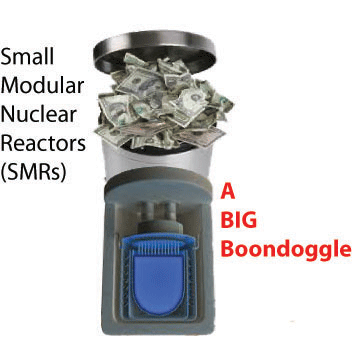 38 companies express interest in building mini nuclear power station at Trawsfynydd, Wales Online, 24 MAY 2016 BY CHRIS KELSEY , OWEN HUGHES
The old nuclear power station site in Snowdonia could be the site for a new generation of nuclear power stations
-
A competition to develop a miniature nuclear power station at Trawsfynydd has attracted interest from 38 companies from around the world.
Small modular reactors (SMRs) are reactors with an electricity output less than 300MW. They have been compared to the nuclear reactors that have been used to power submarines since the 1950s. All the Royal Navy’s submarines are powered by nuclear reactors.
Last year the UK Government announced £250m funding over the next five years for nuclear research and development, including a competition to identify the best value SMR design for the UK…….
- It is understood that they will be told in the coming weeks whether they have moved to the next phase.
The Times has reported that among the companies interested in Trawsfynydd are US firm Bechtel, which has been signed up to build Wylfa Newydd.
Other firms with a background in this type of reactor and understood to be interested are US firms NuScale and Westinghouse, China’s CNNC and a Korean consortium…….
- A report by the Energy and Climate Change Committee has identified Trawsfynydd in Gwynedd – which is currently being decommissioned – as a potential site for a mini nuclear power plant……..http://www.walesonline.co.uk/business/business-news/38-companies-express-interest-building-11376387
American and Japanese corporations to sell nuclear reactors to UK, in North Wales
 £14bn North Wales nuclear power station to be built by the Japanese and
  Americans 22 MAY 2016 BY SION BARRY
Menter Newydd is a joint venture between Bechtel Management Company and Hitachi Nuclear Energy Europe. A US-Japanese consortium has been established to build the £14bn Wylfa Newydd nuclear plant.
Horizon Nuclear Power has appointed Menter Newydd to help deliver the company’s lead nuclear new build project on Anglesey.
Menter Newydd is a joint venture of Hitachi Nuclear Energy Europe, US giant Bechtel Management Company and Japanese firm JGC Corporation (UK) and will be responsible for the construction of Wylfa Newydd, overseen by Horizon Nuclear Power…..http://www.walesonline.co.uk/business/business-news/14bn-north-wales-nuclear-power-11368974
UK designs for more beautiful nuclear reactors
 Realistic or idyllic? Nuclear plant designs shortlisted http://www.itv.com/news/border/2016-05-20/realistic-or-idyllic-nuclear-plant-designs-shortlisted/
A series of possible designs for the new Moorside nuclear development in Cumbria have been drawn up.
NuGen invited designers from around the world to come up with ideas for what would become Europe’s biggest new nuclear power plant.
Here are some of the schemes have been shortlisted for different parts of the nuclear development.
The shortlisted ideas were selected by an independent panel of experts, including Sir Terry Farrell (the British architect and urban designer famous for work including the MI6 Building in London) and Paul Tiplady (former Chief Executive of the Lake District National Park Authority).
The architecture and landscape community have embraced the challenge and have delivered some thoughtful, considered and visually breath-taking proposals for our Moorside Project.
We’ve narrowed the entries down to five – but we’re very keen to hear what the public think of our selection.
Revolutionary solar power: London Borough’s solar panels over marketplace
London borough installs 6,000 solar panels over marketplace http://www.theguardian.com/environment/2016/may/19/london-borough-installs-6000-solar-panels-on-market £2m scheme by Hounslow council on Western International Market will be biggest solar scheme by any local authority, and use batteries to store energy. A London council is unveiling a vast installation of 6,000 solar panels on a wholesale market rooftop, which it says is the largest such array put up by a local authority.
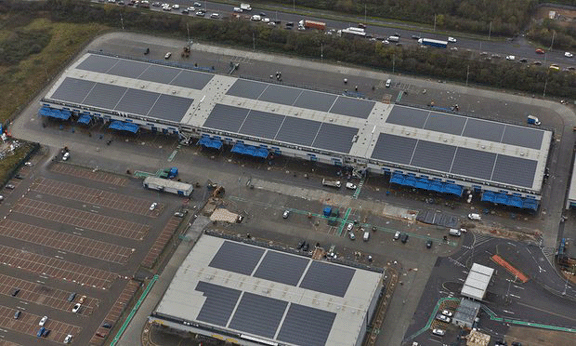
The London Borough of Hounslow says its £2m investment in solar, which has been installed on the roof of Western International Market, is also the first by a council to adopt battery storage to maximise the power from the panels.
The 1.73 megawatt (MW) array of 6,069 panels and four 60kW lithium batteries system now generates half the site’s required electricity.
The site is west London’s largest wholesale market for fresh produce and flowers, and uses around 3.5 megawatt hours (MWh) of electricity to provide climate controlled facilities to around 80 wholesalers and buyers – the equivalent of 1,750 homes a year.
Hounslow council, which owns the market near Heathrow Airport, says the solar system will contribute 2% of its carbon reduction target, cutting emissions by more than 780 tonnes a year.
It will also save £148,000 in energy costs which, along with £100,000 in generation tariff payments and £7,000 in export tariffs, means that the council expects to be £255,000 better off in the first year of operation.
Charles Pipe, energy manager at Hounslow, said: “From the very beginning, this project has been about reducing our carbon footprint and making an investment for the future. “But we have achieved so much more than that. Not only can we expect to see immediate savings on our electricity bills, but we are expecting to see a return on this investment in about five years.”
LG Electronics, one of Hounslow’s partners in the scheme, said it was the company’s largest solar panel installation in Europe and would deliver significant costs savings to the borough.
LG Solar’s UK senior solar sales manager Bob Mills said: “What’s more, the project has set the wheels in motion for further investment and research into the potential of battery storage, which is set to revolutionise the solar industry.
Former AREVA CEO ‘Atomic Anne’ Lauvergeon under a cloud at Rio Tinto
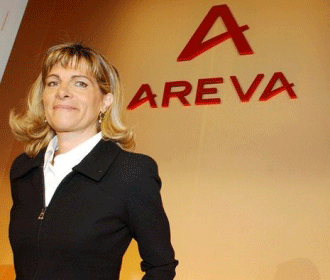 The future of Rio Tinto director ‘Atomic Anne’ Lauvergeon is under a cloud, The Age, May 16, 2016 Peter Ker Resources reporter The future of Rio Tinto director Anne Lauvergeon is under a cloud after French prosecutors starting investigating her conduct while chief executive of energy giant Areva almost a decade ago.
French prosectors spent Friday questioning Ms Lauvergeon over whether she deliberately filed misleading accounts for Areva in 2007.
The investigations centre on Areva’s disastrous takeover of London listed company Uramin in 2007, and the disclosure of multi-billion dollar impairments several years later.
London newspaper the Financial Times reported over the weekend that French prosecutors had confirmed that Ms Lauvergeon was being investigated for “publication of inaccurate accounts” during her time at Areva.
The 56-year-old Ms Lauvergeon, who is known as “Atomic Anne” in France, has served as a non-executive director of Rio since 2014.
The weekend’s revelations come barely two months after French prosecutors launched a separate investigation into alleged insider trading by Olivier Fric, who is Ms Lauvergeon’s partner.
The prosecutors are investigating whether Mr Fric used privileged information to profit from the Uramin deal. Mr Fric’s lawyers have reportedly denied the allegations.
The controversy surrounding Ms Lauvergeon and Mr Fric was known when the Rio board endorsed Ms Lauvergeon for re-election in March……..
Ms Lauvergeon’s continuing work at Rio while the French investigations go ahead is at odds with the approach taken by ASX chief executive Elmer Funke Kupper, who has stood down while the Australian Federal Police conduct anti-bribery investigations into his time spent working for Tabcorp. http://www.theage.com.au/business/mining-and-resources/the-future-of-rio-tinto-director-atomic-anne-lauvergeon-is-under-a-cloud-20160515-govnv7.html
Russia joins the throng desperate to sell nuclear radioactive trash to Britain
 Russia’s state-owned nuclear group keen to break into UK market Rosatom understood to be hoping to revive plans to build reactors in Britain if EDF proposals for Hinkley Point C fail, Guardian, Terry Macalister, 14 May 16, A Russian nuclear group is hoping that the potential meltdown of French plans to build new European pressurised reactors at Hinkley Point could offer an opportunity to break into the British nuclear market.
Deeper concerns about the future of the Somerset scheme were raised by the French energy minister, Ségolène Royal, who warned of the “colossal” cost, which EDF admitted could be £18bn or even £21bn.
Recent talks have been held between state-owned Russian nuclear group Rosatom and the UK’s Nuclear Decommissioning Authority (NDA) despite the chilly political relations between London and Moscow over Ukraine, Moscow sources claimed.
These discussions centred on whether Russia could help Britain with removal of uranium from old reactors – but Rosatom is understood to have a wider agenda of trying to resuscitate earlier plans to build its own reactors in Britain.
“There is still an appetite to enter the UK market,” said a senior Russian nuclear industry source who claimed Rosatom’s London-based representatives still maintained contacts with the Department ofEnergy and Climate Change…….
The Russians accept that sanctions and other political considerations make it difficult for such a plan to progress, but they point out that Rosatom still supplies uranium to UK and US nuclear plants.
The NuDA confirmed that it had held a series of talks with Rosatom. “We have met with them. We are a recognised global authority and we meet with a lot of organisations,” said a spokesman……..
China wants to use Britain as a showcase for its Hualong technology and agreed to take a third share in EDF’s Hinkley scheme in return for being allowed to proceed with Chinese-owned technology at Bradwell……..
Those worries were given extra weight with Royal’s comments in an interview with the Financial Times in which she said: “I am wondering if we should go ahead with the project. The sums involved are colossal.”
And they added to fears about the future of the Somerset project earlier this week when the company’s management was pilloried by shareholders at its annual general meeting and credit agency Moody’s downgraded EDF debt.
John Sauven, Greenpeace’s executive director, said the downgrading was just “a long line of massive red flag warnings” the UK government had received over the Hinkley nuclear project. He added: “Hinkley power station must not become ‘too big to fail’ because of politicians’ egos that are too big to back down.” http://www.theguardian.com/uk-news/2016/may/13/russias-state-owned-nuclear-group-keen-to-break-into-uk-market
Renewable energy, energy efficiency cheaper options for South West England than Hinkley nuclear power
 Alternatives to Hinkley nuClear News No 85 May 2016 If there is anywhere between 4 and 18 months before a final investment decision on Hinkley is made what alternative proposals can be promoted over that time?
 West England, published a study which showed how the South-west’s energy needs could be met with renewable energy. The report focussed on dealing with the baseload question and the economic impact of a renewable energy transition. It concluded that the South West has the renewable energy resources to meet more than 100% of its total energy needs, including replacement of liquid fuels and electrifying railways.
Reasons NOT to back Britain’s Hinkley nuclear power project
nuClear News No 85 May 16“…… there is anywhere between 4 and 18 months to develop the argument for an alternative to building HPC.How Margaret Thatcher’s nuclear dream has turned into UK’s Hinkley nightmare
 Nuclear dream becoming nightmare over Hinkley Point C http://www.plymouthherald.co.uk/Opinion-Nuclear-dream-nightmare-Hinkley-Point-C/story-29269511-detail/story.html By WMN_MartinF May 13, 2016 By ALLAN JEFFERY Some dreams come true; others turn into nightmares. Hinkley Point C nuclear power station has been a dream to many politicians. Is it about to come true?

Margaret Thatcher was one of the first to dream of building Hinkley C. It was to be the second of 10 nuclear power stations she would build, to rescue the country from the menace of those socialist, coal-dependent generators, providing most of the UK’s electricity and too often holding the country to blackout ransom.
Her dream started well! At public inquiry, at Cannington in 1988/89, despite the hundreds of people and organisations arguing against the build, the inspector gave permission to build Hinkley C.
But her dream turned sour as her privatisation of the nation’s nuclear electricity production bankrupted British Nuclear Energy. The government had to bail out the privatised company. Even worse, the world’s largest nuclear accident at Chernobyl occurred, and the radioactive pollution spread over many countries in Europe. Mrs Thatcher gave up on her nuclear dream. Nuclear was too risky and dangerous and too expensive.
The dream passed to the French government. The dream was to sell all around the world hundreds of a new-generation nuclear reactors, of French design: the EPR. Areva designed the reactor and offered the first one to a group of energy hungry companies in Finland, STK.
It would be built in four years, for 3 billion euros.The dream continued well, the French government were going to build another two EPRs in France, China said they would build two, and many other countries showed interest, even the UK.The French then sold the dream to Labour’s prime minister, Tony Blair, convincing him that building the new French-designed EPR reactors would solve all the UK’s energy problems.
A new nuclear renaissance dream started, though this time there would be no long public inquiries. New national energy policy papers would make sure there would be no planning hold-ups, and allow EDF to build the first two EPR reactors at Hinkley.
There councillors were sold on the dream promises of thousands of jobs and the huge amounts of investment spent in the local economy. EDF ploughed on as quickly as it could; delays would increase costs. Local residents would not be allowed to question the dangers of nuclear power.
The councillors started to notice the environmental problems of such a gigantic building project. Lacking the power to challenge, they started to promote it as a dream for the local economy. They encouraged local firms to prepare for the good economic future, and young people a dream future in Hinkley apprenticeships.
Problems then started to occur with the building of this untried and untested new design of reactor. First at Olkiluoto in Finland and then at Flamanville in France, construction problems multiplied, causing long delays and causing costs to double and then treble. Energy companies in Italy, America and the UK pulled out from investing in this disastrous reactor. Western banks and investment funds all started to advise their clients not to invest in Hinkley C.
They realised that the costs of renewables are falling rapidly; the costs of nuclear are rising fast.The nightmare of problems for the funding of the most expensive power station on earth continued. The UK government, lacking Western private investments, reluctantly accepted that Hinkley has to be subsidised. Whether this financing arrangement is legal under European free-market rules is being strongly challenged in the courts.
EDF cannot fund its share of the building cost of Hinkley C, even though the Chinese government is providing a third of the investment building costs. The energy company has large debts and huge cost commitments of its own.Will EDF finally agree to finance the building of Hinkley C? The growing number of problems, constructional, technical, legal, environmental and financial, of building Hinkley C are beginning to change the dream into a nightmare.
The nuclear dreams of many people will turn to disaster, whatever EDF decides on the final investment decision.If the decision is yes, France could lose its national electricity generator and the French taxpayers will rue the day they tried to follow the nuclear dream.If EDF says no, the UK’s energy policy is in tatters leaving the hopes and dreams of politicians, councillors, aspiring businesses and some British trade unions regretting the day they put all their eggs into one nuclear basket, following the Hinkley C dream.
My dreams are coming true. All around the world I see rapidly growing investment into a decentralised, renewable, truly sustainable future for our children.This is article has been abbreviated. The full version can be read at http://stophinkley.org/StopPress.htm Allan Jeffery is assistant co-ordinator at Stop Hinkley http://www.plymouthherald.co.uk/Opinion-Nuclear-dream-nightmare-Hinkley-Point-C/story-29269511-detail/story.html#ixzz48ZRRn3kS
China General Nuclear Power Corporation denies plan to take over Hinkley nuclear project build
 China nuclear company will not build Hinkley alone if EDF drops out CGN, which is helping French energy company with Hinkley Point C scheme, denies it will build reactors independently, Guardian, Terry Macalister, 13 May 16, The Chinese company helping EDF with plans to build new nuclear reactors at Hinkley Point in Somerset has flatly dismissed the idea it would go it alone if the largely state-owned French company dropped out.
“As a partner to EDF supporting the Hinkley Point project, CGN [China General Nuclear Power Corporation] has no independent plans to build reactors at Hinkley Point C,” it said in a statement.
The Department of Energy and Climate Change reiterated the message with its own statement, which said: “There is no proposal for the Chinese to build a reactor at Hinkley.”
The denials come after George Osborne’s father-in-law, Lord Howell, told the House of Lords that the Chinese were working on a “plan B” to step in if, as some expect, EDF abandons the controversial scheme…….https://www.theguardian.com/business/2016/may/13/hinkley-point-cgn-china-general-nuclear-power-corporation-edf-energy
Chinese govt – secret plans to take over the UK’s Hinkley nuclear project?
 Secret Chinese plans to take over nuclear power station Sam Coates, Deputy Political Editor | Robin Pagnamenta, Energy Editor May 13 2016, The Times, China is drawing up secret plans to build two nuclear reactors on the site of Hinkley Point in Somerset if the existing £21 billion deal collapses.
The Chinese government has a “plan B” to bypass EDF, the French energy giant responsible for the project. China believes that it can build its own reactors on a faster timetable than the project run by EDF, in which they have made an investment, according to Lord Howell of Guildford, the former energy secretary and father-in-law of George Osborne.
His statement will raise the pressure on the beleaguered Hinkley C project, which intends to…. (subscribers only) http://www.thetimes.co.uk/article/secret-china-plans-to-take-over-nuclear-power-station-z7qjn0cqk
£21bn the likely cost of ever more expensive Hinkley Point nuclear power station
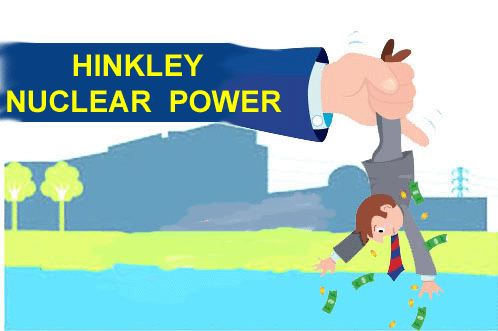 Hinkley Point nuclear power station costs could rise to £21bn, EDF says, Belfast Telegraph, 12 May 16 Energy giant EDF has said the cost
 of building the Hinkley Point C nuclear power station could jump to almost £21 billion, about £3 billion more than it said last year.
In a statement ahead of its annual meeting, the French group estimated the cost of building the twin reactor plant at the Somerset site would be £20.7 billion. EDF said it would provide up to £13.8 billion, while Chinese utility CGN will bring £6.9 billion of financing to the project. It said these latest set of figures provided “a contingency margin”.
However, in October EDF said the project would cost £18 billion, with it providing £12 billion and £6 billion from CGN.
EDF said that the building plan for Hinkley would take around 115 months (nine-and-a-half years) “after the final investment decision until commissioning of the first reactor”.
The French firm had said in October that it expected a final investment decision within weeks and first power in 2025, but that decision has now been delayed until September as the company bids to arrange financing.
This now suggests that if the project completes its financing in September, the plant would not be able to pump out power until the first half of 2026.
This is three years behind EDF’s estimate in 2013, that the plant would be operationalin 2023……..http://www.belfasttelegraph.co.uk/business/news/hinkley-point-nuclear-power-station-costs-could-rise-to-21bn-edf-says-34709042.html
Britain failed to consult Europe over Hinkley nuclear safety dangers – UN
 Hinkley Point: UN says UK failed to consult over risks UN Economic and Social Council says Britain has not met its obligations to discuss the impact of nuclear accident with neighbouring countries Terry Macalister, Guardian, 9 May 16 The British government has run into a major new problem with the Hinkley Point C nuclear project, with a United Nations committee ruling that the UK failed to consult European countries properly over potential environmental risks.
Documents seen by the Guardian show Britain “is in non-compliance with its obligations” (page 21) to discuss the possible impact of any accident or other event that could affect those nations in proximity to Hinkley.
This is just the latest in a string of problems connected with the planned £18bn project to construct new reactors in Somerset, with the developer EDF of Francerecently delaying a final investment decision until September.
Paul Dorfman, a senior researcher at UCL’s energy institute, said the ruling from the UN Economic and Social Council throws great uncertainty over Hinkley.
“This is a huge blow to the government and introduces a whole new element of doubt over the scheme. It is hard to see how EDF can sign off any final investment decision whilst the government has yet to resolve this important issue.”…..http://www.theguardian.com/uk-news/2016/may/08/hinkley-point-united-nations-says-uk-failed-to-consult-over-risks
Global danger in transporting nuclear wastes by plane
 Whether it is transported by sea, or even by air, there is real concern over the potential for an accident or a malicious attack that would put the public at risk.
How many nuclear weapons could be made if such material got into the wrong hands? Why risk global nuclear security by transporting this waste across the Atlantic by air?
We call for this deal to be cancelled forthwith. The waste should be stored on-site at Dounreay and not moved over 6,000 miles away.
UK-US air transports of high enriched uranium: global security at risk for commercial gain, Ecologist Ernie Galsworthy / NFLA 3rd May 2016 Planned air transports of high-enriched uranium from Dounreay in Scotland to the US state of Tennessee would risk of accident or a terrorist seizure of weapon-usable nuclear material. The motive for the transport appears to be purely commercial – and would thus put the public at needless risk for the sake of a cut-price nuclear waste / fuel deal between US and UK authorities.
There has been a recent flurry of media reports suggesting that a proposed transport of radioactive materials from the Caithness Dounreay site to the United States could be sent by plane. Continue reading
1 This Month





PLEASE OPPOSE HR 8255 AND S.3639 – bills would accelerate satellite deployment, with no environmental review or safeguards – https://ncstd5li.quorum.us/campaign/169331/
To see nuclear-related stories in greater depth and intensity – go to https://nuclearinformation.wordpress.com
-
Archives
- October 2026 (49)
- September 2026 (339)
- August 2026 (330)
- July 2026 (355)
- June 2026 (287)
- May 2026 (306)
- April 2026 (356)
- March 2026 (251)
- February 2026 (267)
- January 2026 (308)
- December 2025 (358)
- November 2025 (359)
-
Categories
- 1
- 1 NUCLEAR ISSUES
- business and costs
- climate change
- culture and arts
- ENERGY
- environment
- health
- history
- indigenous issues
- Legal
- marketing of nuclear
- media
- opposition to nuclear
- PERSONAL STORIES
- politics
- politics international
- Religion and ethics
- safety
- secrets,lies and civil liberties
- spinbuster
- technology
- Uranium
- wastes
- weapons and war
- Women
- 2 WORLD
- ACTION
- AFRICA
- Atrocities
- AUSTRALIA
- Christina's notes
- Christina's themes
- culture and arts
- Events
- Fuk 2022
- Fuk 2023
- Fukushima 2017
- Fukushima 2018
- fukushima 2019
- Fukushima 2020
- Fukushima 2021
- general
- global warming
- Humour (God we need it)
- Nuclear
- RARE EARTHS
- Reference
- resources – print
- Resources -audiovicual
- Weekly Newsletter
- World
- World Nuclear
- YouTube
-
RSS
Entries RSS
Comments RSS

