Report questions value of new nuclear projects in Wales compared with renewables
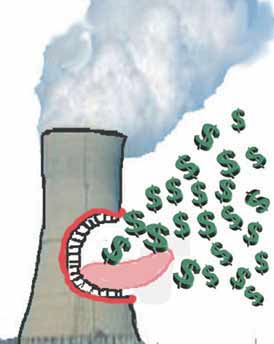
 New nuclear projects in Wales must be ‘cost-competitive’ with renewables, say MPs , Business Green, 26 July 16 Planned nuclear sites in North Wales should only go ahead if government can prove development is ‘value for money’, as Business Secretary Greg Clark visits Japan to fan investor interest in UK nuclear projects
Lawmakers on the Welsh Affairs Committee have published a new report insisting that before proposed nuclear developments at Wylfa Newydd and Trawsfynydd in North Wales go ahead the government must prove the financial viability and community benefit of the projects.
“The government must prove that the cost of any nuclear development is well understood and competitive with renewable sources. These costs must be made public in a format that can be easily understood,” Committee chair David Davies MP said.
“There has to be a demonstrable benefit for the local community as well,” he added. “Local businesses must form a key part of the supply-chain and be given sufficient information to allow this to happen.”………
The report concludes the government should only support the development at Wylfa Newydd if the strike price for the project’s electricity is competitive with renewables and below that of Hinkley Point C, EDF’s controversial nuclear project in Somerset which is due to receive a final investment decision this week. Hinkley’s strike price is £92.50 per MWh – more than double the current market price of power. In comparison, the strike price for onshore wind is around £80 per MWh with some experts now arguing new onshore wind farms can be built at a lower levelised cost than new gas power plants. ……..
Cost estimates for Wylfa Newydd must cover the lifetime of the project, including decommissioning and waste disposal, MPs said, after concerns were raised during their investigation that nuclear power projects are often subject to delays and cost schedule overruns. Cost estimates for Hinkley Point C have ballooned from £16bn in 2012 to almost £21bn earlier this year, while last week EDF’s Paris headquarters were raided by the French finance authorities investigating concerns about its reporting of maintenance and development costs………http://www.businessgreen.com/bg/news/2465917/new-nuclear-projects-in-wales-must-be-cost-competitive-with-renewables-say-mps
 |
Click here to Reply or Forward
|
Cost of Hitachi nuclear plant for North Wales is far too high
Hitachi U.K. Nuclear Plant Should Get Less Than EDF, Panel Says http://www.bloomberg.com/news/articles/2016-07-25/hitachi-u-k-nuclear-plant-should-get-less-than-edf-panel-saysAlex Morales AlexJFMorales
-
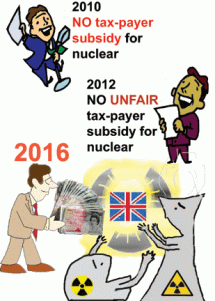 EDF’s Hinkley Point is set for $39 billion of future subsidies
 -
Hinkley secured guaranteed power price at twice current rate
-
Hitachi Ltd. should be paid less for the power from its planned nuclear plant in North Wales than Electricite de France SA has been promised for reactors in western England, a panel of U.K. lawmakers said, seeking to keep a lid on energy prices paid by consumers.
The government should also ensure the cost of the Wylfa Newydd project by Hitachi’s Horizon unit is competitive with renewable-power plants such as onshore wind farms, the cross-party Welsh Affairs Committee said Tuesday in an e-mailed report. The lawmakers called for a “clear and comprehensible explanation” of the lifetime costs of the 2.7-gigawatt project and for a “demonstrable benefit” to the local community.
The U.K. is struggling to build generating capacity fast enough to keep up with the closure of aging nuclear power stations and a phase-out of coal-fired plants. EDF is set to make a final investment decision on Thursday on whether to proceed with an 18-billion-pound ($24 billion) plan to build two reactors at Hinkley Point. The utility has repeatedly postponed a decision on the long-delayed project, despite securing a U.K. government guarantee that it’ll receive 92.50 pounds per megawatt-hour of power, more than double current rates.
- “The government should only build Wylfa Newydd if the strike price is below that agreed for the Hinkley Point C and competitive with renewable sources,” the committee said in a statement. “They must be transparent on cost and provide a clear and comprehensible explanation of the lifetime cost of the project, including decommissioning and waste disposal.”
Fixed Amount
Power from Hinkley Point and Wylfa will be paid for under a so-called contract for difference, which fixes the amount the utility receives per megawatt-hour, making its income predictable. If prevailing power prices are lower than the agreed “strike price,” utilities recoup the difference through consumer bills. If the prevailing price is greater, the utility returns the difference to consumers.
- Because prices have fallen since the EDF contract was agreed in 2013, the future subsidy cost to consumers of Hinkley has increased, according to areport earlier this month from the National Audit Office, which scrutinizes government spending. Using current projections for the wholesale power price, it estimated the lifetime cost of the top-ups has ballooned to 29.7 billion pounds from 6.1 billion pounds originally.The Welsh Affairs Committee also called on ministers to draw up contingency plans in case the Wylfa plant, consisting of two Hitachi advanced boiling-water reactors, isn’t completed as planned by 2025. EDF had originally envisaged its new reactors would generate power by Christmas 2017. Under its current schedule, Hinkley won’t come online until 2025, the same year as Hitachi aims to complete Wylfa.
Despite Brexit, Swedish energy company Vattenfall commits to £300m UK offshore windfarm
Vattenfall commits to £300m UK offshore windfarm despite Brexit
Aberdeen Bay windfarm near Donald Trump golf course will be key testing ground for reducing cost of offshore turbines, Guardian, Adam Vaughan, 21 Jul 16, The Swedish energy company Vattenfall is pushing ahead with a £300m windfarm off the coast of Aberdeen despite last month’s EU referendum vote.
The offshore windfarm has been dogged by years of legal battles between Donald Trump and the Scottish government over its impact on his golf course, which the tycoon ultimately lost in the courts last year.
But on Thursday Vattenfall announced its final investment decision on the European Offshore Wind Deployment Centre, which sees it buying out AberdeenRenewable Energy Group’s 25% share for an undisclosed sum.
The 11 turbines in the development will send clean energy back to the grid, but will also be a key testing ground for bringing down the cost of the technology, which is around twice as expensive as turbines on land. Ministers made clear last year that offshore was “still too expensive” and further subsidies would be conditional on the industry cutting cost.
Donald Trump’s defeat over windfarm welcomed by green campaigners
The 92.4MW project in Aberdeen Bay is all about trying experimental technologies to drive down the costs, Vattenfall said. “It’s all geared to a cost reduction,” said Gunnar Groebler, the senior vice president at Vattenfall. “We expect a lot of findings, a lot of options to further reduce the cost. If you look in Europe, the cost is clearly going south. This windfarm will help us get to the next level.”
Among the cost-cutting measures is a means of attaching the turbines to the seabed using technology that uses less material and higher voltage cabling that loses less of the electricity generated.
But the investment decision is also a vote of confidence in the industry, after the vote to leave the EU. Siemens said Brexit could freeze its offshore wind plans in the UK, though it later rowed back on the remarks.
Groebler said Vattenfall was in the UK to stay. “We’ve repeatedly said the UK is a fundamentally interesting market for us, especially in wind, both onshore and offshore, and we have no reason to change that opinion. The best proof is the decision we are making, this is not something we do lightly.”
He added that it was too early to say what the new UK government’s approach would be towards the industry, but he had seen no signs it would differ from government strategy under David Cameron……
Paul Wheelhouse, the Scottish energy minister, welcomed the investment decision. “This project will keep our nation at the forefront of innovation by allowing energy companies to identify new ways to reduce operating costs,” he said.
WWF Scotland’s climate and energy policy officer, Fabrice Leveque, said: “This is very positive news and provides a welcome boost to Scotland’s offshore wind sector. Scotland has 25% of Europe’s offshore wind resource and this new development provides a great opportunity to progress on capturing the benefits at lowest cost and least impact to the environment.”
Vattenfall said the windfarm will be operational by 2018. https://www.theguardian.com/environment/2016/jul/21/swedens-vattenfall-commits-uk-offshore-windfarm-despite-brexit-aberdeen-donald-trump-golf-course
UK proposal to offer subsidy contracts to Russia, China and South Korea to build nuclear power stations!



Russia, China and South Korea ‘should be invited to build UK nuclear plants’, Telegraph Emily
Gosden, energy editor 23 JULY 2016
Russian, Chinese and South Korean nuclear companies should be offered subsidy contracts to build reactors in the UK if they are cheaper than other projects already under development, a prominent nuclear lobbyist has said.
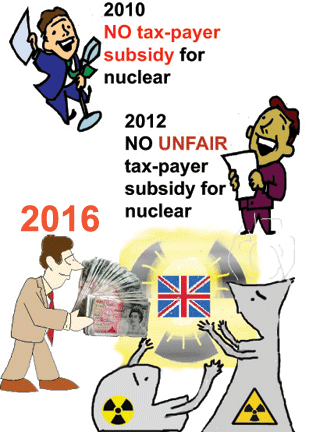
Tim Yeo, the former chairman of the House of Commons energy select committee, said EDF’s proposed £18bn plant at Hinkley Point, which is expected to get the go-ahead this week, should be allowed to proceed, but he urged the Government to rethink its approach to future projects.The Japanese-owned Horizon and Franco-Japanese NuGen consortia are both developing plans for reactors at sites in the UK and hope to secure approval for their technologies and subsidy deals from the Government.
Mr Yeo, the MP for South Suffolk for 32 years until the 2015 general election, now chairs New Nuclear Watch Europe, a lobby group whose members include the Korean nuclear firm Kepco. He urged the Government to “urgently examine which nuclear vendors can deliver the cheapest electricity, maximise the number of UK supply chain jobs and minimise the risk of construction delays”………..
He also advocated a new funding approach under which “most of the construction costs are funded by government borrowing throughout the construction period” to help cut financing costs. http://www.telegraph.co.uk/business/2016/07/23/russia-china-and-south-korea-should-be-invited-to-build-uk-nucle/
Rail transport of nuclear wastes across North Wales is opposed by residents
 The People against Wylfa B (PAWB) group leafleted railway stations across North Wales Demonstrations have been held against radioactive waste being transported by rail along the North Wales coast. Daily Post,, 24 JUL 2016 BY GARETH WYN-WILLIAMS

Members of PAWB (People Against Wylfa B) handed out leaflets at train stations including Bangor, Llandudno Junction, Colwyn Bay and Rhyl on Saturday morning, alerting commuters of the nuclear waste that is transported up to twice a week from Wylfa to Sellafield in Cumbria. The Nuclear Decomissioning Authority (NDA) say such waste has been transported since 1962 without a single accident.
But PAWB argues that if a train carrying waste was to be involved in a collision, residents would be exposed to “highly dangerous and lasting radiation”. Anti-nuclear campaigner Dylan Morgan, who has been protesting for years against a new nuclear plant on Anglesey, said: “The Wylfa trains go weekly on the North Wales coast line through our towns and villages, often at peak times and within three metres of ordinary passenger trains.
“Each of these waste flasks contain hundreds of extremely radioactive atomic fuel rods. Should one of these flasks become damaged, we would be exposed to highly dangerous and long lasting radiation.
“At Sellafield, some of that nuclear waste is reprocessed. That waste contains plutonium, which can be used for nuclear bombs like Trident.
“Sellafield receives far more waste than it can manage and has become a highly radioactive waste dump, which will pollute the environment for centuries to come and cannot be stopped from radiating.”…….http://www.dailypost.co.uk/news/north-wales-news/campaign-against-anglesey-nuclear-train-11652484
Legal dispute in Britain over £7bn nuclear waste clean-up contract
 High court to rule on £7bn nuclear clean-up contract https://next.ft.com/content/5c2dbe24-4f39-11e6-8172-e39ecd3b86fc A win for Energy Solutions would raise questions about procurement process y: Gill Plimmer, 24 July 16
Britain’s Nuclear Decommissioning Authority is in the High Court this week for the final ruling in a long-running damages claim on a £7bn deal to clean up Britain’s oldest nuclear power plants.
Energy Solutions, a US-based company, filed a high court writ in 2014 after losing the contract to engineering company Babcock and Texas-based Fluor. It had been managing the nuclear sites for 14 years and in documents filed to the court alleged that the NDA did not follow its own procedures when the new contract was awarded and that its point scoring system was flawed.
At the heart of the dispute is one of the largest contracts ever put out to tender by the government, which involves about 3,000 workers cleaning 12 of Britain’s 25 nuclear sites. These include Sizewell, Hinkley and Dungeness — built in the 1960s to produce plutonium to make nuclear weapons but now at the end of their lives.
If the NDA loses the case it could cost the government hundreds of millions of pounds and will again raise questions over the way large and sensitive public-sector contractsare awarded.
The judgment is expected on July 29 and will rule whether the NDA made serious errors in awarding the contract. If so, there will be further hearings, which could stretch into 2017, to decide any payment for damages.
Although Energy Solutions competed for the contract in partnership with the US company Bechtel, Energy Solutions is taking legal action alone.
Energy Solutions, which has since been taken over by the construction and support services company Atkins, declined to comment. Atkins said it had “no economic interest in or any control over the resolution of the … claim, which has been retained by the remaining part of the Energy Solutions business”.
A series of botched contracts has raised concerns over the government’s procurement processes. The referral of G4S and Serco to the Serious Fraud Office for overcharging on electronic tagging contracts for offenders and the West Coast main line rail franchising debacle two years ago are among examples.
In 2012, FirstGroup won a 13-year deal to manage the rail network linking London to Scotland, only for Virgin Trains to challenge the decision in court and eventually force a government U-turn.
An NDA spokesperson said: “We continue to await the judgment being handed down and cannot comment before this time.”
BBC reveals its plans for nuclear war during the Cold War period
 The BBC’s detailed plans for nuclear war, BBC News 23 July 2016 For the first time, the BBC has given detailed access to the plans it drew up in the Cold War for a Wartime Broadcasting System to operate in the event of nuclear war. Paul Reynolds, a former BBC diplomatic and foreign correspondent, has been studying the secrets of what was known as the “War Book”.
The War Book reveals a world of meticulous BBC planning. The Wartime Broadcasting System (WTBS) – referred to in the book as “Deferred Facilities” – would have operated from 11 protected bunkers spread across the UK.
Known as “Regional Seats of Government”, these would also have sheltered government ministers and staff from government departments during what is termed a “nuclear exchange”. The BBC had a studio in each, usually with five staff drawn mostly from nearby local radio stations.
The BBC’s headquarters would have been a bunker at the Engineering Training Department at Wood Norton in Worcestershire, where 90 BBC staff would have been assembled, including engineers, announcers, 12 news editors and sub-editors and ominously “two nominations from Religious Broadcasting”. Output would have been controlled by the government…….http://www.bbc.com/news/magazine-36865345
North Korea’s nuclear weapons not able to reach Britain
 North Korea admits ‘our nuclear weapons aren’t a threat to the UK’, Mirror UK, , 22 JUL 2016, [good pictures and video]
 The rogue state claimed that Theresa May’s comments on the nuclear threat that Kim Jong-un poses were “absolutely astonishing”. North Korea has admitted that its nuclear weapons CAN’T reach the United Kingdom. Pyongyang said that claims made by Theresa May on the threat it poses were “absolutely astonishing”.
A statement from the North Korean foreign ministry said: “It is illogical that the DPRK’s nuclear weapons pose a threat to the UK.
“It is a pity that the UK makes an excuse for the building of [nuclear submarines] by finding fault with the DPRK, thousands [of] kilometres away from it.”
Prime Minister May was making the case for renewing Britain’s Trident missile defence system when she pointed out that the UK must be prepared to act should it come under attack. May added: “We must continually convince any potential aggressors that the benefits of an attack on Britain are far outweighed by their consequences and we cannot afford to relax our guard or rule out further shifts which would put our country in grave danger.”
However North Korea responded: “The DPRK does not regard the UK’s nuclear weapons as a threat to it.
“Therefore, the UK has no need to regard the DPRK’s nukes as a threat to it.”………http://www.mirror.co.uk/news/uk-news/north-korea-admits-our-nuclear-8469712
Politics trumps good sense as EDF prepares to approve Hinkley Point C nuclear project
handing billions of energy bill payers money over to the French government for an outdated technology makes no business sense
 Hinkley Point C nuclear project expected to get go-ahead next week EDF likely to greenlight construction of power plant in Somerset, providing boost to UK government amid Brexit fallout, Guardian, Terry Macalister, 23 July, The Hinkley Point C nuclear project is poised to get the go-ahead from EDF next week in what will be a major boost to a new government trying to steady nerves on the economy after the British vote to leave the European Union last month.
A board meeting of the French energy group on Thursday 28 July is expected to give a final investment decision in favour of building new reactors in Somerset despite internal divisions over the £18bn scheme.
The decision has been repeatedly postponed, partly because of pressure from trade unionists on the board of the partly state-owned French group who claim EDF cannot afford the cost and risk of such a massive project in the UK.
But Jean-Bernard Lévy, EDF’s chief executive, has the support of the British government to press ahead with a scheme that represents an important shop window for selling nuclear technology and expertise worldwide.
EDF said it would discuss Hinkley Point C (HPC) – which involves building two so-called European pressurised reactors (EPR) – at its forthcoming board meeting and underlined the importance of building in Britain. “The HPC project is a major element of the group’s … strategy. The two EPR reactors at Hinkley Point would strengthen EDF’s presence in Britain, a country where its subsidiary EDF Energy already operates 15 nuclear reactors and is the largest electricity supplier by volume.”
EDF would not publicly commit itself to a decision in favour of the project, but nuclear industry sources said all company preparations were being made as if it was a done deal. “We are all expecting the go ahead next week,” the sources said.
The timing could not be better for the UK government, which regards Hinkley as a flagship energy scheme despite criticism from the City about its massive cost.
EDF insists it can build the project for £18bn but a complex system of subsidies agreed by the former chancellor, George Osborne, could cost the consumer up to £37bn, according to a recent estimate published on the Department of Energy and Climate Change (Decc) website………
Critics remained vocal. “It’s right that the UK should remain open for business but handing billions of energy bill payers money over to the French government for an outdated technology makes no business sense,” said John Sauven, executive director of Greenpeace UK.
“A possible final investment decision next week will only show that high-level post-truth politics trumps good sense. The type of reactor EDF wants to build at Hinkley hasn’t yet been shown to work.
“For UK bill payers, the rationale for a massively over-priced power station like Hinkley has long since disappeared but all the key players are too embarrassed to stop it.”………https://www.theguardian.com/uk-news/2016/jul/22/hinkley-point-c-nuclear-project
Priority to remove Wylfa nuclear waste
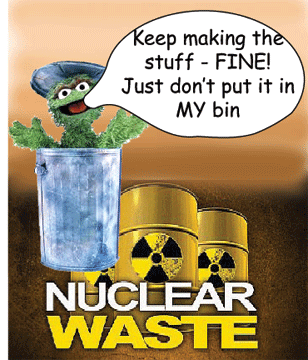 Removing Wylfa nuclear plant’s radioactive fuel ‘priority’, BBC News, 22 July 2016
The push to recover used radioactive fuel from the last nuclear power station of its kind is under way.
Wylfa nuclear plant’s last reactor was turned off after 44 years at an outage ceremony on Anglesey in December.Workers have spent the past six months putting decommissioning plans into action, including a new safety regime.Removing 800 tonnes of spent Magnox fuel will now be the “dominant” focus over the next three years, officials have said.
“Once we are fuel free, over 99% of all the radioactivity on the site will have left,” said Gordon Malcolm, deputy site director at Wylfa. “Then the whole site moves on to the next phase of work, preparations for care and maintenance… which will last for the rest of this century.”
Spent fuel from Wylfa will be taken to Sellafield in Cumbria for reprocessing, before much of the site is cleared, leaving just the reactor buildings and fuel stores.
According to officials, 99% of the fuel used to power Reactor One remains on site after it was shut down last year.On top of this, 60% of the old fuel used in Reactor Two until it was closed in 2012 is also at Wylfa………
Site staff also have one eye on developments next to their plant, where there are plans for a new nuclear plant built by Japanese-owned Horizon Nuclear Power.
The Wylfa Newydd developers are still waiting for approval to use their design for a new reactor and hope to submit planning applications in 2017. In the meantime, Horizon has been carrying out preliminary site investigations,including a seabed study…….http://www.bbc.com/news/uk-wales-36836836
Scottish independence a sure thing, now that UK govt will renew Trident nuclear missile system?
 Trident renewal ‘assures Scottish independence,’ says navy whistleblower William McNeilly https://www.rt.com/uk/351814-trident-renewal-william-mcneilly/ 18 Jul, 2016 As Prime Minister Theresa May convenes Parliament on Monday to debate renewing Britain’s Trident nuclear deterrent, Royal Navy submariner-turned-whistleblower William McNeilly tells RT renewal coupled with Brexit will force Scotland to seek independence.
“They rushed the European vote. Now they want to rush the Trident vote,” said McNeilly.
“Those who support the Trident system lack vision. They talk like they are the ones who want to defend the UK. The truth is they are the ones who will destroy the UK if they get their way.
“Voting to leave the EU, then voting Yes on Trident, will guarantee Scottish independence.”
In May 2015, McNeilly, 27, leaked a report exposing 30 safety and security failures documented over his three-month tour on board one of Britain’s Vanguard submarines. Narrowly escaping jail for the leak, he was dishonorably discharged, returning home to his native Belfast.
McNeilly says renewal will lead to the splintering of the United Kingdom, squander hundreds of billions of pounds, and offer terrorists a vulnerable target.
“Scotland is aiming to get another vote [for independence] and these people want to force the Scottish people to keep Trident. The Trident supporters are on the verge of breaking up the UK with this Trident vote, just like they broke up Europe.
“The majority of Scotland want Trident removed. If they force the Scottish people to keep a nuclear system that is damaging their land and sea, putting their lives and land at risk, costing them an absolute fortune … then the majority of Scotland will vote Yes to leave the UK.”
Already spoiling for a second referendum on Scotland’s independence in the wake of the Brexit vote, in which a majority of Scots voted to “Remain” in the EU, McNeilly believes the Scottish National Party (SNP) will see a vote in favor of Trident’s renewal as the final straw.
“The Better Together campaign were able to secure a No vote in the last [independence referendum] because they used the European Union as leverage. Now the Scottish National Party are the ones who will use the European Union as leverage.
“Trident is the fuel the Scottish National Party needs for an independence vote… the Scottish National Party is striking its matches.”
If Scotland leaves the United Kingdom, the government “will have nowhere to put the submarines and will be forced to spend countless more billions on building a base for them or moving them or looking like complete fools by scrapping them after destroying our unity.”
UK submerged nuclear submarine collides with merchant vessel off Gibraltar

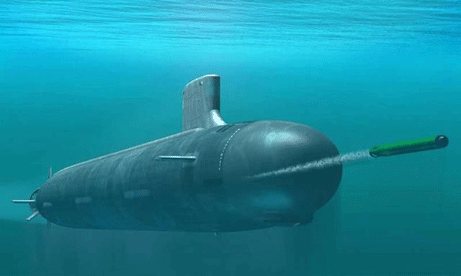 UK nuclear sub collides with merchant vessel off Gibraltar Rt.com 21 Jul, 2016 One of Britain’s newest Astute-class submarines has docked at Gibraltar after suffering a “glancing collision” with a merchant vessel, the UK Royal Navy announced, emphasizing that the HMS Ambush suffered “absolutely no damage” to her nuclear reactor
Cumbria demands huge investment to support Moorside nuclear project
 Huge investment needed to support Moorside nuclear project, say council, News and Star, 21 July 2016 CUMBRIA’S council leaders say any new nuclear facility built in the county must be accompanied by huge investment in the area’s key infrastructure – such as the road and rail network.
During a meeting at today’s Cumbria County Council cabinet meeting leader Stewart Young said that the authority needed the Government or NuGen – the firm behind the new Moorside development in west Cumbria – to stump up cash in advance so work can can begin…….
“The sheer scale of this nuclear project is unprecedented for Cumbria and in fact unprecedented for the UK. To ensure that everyone benefits we need a guarantee from Government or NuGen or both of extensive additional investment into services like the county’s infrastructure, such as roads, railways and port, as well as accommodation for the workforce, and the development of skills to ensure that as many jobs as possible are taken by Cumbrians.”
The call was made as part of the council’s formal response to the consultation into the Moorside project…… The formal consultation process ends on July 30. http://www.newsandstar.co.uk/news/latest/Huge-investment-needed-to-support-Moorside-nuclear-project-say-council-731df4b0-d076-4d29-86f7-2eea67a2e265-ds
Anti Trident nuclear protests in 36 Scottish cities, towns and villages,
 Thousands take to streets as Scotland voices its opposition to “ghastly” Trident
 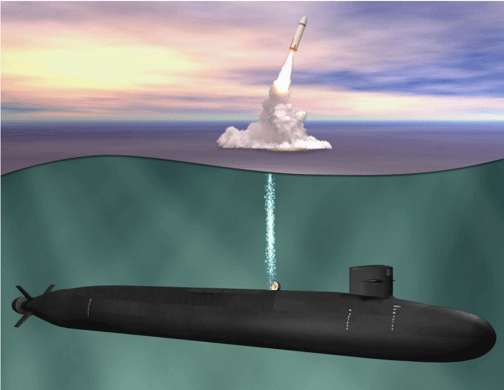 weapons, Herald Scotland, Andrew Whitaker, 17 July 16, IN what was thought to be the biggest national peace demonstration north of the Border since the last Iraq war, more than 10,000 Scots have taken part in anti-Trident protests ahead of tomorrow’s Commons vote on renewing the nuclear weapons system.
Anti-Trident protests were held yesterday (Sat) in 36 Scottish cities, towns and villages, with locations including Glasgow, Edinburgh, Aberdeen, Dundee, Inverness, Dumfries and Largs, which were all organised within days of it being announced the Westminster vote would take place.
Armed forces veterans, anti-war campaigners, students, parents and their children carrying anti-nuclear banners and singing pro-peace songs sent a clear message to MPs that Scotland was overwhelmingly against renewing the Trident system, which the Ministry of Defence estimates will cost £31bn over 20 years.
The Scottish Scrap Trident coalition, which organised the demonstrations, said events in areas such as Edinburgh, Aberdeen and Paisley attracted hundreds, with others protests also held in Largs and Cromarty.
Coalition spokesman David Mackenzie suggested that the demonstrations were among the biggest since the 2003 Iraq war, and said: “Early calculations indicate that this is one of the biggest public demonstrations in Scotland for many years, showing just how people outraged people feel about this ghastly business.”………http://www.heraldscotland.com/news/14624176.Thousands_take_to_streets_as_Scotland_voices_its_opposition_to__quot_ghastly_quot__Trident_weapons/
UK and Germany of backtracking on the spirit of the Paris climate deal, funding fossil fuels

 UN criticises UK and Germany for betraying Paris climate deal
Climate change envoy singles out both countries for subsidising the fossil fuel industry and says the UK has lost its position as a climate leader, Guardian, Adam Vaughan, 18 July 16, Ban Ki-moon’s climate change envoy has accused the UK and Germany of backtracking on the spirit of the Paris climate deal by financing the fossil fuel industry through subsidies.
Mary Robinson, the former president of Ireland and UN special envoy on climate change and El Niño, said she had to speak out after Germany promised compensation for coal power and the UK provided tax breaks for oil and gas.
Governments in Paris last year not only pledged to phase out fossil fuels in the long term but to make flows of finance consistent with the reduction of greenhouse gas emissions.
“They’ve [the British government] introduced new tax breaks for oil and gas in 2015 that will cost the UK taxpayer billions between 2015 and 2020, and at the same time they’ve cut support for renewables and for energy efficiency,” she told the Guardian…..
The criticism comes as Theresa May’s government has come under fire at home and abroad for its leadership on climate change after it abolished the Department of Energy and Climate Change. Senior figures such as the outgoing UN climate change chief have urged the UK not to abandon its climate commitments as it leaves the EU. “Let us remember that the Brexit vote was not about climate change,” said Christiana Figueres.
Natalie Bennett, the leader of the Green party, said: “This damning indictment of the UK’s energy policy comes just days after our new prime minister scrapped the Department of Energy and Climate Change and appointed an environment secretary who has consistently voted against measures to tackle climate change.
“I urge Theresa May to listen carefully to Robinson’s remarks and start reversing the damaging policies put in place by her predecessor – like giving tax breaks to fossil fuel companies while cutting subsidies for renewables.”
Robinson said that while Germany had made some positive steps such as aiding developing countries on climate change, it was sending mixed messages.
Germany says its on track to end coal subsidies by 2018 but the German government is also introducing new mechanisms that provide payment to power companies for their ability to provide a constant supply of electricity, even if they are polluting forms, such as diesel and coal,” she said. She called on Germany to make a real commitment to get out of coal.
But she said her criticism was far from limited to the two countries. “We want all countries to end [fossil fuel] subsidies,” she said…..
The likely US Republican presidential nominee, Donald Trump, has said he would try to unpick the deal, but Robinson said if it was ratified by the US this year “unwinding it would be very prolonged and difficult. I sincerely hope we won’t be facing that problem.”
However Hillary Clinton would be good on climate because she had been pushed by Bernie Sanders to adopt an ambitious climate change platform, she said.
Robinson said she been to Ethiopia recently and seen firsthand the way manmade climate change was exacerbating natural climate phenomenons such as El Niño, which brings drought to some parts of the world, and flooding to others. “I saw so many malnourished children, and it’s not tolerable.”…….https://www.theguardian.com/environment/2016/jul/18/un-criticises-uk-and-german-for-betraying-the-spirit-of-the-paris-climate-deal
1 This Month





PLEASE OPPOSE HR 8255 AND S.3639 – bills would accelerate satellite deployment, with no environmental review or safeguards – https://ncstd5li.quorum.us/campaign/169331/
To see nuclear-related stories in greater depth and intensity – go to https://nuclearinformation.wordpress.com
-
Archives
- October 2026 (49)
- September 2026 (339)
- August 2026 (330)
- July 2026 (355)
- June 2026 (287)
- May 2026 (306)
- April 2026 (356)
- March 2026 (251)
- February 2026 (267)
- January 2026 (308)
- December 2025 (358)
- November 2025 (359)
-
Categories
- 1
- 1 NUCLEAR ISSUES
- business and costs
- climate change
- culture and arts
- ENERGY
- environment
- health
- history
- indigenous issues
- Legal
- marketing of nuclear
- media
- opposition to nuclear
- PERSONAL STORIES
- politics
- politics international
- Religion and ethics
- safety
- secrets,lies and civil liberties
- spinbuster
- technology
- Uranium
- wastes
- weapons and war
- Women
- 2 WORLD
- ACTION
- AFRICA
- Atrocities
- AUSTRALIA
- Christina's notes
- Christina's themes
- culture and arts
- Events
- Fuk 2022
- Fuk 2023
- Fukushima 2017
- Fukushima 2018
- fukushima 2019
- Fukushima 2020
- Fukushima 2021
- general
- global warming
- Humour (God we need it)
- Nuclear
- RARE EARTHS
- Reference
- resources – print
- Resources -audiovicual
- Weekly Newsletter
- World
- World Nuclear
- YouTube
-
RSS
Entries RSS
Comments RSS

