Nuclear companies NuGen and Horizon keen for projects in UK, despite the Hinkley nuclear fiasco
UK new nuclear programme not dependent on Hinkley, say rivals, Telegraph, Emily Gosden, energy editor 2 AUGUST 2016 Nuclear developers NuGen and Horizon have played down fears that scrapping Hinkley Point would derail the wider UK new-build programme, insisting their projects are not dependent on EDF’s getting the go-ahead.
Industry experts have warned that confidence across the sector would be damaged if Theresa May pulls the plug on the £18bn project, especially given the French energy giant has already invested £2.4bn in Hinkley with unstinting Government support until now.
But NuGen, which is jointly owned by Japan’s Toshiba and France’s Engie, said it would continue developing its project at Moorside in Cumbria “irrespective of the status of other developers’ plans”.
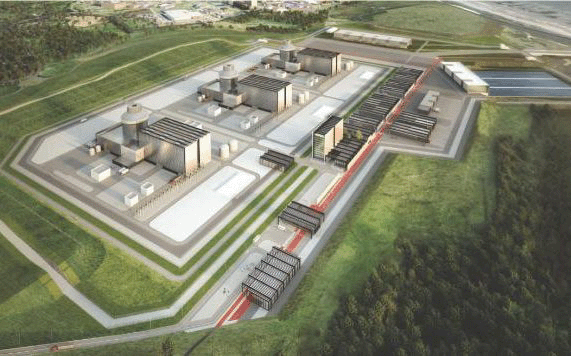
Hitachi’s Horizon project, which plans reactors on Anglesey,also distanced itself from the worries over Hinkley, saying its “sole focus remains, as it always has been, on making strong progress with our own flagship Wylfa Newydd power station project”.
Despite Mrs May’s surprise review of Hinkley, a Horizon spokesman said it had “no qualms about the continued commitment of the Government to UK nuclear new build”.
Reports in recent days have suggested the UK Government could face compensation demands from EDF if it pulled out of Hinkley.
Peter Atherton, an associate at consultants Cornwall Energy, said EDF had been operating under “an implicit guarantee from the Government that, provided you can get your technology through the approval process, and we can reach a satisfactory contractual arrangement, the project will go ahead”.
The Department for Business, Energy and Industrial Strategy on Tuesday reiterated that there would be no liabilities for the UK taxpayer or consumer if Hinkley were cancelled, as no contracts had been signed.
However, Mr Atherton said that if Hinkley were cancelled without any reimbursement for EDF, this would “significantly undermine” other developers’ confidence and might prompt them to seek some sort of financial guarantee.
“If I was them I would say to the Government, OK, if want us to carry on developing this project, we need you to fund it or to guarantee that if you pull the plug on us you pay those development costs,” he said.
Both Horizon and NuGen are privately keen to emphasise the differences between their projects and EDF’s.
Neither project has Chinese involvement, understood to be one of the key causes of concern for Mrs May over Hinkley, which would be one-third funded by Chinese state companies.
Both have also long been working to meet the Government’s expectation that they will be cheaper than Hinkley…..http://www.telegraph.co.uk/business/2016/08/02/uk-new-nuclear-programme-not-dependent-on-hinkley-say-rivals/
British support for use of nuclear weapons

 Most Britons support the use of nuclear weapons A total of 59 percent of
  people surveyed said they would launch a nuclear strike if they were prime minister. http://www.telesurtv.net/english/news/Most-Britons-Support-Use-of-Nuclear-Weapons-20160730-0012.html
A majority of Britons support their new prime minister’s proposal to deploy nuclear weapons, a recent poll by YouGov revealed on Saturday.
In a debate at the Parliament, new Prime Minister Theresa May said she would be ready to launch a nuclear strike that would result in the deaths of 100,000 people and urged lawmakers to back a renewal of Britain’s submarine-based Trident nuclear weapons system.
A total of 59 percent of people surveyed said they would do the same if they were in the prime minister’s shoes, while 66 percent say they support May in her assertion, with only 15 percent rejecting such a position.
Meanwhile, another survey found 44 percent of British people want to see Trident replaced. Three years ago YouGov made a similar survey, finding that 35 supported the nuclear program and 26 wanted to replace it, while another 25 percent said that Britain should give up nuclear weapons altogether.
Trident was created in 1980 under then Prime Minister Margaret Thatcher’s rule with the purpose to “deter the most extreme threats to our national security and way of life, which cannot be done by other means.”
May became prime minister on July 13 following the resignation of David Cameron after Britons voted in a June 23 referendum to leave the EU, weakening the 28-nation bloc and creating huge economic uncertainty.
May is well known for her hawkish, pro-war positions. When she was leader of the Conservative Party she voted for the U.S.-U.K. invasion of Iraq in 2003. She has also supported other interventions, like the 2011 military intervention in Libya.
Theresa May not happy with Chinese nuclear investment plans for Britain
 Britain’s May worried by China investment, intervened to delay nuclear deal, SMH, Kate Holton , 31 July 16 London: British Prime Minister Theresa May was concerned about the security implications of a planned Chinese investment in the new Hinkley Point nuclear plant and intervened personally to delay the project, a former colleague and a source said.
The plan by France’s EDF to build two reactors with financial backing from a Chinese state-owned company was championed by Mrs May’s predecessor David Cameron as a sign of Britain’s openness to foreign investment.
But just hours before a signing ceremony was due to take place on Friday, Mrs May’s new government said it would review the project again, raising concerns that Britain’s approach to infrastructure deals, energy supply and foreign investment may be changing.
The decision could prove a test for Mrs May, with any attempt to renegotiate the terms of the project potentially straining relations with Paris and Beijing at a time when Britain is seeking to build trade deals following the country’s vote to leave the European Union.
“When we were in government Theresa May was quite clear she was unhappy about the rather gung-ho approach to Chinese investment that we had,” Vince Cable, Britain’s former business secretary and a leading member of the Liberal Democrats, who governed in coalition with Mr Cameron, told BBC Radio.
He later told Sky News her concerns over China’s involvement were linked to national security. “This was an issue that was raised in general but it was also raised specifically in relation to Hinkley,” he said……..http://www.smh.com.au/world/britains-may-worried-by-china-investment-intervened-to-delay-nuclear-deal-20160731-gqhkm7.html
Britain’s history of supplying nuclear weapons technology to North Korea
What Theresa May forgot: North Korea used British technology to build its nuclear bombs.Ecologist, David Lowry 26th July 2016
When Theresa May proclaims in Parliament that we need the £200 billion Trident nuclear missile system to see off the North Korean nuclear threat, writes David Lowry, just bear this in mind. It is a threat that the UK, global nuclear proliferator in chief, created in the first place, providing both the reactor technology and vital centrifuge materials to make North Korea’s nuclear dream come true.
- ” … today the threats from countries such as Russia and North Korea remain very real.”
- “North Korea has stated a clear intent to develop and deploy a nuclear weapon, and it continues to work towards that goal, in flagrant violation of a series of United Nations Security Council resolutions.”
- “North Korea is the only country in the world to have tested nuclear weapons this century, carrying out its fourth test this year, as well as a space launch that used ballistic missile technology. It also claims to be attempting to develop a submarine-launch capability and to have withdrawn from the nuclear non-proliferation treaty.”
- “Based on the advice I have received, we believe that North Korea could already have enough fissile material to produce more than a dozen nuclear weapons. It also has a long-range ballistic missile, which it claims can reach America, and which is potentially intended for nuclear delivery.”
It reminded me of the similarly ill-informed former Prime Minister Tony Blair, in his speeches to MPs trying to win them over with dodgy ‘advice’ from British intelligence, to go to war by invading Iraq in 2003.
MPs have short memories, despite the Chicot Report on the Iraq invasion disaster not yet two weeks old, and 472 motley MP fools backed May and Trident replacement. As with the Iraq invasion, MPs will in future have to admit their regrets at being fooled. And again, they ignord the thousands of demonstrators outside, calling for Trident to be abandoned.
Britain’s nuclear proliferation ‘secret’
But May was right in one way. North Korea has developed nuclear weapons. But what she did not say was they did it with copied British bomb-making technology.
There is significant evidence that the British Magnox nuclear plant design – which was primarily built as a military plutonium production factory – provided the blueprint for the North Korean military plutonium programme based in Yongbyon. Here is what Douglas (now Lord) Hogg, then a Conservative minister, admitted in a written parliamentary reply in 1994 to Labour MP Llew Smith:
“We do not know whether North Korea has drawn on plans of British reactors in the production of its own reactors. North Korea possesses a graphite moderated reactor which, while much smaller, has generic similarities to the reactors operated by British Nuclear Fuels plc. However, design information of these British reactors is not classified and has appeared in technical journals.”
The uranium enrichment programmes of both North Korea and Iran also have a UK connection. The blueprints of this type of plant were stolen by Pakistani scientist, A Q Khan, from the URENCO enrichment plant in The Netherlands in the early 1970s.
(see David Albright, Peddling Peril, 2010 pp 15-28, Free Press, New York)
This plant was – and remains – one-third owned by the UK government. The Pakistan government subsequently sold the technology to Iran, who later exchanged it for North Korean Nodong missiles……….
Lessons of history
This sorry tale has several important lessons for us today. First – and this must never be forgotten – the UK’s early ‘atoms for peace’ nuclear power programme was specifically designed and intended to produce plutonium for nuclear bombs. And it was not just nuclear waste from Calder Hall that went for plutonium extraction at Windscale, but from other sites that were meant to be purely civilian such as Hinkley Point.
The UK is therefore guilty of ‘breaking the rules’ that are meant to separate civil and military nuclear activities, and its complaints of other states doing the same all carry the unmistakeable whiff of ripest humbug.
Second, for all its public position of seeking to restrain nuclear proliferation, the UK is actually one of the world’s most egregious nuclear proliferators: providing arch-nuclear enemy North Korea with both the Magnox technology it has used to produce plutonium for atom bombs; and the high strength aluminium it has used for its uranium centrifuges.
So when Theresa May stands up in Parliament and proclaims that we need the Trident nuclear missile system to see off the North Korean nuclear threat, remember: it is a threat that the UK created in the first place, providing both the nuclear reactor technology and the centrifuge materials to make it happen.
And when the UK cites the nuclear threat from North Korea as a reason to spend an estimated £200 billion on the next generation of Trident, we can be sure that North Korea and other countries aspiring to their own nuclear weapons are applying precisely the same logic to the British nuclear threat.
And that considering the UK’s history of aggressive regime-changing interventions in Iraq and Libya, the hundreds of (up to 225) nuclear warheads in its possession, and its ability to target them accurately anywhere in the world, North Korea’s fears are probably a great deal better founded than Mrs May’s. http://www.theecologist.org/News/news_analysis/2987935/what_theresa_may_forgot_north_korea_used_british_technology_to_build_its_nuclear_bombs.html
After Brexit, concerns grow on Britain- Ireland nuclear agreements
Fears grow over nuclear power agreements with UK after Brexit Reports reveal ‘high operational risk’ if UK no longer has to adhere to EU rules on power plant , Independent ie Philip Ryan 31 July 16 senior Government officials have raised serious concerns over the impact Brexit will have on Ireland and Britain’s nuclear power agreements, the Sunday Independent can reveal. A risk assessment compiled by the Department of the Environment in the wake of the Brexit referendum warns of a “high operational risk” to arrangements Ireland has with the UK on nuclear policy.
The briefing document says environmental assessments and mandatory consultation processes “may prove more difficult” to enforce when Britain leaves the European Union (EU).
Ireland has bilateral agreements with Britain which entitle the government to information on the UK’s nuclear programme.
The UK will no longer be tied down by strict EU laws which underpin these agreements once it officially leaves the union.
Documents released following a Freedom of Information request reveal high-ranking civil servants fear information exchanges will be under threat once Britain leaves the EU.
Concerns were first raised two years ago in a risk assessment compiled by the Department of the Environment for the Taoiseach’s Office.
“There could be some issues for Ireland in the event of a change in the current EU/UK relationship in the area of nuclear policy,” the report said…….http://www.independent.ie/business/brexit/fears-grow-over-nuclear-power-agreements-with-uk-after-brexit-34925805.html
World’s largest nuclear project, UK’s Hinkley Point C, now in doubt
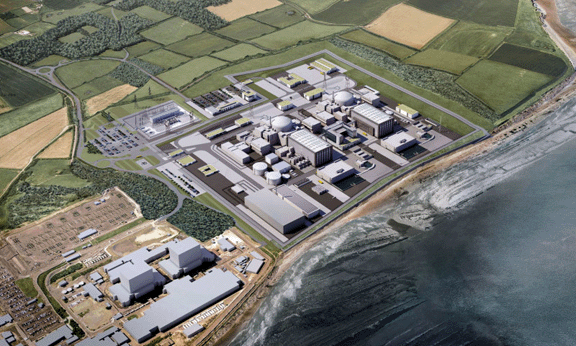 Britain casts doubt on EDF’s $24 billion nuclear project, Reuters LONDON | BY NINA CHESTNEY AND WILLIAM SCHOMBERG, 29 July 16 Britain has cast doubt on a $24 billion (18 billion pounds) project with French utility EDF to build the UK’s first new nuclear plant in decades, delaying a final decision on the plan just weeks after the Brexit vote ushered in a new prime minister.
The surprise decision to review the Hinkley Point C project was made public hours after the board of French state-controlled EDF voted to proceed with it.
The British government, which had been expected to sign contracts on Friday, said instead that it wanted to give the plans further consideration, postponing its verdict until early autumn.
The review came little more than a month after Britons voted to leave the EU in a referendum that forced the resignation of Prime Minister David Cameron – whose administration gave the initial go-ahead to the project – and the accession of Theresa May.
The vote, and the resulting economic uncertainty, threw doubt on the future of major British infrastructure projects, including the nuclear plant……..
Analysts and unions said the review under new Prime Minister May would likely delay the project further……..
Although EDF and Chinese partner China General Nuclear are responsible for the 18-billion-pound ($24 billion) cost of the project, Britain has committed to pay a minimum price for the power generated by the plant for 35 years.
Critics, including some British lawmakers and academics, say the country would be overpaying at that minimum price, which equates to double current market levels.
“Because of the fall in the energy price over the past 12 months, the project does look very expensive and there have been a lot of calls for other projects to be considered or for this to be taken back to the drawing board,” said Oliver Salvesen, analyst at investment bank Jefferies………
The British review could lead to increased resistance in France to the project, which was only narrowly approved by the EDF board on Thursday……
If the project goes ahead after the government’s review, the plant would not come online until the 2030s, industry experts estimate. EDF will still have to shoulder the costs of the long construction phase during which the investment will not generate any cash flow, which is credit negative for the firm, said Paul Marty, vice president and senior credit officer at Moody’s……..http://uk.reuters.com/article/uk-edf-britain-nuclear-idUKKCN1090EW
Nuclear industry astonished as British government stalls plans to build Hinkley C nuclear power station
Plans to Build World’s Largest Nuclear Plant on Hold, EcoWatch, Climate News Network 29 July 16
The British government astonished the nuclear industry late last night by refusing to go ahead with plans to build the world’s largest nuclear plant until it has reviewed every aspect of the project.
The decision was announced hours after a bruising meeting of the board of the giant French energy company EDF, at which directors decided by 10 votes to seven to go ahead with the building of two 1,600 megawatt reactors at Hinkley Point in Somerset, southwest England………
critics of the controversial project were delighted. John Sauven, the executive director of Greenpeace, said: “Theresa May now has the chance to stop this radioactive white elephant in its tracks.”
“She should look at the evidence and see that this deal would be a monumental disaster for the taxpayers and the bill payers. Countless experts have warned that for British families this power station will be terrible value for money, Sauven added.”
Until last night, the UK was the most positive country in Europe about nuclear power and planned to build a total of 10 nuclear power plants, Hinkley Point being the first of them. This was despite the fact that nuclear costs continue to escalate while its main competitors—renewables of all kinds—fall in price.
The Hinkley Point project is now more expensive than offshore wind power, which is the most expensive renewable and is far more costly than solar and onshore wind. Biogas and small-scale hydro projects in Britain, all so far underdeveloped, are also cheaper than nuclear…….
Safety Fears
The price of all renewables is going down as they develop, while the price rises for nuclear power, with safety fears and threats from terrorism pushing costs up.
It is also argued, even by the UK’s national electricity grid, that the day of the large power plant is over, to be replaced by small local generators providing electricity near to homes and factories—something that renewables are ideally suited for.
Even France, which has 58 reactors and is building a Hinkley prototype at Flamanville in Normandy, has no plans to build any more. All its new energy projects are renewables and it has plentiful supplies of untapped wind and solar power, which are cheaper……..http://www.ecowatch.com/plans-to-build-worlds-largest-nuclear-plant-on-hold-1949913505.html
Britain’s High Court rules that UK nuclear agency ‘manipulated’ £7bn clean-up contract
 UK nuclear agency ‘manipulated’ £7bn clean-up contract High Court ruling exposes government to potential £200m damages claim Ft.com by: Catherine Belton, 30 July 16 Britain’s Nuclear Decommissioning Authority “manipulated” and “fudged” a tender process for a £7bn contract to clean up the country’s nuclear power plants, the High Court has ruled.
The judgment, handed down on Friday, raises fresh questions over the way government entities hand out multibillion-pound contracts and casts further doubt on the UK’s nuclear industry a day after the government’s decision to launch a review of the £18bn Hinkley Point project. It could eventually cost the government hundreds of millions of pounds in damages.
The NDA said it was considering its legal options after the ruling, which found that it had wrongly awarded one of the government’s largest contracts to Babcock, the UK engineering company, and Texas-based Fluor……..
The court found that the NDA had “manipulated” the valuation process in order to avoid disqualifying the Babcock-Fluor bid. “In my judgment the NDA sought to avoid the consequence of disqualification by fudging the evaluation,” Justice Fraser wrote in his ruling.
He found that the NDA “fell short” in meeting its obligations of “transparency and equal judgment”……..
he contract involves the clean-up of 12 of the UK’s 25 nuclear sites, including the Sizewell, Hinkley and Dungeness “Magnox” nuclear power stations built in the 1960s which have reached the end of their lives.
The government is facing increasing scrutiny over its procurement process following the referral of G4S and Serco to the Serious Fraud Office for overcharging on electronic tagging contracts for offenders, and the West Coast main line rail franchising debacle two years ago. https://next.ft.com/content/7f11f174-55ad-11e6-9664-e0bdc13c3bef
France disturbed at possibility of Theresa May dumping Hinkley C nuclear station plan
 French Are Left Reeling as May Mulls Nuclear-Power Dilemma, Bloomberg, Robert Hutton RobDotHutton Francois De Beaupuy FrancoisDeBeaup July 29, 2016 —
-
New prime minister could dump project and blame Cameron
-
U.K. concerns are over Chinese involvement and rising cost
Even so, the French were stunned on Thursday evening when Britain said it needed more time to think about the plan. A planned signing was canceled. Hollande, with an election coming next year, has been attacked by labor unions who say the 18 billion-pound ($24 billion) project could bankrupt state-owned Electricite de France SA………
May’s joint chief of staff, Nick Timothy, last year described the decision to allow Chinese involvement in the project as “baffling.” He raised the prospect of China being able to shut down British energy production “at will” in an article for the Conservative Home website.
Brexit Talks
But there are risks to blocking the deal. It would infuriate the French, a needed ally in the Brexit talks. It would also lead to a dispute over where the costs of unwinding the project should fall………
“My assumption is still that the U.K. will probably sign off on it,” said Joel Kenrick, a political adviser to Energy Secretary Chris Huhne from 2010 to 2012.. “But then, I can’t actually see it being built. EDF have just got such a poor track record.” http://www.bloomberg.com/news/articles/2016-07-29/french-are-left-reeling-as-may-mulls-her-nuclear-power-dilemma
Future of UK’s Bradwell and Sizewell nuclear projects now in doubt as government to review Hinkley plan
 Bradwell & Sizewell futures unclear after delayed Hinkley decision http://www.itv.com/news/anglia/story/2016-07-28/bradwell-sizewell-futures-unclear-after-delayed-hinkley-decision/
A late move by the government to review all of the component parts of the proposed nuclear power deal in the region has cast doubt that it will go ahead in its current form.
The French Energy giant EDF has agreed to fund a new nuclear power station at Hinkley Point in Somerset which was expected to pave the way for new plants to be constructed at Sizewell in Suffolk and Bradwell in Essex.
In a dramatic twist though, the Government says it now won’t decide whether to proceed with the projects until the autumn.
The £18 billion Hinkley project is “on ice” to allow the prime minister Theresa May to “make up her mind”, ITV News understands.
EDF approved UK Hinkley nuclear project, but now there’s a new delay
Hinkley nuclear plant faces fresh delay after EDF approves investment, Ft.com 28 July 16
Ministers announce new review immediately after EDF gives green light to £18bn project The plan to build an £18bn nuclear reactor at Hinkley Point was hit with a last-gasp delay on Thursday night as the government decided to hold a new review hours after EDF, the project’s French developer, gave it the go-ahead.
He said: “The UK needs a reliable and secure energy supply and the government believes that nuclear energy is an important part of the mix. The government will now consider carefully all the component parts of this project and make its decision in the early autumn.”
One person said the scheme was expected to proceed after the review but the fresh delay had been a surprise.
The news came after EDF had given the go-ahead for the UK’s first nuclear power plant in 20 years, approving the Hinkley Point scheme at a board meeting on Thursday.
Directors approved the long-delayed project during a meeting in Paris. But opposition from within the company was underlined by the resignation in protest of a board member as the meeting started. The board was more divided than had been expected…….
critics say the project could also risk the financial future of EDF, the highly indebted French utility, whose chief financial officer Thomas Piquemal quit in March, warning that its future was being put in danger by Hinkley Point.
The scheme has been subject to multiple delays and budget revisions since first being proposed in the mid-2000s as part of what Tony Blair’s government promised would be a “nuclear renaissance” for the UK.
New reactors are also being planned in north Wales and in Cumbria, while EDF wants to help develop two sites after Hinkley Point — at Sizewell in Suffolk and Bradwell in Essex.
EDF had hoped to take the final investment decision earlier this year but it was postponed amid growing opposition from board members and executives.
That opposition persisted until the end, despite the company’s decision to push ahead with the scheme. As the meeting got under way, Gérard Magnin quit as a state representative on EDF’s board, calling the company’s nuclear strategy “highly risky”.
In the end, the vote was carried by 10 to 7. It was closer than expected, with all six union representatives and one shareholder representative voting against the measure.
Ministers in the UK must now give their final sign-off to the scheme, having already agreed to pay £92.50 — double the current wholesale price — for each megawatt hour of electricity it produces for 35 years………https://next.ft.com/content/181077e2-54dc-11e6-befd-2fc0c26b3c60
Like Brexit, UK’s Hinkley nuclear plan is based on shaky politics, not on economic reality
Areva, the French state-owned company which makes the reactors, is being taken over by EDF but it is being investigated by France’s Nuclear Safety Authority over “irregularities” in 400 parts. Areva also faces a state aid investigation.
 Even many of the staff inside EDF think Hinkley is a colossal white elephant. The company’s unions, who are represented on the board, fear the project will sink the company and have started legal action to delay the decision, while its finance director resigned in March.
For Hinkley, as with Brexit itself, political chicanery has triumphed over economic reality.
Hinkley’s nuclear plant fails all tests – bar the politics https://www.theguardian.com/environment/damian-carrington-blog/2016/jul/28/hinkley-point-c-nuclear-plant-fails-all-tests-bar-the-politics
Huge, expensive and difficult to build, Hinkley is a throwback to the last century, just as the world is embracing the smart energy systems of the future, Guardian, Damian Carrington, 29 July 16 The new nuclear reactors now given the go-ahead at Hinkley Point have failed every test bar the one that finally mattered – political expediency.
The plant, to be paid for by UK energy customers, could cost them £37bn and is a leading contender for the most expensive object ever built on the face of the Earth. A former Conservative energy secretary calls it “one of the worst deals ever” for Britain.
It faces formidable commercial, technical and legal obstacles to getting built remotely on time or budget, or indeed at all. And while the rest of the world is accelerating ahead with the smart energy systems of the 21st century, Hinkley is a throwback to the nuclear age of the 20th.
But the French government, which majority-owns Hinkley’s builders EDF, wants to preserve its national nuclear industry. The UK government, blinded by the dazzle of a mega-project, is happy to let its citizens pick up the bill.
It has taken almost a decade to get to this point. In 2007, EDF said British Christmas turkeys would be being roasted with its nuclear electricity in 2017. The earliest possible switch-on now is 2026, another decade away.
What is scary is that reaching the final decision to go ahead was the easy bit. Now they have to deliver a giant and fiendishly complex construction project, described by one nuclear engineer as like “building a cathedral within a cathedral”, that is, “unconstructable”.
EDF has never managed to build the types of reactors intended for Hinkley. Its two attempts so far, in France and Finland, remain many years behind schedule and many billions over budget. Perhaps they are hoping for third time lucky.
UK nuclear power generation is £27.5 more expensive per MWh than that generated by gas power plants
Yet the commercial foundations for this engineering miracle are incredibly shaky. EDF is on the ropes financially and had to be given a €3bn bailout in April by the French government. That may well be challenged under EU state aid rules, which would join an ongoing state aid legal case brought by Austria against UK subsidies for Hinkley.
It gets worse. The French Financial Markets Authority raided EDF this month, investigating allegations that it misrepresented the cost of Hinkley and other projects. Banks and other financial institutions already loathed the Hinkley plan, with EDF warned of further credit rating downgrades if it goes ahead, making its huge debt more expensive to maintain.
Areva, the French state-owned company which makes the reactors, is being taken over by EDF but it is being investigated by France’s Nuclear Safety Authority over “irregularities” in 400 parts. Areva also faces a state aid investigation.
Even many of the staff inside EDF think Hinkley is a colossal white elephant. The company’s unions, who are represented on the board, fear the project will sink the company and have started legal action to delay the decision, while its finance director resigned in March.
With foundations this unsound, you would think the UK could get out of the deal easily if it turns sour. But think again. The deal to be signed with EDF contains a “poison pill” which could leave taxpayers with a £22bn bill if a future UK government shuts the plant down.
The government is adamant that Hinkley, which could provide 7% of the UK’s electricity, is a vital part of a secure low-carbon future. But a barrage of recent reports from serious players say the opposite. The future is not gigantic centralised energy plants, but widespread networks of renewable energy and storage, interconnected across the continent, bolstered by energy efficiency measures and the smart management of demand.
Hinkley Point C will provide 7% of UK electricity when it starts to produce electricity in 2025
Bodies including the government’s own National Infrastructure Commission(NIC), the National Grid, industry group Energy UK, all point to a smart system that is more secure, cheaper and faster to build. They all use the same word – “revolution” – for the fast changes now happening in energy, while theInternational Energy Agency talks of a rapid “transition”.
Hinkley’s reactors are a revolution only in the sense that they overturn all logic. Energy efficiency could deliver six Hinkley’s worth of electricity by 2030, interconnector cables to Norway, Denmark and France could add another two or three Hinkleys to the grid by 2025 and four Hinkleys’ worth of electricity could be saved by 2030 by increasing the ability to store electricity and making the grid smarter, with the latter alone saving bill payers £8bn a year. Solar and wind power are also cheaper than Hinkley’s nuclear power.
EDF had said its decision on Hinkley would be made in September at the earliest. So why the sudden rush, after so many years of delay? The company’s announcement that the decision was being brought forward came on the evening after Theresa May, keen to signal post-Brexit Britain remains open for business, had met Francois Hollande for talks. For Hinkley, as with Brexit itself, political chicanery has triumphed over economic reality.
Hinkley Point nuclear station – not just a folly – but a massive folly
Why Hinkley Point is a nuclear folly of Titanic proportions https://www.newscientist.com/article/2099287-why-hinkley-point-is-a-nuclear-folly-of-titanic-proportions/ French utility company EDF is going ahead with plans for a massive new nuclear reactor in the UK, but there are many reasons to doubt it will ever be finished, says Michael Le Page
It’s also crucial for France, which largely owns EDF, the company that will build Hinkley. France needs the project to help cover the huge cost of revamping its ageing collection of nuclear plants, which currently supply three-quarters of the country’s electricity. And Hinkley matters to China, too, as one of its state-owned companies will be stumping up a third of the cost.
But despite today’s much-delayed decision by EDF to go ahead with the megaproject, its future still looks doubtful. There are huge financial, legal, technical and safety-related icebergs lurking in the seas ahead.
Behind schedule
One reason why is that the two reactors planned for Hinkley are based on a new design. The EPR design is supposed to be safer and more efficient, but it has proved so difficult to construct that not one has yet been completed.
EDF started building the first EPR, at Olkiluoto in Finland, in 2005. It was supposed to start up in 2009. Work on the second, at Flamanville in France, began in 2007 and was due to be finished in 2012. Another two EPRs are being built in Taishan, China. All four projects are years behind schedule and have cost billions more than expected.
There are also worries about the fact that a state-owned Chinese company will be supplying some of the parts and workers for the project. The UK’s intelligence agencies are said to be concerned that a “back door” could be built into the control systems, allowing China to shut down the plant if it wanted to.
Last but not least, there are various legal challenges pending. The Austrian government, for instance, is appealing against the European Commission’s decision to approve state aid for the project, saying it breaches European laws. Meanwhile, French authorities are investigating possible financial misreporting by EDF.
Even in the unlikely event that the Hinkley project dodges all these icebergs, there may not be a happy ending. Many analysts think it’s a bad deal for the UK, because it has had to promise to pay a very high price for Hinkley’s electricity.
The worst-case scenario is that the project sails on for many more years before finally sinking. That will be a disaster for everyone.
Interactive tool shows you what would happen if a nuclear bomb hit London
 What would happen if a nuclear bomb hit London? Use this interactive tool to discover your fate, Mirror, UK 28 July 16 What would happen if a nuclear bomb hit Britain?
The effects would be devastating but this tool shows just how widespread they would be.
It’s a highly unlikely scenario, of course.
However, 60 years ago, crisis planners were desperately worried about the threat of a nuclear attack and identified key cities and towns in the UK which were a likely target to be wiped out with one nuclear bomb.
Here’s what the effects could be today if a nuclear bomb detonated in London.
We’ve used the Nukemap website and looked at three different bombs, all of which have been either used or tested.
It’s a highly unlikely scenario, of course. However, 60 years ago, crisis planners were desperately worried about the threat of a nuclear attack and identified key cities and towns in the UK which were a likely target to be wiped out with one nuclear bomb.
Here’s what the effects could be today if a nuclear bomb detonated in London. We’ve used the Nukemap website and looked at three different bombs, all of which have been either used or tested.
1. Ivy Mike – the first H-bomb (10.4 megatons)
Estimated fatalities: 2,336,920
Estimated injuries: 2,614,180
Fireball radius (orange): The entire city centre including monuments such as Big Ben, the Houses of Parliament and Buckingham Palace would be consumed by a nuclear fireball 3.2km wide – stretching up to Camden Town and down to Brixton. The fatality rate is 100%.
Radiation radius (green): Slightly wider than the fireball radius. Without medical treatment, expect between 50% and 90% mortality from acute effects alone. Dying takes between several hours and several weeks
Air blast radius (red – 20psi): The most intense air blast would have a radius of 4.75km and demolish heavily built concrete buildings in Chalk Farm, London Bridge, Chelsea and Kensington among other areas. The fatality rate is still 100% or very close.
Air blast radius (grey – 5psi): A lesser air blast radius would still cause the collapse of all residential buildings within a 10km radius. That means houses would collapse all the way out in East Finchley, Stratford, Poplar and Streatham. Injuries are universal and fatalities widespread.
Thermal radiation radius (lighter orange): The thermal radiation radius is 29.1km. This would mean third degree burns “throughout the layers of the skin”, which could cause severe scarring, disablement and even amputation. This radius covers Watford, Hayes, Epsom, Croydon, Twickenham, Dartford and Epping.
2. The Tsar Bomba – the largest USSR bomb tested (50 megatons)……
3. ‘Fat Man’ – the Nagasaki bomb (20 kilotons)……..http://www.mirror.co.uk/news/uk-news/what-would-happen-nuclear-bomb-8514152
‘Stop Hinkley’ campaign urges UK govt to switch to renewables, and yes, to Stop Hinkley nuclear
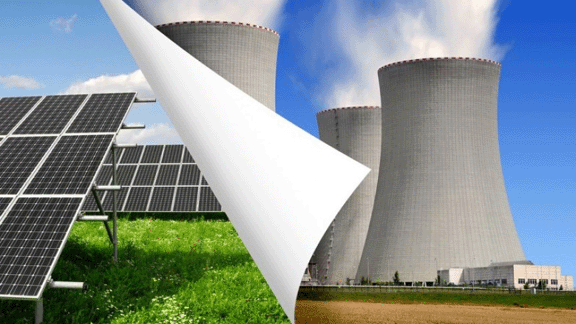 Campaigners call on government to stop Hinkley Point http://www.energylivenews.com/2016/07/26/campaigners-call-on-government-to-stop-hinkley-point/ Jul 26, 2016 Jacqueline Echevarria A group of campaigners are calling on the government to ditch the new nuclear power station at Hinkley Point C (HPC) in Somerset.
Called ‘Stop Hinkley’, the group has sent a letter to Business, Energy and Industry Strategy Secretary Greg Clark ahead of a final investment decision for the project by EDF’s Board onThursday. They say a final investment decision for Hinkley would be “little more than spin as problems mount for nuclear delusion”.
They believe the nuclear project is too expensive, will kill British manufacturing, is bad for consumers, the taxpayer, business and potentially the environment and is a total waste of money.
Renewable energy and energy efficiency projects could be implemented very quickly and much more cheaply, they added.
They stated ditching EDF’s plans for HPC would provide the country with a “wonderful” opportunity to turn Somerset into a sustainable energy hub for England.Allan Jeffery from Stop Hinkley said: “Now even the financial press says Hinkley Point C has become a laughing stock. The cost keeps rising while the cost of renewables is falling rapidly and the potential to make savings with energy efficiency is huge. We could replace Hinkley much more quickly and cheaply without the safety fears and without producing dangerous waste we don’t know what to do with.”
According to the former Department of Energy and Climate Change, the estimated cost of the Hinkley Point C project over its lifetime could reach £37 billion.
French authorities have raided EDF’s headquarters in France before the Hinkley decision.
ELN has contacted BEIS for a comment.
1 This Month





PLEASE OPPOSE HR 8255 AND S.3639 – bills would accelerate satellite deployment, with no environmental review or safeguards – https://ncstd5li.quorum.us/campaign/169331/
To see nuclear-related stories in greater depth and intensity – go to https://nuclearinformation.wordpress.com
-
Archives
- October 2026 (49)
- September 2026 (339)
- August 2026 (330)
- July 2026 (355)
- June 2026 (287)
- May 2026 (306)
- April 2026 (356)
- March 2026 (251)
- February 2026 (267)
- January 2026 (308)
- December 2025 (358)
- November 2025 (359)
-
Categories
- 1
- 1 NUCLEAR ISSUES
- business and costs
- climate change
- culture and arts
- ENERGY
- environment
- health
- history
- indigenous issues
- Legal
- marketing of nuclear
- media
- opposition to nuclear
- PERSONAL STORIES
- politics
- politics international
- Religion and ethics
- safety
- secrets,lies and civil liberties
- spinbuster
- technology
- Uranium
- wastes
- weapons and war
- Women
- 2 WORLD
- ACTION
- AFRICA
- Atrocities
- AUSTRALIA
- Christina's notes
- Christina's themes
- culture and arts
- Events
- Fuk 2022
- Fuk 2023
- Fukushima 2017
- Fukushima 2018
- fukushima 2019
- Fukushima 2020
- Fukushima 2021
- general
- global warming
- Humour (God we need it)
- Nuclear
- RARE EARTHS
- Reference
- resources – print
- Resources -audiovicual
- Weekly Newsletter
- World
- World Nuclear
- YouTube
-
RSS
Entries RSS
Comments RSS

