
 Commons votes for Trident renewal by majority of 355 Over half Labour MPs but not Jeremy Corbyn back motion after Theresa May says she would order nuclear strike, Guardian, Rowena Mason, Anushka Asthana,
Britain’s Parliament votes to renew Trident nuclear missile system
Theresa May has said she would be willing to authorise a nuclear strike that could kill 100,000 people, as the House of Commons voted overwhelming to replaceBritain’s Trident programme.
The prime minister confirmed she would be prepared to press the nuclear button if necessary as she opened a debate about whether the UK should spend up to £40bn replacing four submarines that carry nuclear warheads.
After more than five hours of discussion, parliament voted in favour of Tridentrenewal by a majority of 355 in a motion backed by almost the entire Conservative party and more than half of Labour MPs.
It was opposed by all Scottish National party (SNP) MPs, the Lib Dems and Labour leader, Jeremy Corbyn, a lifelong unilateralist who spoke out strongly against the plans during the debate.
Other members of Corbyn’s frontbench team, including the shadow defence secretary, Clive Lewis, and the shadow foreign affairs secretary, Emily Thornberry, abstained after claiming in a Guardian article that the government was turning an issue of “national security into a political game”.
However, around 140 of his MPs – including leadership challengers Angela Eagle and Owen Smith – voted in favour of renewing Trident, with many highlighting Labour’s historic position in support of a continuous at-sea nuclear deterrent. Forty-seven Labour MPs joined Corbyn in voting against Trident, while another 41 were absent or abstained.
While Labour were split on the issue, the Conservatives have been hoping the Trident issue could help unify their party after a fractious EU referendum campaign.
However, May attracted gasps during the debate when she made clear she would be willing to authorise a nuclear strike killing 100,000 people, when challenged by the SNP about whether she would ever approve a nuclear hit causing mass loss of life……. https://www.theguardian.com/uk-news/2016/jul/18/mps-vote-in-favour-of-trident-renewal-nuclear-deterrent

Teresa May would approve a nuclear weapon strike on a population
Theresa May would authorise nuclear strike causing mass loss of life Asked in Trident debate if she would approve attack that could kill 100,000 people, PM answers with a decisive ‘yes’,Guardian, Rowena Mason, Anushka Asthana, and Rajeev Syal, 19 July 16. Theresa May has said she would be willing to authorise a nuclear strike killing 100,000 people as she made the case for replacing Britain’s Trident submarines ahead of a House of Commons vote on the matter.
The prime minister answered decisively when challenged by the Scottish National party about whether she would ever approve a nuclear hit causing mass loss of life.
Intervening in her opening speech, the SNP MP George Kerevan asked: “Is she personally prepared to authorise a nuclear strike that can kill a hundred thousand innocent men, women and children?”
May responded: “Yes. And I have to say to the honourable gentleman the whole point of a deterrent is that our enemies need to know that we would be prepared to use it, unlike some suggestions that we could have a deterrent but not actually be willing to use it, which seem to come from the Labour party frontbench.”
Her statement was met by gasps from some MPs on the opposition benches, as the chamber debated whether or not to renew Trident.
Jeremy Corbyn, the Labour leader, responded to May by making the case for nuclear disarmament, pointing out that the party’s pro-Trident position was under review.
He has given his MPs a free vote during Labour’s ongoing defence review, which the Guardian understands involves at least five options ranging from complete replacement to disarmament by the 2030s. The three other options are reduced patrols and fewer submarines, missiles carried by aircraft, and adapted submarines to carry both conventional and nuclear warheads.
Speaking in the Commons, Corbyn said there were currently 40 warheads, which are each eight times as powerful at the atomic bomb that killed 140,000 people at Hiroshima in Japan in 1945.
“What is the threat we are facing that one million people’s deaths would actually deter?” he said, adding it did not stop Islamic State, Saddam Hussein’s atrocities, war crimes in the Balkans or genocide in Rwanda.
“I make it clear today I would not take a decision that kills millions of innocent people,” Corbyn told MPs. “I do not believe the threat of mass murder is a legitimate way to deal with international relations.”
May said it would be a “dereliction of duty” to give up Britain’s nuclear deterrent and pledged to keep to the Nato target of spending 2% of national income on defence while she is prime minister.
Addressing the idea of downgrading the deterrent to a cheaper option, she said: “I am not prepared to settle for something that does not do the job.”……https://www.theguardian.com/uk-news/2016/jul/18/theresa-may-takes-aim-at-jeremy-corbyn-over-trident-renewal
18 July British Parliament to vote on renewal of Trident nuclear missile system
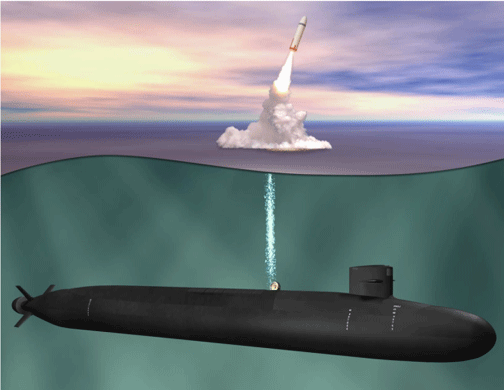 British MPs to vote on renewing nuclear deterrent on July 18 MENAFN – Muscat Daily – 13/07/2016 Warsaw– Britain’s parliament will vote this month on renewing the Trident nuclear weapons programme, Prime Minister David Cameron said Saturday as he sought to reassure NATO allies alarmed by Brexit.Cameron’s announcement at a NATO summit in Warsaw comes as the alliance grapples with the implications for its unity after key member Britain shocked the world by voting to leave the European Union.Conservative leader Cameron is pushing through the vote on the A20 billion (23 billion euro, 25 billion) plan to maintain the submarine-based system before he steps down in September in the wake of the EU result.”Today I can announce that we will hold a parliamentary vote on the 18th of July to confirm (lawmakers’) support for the renewal of a full fleet of four nuclear submarines capable of providing around-the-clock cover,” Cameron told a press conference at what will be his final NATO summit after six years in power……
Cameron is likely to win the Trident vote as his party widely backs it.The leader of the main opposition Labour party Jeremy Corbyn has opposed the upgrade but a significant part of his increasingly rebellious MPs are also likely to support it.The future of Britain’s nuclear deterrent is however in question as the submarines are based in Scotland, where the government is considering a second independence referendum following the Brexit vote.Asked why he was pushing through the vote before handing over to his as-yet-undecided successor, Cameron said it was a pledge in his party’s 2015 election manifesto “and we need to get on with that.””I don’t think it needs to be caught up in the leadership contest (of the Conservative party) and we will be doing it on the 18th of July,” he said….http://www.menafn.com/1094852840/British-MPs-to-vote-on-renewing-nuclear-deterrent-on-July-18
Illegal to use Trident nuclear missile, so it should be phased out
 Using Trident would be illegal, so let’s phase it out https://www.theguardian.com/commentisfree/2016/jul/15/trident-illegal-nuclear-britain-arsenal Geoffrey Robertson, 15 July 16
Nuclear doom is nearer than most of us believe, experts warn. Britain must set a moral lead by becoming the first of the ‘big five’ powers to reduce its arsenal The most portentous decision for every new prime minister is what to write in the secret “letter of last resort” to Trident submarine commanders telling them what to do with their nuclear missiles if the British government is wiped out. In Monday’s debate on the renewal of Trident, Theresa May should tell parliament what life-or-death decision she has made in her letters of last resort.
It is said that Margaret Thatcher ordered our nukes, trained on Moscow, to be fired so as to cause maximum destruction to the enemy – ie to its civilians. That order, even for a nuclear “second strike”, would today be illegal.
It is ironic that although Chilcot produced so much condemnation of Blair for joining an unlawful war, MPs are now being asked to vote for a weapons system that cannot be used without committing a crime against humanity. This was defined in 1998 by the Rome Statute, which set up the international criminal court, as “a systematic attack directed against a civilian population, resulting in extermination or torture, or an inhumane act intentionally causing great suffering”.
The same statute additionally makes it a war crime to intentionally launch an attack in the knowledge that it would cause incidental loss of civilian life or severe damage to the natural environment, out of proportion to military advantage.
Trident’s 200 thermonuclear bombs, each 10 times more powerful than those that struck Hiroshima and Nagasaki, are illegal because they cannot discriminate between military targets and hospitals, churches and schools; because of their capacity to cause untold human suffering for generations to come; and because their consequences (eg ionising radiation, which tortures victims and lingers for half a century) are beyond the control or knowledge of the attacker, who cannot judge the proportionality of their use.
As the international court of justice put it, back in 1996: “The destructive power of nuclear weapons cannot be contained in space or time. They have the potential to destroy all civilisation and the entire ecosystem of the planet.”
So why is our law-abiding government spending tens of billions on a weapons system that cannot lawfully be used?
First, because its advisers wrongly think that nuclear weapons are legal in certain circumstances. Back in that 1996 case, the UK argued that it could lawfully drop “a low-yield nuclear weapon against warships on the high seas or troops in sparsely populated areas”.
This scenario has now been shown up as fantastical: “first use” in these circumstances by the UK would trigger a nuclear reprisal with inevitable damage to the atmosphere, the oceans and the “sparsely populated” area (which would henceforth be entirely unpopulated). In any event, Trident’s weapon-bays will not carry “low-yield” bombs, and if they did the result would be better achieved by conventional weapons, making nuclear deployment unnecessary and disproportionate.
The world court ruled that the threat or use of nuclear weapons would “generally” be contrary to war law but might be lawful “in extreme circumstances of self-defence, in which the very survival of a state would be at stake”. This was a time-warped view of war law in 1996 that is not tenable today. The court, to be fair, predicted as much, saying that it expected international law to “develop” towards a total ban on the use of the bomb. It soon did, with the Rome Statute and subsequent development of the principle that a state has no right to preserve itself at the expense of damage to other states and to the rights to life of millions of citizens.
It is absurd to suggest that it would have been lawful for Hitler, his back to the bunker wall, to start a nuclear Götterdämmerung to save the Nazi state (Nuremberg decided it was not lawful for him even to fire doodlebugs). Given what we now know about the uncontrollable and devastating propensities of modern nuclear weapons, it is unlawful to fire them at all.
There is a further legal reason for allowing Trident to wear out. It is Article VI of the nuclear proliferation treaty (NPT), by which parties undertake to proceed in good faith to “general and complete” nuclear disarmament.
The world court’s 1996 ruling decided that this imposed not a “mere” obligation but a binding legal obligation on existing nuclear states to reduce the number of their bombs gradually, to zero. It is contrary to the spirit of article VI to upgrade rather than downgrade the fleet.
A decision to phase out Trident would help Britain recover some of the clout it has lost through Brexit. It would show moral leadership, and shame other nuclear powers that have failed to live up to their NPT obligations (especially the US; President Obama’s Nobel prize was prematurely awarded in part for envisaging “a world without nuclear weapons”).
Moral leadership from a nuclear-weapons state is urgently needed. The latest US defence budget allocates $1tn for future modernisation of its nukes and it has acquired new sites for them, in Poland and Romania. President Putin has promised in return a new generation of nuclear-tipped intercontinental ballistic missiles. The American most knowledgeable on the subject – Bill Clinton’s defence secretary William J Perry – has just published a book warning that “nuclear doom” is closer today than it ever was during the cold war.
Although possession of nuclear weapons is not per se unlawful, the UK is under a duty to reduce its arsenal: the vice of refurbishing Trident is that it encourages other states to do the same, and remains a constant stimulus for countries – particularly in the Middle East and Asia – to acquire arsenals of their own.
When negotiating to buy Polaris (Trident’s predecessor), back in 1962, Harold Macmillan confided in his diary that “the whole thing is ridiculous”, but consoled himself with the thought that “countries which have played a great role in history must retain their dignity”.
A half-century later, the best way for Britain to regain its dignity post-Brexit is not to throw vast sums of money away on a weapon that cannot lawfully be used, but rather to appear as the first of the “big five” powers to shoulder its legal obligation to disarm under article VI of the NPT. It will be many years before the mushroom cloud becomes a hallucination, but at least Britain would be able to boast that it had led the way.
UK does not want to move nuclear weapons from Scotland
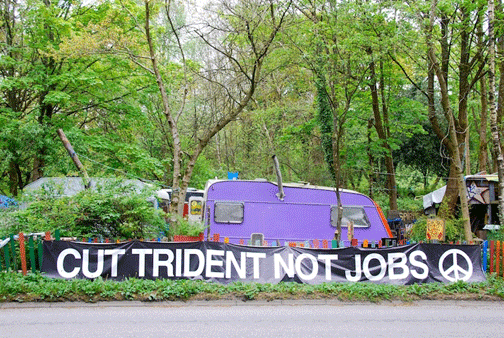 ‘No plans’ to move nuclear weapons from Scotland, BBC News, 15 July 2016
The UK government does not intend to make alternative plans for the storage of the UK’s nuclear weapons outside of Scotland, it has emerged.
The Scottish government opposes the Trident missile system and the storing of nuclear weapons in the country.
On Monday, MPs will vote on whether or not to renew Trident, which is based at Faslane on the Clyde.
No contingency plans for moving Trident were put in place in the run up to the 2014 Scottish independence vote. The Scottish government had pledged it would get rid of nuclear weapons if Scotland voted to leave the UK.
The MoD has said it was not anticipating another referendum and Faslane is the best place for the weapons to be based.
After the UK referendum vote to leave the EU, Scotland’s First Minister Nicola Sturgeon said a second independence referendum was now “highly likely”…….http://www.bbc.com/news/uk-scotland-scotland-politics-36800543
UK Conservatives could, and should, shut down useless Trident nuclear deterrent
 The Tories know Trident is a waste of money and only they can kill it off, Guardian Chris Mullin, 15 July 16 Our nuclear deterrent is purely symbolic but Labour would never be forgiven for letting it go A
few days from now parliament will be asked to make a final decision on whether or not to spend around £40bn renewing Trident. Many of the Labour MPs arguing in favour do so not because they regard nuclear weapons as an essential tool in our armoury, but because they are terrified of being thought “soft” on defence. And they are right to be worried. For years the British addiction to nuclear armaments has proved a devastating weapon in the hands of the Conservatives and their friends in the tabloid media, even if they are not much use against our enemies.
And yet just about anyone who has ever given the matter any thought knows it’s bonkers. Most Tories know in their heart of hearts that Trident is of little or no relevance to national defence in the 21st century. So, too, do a fair swath of the military. Indeed, our possession of nuclear weapons was never primarily about defending us from the Russians. On the contrary, it made us a target.
One has only to read the minutes of a top-secret cabinet subcommittee on 26 October 1946, at which the fateful decision to develop a nuclear arsenal was taken. Opinions were divided. The chancellor, Stafford Cripps, was against on the grounds that they were a luxury we couldn’t afford. Ernie Bevin, the foreign secretary, arrived late having nodded off after a good lunch. “What’s your opinion, Ernie?” he was asked. To which Bevin replied: “We’ve got to have that thing over here, whatever it costs … we’ve got to have the bloody union jack flying on top of it.” Why? Because, said Bevin, the Americans will never take us seriously, if we don’t.
And that in a nutshell is why British taxpayers have been saddled for 65 years with an expensive, but fundamentally useless weapons system. It is about keeping up appearances. Maintaining the pretence that we are a superpower, capable (to use a phrase much beloved by successive British prime ministers) “of punching above our weight”. …….https://www.theguardian.com/commentisfree/2016/jul/14/tories-trident-waste-money-nuclear-deterrent-symbolic-labour
Teresa May’s backward step in abolishing Climate Change Department
Climate change department closed by Theresa May in ‘plain stupid’ and ‘deeply worrying’
move Campaigners called for ‘urgent reassurance from the new government’ that the fight against climate change and pollution will not be ‘abandoned’ Independent Ian Johnston Environment Correspondent , 15 July 16 The decision to abolish the Department for Energy and Climate Change has been variously condemned as “plain stupid”, “deeply worrying” and “terrible” by politicians, campaigners and experts.
One of Theresa May’s first acts as Prime Minister was to move responsibility for climate change to a new Department for Business, Energy & Industrial Strategy.
Only on Monday, Government advisers had warned of the need to take urgent action to prepare the UK for floods, droughts, heatwaves and food shortages caused by climate change.
The news came after the appointment of Andrea Leadsom – who revealed her first question to officials when she became Energy Minister last year was “Is climate change real? – was appointed as the new Environment Secretary……..
Green Party MP Caroline Lucas described the decision as “deeply worrying”.
“Climate change is the biggest challenge we face, and it must not be an afterthought for the Government,” she said.
“Dealing with climate change requires a dedicated Minister at the Cabinet table. To throw it into the basement of another Whitehall department, looks like a serious backwards step.”
She said she would work with any Minister “willing to take climate change seriously”, but added she would seek to hold Government to account for “any backpeddling on our climate change commitments”.
Craig Bennett, chief executive of Friends of the Earth, pointed out that a major report into the effects of climate change on Britain had made clear that it was already happening.
“This is shocking news. Less than a day into the job and it appears that the new Prime Minister has already downgraded action to tackle climate change, one of the biggest threats we face,” he said…….
A letter by DECC’s permanent secretary, Alex Chisholm, to staff in his department, which was leaked to Civil Service World, confirmed that its responsibilities were being transferred to the new Department for Business, Energy and Industrial Strategy, under its new Secretary, Greg Clark…….http://www.independent.co.uk/environment/climate-change-department-killed-off-by-theresa-may-in-plain-stupid-and-deeply-worrying-move-a7137166.html
Teresa May and the nuclear “Letter of Last Resort.”
 The Grim Task Awaiting Theresa May: Preparing for Nuclear Armageddon In her first hours as Britain’s new prime minister, May will take part in a time-honored tradition: Handwriting what’s known as a “Letter of Last Resort.”Politico Magazine By Garrett M. Graff July 14, 2016 If tradition holds, in her first hours as the United Kingdom’s new prime minister, Theresa May will meet with the British defense leadership and receive an eye-opening briefing about the nation’s nuclear plans.
Sir Nicholas Houghton, the 61-year-old chief of the Defence Staff who is due to retire this month to become the constable of the Tower of London, will, as one of his final acts, walk Prime Minister May through the country’s nuclear plans and the damage that could result in the event of nuclear attack on her country.
Then, amidst the all the public pomp and circumstance of assuming her office and determining a course of action for the country following the world-changing “Brexit” vote, one of the first things May will be tasked with doing in her new office is perhaps the most grim duty of any head government official in the world: Handwriting what’s known as a “Letter of Last Resort”—the secret instructions, to be remain sealed until after Armageddon, about what the nation’s submarine commanders should do with the UK’s nuclear weapons, housed on their subs, if the country has been destroyed. Actually, she’ll write four of them—all identical—one to each sub commander in the U.K. fleet.
Throughout the Cold War, each nuclear power struggled to figure out how it would approach Armageddon. The Soviet Union ultimately built a rocket that could beam launch orders to Soviet silos even after the human chain of command had been destroyed, a “Dead Hand” machine ultimately uncovered by nuclear historian Bruce Blair in 1993 and made famous by journalist David Hoffman’s eponymous 2009 book. The United States, meanwhile, built a complex network of planes, trains, ships, communication networks and bunkers that could ensure control over the nation’s nuclear systems even amidst a devastating attack.
The British approached a nuclear holocaust differently, and in an appropriately British fashion. Rather than rely on high-tech gadgetry, their prime ministers handwrote “Letters of Last Resort,” and then locked those letters inside of a safe inside of another safe, and placed them in the control rooms of the nation’s nuclear submarines. The safes will only be accessible to the sub’s commander and deputy, who must decide together when Britain has been entirely destroyed.
Britain has long charted its own course when it comes to nuclear weapons, so much so that the secrets of one prime minister often surprise the next………
as the scale of nuclear devastation began to boggle the imagination, Britain faced a unique threat among the nuclear superpowers: Its comparatively tiny island—and its heavily concentrated population and government centers—could be easily obliterated by the power of later generations of atomic and hydrogen bombs. Whereas even a relatively large attack might have left much of the United States or the Soviet Union untouched and allow enough survivors to reconstitute the so-called “National Command Authority,” the military and civilian leaders who can order a nuclear launch, and plan a retaliatory strike, even a small-scale surprise attack from the Soviet Union would have likely destroyed all remnants of Whitehall and the British command chain. Plus, given its geographic proximity to the Soviet Union, Soviet subs, bombers and ICBMs could strike quickly, with little warning and little time to evacuate the nation’s leadership to protective bunkers readied in the English countryside.
And thus was born the tradition of the “Letter of Last Resort.”
It has become a moment when British leaders must wrestle personally with the awesome new responsibilities embodied in their nuclear control………
one might draw some clues from her legislative agenda in the weeks ahead: She’s said she’s eager to push ahead with replacing the aging Vanguard submarines, which will be obsolete in the middle of the next decade. Maintaining the nation’s nuclear deterrence will likely to cost north of $250 billion, but she’s said it’s critical to Britain’s international role post-Brexit. http://www.politico.com/magazine/story/2016/07/the-grim-task-awaiting-teresa-may-preparing-for-nuclear-armageddon-214049#ixzz4EQ4PMC9e
UK Parliament prepares to deliberate on whether to ban the bomb
 The nuclear option. Parliament prepares to deliberate on whether to ban the bomb , The Economist 16 July 16 NINE countries are believed to have nuclear weapons. On July 18th Britain will decide whether it wants to remain in that club, when its MPs debate whether to renew the country’s Trident nuclear deterrent. Theresa May, the new prime minister, has said it would be “sheer madness” to give it up, and the vote is expected to pass easily. Perhaps 150 of Labour’s 230 MPs will vote in favour of the plan, rebelling against their leader, Jeremy Corbyn.
The House of Commons approved in principle the retention of a nuclear deterrent in 2007. A review in 2013 reaffirmed that “like-for-like” replacement of the four submarines that carry the missiles represented the best and most cost-effective way to do it. Parliament will now decide whether to approve the spending of £31 billion ($41 billion) over 20 years to replace the four Vanguard-class subs, which will wear out within a decade.
 Trident’s detractors argue that a lot has changed since the programme was approved in 2007. For one thing money is tighter. Around one-quarter of defence spending on new equipment procurement will be on submarine and deterrent systems by 2021-22. There has also been a surge in support for independence in Scotland, where the submarines are based. It is unlikely that the government would choose to site the capability north of the border if the renewal process began again now, says William Walker of St Andrew’s University. The Scottish government opposes the plan; almost all of the 59 Scottish MPs at Westminster are expected to vote against it (though polls suggest that public opinion in Scotland is more mixed). If Scotland were to become independent—now more likely because of Brexit—Britain could well have to relocate its subs, at further expense.
Critics also say Trident relies too much on a single naval platform (America has air, land and sea options), and that improved ballistic-missile defences and the future use of underwater drones and cyber warfare could threaten the subs’ security. Yet land-based ballistic missiles are vulnerable to attack, and arming aircraft with nuclear-tipped cruise missiles permanently aloft carries a significant danger of nuclear accident and is much more expensive. …..http://www.economist.com/news/britain/21702226-parliament-prepares-deliberate-whether-ban-bomb-nuclear-option
Birmingham protest against the trucking of nuclear weapons through their city
 Warning over nuclear weapons being shipped past Birmingham, Birmingham Mail, 14 JUL 2016 BY GRAEME BROWN, Warheads from Britain’s nuclear weapons system Trident are shipped past the city on the M6 Campaigners say Birmingham is being put at risk by nuclear weapons being driven past the city six times a year
The International Campaign to Abolish Nuclear Weapons (ICAN) will host a public meeting in Birmingham on July 23 to raise awareness of the fact that nuclear weapons are routinely driven past the city.
Warheads from Britain’s nuclear weapons system Trident are shipped past the city on the M6 from their base in Scotland to be refurbished in Berkshire.
The Ministry of Defence said the strictest safety measures were taken to move the weapons – and no incidents had occurred in 50 years.
The Ministry of Defence said the strictest safety measures were taken to move the weapons – and no incidents had occurred in 50 years.
Matt Hawkins, project officer at ICAN-UK, said the weapons travel in lorries past schools, hospitals, and homes.
He said: “The Government has a duty to protect its citizens but, by possessing nuclear weapons and driving them past our towns and cities, they are needlessly putting us in great danger.
“Our aim with this meeting in Birmingham is to let people know that nuclear weapons are driven so close to their doors – we think it is their democratic right to know this. “We then want to give the people of Birmingham the chance to raise their concerns with the politicians who are supposed to be protecting us all from danger, not putting our lives at risk.”
The meetings come as MPs face a vote on renewing the UK’s Trident nuclear weapons system……..http://www.birminghammail.co.uk/news/midlands-news/warning-over-nuclear-weapons-being-11611290
Reject nuclear weapons – say Scottish bishops
 Scottish bishops urge Britain to reject nuclear weapons, Crux, Simon Caldwell July 14, 2016
All eight bishops issued a joint statement calling for nuclear disarmament ahead of a July 18 vote in Parliament on whether to renew the Trident submarine-based nuclear weapons system.
The bishops also suggested the $272 billion cost of replacing the aging arsenal of nuclear weapons could not be morally justified.
“The bishops of Scotland have, for a long time, pointed out the immorality of the use of strategic nuclear weapons due to the indiscriminate destruction of innocent human life that their use would cause,” they said.
Theresa May, the incoming prime minister and leader of the ruling Conservative Party, is keen to retain a nuclear capacity, but the Labor Party leadership and the Scottish National Party want to scrap the warheads.
The intervention by the Scottish bishops represents the second time in a decade and the third in 35 years that they have called on Britain to rid itself of nuclear weapons.
The statement comes less than a year after Pope Francis marked the 70th anniversary of the day the United States dropped an atomic bomb on Nagasaki, Japan, by inviting humanity to reject war and to “ban nuclear weapons and all weapons of mass destruction.”
It also comes as the Washington Post reported that U.S. President Barack Obama will use his final six months in office to push for a radical reduction of nuclear weapons globally, in the hope that the policy might lead to eventual abolition.MANCHESTER, England – The British government must take “decisive and courageous steps” toward ridding the country of nuclear weapons, the Catholic bishops of Scotland have said.
They said Britain had an obligation under the 1968 Nuclear Non-Proliferation Treaty “to work toward the disposing and elimination of all nuclear weapons.”
“Britain should take more decisive and courageous steps to revive that aspect of the treaty and not seek to prolong the status quo,” the bishops said in the July 12 statement.
UK’s Department of Energy and Climate Change (DECC) compares falling costs of renewables with rising costs of nuclear power
 Nuclear competitiveness falling with rise of renewables, says government watchdog, businessGreen, Jocelyn Timperley, 14 July 16, A new report on the future of Britain’s electricity supply from the government spending watchdog has highlighted the falling costs of renewables compared with nuclear, with figures projecting onshore wind and solar will be the cheapest ways of generating electricity by 2025.
The report examines how new sources of electricity can be used to meet the looming capacity gap the UK faces over the coming decade while supporting emissions targets and keeping energy bills affordable.
Its findings show that renewables may be a cheaper option than conventional energy sources, with Department of Energy and Climate Change (DECC) forecasts for the levelised cost of energy of wind and solar in 2025 having decreased since 2010. The cost forecast for nuclear during the same time period has increased while it has remained constant for gas.
“Supporting early new nuclear projects could lead to higher costs in the short term than continuing to support wind and solar,” the report concludes. “The cost competitiveness of nuclear power is weakening as wind and solar become more established.”………
The NAO also lays out how the projected costs of Hinkley Point C have skyrocketed since the strike price was initially agreed based on an estimated cost of £6.1bn in October 2013. Projections laid out in the report show the top-up subsidy payments for the nuclear plant have changed along with forecasts of the wholesale price of power, with the most recent estimate in March 2016 valuing the payments at £29.7bn.
In addition, the NAO warned of the risks for consumers of signing up to the 35-year Hinkley Point C contract, expected to begin in 2025, due to the difficulty in predicting how wholesale electricity prices will fluctuate, as well as how other energy technologies will develop. “Over a longer time frame there is greater potential for technological changes that reduce the competitiveness of nuclear compared with other power sources,” the report says.
The new report comes just days after DECC vastly raised its estimate of how much the Hinkley project would cost in subsidies over its lifetime, suggesting it will cost £37bn in total subsidies, more than double its £14.4bn estimate a year ago……..
Among a host of other environment and energy decisions, Theresa May will soon have to make the long-awaited decision on whether to go ahead with Hinkley Point. And the NAO report makes clear it will be as much a strategic and political decision as an economic one. http://www.businessgreen.com/bg/analysis/2464823/nuclear-competitiveness-falling-with-rise-of-renewables-says-government-watchdog
UK taxpayers up for an extra £30bn for Hinkley Point C nuclear project?
 Report reveals top-up fees for Hinkley Point C could cost us an extra £30bn http://www.bristolpost.co.uk/report-reveals-top-up-fees-for-hinkley-point-c-could-cost-us-an-extra-30bn/story-29511798-detail/story.html A government spending watchdog has warned tax payers could cost energy consumers £30 billion in “top-up payments” for Hinkley Point C. By David_Clensy July 14, 2016
The deal for the Somerset nuclear power station sees the government paying EDF a fixed price for electricity generation over 35 years from 2025. But if the wholesale price falls, the government pays EDF a top-up fee.
The National Audit Office had previously estimated that this top-up fee would amount to £6.1 billion during the 35 year period, but in its latest report the watchdog has scaled up the estimate to £29.7 billion – nearly doubling the cost of the £37 billion construction project.
The report also expressed fears that taxpayers could end up with a range of other payments under debt guarantees agreed by the government with EDF. “Supporting early new nuclear projects could lead to higher costs in the short term than continuing to support wind and solar. The cost competitiveness of nuclear power is weakening as wind and solar become more established,” the report, Nuclear Power in the UK, states.
Environmental lobbying group Greenpeace has jumped upon the opportunity to call upon the new Prime Minister to scrap the entire project.
John Sauven, director of Greenpeace UK, said: “The government’s line that Hinkley is a good deal for billpayers is falling apart. Today’s damaging report from the NAO should kill this myth once and for all. It makes the government’s slash and burn approach towards help for homegrown renewable energy companies look completely out of step with reality. Unlike nuclear the cost of renewables is falling every year.”
Britain’s new Government axes climate department
 Government axes climate department By Paul RinconScience editor, BBC News website, 14 July 16, The government has axed the Department of Energy and Climate Change (Decc) in a major departmental shake-up.
The brief will be folded into an expanded Department of Business, Energy and Industrial Strategy under Greg Clark.
Ed Miliband, the former energy and climate secretary under Labour, called the move “plain stupid”.
It comes at a time when campaigners are urging the government to ratify the Paris climate change deal…….One of the most pressing items on the environment agenda is the ratification of the Paris climate deal, which was inked last year.
The climate “sceptic” group Global Warming Policy Forum has long demanded the demise of Decc, so alarm bells are ringing loudly for some green groups……
The Green Party and Friends of the Earth, for instance, see the move as potentially a major downgrade for climate as a government priority.
Decc has made the UK a world leader in climate policy, and scrapping the department removes the words “climate change” from the title of any department. Out of sight, out of mind, in the basement, perhaps…….http://www.bbc.com/news/science-environment-36788162
Chilcot says Britain shirking its responsibilty to help clean up radioactive destruction in Iraq
 Chilcot: UK refusing to help clean up Iraq after raining down radioactive shells https://www.rt.com/uk/350804-iraq-chilcot-depleted-uranium/#.V4VPdDurb8w.facebook 12 Jul, 2016 Britain has no intention of cleaning up its deadly radioactive legacy in Iraq or even monitoring the terrifying impact depleted uranium (DU) shells will have on the population in the future, it has been claimed.
Writing in the Ecologist on Tuesday, Doug Weir, who is coordinator of the International Coalition to Ban Uranium Weapons (ICBUW), says that hidden within the Chilcot report is a previously classified military document setting out the UK’s rejection of any duty to cleanse Iraq of DU of unexploded ordnance (UXO).
In it, the clearance of unexploded ordnance and DU is considered and the Ministry of Defence [MoD] argues that it has: “… no long-term legal responsibility to clean up DU from Iraq” Weir writes.
“Instead it proposes that surface lying fragments of DU only be removed on ‘an opportunity basis’ – i.e. if they come across them in the course of other operations.”
This indicates, according to Weir, that the UK has effectively swerved any obligation to clear up after itself in Iraq.
“In other words, the UK’s stance is that chemically toxic and radioactive DU ‘ash’ from spent munitions is strictly the problem of the country in which the munitions were used – in this case Iraq – and that the UK, which fired the DU shells, has no formal responsibility of cleaning up the mess.”
DU ammunition is used in only two UK weapons systems – the Royal Navy’s PHALANX Close-In Weapon System and in the Charm 3 ammunition fired by the Challenger 2 main battle tank.
However, the route to shirking responsibility may not be as easy as the UK government seems to hope. In October, the UN will meet to debate a sixth resolution on DU weapons. It’s a move which will give succor to the government of Iraq, which in 2014 called for the international community to help clean up DU.
Weir remains hopeful that the UN meeting may be able to encourage governments to take responsibility for the use and fallout of the weapons.
“When the United Nations last discussed DU two years ago, 150 governments recognised the need for states to provide assistance to countries like Iraq,” he wrote.
“This October, our Coalition will add our voice to those of the states affected by DU weapons in calling for an end to the use of DU weapons and for the users to finally accept responsibility for their legacy,” he added.
1 This Month





PLEASE OPPOSE HR 8255 AND S.3639 – bills would accelerate satellite deployment, with no environmental review or safeguards – https://ncstd5li.quorum.us/campaign/169331/
To see nuclear-related stories in greater depth and intensity – go to https://nuclearinformation.wordpress.com
-
Archives
- October 2026 (49)
- September 2026 (339)
- August 2026 (330)
- July 2026 (355)
- June 2026 (287)
- May 2026 (306)
- April 2026 (356)
- March 2026 (251)
- February 2026 (267)
- January 2026 (308)
- December 2025 (358)
- November 2025 (359)
-
Categories
- 1
- 1 NUCLEAR ISSUES
- business and costs
- climate change
- culture and arts
- ENERGY
- environment
- health
- history
- indigenous issues
- Legal
- marketing of nuclear
- media
- opposition to nuclear
- PERSONAL STORIES
- politics
- politics international
- Religion and ethics
- safety
- secrets,lies and civil liberties
- spinbuster
- technology
- Uranium
- wastes
- weapons and war
- Women
- 2 WORLD
- ACTION
- AFRICA
- Atrocities
- AUSTRALIA
- Christina's notes
- Christina's themes
- culture and arts
- Events
- Fuk 2022
- Fuk 2023
- Fukushima 2017
- Fukushima 2018
- fukushima 2019
- Fukushima 2020
- Fukushima 2021
- general
- global warming
- Humour (God we need it)
- Nuclear
- RARE EARTHS
- Reference
- resources – print
- Resources -audiovicual
- Weekly Newsletter
- World
- World Nuclear
- YouTube
-
RSS
Entries RSS
Comments RSS

