Horizon nuclear company funds college in Wales
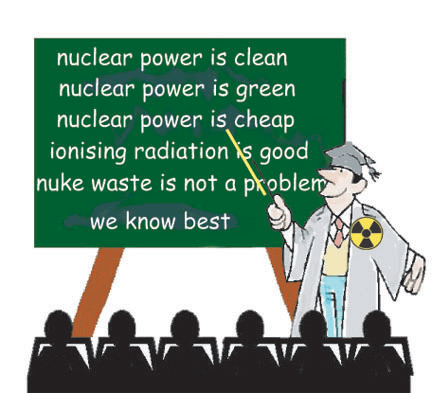 Wylfa Newydd nuclear firm funds Anglesey engineering centre 9 August 2016
The company behind an £8bn nuclear power plant will pay £1m towards an engineering centre on Anglesey.
Horizon Nuclear Power, the firm behind Wylfa Newydd, will pay towards Grwp Llandrillo Menai’s Llangefni building…….
- Horizon will provide technical support to Coleg Menai, one of the colleges under Grwp Llandrillo Menai, and apprentices will move from the Bangor campus to Llangefni once the new centre is finished.
The Welsh Government pledged £5m to the centre in 2015.…..
- Duncan Hawthorne, Horizon’s chief executive officer, said: “I’m delighted to announce this landmark funding provision to Grwp Llandrillo Menai.
Chines military nuclear firm invited to bid for building Small Nuclear Reactors in Britain


 Chinese firm with military ties invited to bid for role in UK’s nuclear future,
China National Nuclear Corporation on government list of preferred bidders for development funding for next-generation modular reactors, Guardian, Adam Vaughan, 8 Aug 16, A controversial Chinese company has been selected to bid for millions of pounds of public money in a UK government competition to develop mini nuclear power stations.
The China National Nuclear Corporation (CNNC) features twice in a government list of 33 projects and companies deemed eligible to compete for a share in up to £250m to develop so-called small modular reactors (SMR).
The involvement of a different Chinese company in the high-profile Hinkley Point C project in Somerset was widely believed to have prompted the government’s decision to pause the deal at the 11th hour last month.
Nick Timothy, Theresa May’s co-chief of staff, has previously expressed alarm at the prospect of CNNC having such close access to the UK’s energy infrastructure because it would give the state-owned firm the potential ability to build weaknesses into computer systems.
The company was formerly China’s Ministry of Nuclear Industry and developed the country’s atomic bomb and nuclear submarines, as well as being a key player in its nuclear power industry.
In an article on the ConservativeHome website, Timothy singled out CNNC’s military links as a reason the UK government should be wary of such involvement.
“For those who believe that such an eventuality [shutting down UK energy at will] is unlikely, the Chinese National Nuclear Corporation – one of the state-owned companies involved in the plans for the British nuclear plants – says on its website that it is responsible not just for ‘increasing the value of state assets and developing the society’ but the ‘building of national defence’,” he wrote.
Tom Burke, chairman of the environment thinktank E3G and a former British government adviser, said there were legitimate concerns over the company. “I don’t fuss very much about the Chinese owning a nuclear power station [China General Nuclear in the case of Hinkley]. But I would be much more concerned about bringing in CNNC because they are known to be much more closely involved with the military and Chinese nuclear weapons programmes,” he said.
CNNC was not involved in the original Hinkley deal but it was reported on Sunday that the company has agreed in principle to buy half of China’s 33% stake in the £24bn project if it goes ahead…….. https://www.theguardian.com/environment/2016/aug/07/chinese-firm-with-military-ties-invited-to-bid-for-role-in-uks-nuclear-future
UK govt accidentally published list of preferred bidders for funding for Small Modular Nuclear Reactors
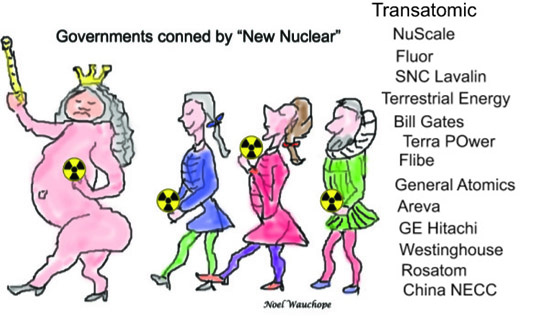 Chinese firm with military ties invited to bid for role in UK’s nuclear future
China National Nuclear Corporation on government list of preferred bidders for development funding for next-generation modular reactors, Guardian, Adam Vaughan, 8 Aug 16“……….The list of companies accepted for the competition was published briefly, apparently accidentally, on the website of the new Department for Business, Energy and Industrial Strategy on Friday before being deleted. It reads as a who’s-who of US, British, Japanese and Chinese industry players hoping to develop and build small modular reactors. These are much smaller than conventional nuclear plants with a capacity of less than 300MW – or a 10th of what Hinkley Point C should provide.
They are pitched by industry as a cheaper and quicker way to provide low-carbon energy capacity than conventional big nuclear plants because they could be built in a factory and transported to where their power is needed. The US and UK are racing to be the most attractive home for the first of the new designs to be commissioned.
Last November, George Osbornepromised £250m over five years for a nuclear research and development programme to “revive the UK’s nuclear expertise and position the UK as a global leader in innovative nuclear technologies”. An undisclosed amount of that sum is for a competition to find the best value SMR design for the UK, to “pave the way” towards building one in the UK in the 2020s.
CNNC sits alongside US companies such as NuScale; British ones including Rolls-Royce, Sheffield Forgemasters and Tokamak Energy; Japanese-owned Westinghouse; and the US-Japanese partnership GE-Hitachi, as participants the government considers eligible for phase one of its competition.
CNNC’s chief designer of small nuclear plants visited a conference in London last year to pitch a plan for cooperating with UK industry, and is already partnering with Rolls-Royce. It hopes to build the first SMR in the UK, with future ones sold around the world.
NuScale Power put itself forward for the competition in the spring. Its design, said its managing director, Tom Mundy, “answers the particular needs of the UK’s energy market and the wider UK economy, and we intend to participate fully in the government’s competition”.
The 33 participants will be whittled down in several phases, with the announcement of the eventual winners scheduled for late 2017……
When asked about the list published on Friday, a spokeswoman for the Department of Business, Energy and Industrial Strategy, said: “In March 2016, the government launched the first phase of a competition to identify the best value SMR for the UK. The ambition is to create an opportunity for the UK to become a world leader in SMRs.
“Those companies which are eligible to participate in the competition have been aware for over two months.” https://www.theguardian.com/environment/2016/aug/07/chinese-firm-with-military-ties-invited-to-bid-for-role-in-uks-nuclear-future
Disappearance of documents disclosing UK’s involvement in Israel’s alleged nuclear arsena
 Documents detailing UK’s involvement in Israel’s alleged nuclear arsenal vanish, Jerusalem Post, 5 Aug 16 Israel maintains a policy of ambiguity concerning nuclear weapons, neither confirming nor denying publicly that it has the capability. The United Kingdom on Thursday said that records detailing the UK’s involvement in Israel’s alleged nuclear arsenal have gone missing over the last four years, according to London based internet publication, The Independent.
Strained relations between China and UK, after Theresa May delays Hinkley nuclear decision
U.K. Delay on Hinkley Point Nuclear Power Plant Strains Relations With China Decision by new government to review deal comes as British vote to leave the European Union puts trade policy in question, WSJ By JENNY GROSS in London and CHUN HAN WONG in Beijing Aug. 5, 2016
New Prime Minister Theresa May’s surprise move to delay a final decision on building a nuclear plant part-funded by China has prompted questions in Beijing about the U.K.’s commitment to foreign investment and a “golden era” in ties between their capitals.
Britain announced last week it needed until the fall to review the controversial £18-billion ($23.7 billion) project, postponing a deal with China and France agreed to last year by Ms. May’s predecessorDavid Cameron to build the country’s first new nuclear plant in a generation.
Ms. May has said the U.K. will continue to seek investment from around the world, but how she proceeds in China will be closely watched as a bellwether of her government’s diplomatic and economic policy as the country navigates its exit from the European Union following a public vote in June……..
Chinese state media warned that undue delays or cancellation of the project would damage mutual trust. The delay had already spurred concern that Britain might be “thinking of erecting a wall of protectionism,” China’s official Xinhua News Agency said in an editorial this week…….
A Chinese government adviser said China will want Britain to provide a clear explanation for its actions and assurances on the directions of its China policy. He added that while the nuclear deal marked a crucial advance for Beijing, ultimately Britain needs China more than the other way around…….
Nick Timothy, Ms. May’s newly appointed joint chief of staff and a close adviser, last year wrote that the deal was “baffling” and said security experts are worried the Chinese could build weaknesses into computer systems that would allow them to shut down Britain’s energy production.
—Selina Williams in London and Inti Landauro in Paris contributed to this article.http://www.wsj.com/articles/u-k-delay-on-hinkley-point-nuclear-power-plant-strains-relations-with-china-1470402457
Hinkley Nuclear Project : A dramatic turn of events
Nu Clear News No 87 5 Aug 16 Hinkley : A dramatic turn of events It has now been a few days since the Government shocked the energy industry by announcing a further review of the Hinkley Point C nuclear power station just a few hours after EDF approved the project.
Although we may never know exactly what has gone on behind the scenes it is clear that EDF had moved its final investment decision forward from September in order to bounce the new UK Government into giving its approval quickly before mounting problems become even more obvious to everyone.
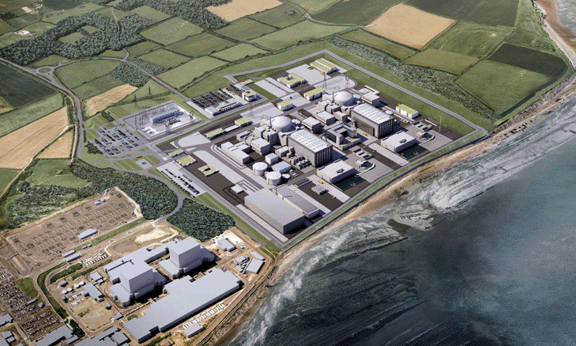
Stop Hinkley spokesperson, Roy Pumfrey said
Much of the media seems to think this is just a temporary pause and that Hinkley Point C will eventually go ahead, but if Theresa May gives this scheme just a cursory glance she will see that we are being asked to buy a pig in a poke.
According to the Financial Times (2) the head of EDF, Jean-Bernard Lévy gave his fellow board members only two days to read 2,500 pages of contracts for a deal which one investment analyst described as “verging on insanity”.
The decision to review the project has been attributed by some to security concerns about Chinese involvement in the sector expressed by Mrs May’s chief of staff, Nick Timothy. The Stop Hinkley Campaign has itself expressed concerns in the past about making nuclear deals with a country with such a poor health and safety record.
Writing on the Conservative Home website last October Timothy said the Hinkley deal could lead to the Chinese designing and constructing a third nuclear reactor at Bradwell in Essex. Security experts – reportedly inside as well as outside government – are worried that the Chinese could use their role to build weaknesses into computer systems which will allow them to shut down Britain’s energy production at will. (5) For those who believe that such an eventuality is unlikely, the Chinese National Nuclear Corporation – one of the state-owned companies involved in the plans for the British nuclear plants – says on its website that it is responsible not just for “increasing the value of state assets and developing the society” but the “building of national defence.” MI5 believes that “the intelligence services of…China…continue to work against UK interests at home and abroad.”
Mandiant, a US company that investigates computer security breaches around the world, looked into the operations of just one Chinese cyber espionage group, believed to be the Second Bureau of the People’s Liberation Army of China, or ‘Unit 61398’. Mandiant found that Unit 61398 has compromised 141 different companies in twenty major industries.
There were 115 victims in the United States and five in the UK. The intellectual property stolen included technology blueprints, manufacturing processes, test results, business plans, pricing documents, partnership agreements, and emails and contact information. Timothy said
evidence like this makes it all the more baffling that the British Government has been so welcoming to Chinese stateowned companies in sensitive sectors. The Government, however, seems intent on ignoring the evidence and presumably the advice of the security and intelligence agencies. But no amount of trade and investment should justify allowing a hostile state easy access to the country’s critical national infrastructure. Of course we should seek to trade with countries right across the world – but not when doing business comes at the expense of Britain’s own national security. http://www.no2nuclearpower.org.uk/nuclearnews/NuClearNewsNo87.pdf
Problems of UK and EU’s uranium supply from Russia, Kazachstan and elsewhere
 Uranium from Russia, with love, Ecologist, 4th August, 2016 Uranium mining is a dirty business that we didn’t clean up but sourced out to less demanding countries, so why isn’t this being discussed in any debate about nuclear energy asks NICK MEYNEN
One issue is security. Reciprocal sanctions between Russia and the EU are now in place for over two years. If some recent polls in the US become reality and Trump becomes the new US president, things will get worse for the EU. Trump already hinted that a grim scenario (or much worse) could play out in Latvia or Estonia, EU countries with a Russian minority of over a quarter of the whole population. How hard can the EU bite in the hand that feeds it with the gas and uranium it so desperately needs? Putin will answer: not that hard.
Another issue is the future supply risk. Any power plant envisaged today will need uranium in 40 years from now. But both Russia and Kazachstan, the two biggest uranium exporters to the EU have plans to build new nuclear power plants for themselves. Kazachstan has gone from zero to hero: in 20 years it went from no production to supplying 40% of the world’s uranium. But aside from their own future needs, and those of nearby befriended Russia, analysts fear that mismanagement is likely to lead to a collapse in exports…………http://www.theecologist.org/News/news_analysis/2987988/uranium_from_russia_with_love.html
UK found not in compliance with The United Nations Espoo (EIA) Convention Compliance Committee
 NucClear News August 2016 The Nuclear Free Local Authorities (NFLA) welcomes the recently published decision of the United Nations Espoo Convention Compliance Committee, following its investigation in whether the United Kingdom is compliant with international environmental law in the case of Hinkley Point C.
The Committee found that the United Kingdom was not in compliance with the Espoo Convention. The Espoo (EIA) Convention sets out the obligations of UN member states to assess the environmental impact of certain activities at an early stage of planning. It also lays down the general obligation of States to notify and consult each other on all major projects under consideration that are likely to have a significant adverse environmental impact across boundaries. Hinkley Point C comes into consideration for such a consultation.
Complaints raised by the German MP Sylvia Kötting-Uhl and the NGO ‘Irish Friends of the Environment’ to the Espoo Convention Implementation Committee argued that the UK Government had inadequately consulted other member states of the potential environmental impacts of the Hinkley Point C project.
In its findings, the Implementation Committee concluded that the UK Government should have notified more countries than just the Republic of Ireland of the potential impacts of Hinkley Point C. It concluded on the basis of the ‘Guidance on the Practical Application of the Espoo Convention’, that “notification is necessary unless a significant adverse transboundary impact can be excluded.” http://www.no2nuclearpower.org.uk/news/3-august-2016/
Changing energy markets make it imperative for Britain to rethink Hinkley nuclear power plan
 Why changing market forced re-think on UK nuclear power station http://www.afr.com/business/energy/nuclear-energy/changing-market-forces-rethink-on-uk-nuclear-power-station-20160804-gqligy 5 Aug 16 The UK government wants to do a rethink on the proposed rethink of Hinkley Point C nuclear power station because of a change in the structure of the UK energy market. Matt Cardy
Less than three years ago the British government struck a deal with EDF, a French state-owned utility, to subsidise the first new nuclear power station built in Britain since 1995: Hinkley Point C on the Somerset coast. The agreement was hailed by David Cameron, the then-prime minister, as “brilliant news”. But a lot has changed since then—and not just the incumbent at 10 Downing Street.
On July 28th, hours after EDF’s board narrowly endorsed a decision to go ahead with the £18 billion ($24 billion) Hinkley Point investment, the new government of Theresa May unexpectedly slammed the brakes on, launching a review of the project that it says it will finish by the autumn. It is understood to want to probe a deal with China General Nuclear Power, a Chinese state behemoth, which had offered to stump up one-third of the price tag in exchange for permission to build a nuclear-power station of its own at Bradwell, in Essex. The delay is the clearest sign that Mrs May is rethinking the open-door industrial policies of her predecessor.
Yet analysts say there is more to the delay than mere Sinophobia. Hinkley is “big and based on last-century technology, which is not what the UK’s power system needs for the future,” says Michael Grubb of University College London. A review of the assumptions prevailing when the government struck the deal reveals how flimsy the economic rationale was.
Price outlook changes Hinkley already operates as a nuclear power station. The plan was to expand with another reactor. But the changing demand for baseload power is now said to require a rethink. Andrew Matthews
In 2012 Britain’s energy boffins predicted that for the foreseeable future the price of non-nuclear fuels, such as natural gas, would be more than double where they are today. As a result, they estimated that wholesale electricity prices—the basis for determining the level of subsidy to EDF—would remain above £70 per megawatt hour. They are currently below £40. Last month the National Audit Office, a spending watchdog, said that forecasting error alone had almost quintupled the implied value of the subsidy, from £6 billion to almost £30 billion over 35 years.
At the time, the civil servants reckoned that by 2025, when Hinkley Point is due to open, the cost of producing electricity from a nuclear-power station would be lower than from a gas-fired one—and much lower than from wind farms and solar-power plants. They have since reversed those views (see chart). Since Hinkley became a serious proposal less than a decade ago, the cost of nuclear power has increased, that of renewables has fallen and the price of battery storage—which could one day disrupt the entire power system—has plummeted. What is more, EDF’s nuclear technology has failed to get off the ground in the two projects in Finland and France that have sought to use it. “When so much has changed, it would have been inappropriate not to pause,” says Professor Grubb.
Hinkley’s supporters counter that it would help to plug a looming gap in the country’s energy supply. Over the next 15 years, Britain plans to shut down its coal-fired power stations and decommission all but one of its ageing nuclear plants, losing 23 gigawatts (GW) of power-generating capacity. Hinkley Point C, with a capacity of 3.2GW, is intended to ensure there is enough clean energy to offset that, by kickstarting a broader revival of nuclear power in the country. It would also strengthen energy security, reducing reliance on Russian gas. And its power would be clean: without it, supporters say, Britain would fail to meet its obligation under the 2008 Climate Change Act to reduce greenhouse gases to 80% below their 1990 level by 2050.
Renewables have bigger share But these arguments fail to account for how quickly the energy landscape is changing. First, as their costs continue to drop, renewables are becoming a bigger part of the energy mix. They currently account for about one-quarter of Britain’s power output. But renewables are intermittent, generating little power on days that are calm or overcast. So they must be complemented by alternative sources of energy, which add to the total cost. Big power stations such as Hinkley Point cannot fill that role: nuclear power is hard to flex up and down. Combined-cycle gas turbines (CCGTs) are cheaper and more nimble. As a backup to renewables, they can enable Britain to “muddle along” at least for another 20 years, says Deepa Venkateswaran of Bernstein Research, a firm of analysts. That would buy time to assess the progress of other clean technologies, such as battery storage and carbon capture.
Smaller businesses are also jostling to step into the breach, offering standby power when shortages occur. One such firm, UK Power Reserve, uses small gas-fired generators that can be switched on and off quickly. It calls itself a “scalpel” compared with a CCGT “sledgehammer”. Another, Upside Energy, proposes selling to the grid surplus power stored in battery systems that back up everything from office computers to traffic lights. Others enable companies to shift their power consumption to times of lower demand, cutting their bills. Such options may not provide the bedrock of power or thousands of jobs that EDF promises at Hinkley Point, and may require more innovative policymaking. But in terms of value for money, they could beat it hands down.
Strong support for renewables in UK public
 What does the public really think of renewables? http://www.goodenergy.co.uk/blog/articles/2016/07/29/what-does-the-public-really-think-of-renewables Did you know that 76% of the UK public support renewables, while just 21% support fracking?
This week the newly named Department for Business, Energy and Industrial Strategy (DBEIS) released its latest public attitudes tracker, asking UK residents their opinion on various energy topics ranging from bills to fracking.
The surveys, which first began in March 2012, time and again reveal overwhelming public support for renewable energy.
Strong support for renewables
In the past 18 surveys, support for renewables has never dropped below 75%, and the proportion backing solar has always been 80% or higher.
Seven in 10 of us agree that renewable energy provides economic benefits to the country, something we’re dedicated to delivering through our Renewables Development Charter.
In comparison, support for nuclear and fracking is consistently overshadowed by renewables, with the latest stats revealing that 36% and 21% of the UK public support these technologies respectively.
Good Energy founder and CEO Juliet Davenport was thrilled with the news. She said: “Clean energy has always had the public’s support because it offers good value – it’s local, it’s sustainable and it offers a solution to climate change.”
“The gulf between what the public wants for our energy future and what our Government is imposing is growing.
“The newly formed BEIS department needs to listen to public support, take the lead in seizing new opportunities and keep us on the path to decarbonisation.”
Record breaking clean power These figures are a huge boost to renewables, and come at a time when clean sources of generation are breaking records.
25% of our power needs now comes from green energy, and it was recently announced that one million UK homes are generating electricity and heat using the power of British sunshine.
With 2016 a year of political change and uncertainty for the renewable energy industry, it is good news like this which demonstrates the progress we are making towards a truly low carbon future.
Join the clean energy revolution by switching to our 100% renewable electricity and Green Gas
Hinkley nuclear fiasco is a threat to French company EDF
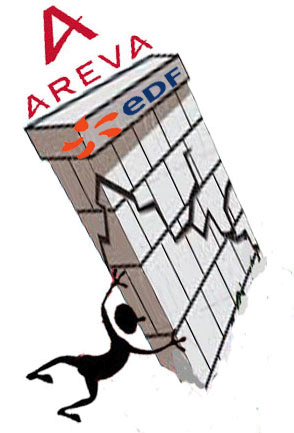 Nu Clear News No 87 5 Aug 16 EDF’s future threatened. Perhaps of more immediate concern is that a go-ahead for Hinkley could threaten the future of the company itself. EDF is a company in a very precarious financial situation. The ratings agency, S&P, postponed a decision to downgrade its credit rating when the UK Government announced the review. (7) EDF has €37 billion of debt. The collapse in energy prices has pushed earnings down 68% in 2015. The Company needs to spend €50 billion upgrading its network of 58 ageing reactors by 2025. It is scrambling to sell €4 billion of new shares and €10 billion of assets to strengthen its balance sheet. EDF is also expected to participate in the €5 billion bailout of Areva, the bankrupt developer of EPR technology, by taking a 75 per cent stake. (8) About the last thing it needs is a new €15 billion millstone around its neck.
Roy Pumfrey said “The EDF Board should take the opportunity presented by this pause to see that its Nuclear SatNav has taken the Company down a dead end; it’s only a matter of time before we hear that voice saying “At the next opportunity, turn round!”‘
He continues: “Perhaps most disappointing if not unexpected has been the reaction of the big UK Union leaders. Whilst confessing themselves ‘baffled’ by the government’s ‘bonkers’ decision, they should ask why the French union leaders representing EDF’s own workers were (and are) solidly and vocally opposed to HPC. This project involves a reactor which many of EDF’s own staff regard as unconstructable, selling off the family silver to fund it and putting EDF and therefore their own livelihoods at risk. UK unions do not seem to appreciate that the fantasy 25,000 jobs on HPC are a conjurer’s trick. Only 30% will be ‘local’, which means 90 minutes drive time from HPC, and with only 5,600 on site on any one day, a job with a particular skill set will only be good for two years at most. That’s assuming that
HPC can be built in an optimistic ten years, even that too long to keep the lights on.”
Over recent months several different alternative to building Hinkley Point C have been detailed (10) Most recently consultancy firm Utilitywise has described the proposed nuclear station as an “unnecessary expense” Energy efficiency measures could save the equivalent amount of electricity along with £12bn
Roy Pumfrey said: “This Government review of Hinkley Point C provides us with a wonderful opportunity to turn Somerset into a sustainable energy hub for England. The alternatives would be better for jobs, better for consumers, would reduce the mountain of dangerous waste we don’t know how to deal with and save Somerset from a decade of disruption caused by one of the biggest construction projects in the world The sooner EDF and the UK Government come to their senses the better. http://www.no2nuclearpower.org.uk/nuclearnews/NuClearNewsNo87.pdf
UK: Conservatives against Hinkley nuclear power project
 Nu Clear News No 87 5 Aug 16 Anti-Hinkley Tories Perhaps most interesting amongst recent events has been the emergence of Conservative figures calling on the government to call time on the Hinkley proposals. The think-tank Bright Blue, whose advisory board includes Francis Maude, Nicky Morgan and former DECC minister Greg Barker, has said the government needs a new “plan A”. The group stresses that its position is not necessarily endorsed by all members of the organisation, which includes more than 100 parliamentarians. “The Government should abandon Hinkley C – pursuing it in light of all the evidence of cost reductions in other technologies would be deeply irresponsible,” said Ben Caldecott, associate fellow, Bright Blue. “We need a new ‘Plan A’. This must be focused on bringing forward sufficient renewables, electricity storage, and energy efficiency to more than close any gap left in the late 2020s by Hinkley not proceeding. This would be sensible, achievable, and cheap.” Zac Goldsmith, also a Bright Blue member, has welcomed the government’s rethink.
New Nuclear UK : fears Hinkley uncertainty will affect Wylfa, Moorside, Sizewell and Bradwell
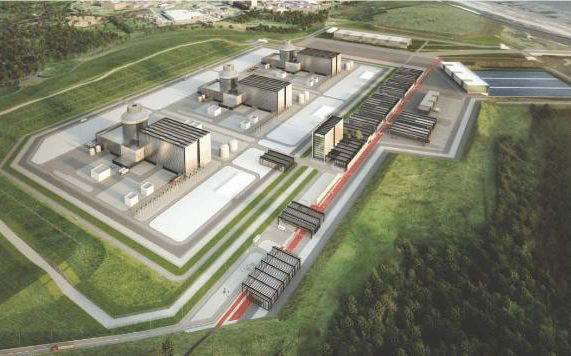 NucClear News No 87, 5 Aug 16 New Nuclear: Wylfa, Moorside, Sizewell and Bradwell. Horizon and NuGen are both insisting that their projects at Wylfa and Moorside are not dependent on EDF getting the go-ahead for Hinkley. But Industry experts have warned that confidence across the sector would be damaged if Theresa May pulls the plug, especially given the French energy giant has already invested £2.4bn in Hinkley with unstinting Government support until now. If Hinkley were cancelled without any reimbursement for EDF, this would “significantly undermine” other developers’ confidence and might prompt them to seek some sort of financial guarantee. (1)
Energy efficiency cheaper and more effective than Hinkley nuclear power
 Utilitywise champions merits of energy efficiency over Hinkley Point C http://www.decentralized-energy.com/articles/2016/08/utilitywise-champions-merits-of-energy-efficiency-over-hinkley-point-c.html, 03/08/2016, By Diarmaid Williams International Digital Editor
 Utilitywise, the independent utility, energy and water cost management consultancy says that implementing energy efficiency makes much more sense for the UK than developing Hinkley Point C nuclear power project.
The cost of implementing energy efficiency measures is estimated to be less than £6 billion, while the construction of the new nuclear plant Hinkley Point C is expected to cost around £18 billion.
The company’s strategy and innovation director Jon Ferris said the controversial nuclear power plant represented an “unnecessary expense,” believing better strategy in terms of technologies such as heating, for example, would be a better option.
“Consumers are increasingly looking at energy efficiency to reduce the impact of levies that are contributing more and more to the cost of electricity consumption.
“Not only can individual businesses make significant financial savings, but the UK could offset more than the expected output from Hinkley Point C by taking all the opportunities to save energy,” he said.
The consulting firm which carried out audits for around 200 UK businesses as part of the Energy Savings Opportunity Scheme (ESOS) found that more efficient lighting and heating improvements would reduce energy consumption by more than 460 GWh.
China not happy with Theresa May’s ‘unwanted accusations’ over Hinkley Point nuclear project
 China warns UK against ‘unwanted accusations’ over Hinkley Point Downing Street’s suspicions endanger ‘hard-won mutual trust’ between two countries, Beijing says. By Karthick Arvinth, IBT, August 2, 2016 China says it will not tolerate “unwanted accusations” over its investments in the UK after Theresa May’s government decided to review a controversial nuclear power project at the last minute.
A commentary published by the state-run Xinhua news agency on 1 August said Downing Street’s stance on Hinkley Point C risked damaging the “hard-won mutual trust” between the two countries fostered by Chinese President Xi Jinping’s state visit to Britain last year…
Xinhua warned that the “suspicious approach” towards China could deter other investors from investing in post-Brexit UK……..http://www.ibtimes.co.uk/china-warns-uk-against-unwanted-accusations-over-hinkley-point-1573739
1 This Month





PLEASE OPPOSE HR 8255 AND S.3639 – bills would accelerate satellite deployment, with no environmental review or safeguards – https://ncstd5li.quorum.us/campaign/169331/
To see nuclear-related stories in greater depth and intensity – go to https://nuclearinformation.wordpress.com
-
Archives
- October 2026 (49)
- September 2026 (339)
- August 2026 (330)
- July 2026 (355)
- June 2026 (287)
- May 2026 (306)
- April 2026 (356)
- March 2026 (251)
- February 2026 (267)
- January 2026 (308)
- December 2025 (358)
- November 2025 (359)
-
Categories
- 1
- 1 NUCLEAR ISSUES
- business and costs
- climate change
- culture and arts
- ENERGY
- environment
- health
- history
- indigenous issues
- Legal
- marketing of nuclear
- media
- opposition to nuclear
- PERSONAL STORIES
- politics
- politics international
- Religion and ethics
- safety
- secrets,lies and civil liberties
- spinbuster
- technology
- Uranium
- wastes
- weapons and war
- Women
- 2 WORLD
- ACTION
- AFRICA
- Atrocities
- AUSTRALIA
- Christina's notes
- Christina's themes
- culture and arts
- Events
- Fuk 2022
- Fuk 2023
- Fukushima 2017
- Fukushima 2018
- fukushima 2019
- Fukushima 2020
- Fukushima 2021
- general
- global warming
- Humour (God we need it)
- Nuclear
- RARE EARTHS
- Reference
- resources – print
- Resources -audiovicual
- Weekly Newsletter
- World
- World Nuclear
- YouTube
-
RSS
Entries RSS
Comments RSS

