Hinkley Point’s nuclear weapons connection
 Hinkley’s Hidden History , 18 Aug 2016 Morning Star
With the government decision over the new reactor at Hinkley postponed,  nuclear historian DAVID LOWRY reveals how the British nuclear power and weapons programmes were born together – and have yet to be separated THE first nuclear power plant on the Hinkley Point site in Somerset was built in the 1960s.
At the time, the United States, was intimately involved in the planning. Why was this?
The first public hint is to be found in a statement by the Ministry of Defence on June 17 1958 on “the production of plutonium suitable for weapons in the new [nuclear] power stations programme as an insurance against future defence needs” in Britain’s first-generation magnox reactor.
By chance, on the same day, France’s president Charles de Gaulle authorised a nuclear test to be held early the next year.
The site chosen was the Reganne oasis 700km south of Colomb Bechar in the Sahara Desert of Algeria.
France also used a magnox-style reactor at Chinon in the Loire Valley to make the plutonium explosives.
A week later in the British Parliament, Labour’s Roy Mason asked why the government had “decided to modify atomic power stations, primarily planned for peaceful purposes, to produce high-grade plutonium for war weapons” and “to what extent this will interfere with the atomic power programme?”
He was informed by paymaster general Reginald Maudling: “At the request of the government, the Central Electricity Generating Board has agreed to a small modification in the design of Hinkley Point and of the next two stations in its programme so as to enable plutonium suitable for military purposes to be extracted should the need arise…….
The headline story in the Bridgwater Mercury, serving the community around Hinkley was: “MILITARY PLUTONIUM To be manufactured at Hinkley.”
The article explained: “An ingenious method has been designed for changing the plant without reducing the output of electricity.”
The CND was reported to be critical, describing this as a “distressing step,” insisting: “The government is obsessed with a nuclear militarism which seems insane.”
Sadly, with the blinkered push to replace Trident today, not much seems to have changed in the 55 years since……
on July 3 1958, Britain and the US signed a detailed agreement on co-operation on nuclear weapons development, after several months of congressional hearings in Washington DC — but, significantly, with no oversight whatsoever in Parliament.
As this formed the basis, within a mere five years, for Britain obtaining the Polaris nuclear WMD system from the US, and some 20-odd years later for Britain to buy US Trident WMD, the failure of Parliament to at least appraise the security merits of this bilateral atomic arrangement was unconscionable……
Following further detailed negotiations, the Ango-American Mutual Defense Agreement on Atomic Energy matters (defence is spelled with an “s” even in the British version of the treaty, demonstrating the origin of the drafts), to give it its full treaty title, was amended on May 7 1959, to permit the exchange of nuclear explosive material for military purposes.
The Times science correspondent wrote on May 8 1959 under the headline: “Production of weapons at short notice” that “the most important technical fact behind the agreement is that of civil grade — such as will be produced in British civil nuclear power stations — can now be used in weapons.”……
And so it may be seen that Britain’s first civil nuclear programme was used as a source of nuclear explosive plutonium for the US military, with Hinkley Point A the prime provider.
Two decades later, Wales national daily, the Western Mail, reported on October 8 1984 that the largest magnox reactor in Britain, at Wylfa on Anglesey, had also been used to provide plutonium for the military.
Plutonium from both reactors went into the British military stockpile of nuclear explosives and could well still be part of the British Trident warhead stockpile today.
Subsequent research by the Scientists Against Nuclear Arms, published in the prestigious science weekly journal Nature, has demonstrated that around 6,700kg of plutonium was shipped to the US under the military exchange agreement, which stipulates explicitly that the material must be used for military purposes by the recipient country.
To put this quantity into context, a nuclear warhead contains around 5kg of plutonium so this is a very significant quantity.
What would Iran and North Korea make of this deliberate intermixing of civil and military nuclear programmes by one of the nuclear weapons superpowers which leads the criticisms of them for allegedly doing this very thing today?
Dr David Lowry is senior research fellow at the Institute for Resource and Security Studies, Cambridge, Massachusetts. http://www.morningstaronline.co.uk/a-dabf-Hinkleys-hidden-history#.V7dqoFt97Gg
Foreign companies depend on UK nuclear success for their global marketing drive
 The major hurdle for Horizon and NuGen is that they must sell their visions to global investors. Both developers say they will build their plants for less than the £18bn it will cost to build Hinkley Point, but they will not say by how much……
For Toshiba and Hitachi, building nuclear reactors in the UK represents a  chance to boost their reputations — and the image of nuclear power more generally around the world
Energy: Generating criticism Kiran Stacey, Energy Correspondent, Ft.com 18 Aug 16 The UK’s ambitious plans to build six nuclear plants are raising concerns that it is losing control over critical infrastructure
In a field in a remote part of north-west Wales, a lone farmer cuts the grass, parcelling it up into hay bales which can be sold for a modest profit. His farm, and even the hill on which it sits, will soon be demolished by the Japanese-owned company Horizon — ground zero in an ambitious scheme to build one of a string ofnuclear power stations across the UK.
Wylfa, on the island of Anglesey, is one of several sites designated for the plants, which could cost up to £100bn and, if all goes to plan, will replace the UK’s ageing coal power stations. But despite the billions of pounds about to be poured into nuclear energy in Britain, only some is likely to stay in the UK. Of the six plants being planned, none will be owned by a British company.
For nuclear power groups from France, China, the US and Japan, the UK’s ambitious plans represent a ripe opportunity in an otherwise difficult global market. Following the meltdowns at the Fukushima plant in Japan in 2011, several countries, including Japan and Germany, scaled back or cancelled their nuclear energy plans.
The lack of British participation in such a massive domestic programme has drawn opposition. Critics say the project represents yet another example of the country’s propensity to allow foreign companies and governments to profit from the UK’s most sensitive — and lucrative — infrastructure projects.
That critique appears to be shared by some in the UK government. When Theresa May, the prime minister, unexpectedly delayed the £18bn plant planned for Hinkley Point in south-west England, allies said it was over concerns about the involvement of two Chinese state-backed companies alongside France’s EDF, the state-backed utility. Some officials see the plant as a matter of national security, warning that the Chinese state could have the power to turn off a large chunk of Britain’s electricity supply.
Mrs May’s decision has caused consternation in Beijing, where officials had been reassured by the previous government’s unflagging support for the project. She will travel to China next month to steady bilateral relations, and is expected to make a decision over the project around the time of that trip…….
Made in Japan At Wylfa, the Hitachi branding on the cranes involved in initial groundworks give a signal of how integral the Japanese company, which owns Horizon, is to every stage of the process. The entire station will be built in Hitachi City in Japan before being shipped over, piece by piece, to north Wales. Horizon has submitted its design to regulators for approval, and will only make the final decision to go ahead after it has funding in place and made the necessary planning applications.
At Moorside, in the northern county of Cumbria, a company called NuGen is developing another site over the road from Sellafield power station. NuGen is a joint venture of Japan’s Toshiba and Engie, the French utility, whose biggest shareholder is the French state. Its reactor has been designed by Westinghouse, the US industrial company, most of which is owned by Toshiba.
If Mrs May is worried about the Chinese being able to shut down Hinkley Point, she might be even more concerned with the plans of EDF, China General Nuclear Power and China National Nuclear Corp in eastern England. After the consortium develops another plant at Sizewell, in Suffolk, the Chinese groups are hoping to design and build the plant at Bradwell in Essex……..
One of the main motivations for EDF’s Chinese partners to invest in the UK is the stamp of quality they would gain as they market their Hualong One design internationally.
“With both the government and public opinion in favour of nuclear power, Britain is a very attractive market for building new nuclear plants,” a spokesman for Hitachi says.
The major hurdle for Horizon and NuGen is that they must sell their visions to global investors. Both developers say they will build their plants for less than the £18bn it will cost to build Hinkley Point, but they will not say by how much……
For Toshiba and Hitachi, building nuclear reactors in the UK represents a chance to boost their reputations — and the image of nuclear power more generally around the world…….. http://www.ft.com/cms/s/0/8135630a-5a5d-11e6-9f70-badea1b336d4.html#axzz4HoS1C8dw
UK’s Crown Estate recommends UK switching attention from nuclear power to offshore wind

 Hinkley C’s future is in doubt. Let’s turn our sights to offshore wind
Falling costs and increased reliability mean this clean power now offers a mature part of the solution for the UK’s energy mix Guardian 15 Aug 16 Huub den Rooijen Director of energy, minerals and infrastructure at Crown Estate
With the government re-examining the case for new nuclear reactors at Hinkley Point, it’s a good time to reflect on recent breakthroughs in another low carbon technology: offshore wind.
Offshore wind is already meeting about 5% of the UK’s electricity demand, more than any other country globally, and is on course to meet 10% by 2020. The sector has undergone a sea change over the last few years, driven by rapid advances in technology, cost, and industry’s ability to deliver on time and to budget.
In fact, over the last three years, construction costs have come down by more than 40% in the UK alone. And by 2025, industry and government expect UK prices to be comparable with new gas generation at about £85 per megawatt hour (MWh).
In the Netherlands, there has been an even bigger step change. Although there are differences in terms of regulation, most would agree that after a recent offshore wind tender the Dutch are now going to be paying the equivalent of about £80 per MWh for their 700MW windfarm. That is significantly lower than Hinkley Point C at £92.50per MWh.
As active managers of the UK seabed, including awarding leases for offshore wind, we take a keen interest in this result. After all, the Dutch windfarm is only about 75 miles away from UK waters, and has very similar conditions like water depth, wind speeds, and distances to ports. If costs can be slashed in the Netherlands, geography tells us they can be slashed here too……..
As the Committee on Climate Change urges government to consider alternatives if there are delays to renewing our nuclear fleet, we should remember our seabed is a powerful energy asset.
At present, we have 2,200 wind turbines in operation and under construction, taking up less than 1% of our total seabed. National Grid estimates that nearly half of all power could be generated from our seabed by 2030 through offshore wind, combined with tidal power lagoons and strong electrical connections to our neighbouring countries.
We have an inexhaustible supply of reliable and clean power right on our doorstep, and competitively priced offshore wind now offers a mature part of the solution for the UK’s energy mix. https://www.theguardian.com/environment/2016/aug/14/hinkley-cs-future-is-in-doubt-lets-turn-our-sights-to-offshore-wind
World’s biggest offshore windfarm on track in UK
Second phase of world’s biggest offshore windfarm gets go-ahead Multibillion-pound Hornsea Project Two, 55 miles off Grimsby coast, would see 300 turbines span an area five times size of Hull, Guardian, Josh Halliday, 16 Aug 16, Plans for the world’s biggest offshore windfarm off the Yorkshire coast are to be expanded to an area five times the size of Hull after being approved by ministers.
The multibillion-pound Hornsea Project Two would see 300 turbines – each taller than the Gherkin – span more than 480 sq km in the North Sea.
Fifty-five miles off the coast of Grimsby, the project by Denmark’s Dong Energy is expected to deliver 1,800MW of low-CO2 electricity to 1.8m UK homes. The development would represent a large boost to the UK’s wind energy industry, with Dong Energy pledging to invest £6bn in the UK and create more than 2,500 jobs……https://www.theguardian.com/environment/2016/aug/16/hornsea-project-two-windfarm-second-phase-grimsby
With Hinkley Big Nuclear in decline, the “Small Nuclear” lobby sees its chance
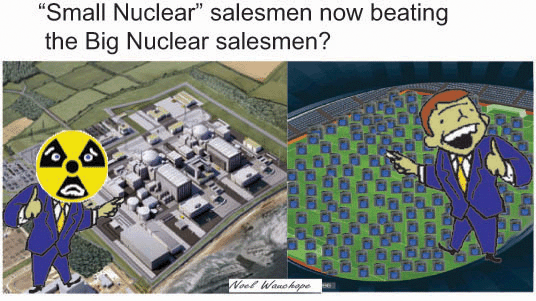
Hinkley Point may be taking all the attention at present, but it is not the be all and end all of nuclear power in the UK. There is plenty more in the pipeline so, whatever happens in Somerset, progress can be made elsewhere. The UK’s Office for Nuclear Regulation aims to complete Generic Design Assessments for new reactors, the AP1000 and Advanced Boiling Water Reactor (ABWR), during 2017.
NuGen, jointly owned by Japan’s Toshiba and France’s Engie, is progressing with plans to build an AP1000 at Moorside in West Cumbria. At present, they are carrying out site assessment surveys, including geophysical surveys, geological age dating and some borehole drilling work, which must be completed before construction can begin. AP1000 reactors, designed by Westinghouse, are being planned in multiple countries worldwide, with the first plants scheduled to come online in China this year. There have been some delays on these world-first reactors, but not as serious as those in France and Finland for the European Pressurised Reactor (EPR) proposed for Hinkley…….
In addition to these planned sites, there is also ongoing research and development into the next generation of advanced nuclear reactors. The Government promised, in Autumn 2015, an investment of £250 million over 5 years to develop the reactors of the future. This includes a competition to decide which small modular reactor or reactors should be demonstrated in the UK. Advanced reactors have the potential to be cheaper, even cleaner and even safer than current designs, and have added benefits such as the potential ability to use up spent fuel and the plutonium stockpile. (Weinberg Next Nuclear will soon be publishing a report on how to manage plutonium)….http://www.the-weinberg-foundation.org/2016/08/11/dont-worry-british-nuclear-doesnt-have-all-its-eggs-in-one-basket/
Queen Elizabeth’s Estate notes that renewable energy is cheaper than Hinkley nuclear
Crown estate wades into Hinkley Point nuclear debate https://www.theguardian.com/environment/2016/aug/14/crown-estate-hinkley-point-nuclear-debate
Body says, with government reviewing £18.5bn project, benefits of renewables such as offshore wind should be looked at, Guardian, Terry Macalister, 14 Aug 16, The crown estate has waded into the battle over Hinkley Point, pointing out that offshore windfarms are already being built at cheaper prices than the proposed atomic reactors for Somerset.
While not arguing the £18.5bn nuclear project should be scrapped, the organisation – still legally owned by the Queen – said that the government’s current Hinkley review makes it a good time to consider the advantages of other low carbon technologies.
The crown estate said that windfarms at sea will be on course to meet 10% of the country’s electricity by 2020 while Hinkley Point C is not expected to be constructed till the mid 2020s, to produce 7%.
“The [wind] sector has undergone a sea change over the last few years, driven by rapid advances in technology, cost and the industry’s ability to deliver on time and to budget,” said Huub den Rooijen, the director of energy, minerals and infrastructure at the crown estate.
“In the Netherlands, there has been an even bigger step change. In the busy time around the EU referendum, many people will have missed the publication of their most recent offshore wind tender.
“Although there are differences in terms of regulation, most would agree that the Dutch are now going to be paying the equivalent of about £80/MWh for their 700 megawatt windfarm. That is significantly lower than Hinkley Point at £92.50/MWh.”
The comments come after an unpublished report by the energy department shows that it expects onshore wind power and large-scale solar to cost about £50-£75 per megawatt hour of power generated in 2025. New nuclear is anticipated to be around £85-£125/MWh, in line with the guaranteed price of £92.50/MWh that the government has offered Hinkley’s developer, EDF.
Government data published last Thursday showed that renewables generated a quarter of the UK’s electricity in the first quarter of this year. About half of that came from on and offshore wind combined.
The Hinkley project has been hit by controversies since it was first raised as a possibility by EDF more than nine years ago. There have been delays and concerns about the costs of the £18.5bn project. In recent days a new row has blown upabout the wisdom of allowing EDF’s proposed Chinese partner access to the UK energy infrastructure for national security reasons.
Den Rooijen said the government’s committee on climate change has urged ministers to consider alternatives if there are delays to renewing our nuclear fleet. “We should remember our seabed is a powerful energy asset. At present, we have 2,200 wind turbines in operation and under construction taking up less than 1% of our total seabed,” he said.
“National Grid estimates that nearly half of all power could be generated from our seabed by 2030 through offshore wind, combined with tidal power lagoons and strong electrical connections to our neighbouring countries.
“We have an inexhaustible supply of reliable and clean power right on our doorstep, and competitively priced offshore wind now offers a mature part of the solution for the UK’s energy mix.”
Hinkley going down? Next glorious gimmick – Small Nuclear Reactors
UK set to continue developing baby nuclear reactors which may fuel Rolls-Royce jobs, This Is Money By NEIL CRAVEN, FINANCIAL MAIL ON SUNDAY, 14 August 2016 Britain is to forge ahead with plans to develop ‘baby’ nuclear reactors just two weeks after the Prime Minister threw energy policy into chaos by revealing there will be a shock delay to making a decision over Hinkley Point.
The announcement over whether to proceed with Hinkley in Somerset has been postponed until next month.
That allows new Premier Theresa May more time to consider concerns relating to the cost of the £25billion project and potential security risks posed by Chinese involvement.
This weekend the Government revealed it will shortly select preferred partners to construct Small Modular Reactors – which could help provide an alternative to Hinkley. They would be built using British factories and participation and could boost UK firms including Rolls-Royce.
Whitehall sources said the project, currently involving 33 engineering groups, would reaffirm Britain’s determination to be a ‘world leader’ in SMR production.
It is not yet clear whether the decision to develop the ‘baby’ reactors is linked to the Hinkley delay.
The Government has already earmarked £250 million to fund a five-year programme to develop SMRs and this autumn it is expected to announce the next phase including naming the lead companies to be involved.
Hinkley supporters fear an announcement could be timed to coincide with a final decision on Hinkley, drawing the sting if the Government decides to cancel the larger project……http://www.thisismoney.co.uk/money/markets/article-3739075/UK-set-continue-developing-baby-nuclear-reactors-fuel-Rolls-Royce-jobs.html
France’s ruling socialist party calls for freeze on Hinkley Point nuclear development

 Hinkley Point near melt-down as French socialist party calls for freeze, Telegraph, Ambrose Evans-Pritchard 9 AUGUST 2016 Britain’s Hinkley Point nuclear project is close to unravelling after France’s ruling socialist party threw its support behind dissident trade union leaders and called for a fundamental review of the high-cost venture.
The whole saga has now become freighted with politics and misunderstandings in a three-way jostle between France, Britain, and China, with no outcome in sight that can please everybody.
The French socialists warned that Hinkley threatens the financial viability of EDF, the state-owned energy giant 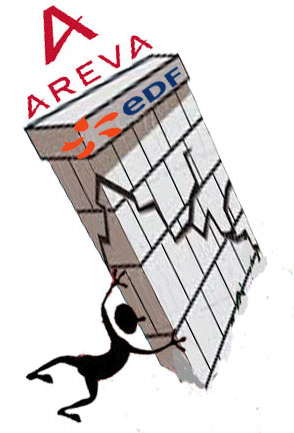 responsible for two thirds of the £18bn funding and for limitless liabilities if it all goes wrong.
“The socialist party judges that a project of such importance, that involves the solidity and survival of the national energy group, makes it imperative to ask every question and raise every reserve before going any further,” it said.
It endorsed a furious complaint by the six trade union members on the EDF board, who said the final go-ahead for the project was rammed through in late July without full disclosure in a “governance scandal”, and that the decision is now “null and void”.
Brexit has further changed the landscape and brought matters to a head. “The whole relationship with Britain, whether political or economic, must be reviewed in light of its withdrawal from the EU, and a project as important as Hinkley Point cannot reasonably be exempted,” said the party………
Nuclear power cannot easily be switched on and off. It is ill-adapted for use as a back-up source to cover lulls in renewable power. “In a world moving towards cheaper, flexible, decentralized power systems, investing in eye-wateringly expensive, always-on ‘base-load’ plants increasingly looks like a 20th Century solution for a 21stCentury problem,” said Richard Black from the Energy and Climate Intelligence Unit.
If the chief reason for continuing the project is to preserve good relations with France and China, the whole story is a textbook example of why it is hazardous to strike commercial deals with foreign state-owned companies. http://www.telegraph.co.uk/business/2016/08/09/hinkley-point-near-melt-down-as-french-socialist-party-calls-for/
Theresa May is advised that now is the time to get out of Hinkley nuclear project.
 Hinkley Point: May told to pull the plug on nuclear project over China spying accusations THERESA MAY is being urged to quit the controversial Hinkley Point C project over Chinese spying allegations. Express By ZOIE O’BRIEN, Aug 11, 2016 A scandal has broken out in the US suggesting a Chinese man was attempting to recruit US atomic experts to steal technology secrets to help China’s nuclear power programme.
But the legal papers include the name of China General Nuclear Power (CGN), which holds a stake in the UK’s planned new nuclear power station – Hinkley Point C.
Szuhsiung Ho, a senior adviser to CGN, will appear in court next week to face charges. As a result the Prime Minister is being urged to pull the British project immediately.
May paused development last month over national security fears but now she is being told to scrap plans altogether.
Paul Dorfman, a senior research fellow at University College London, said the British prime minister does not have to offend the Chinese. He suggested she could blame poor reactor technology from France’s EDF.
He told the Guardian: “No other OECD country would let China into its critical nuclear infrastructure, given its history of nuclear weapon proliferation. May has already taken the diplomatic ‘hit’ for this, so what’s she got to lose?
“If government wanted to, it could avoid taking China to task on this by reframing the problem in the context of the failed French EPR reactor, which is three times over-cost and over-time where it’s being built in Finland and France.”
The Somerset power station has already caused huge debate with petitions and campaigns being launched to prevent its being built.
Now, spying allegations have caused huge concern in the UK. Angus MacNeil MP, the chair of the energy and climate change select committee, said there are now grave concerns about corporate integrity and must form a key part of the government’s current review of Hinkley.
He said: “I am not sure the Chinese have anything to steal from Britain in the way of nuclear secrets. That is after all why they are being brought in, but it does raise questions about how honourable the company is and whether it could cut corners on construction methods and issues like that.”……..http://www.express.co.uk/news/uk/698965/Hinkley-Point-May-China-spy-fears-Somerset-project
Time to pull the plug on unaffordable Hinkley Point nuclear power project
 UK must pull the plug on the exorbitant Hinkley Point nuclear power project Do we submit to blackmail or do we risk losing Chinese trade? IBT, By Michael Toner , 11 Aug 16, “…..Today we’re witnessing a folly so shambolic, so expensive, so eye-poppingly spectacular that it puts all others in the shade. It goes by the name of Hinkley Point, the proposed new nuclear power station in Somerset. And it’s the misbegotten creation of our entire political establishment, with Labour, Lib-Dem and Tory MPs all complicit.
One of the few politicians who emerges with some credit from this unfolding disaster is our new Prime Minister Theresa May, who stunned everybody when immediately on entering Downing Street she refused to rubber-stamp the deal and instead ordered a review of the whole project. As we shall see, her reasons for delaying a decision were eminently sensible.
But what howls of anguish it has provoked. The French-owned energy company EDF, which will build Hinkley Point, is appalled. President Hollande’s government makes no secret of its displeasure. And now China, which is providing billions to finance the project, is weighing in with threats of dire consequences for Britain if the deal doesn’t go ahead.
August 9, 2016……It’s time to examine how we ever came to be in this mess. And for that we must go back to the last Labour Government and an Energy Secretary named Ed Miliband. Remember him?………
, it enthused the then Energy Secretary Ed Davey of the Lib Dems, “For the first time, a nuclear power station in this country will not have been built with money from the British taxpayer. This is an excellent deal for Britain and British consumers”.
Oh dear. Let’s examine the details of Mr Davey’s “excellent” deal……
then there’s the eye-watering expense of this scheme. Hinkley Point will cost at least £18billion and will probably end up costing much more. The sums are so huge that ministers could only persuade EDF to accept such a burden by allowing it to charge sky-high prices for the electricity it produces. British consumers will end up paying for the world’s most expensive electricity for decades.
And for what? The plant won’t be built for at least another eight years, even if everything goes to plan – a big “if”, given the record so far. And if ever it eventually runs at full capacity, it would provide power only for six million homes – a pitiful return for such a huge and risky investment.
Theresa May has every right to re-examine this whole misconceived project. And given the reaction of the Chinese ambassador, wouldn’t the rest of us be equally right to re-examine the wisdom of sucking up to the bullies of Beijing? http://www.ibtimes.co.uk/uk-must-pull-plug-exorbitant-hinkley-point-nuclear-power-project-1575151
UK’s £31 billion Trident submarines programme on the skids
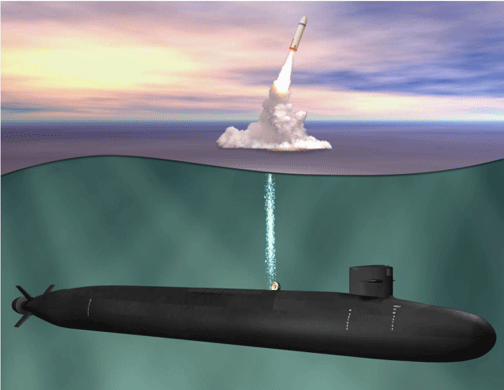 Trident plans ‘in doubt’, says government watchdog, The Ferret, Rob Edwards on August 8, 2016 The UK’s £31 billion programme to replace Trident submarines in on the skids, according to a high-level government spending watchdog.
A report by the Infrastructure and Projects Authority (IPA) to the Treasury and Cabinet Office has warned that the plan to build four new nuclear weapons submarines for the Clyde is “in doubt”.
This is despite the overwhelming vote in the House of Commons last month in favour of replacing Trident. The plan was opposed by every Scottish MP, except for the lone Tory, David Mundell.
The poor assessment of the Trident programme’s prospects was buried in a report about 143 projects published online by the IPA several days before the vote at Westminster. It gave the submarine successor programme its second worst rating of “amber/red”.
This means that the project is judged to be running into serious difficulties because of cost overruns, management problems and technical issues. “Successful delivery of the project is in doubt, with major risks or issues apparent in a number of key areas,” said the IPA.
“Urgent action is needed to address these problems and/or assess whether resolution is feasible.”
According to critics, costs have already risen by between £15 and £20 billion. The planned date for bringing the submarines into service has been delayed from 2024 to the “early 2030s”……….https://theferret.scot/trident-doubt-government-watchdog/
UK government’s own projections find solar and wind ‘cheaper than new nuclear’
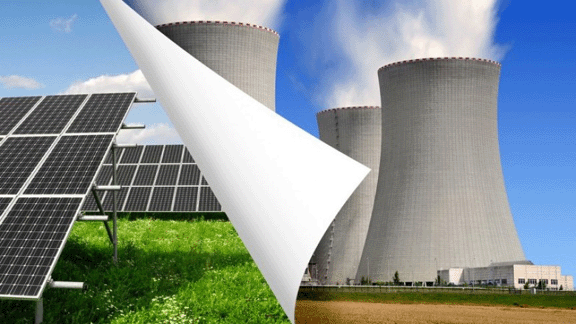 Solar and wind ‘cheaper than new nuclear’ by the time Hinkley is built https://www.theguardian.com/environment/2016/aug/11/solar-and-wind-cheaper-than-new-nuclear-by-the-time-hinkley-is-built
UK government’s own projections expect onshore wind power and large-scale solar to cost less per megawatt hour than new nuclear by 2025, Guardian, Adam Vaughan, 11 Aug 16, The government expects solar and wind power to be cheaper than new nuclear power by the time Hinkley Point C is completed, its own projections show.
Theresa May’s government last month made a surprise decision to delay a deal on Hinkley, prompting a renewed look at what alternatives could power Britain if ministers this autumn fail to back new reactors in Somerset.
An unpublished report by the energy department shows that it expects onshore wind power and large-scale solar to cost around £50-75 per megawatt hour of power generated in 2025. New nuclear is anticipated to be around £85-125/MWh, in line with the guaranteed price of £92.50/MWh that the government has offered Hinkley’s developer, EDF.
The NAO cited the forecasts as coming from the energy department in March 2016. The department said the NAO had been provided with an early draft of its report, and the full version would be published soon.
Niall Stuart, chief executive of the trade body Scottish Renewables, said: “These numbers speak for themselves: onshore wind and solar will be significantly better value than all other large scale sources of power in the UK by 2025.
“It is time to start backing the two technologies to deliver the clean power we need to hit our climate change targets and the cheap electricity required to keep bills down for consumers.”
Molly Scott Cato, a Green party MEP, said: “These latest figures confirm what many of us have been saying for years: that the Hinkley project is a dud.
“The cost of renewables is tumbling and Hinkley will become a giant white elephant as it struggles to compete with cheaper renewable options. Research has shown that solar power would be a less costly way of generating the equivalent amount of power, and now the government’s own projections show that onshore wind too will be cheaper than nuclear by the time Hinkley is built.”
Since coming to power in May 2015, the government ended onshore wind subsidies and allowed communities to veto turbines near them, as well as axing and cutting various subsidies for solar.
Government data published on Thursday showed that renewables generated 25.1% of the UK’s electricity in the first quarter of this year. Around half of that came from on and offshore wind combined.
Offshore wind is cheaper and safer than Hinkley Point
Winds of spare change, Breaking Views, 8 August 2016 By Olaf Storbeck Theresa May should look to Denmark instead of France to secure Britain’s future energy needs. ……As things stand, the UK is proposing to guarantee French state-controlled utility EDF a minimum price of 92.50 pounds for each megawatt-hour of electricity produced at the 18-billion-pound Hinkley Point project. Back in 2013, when the deal was struck, offshore wind was almost 50 percent more pricey.
Wind technology’s costs have plummeted since then. The latest generation of wind farms on the ocean is producing electricity for less than 85 pounds per megawatt hour rather than 130 pounds, new data from state-controlled Danish utility DONG Energy shows. Bigger and more efficient turbines contribute, as well as improvements in construction and grid connection.
This progress, which is faster than even DONG expected, is undermining the economic case for Hinkley Point. Offshore wind is already 8 percent cheaper. And the gap is likely to widen, as the industry continues to be on a steep learning curve, while construction costs for nuclear plants have a notorious tendency to creep upwards.
Renewable energy’s usual issue is intermittency. But offshore wind out at sea is strong and steady, so turbines generate power 98 percent of the time. Replacing Hinkley Point’s planned capacity of 3.2 gigawatts with offshore wind would admittedly require building wind parks of twice that size – offshore turbines on average deliver only around half of their nominal capacity. But as there is no shortage in potential locations for offshore wind farms, such a large scale ramp-up is technologically possible.
Offshore wind is not just cheaper, but also less risky than Hinkley Point. Wind parks usually go on the grid within four years, compared to at least a decade for planned nuclear plants. Similar reactors in Finland and France are dogged by a tripling of costs and years of delay. And the UK taxpayer would have to pay the nuclear subsidies over 35 years, while those for wind farms usually run less than half that long.
That’s before the wind turbines’ other obvious benefit: they don’t leave toxic radioactive waste behind. If May wants to pull the plug on Hinkley Point, she has a ready-made case. https://www.breakingviews.com/considered-view/cheap-wind-energy-can-deal-final-blow-to-hinkley/
Many decades after closure, UK’s Dounreay Fast Reactor is still dangerously radioactive
Coolant removed from Dounreay Fast Reactor, WNN 05 August 2016 A ten-year process to remove 68 tonnes of highly-radioactive liquid metal coolant from the primary circuit of the UK’s Dounreay Fast Reactor (DFR) has now been completed, marking a major milestone in its decommissioning.
Dounreay’s experimental fast breeder reactor, housed inside a steel sphere, led British nuclear R&D during the 1950s and 60s. It became the world’s first fast reactor to provide electricity to a national grid in 1962…..Dounreay Site Restoration Limited (DSRL) announced today that some 68 tonnes of the liquid metal coolant – a blend of sodium and potassium called NaK – have been removed from the primary circuit of the DFR and destroyed over a ten-year period.

Most of the NaK had been removed by 2012, since when work has been under way to remove the last of the coolant from the difficult to access pipework and base of the structure…….
DSRL said the destruction of the DFR’s liquid metal coolant has removed “one of the highest hazards remaining in the Nuclear Decommissioning Authority (NDA) estate”.
NDA chief operating officer Pete Lutwyche said, “The difficulty of this task can’t be understated, and I welcome the news that this work is complete. Everyone involved should be proud of their achievement.”
The focus of decommissioning work at the DFR will now be the removal of some 1000 breeder elements that remain in the reactor vessel, DSRL said. This must be completed before cleaning and removal of the reactor and its nine kilometres of cooling pipework. http://www.world-nuclear-news.org/WR-Coolant-removed-from-Dounreay-Fast-Reactor-0508164.html
China keen to market its nuclear reactors to UK, warns Britain not to dump Hinkley

That’s not sitting well with China.
“Right now, the China-U.K. relationship is at a crucial historical juncture,” China’s ambassador to Britain, Liu Xiaoming, wrote in an article for the Financial Times.
“I hope the U.K. will keep its door open to China and that the British government will continue to support Hinkley Point — and come to a decision as soon as possible so that the project can proceed smoothly,” he added.His warning comes at a delicate time for the U.K. economy. The Bank of England last week forecast lost growth and higher unemployment as it cut interest rates in response to the decision to leave the European Union.
Having thrown the future of its relationship with its biggest trading partner up in the air, Britain is looking to boost trade and investment ties with the rest of the world.
Liu pointed out in his article that Chinese companies have invested more in the U.K. over the past five years than in France, Germany and Italy combined. China also accounted for just over 3% of U.K. exports last year.
Under the deal announced in October, China General Nuclear Power Corporation (CGN) would have a 33.5% stake in the power plant. France’s EDF (ECIFY) will hold the rest.
The bigger prize for China, though, is a related deal to build another nuclear power plant some 60 miles northeast of London, using its own reactor technology. It would have 66.5% of that venture.
May hasn’t given much away about her reasons for delaying the decision on Hinkley Point.
But the deal was controversial from the start, with critics warning that giving China access to vital infrastructure could compromise national security. The plan has also come under fire for guaranteeing an electricity price way above market levels……… http://money.cnn.com/2016/08/09/news/companies/china-uk-nuclear-power-plant-hinkley/
1 This Month





PLEASE OPPOSE HR 8255 AND S.3639 – bills would accelerate satellite deployment, with no environmental review or safeguards – https://ncstd5li.quorum.us/campaign/169331/
To see nuclear-related stories in greater depth and intensity – go to https://nuclearinformation.wordpress.com
-
Archives
- October 2026 (49)
- September 2026 (339)
- August 2026 (330)
- July 2026 (355)
- June 2026 (287)
- May 2026 (306)
- April 2026 (356)
- March 2026 (251)
- February 2026 (267)
- January 2026 (308)
- December 2025 (358)
- November 2025 (359)
-
Categories
- 1
- 1 NUCLEAR ISSUES
- business and costs
- climate change
- culture and arts
- ENERGY
- environment
- health
- history
- indigenous issues
- Legal
- marketing of nuclear
- media
- opposition to nuclear
- PERSONAL STORIES
- politics
- politics international
- Religion and ethics
- safety
- secrets,lies and civil liberties
- spinbuster
- technology
- Uranium
- wastes
- weapons and war
- Women
- 2 WORLD
- ACTION
- AFRICA
- Atrocities
- AUSTRALIA
- Christina's notes
- Christina's themes
- culture and arts
- Events
- Fuk 2022
- Fuk 2023
- Fukushima 2017
- Fukushima 2018
- fukushima 2019
- Fukushima 2020
- Fukushima 2021
- general
- global warming
- Humour (God we need it)
- Nuclear
- RARE EARTHS
- Reference
- resources – print
- Resources -audiovicual
- Weekly Newsletter
- World
- World Nuclear
- YouTube
-
RSS
Entries RSS
Comments RSS

