At G20, British PM Theresa May confirms that UK is reviewingHinkley nuclear project
G20 Summit: May confirms Hinkley nuclear power station security being reviewed It comes on the eve of a crucial bilateral meeting with Chinese President Xi Jinping, Independent Joe Watts and Ted Jeory Political Editor
 Theresa May has confirmed that her officials are reviewing security around the Hinkley nuclear project in which the Chinese government is involved.
The Prime Minister signalled while speaking at the G20 Summit in Hangzhou that security would be a component in work to review the Hinkley scheme. It comes as Mrs May prepares for her first meeting with President Xi Jinping of China, and just hours after she failed to answer a direct question on whether she trusted the Chinese government.
A full withdrawal from the project could spark a major diplomatic row, severly damaging the “golden era” relations with China that Mrs May claims she wants.
The Independent has already reported how Mrs May’s officals were said to be looking for a way out of the deal. ……http://www.independent.co.uk/news/uk/politics/g20-theresa-may-xi-jinping-hinkley-nuclear-security-review-a7224786.html
Great danger in air transport of nuclear wastes: anger in Aberdeen
 Fury over “dangerous” nuclear flights from the Highlands to US, Aberdeen Press and Journal 2 September 2016 by Iain Ramage Road around Wick Airport will be regularly shut over the next 18 months so nuclear waste can be taken be flown to the US. Plans to transport highly enriched uranium (HEU) from Dounreay in Caithness to the US emerged late last year.

Politicians and activists have condemned the move, warning that flying the material is excessively dangerous.
The Nuclear Decommissioning Authority (NDA) has remained silent on the issue, but an £18million upgrade of the airport was recently carried out to make it suitable for larger planes.
And, now Highland Council has published a road closure order which reveals minor routes around the airport will be closed over the coming months. The closures could happen at any time from today, and will last up to five hours each time.
A spokeswoman at Dounreay said she could neither confirm nor deny that nuclear waste from the redundant power station would be flown from Wick.
Former Prime Minister David Cameron confirmed earlier this year, after talks with President Obama, that it was the UK’s intention to transport uranium from Dounreay to the South Carolina. It will be swapped for other forms of uranium to be shipped to Europe which, it is believed, will be used in producing medical isotopes.
Caithness, Sutherland and Easter Ross SNP MP Paul Monaghan has described the deal to transport the waste by plane “morally reprehensible”. And Highlands and Islands Green MSP John Finnie last night said many people would be surprised to find out about the road closures – but that the disruption was nothing compared to the risks involved with flying the waste.
“Many will be astonished that it is considered appropriate to move, let alone fly, this waste material from Dounreay,” he said. “The local disruption is nothing compared to the risks any transit poses. This waste should be retained at Dounreay.”
The council’s local area leader Gillian Coghill said: “We were not briefed about this, which is absolutely shocking……….
Independent nuclear consultant John Large raised concerns about the transport of the material. He said if there was an accident it would involve an extremely vulnerable and potentially radiologically significant material. “The radiological consequences of even a relatively small amount of this material would be very serious,” he said.
“In terms of nuclear safety, the International Atomic Energy Agency recognises that the transportation of radioactive materials is the one at most risk and is most prone and vulnerable to terrorist attack.
“The risk in transport by aircraft is the fuel being engulfed in fire, the packages breaking down and the fuel igniting.”
Mr Large added that it was incumbent on Dounreay to provide sufficient information for the public to come to an informed judgement about the move. “It doesn’t matter whether the material is for civil or military stock, it presents the same risk,” he said. https://www.pressandjournal.co.uk/fp/news/highlands/1014760/fury-over-nuclear-flights/
Missing firearm among 130 security breaches at nuclear sites
 The Civil Nuclear Constabulary (CNC) experienced 130 security breaches since 2011, Freedom of Information data has revealed, Police Professional 2 Sep 16
Of these, two were classed as high-risk and two more as medium-risk. The most serious incident saw an unloaded handgun go missing from the National Shooting Centre in Surrey in July 2012. The case was reported to Surrey Police, but it was never confirmed whether the weapon was lost or stolen.
In the other high-risk incident, confidential information was texted to an officer at Sellafield nuclear site. The two medium-risk breaches involved gate access keys for Hinkley point in Somerset being lost, and a force camera being stolen in 2012. The remaining incidents mostly comprised the loss of documents and windows being left open……..http://www.policeprofessional.com/news.aspx?id=27041
Britain’s Greens uncompromisingly oppose nuclear power and fracking
 Caroline Lucas: No compromise on fracking or nuclear http://www.bbc.com/news/uk-politics-37257618, 3 Sept 16, The Green Party has elected two leaders in a job-sharing arrangement they describe as a “first in Westminster politics”.
Caroline Lucas, the former leader and the party’s sole MP, will be co-leader with Jonathan Bartley, its work and pensions spokesman.
Ms Lucas got big cheers from members at the party’s conference in Birmingham when she discussed climate change and promised to oppose nuclear power and fracking.
England’s Tories are still pro nuclear enthusiasts
‘We’re still backing nuclear’ – New Energy Minister’s pledge 2 September 2016 THE new Energy Minister has underlined the Government’s commitment to nuclear energy, boosting hopes of a new power plant in west Cumbria.
Baroness Lucy Neville-Rolfe was making her first visit to Sellafield following her appointment as Energy Minister in July.
One of the first actions of Theresa May’s new administration was to delay a decision on a nuclear power station at Hinkley Point in Somerset.
The surprise announcement cast doubt on NuGen’s plans to build three nuclear reactors at Moorside, Sellafield.
But Baroness Neville-Rolfe made it clear that the Government remains committed to nuclear in principle, whatever reservations there may be about the Hinkley Point project……. ““Nuclear energy is clean and it doesn’t have the problems around discontinuity of supply that you see with wind power for example.” “Nuclear power plants are costly to build but they last for 60 years”……http://www.nwemail.co.uk/Were-still-backing-nuclear-New-Energy-Ministers-pledge-c794da03-6d39-49d3-b834-9547935d57c8-ds
UK plans nuclear reactors of 3 different types – a recipe for failure
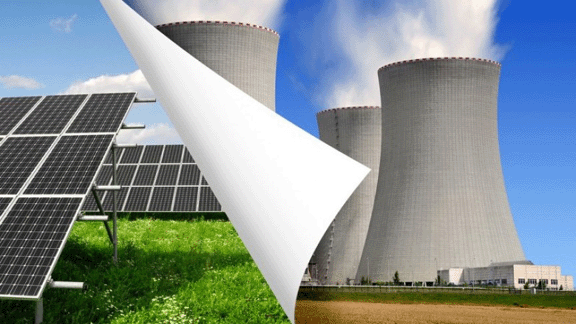 The special treatment the UK is granting to nuclear projects fails to take account of the fact that
 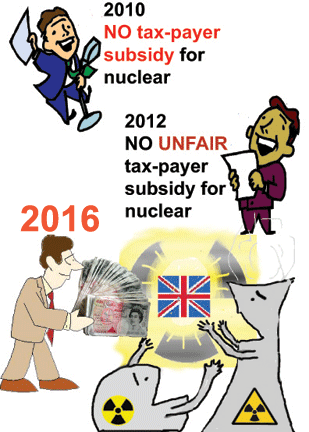 energy markets are undergoing a period of rapid change, “a revolution, not an evolution,” Schneider said. Electricity generation is going in the direction of ever smaller, more decentralized equipment like rooftop solar, integrated horizontally in networks. Nuclear, in Schneider’s view, represents an out-dated, over-priced paradigm of centralized power generation and distribution
Puzzling path to new UK nuclear power stations, DW, 2 Sep 16 The UK plans to build several new nuclear reactors – of three different types, oddly, including a Franco-German design that has gone radically over-budget elsewhere. That’s a recipe for high costs, critics say. Over the past several years, a number of companies have put forth applications to build new nuclear reactors in the UK. But none have started construction, and now, there’s some doubt whether any of them will go forward. Continue reading
UK PM Theresa May to be pressured at G20, by China, to approve Hinkley nuclear power project
 G20: China expected to press Theresa May on Hinkley nuclear plant As PM prepares to meet Xi Jinping at summit, officials have reportedly raised issue of delayed power station, Guardian, Rowena Mason, Tom Phillips, 2 Sep 16, Theresa May is expected to come under pressure from China at the G20 summit over her decision to review the proposed Hinkley nuclear plant, after the issue was raised by Beijing in a meeting with the British energy minister.
The new British prime minister will have her first face-to-face meeting with Xi Jinping, the Chinese premier, at the summit on Sunday or Monday, amid continuing tensions over Hinkley Point in Somerset.
May angered Beijing by deciding in July that approval of the French- and Chinese-backed £18bn nuclear plant would be delayed, apparently as a result of security concerns over Chinese involvement.
The Chinese government has been publicly making its clear it wants the project to go ahead, but May and her ministers have stuck to the position that the government is “considering all the component parts of the project before making its decision in the early autumn”.
It is understood Chinese officials raised the issue of Hinkley last week when Baroness Lucy Neville-Rolfe, the new energy and intellectual property minister, made a low-profile trip to China. The Chinese National Energy Administration said on its website that Neville-Rolfe met one of its top officials in Beijing to discuss Hinkley Point……..
anti-nuclear groups urged the prime minister to stand firm against Chinese and French lobbying for the Hinkley Point power station to go ahead.
John Sauven, executive director of Greenpeace UK, said May had a “delicate diplomatic job awaiting her at the G20, and she will no doubt come under renewed pressure to give Hinkley the go-ahead.”
“But the prime minister has shown before that she won’t be bullied into signing up to a deal that doesn’t serve the interests of the British public,” he added…….. https://www.theguardian.com/uk-news/2016/sep/01/g20-china-expected-press-theresa-may-hinkley-nuclear-plant
Nuclear safety breaches in UK raise problems about China’s involvenment
Nuclear Plants Had 21 Breaches Last Year And Officials Are Looking At China http://dailycaller.com/2016/08/29/nuclear-plants-had-21-breaches-last-year-and-officials-are-looking-at-china/ ANDREW FOLLETT Britain’s nuclear power plants had 21 security breaches last year and experts suspect that China might be involved, U.K. police announced Monday.
The Civil Nuclear Constabulary, which is in charge of security at nuclear plants, found 13 cases of identity cards and similar materials being lost or stolen at the plants that could be used to grant access to one of the country’s eleven nuclear reactors. In one case, armory access codes were accidentally emailed to unauthorized personnel.
“It sets alarm bells ringing that so many security failures could have happened at a time when there are plans to expand the UK nuclear industry,” Dr. David Lowry, a research fellow at the US Institute for Resource and Security Studies, told The Ferret.
The Ferret obtained a document detailing each of the 21 nuclear plant security breaches in 2015. The documents shows the number of security breaches has substantially risen from only 13 last year, and some are worried that some of the breaches may have been a result of espionage. Eight of the security breaches, however, were actually caused by the police themselves.
Despite the espionage concerns, a columnist for a Chinese state-run media outlet called Britain’s reluctance to approve Hinkley Point a result of “China-phobia.”
The Chinese pundit attacked May for delaying the approval of the Hinkley Point nuclear power project — one third of which will be paid for by the state-owned China General Nuclear Power. May’s decision came after U.S. officials charged CGNP with espionage.
May initially considered canceling the Hinkley Point nuclear plant due to its high costs and environmentalist opposition before the Chinese company behind the project was charged with nuclear espionage by the U.S. government in August.
Nuclear supporters launche last-ditch push for approval of UK’s Hinkley Point project
Hinkley supporters in last-ditch push for approval Union leaders call for an end to ‘faffing’ over £18bn scheme, Ft.com by: Andrew Ward and Jim Pickard in London, 28 Aug 16
Supporters of the proposed Hinkley Point nuclear power station have launched a last-ditch push for approval as Theresa May, prime minister, nears a decision on whether to go ahead with the £18bn project.
UK union leaders on Sunday called for an end to the “faffing” over a scheme they say is crucial to keeping Britain’s lights on, after EDF, the French company planning to build the Somerset plant, sought to ease security concerns over Chinese involvement.
The comments signalled a fight back against critics of Hinkley, whose arguments have appeared to be in the ascendancy since Mrs May ordered a review of the politically sensitive project last month………https://www.ft.com/content/216e2eb0-6d14-11e6-9ac1-1055824ca907
UK nuclear police admit to increased number of security breaches
 Terror fears after series of security breaches at nuclear power stations, Herald Scotland Neil Mackay , 28 Aug 16, THE police force charged with guarding UK nuclear power plants has admitted to a substantial increase in the number of breaches of security last year.
There were 21 separate incidents involving stolen or lost smart phones and identity cards, up from 13 the previous year.
In one case a Blackberry was taken in a “domestic burglary”, and in another a SIM card was “accidently thrown in disposal chute at home address.” Emails containing sensitive information, including an armoury access code and personal data, were sent in breach of security protocols.
“Terrorists must be delighted with this catalogue of cock-ups,” said Dr Richard Dixon, director of Friends of the Earth Scotland.
“It seems you just have to follow some nuclear police around for a while and they’ll drop their pass in a car park, leave a work phone on the train or accidentally send secret info through Google mail. It would be laughable if it wasn’t about the safety of some of the most dangerous sites in the UK.”
The revelations uncovered by the Sunday Herald have been condemned as well as prompting alarm from campaigners and politicians. They point out that there have recently been concerns about Chinese state companies stealing nuclear industry secrets.
One of the reasons why the Prime Minister Theresa May is thought to have delayed a decision last month on a long-planned £18 billion nuclear power station at Hinkley Point in Somerset is the 33 per cent stake by the China General Nuclear Power Company. The company has been charged with nuclear espionage by the US government.
The Civil Nuclear Constabulary (CNC) is responsible for policing 11 nuclear sites across the UK. They include three in Scotland – the former fast reactor establishment at Dounreay in Caithness and the nuclear power stations at Hunterston in North Ayrshire and Torness in East Lothian.
The CNC has an annual budget of £100 million and 1,100 armed police officers with access to eight different weapons systems. Its latest annual report, published online, disclosed the 21 security breaches in the year to this April, compared to 13 in 2014-15.
Five were categorised as “loss or theft of protectively marked electronic equipment, devices or paper documents from outside secured CNC premises”. A further six breaches were “unauthorised disclosure through insecure transmission of protectively marked documents”. Ten more were said to be “low-level…….
Dr David Lowry, a senior research fellow at the US Institute for Resource and Security Studies, also highlighted security concerns about Chinese involvement. “It sets alarm bells ringing that so many security failures could have happened at a time when there are plans to expand the UK nuclear industry,” he said.
Lowry pointed out that the government watchdog, the Office for Nuclear Regulation, had stated in its 2015-16 annual report that there were areas where security arrangements at nuclear plants “did not fully meet regulatory expectations”……..http://www.heraldscotland.com/news/14709247.Terror_fears_after_series_of_security_breaches_at_nuclear_power_stations/
New report shows that Britain’s Hinkley Point C nuclear station is not essential
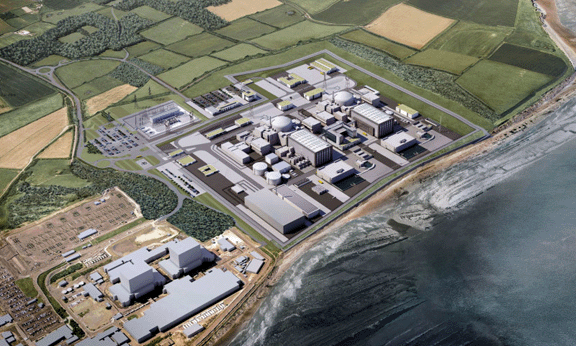 Hinkley Point C nuclear plant not essential – think tank, BBC News 26 Aug 16, The Hinkley Point C nuclear power plant is “not essential” for the UK to meet its energy and climate change targets, according to a think tank.
The Energy and Climate Intelligence Unit (ECIU) also said opting for “established” approaches instead would save bill payers £1bn a year in total.
EDF Energy, which has agreed to back Hinkley, said the ECIU report did not offer “credible alternatives”.
The government is due to make a final decision on Hinkley in the autumn………
One of the report’s authors, former Npower chief executive, Paul Massara – who now runs North Star Solar – said: “You are looking at a deal which is two and half times the current price, it goes on for 35 years and effectively this report today shows we can transition to a low carbon, affordable secure option without Hinkley and that’s what we should be doing.”
Mr Massara said a more “flexible” cost saving approach was needed that “includes things like demand-side management, which means people can turn down their electricity demand and manage their demand, with smart meters and batteries which are going to come in the next five to six years”…….
In its report, the not-for-profit ECIU made the assumption that “the total annual cost of Hinkley will probably be about £2.5bn”.
It then calculated the cost of a basket of alternative measures to meet the country’s energy and climate change targets, and concluded that bill payers, both domestic and business, would end up paying a total of £1bn less per year for their energy if they were adopted than if Hinkley C were built.
‘Not essential’
The think tank’s alternative proposals include building more wind farms and gas-fired power stations than are currently planned and laying more cables connecting the UK grid with other countries.
“Our conclusion is that [Hinkley Point’s] not essential,” said ECIU director, Richard Black.
“Using tried and tested technologies, with nothing unproven or futuristic, Britain can meet all its targets and do so at lower cost,” he added……..http://www.bbc.com/news/business-37191222
Britain’s nuclear industry in turmoil over botched contracts
 UK nuclear industry hit by fresh turmoil, Ft.com Gill Plimmer August 26, 2016 Britain’s nuclear industry has been hit by fresh turmoil after the government said it was planning to appeal against a ruling that it had botched a £7bn contest to clean up toxic power plants, while another company threatened to bring legal action.
A High Court judge ruled on July 29 that the Nuclear Decommissioning Authority had acted unlawfully in the way it awarded a contract to dismantle and make safe 12 of the UK’s first-generation nuclear power stations. The decision leaves the government agency exposed to multimillion pound claims for damages.
The initial court challenge was brought by Energy Solutions, the US-based company that lost the contract after managing the nuclear sites for 14 years, but on Friday another US contractor, Bechtel , said it would also take legal action. Other losing companies or consortiums, such as Ch2MHill and Serco, are expected to follow.
Bechtel is understood to be seeking compensation for the loss of future earnings but others may just seek to recoup bid costs, which are estimated at £15m per consortium……….
John Clarke, chief executive of the NDA, announced this month his intention to retire next year………http://www.ft.com/cms/s/0/0c4e74e4-6b80-11e6-a0b1-d87a9fea034f.html#axzz4ITV1TlFn
Hinkley nuclear station unnecessary – wind and solar can do the job faster and cheaper
Why Use Nuclear When We Have Wind and Solar Power? http://trendintech.com/2016/08/26/why-use-nuclear-when-we-have-wind-and-solar-power/ By T.Henry August 26, 2016 The Hinkley Point nuclear project has been a topic of discussion recently with the time getting closer for a decision to be made about the future of the project. While once upon a time, nuclear power was thought to be the best form of renewable energy, with the recent developments in solar and wind energy, this isn’t the case any longer. Cheap lithium-air batteries can also be used that are long life and can store five times the energy as the lithium-ion ones that are used today.
One of the main arguments against Hinkley going ahead is not its £18.5 billion price tag, but its constant power generation is no longer what we are looking for. With the cost of renewables like wind and solar reducing daily and the ability to store extra energy produced, doesn’t it make more sense to invest in these forms instead of nuclear? If the UK was to accelerate renewables, we could achieve 100 percent renewable power well before 2050 advises Jeremy Leggett, founder of Solarcentury.
There are already 1000 cities and 60 giant corporations across the globe that are committed to a 100 percent renewable supply. Portugal showed how it could be done in May when it ran for four days on an only wind, solar, and hydropower. Britain also made the headlines that same month as it produced more electricity via solar energy than coal-fired stations. In Brussels, wind energy alone reached an installed capacity of over 430 gigawatts, which is more than the 382 gigawatts of nuclear.
Senior research fellow at the Energy Institute at University College London, Paul Dorfman, states, “Hinkley will not come online in time to help with the critical UK electricity gap or with our carbon emission commitments. In fact, due to inevitable delays and cost overruns, Hinkley will block scarce resources going to necessary UK renewables, grid upgrades, and energy efficiency. Don’t believe the hype: it’s not ‘nuclear and renewables’ – because of the sheer cost of nuclear, it’s ‘nuclear or renewables.’”
Even the people at The Economist have lost faith in Hinkley and headlined a recent article, “Hinkley Pointless”, pointing out that it makes much more sense to use the time and resources set aside for it to improve electricity storage. But, on the other end of the scale, Tom Greatex, chief executive of the Nuclear Industry Association and former MP feels that we need to use all available technologies to meet our energy needs and that includes both renewables and nuclear. Hinkley Point is projected to supply around 7 percent of the UK’s electricity needs with a look to more than double this by the mid-2020’s.
UK figuring out how to get out of the Hinkley nuclear power deal
Hinkley Point nuclear power station: Whitehall officials ‘exploring ways UK could pull out of deal’ Theresa May’s administration called an unexpected halt to the project amid security and viability concerns, Independent Joe Watts Political Editor @JoeWatts_ Thursday 25 August 2016 Whitehall officials reviewing the massive Hinkley Point nuclear project are exploring how the UK might withdraw from the deal while minimising financial risk and damage to international relations, it has been claimed.
Westminster sources told The Independent civil servants are looking to see if there is any loophole, clause or issue in contracts yet to be signed that allow the Government to pull back without huge loss and while also saving face.
Ministers are acutely aware of the potential damage a withdrawal could do to relations with China, which is committed to pouring billions of pounds into the controversial project.
Former Chancellor George Osborne was an enthusiastic supporter of the £18 billion scheme, but since Theresa May’s arrival it is being reviewed by the new administration. A Whitehall source said: “There is a working assumption of people in government that the civil service is looking for a way out, a legal loophole, a clause.
“They are looking for anything that will allow the Government to withdraw and also allow the Chinese to withdraw while also saving face.”
It was expected last month when the board of French energy company EDF voted to go ahead with Hinkley C power station that the British Government would give its approval.
Instead new Business Secretary Greg Clark announced he needed more time to make a decision.
It followed claims that the price promised for Hinkley’s electricity at £92.50 per MWh, more than double the wholesale price, was too expensive……..
EDF may also have problems fulfilling its end of any agreement. The company’s finance director Thomas Piquemal resigned earlier this year, fearing Hinkley could lead to the firm’s insolvency.
title=”24 August 2016 16:26 London”>A senior Government figure said: “The other thing no-one is talking about is what happens after the French election.
“Hollande is not going to be there and it is not clear whether Sarkozy or Juppe are committed to it.”
A spokesperson from the Department for Business, Energy & Industrial Strategy said: “No contract has been signed and it is only right that a new Government considers all component parts carefully before making a final decision.” http://www.independent.co.uk/news/uk/politics/hinkley-point-edf-nuclear-power-station-deal-how-uk-could-pull-out-a7207776.html
Britain’s nuclear police physically unable to work to age 65
Civil nuclear police: Working to 65 ‘physically impossible’, BBC News, 24 August 2016 Representatives of 1,250 armed police officers who protect UK civil nuclear sites have challenged a rule forcing them to work beyond the age of 60.
While most UK police can retire at 60, Civil Nuclear Constabulary officers must work until 65 under a new law.The Civil Nuclear Police Federation says it will be “physically impossible” for officers in their mid-60s to protect the public from terrorism.
It has taken the case to London’s High Court to try to get the rule changed.
It argues its officers have the most physically demanding role in the police service and will not be able to maintain their standards of fitness and weapons proficiency into their 60s.
A government spokesperson said the Civil Nuclear Police Authority – which oversees the Civil Nuclear Constabulary (CNC) – was “considering how to implement changes and reforms”.
The changes were brought in as part of the Public Service Pensions Act………
Analysis By Danny Shaw, BBC home affairs correspondentUnlike other forces that are in the headlines nearly every day – the Met, West Midlands and Greater Manchester Police, for example – you don’t hear a lot about the Civil Nuclear Constabulary.
Much of its work goes unseen, guarding nuclear sites in remote corners of the UK and protecting material in transit.However, it is vital work, particularly at a time when the terrorism threat level is graded “severe” with an attack assessed as “highly likely”. That’s one reason why its officers are incensed – and baffled – by pension changes which mean they’d have to work until at least 65 before retiring……..http://www.bbc.com/news/uk-37169994
1 This Month





PLEASE OPPOSE HR 8255 AND S.3639 – bills would accelerate satellite deployment, with no environmental review or safeguards – https://ncstd5li.quorum.us/campaign/169331/
To see nuclear-related stories in greater depth and intensity – go to https://nuclearinformation.wordpress.com
-
Archives
- October 2026 (49)
- September 2026 (339)
- August 2026 (330)
- July 2026 (355)
- June 2026 (287)
- May 2026 (306)
- April 2026 (356)
- March 2026 (251)
- February 2026 (267)
- January 2026 (308)
- December 2025 (358)
- November 2025 (359)
-
Categories
- 1
- 1 NUCLEAR ISSUES
- business and costs
- climate change
- culture and arts
- ENERGY
- environment
- health
- history
- indigenous issues
- Legal
- marketing of nuclear
- media
- opposition to nuclear
- PERSONAL STORIES
- politics
- politics international
- Religion and ethics
- safety
- secrets,lies and civil liberties
- spinbuster
- technology
- Uranium
- wastes
- weapons and war
- Women
- 2 WORLD
- ACTION
- AFRICA
- Atrocities
- AUSTRALIA
- Christina's notes
- Christina's themes
- culture and arts
- Events
- Fuk 2022
- Fuk 2023
- Fukushima 2017
- Fukushima 2018
- fukushima 2019
- Fukushima 2020
- Fukushima 2021
- general
- global warming
- Humour (God we need it)
- Nuclear
- RARE EARTHS
- Reference
- resources – print
- Resources -audiovicual
- Weekly Newsletter
- World
- World Nuclear
- YouTube
-
RSS
Entries RSS
Comments RSS

